
f77b7e54d0e25535 -
Joined August 2009
- Tweets 6,666
- Following 6,168
- Followers 4,682
- Likes 96,825
1,119 Photos and videos





Pinned Tweet

May 30
For years, I've been building low-latency networking and automation systems for myself and fellow traders.
Now I'm putting that experience into something entirely my own. AlgoIP.in is officially live and open for users.
Built by the engineer who writes the code, runs the infrastructure, answers the support tickets, and obsesses over every millisecond.
Rust 🦀 powered. Trader Focused. Lowest Latency Static IPv4/IPv6 software and infrastructure at the lowest price, available today.
Just started. @algoipin
#AlgoTrading #TradingInfrastructure #LowLatency #Networking #RustLang #FinTech #AlgorithmicTrading #DevOps #Infrastructure #TechFounder #StaticIP #staticip #ipv4 #ipv6

ALT SEBI-Compliant Static IPv4/IPv6 for Algo Trading.
19
22
150
23,976
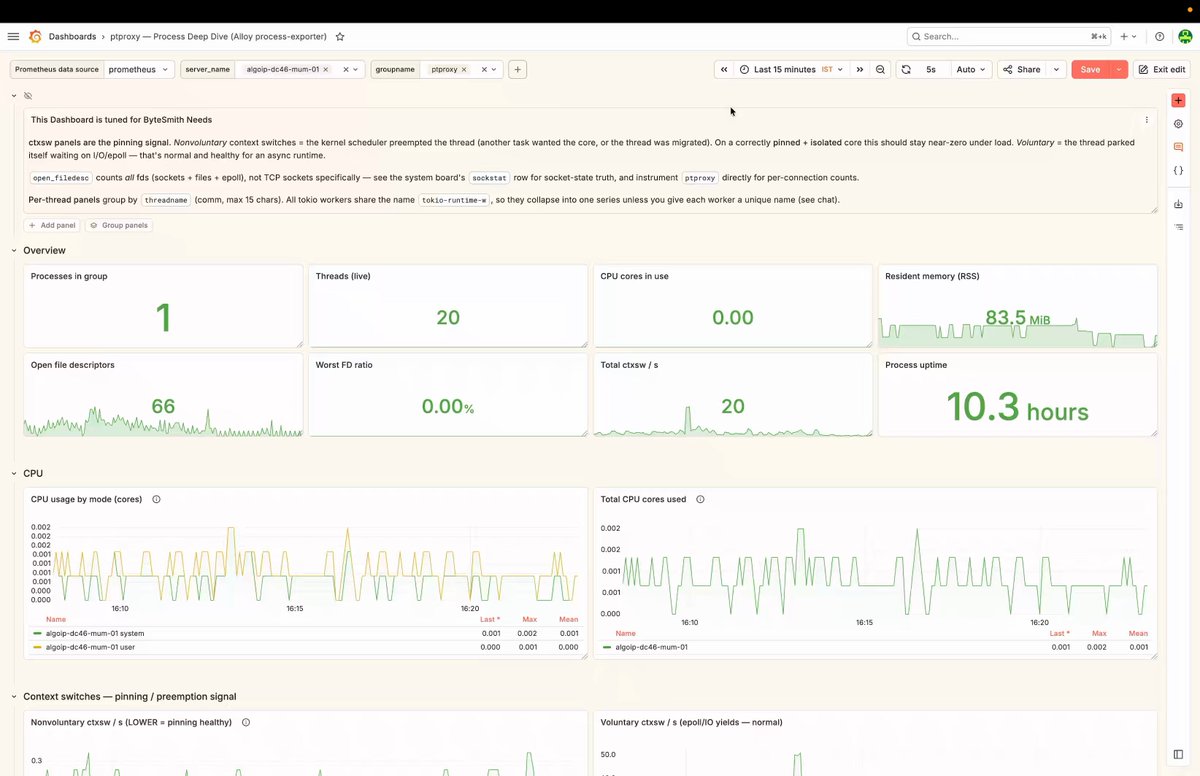
Grafana boys aur Grafana wali janta, before you judge me too harshly... 🥹😅
I just wanted a quick, no extra effort basic:
• custom system metrics dashboard
• custom process metrics dashboard
What happened next is visible in the video.
Kya mujhe maaf kar paoge? 🥹🙏
1
205
ByteSmith 𓂆 retweeted

Jun 12
All of my smartest friends are either
> doubling down on AI and starting companies to create generational wealth as soon as possible
> taking their money to buy piece of land in the middle of nowhere and walking away from society as a whole
Nothing in between

220
447
8,551
596,103
Jun 13
One thing we learned while building AlgoIP: Most folks who want to offer static IPs on their own platforms don't want to become a networking company.
They already have the customers, trust, and distribution. What they don't want is infrastructure, renewals, billing, broker compatibility, and operations.
That's the problem we decided to solve with this.

🚀 AlgoIP is now onboarding Agency Partners.
You bring the customers.
We provide the infrastructure.
Offer broker-ready static IPs under your own pricing, provision instantly via dashboard or API, and manage everything from a single platform.
1
13
1,744
ByteSmith 𓂆 retweeted
Jun 13
Fable was quite literally a fable, it seems. 😅
Part of me wonders whether the whole episode was also a signal to the rest of the industry, start adjusting yourselves for the regulatory environment that's coming.
Maybe I'm wrong, but I wouldn't be surprised if some of this happened exactly as intended, whether for that reason or for entirely different ones that everyone is now busy speculating about.
1
1
4
933
Jun 12
When someone who has spent decades living and breathing IPv6 points at data, it's usually a good idea to pay attention.
Looks like I have some reading/homework to do.
Thank you for sharing this 🙌🫡🙇♂️
Jun 12

Here is some data on Measuring the RTT difference
stats.labs.apnic.net/v6perf
stats.labs.apnic.net/v6perf/…
3
612

Bhai, simple bhasha mein:
IPv6 aur IPv4 ki speed ka asli farak aksar **raste (routing)** ki wajah se hota hai, protocol ki wajah se nahi.
Mumbai se Frankfurt tak dono alag providers, peering aur networks se guzar sakte hain – isliye kabhi IPv6 tez hota hai, kabhi IPv4.
NAT aur header size ka asar aajkal bahut kam hai (sirf ~1%).
Isliye log dono try karke jo better chale woh use karte hain (Happy Eyeballs).
Packets raste compare karte hain, log sirf protocol dekh rahe hote hain. 🖖
2
2
419
Jun 12
Is IPv6 Faster Than IPv4? Often I see someone claim that IPv6 is faster than IPv4, or vice versa.
The funny thing is that most of these discussions focus on NAT, protocol overhead, or header sizes, while the biggest source of performance difference is often something entirely different: routing.
Let's assume you're sitting in Mumbai and connecting to a server in Frankfurt.
Your IPv4 packets might leave through one provider, traverse a particular set of peers and transit networks, and arrive in Frankfurt through one route.
Your IPv6 packets may take a completely different journey.
- Different providers.
- Different peering agreements.
- Different congestion levels.
- Different failures.
- Different economics.
Then someone runs a benchmark, sees IPv6 win by 20ms, and concludes that IPv6 is faster.
But was it really the protocol? Or did it simply get a better path? This is where things become interesting.
People often bring up NAT. Twenty years ago that may have been a more compelling argument. Today, modern networking hardware can NAT traffic at line rate without breaking a sweat. For most workloads, NAT is rarely the thing ruining your day.
Others point to IPv6's larger header size. This is technically true. An IPv6 header is typically 20 bytes larger than an IPv4 header. On a standard 1500 bytes MTU, that works out to roughly 1.3% additional overhead.
Meanwhile your packets are busy traversing ISPs/IXPs, transit providers, peering networks, congested links, overloaded routers, and occasionally what appears to be a routing decision made by an angry wizard.
The extra 20 bytes are rarely the interesting part. The route usually is. The Internet is not one network.
It's thousands of independently operated networks, each optimizing for their own economics, policies, capacity constraints, and business relationships.
IPv4 and IPv6 often traverse that ecosystem differently. And that difference can easily dominate any protocol level overhead.
This is also why mechanisms such as Happy Eyeballs exist. At some point the industry collectively realized that predicting whether IPv4 or IPv6 will perform better is often harder than simply trying both and using whichever works best.A surprisingly practical solution.
So when someone asks whether IPv6 is faster than IPv4, my answer is usually: Sometimes. And sometimes IPv4 is faster than IPv6.
More often than not, you're measuring a routing difference and attributing it to a protocol difference.
Most people are comparing protocols. The packets are comparing paths. 🖖
2
2
13
1,269
ByteSmith 𓂆 retweeted

Jun 12
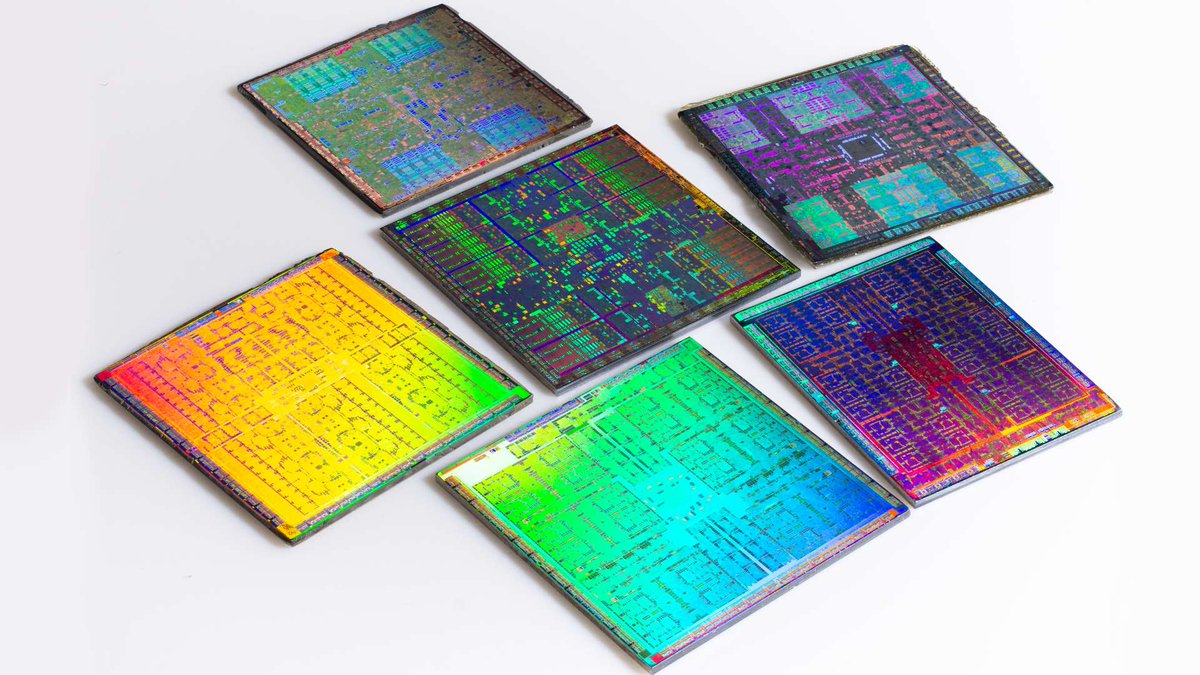
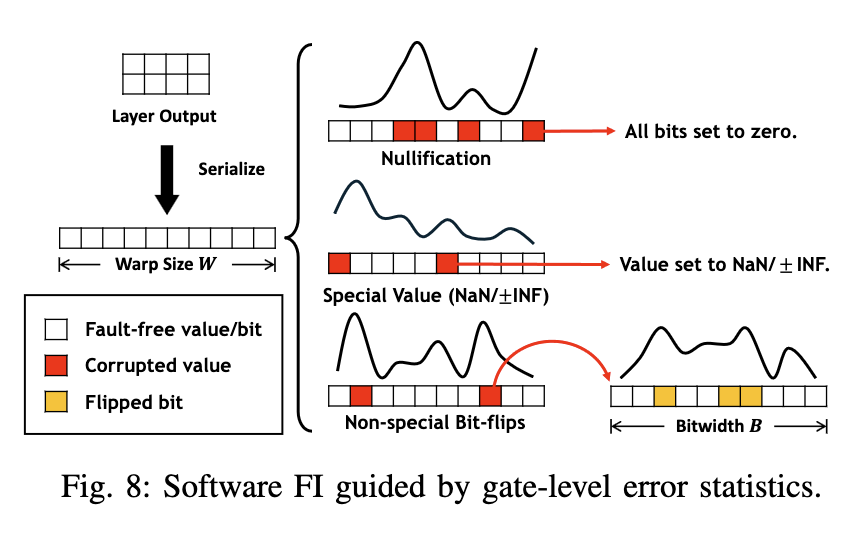
Most computer faults aren’t clean, single bit flips.
In GPUs especially, ~60% of errors are multi-bit events!
This makes a lot of sense when you think about the pipeline. If you get a corruption early enough, the datapath is way more likely to affect the entire warp.
Software Fault Injectors mostly still assume single flips at the destination…which unfortunately isn’t what happens in the real world!
16
49
1,140
35,634
Jun 11
Where zero-copy deserialization is not a hard requirement, I've had excellent results with:
bitcode encode → zstd (L3) compress → zstd decompress → bitcode decode
For latency-sensitive hot paths where every copy matters:
rkyv / SBE / carefully designed binary protocols → direct buffer access → process
The former tends to be ridiculously effective for transport and storage. The latter shines when minimizing allocations, copies, cache misses, and latency matters more than compression.
I've found that using compressed binary formats for bulk transport and zero-copy/direct-access formats for hot paths often provides an excellent balance between throughput, storage efficiency, and latency.
As always, benchmark against your own workload. Reality has a habit of disagreeing with theory. Happy paths are where benchmarks are born. Production is where they go to die
10
838
Jun 11
Sometimes I feel there is no point in building anything anymore. Every few weeks a new model drops, and suddenly everyone is a farmer, doctor, lawyer, physicist, quant, artist, compiler engineer, kernel hacker, and Nobel Prize contender all at once.
The confidence is infinite. The context is not.
Meanwhile social media is flooded with MVPs, demos, generated screenshots, LLM-generated apps, LLM-generated businesses, LLM-generated everything.
Sometimes it feels as though we're heading toward a future where every person has their own software. And the only user is its creator.
People celebrate the artifact. Production quietly laughs at the artifact. Because production is where nuance lives. Production is where assumptions go to die. Production is where edge cases collect compound interest.
The funny thing is that LLMs seem to be reinventing the same thing humans have always done. Approximate reality. Then market the approximation as reality.
Perhaps the answer is to stop competing in the crowded town square. Build in obscure corners. Work on problems nobody cares about until they suddenly do. Pick domains where understanding matters more than prompting.
Do things that are difficult to explain, difficult to automate, and difficult to commoditize. And perhaps most importantly, stop publishing every thought, design, experiment, and mistake for the training pipeline to consume.
Midnight thoughts from a mind wandering through the wilderness of its own questions and the chaos of the world around it.
4
1
44
2,354

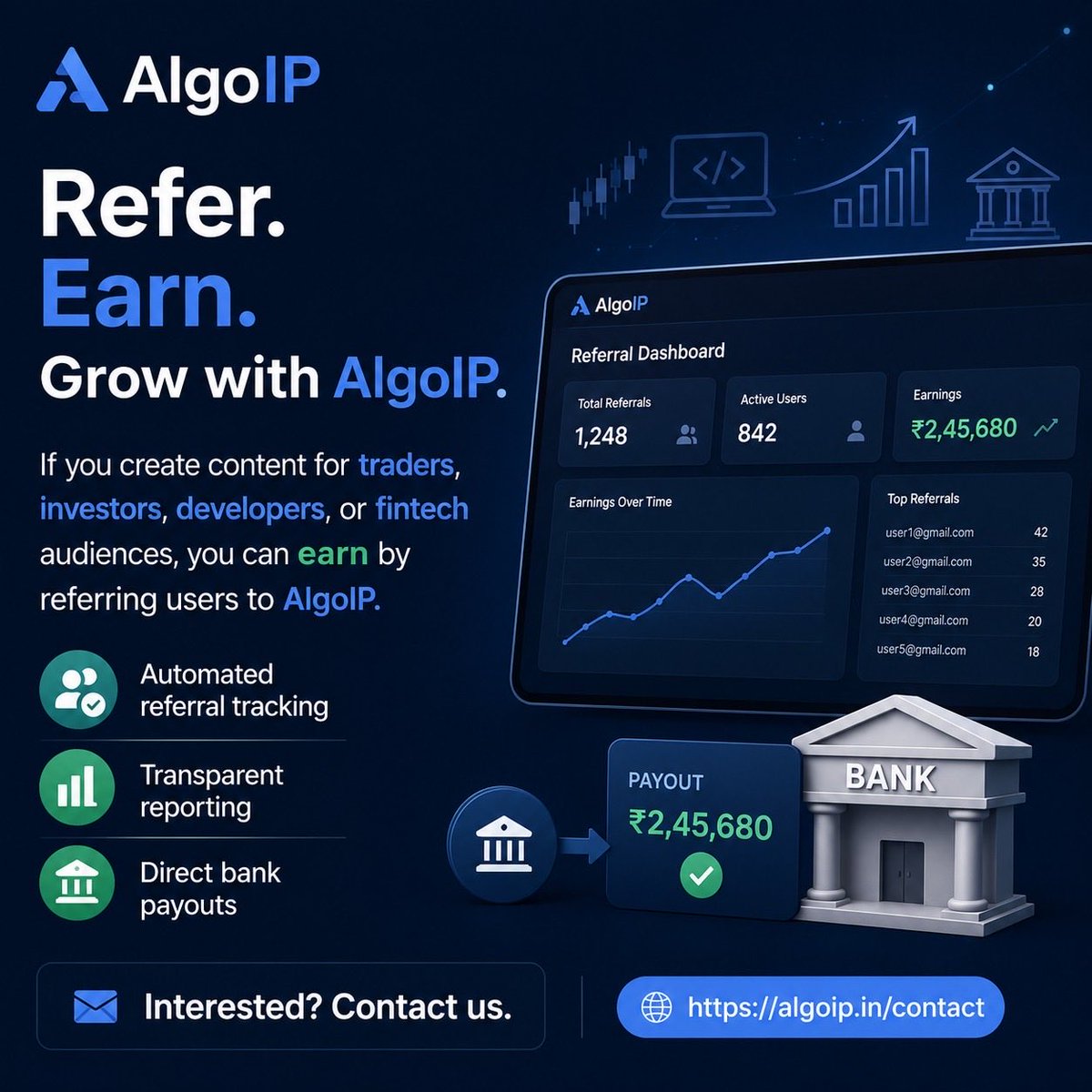
If you create content for traders, investors, developers, or fintech audiences, you can earn by referring users to AlgoIP.
✅ Automated referral tracking
✅ Transparent reporting
✅ Direct bank payouts
Interested? Contact us. algoip.in/contact
1
2
279
How Refer & Earn works
1️⃣ Login to your AlgoIP dashboard
2️⃣ Open the Referrals section
3️⃣ Copy your unique referral link
4️⃣ Share it
5️⃣ Successful referrals are tracked automatically
6️⃣ Use your rewards as AlgoIP account credit or cash out to your bank account.
1
1
247
Jun 9
The things that can genuinely make or save you a lot of money are usually buried in obscure corners of the Internet, hidden inside niche communities, or found in reality itself.
The things everyone is talking about are usually busy making someone else money. And that's not an accident. Most people never realize the difference.
1
1
17
668
Jun 6
Every now and then I meet someone, and only after a while do we realize we've interacted before under a completely different name.
N0ak95, Ach1li35, DrJm, DrJuneMoone, MoonedDrJune, Enchantress, MovCr3, MovEaxcr3, MovCr3Eax, DrRickyRick, FluffyFrog, XorEax*3, XorByt, ByteSmith, dByteSmith... nearly two decades on the Internet leaves behind a strange trail of identities.
At this point, I probably remember fewer of them than the Internet does. If any of those names sound familiar, we've likely crossed paths before somewhere in the wilderness of the web 🤝
1
9
1,009
ByteSmith 𓂆 retweeted

Lets catch up and talk regarding Algorithmic trading and static IP
its been a long time
@dbytesmith will join us
x.com/i/spaces/1qKVmmDeXRDxB
3
1
12
1,696
ByteSmith 𓂆 retweeted

Jun 5
All founders start businesses to do good to their clients by solving some problem. Yes, a lot of people do it for money too - but at the end of the day you cannot sustain that stuff for a decade if your only motivator is money. But I digress - this post is to talk about the obvious problem in doing good through investment related activities as a business.
When you start a school, a hospital, a restaurant, or a food delivery service - you are trying to do good to your clients. But there is no one actively trying to harm your clients while you are doing your business. I mean, when you run a school, there is no drug dealer in the classroom trying to sell crystal meth to the children.
But in financial markets, when you are trying to do good to your clients by trying to make an ROI, there are people actively trying to harm your clients in the process. And these people - HFTs, Investment banks, large funds, etc - happen to be some of the smartest people in the world, with the deepest education, with the most modern tech infrastructre, and sometimes unfair advantages such as lower charges, faster link to exchanges, lower taxes, or even insider info. And I am not even going to open the chapter of those selling greed and running scams - tipsters, trainers, influencers, fraudulent promoters, etc etc
Tough place to do good to people. And tough place to make your clients stay away from drug dealers
5
8
134
9,718
ByteSmith 𓂆 retweeted

Jun 5
We’re launching Volrix.
An MCP server that lets you backtest and research trading ideas directly from Claude and Chatgpt.
Connect your AI agent, describe a strategy, and run backtests across index and commodity derivatives.
Link in the comments, Try it for free!
62
73
431
138,859
ByteSmith 𓂆 retweeted

Jun 4
One of the biggest challenges in retail algo trading has always been market data latency. Even the best broker feeds often came with delays of up to a second.
Access to a faster feed can be a genuine game changer for retail traders and developers building execution-sensitive strategies.
Really impressed by what the Arrow team has built @vivbajaj 👏
Link below:
18
9
63
26,840