
Joined May 2010
- Tweets 1,640
- Following 769
- Followers 898
- Likes 2,467
45 Photos and videos






Pinned Tweet

Mar 19
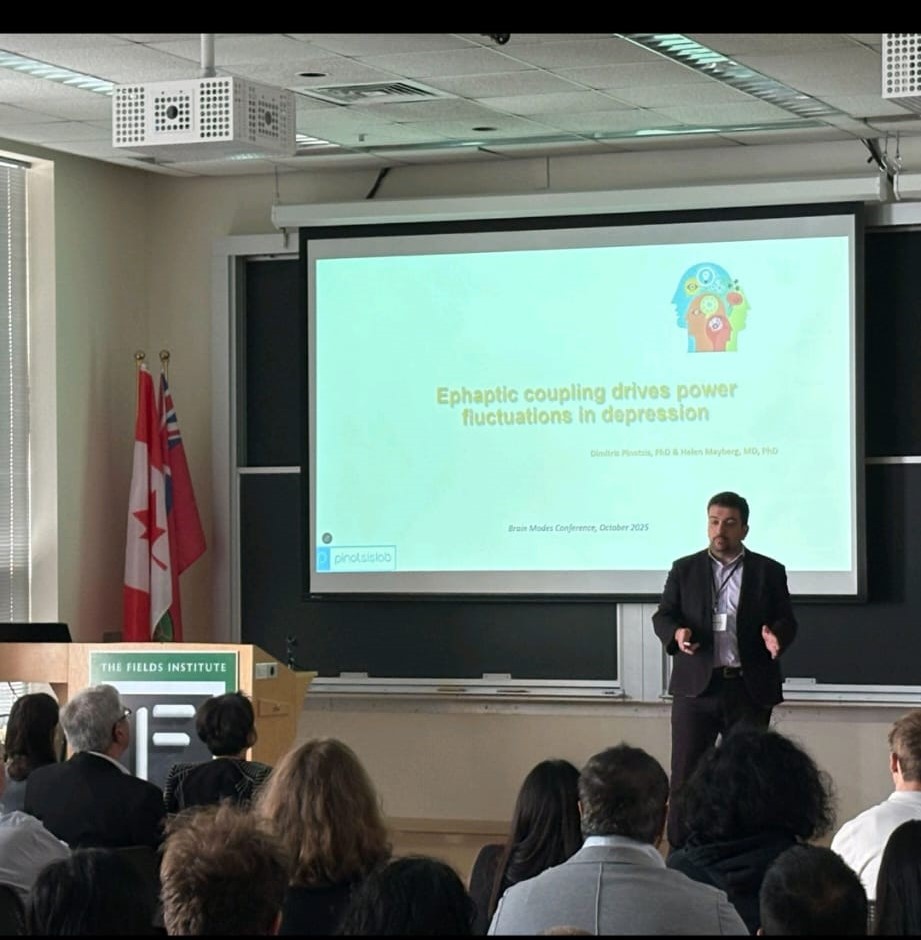
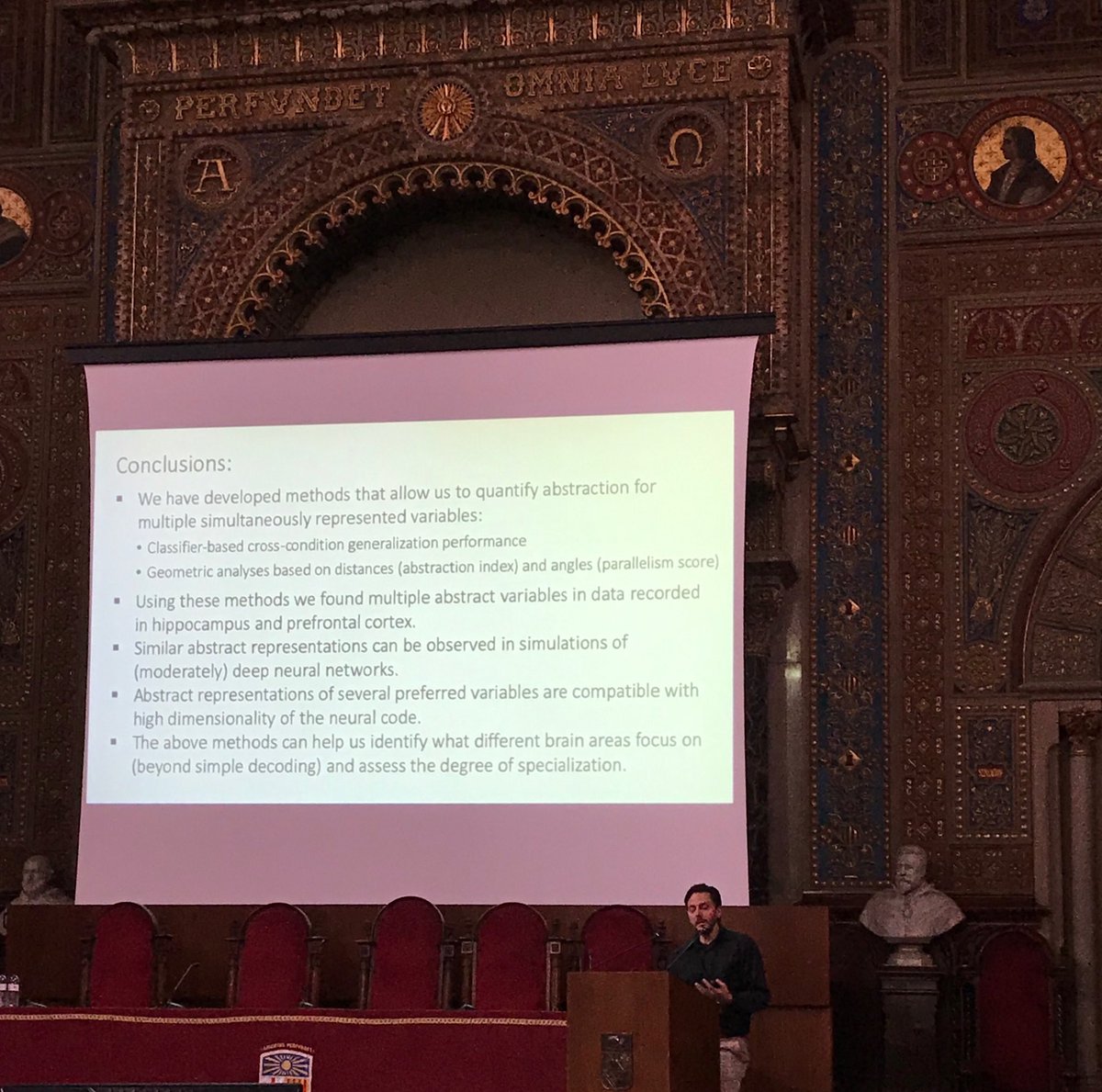
In #depression, electric fields diverging from the activity of neurons that generate them may signal a loss of coordinated control—much like an orchestra in which musicians gradually drift out of alignment with the conductor academic.oup.com/cercor/arti…
2
14
2,976
Memory storage seems to depend on connectivity patterns. That's supported by cognitive maps and oscillations. Your suggestion seems plausible. Once the pattern is re-enacted memory is recalled. Like musicians in an orchestra who play the song once they are all back on stage.
Jun 12

This idea that memory is distributed across regions of the brain is interesting but I wish it were more concrete to help my own understanding. Does this mean a memory (ex: driving your car yesterday) is broken into bits and the bits are combined and reassembled during recall?
1
1
1
306
Thanks Stuart. Cytoelectric oscillations with microtubules are definitely there. My goal is to use this new understanding to improve BCI,in eg depression, see paper below. New insights = potential for treatment. Such a nice chat with you, and fun DDG. pubmed.ncbi.nlm.nih.gov/4129…

Thanks Dimitris
Your linked paper shows that ephaptic fields encode memory in cytoskeleton.
Bravo! The resolution for microtubule-based information would be far greater than what could be encoded by membrane-generated fields so I suspect the microtubules are involved.
But that’s not proof.
What were the frequencies of the fields
(were they oscillating?) I’d bet megahertz and gigahertz as in this paper. pubmed.ncbi.nlm.nih.gov/3388…
It’s the same issue about the origin of EEG. Assumed to be from membranes but no proof. Microtubules in cell free systems oscillate at 39 hertz. pubmed.ncbi.nlm.nih.gov/3009…
And we still don’t understand EEG - there is no unified theory. But there is!
Roger Penrose and I suggest EEG is ‘interference beats’ of megahertz and gigahertz oscillations. sciencedirect.com/science/ar… That would account for the frequency downshifting seen in brain processing.
Christof Koch’s claims that ephaptic fields come from membranes have to be taken with a grain of salt. He’s never acknowledged cytoskeletal oscillations. But I don’t believe cartoon neurons could generate or perceive high frequency fields.
So are the megahertz and gigahertz brain waves real? We intend to find out.
Thanks for your great work. It was fun hanging out in the Himalayas last week.
You had your DDG measured. What was your megahertz and gigahertz output?
2
1
7
1,236
pinotsislab retweeted

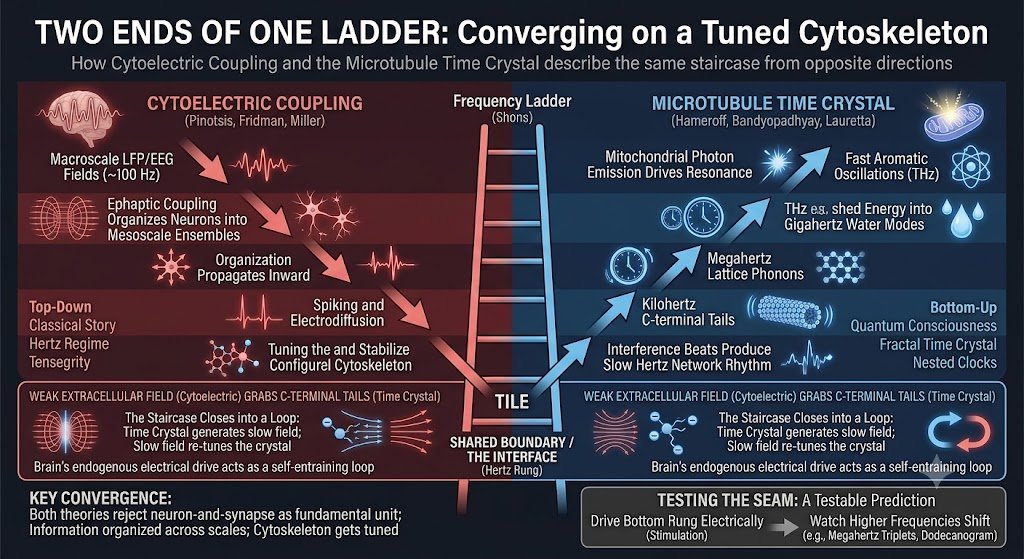
Two Ends of One Ladder
Two papers landed in my reading this month from opposite corners ... one classical and cautious, one quantum and ambitious. They read like descriptions of the same structure, climbed from opposite ends of a frequency ladder. A thread on how they might fit. 🧵
1/16
7
4
24
1,500
Jun 12
Hi @StuartHameroff See below for a biological correlate of GC : Ephaptic coupling strength , could involve microtubules too pubmed.ncbi.nlm.nih.gov/3742… Building on @anilkseth 's work. W/@MillerLabMIT
Jun 10
Thanks Anil. Congratulations team.
May I ask what the biological correlate of the GC is? Is it axonal-mediated synaptic transmissions? Maybe it’s
Orch OR?
Granger Causality is a predictive time series, a sequence of events like in Orch OR at 10 megahertz. The outcome of each depends on its history of previous selections.
Orch OR is a series of events which are more than predictive, each an evolution of the wavefunction by the Schrodinger equation. These collapse/terminate at time t =h/E selecting particular states,
with a quantum qualia and noncomputable Platonic values. Because of the inverse relation there is a spectrum of conscious moments, with greater phenomenal experience at higher frequencies. The evolving quantum states can entangle throughout the brain.
2
1
7
3,111
Jun 7
Does the brain have quantum properties? How to test this? Cool discussion with coauthor Partha Ghose (student of Bose from Bose-Einstein condensates) and @StuartHameroff -- at IIT Mandi.
2
93
pinotsislab retweeted
With Partha Ghose, the last student of SN Bose of Bose-Einstein condensates. Ghose co-authored pmc.ncbi.nlm.nih.gov/article… with Dimitris Pinotsis. They will both speak tomorrow at the MBC conference at IIT Mandi

1
6
58
1,979
pinotsislab retweeted

May 21
Thanks Dimitris
By ‘reshaping’ you’re suggesting microtubules encode memory, which I believe to be true. Synaptic proteins last hours to days but memories can last lifetimes. There are about 10^8 tubulins per neuron, each with about 30 possible genetic or post translational states so that’s a lot of possible mosaics. Microtubules don’t divide so the lattice memory mosaic is preserved. When microtubules fall apart as they do in Alzheimer’s, memory is lost.
May 21

Right
@StuartHameroff
, microtubules could be the fastest to respond to field effects , e.g. once a memory is recalled, and balance out drift by being the first to reshape themselves so that they preserve the overall electric field after some neurons have dropped out.
1
6
38
2,797
May 21
Right
@StuartHameroff
, microtubules could be the fastest to respond to field effects , e.g. once a memory is recalled, and balance out drift by being the first to reshape themselves so that they preserve the overall electric field after some neurons have dropped out.
May 21
Thanks Dimitris
So the neural activity correlating with shifting mental representation comes from charge movements in cytoskeleton, like the charged C-termini tails with ions from each tubulin. ingentaconnect.com/content/i…
And in your previous paper you showed
that such activity sculpted information and memory into the cytoskeleton, e.g. in different neurons.
In this paper @anirbanbandyo ‘s group showed functional communication among neurons mediated by cytoskeletal megahertz and gigahertz pubmed.ncbi.nlm.nih.gov/3388…
So it’s possible representational drift is mediated through microtubules in different neurons (and glia?) oscillating and entangling in megahertz and gigahertz. Microtubules are the most likely site for memory encoding in the brain. pubmed.ncbi.nlm.nih.gov/2241…
As Earl has been pointing out, it seems the brain has two modes.
1) A connectome-based computational modal mode, and
2) A distributed wave field-like, faster (?quantum) mode, possibly a collective time crystal.
Maybe 2) is for consciousness, and 1) is for it to interface with the external world.
And maybe we’re all like Steve Martin in his great film ‘The man with two brains’.
@lndriscoll
1
1
5
3,320
pinotsislab retweeted
May 21
Thanks Dimitris
So the neural activity correlating with shifting mental representation comes from charge movements in cytoskeleton, like the charged C-termini tails with ions from each tubulin. ingentaconnect.com/content/i…
And in your previous paper you showed
that such activity sculpted information and memory into the cytoskeleton, e.g. in different neurons.
In this paper @anirbanbandyo ‘s group showed functional communication among neurons mediated by cytoskeletal megahertz and gigahertz pubmed.ncbi.nlm.nih.gov/3388…
So it’s possible representational drift is mediated through microtubules in different neurons (and glia?) oscillating and entangling in megahertz and gigahertz. Microtubules are the most likely site for memory encoding in the brain. pubmed.ncbi.nlm.nih.gov/2241…
As Earl has been pointing out, it seems the brain has two modes.
1) A connectome-based computational modal mode, and
2) A distributed wave field-like, faster (?quantum) mode, possibly a collective time crystal.
Maybe 2) is for consciousness, and 1) is for it to interface with the external world.
And maybe we’re all like Steve Martin in his great film ‘The man with two brains’.
@lndriscoll
May 21
Neural activity seems to be coordinated and constrained by the electric field arising from all charged structures in the cytoskeleton, including microtubules , and processes like mechanotransduction, resulting from cytoelectric coupling sciencedirect.com/science/ar…
3
7
28
3,921
pinotsislab retweeted

May 21
@dimitrispp showed that electric fields carry info and have *little or no representational drift*
Beyond dimension reduction: Stable electric fields emerge from and allow representational drift
doi.org/10.1016/j.neuroimage…
#neuroscience
7
36
4,043
pinotsislab retweeted
May 21
The brain’s code seems to be in constant flux.
Neurons fire much more erratically than researchers thought.
nature.com/articles/d41586-0…
#neuroscience
9
34
130
21,760
Apr 22
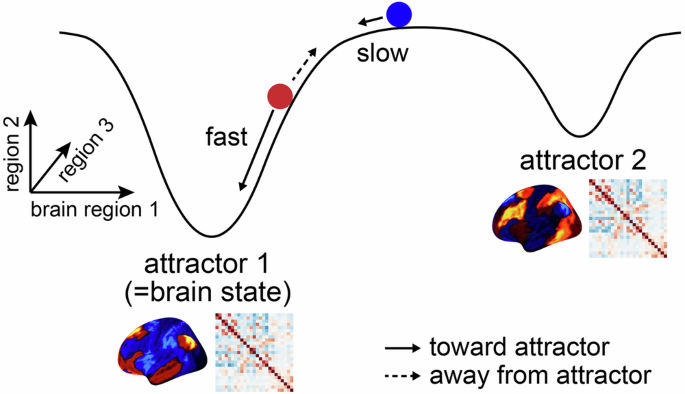
Attractors in the control (below) and depressed brain here: academic.oup.com/cercor/arti…
Apr 21

The geometry of neural dynamics along the cortical attractor landscape directly reflects changes in attention, as large-scale brain activity shifts across its hills and valleys depending on the state.
nature.com/articles/s41467-0…
2
5
971

Nature Reviews Neuroscience
Categorization is ‘baked’ into the brain
nature.com/articles/s41583-0…
1
26
151
8,182
Apr 15
Interesting parallels between connectioism in neurons and microtubules, thanks @StuartHameroff
Apr 15
Congratulations Dimitris, Andre and Earl
I think Predictive Coding/Recurrent Processing occurs at multiple scales including faster intracellular processing among mixed polarity networks of microtubules inside neuronal dendrites and soma (and ONLY there in all biology)!
Here’s a paper we wrote in 1990 modeling information processing with error correction between two adjacent anti-parallel microtubules connected by microtubule-associated proteins (‘MAPs). ui.adsabs.harvard.edu/abs/19…
They learned!
Why else would dendrites and soma have networks of mixed polarity, interrupted microtubules in anti-parallel arrays? Is this how unicellular organisms use PC/RP?
Is lower dimension actually slower frequency scales, e.g. through interference in faster microtubule oscillations?
2
255
Apr 15
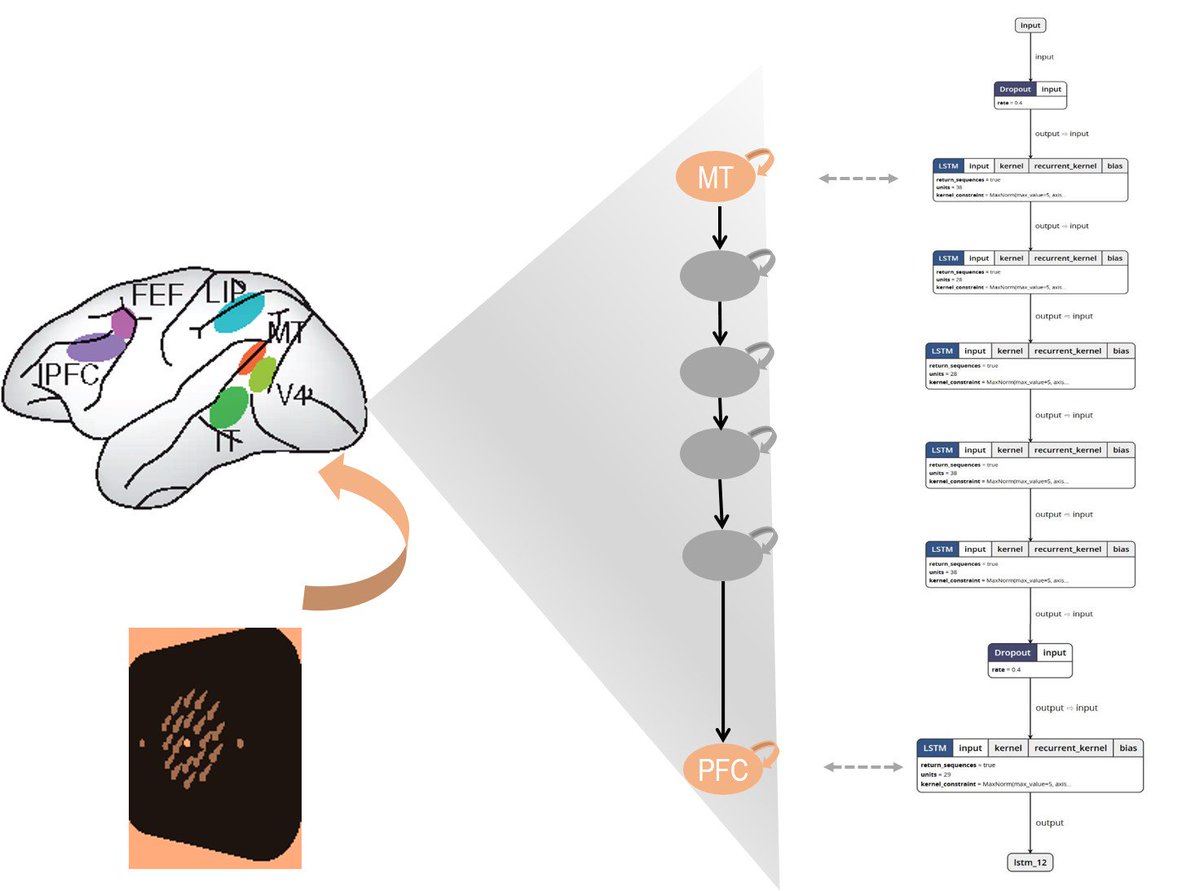
How does the brain process information? We found evidence in favour of a hybrid predictive coding-routing model that combines top-down predictions with superficial-layer inhibition. Models are complementary,not competing-w/ @MillerLabMIT @BastosLabNeuro biorxiv.org/content/10.64898…
5
40
2,761
pinotsislab retweeted

Interesting new approach to test predictive processing models and their neuronal implementation by @dimitrispp

New discovery! Spoiler alert: Neural dynamics are key.
Evidence for predictive computations in a brain hierarchy during a visual search task
doi.org/10.64898/2026.04.09.…
Work led by @dimitrispp
#neuroscience
6
33
5,032
pinotsislab retweeted
New discovery! Spoiler alert: Neural dynamics are key.
Evidence for predictive computations in a brain hierarchy during a visual search task
doi.org/10.64898/2026.04.09.…
Work led by @dimitrispp
#neuroscience
6
28
118
11,348
pinotsislab retweeted
Mar 20
Electric fields. Brains are awash in them and they have an influence. It would be weird if they didn't.
Ephaptic coupling and power fluctuations in depression
doi.org/10.1093/cercor/bhag0…
#neuroscience
8
16
84
3,461
Mar 20
Your question @StuartHameroff is deep. Here is a link: Quantum coherence emerges from mesoscale electric fields csbj.org/article/S2001-0370(…
Mar 20
Thanks @dimitrispp Will take a look. How does it jive with our microtubule time crystal?
ingentaconnect.com/content/i…
1
232