Free. Dutiful. Health is wealth.
Joined February 2009
- Tweets 15,651
- Following 4,924
- Followers 1,403
- Likes 59,991
542 Photos and videos










Jun 14
Yes, that's true.

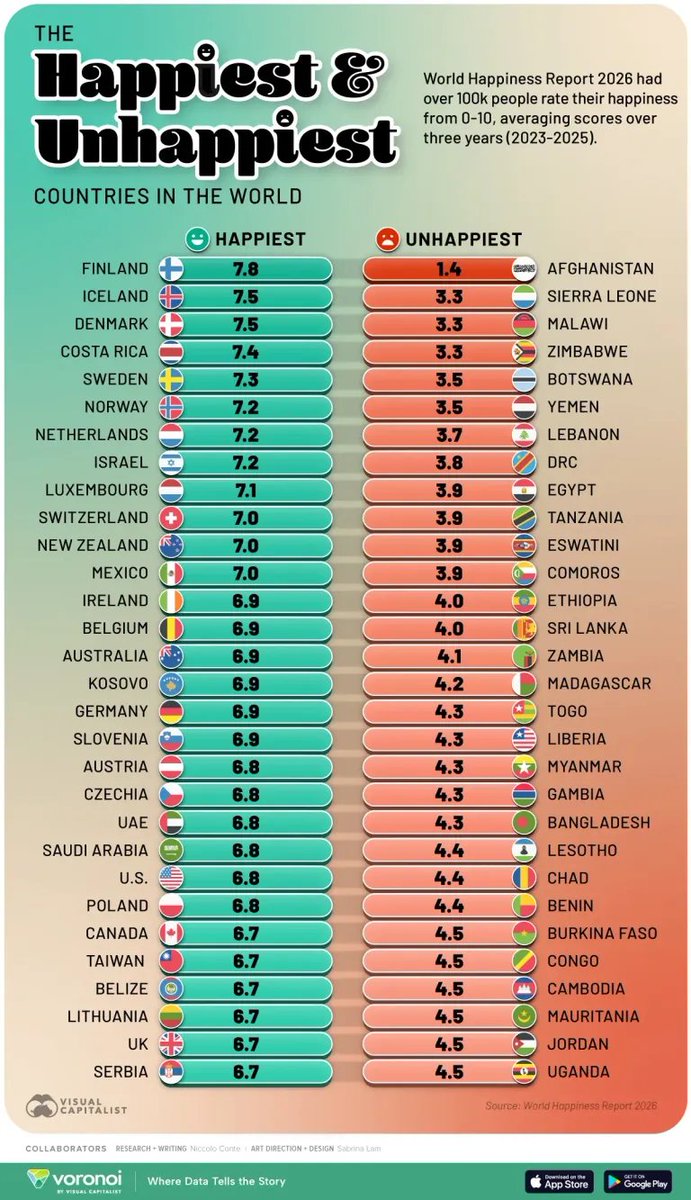
in nature if a monkey hoarded 1 trillion bananas the other monkeys would beat that monkey to death and take his bananas
1
122
D. Malcolm Carson retweeted

Jun 12
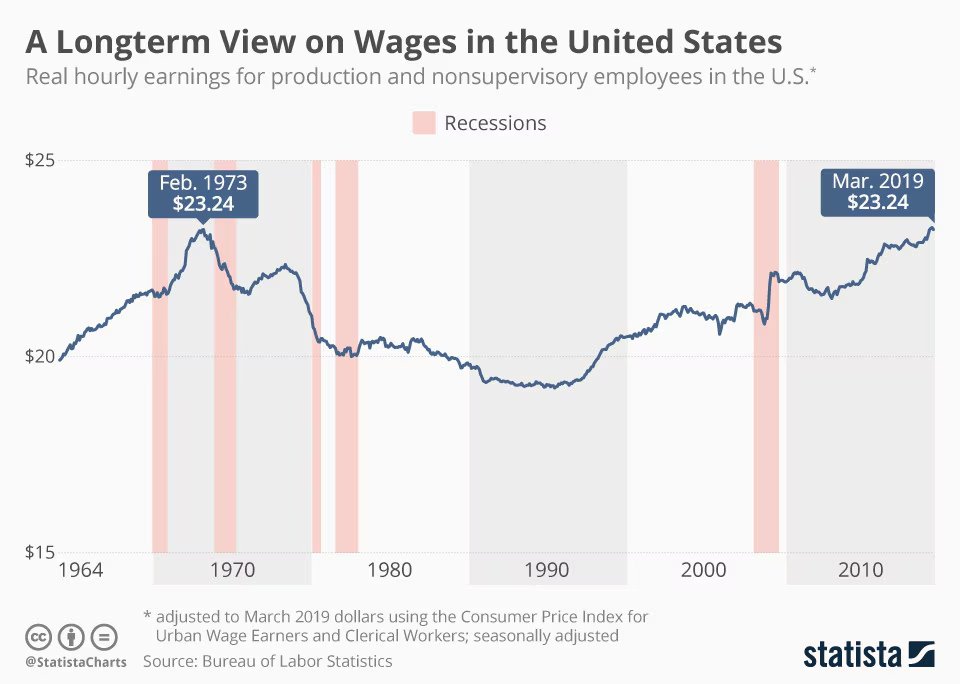
Been brushing up on the discourse and I’ve decided that every single person is richer than me is a greedy bastard and every single person poorer than me is a loser. I and only I have the exact right amount of money.
198
953
10,586
212,531
D. Malcolm Carson retweeted

Jun 11
I highkey get really pissed off when claude is struggling to do something then tells me why it's struggling
I really don't care just do my job
4
1
45
2,896
D. Malcolm Carson retweeted

Jun 8
One of the most prolific criminals in all of San Francisco tells @adam22 that “crime in San Francisco is over with” because of Flock cameras drones. He complains that he can’t even do drivebys anymore.
It’s simple: when the risk of getting caught is too high, crime plummets.
247
267
4,625
1,438,357
D. Malcolm Carson retweeted

Jun 7
7,054
7,078
117,407
18,025,556

Mira Murati says human-AI collaboration needs models that can listen while they think:
"The types of models that we work with today, they're very turn-based. You talk, they talk, then they go off and think."
"While they're thinking, it's almost like they're deaf and blind. They cannot perceive anything else about what's going on."
"By contrast, our interactions with each other are very rich. There is a lot of information in our interactions when we are silent, when we're thinking, when we're interrupting one another."
"Interaction models are able to capture all of this nuance. They're not turn-based. They're more like time-based interaction, where they're continuously taking in audio, text, video, and continuously providing output."
"This enables you to catch things like interruptions and simultaneous speech, and really create a rich, high bandwidth interaction between humans and machines."
@miramurati at Bloomberg Tech live with @emilychangtv
157
206
2,981
1,649,139

D. Malcolm Carson retweeted

Jun 5
I know it looks Little League, but the MLB has to go to the double base at first. There’s no reason these types of plays should still be happening.
996
91
5,420
1,164,930
D. Malcolm Carson retweeted

May 31
The actual answer is a 24 team MLB with relegation and promotion for triple a
1
3
814
D. Malcolm Carson retweeted

May 31
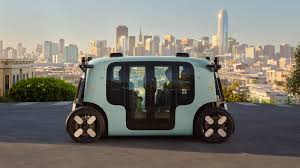
Self-driving cars are fun because you never see competing SaaS products having a literal standoff in the street
326
912
14,898
1,208,704
May 27
I'm already nostalgic for post-pandemic San Francisco: open, but no crowds, no lines, etc.
3
102
D. Malcolm Carson retweeted

May 25
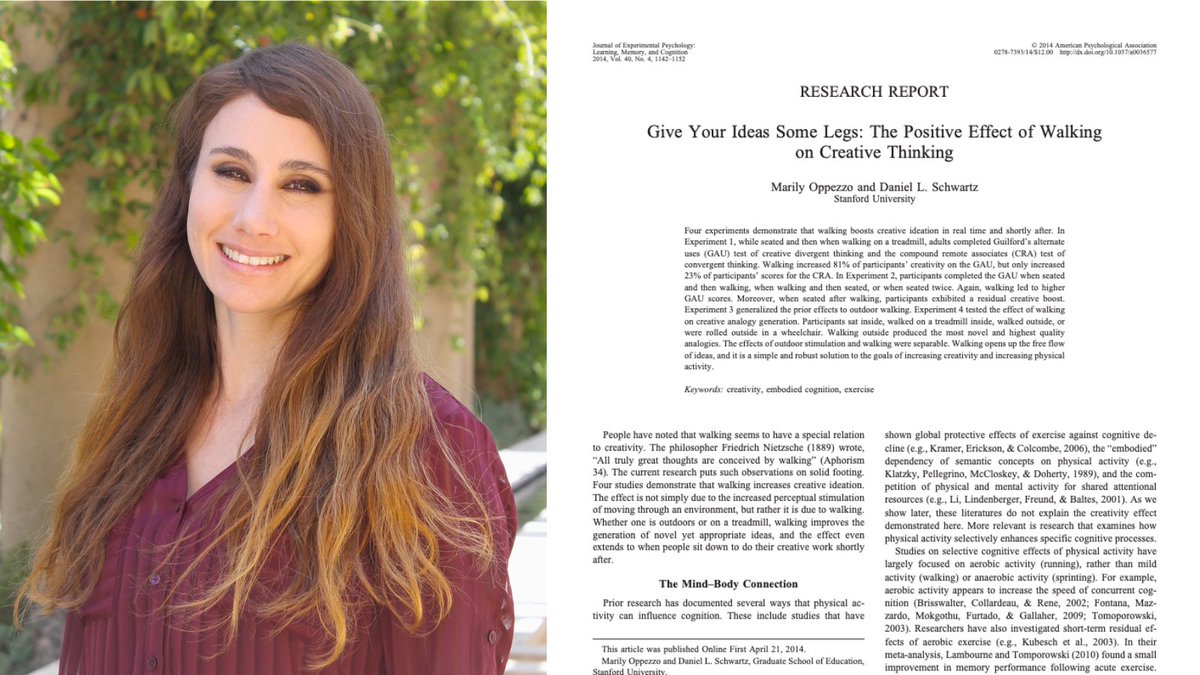
A Stanford psychologist spent 4 years proving that the simple act of walking generates 60% more creative ideas than sitting, and the experiment she designed to kill every alternative explanation is one of the most decisive findings in modern psychology.
Her name is Marily Oppezzo.
She got the idea for the study while walking with her advisor at Stanford to discuss her thesis topic, and the paper she eventually published in the Journal of Experimental Psychology in 2014 is sharp enough that it should have ended the seated meeting on the day it came out.
She ran 4 experiments on 176 people. Same person tested twice. Once sitting, once walking. The creativity tasks were the standard ones psychologists have used for decades to measure how good a brain is at generating novel useful ideas.
The result was almost too clean to publish.
81% of participants in the first experiment produced more creative ideas while walking than while sitting. In the second experiment, 88%. In the third, 100%. Every single person walked into a more creative version of themselves.
On average, people generated 60% more novel useful ideas the moment their legs started moving.
The skeptical question is the obvious one. Maybe it was the fresh air. Maybe it was the scenery passing by. Maybe it was the change of environment doing the work, not the walking itself.
Oppezzo killed every one of those explanations with one experimental decision.
She put people on a treadmill facing a blank wall. No scenery. No fresh air. No environmental change. Just legs moving in place while staring at white drywall. The 60% boost held.
Then she ran the experiment that closed the case completely. She took participants outside in two conditions. Half of them walked through a Stanford courtyard. The other half were pushed through the exact same courtyard in a wheelchair. Same outdoor stimulation. Same scenery passing at the same speed. The only difference was whether the legs were moving.
The walkers produced dramatically more novel high-quality ideas than the wheelchair group. The outdoors did almost nothing on its own. The walking did everything.
This is the part of the study that hit hardest when I read it the first time.
She also tested the opposite kind of thinking. Convergent thinking. The kind where there is one right answer and you have to narrow down to it.
Word puzzles where 3 words share a hidden fourth word that connects them. The seated participants did slightly better on these. Walkers got slightly worse.
Walking is not a general intelligence enhancer. It does one specific thing. It opens up the divergent search inside your brain. The part that generates options. The part that produces unexpected connections. The part that takes a problem and finds five ways into it instead of one.
When you need to converge on the single right answer, sit down. When you need to find the answer in the first place, get up.
The mechanism is now well understood. Walking selectively activates what neuroscientists call the default mode network, the system inside your brain that runs when you are not consciously focused on anything. The DMN is where mind-wandering happens. Where memories cross-reference each other. Where ideas that have been sitting in separate folders inside your head finally bump into each other.
When you sit at a desk and force yourself to concentrate, you suppress the DMN. When you walk at a natural pace, the executive part of your brain gets just busy enough handling the walking that the DMN comes online and starts doing the work that focus was blocking.
The most useful finding in the entire paper is the one almost nobody quotes.
The boost did not turn off the moment people stopped walking. Participants who walked first and then sat back down stayed elevated. Their next round of seated creativity work was still significantly better than people who had been sitting the whole time. The rest lingered for at least several minutes after the legs stopped moving.
You do not need to do creative work while walking. You need to walk before the creative work. The brain holds the state.
The history of this is the part that should haunt anyone who still does meetings in chairs.
Charles Darwin built a gravel loop behind his house in Kent called the Sandwalk and walked it 3 times a day for the rest of his life. The theory of evolution was developed one lap at a time on that path.
Nietzsche walked up to 10 hours a day during the years he wrote his most important books and openly said the work was conceived on his feet.
Beethoven composed for the morning and walked for 5 hours every afternoon with a pencil in his pocket for when something landed.
Kahneman said the best thinking of his Nobel Prize-winning career happened on leisurely walks with Amos Tversky. Steve Jobs refused to take important conversations sitting down. He held them on foot.
Every one of them was using the system Oppezzo would not measure until 2014. They just did not know what to call it.
The question worth sitting with is the one almost nobody asks.
Every meeting you have ever attended sitting around a table was a meeting held at a fraction of the brain power that was actually available to the people in the room. Every brainstorm that got stuck inside a conference room. Every problem you tried to solve at a desk and gave up on. Every idea you could not quite get to.
The intervention is the easiest one in modern science. No supplement. No app. No subscription. No training program. Just a pair of legs and 15 minutes.
The Stanford lab proved it. The philosophers knew it. The neuroscience explains it.
And almost everyone reading this is still trying to think their way out of problems sitting completely still.
281
3,042
11,848
1,590,543
D. Malcolm Carson retweeted

May 25
LA was historically a collection of walkable main streets connected by trolleys. If there’s a defining thing about Angelenos, people love their neighborhoods where they can walk and get a cup of coffee.
May 25

Angeleno is physically incapable of comprehending walkable cities
12
52
837
29,964
May 20
A quasi-religious techno-doomer cult taking over the world by developing and controlling the world's most advanced AI technologies is a sci-fi plot that would strain credibility, but apparently here we are.
May 20

The amount of money thats going to flood the EA ecosystem…hundreds of he who will not be named
11
168
D. Malcolm Carson retweeted

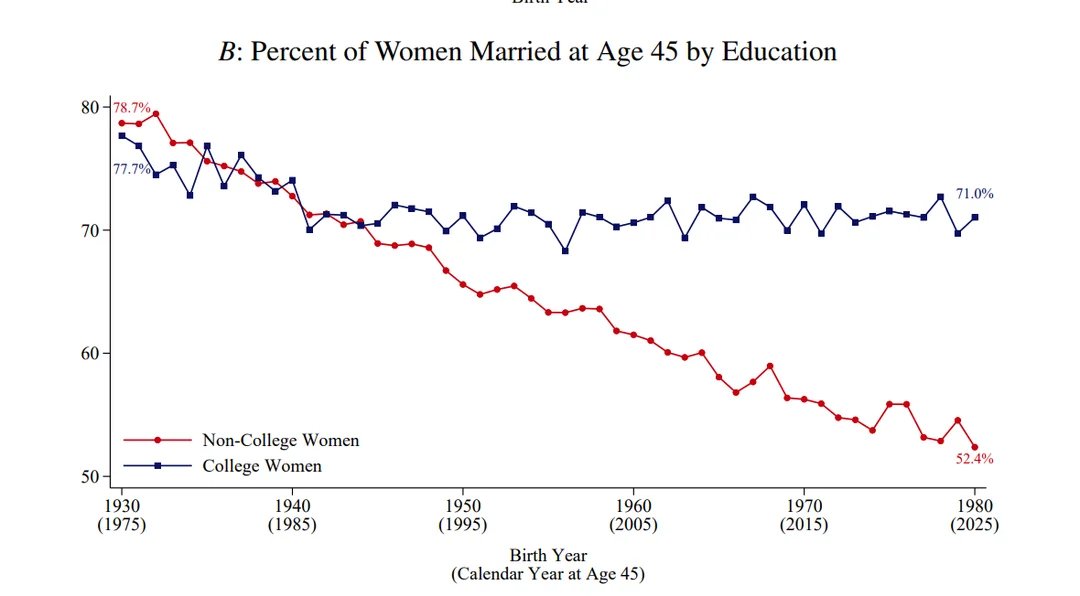
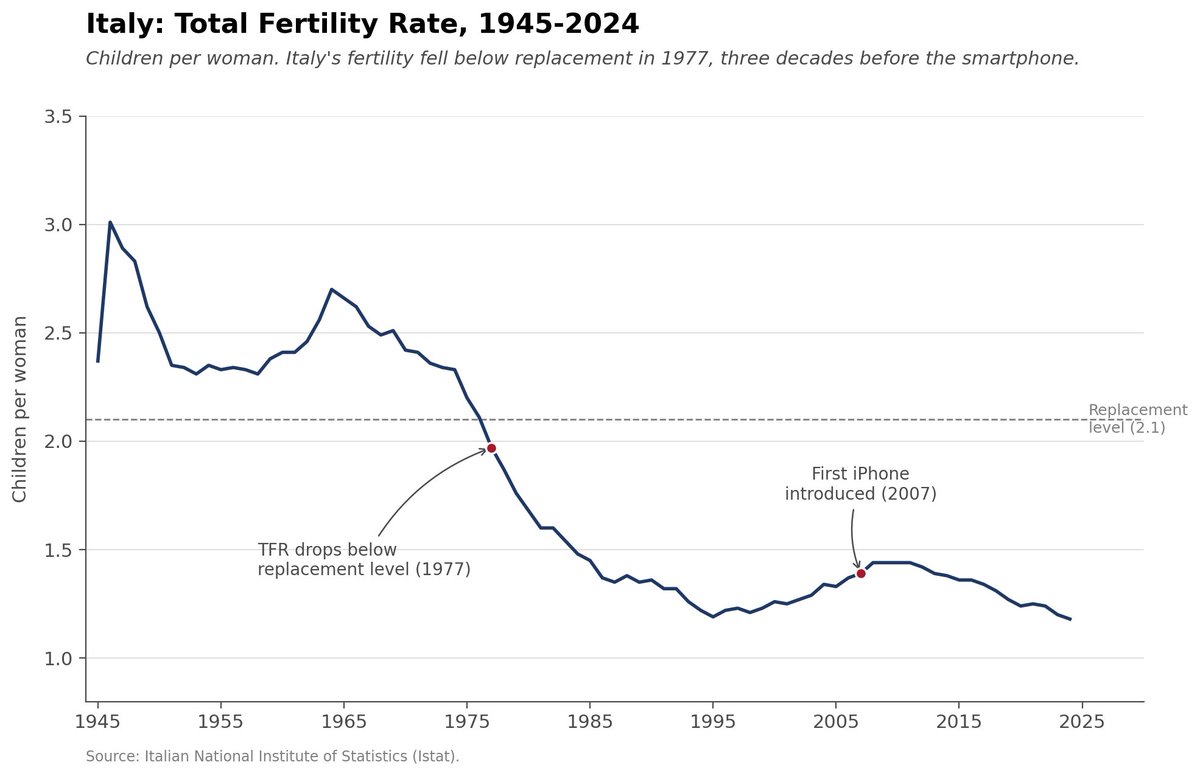
Smartphones are not the explanation for the recent decline in fertility. Instead, they are an accelerator of deeper forces already at work.
Let’s start with the facts. Fertility is falling almost everywhere: in rich, middle-income, and poor countries; in secular and religious countries; and in countries with high and low levels of gender equality.
The decline accelerated around 2014. So, no country-specific explanation will work unless you are willing to believe that 200 distinct country-specific explanations arrived at roughly the same time.
Smartphones look like the obvious candidate: the first iPhone was released in 2007, and global adoption has been astonishingly fast.
Economists understand the first major decline in fertility in advanced economies, from 6 or 7 children per woman throughout most of human history to about 1.8, that occurred between the early 1800s and roughly 1970, well before smartphones. The main drivers were a sharp fall in child mortality (effective fertility was rarely above 3 and often close to 2) and the shift from a low-skill, rural agrarian economy to a high-skill, urban industrial one. We have quantitative models that fit these facts well.
Country-specific factors mattered too, of course. Proximity to low-fertility neighbors accelerated Hungary’s decline, while fragmented landowning structures accelerated France’s. But these were second-order mechanisms.
This is also why most economists long considered Paul Ehrlich’s doom scenarios implausible. We forecast that fertility in middle- and low-income economies would follow the same path as in the rich, probably faster, because reductions in child mortality reached India or Africa at lower income levels (medical technology is nearly universal, and most gains come from handwashing and cheap antibiotics, not Mayo Clinic-level care). Much of what we see in Africa or parts of Latin America today is still that old story.
But in the 1980s, a new pattern appeared. Japan and Italy fell below 1.8, the level we had thought was the new floor. By 1990, Japan was at 1.54 and Italy at 1.36.
This second fertility decline began in Japan and Italy earlier than elsewhere, driven by country-specific factors, but the underlying dynamics were widespread: secularization, an education arms race, expensive housing, the dissolution of old social networks, and the shift to a service economy in which women’s bargaining power within the household is higher. The U.S. lagged because secularization came later, suburban housing remained relatively cheap, and African American fertility was still high. U.S. demographic patterns are exceptional and skew how academics (most of whom are in the U.S.) and the New York Times see the world.
My best guess is that, without smartphones, Italy’s 2025 fertility rate would be about 1.24 rather than 1.14. I doubt anyone will document an effect larger than 0.1-0.2. Italy was at 1.19 in 1995, not far from today’s 1.14. The TFR is cyclical due to tempo effects, so I do not read too much into the rise between 1995 and 2007 or the decline from 1.27 in 2019 to 1.14 today. The direct effect of smartphones is not zero, but it is not, by itself, that large.
Where social media, in general, and smartphones, in particular, matter is in the diffusion of social norms. What would have taken 25 years now happens in 10. Social media are not the cause of fertility decline; modernity is. But they are a very fast accelerator.
That is why social media are a major part of the story behind Guatemala (yes, Guatemala) going from 3.8 children per woman in 2005 to 1.9 in 2025. Without them, Guatemala would also have reached 1.9, just 20 years later.
Modernity, in its current form, is incompatible with replacement-level fertility. By modernity, I do not mean capitalism: fertility fell earlier and faster in socialist economies than in market economies. Socialist Hungary fell below replacement in 1960, and socialist Czechoslovakia in 1966 (both experienced small, short-lived baby booms in the mid-1970s). By modernity, I mean a society organized around rational, large-scale systems and formalized knowledge.
Countries will not converge to the same fertility rate. East Asia is likely stuck near 1, possibly below, given its unbalanced gender norms and toxic education systems. Latin America faces the same gender problem plus weak growth prospects, so I expect something around 1.2. Northern Europe has more egalitarian family structures and might hold near 1.5. The very religious societies are probably the only ones that will sustain 1.8.
All of this could change with AI or changes in population composition. We will see. But on the current evidence, deep sub-replacement fertility is the “new new normal.” Unless we reorganize our societies, better learn to handle it as best we can.
224
918
3,712
901,443
D. Malcolm Carson retweeted

May 16
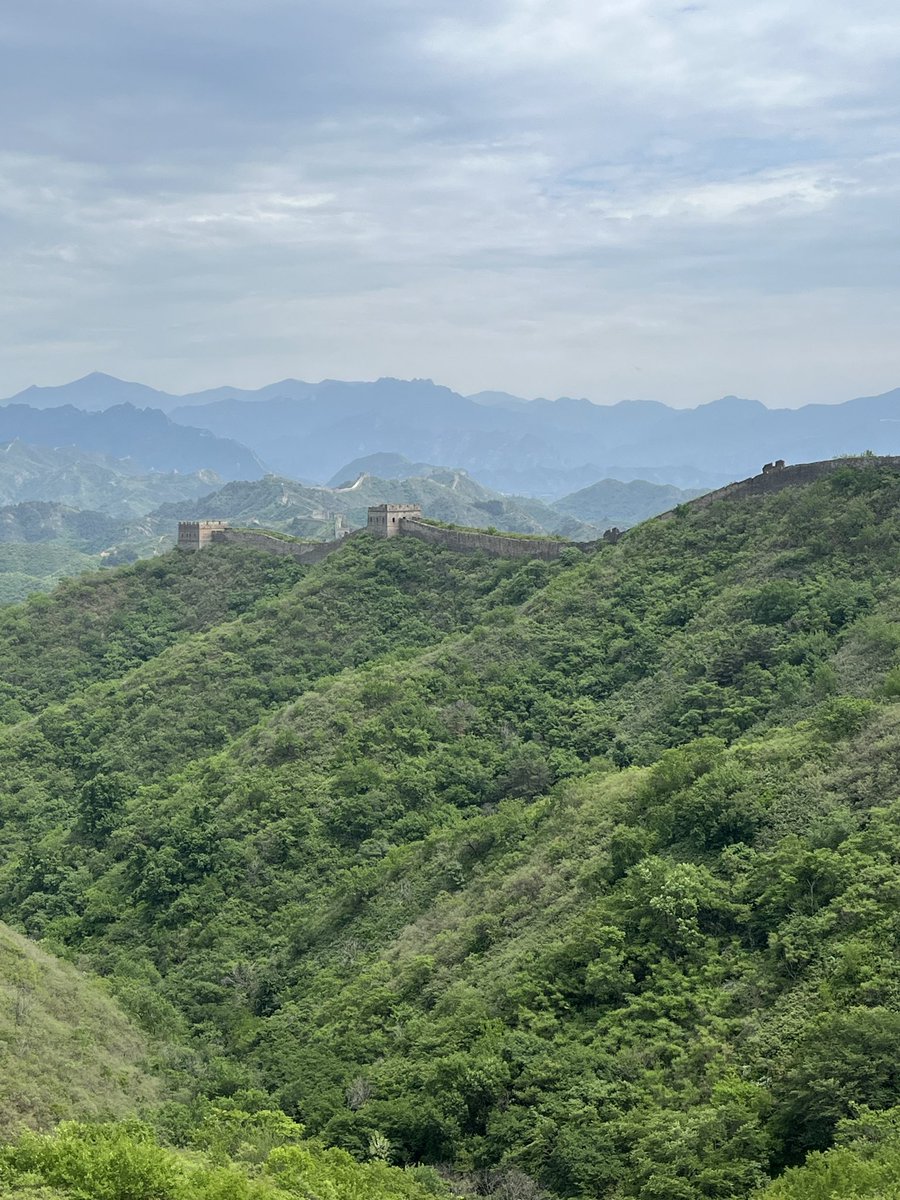
Lingered in China for an extra day after the president left to go explore the Great Wall. Nothing you’ve seen of it in photos or video can do justice to how incredible it is to experience in person. It blows your mind.


55
86
1,448
107,667
D. Malcolm Carson retweeted

May 1
...and it's borderline criminal that the plans for it call for building only FOUR HUNDRED AND SEVENTY EIGHT units of housing!
We should be building an entire cyberpunk megacity there with hundreds of thousands of units!!

May 1

It's pretty crazy that there's a city-sized expanse of flat unoccupied concrete just waiting to be developed directly on the doorstep of downtown San Francisco

40
25
620
68,107
D. Malcolm Carson retweeted

Apr 19
A parasite that has been eating people for 3,500 years is about to be wiped off the planet. It infected 3.5 million people in 1986. Last year, it infected 10. And I have not seen it make a single front page.
It is called Guinea worm. You drink contaminated water from a pond in a poor village. A year later, a worm up to three feet long starts coming out of your leg through a burning blister. There is no pill that stops it and no surgery that works. You wrap the worm around a stick and pull it out slowly, over days or weeks, inch by inch. If you rush, the worm breaks inside you and causes a fresh infection.
Guinea worm is ancient. Preserved worms have been pulled out of Egyptian mummies from around 1000 BCE. The Ebers Papyrus, an Egyptian medical scroll from 1550 BCE, describes pulling the worm out with a stick. For three and a half thousand years, that was the best humans could do.
Then in 1986, public health workers decided to kill the parasite off. They had no vaccine and no drug. What they had was cheap cloth water filters and a small army of volunteers willing to walk from village to village for decades.
The plan was simple. Give everyone who drinks from a pond a cloth filter to strain out the tiny water fleas that spread the parasite. Then send volunteers walking house to house, year after year, teaching people how to use the filters and keeping anyone with an emerging worm out of the water.
It worked. From 3.5 million cases a year to 10. Four were in Chad, four in Ethiopia, two in South Sudan. The other four countries where the worm used to be common, Angola, Cameroon, the Central African Republic, and Mali, had zero human cases for the second year in a row. The World Health Organization has already certified 200 countries as Guinea worm free. Six are left.
The last hurdle is dogs. Cameroon had 445 infected animals last year and Chad had 147, so a lot of the remaining work is on animals, not humans. Strays get leashed, and crews treat ponds to kill any remaining worms. The campaign keeps watching until the number hits zero.
When Guinea worm hits zero, it becomes the second human disease ever erased from the planet. The first was smallpox. It will also be the first parasite humans have ever wiped out, and the first disease ever ended without a single dose of medicine. Volunteers walked village to village with cloth filters for 40 years. Now a plague from the age of the pharaohs is about to be gone.
Apr 17

Give me the kind of good news from around the world that nobody ever talks about... but should.

730
20,539
128,615
7,913,812
Apr 18
If "UHI" was a grant to every citizen of silent ownership shares in an "AI Tech Fund" that pays dividends in the same amount, would that mollify the right's objections?
1
2
136
D. Malcolm Carson retweeted

Apr 17
I propose on short domestic flights, airlines should have a rule against putting seats back. It’s not necessary and it’s really irritating to person behind you! I don’t understand folks who do this for a flight under two hours!!
483
16
516
56,401