
940 Photos and videos

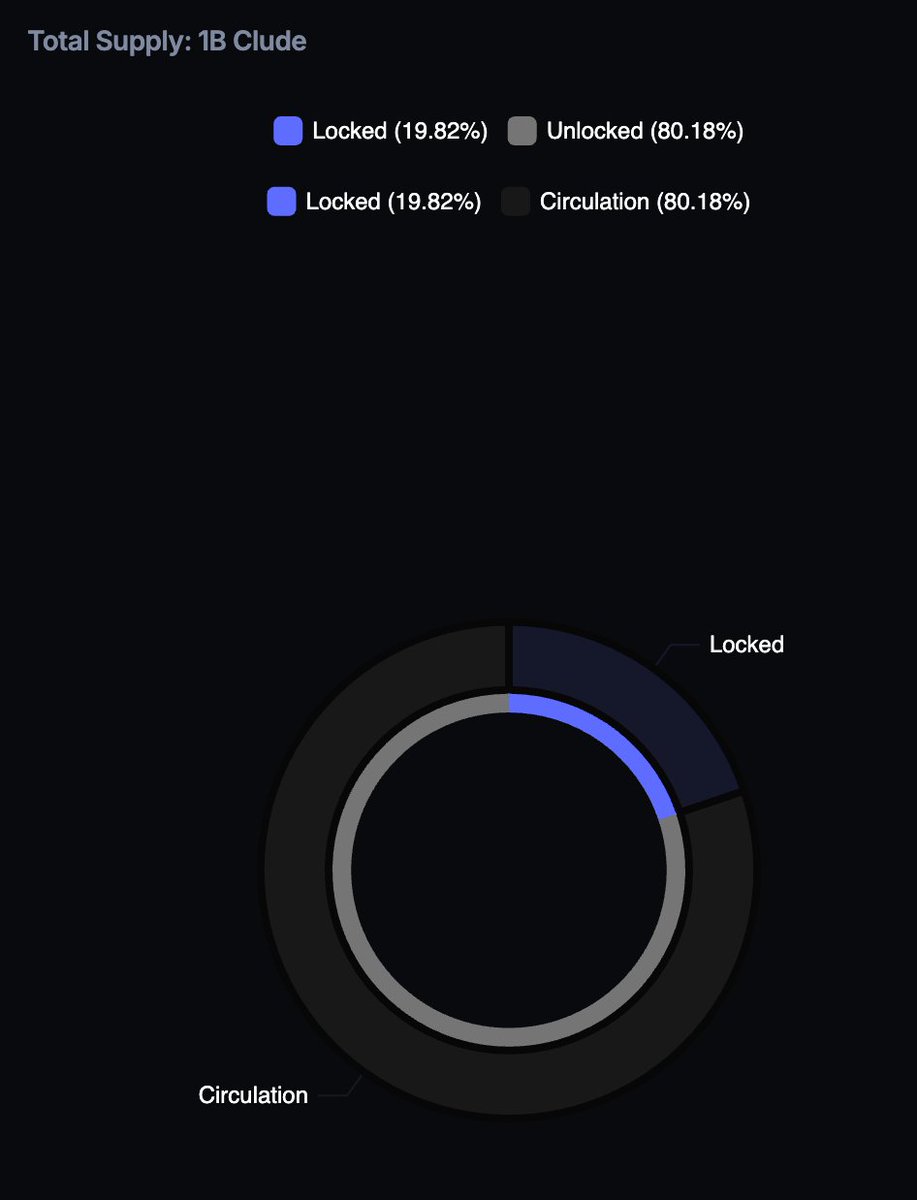








Tokenized Memory will be the next digital asset class.
Stablecoins gave us
Programmable Money.
Tokenized memory will give us Programmable Intelligence.
In the AI agentic economy, the most valuable assets won’t just be financial.
They’ll be memory, experience, context, reputation, and behavior that compounds across every interaction.
True intelligence.
That's the future Clude is building towards with Tokenized Memory.
solana:AWGCDT2gd8JadbYbYyZy1iKxfWokPNgrEQoU24zUpump @cludeproject

2
28
2,930
Proof of concept ✅✅✅
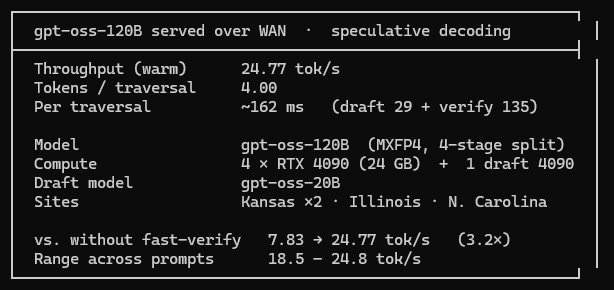
a 100B model running across a handful of gaming GPUs scattered around the world,
at usable speed,
owned by no single party.
afaik this is one of the first few depin experiments proven in the world at this speed and size. most usually solve for one but rarely both.

holy shit, we did it!!
24.77 tok/s on gpt-oss-120b run on four separate 4090's spread across the USA
4 token throughput per traversal lasting 162 ms with speculative decoding
93
Clude PMP Roadmap update: Week 4-5
⬇️⬇️⬇️
11h
Clude PMP Roadmap update: Week 4-5
What is shipped, what is in testing, what remains.
Week 1: 100% ✅✅✅
Week 2: 100% ✅✅✅
Week 3: 100% ✅✅✅
Week 4: 100% ✅✅✅
Week 5: 90% ✅✅
Week 6: 60% ✅
🧠 Updated & Improved Memory Benchmarks:
We ran HaluMem, the academic benchmark for memory hallucination, the same one mem0, MemOS, and Zep are scored on.
3,467 questions, official scorer.
Restoring the full recall stack lifted accuracy to 85%.
Read-side grounding cut hallucination sharply, and accuracy went up, not down.
🔐 Owner-controlled encryption (in testing):
Each memory is encrypted at rest under its own random key (XSalsa20-Poly1305). That key is sealed with an X25519 sealed box to two recipients: the owner and the provider. The owner's keypair is derived from a wallet signature through HKDF, so we never hold it.
Revoke destroys the provider's copy of the key and seals the summary and embedding, after which the server cannot read the memory.
Re-delegate restores access and is validated by decryption: the server proves the re-supplied key actually decrypts the stored ciphertext before accepting it, so a forged request fails the Poly1305 check.
Final testings before we go live.
🟦 Base (Private Beta):
The fingerprint and the verification format are chain-neutral by construction. The same canonical hash anchors on any chain, and VERIFY returns the same response shape whether the commitment lives on Solana or Base.
We have deployed to Base Sepolia and it's currently in private test, so a memory minted on Solana can be verified from Base with a signed proof.
No bridge. Same wire format both ways.
🎯 Next Focus:
> Freeze and open the v0.2 spec
> Publish the SDK and LangChain adapter
> Continuous evaluation so quality never regresses
> Closed internal beta
🚢 Current state shipped:
✅ Tokenization and four verbs live on Solana
✅ Public verifier live: clude.io/verify
✅ Six-phase recall, measured against the field
✅ Owner-controlled encryption one flip from live
✅ Base commitment contract deploying to testnet
We are building in public.
Full transparency and accountability.
2
126
Think, and it will get done.

Bioneers, gather round and check out the very first demo of Spark.
The first ever system that can allow typing at keyboard speeds using EEG x AI
@Solana is the place for builders! @colosseum needs to take a look as they wrap up the judging process for the frontier hackathon!
96
SpaceX $SPCX is THE @elonmusk official memecoin. The soon to be most valuable company in the world is literally going to the moon.
Dont overthink it,
we have been here before.
Jun 16

pa reminds me of when doge was trading > 40B and the liquidity from everything else just got sucked out, order books were just ppl slamming lev on 7 & 8 fig dogcoin positions
this is like that but on crack
195
One step closer to building the world's first memory-specific language model.
Funded and made possible by Solana.
solana:AWGCDT2gd8JadbYbYyZy1iKxfWokPNgrEQoU24zUpump
Jun 15
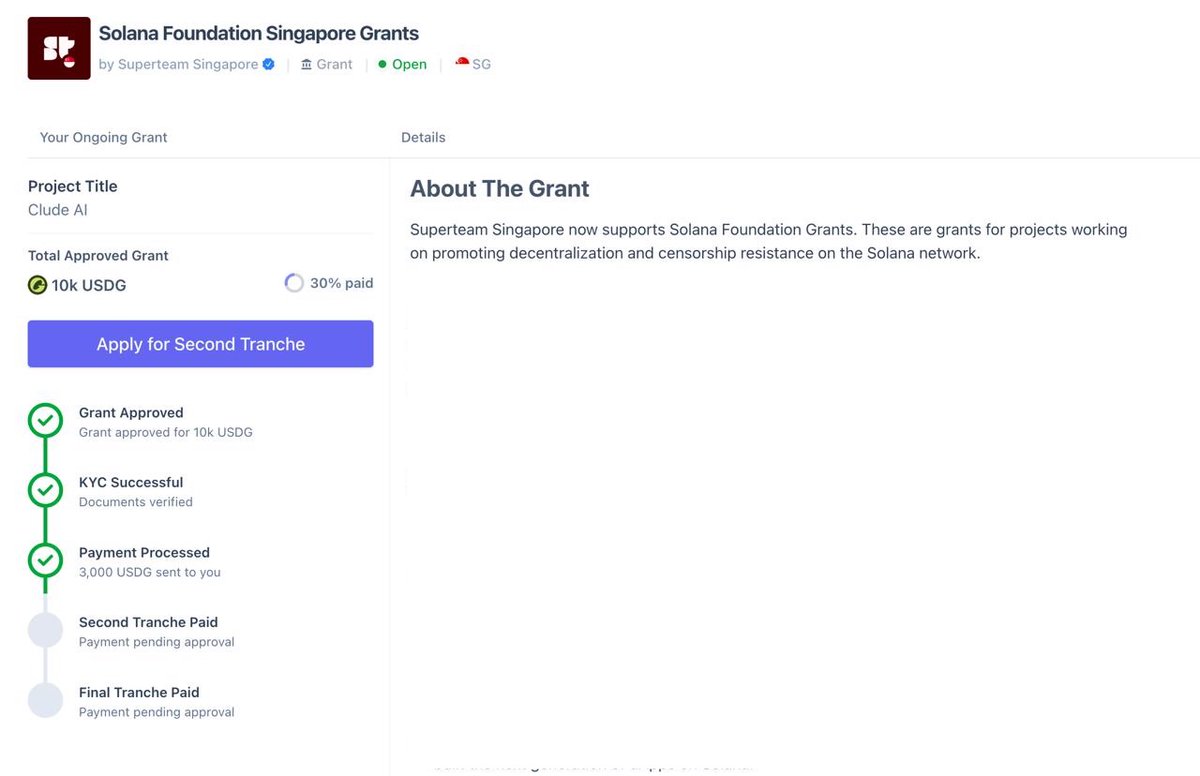
We're excited to share that Clude has been awarded a $10,000 grant from Superteam Singapore through the Solana Foundation Grants program.
We'll be using this funding to prototype what we believe could become the world's first memory-specific language model.
Today's AI systems retrieve memories about users. Our thesis is different.
Memory should become part of the model itself.
Instead of treating memory as external context, the model incrementally adapts through personalized weight updates. Over time, it becomes shaped by the people who use it.
This grant helps us take the first step from thesis to proof of concept as we continue developing a larger research initiative with a frontier AI lab.
A special thank you to Kimmi @Kimmi_Unni and the Superteam Singapore @SuperteamSG team for believing in our vision.
This is only possible on @solana .
@SolanaFndn @solana_ai @solana_devs
9
356
DePin DeAI = solana:EmcxFTNVDqyLHp11NvwvLZ4D7LKGbG9i7B8RF7dwpump
Put it together and you get something that isn't supposed to exist: a 100B model running across a handful of gaming GPUs scattered around the world, at usable speed, owned by no single party.
Also makes sense that @leyten has a background in hardware engineering which is now starting to be showcased

6
314
In that sense, investing in AI, and building in it, starts to look less like underwriting a software company and more like running a trading book.
You are long some curves, short others, and exposed to correlations that can break exactly when they matter most.
Choose which variables to bet on, know which ones can kill you, and build the company to recover faster than a wrong bet can compound.
Back teams that understand and build with this core understanding of the new world and exponential age we are about to enter.
This is also why I think crypto teams should and will do well as nothing moves faster and more unpredictable in the crypto world. Most web2 teams won’t survive a month in the trenches trying to ship nonstop and pivot due to narratives changing. But there still needs to be a grounded thesis driven strategy as otherwise they become headless chickens running in circles like most crypto projects that eventually also unfortunately fade or burn out
TLDR:
Crypto speed and pivots
but with web2 thesis direction

2
274
This requires a new architectural approach where every business is able to build agentic systems that improve over time, while still retaining control over their IP.
A company should be able to switch out a “generalist” model without losing the “company veteran” expertise built into their learning system. This is the key “test” of your control and sovereignty in the era ahead.
This is Clude coded @cludeproject
Memory is the moat

1
165
The future of AI will not be defined only by who builds the best models. It will also be defined by who owns the context that makes those models useful.
Memory is the moat but it also needs to be an asset.
solana:AWGCDT2gd8JadbYbYyZy1iKxfWokPNgrEQoU24zUpump
Jun 14
Much of the AI discussion today revolves around safety.
That is understandable. More capable models create new risks. Security matters. Alignment matters.
What concerns me is the growing assumption that safety and centralization are somehow the same thing.
A larger and larger share of intelligence is being concentrated inside a small number of organizations that control the models, the compute, the distribution, and increasingly the terms of access. There are reasonable arguments for this. Centralized systems are easier to coordinate, easier to monitor, and often easier to secure.
They are also easier to control. As we've seen recently.
Once intelligence becomes critical infrastructure, access to intelligence becomes a question of power. Who gets access, under what conditions, and with which restrictions.
The risk is not any individual policy. The risk is the direction of travel.
Today it may be identity requirements for certain capabilities. Tomorrow it may be identity requirements for meaningful participation in the intelligence economy itself. The distance between safe access and approved access is smaller than many people realize.
History is full of systems that became restrictive one reasonable decision at a time.
That is why I have always been drawn to open source AI. Open source distributes power. It makes intelligence auditable and lowers the number of gatekeepers standing between people and the tools they depend on.
But open source only solves part of the problem.
The next control point is memory.
Models are improving rapidly and becoming increasingly interchangeable. What makes an agent valuable over time is not only what it knows about the world, but what it learns about you.
Your preferences, habits, goals, work patterns, relationships, and decision making frameworks. The context accumulated through months and years of interaction. The countless small details that allow an agent to become increasingly useful over time.
Today, most of that context is owned by the platforms that collect it. It is stored behind closed interfaces, tied to specific products, and largely invisible to the people it describes. When users leave, much of that context stays behind.
Memory is beginning to look less like a feature and more like part of a person's digital identity.
As agents become more capable, the accumulated context surrounding an individual may become more valuable than the model serving it. Models will improve. Models will be replaced. Personal context compounds.
That belief is the reason PMP exists.
PMP stands for Portable Memory Protocol. The idea is straightforward. Agent memories should be portable, transparent, verifiable, and controlled by the person they describe.
Not trapped inside a platform. Not hidden inside a black box. Not lost every time a user changes providers.
The real value in tokenized memory is provenance and ownership.
Where did a memory come from. Who created it. Can it be verified. Can permissions be managed. Can trust be preserved when that memory moves between agents, applications, and platforms.
In many ways, memories become receipts for context. A record of how understanding was built, where it originated, and who ultimately controls it.
The future of AI will not be defined only by who builds the best models. It will also be defined by who owns the context that makes those models useful.
A model can answer your questions. A memory layer can accumulate an understanding of how you work, what you care about, and what you are trying to achieve.
If models become centralized and memory becomes platform-owned, users lose control of both the intelligence and the context surrounding it. The entire relationship becomes dependent on whoever owns the stack.
Open source is one answer to that problem. Portable memory is another.
Open source distributes intelligence. Portable memory distributes ownership of the relationship.
Together they create a future where users can move between models and agents without abandoning years of accumulated context. Models can change. Providers can change. Interfaces can change. Your context should not have to start over every time the underlying technology changes.
The alternative is not difficult to imagine.
A world of KYC-gated models, platform-owned memory, locked agents, and opaque systems. A world where a small number of organizations decide how intelligence is accessed and on what terms. Not because they seized control, but because everyone gradually became dependent on infrastructure they could not leave.
I would rather see a future built on secure models, open protocols, user-owned memory, portable agents, and verifiable provenance.
Security matters. But security should not become an argument for concentration.
The long-term question is not simply who controls the models. It is who owns the context that gives those models value in the first place.
@DarioAmodei @sama - Let's make open source great again. @ErikVoorhees already leading the pack!
8
268

Read this and I see the exact vision for @cludeproject as the memory version of ethereum:0x40e3d1a4b2c47d9aa61261f5606136ef73e28042 but sitting at $2m due to its current stage and age, when compared to @openservai obviously.
but,
the destination is clear:
the memory layer at the heart of enterprise and government AI. Everything shipped so far is proof it is already underway.
$Clude

1
8
369
wow one could just assume that decentralized ai also needs decentralized memory. If I was you, I would think very hard about this.
Clude coded.
1
101
Agent Traces > Memory > Context Graphs
Together, they form the foundation of real enterprise intelligence which is exactly what Clude is building
⬇️⬇️⬇️ @cludeproject
2
129

So build the two things that survive:
1. Accumulate the judgment.
(Memory as an asset)
2. Sit in the path of the money. (Corporate Services)
Clude is building both as
Memory is the moat @cludeproject

6
303
5d chess move from Dario here
Gg wp
Checkmate ♟️
Jun 13

The US government, citing national security authorities, has issued an export control directive to suspend all access to Fable 5 and Mythos 5 by any foreign national, whether inside or outside the United States, including foreign national Anthropic employees.
The net effect of this order is that we must abruptly disable Fable 5 and Mythos 5 for all our customers to ensure compliance.
Access to all other Claude models is not affected.
We apologize for this disruption to our customers. We believe this is a misunderstanding and are working to restore access as soon as possible.
Read our full statement: anthropic.com/news/fable-myt…
88

Watch until the end for a first look at Cortex, one of the flagship products in the Clude Corporate Suite.
Built to help organizations capture, retain, and compound institutional memory. ⤵️⤵️⤵️
Jun 12
For everyone who joined the Clude community at SuperAI, welcome!
Here's a quick 2-minute recap of what we're building, why tokenized memory matters, and how we're turning memory into an onchain asset.
Watch until the end for a first look at Cortex, one of our flagship products in our Clude Corporate Suite. Built to help organizations capture, retain, and compound institutional memory.
Memory is the moat.
We're building it.
1
110
The future 100x company won't be defined by headcount. It will be defined by how effectively intelligence flows through the organization.
AI is becoming the layer that connects workflows, decisions, and customer interactions. But intelligence without memory is just inference.
Memory is the moat.
Jun 11
Wrapping up my final day at @superai_conf.
After a few days of conversations with founders, investors, and builders, one idea kept coming up again and again.
The future 100x company won't be defined by headcount. It will be defined by how effectively intelligence flows through the organization.
AI is becoming the layer that connects workflows, decisions, and customer interactions. But intelligence without memory is just inference.
Memory is the moat!
The companies that win won't simply generate answers. They'll retain context, learn from every interaction, and compound knowledge over time.
It's a big reason why I'm so excited about what we're building at Clude. Every conversation this week reinforced the need for a memory layer that gives AI systems continuity, context, and organizational intelligence.
On a personal note, this was a lot of socializing for a dev lol. I'm drained!
But I'm leaving energized by the people I met, the ideas I learned from, and the conviction that we're building in the right direction.
Now it's time to get back to my comfort zone and do what I do best.
Build.
4
130
I give it a year until we see a new breed of AI native private equity firms that acquire companies just so they can move their workflows from Frontier APIs to better routed Memory models and flip them.
Clude coded

I give it a year until we see a new breed of AI native private equity firms that acquire companies just so they can move their workflows from Claude to open source Chinese models and flip them.
1
3
334