
Prof at UofT, definitely *not* running any WhatsApp or Telegram group on crypto.
Joined July 2012
- Tweets 3,204
- Following 400
- Followers 1,110
- Likes 1,939
270 Photos and videos









Pinned Tweet

19 Jul 2022
It's that time again: no, I do not run any Telegram group, some criminals are impersonating me.
Please don't add pain to injury by sending me angry emails. There's nothing I can do about these scammers. Block and report and be done with it.
6
1
15
Jun 14
Such a disgrace.
Jun 11

Opinion: SpaceX IPO makes Elon Musk the first trillionaire. Here’s how to properly hate him theglobeandmail.com/business…
36
Andreas Park retweeted

Jun 5
NEW: The City of Toronto says only a fraction of the 2026 FIFA World Cup tickets it bought as an investment remain unsold, with the soccer gamble looking set to pay off a week before the games begin. #ToPoli
globalnews.ca/news/11891194/…
90
123
1,120
3,998,820
May 31
I could not agree more!
May 30

The fact that foundational innovations have been overlooked in the past does not imply that ETH is being mis-valued now. These lazy arguments are part of why the Ethereum community is in such a difficult position now.
ETH has two main problems. One is a demand issue. The other is a value capture issue. The Ethereum community has done essentially nothing to resolve these issues and ETH prices reflect that and will continue to reflect that until these issues are solved.
On the demand issue, the most widely used applications on Ethereum are DeFi applications and the economic value of those applications depend on widespread usage. For example, when a given DEX has high liquidity provision, it generates low trading costs and can thereby sustain high trading volume. At the same time, the same DEX could generate low trading volume and low liquidity provision because low liquidity provision implies high trading costs which implies low trading volume that then re-enforces the low liquidity provision. This is known as multiple equilibria and it is a common feature in platforms.
Crucially, platforms do not drift into the good equilibrium on their own. Someone has to build the user base that gets you there, which means actively engaging outside the crypto community. The Ethereum community has shown no sign of doing this: over one year after the end of the Gensler SEC, Ethereum remains largely unknown beyond the crypto community and that is a horrible sign.
On the value capture issue, there is a gap between Ethereum the blockchain and ETH the asset. If stablecoins are widely traded on the Ethereum blockchain but the gas fees generated are too low, that does not imply meaningful ETH demand. Here, again, the Ethereum community has been largely obtuse about understanding this point and trying to resolve it.
Ethereum was an excellent idea with the potential to be transformative. However, transformative ideas can fail without effective execution. In this context, effective execution means resolving the two core issues rather than pretending they do not exist.
53
Andreas Park retweeted

May 12
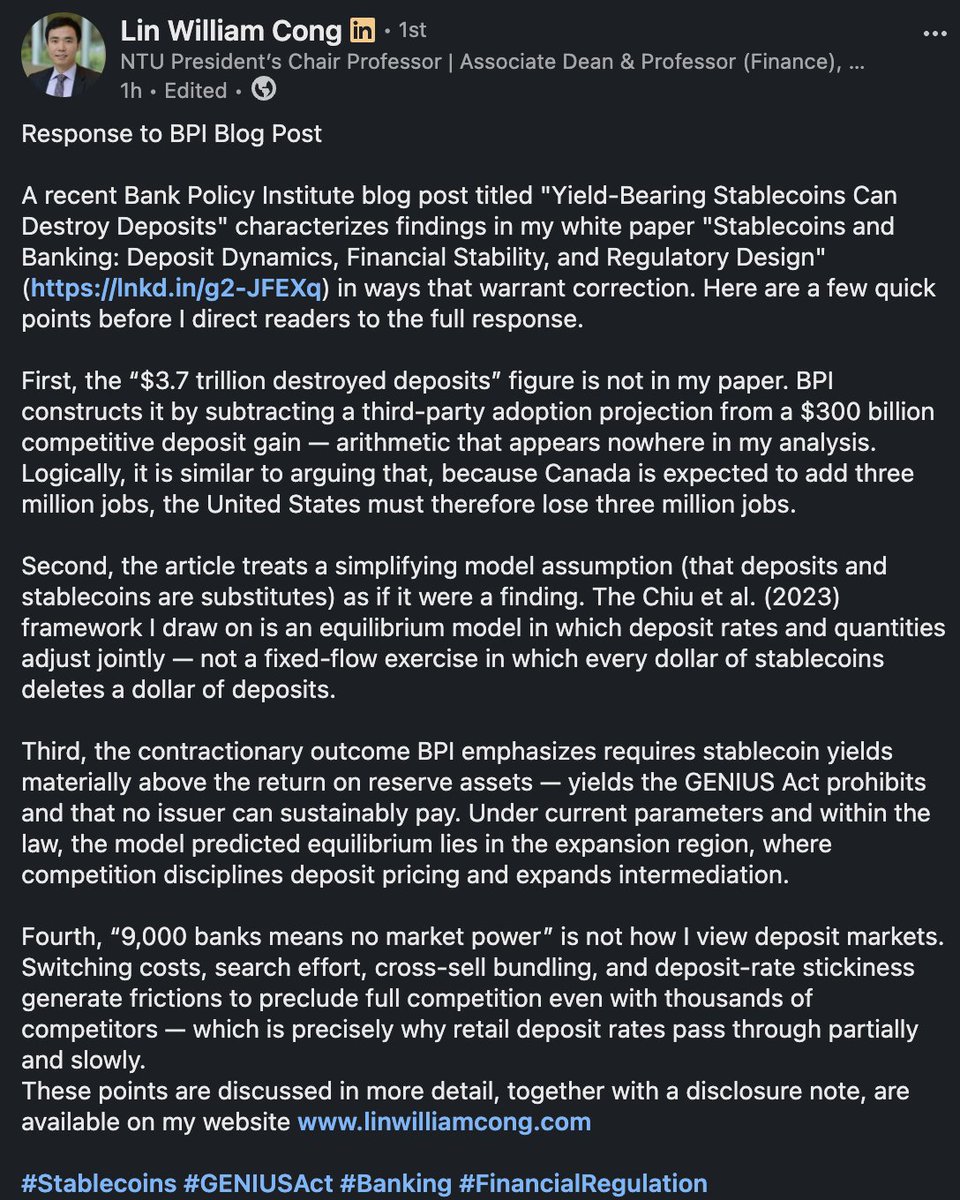
Nothing says "we let the AI write our policy memos" like citing an academic paper that argues the opposite of your position. @bankpolicy filed evidence against itself and called it advocacy. 🍿
10
39
3,227
May 12
Happy that my paper with @KatyaMalinova on tokenizating stocks is now available at Research Policy:
sciencedirect.com/science/ar…
6
200
May 8
"Light" weekend reading y'all!
My colleague Jona Stinner and I have been thinking for a while about algorithmic stablecoins and why they have always crashed and burnt. Is that inevitable?
To be clear, there was lots wrong with, say, Terra. As I understand it, it was mostly vacuous in terms of use except for the lending protocol Anchor which was financed by its own tokens which derived value from demand for Anchor and the stablecoin and so on - you get the picture.
But the real question is: can one get a stablecoin to work "within" a network, without backing it by treasuries but rather by creating a mint-burn-seigniorage mechanism where a stablecoin is exchangeable to a blockchain token and somehow magically this all works (<waves hands>).
Jona and I use a pretty significant amount of paper to conclude: not really, at least not in the utopian seigniorage-free money way where you exchange stables for a network token (= the native cryptocurrency).
Now, for the crypto-skeptics among you who will say "of course not - it's all magic internet money" please bear with me. There is something to learn here. Generally speaking, a "seigniorage" algostable that flips to a network token is essentially a claim on the network value (think like in accounting: left hand side is transaction demand, right hand side are tokens as claims on that demand). If Modigliani-Miller (google Pizza theory of finance) held, then you could create such a stable -- it's like a senior claim on transaction demand.
The problem is that Modigliani-Miller doesn't hold 'cos a network token acts as network money. People are only willing to hold it if its value doesn't deteriorate too much by inflation (Julian Prat and co-authors have a nice paper on pricing network tokens in Management Science; we build on it). The problem with algostables is that their redemption creates inflation.
This burn-redemption mechanism can work for a while, in particular when the price of the network token rises. But if there is a negative price shock you get to total collapse very quickly. Loosely, if with stables and network token as claims on the transaction demand and there is a shock to the latter, the stables look "shaky", just like corporate bonds look less safe when a firm's profits take a hit when a product flops. A natural reaction would be to retire stables because that would make what's left safer, right? Well, no. The resulting inflation can very quickly push the network token over the brink.
We calibrated the model to the Terra situation and were able to predict the total collapse to within hours.
So, darn it, is there no way out? Not that we want to suggest anyone take another stab at designing an algostable, but what our approach shows is that one needs to design a stable so that Modigliani-Miller applies, i.e, one must separate network demand from mint-burn. One way to do this within a network is to design a third token that is backed by, for instance, fees collected from consensus. The mint-burn mechanism would then operate against this "dividend" token. At least within the context of our paper, that can work. Disappointingly for enthusiasts, such a stable would have small scale (must be backed by future fees), it would likely come with all kinds of governance issues, and it would require to organize a blockchain to something that resembles ... a firm. Oh, and the resulting stable is conceptually very similar to collateral backed stablecoins like DAI/USDS.
So the answer to our paper's title "Can an algorithmic stablecoin be stable?" is: not as a "seigniorage" free-money type token - you need an identifiable income stream that's carved out with firm-like features.
papers.ssrn.com/sol3/papers.…
80
May 2
Enshittification explained.
Apr 30

Search is full of ads and wrong answers. Every other email is an ad. Prime Video charges you and shows ads. Paramount? Ads. Peacock? YouTube? Hulu? Ads followed by more ads. Netflix full of ads. Meta and X, every other thing is an ad. Pinterest is nothing but ads. AI is in everything. AI finishes sentences incorrectly and won’t stop. AI reads your email and search history to target you with more ads. Every time you open an app or visit a site there’s an update making it worse. In a hurry? First, click here to agree to terms you don’t have time to read and must accept. You need an account to do that. Change your temporary password. Enter your 2FA code. Check your email and enter that code. Now use a passkey. Your password is too simple to remember. Change it. No, not like that. Now log on. Enter your 2FA code. Check your email for a code… Welcome back! We’ve updated our terms of service and privacy policy (you have none). Subscribe to the site. Subscribe to Netflix. Subscribe to toilet paper. Subscribe to these groceries. Pay a membership fee for the right to subscribe then tip your driver who delivers the subscriptions your membership lets you subscribe to. Time to work? We’ve got to update your laptop and will slow down everything you do until you agree to update. But first, click here to agree. Update installed — your laptop’s broken now. It doesn’t matter, since your boss just replaced you with AI. Go to your phone to complain on social media. Wait, your phone needs an update so we can add more AI. Click here. Oh sorry, your phone can’t handle this update. Now it’s useless. Go get the newest phone. Here’s a text from a friend, an email, a voice mail they left three days ago but you didn’t see until now because of sync problems with the cloud. It’s their GoFundMe. Their MLM. Their Patreon. Never mind, you didn’t respond to their text within 9 minutes and now you’re no longer friends. They blocked you. Make new friends. Download this app to find people in your area. In your neighborhood. On your street. Two doors down from you. Do you know this person yet, we think you’d get along. You need an account to use this app. That username is taken. Enter a password. Not that one, you used it on another site. You need to be connected to WiFi to download the app. Allow the app to connect to other devices on your network. Allow the app to access your contacts, know your precise location, store your credit card details. Oops, sorry, we got hacked now all that info is available on the web. There’s a class action suit. You can join. It’ll take a decade to get your $3.73 share of the ten billion settlement. We’ll send it via PayPal or deposit it to your bank, just tell us those details. Oh no, another hack. That info is circulating now, too. Here’s a spam call, a spam email, a spam text. Why are you angry? Why are you talking about getting rid of your phone? Why don’t you like AI, it lets us make all of this easier? Do you know how ridiculous that sounds? This is progress. You’ll be left behind. Do you want to be left behind? Do you???
91
Andreas Park retweeted

Apr 20
You may have seen our paper "The AI Layoff Trap" making the rounds this week under some fairly dramatic headlines.
I'm one of the authors. Here's what it actually says and what it doesn't. 🧵
1
1
6
526
Mar 24
Looks like someone (an AI?) came up with the ultimate solution for LLM-hallucinated references: just create the journal and the made-up papers!
isipress.org/index.php/IJAIR
(As far as I can tell, the authors of the papers don't exist at the listed institutions and so none of these papers are, eh, real.)
1
129
Andreas Park retweeted

Mar 12
Blockchain and AI are complementary technologies. Specifically, AI agents need data to be useful, and a blockchain is an ideal backend to store that data. Why? Because a blockchain can serve as a common point of access for data while also giving users discretion over how that access is granted.
This is important because right now your data is fragmented across many platforms, each with its own rules and each able to revoke access at any time. There's no unified way to let an agent work across your digital life and you have limited say in what agents can access. If the data is onchain, an agent could pull from one place and on your terms with no platform serving as a bottleneck. Of course, to make this work, we also need to resolve privacy issues, but that's very much part of the crypto roadmap @_julianma.
@AgostinoCapponi, @skominers and I discussed this topic in some detail recently. Check out our conversation: youtube.com/watch?v=EJFxN_rI…
2
6
9
913
Mar 12
Gemini is now the Gen X of LLMs


112
Mar 12
I can’t overemphasize how much I endorse this development!!!
Mar 12

Ethereum needs an Encrypted Mempool and it needs it fast.
It's not just about stopping sandwiching. Encrypted mempools are how Ethereum matures its onchain markets.
I just published a post on why Ethereum needs encrypted mempools. Here are the core arguments:
2
101
Andreas Park retweeted
Mar 10
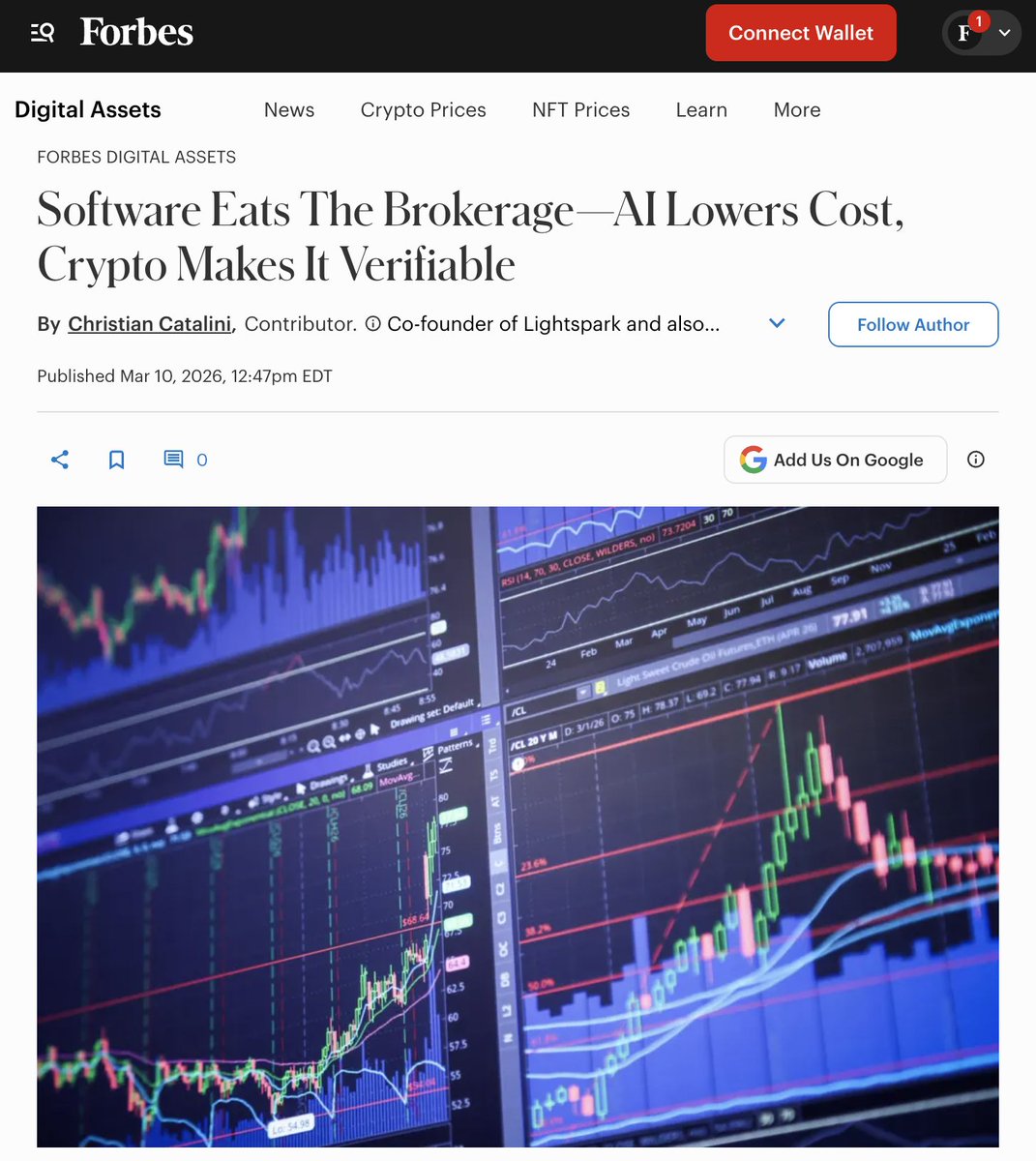
The internet made it free to watch. Finance kept it expensive to own. Billions of people follow markets from a phone, yet four billion adults cannot buy into them. Not because the system is hostile—because it is expensive. Modern finance can move $500 million domestically in seconds. It cannot serve a $50 investor at a profit. Compliance, custody, settlement: the entire machinery was built for institutional scale, and its costs do not scale down.
The exclusion mechanism is not mysterious. To let someone buy $50 of stock, a traditional intermediary must still perform the full institutional dance: verify identity, screen sanctions, collect documents, arrange custody, connect to settlement, maintain records, assume regulatory liability. When the lifetime revenue on the account is measured in cents and the compliance burden in dollars, the math does not become inclusive just because people make grand speeches about an idealistic “Finternet”. Financial institutions do not hate small investors. Their unit economics do.
So the system does the rational thing. It sets minimums. It geoblocks. It "de-risks." It politely informs vast populations that they may participate later—once they have more wealth, cleaner paperwork, or the good fortune to live in a friendlier jurisdiction. In roughly half the world’s countries, there is not even a liquid stock exchange. The financial system works well. It just does not work for most people.
For decades, that was an inconvenience. In an economy approaching AGI, it becomes a structural crisis.
Much of retail finance is rules-based and measurable: onboarding, document handling, customer support, suitability checks, reporting, reconciliation, basic portfolio construction. Those are exactly the tasks AI drives toward software-like marginal cost. The minimum economically viable account size should fall hard. A $50 account in Nairobi or Manila ought to become almost as cheap to serve as a $50,000 account in New York.
But here the story takes a harder turn. AI also degrades the evidence that compliance depends on.
Finance is not only an execution business. It is a verification business. The same tools that make forms cheaper to process make documents cheaper to fake. A scanned passport is no longer just identification—it is raw material for a generative model. A video selfie is no longer a liveness check—it is a challenge to the best deepfake generator on the market. AI makes the onboarding cheaper and the utility bill less believable.
We call this the measurability gap: AI lowers the cost of executing tasks far faster than it lowers the cost of verifying whether those tasks were done honestly. In finance the gap bites immediately. You can automate the paperwork faster than you can believe the paperwork. A system that responds by layering ever-thicker checks on top of increasingly untrustworthy documents is not solving the problem. It is performing seriousness at rising cost.
The resolution is architectural, and it comes from the part of crypto that never makes headlines.
The useful insight is not that every asset should become a meme coin. It is that compliance and ownership can be made portable, programmable, and provable. In a better design, a trusted institution verifies a user once and issues a reusable digital credential. The user can then prove what regulators actually care about—residency, sanctions clearance, accredited status, eligibility—across compliant venues without handing over the same dossier every time. Zero-knowledge proofs are the technical mechanism. The plain-English version: stop making people reapply for the right to exist every time they want to buy an asset.
But architecture is policy. If tokenization is sold to incumbents as private back-office software, they will do the obvious incumbent thing: lower their own costs, preserve the walls, keep the spread. The economics become transformative only when the base layer is open. Then portability is real. Users move assets between providers. Services unbundle. Intermediaries compete on price instead of living off network lock-in.
That matters because traditional finance still extracts rent through closed networks. A simple equity trade can bounce through brokers, custodians, clearinghouses, transfer agents, and foreign-exchange layers—each adding cost, delay, and another chance to say no. On open rails, settlement moves from days to near-instant atomic exchange. Compliance is done once and reused. Minimums shrink from meaningful sums to the size of a mobile top-up. Recent estimates suggest tokenized equity trading could cut transaction costs by more than 30 percent. More important, it changes who counts as a customer.
Finance starts to look less like a cartel of databases and more like the internet.
The real test of the next financial system is not whether Wall Street can tokenize another product for institutions. It is whether a person with $50 in weekly savings can buy, hold, and sell a tiny slice of productive capital as easily as sending a message.
Finance's last frontier is not payments. It is participation.
5
16
71
7,532
Mar 7
It's time for a big shoutout to @RefineInk. I've now used it for finalizing two papers, and it is phenomenal!
For one paper, it caught a mathematical inconsistency that badly needed fixing, and it also forced us to think much harder about the narrative. Most certainly, it gave comments that many, many reviewers would make, and so I am very hoping that it saves us one round of reviews!
Maybe the highest praise I can give: I got just as annoyed with refine's reviews as I would for any rejection reviews :-) So it totally works. Awesome job, @ben_golub, what a service to the research community!
11
41
14,004
Andreas Park retweeted
Mar 6
The video is now available:
Mar 3
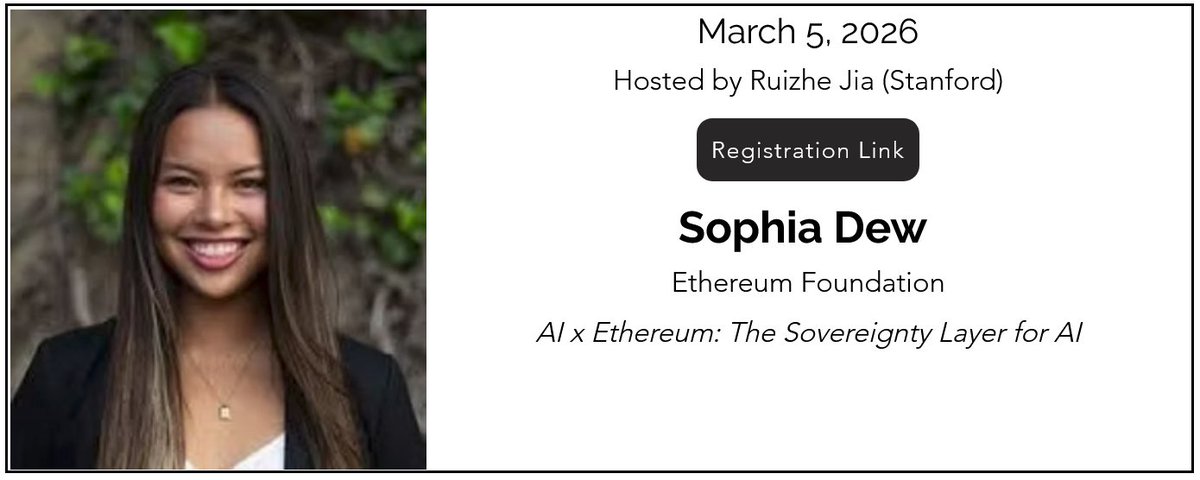
This Thursday at 11 AM ET: @sodofi_ @ethereumfndn explains the AI x Ethereum interface in a session moderated by @RuizheJia @Stanford. Register at columbiauniversity.zoom.us/w…
1
2
16
1,698
Andreas Park retweeted
Mar 3
This Thursday at 11 AM ET: @sodofi_ @ethereumfndn explains the AI x Ethereum interface in a session moderated by @RuizheJia @Stanford. Register at columbiauniversity.zoom.us/w…
1
5
10
2,740
Feb 20
Well well ... seems both natural and fair. Reminds me of robotwars!
humanxaifinance.org/
2
169
Andreas Park retweeted

🇺🇸 SEC Chair Paul Atkins said all U.S. markets will be on chain crypto within two years.
22
53
327
16,361