
Emerson/Merrill Lynch Professor @UF. Advisor @CUSEAS CDFT. FinTech Fellow @CornellMBA. Co-Organizer for CBER Forum. PhD @NYUStern MSc @Columbia BSc @CornellEng.
Joined August 2021
- Tweets 891
- Following 160
- Followers 1,017
- Likes 882
129 Photos and videos








Pinned Tweet

Jan 20
As tokenization of traditional financial assets gains regulatory attention, a fundamental question demands rigorous analysis: Can blockchain technology provide secure settlement?
In a new paper with @camharvey (@DukeU) and Kose John (@NYUStern), we develop an economic model to address this question. Our analysis yields two main insights.
First: blockchain security is tied to blockchain productivity. A blockchain generating more economic value for users can share that value with validators through higher staking rewards. In turn, higher rewards attract more staked capital, raising the cost for any adversary seeking to disrupt settlement.
Second: under reasonable conditions, a PoS blockchain can be secured against arbitrarily large attack incentives. This may seem surprising, but it follows from a familiar financial phenomenon that prior blockchain literature has overlooked: price impact. To disrupt settlement, an attacker must acquire a large fraction of the blockchain's native asset. However, staked assets are subject to withdrawal delays and cannot be traded immediately, so a higher staking ratio translates directly into a smaller circulating float of the blockchain's native asset. In particular, the attacker must acquire what they need from unstaked assets, and buying a large share of a small supply drives up the price.
This is where the economics become powerful. Higher staking rewards attract more capital into staking, which shrinks circulating supply, amplifying the price impact an attacker would face. Because staking responds to incentives, the staking ratio can be engineered to achieve a desired level of security. Our model shows that, by setting staking rewards appropriately, price impact can be made arbitrarily large, rendering attacks unprofitable regardless of potential gains.
A concrete illustration: Ethereum currently has roughly 30% of ether staked. A majority attack would require purchasing another 30% from the 70% in circulation. Our model shows this generates a price impact of approximately 75%, a cost prior literature has failed to incorporate. Importantly, 75% reflects current staking levels. By increasing staking incentives to raise the staking ratio, price impact can be made larger. This is precisely how a blockchain can be secured against arbitrarily large attack incentives.
📄 Paper: papers.ssrn.com/sol3/papers.…
1
5
9
3,127
Fahad Saleh retweeted

Game theory from here is super interesting:
Original Mags (Google, Amazon, Microsoft, Meta) now have a serious non-zero opportunity to tank the frontier labs.
Go to the government, kneecap the labs’ motion of putting the latest models out in the wild, become the trusted gatekeeper between the labs and the public at large (including internationally) by having the labs go through their clouds (AWS, GCP, Azure) and implement strict KYC to seal the deal.
The frontier labs should have seen this coming years ago and implemented a robust KYC for just this moment. The fact they didn’t is kind of concerning.
Why did they not do it?
Best guess is because it would have changed the run-rate revenues (downward) which would have then changed funding dynamics - lower valuations, more dilution, less secondary.
A valuation reset may happen now anyways, except the labs may end up with less control and more restrictions at the end of it. At the same time, everyone is already clamoring about token prices of the old models from the labs anyways…
This couldn’t be a better setup for open source and neoclouds. Big question is can they meet the moment?
There are too few of them and their progress seems sporadic at best.
234
203
2,752
680,532
Fahad Saleh retweeted
I’ve had a number of conversations with folks inside and outside government about the current situation with Anthropic, and here is what I believe to be true:
— As we know, Anthropic publicly released its Mythos class models earlier this week under the commercial name Fable.
— Fable is Mythos with guardrails. But if those guardrails fail, then you’ve exposed Mythos and its advanced cyber capabilities to people who shouldn’t have them. (Keep in mind that Anthropic itself widely promoted the idea that Mythos was a cyberweapon and needed to be regulated as such. They asked for government regulation of Mythos and championed the guardrails on Fable. If there is a vulnerability — big or small — it is Anthropic’s responsibility to patch.)
— A highly credible trusted partner of both Anthropic and the USG who was testing Fable came forward with a jailbreak of those guardrails. The Admin asked Dario to fix the jailbreak or de-deploy the model. Dario refused.
— In their blog post, Anthropic defended its decision by saying the jailbreak isn’t serious. That is not what the trusted partner and the USG believe; nor is that kind of minimizing language consistent with Anthropic’s brand as the AI safety company. It’s difficult to fathom how they could claim a jailbreak allowing operability of a cyber weapon could be defined as not “serious.”
— In the past, Anthropic has always said that safety must be top priority and taken super seriously. In this case, Anthropic prioritized the continued offering of the consumer model over safety.
— In reaction, the Admin issued the export control. The Admin did this reluctantly. It’s been very surprised that Anthropic hasn’t wanted to cooperate with a reasonable safety request (ie fixing the jailbreak issue). Anthropic’s reaction is very much at odds with their branding and ethos as a safe AI research community.
— The Admin’s hope now is that Anthropic remediates the safety issue, the export control is lifted, and Fable goes back into general release. The Admin wants all of this to happen as soon as possible. It is frankly bewildered that Anthropic hasn’t wanted to comply with safety requests that it previously said were its highest priority.
— Those trying to misdirect and tie this action to the prior DoW/Anthropic issues are wrong. The Admin values Anthropic’s technical capabilities and feels that this issue, while serious, should be easily resolved. The ball is in Anthropic’s court.
1,953
2,876
22,458
6,191,123
Fahad Saleh retweeted

Jun 11
“I said to YOU to never sell your Bitcoin. I never said that THE COMPANY wouldn’t sell its Bitcoin.”
Jesus Christ.
1,164
773
10,831
2,389,424

World Labs CEO Dr. Fei-Fei Li says AI must change how we teach and evaluate students:
"AI must change learning. AI must change K-16 learning."
"The most precious resource of our entire world is human capital."
"When we have gotten the technology that can answer standardized tests... when AI can do better than an average human, it's not about humans are bad. It's about we need to change the education system."
"We need to change how we evaluate. We need to change the way we empower teachers to educate the next generation of students where they can use these tools, be empowered, and do things that we can never imagine."
"All of the kids today should not be scared of AI. They should feel the human agency to lead AI, to use AI in the right way, and to use AI to make the impact that they want to make for the world."
@drfeifei at Bloomberg Tech live with @emilychangtv
55
98
625
80,115
Jun 8
Jun 8

"The time to buy assets is when everybody hates them. I'm more optimistic about Bitcoin right now than I have been since prior to Trump being elected"
Austin Campbell on why washed-out sentiment has him feeling bullish
"You've got Bitcoin in one of the largest drawdowns it's had for a while, below its 200 day moving average. And quite frankly, without many people being bullish Bitcoin on the timeline right now"
"I'm gonna remind everybody, the time to buy assets is when everybody hates them"
"In a weird way, I'm more optimistic about Bitcoin right now than I have been really since prior to Trump being elected"
1
93
Jun 8
Jun 8

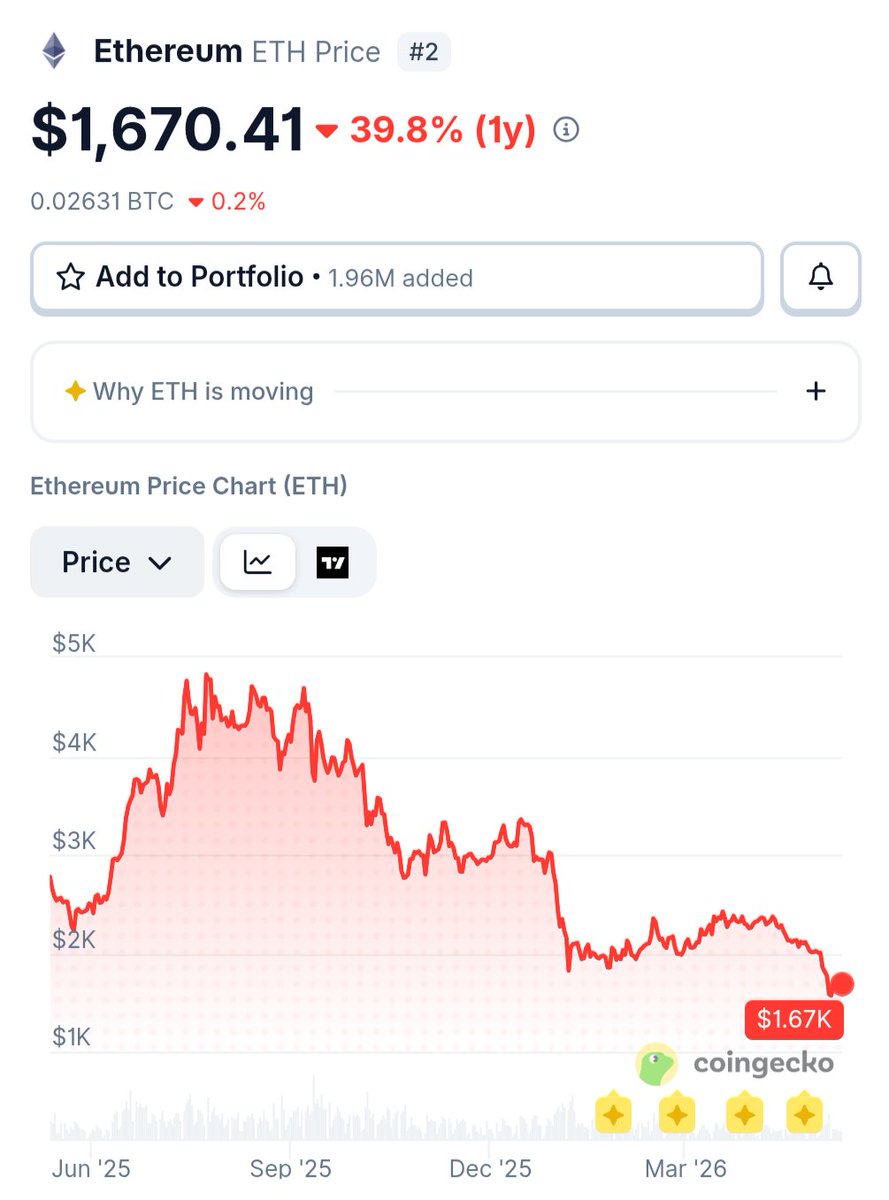
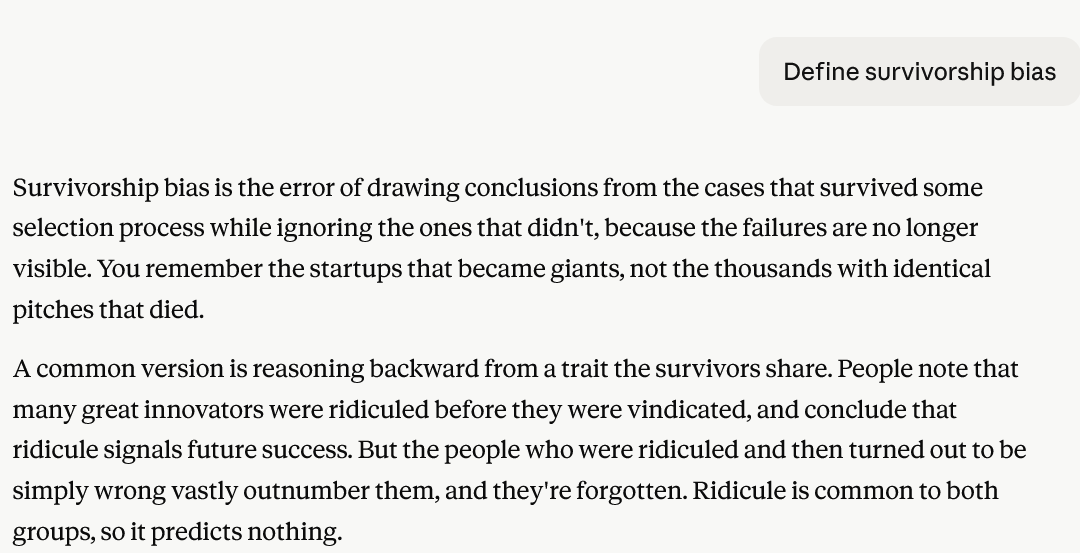
Tom Lee is getting absolutely laughed at for his bet on Ethereum.
Good.
Thinking 10 years ahead isn’t always appreciated.
History is full of business titans who were laughed at for seeing the future too early:
Elon Musk: “Electric cars are weak & lame."
Jeff Bezos: “Selling books… online? Stocks down 99%”
Jensen Huang: “GPUs are just for video games.”
Steve Jobs: “Touchscreen? App marketplace? Smart?”
Jack Dorsey: “A 140-character social network? Who would use it?”
These visionaries weren't crazy.
They were just early.
Ethereum is a nascent industry exploding with growth.
Don’t be so quick to bet against technology.
Don't be so quick to count crypto out.
2
160
Jun 8
Hoffman makes the obvious point that ETH the asset succeeding is distinct from Ethereum the blockchain succeeding. He adds that ETH the asset never had a strategy, which is also true.
But ETH never developed a strategy partly because the loudest voices, Hoffman among them, kept insisting that ETH would succeed as it was. You don't devise a strategy when the people you're listening to tell you it's unnecessary.
Ethereum's current state is the predictable result of taking cues on asset valuation and money from fanboys who understand neither. When does the community learn?
Jun 8

David Hoffman: "There has never been a strategy for Ether the asset beyond an anti-spam mechanism to fix the halting problem."
"That's why Ether was created - to be gas."
Ethereum the network has a strategy. $ETH the asset does not.
Conflating the two is the problem - and until the community separates them, the investment case stays murky.
FT @BitcoinJesusETH @TrustlessState @CamiRusso @DefiantNews.
1
168
Fahad Saleh retweeted

Jun 2
Most tokenization startups are solving for “how do we get assets onchain?”
The better question:
“Why would anyone care once they’re there?”
24
2
61
4,657
Fahad Saleh retweeted

The primal sin of Crypto is to believe and claim it already has product market fit (PMF).
I'll explain:
PMF is passing the toothbrush test, it’s something everyone uses twice a day and finds value in. AI has PMF. Money has PMF, the internet has PMF. We all use each of those twice a day and find value in them.
Crypto doesn't have PMF yet. That's fine. Paper notes took centuries to be adopted, credit cards took decades. We're replacing the existing financial rails with a new and better system, so it's fine for it to take time.
What's not fine is people claiming the job is done. Be it Bitcoin, Ethereum, Zcash, or Starknet. The job isn't done, far from it. Which means we'll see lots of new teams, new innovation, new disruptive technologies. The whole idea of MAXINESS and claiming any one system is perfect is just stupid and wrong.

The primal sin of crypto is believing and claiming it already has PMF.
16
12
93
6,850
May 30
"The banks will not accept it that way"
... and which part of the US constitution gives the banks a veto on legislation?
May 29
JPMorgan CEO Jamie Dimon: "We will fight the CLARITY Act. If we lose, we lose, and we'll live. But it will be fought."
"Nobody is going to bow down to Brian Armstrong or Coinbase... He is full of sh*t"
2
166
May 30
One (unfortunately) common occurrence in the crypto community is for people to discuss asset valuation and monetary economics with no understanding whatsoever of either of these topics...

Ryan disagrees with @TrustlessState's analysis behind selling his ETH
“They're all money, or nothing,” @RyanSAdams says about smart contract chains
David pushes back and says, “in order to be Money, Ethereum needs a stronger monopoly in the market"
What do you think about this debate? 🤔
1
166
May 29
Poor Vitalik. He can't stop being Jesus. Thankfully, George Washington didn't have that problem...

"You can see Vitalik writing an article saying 'I'm not in charge anymore' and then everyone's like
'Oh my God, such a great article. I can't wait for Vitalik to write something next.'"
"It's a trap."
"It's hard to stop being Jesus, I guess."
"Yeah. Jesus is Jesus, dude."
– @TrustlessState
126
Fahad Saleh retweeted

May 21
BREAKING: Florida is now the odds on favorite to win the National Championship at 600 per FanDuel 👀

8
67
1,107
57,671
Fahad Saleh retweeted

May 24
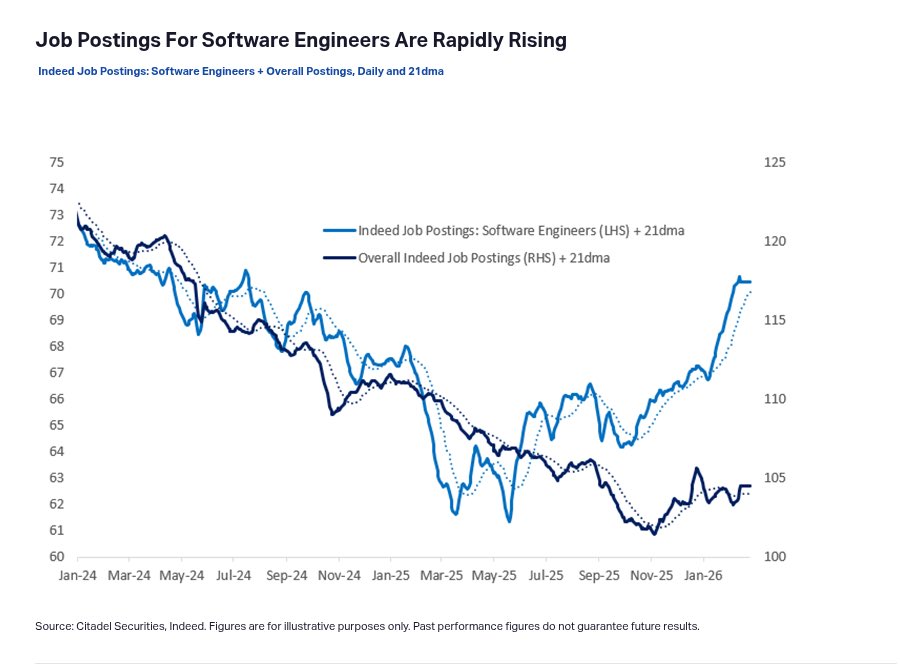
Q: How are job postings for software engineers rising rapidly despite AI agents automating coding?
A: Because there’s far more code to manage than ever before. We’re already seeing a 14x YoY increase in GitHub commits, and it’s accelerating.
AI has dramatically lowered the cost of writing code, so it’s now being used across far more businesses, applications, and use cases.
We’re at the beginning of a massive productivity boom driven by the proliferation of bespoke software throughout the entire economy.
Coding has been AI’s breakout use case this year. The fact that it’s increased demand for software engineers — rather than decreased it — should call into question the entire “AI will cause mass job loss” narrative.
827
1,466
9,115
1,630,160
May 24
This is misleading because it conflates formal power with soft power. Vitalik's influence in Ethereum doesn't come from his board seat. It comes from being the community's most influential voice. By his framing here, Donald Trump is irrelevant to Republican primaries because Trump holds no formal role in candidate selection. Yet Trump has unseated multiple incumbents simply by attacking them publicly, and Vitalik can launch or kill initiatives the same way.
May 24

Some of my perspective on where the @ethereumfndn is going.
First of all, this is only my own view. The board is not just me, and I have no extra special powers on the board that the other board members do not. @aerugoettinea is the one executing much of this transition. My input has been largely on technical questions. The board is in the process of expanding, and my own power within the org will continue to decrease, which is honestly what I want.
The 2025 era brought many important improvements to EF and its ability to execute. Many issues were resolved, and EF continues to benefit from its improved efficiency and greater focus on concrete goals to this day. And so with those problems resolved, early this year, the largest remaining hole that I perceived was something different nagging at me: I would regularly spot people saying things like "vitalik says these beautiful things about ethereum needing to be decentralized, and have privacy, and be a sanctuary technology, but why do the EF's actions not reflect that?"
Now, you may have been hearing something different. You may not have been sensing a feeling of crisis at all, and maybe were hearing people saying that finally we were taking execution and BD seriously and the main task for us is to keep going that way and be even better and faster. Then probably there is genuine difference between you and me, in what kinds of criticism I take most seriously, and what kinds of critics through their criticism are most able to make me feel pain.
As an analogy, let's briefly switch over to a different domain.
One belief you can have about Google is that it is a success story, and has brought a lot of good to humanity in organizing the world's information. Another belief you can have about Google is that they had a beautiful idealistic beginning, but at some point the corruption of mainstream corporate attitudes seeped in, and they slowly bit by bit completely abandoned the "don't be evil" slogan.
My belief on Google specifically is probably somewhere between the two. BUT, if you had taken me back in time to ~2008, and offered me a button to press to make Google one or two standard deviations more "dogmatic", eg. give Richard Stallman permanent veto power over some key policies, I would immediately press it.
Why? Because a choice for one company is not a choice for the world, or even one country. Google existed and exists in the context of a technology industry generally drifting away from early idealistic don't-be-evil roots and toward greed for financial gain, totalizing visions of accelerated superintelligence, infiltration by sociopaths, and craven capitulation to (or worse, active participation in) government pressure for ideological control, surveillance and war. And so *one company* doing something different, positioning itself to be what George Bernard Shaw calls the Unreasonable Man, resisting the trend of the times, would have been better for freedom, balance of power and stability of society as a whole, than *all* large companies bending to dominant trends. This is a part of my version of pluralism.
This line of thinking is not just mine, but I also is not too far off from what Aya and others had in mind with the Mandate.
Now how does this all get to the role of the EF?
EF is not a "center of Ethereum", rather EF is "one node, with a defined purpose, alongside other nodes". We've always said that the EF should be the latter, but many in the Ethereum ecosystem (and even within the EF) wanted us to be the former. Now, we are taking action to ensure that we will be the latter.
This is particularly important because EF is a limited organization, with limited resources and limited organizational capacity. The EF has only ~0.16% of all ETH (less than many other individual ETH holders), whereas among other blockchains it's common for "the central foundation" to have 10-50%. Fiscally, the EF was originally designed to fulfill a limited work scope defined in the token sale docs and other pre-launch materials (building the chain software; getting through Frontier, Homestead, Metropolis, Serenity), which was fully completed in 2022; it was not designed to be an eternal steward.
And so today, the EF is choosing to use its remaining resources to pursue longevity over breadth (yes, this means we sell less ETH). The EF focuses *specifically* on those activities critical to the success of ethereum as a censorship/capture-resistant, open, private and secure system, that would not happen otherwise. This means making hard choices, and in some cases even activities that we highly approve of and people that we highly respect becoming outside of the EF. People of great technical talent, public respect and even alignment with the mission and CROPS being outside of the EF is in fact necessary if we want important tasks to be able to attract outside capital. This also means the EF taking opinionated stands culturally.
This is all intended in cooperation with all other parts of ethereum. We recognize that many other parts of the ethereum world highly respect CROPS and related values. But highly respecting is not the same as choosing to specialize and totally dedicate to a domain (Compare in a different domain: I think reducing animal cruelty is important, and I like vegan food, but am not full unconditional vegan myself)
EF is still in a transition period, and we expect its new long-term form to stabilize over the next few months. What are the guiding principles of this new form? Again, I am only one person, but I can give my answer from a technical perspective (there are also critical non-technical aspects).
At the core, *Ethereum must be impressive*. We are living in an age of highly intelligent AI and all kinds of other technological acceleration. "Status quo EVM, with a hard fork or two a year to optimize for short-term needs of users" is not interesting.
To some, "impressive" means: 250ms latency and 1M TPS. I think Ethereum trying to go that route is a mistake. Being as fast and as scalable as possible, and only a small epsilon more decentralized than the others, is a route to mediocrity, and if we try it we will lose.
I think Ethereum should scale. But I think Ethereum should strive the hardest to be deeply impressive in a different dimension: the CROPS dimension. This means things like:
* Provably bug-free Ethereum. This is a goal that all cybersecurity researchers would have thought is absurd and impossible, up until roughly 6 months ago. Now, it's on the cusp of being possible, thanks to AI-assisted formal verification. So we should be frontrunners in doing this.
* Available chain consensus. Ethereum is, and with lean consensus will cotninue to be, the ONLY chain that has both (i) traditional-BFT style properties that it's safe under asynchrony up to a high level of fault tolerance, and (ii) the bitcoin PoW-style property that under synchrony it's safe up to 49% attackers. As far as I can tell, literally no other chain has this or is planning for it; bitcoin goes for (ii) only and most other chains go for (i) only. Some will remember I fought hard for this, Unreasonably insisting that it is not OK for ethereum to rely on social consensus and hard forks to rescue ethereum from 34% of nodes going offline. It's OK for chains like hyperledger, bnb, solana, tempo, etc. It's not OK for bitcoin or ethereum or eg. zcash.
* Intermediary minimization. The fact that smart contract wallets, protocols like railgun, etc have to send transactions through intermediaries to get included onchain is honestly embarrassing, and it's a constant point of fragility. Hence the work on FOCIL and EIP-8141 (and 7701 and years of work before) to make transaction sending intermediary-minimized with public mempool and strong inclusion properties, in a truly general-purpose way, that covers not just eg. secp256r1, but also privacy protocols and much more. Kohaku is pushing intermediary minimization at the user layer, pulling Ethereum away from the dystopian status quo world where our wallets don't even verify the chain, send our private data out to a dozen third-party servers, and toward a brighter CROPS future.
Some of these goals are Unreasonable - maybe Ethereum would be "fine" getting only 50% of the way - what if we depend on intermediaries, but make it easy to switch? But going 50% of the way would not make Ethereum Deeply Impressive in the CROPS way. So we push for 100%.
Fortunately all these goals are compatible with high TPS, this is a major focus of research (esp. on scaling the state). Well-designed L2s can also help, especially L2s optimized for specific applications (eg. high-volume trading, privacy...). These goals are even compatible with significantly lower slot times, thanks to Raul's work on erasure-coded P2P, and many other optimizations.
The most high-value "product" of the ethereum blockchain, financially speaking, is ETH the asset. Ethereum secures $250 billion of ETH. The types of properties of Ethereum that I mentioned above are very good for ETH the asset. Nearly 90% of my net worth is in ETH, and most of the remainder is ~$40m of onchain fiat of which every dollar has already been allocated for some open-source biotech or software or hardware initiative. That said, there are aspects of supporting ETH the asset - *necessary* aspects even - that are outside the scope of the EF. This is where we need other heroes (some of whom hold more ETH than the EF does) to step in and help. EF has been recently thinking more about how it will relate to other such organizations, and give them needed initial support.
EF will be a smaller ship than in previous years, a more opinionated one - in some cases more opinionated in ways that might be difficult to comprehend - but a longer-lasting one, and one suited to making sure that ethereum brings something meaningful to the world. We are grateful to all those inside and outside the EF who are helping to make this happen.
6
21
5,602
May 23
The purpose of a book is to convey ideas. We don't have to make it an existential crisis just because LLMs may enable us to convey ideas more efficiently.
A book is constrained to provide the content in exactly the same way to all readers even though different readers learn differently. An LLM is not constrained in the same way...

There is nothing magical or special about books. you can get arbitrarily smart without ever finishing a book
4
417
May 23
If you want to understand why permissionless blockchains have completely failed to seize their opportunity, this excerpt is telling:
@dankrad puts forth an obvious point that strategic coherence and coordination is important for a platform to succeed. Thereafter, he describes the suggestion as "really.. provocative [and] really out there," alluding to the fact that most of permissionless blockchain community has failed to understand ideas from platform economics that have been well-known before they were even born...
May 23

"Stop criticizing the Ethereum Foundation, they are fine, the real problem is no one is fighting for ETH to win finance"
Dankrad Feist, Ethereum Foundation researcher, on why ETH needs a second organization to win finance.
"Ethereum is a very different project than Bitcoin. I never saw it as a project just to build a store of value. Its goal is bringing the world of finance on chain."
"There are a lot of really great people and good organizations, but not enough strategy and coordination, no coordinated investment of resources to make this happen."
"Creating another foundation with a billion dollars is not what's going to solve this. We need something permanently funded, otherwise the financial world will figure out another way."
3
2
10
2,546
Fahad Saleh retweeted

May 21
I appreciate the interest in--but not the hyperbole about--the contemplated innovation exemption for the onchain trading of tokenized NMS stock. Keep in mind: I've always expected that it'd be limited in scope & would facilitate trading only of digital representations of the same underlying equity security that an investor could purchase in the secondary market today, not synthetics.
67
75
544
383,412
Fahad Saleh retweeted

May 21
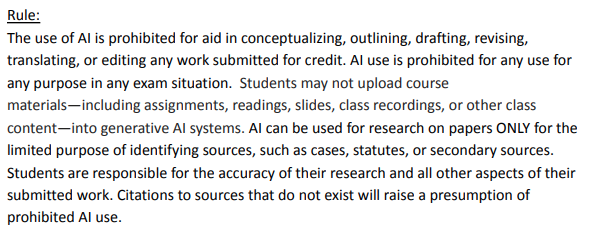
Not only is this policy essentially impossible to
enforce, but it doesn't even seem optimal even if it were enforceable. These tools are going to exist in the workplace; part of our pedagogy should be to train students on how to use them well!
Could you imagine being the law school that banned using Lexis?

24
4
36
31,674
Fahad Saleh retweeted

May 21
The way to save Ethereum: The community needs to create an organization that's economically aligned with Ethereum and accountable to it.
The EF now holds less than 0.1% of all ETH. There is no flow of Ethereum staking or fee revenues to it.
If we want to get Ethereum back to winning:
- create an organisation with credible funding, minimum $1b as a start. That's very reasonable for an ecosystem with $250b market cap
- find a leader who is competent and wants to fight
- make it accountable: a board of people who want ETH to go up, and a charter that holds the org accountable to it
- fund it permanently: A significant amount of staking revenue needs to go to it. A governance mechanism that can adjust it (also part of accountability).
Very hard to imagine now, but I think this is the only way (and it will probably happen, but it might take a long time before it is consensus).
267
126
1,254
330,449