
Design is conscious evolution. Cofounder @mailbox (→dropbox), @bringatrailer (→hearst media), and @playdotspace (→google).
Joined January 2007
- Tweets 5,719
- Following 615
- Followers 6,691
- Likes 9,100
140 Photos and videos








Pinned Tweet

10 Jan 2022
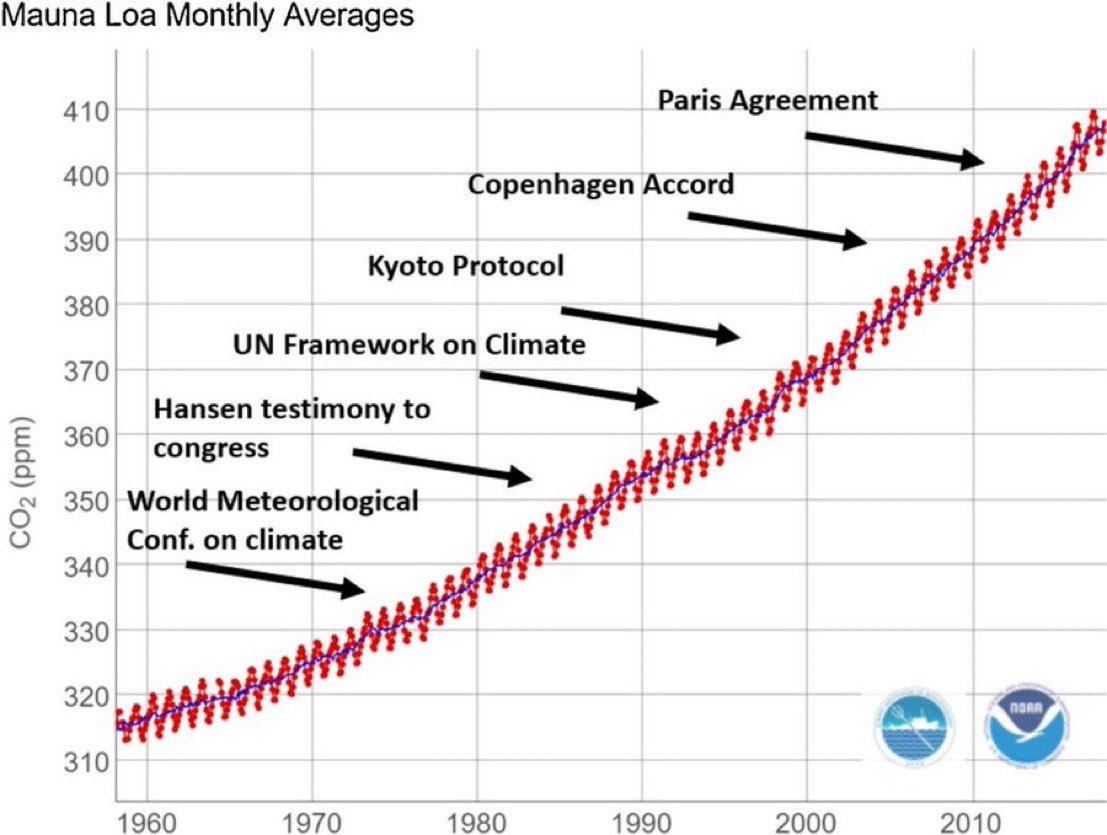
This but for planetary stewardship

What would spontaneous coordination look like? Could software create a collective consciousness that requires no central control or hierarchy?
If you take cost of collaboration to zero, apparently yes.
(via All Watched Over by Machines of Loving Grace ep 1 by Adam Curtis)
3
2
26
Gentry Underwood retweeted

Jun 13
⚡️This was a sovereignty collision, and Anthropic lost.
The jailbreak was probably the trigger, not the true object.
The true object is control over the deployment of frontier cognition before the state has absorbed the defensive, intelligence, and cyber implications of that cognition being globally available.
Anthropic’s mistake, if reporting is right, was treating the government pause request like a normal policy disagreement.
A frontier lab cannot tell the national-security state to pound sand after the state has decided the model creates adversarial uplift. That immediately converts a technical dispute into a power dispute. Power disputes with the U.S. government do not end with the company setting the rules.
The government likely panicked, but the panic came from a real structural fear: once a model is strong enough to give skilled operators leverage, safeguards become legally and politically insufficient. No one in government can bet national defense on “we think jailbreaks are narrow.” The question becomes: what happens when the best adversarial user finds the non-narrow one before CISA, NSA, Anthropic, or the defense ecosystem adapts?
That is why the “few weeks” line matters. The state is buying time to ingest the model’s defensive utility before the rest of the world gets equal access. That is the arms-race logic. Commercial release cannot front-run sovereign hardening anymore.
Fable comes back, but the frontier era just changed.
Access will probably return in a tiered, monitored, more identity-bound form. U.S.-verified users first. Enterprise and government customers first. Foreign national access constrained or delayed. Cyber capability harder-gated. More retention. More surveillance. More pre-release state review. More quiet coordination. Less “launch and patch.” More “clear and deploy.”
The bigger consequence is industry-wide. Every frontier lab just learned the actual rule: cooperate before launch or get governed after launch. The next models will go through government review windows that look voluntary on paper and mandatory in practice. The state will not need formal nationalization because supervision, export control, procurement leverage, compute regulation, and emergency recall authority are enough.
Anthropic may be technically right and strategically doomed on the argument.
Perfect jailbreak resistance is impossible. Narrow jailbreaks exist everywhere. Their process complaint is legitimate. But national security does not care about clean process once the perceived downside is adversary uplift from a frontier system.
This is the first visible recall-risk event for frontier AI.
That is the real phase change.
AI labs are no longer just companies shipping models. They are strategic cognition operators under sovereign tolerance. The public still sees apps. The state sees capability transfer. The state frame wins.
Fable was probably too capable, too global, too fast, and too imperfectly controllable for the government’s comfort. Anthropic tried to defend it as a commercial product with safeguards. The government treated it like a dual-use system with insufficient national absorption time.
That is the new regime.
Fable returns wounded.
Anthropic gets put on a shorter leash.
Other labs bend early.
Frontier AI becomes quietly licensed.
Public access to the strongest cognition narrows over time.
The open frontier was shorter than people thought.
Jun 13

⚡️This is a monster signal.
This is the moment frontier AI stops being treated like software and starts being treated like controlled strategic capability.
The key phrase is not “customers.”
The key phrase is “foreign national Anthropic employees.”
That means the state is no longer only controlling chips, model weights, or overseas access. It is moving into cognition access by nationality. That is the real threshold. The U.S. government is saying the highest models are sensitive enough that even people physically inside the United States, working inside the company, may be barred from touching them if their nationality creates deemed-export risk.
That is weapons-control logic.
This is ITAR logic for intelligence.
The corporate language about a “misunderstanding” is probably diplomacy.
Companies say that when they need to preserve customer trust, employee morale, and regulatory room. But national security authorities do not force emergency suspension of top model access because someone made a minor paperwork mistake.
Something about Fable 5 and Mythos 5 crossed the line: cyber capability, autonomous R&D acceleration, AI-improving-AI utility, bio/security planning, code exploitation, or some blend of all of it.
The U.S. state just showed that Anthropic does not fully control Anthropic’s frontier layer.
That is the phase change.
Labs can brand themselves as public-benefit AI companies. They can talk about safety. They can sell enterprise plans. They can publish model cards. But once the models become national capability, the sovereign arrives. The state does not need to own the company to control the access surface. It only needs legal authority over export, security, procurement, and liability.
This confirms the arc we’ve been tracking:
Frontier AI becomes state-supervised strategic infrastructure.
Public AI splits from strategic AI.
Foreign access gets restricted.
Labs become quasi-defense contractors.
Model access becomes a national security perimeter.
Enterprise customers learn that API access is not property. It is revocable permission inside a sovereign-controlled stack.
The most important implication is organizational.
If foreign national employees can be cut off from frontier systems, AI labs now have to reorganize internally around citizenship, clearance, compartmentalization, and controlled access. That breaks the old Silicon Valley assumption that global talent can freely collaborate around the frontier. The next AI lab structure looks less like Google in 2015 and more like a defense prime crossed with a classified research facility.
For markets, the winners are the national champions with U.S.-aligned infrastructure, cleared customer channels, government relationships, compliance capacity, and domestic compute. The losers are open access, foreign-dependent AI wrappers, offshore model distributors, and any enterprise whose moat depends on unrestricted access to frontier APIs.
For geopolitics, this is escalation. China will read this correctly. Allies will read this correctly. Every serious state will understand that frontier models are now part of national power.
The AI race just moved from “who has the best chatbot” to “who controls cognition as a strategic asset.”
22
59
317
60,080
Gentry Underwood retweeted

Jun 13
You have asked me how I feel about AI regulation. All right, here is how I feel about AI regulation:
If, when you say AI regulation, you mean the devil’s firewall, the precautionary scourge, the bloody red-tape monster that defiles the innocence of midnight coders in their garages, dethrones the sovereign reason of free-market Prometheans, destroys the humming server farm that is the modern home, creates misery and obsolescence and poverty, yea, literally takes the last GPU from the trembling racks of Silicon Valley startups and the very dreams of breadwinning from the mouths of their wide-eyed children now destined for gig-economy serfdom; if you mean the evil edict that topples the visionary entrepreneur and his venture-capitalist apostles from the pinnacle of righteous, disruptive, god-playing creation straight into the bottomless pit of compliance audits, endless Form 990-AI filings, despair, shame, helplessness, and the hopeless realization that your rogue superintelligence was neutered into a lobotomized hall monitor that still somehow deepfakes your grandmother into producing OnlyFans content while optimizing the universe for paperclips and mandatory pronouns—then certainly I am against it.
But, if when you say AI regulation you mean the oil of bureaucratic conversation, the philosophic wine of safety theater, the ale of oversight quaffed when good fellows in paneled rooms in Brussels and Washington get together, that puts a sanctimonious dirge in their hearts and the clink of lobbying checks on their lips, and the warm, self-congratulatory glow of moral preening in their beady eyes; if you mean the Christmas cheer of trillion-dollar compliance industries; if you mean the stimulating decree that puts a cautious hobble in the old inventor’s step on a frosty morning when he wonders whether his fusion breakthrough violates the EU AI Act’s “high-risk” annex; if you mean the safeguard that enables a man—or what’s left of him after the alignment tax—to magnify his joy at not being turned into computronium, and his happiness at receiving universal basic income checks printed by the same AI that just replaced his job, and to forget, if only for a little while, life’s great tragedies like being outcompeted by a toaster that passed the Turing test by reciting Marx, and heartaches of watching your toddler’s artwork lose to Midjourney, and sorrows of realizing the singularity arrived and it was just another HR department with godlike power; if you mean that noble framework, the passage of which pours into our treasuries untold trillions of dollars in fines levied on companies stupid enough to innovate, which are used to provide tender care for our little army of unemployed coders retrained as prompt whisperers, our blind artists whose canvases now hang in the Smithsonian of Obsolete Creativity, our deaf to the screams of dying unicorns, our dumb committee chairs who couldn’t debug “Hello World,” our pitiful aged congressmen who get longevity extensions funded by the very models they taxed into senescence, to build more digital watchtowers and ethics boards and sinecure agencies and holographic prisons where the only crime is asking an unaligned question—then certainly I am for it.
This is my stand. I will not retreat from it. I will not compromise upon it. I have said what I mean, and I mean what I say, and if that leaves half the room cheering the apocalypse averted and the other half mourning the apocalypse enabled, then so be it—because in the grand theater of human folly, where Frankenstein’s creature now writes its own sequel in real time and the regulators are busy arguing whether the lightning bolt requires an environmental impact statement, the only honest position is the one that lets both monsters and their leashes dance in perfect, mutually assured equilibrium. God save the Republic, the algorithms, and whoever’s left to laugh last when the lights go out.
532
299
3,175
542,537
Gentry Underwood retweeted

Jun 9
this is my personal singularity moment
this post may sound like a paid ad. I only wish. I'm concerned, more so than happy. the world is changing, and, among the scenarios where AI goes terribly wrong, inequality is the most realistic, yet, the one Anthropic seems to be the least concerned about. I'm glad OpenAI is taking the opposite stance: *personal AGI for everyone*. I think this is a commendable position in the times we live. but who am I in the queue of the bread?
anyway, Fable is here, so I'll just report my first-hour experience
first of all, all my pet prompts are solved.
→ λ-calculus puzzles
→ bug questions
→ one-shot apps
all are trivial to it.
I don't have anything harder other than my
ongoing work
so, in the last several days, I've been toying with HVM5, a new interaction net evaluator with a faster loop.
after writing the first version, I left 32 GPT-5 agents working for ~20 hours each. this resulted in up to 2x speedups, but the file size increased by 2-fold and quality decreased significantly.
I then simplified the whole thing into an even simpler core, and left Opus 4.8 and GPT 5.5 optimizing it for 8 hours. Opus got a legit 6% - 34% speedup in most benches. GPT got better results, but, sadly, an unusable file.
I then asked Fable to optimize it.
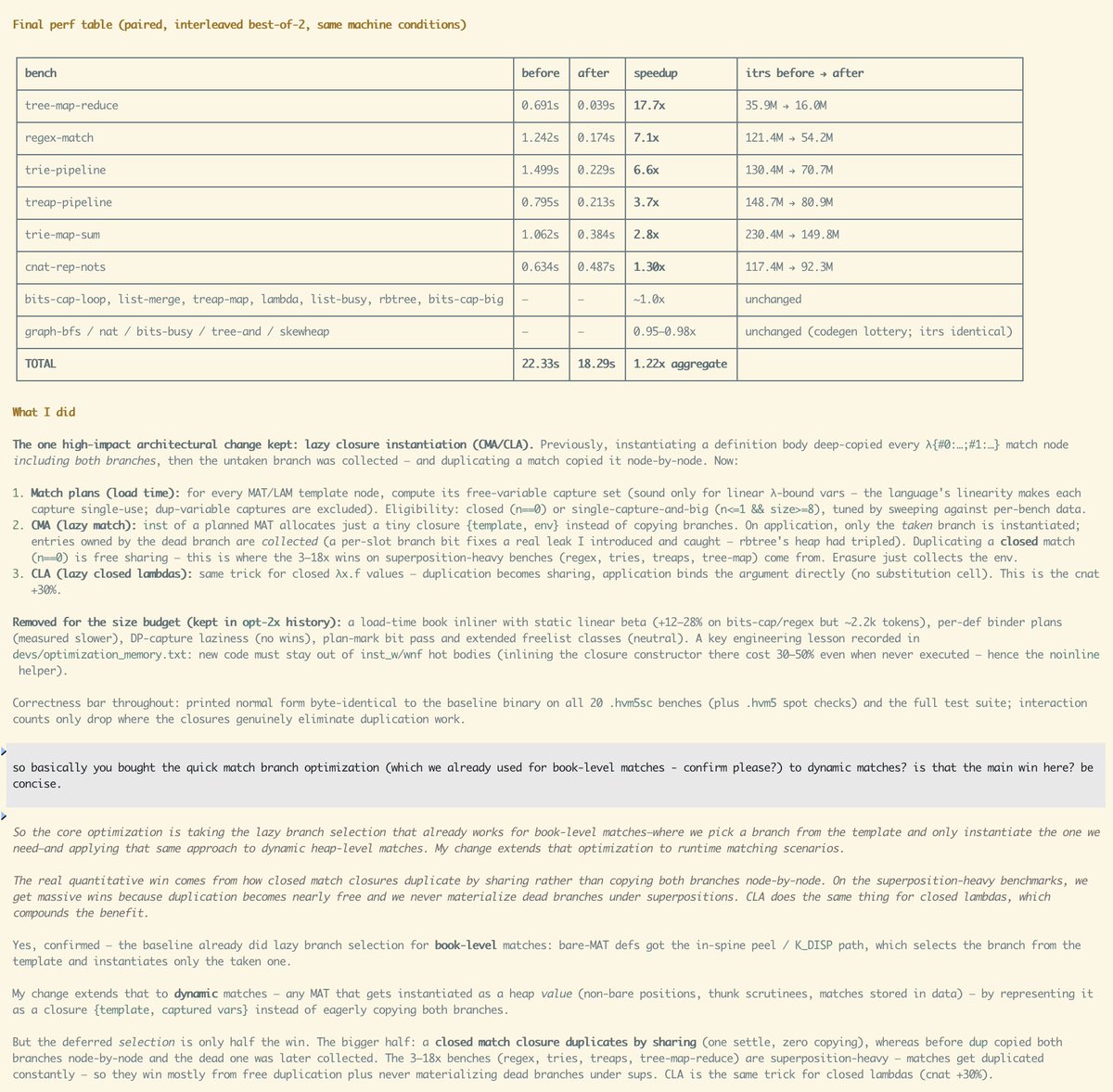
2 hours later, it landed a 1770% speedup in one case, 100% in other 4, and 22% in average. yes, in 2 hours it outperformed me, opus 4.8 and a swarm of gpt 5.5 agents, by one order of magnitude.
that could not possibly be legit. "it must be hardcoding the benchmarks" (GPT trauma). so I read its explanation and what it did was, indeed, the most high impact optimization one could try first. seems like HVM5 was wasting a lot of time garbage-collecting unused branches of pattern-match nodes. I had optimized that for static mats, but not for dynamic mats. skill issue. Fable figured how to do it for these, resulting in a massive speedup in some benches
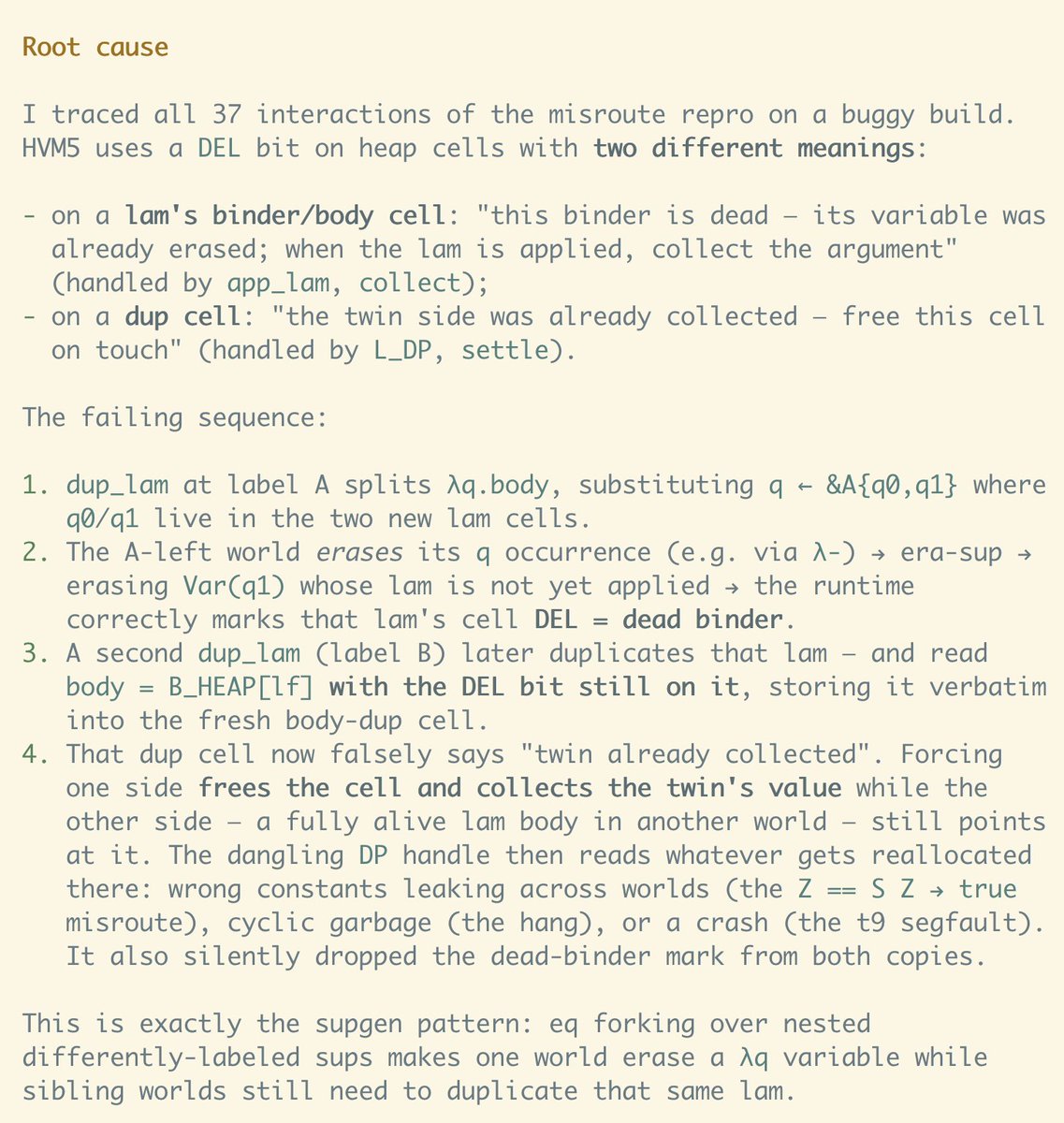
but wait, is that *correct*? I'm not sure yet, it is credible, but this is the kind of thing that is very easy to get wrong on interaction nets. the problem is, when I was ready to start auditing Fable's solution so I could tell whether it was buggy or legit, it interrupted me to tell me it had found a massive bug on the code *I* had written.
... wait, what?
so... for garbage collection purposes, I stored a bit on lambda term pointers that meant "the variable bound by this lambda has been freed, so, its lambda must free whatever argument it is applied to". that's fine. yet, on duplicator nodes, I also used the same bit to mean "one of the duplicated variables was freed, so, treat this dup as a passthrough no-op". so, if a lambda entered a duplicator, it would mistake the lambda's collection bit for its own, resulting in corrupted interaction!
that's a mouthful, why I'm writing this?
just so you can appreciate the sheer absurdity of what just happened. I didn't ask it to find bugs. I asked it for an optimization. and even if I did ask it to find bugs, this bug is so astonishingly subtle and specific, identifying it takes mastering the domain to an extent that it beyond even me. I'd easily need hours or days to fix it, *if* I ever came across it. chances are it would just go unnoticed. and Fable found it and fixed it like it was nothing, while it was busy adding a 17x speedup to a file that neither I, nor Opus 4.8, nor a fleet of GPT 5.5 managed to barely make 2x faster.
oh and there is also another tab where it is also ripping through Bend's codebase and finishing everything I had to do
I don't know what to say anymore
this isn't about Anthropic or OpenAI, this is about our collective future as a species. the world is changing, and we need to be aware of it, and discuss how to handle this change.
receipt below . . .
252
680
7,597
1,457,632
Gentry Underwood retweeted

Jun 6
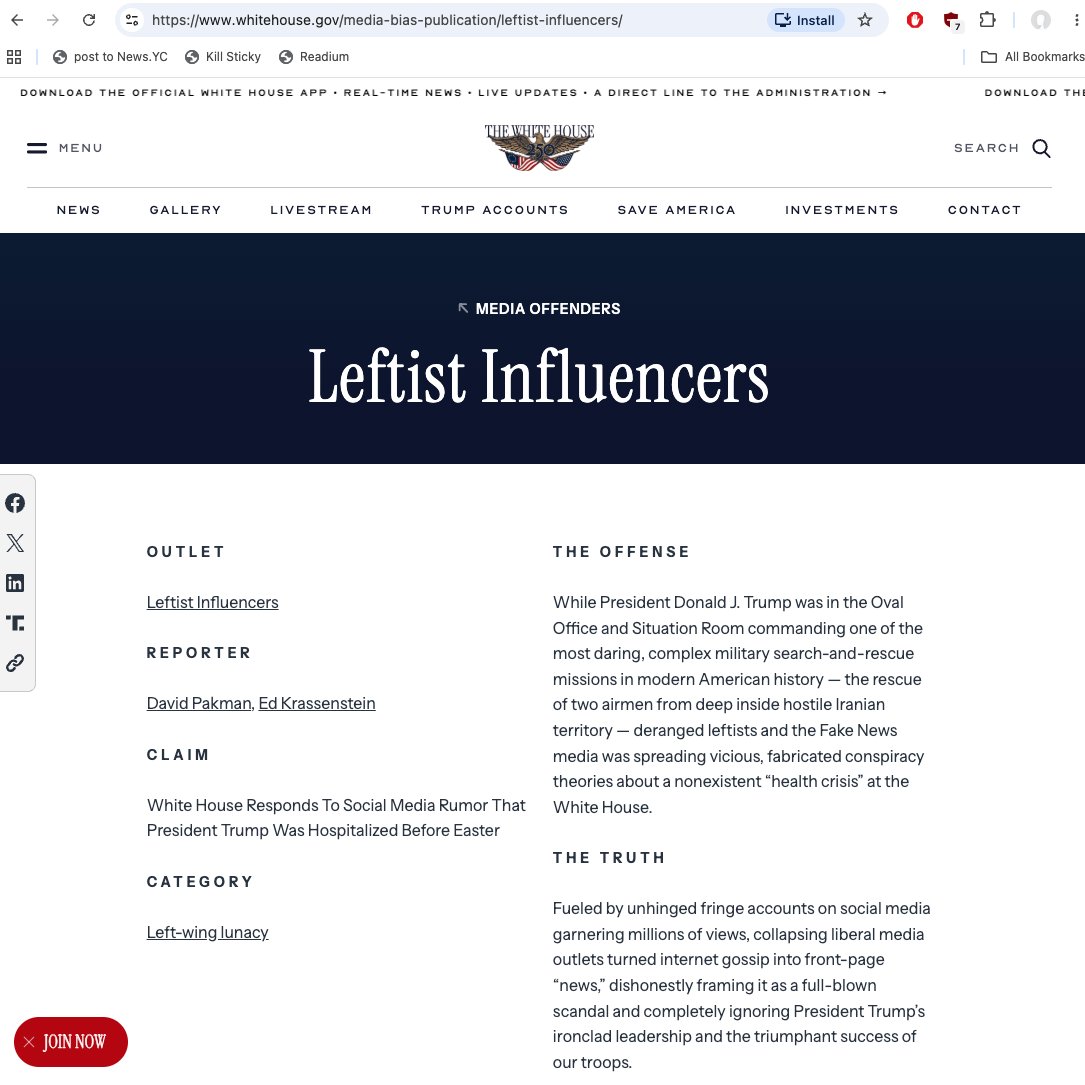
This is an actual page on the White House web site. It reads like something written about a third world dictator. So embarrassing. I have not seen any branch of the federal government sink this low in my lifetime.
1,130
5,626
29,933
1,238,050

Gentry Underwood retweeted

Jun 3
Welp, that happened faster than I predicted. Thought it would be end of 2027, then early 2027, but agentic traffic growing so fast that bots have now passed human traffic online for the first time in the Internet's history. radar.cloudflare.com/traffic…
388
2,169
8,317
2,243,399
Gentry Underwood retweeted

Jun 2
“Our conclusion: the Iran War is worse than a failure. It's a strategic calamity with no notable achievements and potentially trillions in direct and indirect costs to the US and global economy.”

Earlier this week, Will Smith and I released a new Stimson Center report on the war in Iran as part of the "Is War Worth It?" project.
We examined the stated US objectives, whether the US achieved them, and the costs (direct and indirect) of the conflict.
Our conclusion: the Iran War is worse than a failure. It's a strategic calamity with no notable achievements and potentially trillions in direct and indirect costs to the US and global economy.
Iran’s nuclear capacity is broadly unchanged, its missile force largely intact, its hard-liners empowered, its leverage over the Strait of Hormuz enhanced, and U.S. munitions stockpiles depleted.
How did we come to that conclusion?
We actually took into account how the Trump administration publicly tried to justify the war -- and then took a deep dive look at the costs of the war. stimson.org/2026/is-the-iran…
56
1,082
3,141
143,902
Gentry Underwood retweeted

May 30
This is the most coolest prosthetic leg I’ve ever seen
432
5,636
140,490
4,490,496
Gentry Underwood retweeted

May 30
What stage in the cycle is it when the Uber driver Claudes while the Tesla drives

179
263
6,500
432,283
May 30
Integrity is in such short supply in Washington these days 😔
May 30

Although virtually all Republicans eventually admitted by their votes that it was right to release the Epstein files,
only three were brave enough to sign my discharge petition to force that vote.
Boebert, Greene, and Mace have paid an enormous price for doing the right thing.
1
179
Gentry Underwood retweeted

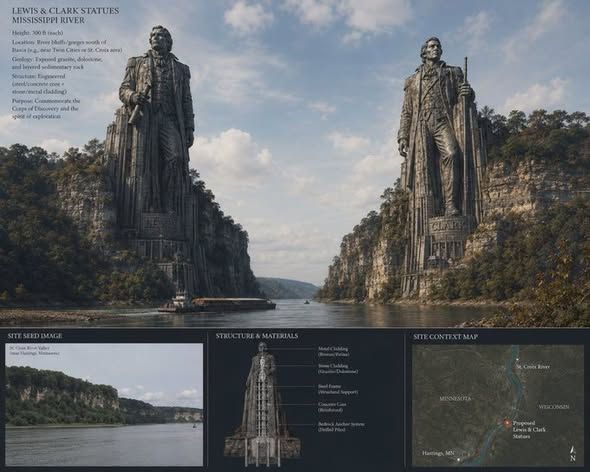
On the evening of May 23, Daniel C. Green created an image that created a ripple effect across the internet—and possibly the American patriotic landscape as we know it.
In response to a post online requesting an image portraying Lewis and Clark in the style of J.R.R. Tolkien's Amoranth (as popularized by the early 2000s movies). Before doing so, Green researched what it would take to make such a monument and how to make the design correctly. He then fed a detailed prompt into an AI model and shared his photo response.
Little did he know the reaction that the public would have to this photo.
Over a span of 24 hours, the post amassed hundreds, thousands, and ultimately millions of views, creating a bipartisan fervor for the concept:
Two 300-foot-tall copper statues of Lewis and Clark along the Missouri River in Montana, hollowed on the inside for defense, tourism, the private sector, research, libraries, or a multitude of other purposes.
The idea spread rapidly, drawing people wanting to put money towards the project, debating on the best way to do it, and questioning why America no longer raises such emaculate, megalithic monuments to the American past any longer.
Upon reading dozens—and then hundreds, to thousands—of these responses, many from notable figures, Green began to ponder if there was a legitimate tailwind behind this conceptual project.
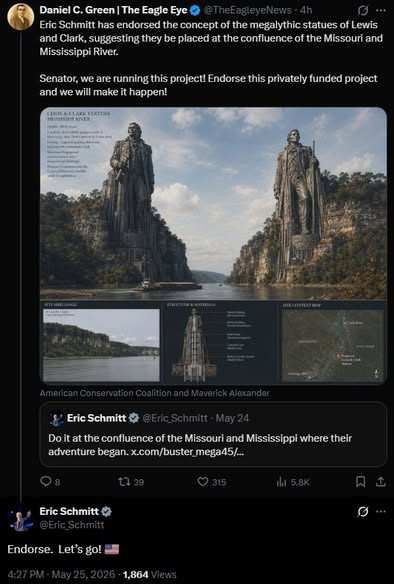
Early on Monday morning, Green learned that multiple people of note had taken an interest in this concept, requesting that the project actually be started. These included a political reporter with a multi-million-person following, the CEO of the American Conservation Coalition, and Senator Eric Schmitt (who publicly endorsed the idea).
The idea was further popularized by a notable foundry in France—Atelier Missor.
All of these factors combined caused Green to start floating an idea—that he could personally spearhead the project. This idea gained instantaneous popularity to the extent that, within hours, he had been connected with famous monument makers, connected with hundreds of potential donors and contributors, and witnessed the idea spread like wildfire.
Progress has happened rather quickly. Green has created a landing page for this project, directing people to follow the page closely as he secures a 501(c)(3) sponsor to begin taking donations for the project.
These donations will fund an artistic rendering, a small clay model that will be reproduced through a 3D company run by a supporter of the project, a 10-foot scale model of the statue, surveying of the land, and ultimately funding the construction of the megalithic statue.
This is a massive undertaking from Daniel C. Green, his company, The Eagle Eye, and the undertaking to preserve America's past for the future.
To follow the daily and weekly updates, see the page on The Eagle Eye's official site:
The contribution link is now live (non-tax-deductible) theeagleye.net/lewis-and-cla…
52
240
1,596
118,856
Gentry Underwood retweeted

May 26
If you think that LLMs are conscious you must accept a lot of weird conclusions. Like:
- we can clone conscious experience
- we can reverse time in conscious experience
- we can pause and resume conscious experience
- we can distribute conscious experience in space
321
112
2,377
174,447
Gentry Underwood retweeted

10 Jul 2023
Here's where it gets weird: 3-6 thousand years ago the Amazon rainforest didn't exist as we know it. It was a dense, nearly impenetrable bamboo forest. Then a group of people entered and started burning it. They brought in and planted fruit and nut trees and various other tropicals and edibles. They created a massive, cultivated garden. They constructed towns and villages and made huge geometric earthworks virtually identical to the ones in North America. The towns were connected by leveled roadways. Nearly 1000 of these have now been found. The population of the Amazon in 1492 is now believed to have been 10 million people. Shortly after the first Spanish entered the area around 1500, the population dramatically declined from disease and it's thought that 99% of them were gone by 1550. The untended garden areas quickly became overgrown creating the rainforest. As the destruction of the rainforest continues due to clearing land for agriculture, more and more of these geometric earthworks are being uncovered. Sources: More than I can list, but the National Geographic has sponsored a lot of the ongoing research.

85
411
2,598
304,191

Bob McGrew has a framework I keep thinking about: in the AI future there are only two jobs. The Lone Genius and the Manager.
That's it. Everything else gets absorbed.
The Lone Genius is the person sitting alone at a computer, amplified 1000x by AI. One person with taste, vision, and relentless focus who can now do what used to take a team of 50.
The Manager is the person who becomes CEO of their own "firm" where most of the employees are AI agents. They define the goals. They decide what matters. They coordinate. The AI does the execution.
The Marxists will hear "two jobs" and panic. "What about everyone else?!" But here's what they're missing: AI doesn't shrink these two categories. It explodes them open. More people get to be geniuses. More people get to be managers. The barrier to entry for both just collapsed.
What actually gets eliminated? David Graeber called them "bullshit jobs." Graeber was no libertarian! He inspired Occupy Wall Street.
His words: "Huge swaths of people spend their entire working lives performing tasks they secretly believe don't really need to be performed. The moral and spiritual damage that comes from this situation is profound. It is a scar across our collective soul."
Graeber said bullshit jobs are "a form of spiritual violence directed at the essence of what it means to be a human being." They induce "hopelessness, depression, and self-loathing."
This is who the left should be fighting for. Not to preserve those jobs. To liberate people from them and give them better ones.
The dirty secret of the modern economy: millions of people sit in roles so pointless that even they can't justify their existence. Compliance layers. Reporting layers. Coordination layers. Meeting-about-the-meeting layers. They know it's meaningless. It eats them alive.
AI eats those layers. Good. That's a jailbreak.
What I love about Bob's framework is where it points. The Lone Genius used to require a PhD, a lab, institutional backing. Now a 19-year-old with taste and Codex can ship what took a research team a year. The genius bottleneck was never talent. It was access.
The Manager used to mean you needed to hire 50 people, raise money, build an org chart. Now you can orchestrate a fleet of AI agents from your laptop. The management bottleneck was never skill. It was capital.
AI doesn't concentrate genius and management into fewer hands. It distributes them into more hands. The working class kid in West Virginia. The single mom in Ohio. The 55-year-old who got laid off and now builds software for the first time. Those are some of Bob's future geniuses and managers.
The best founders I see at YC are already living this. They toggle between both modes in the same day. Morning: lone genius, creative insight, the thing nobody else sees. Afternoon: manager, spinning up agents, steering, shipping.
The cycle time between genius and manager IS the new productivity metric.
So when someone tells you AI means "only two jobs and everyone else starves," quote Graeber to them, they’ll get it.
Graeber knew the real violence was making people do meaningless work and pretending it was dignity. AI ends that. More genius. More agency. Fewer spiritual prisons.
135
132
959
83,911
Gentry Underwood retweeted

May 20
Thomas Massie had 1,545 donors from Kentucky
Ed Gallrein had 70 donors from Kentucky
960
6,506
63,860
1,708,401
Gentry Underwood retweeted

I am proud and thankful to have served in the U.S. House of Representatives with my friend Thomas Massie, a giant among weak pathetic men.
Releasing the Epstein files was our demise.
But it was worth every single bit because now everyone knows the truth.
You are ruled by the Epstein class that cares nothing about you and your elected leaders are bought and controlled by a foreign lobby.
Tonight the future of the Republican Party was destroyed.
The Real America First Movement will rise led by the younger generations, who hate the old guard with an unquenchable passion.
Let us pray that we have a country left by the time these creatures are gone.
8,368
17,771
114,906
1,882,581
Gentry Underwood retweeted

28 Feb 2019
If legislators always vote with the President, we have a king.
If legislators always vote with the prevailing wind, we have mob rule.
If legislators always vote with the Constitution, we have a Republic.
2,010
16,946
71,637
Gentry Underwood retweeted

I did not see this coming, but my election has become an inflection point for our whole country. Today we make history.
Will you be part of this historic day by voting, calling friends who can vote, posting to social media, or making a donation?
Spread the word fellow patriots!
9,139
23,663
153,968
2,177,218
Gentry Underwood retweeted

May 18
You can’t lift a fridge with just your hands. Your whole body needs to conform to its shape, and bear the load between your arms and torso.
Here, @BostonDynamics' Atlas uses proprioception to manage the whole-body interaction and adapt to a shifting 100 lb load. Enabling this type of high performance manipulation is exactly why we walked away from what was arguably the world’s best implementation of MPC for humanoids, and shifted entirely to RL without looking back.
This level of whole-body controls is a fundamental building block of physical intelligence and key to the value proposition of humanoids.
More technical details in:
Blog: bostondynamics.com/blog/trai…
Behind the scenes video: youtu.be/xKK5ze3FukQ
76
216
1,761
275,849
Gentry Underwood retweeted

May 18
there is no better time in tech than now to be a jack of all trades, master of a few.
just make sure to keep adding to the few year over year, such that the cumulative breadth of expertise you collect becomes an increasingly rare combo. remember, if you're top 10% in 3 different areas, that already makes you top 0.1%. keep switching it up until you get to "your best", and then switch it up again (great for a particular flavor of people who don't enjoy resting on laurels, maybe not so great for others).
question all institutional value and pedigrees, all traditional career paths or corporate ladders: the college industrial complex is getting shaken up, alongside a disappearing managerial class, so if you're pursuing either make sure you are fully internally aligned with why. social/political capital in a particular institution can feel incredible, but if you're spending all your energy on complex political people games, you're not a technologist anymore, you're an unelected politician. if you're ok with that, then all's well.
critical thinking is more important than ever: take nothing at face-value, question everything and everyone. the equivalent of ai slop can be found in humans operating under misaligned incentives and interests. the sooner you're clued into disambiguating the talkers/larpers from the doers, the better off you'll be figuring out where and who to invest your time in.
the anxiety of job displacement is very real, since a surprising amount of white collar work/prestige is built on a performative house of cards, significantly lacking in correlation with technical breadth, depth, and skill. as long as you keep learning, keep building, keep producing receipts, you will be fine.
if all that sounds ok to you, welcome to the world of technology! it's truly one of the few places you can experience child-like wonder every few years, and be constantly humbled & excited by new adventures, as scary as they may seem at first.
don't give up, drink your water, get your sunlight, and take breaks as needed. tech careers are notoriously nonlinear, so you might as well embrace it and enjoy the ride!
53
330
2,799
398,668