
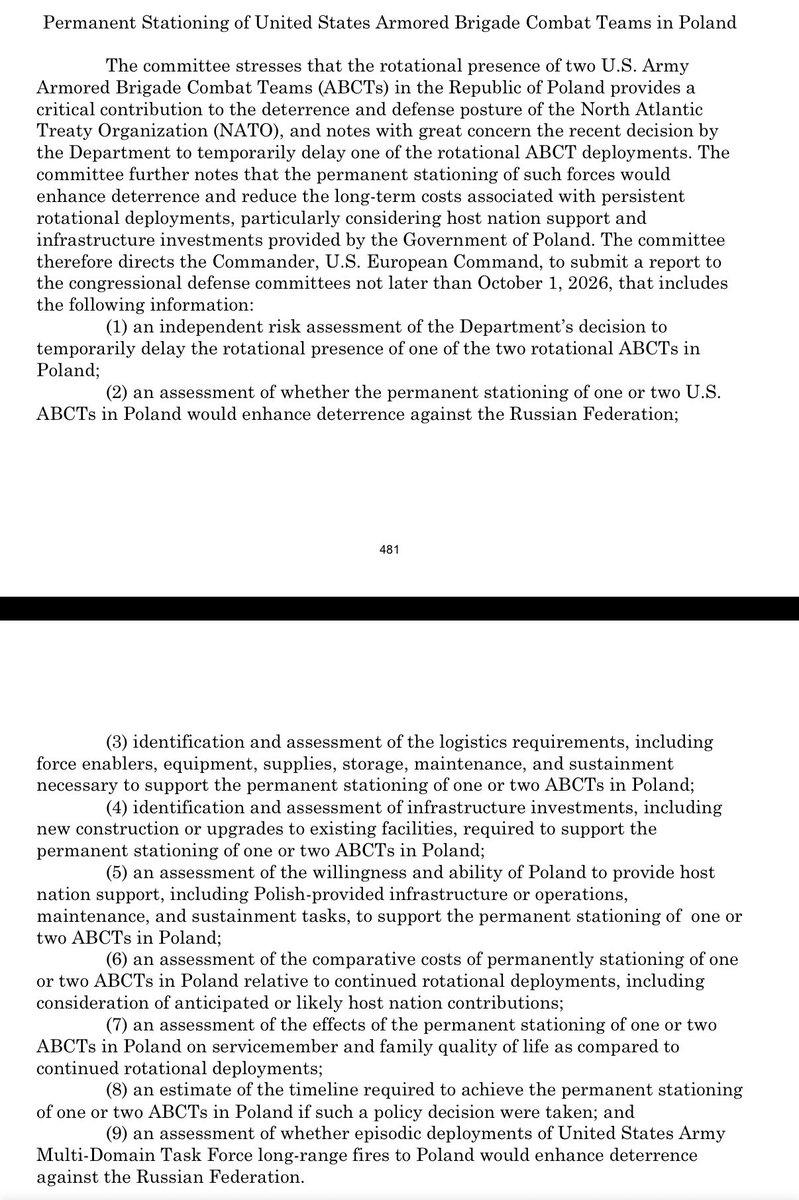
Proposed #NDAA27 draft would require @US_EUCOM’s Commander to deliver a report on U.S. global force posture with special emphasis on USEUCOM and the American military presence in Poland 🇵🇱.
A key element of the legislation is a review examining whether the rotational deployment of one or two U.S. Army Armored Brigade Combat Teams (ABCTs) in Poland should transition into a permanent stationing.
1
9
23
3,274
It feels like the answer to current uncertainty. It isn’t.
U.S. 🇺🇸 2nd Armored Brigade Combat Team, 1st Cavalry Division, has been deploying to Poland 🇵🇱 as regular planned Armored Brigade Combat Team (ABCT) rotation. It hasn’t been delayed. It has been recently paused/cancelled with some of its elements already deployed at forward operating sites.
Will mentioned below reduction affect this brigade and following ABCTs? What is effective date of reduction from four to three ABCTs?
May 19

STATEMENT:
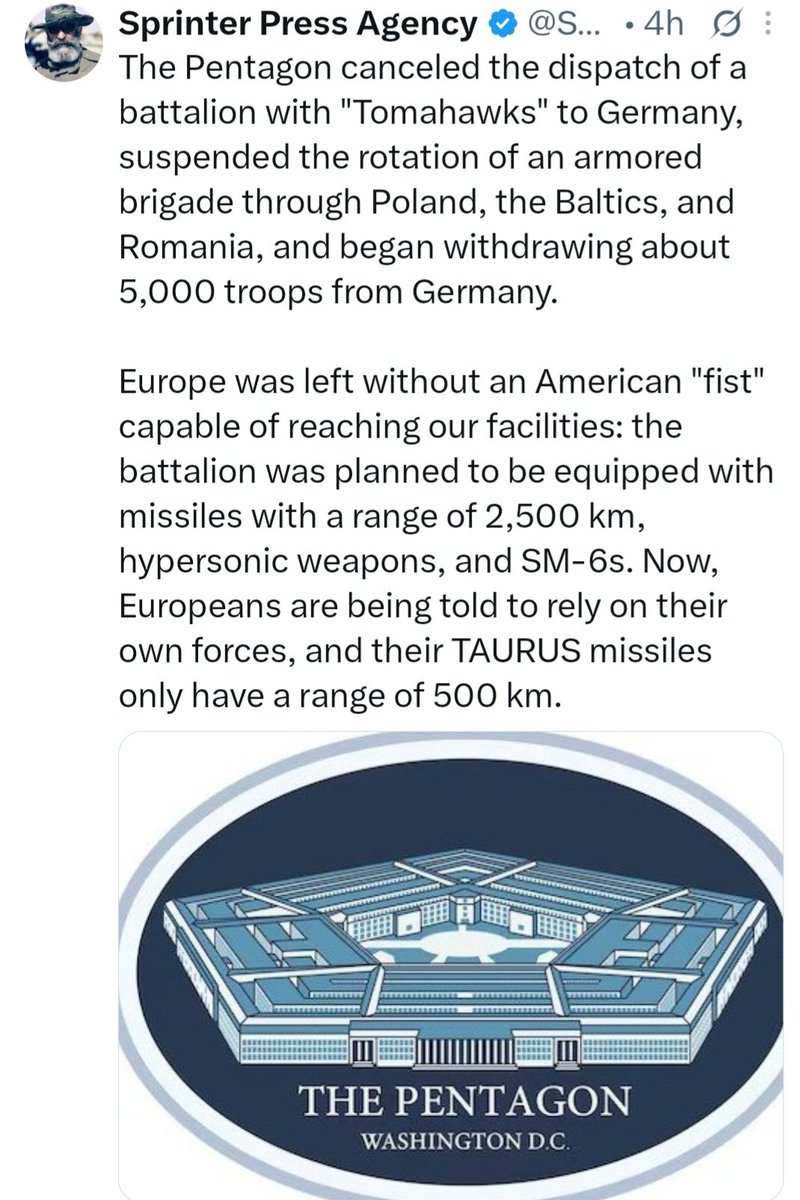
The Department of War has reduced the total number of Brigade Combat Teams (BCTs) assigned to Europe from four to three. This returns us to the levels of BCTs in Europe in 2021. This decision was the result of a comprehensive, multilayered process focused on U.S. force posture in Europe. This is resulting in a temporary delay of the deployment of U.S. forces to Poland, which is a model U.S. ally.
The Department will determine the final disposition of these and other U.S. forces in Europe based on further analysis of U.S. strategic and operational requirements, as well as our allies’ own ability to contribute forces toward Europe’s defense. This analysis is designed to advance President Trump’s America First agenda in Europe and other theaters, including by incentivizing and enabling our NATO allies to take primary responsibility for Europe’s conventional defense.
Secretary Hegseth spoke with Polish Deputy Prime Minister Kosiniak-Kamysz earlier today, and the Department will remain in close contact with our Polish counterparts as this analysis proceeds, including to ensure that the United States retains a strong military presence in Poland. Poland has shown both the ability and resolve to defend itself. Other NATO allies should follow suit.
The Department will provide more information at the appropriate time, in the appropriate setting.
1
6
16
3,533

A Black woman in medicine. An M.D. A future cardiothoracic surgeon. Every obstacle was worth it for this moment. ❤️
The journey was never conventional, but neither are the dreams I’m chasing.
Officially Dr. Lackland, M.D.
#CTSurgery #MedX #ChaseYourDreams #graduation #ABCTS




37
87
691
7,014

May 17
I am truly and honestly professionally curious of why we haven't had Leaders line up and acknowledge this grind as they did in 2024 on the ABCTs, and Honestly any of the formations like the 82nd, or our LRF units that have been on this unsustainable treadmill.
Crickets....
Very telling.
May 16

24 short Months Ago these Award Winning articles by @davis_winkie
Were published.
They All argued the same theme, ABCT Rotations were destroying the force, harming Soldiers and were NOT SUSTAINABLE.
Many Voices spoke out about how the Army and Policy makers MUST address and fix this, even some contributed to the Award winning Article itself.
Now those exact same Voices are either Silent or Worse attacking the decision to pull the ABCT out of Europe. The Exact same argument they were Championing a Short few months than Ago.
Why is that? What changed!!
Why such a different response when @PeteHegseth made the hard strategic decision that All of these Voices wanted??
armytimes.com/news/your-army…
3
4
41
4,586

May 16
As long as politicians use the ABCTs as a cheap substitute for permanent diplomatic architectures or permanent overseas bases, the core problem will remain. Army leaders must come to grips with this reality sooner than later.
May 16

This is tremendous background on why the reduction in European rotations is necessary for the US Army.
Not only is the described OPTEMPO incredibly stressful on soldiers and equipment, it breaks families.
In the Cold War days at least being assigned permanently to Germany for three years at a pop meant decent family time, as they came with you and you all ate schnitzel and explored castles in off duty time.
Nowadays this is not true, and the constant, sometimes unpredictable, brigade task force rotations wreck families for married soldiers.
And when your family affairs are in tatters, individual and unit readiness suffers.
SecWar is on point with reducing those rotations.
1
2
90

May 16
Marc, we’ve been rotating armored brigade combat teams (ABCTs) into Europe on 9 month heel-to-toe rotations since Crimea (ATLANTIC RESOLVE) to strengthen deterrence in Europe. This retreat is a gift to Putin.
May 16

Wrong again, Marc.
This was not for an exercise.
This was a nine-month rotational deployment, as US Army has done in Poland for several years, with new US unit replacing unit returning to home base after its nine m-month rotation.
Get that fact-checker!
1
4
28
10,328

May 16
a few words from Poland here
1) I do appreciate and respect that discussion.
2) Even if a decision to reduce (not overall stop 2 - instead of one) rotations was neccesary, which is sth I can believe in, it could/should have been communicated better (in advance)
3) 278 CAV has the newest Abrams tanks and is going into an IBCT per Transformation Ininiative. Two other NG brigades also are going into an IBCT
You already have equipment for additional ABCT
2 CAV in Germany is somehow a remainder of a Fulda Gap structure, can be re-converted into an ABCT and sent further east.
As for infrastructure, we will build and pay for it as we did for rotational units (appreciated recently by sec. Driscoll).
In the meantime, rotations of single ABCTs into Europe can be done with equipment that can be deployed here (ex NG, there *is* a spare capacity in Germany and Powidz hub is already operational so the stuff doesn't sit in Mannheim anymore) so that you don't waste Soliders time on transport.
3
89

The other option is permanently station two ABCTs with Division base in Europe. Improves deterrence, readiness, interoperability and strategic stationing.
2
6
239
May 16
𝐑𝐞𝐚𝐥𝐢𝐭𝐲 𝐂𝐡𝐞𝐜𝐤 𝐟𝐨𝐫 𝐭𝐡𝐞 𝐏𝐨𝐭𝐚𝐭𝐨𝐞𝐬 𝐖𝐡𝐨 𝐒𝐭𝐢𝐥𝐥 𝐃𝐨𝐧’𝐭 𝐆𝐞𝐭 𝐈𝐭:
The SecWar is absolutely strategicly correct, Listen up, because the armored fist that actually wins wars is getting ground into dust and too many people are too damn dumb to see it.
ABCTs — our **𝐀𝐫𝐦𝐨𝐫𝐞𝐝 𝐁𝐫𝐢𝐠𝐚𝐝𝐞 𝐂𝐨𝐦𝐛𝐚𝐭 𝐓𝐞𝐚𝐦𝐬** — 𝐚𝐫𝐞 𝐭𝐡𝐞 **𝐎𝐍𝐋𝐘** 𝐟𝐨𝐫𝐦𝐚𝐭𝐢𝐨𝐧 𝐰𝐢𝐭𝐡 𝐫𝐞𝐚𝐥 𝐦𝐨𝐛𝐢𝐥𝐞 𝐩𝐫𝐨𝐭𝐞𝐜𝐭𝐞𝐝 𝐟𝐢𝐫𝐞𝐩𝐨𝐰𝐞𝐫 𝐭𝐡𝐚𝐭 𝐜𝐚𝐧 𝐩𝐮𝐧𝐜𝐡 𝐭𝐡𝐫𝐨𝐮𝐠𝐡 𝐩𝐞𝐞𝐫 𝐞𝐧𝐞𝐦𝐢𝐞𝐬, seize ground, and end fights fast. Everything else is support. Light units? Drone bait. But for over a decade we’ve treated them like a 𝐝𝐚𝐦𝐧 𝐫𝐞𝐧𝐭𝐚𝐥 𝐜𝐚𝐫 𝐨𝐧 𝐞𝐧𝐝𝐥𝐞𝐬𝐬 𝐫𝐨𝐭𝐚𝐭𝐢𝐨𝐧𝐬.
**81% of active ABCTs** locked in the 3-to-make-1 meat grinder.
**7-8 months per cycle** pissed away on shipping, logistics, and half-assed presence instead of gunnery, maintenance, and NTC-level training.
OPTEMPO so brutal it’s driving the highest suicide rates in the Army. Families wrecked. Equipment backlogged. Readiness headed straight for the toilet.
LTC Van Wie laid it out cold: keep this up and we drop below the 70% “no penetration” line in 4-5 years — right when Russia starts getting its shit back together. 𝐓𝐡𝐚𝐭’𝐬 𝐧𝐨𝐭 “𝐝𝐞𝐭𝐞𝐫𝐫𝐞𝐧𝐜𝐞.” 𝐓𝐡𝐚𝐭’𝐬 𝐡𝐚𝐧𝐝𝐢𝐧𝐠 𝐭𝐡𝐞 𝐞𝐧𝐞𝐦𝐲 𝐚 𝐟𝐚𝐭, 𝐭𝐢𝐫𝐞𝐝, 𝐛𝐫𝐨𝐤𝐞𝐧 𝐚𝐫𝐦𝐨𝐫𝐞𝐝 𝐟𝐨𝐫𝐜𝐞 𝐨𝐧 𝐚 𝐬𝐢𝐥𝐯𝐞𝐫 𝐩𝐥𝐚𝐭𝐭𝐞𝐫.
𝐒𝐞𝐜𝐖𝐚𝐫 𝐇𝐞𝐠𝐬𝐞𝐭𝐡 𝐣𝐮𝐬𝐭 𝐦𝐚𝐝𝐞 𝐭𝐡𝐞 **𝐡𝐚𝐫𝐝, 𝐜𝐨𝐫𝐫𝐞𝐜𝐭 𝐜𝐚𝐥𝐥**. The ~5k troop drawdown that pulls these rotational ABCTs off the hamster wheel? **𝐓𝐡𝐚𝐭’𝐬 𝐥𝐞𝐚𝐝𝐞𝐫𝐬𝐡𝐢𝐩.** It breaks the cycle. Gives the force real dwell for resets, full CTC rotations, maintenance catch-up, and families that don’t get destroyed. Readiness rebounds in 1-2 years. 𝐁𝐲 𝐭𝐡𝐞 𝐭𝐢𝐦𝐞 𝐭𝐡𝐞 𝐫𝐞𝐚𝐥 𝐰𝐢𝐧𝐝𝐨𝐰 𝐨𝐩𝐞𝐧𝐬, 𝐨𝐮𝐫 𝐀𝐁𝐂𝐓𝐬 𝐰𝐢𝐥𝐥 𝐛𝐞 𝐬𝐡𝐚𝐫𝐩𝐞𝐫, 𝐝𝐞𝐞𝐩𝐞𝐫, 𝐚𝐧𝐝 𝐥𝐞𝐭𝐡𝐚𝐥 𝐚𝐬 𝐡𝐞𝐥𝐥 — 𝐧𝐨𝐭 𝐰𝐨𝐫𝐧-𝐨𝐮𝐭 𝐠𝐡𝐨𝐬𝐭𝐬 𝐨𝐟 𝐰𝐡𝐚𝐭 𝐭𝐡𝐞𝐲 𝐬𝐡𝐨𝐮𝐥𝐝 𝐛𝐞.
This isn’t retreat. It’s stopping the self-inflicted wound.
Continuing the old rotation scam would have 𝐝𝐞𝐬𝐭𝐫𝐨𝐲𝐞𝐝 𝐭𝐡𝐞 𝐫𝐞𝐚𝐝𝐢𝐧𝐞𝐬𝐬 𝐚𝐧𝐝 𝐥𝐞𝐭𝐡𝐚𝐥𝐢𝐭𝐲 𝐨𝐟 𝐨𝐮𝐫 𝐦𝐨𝐬𝐭 𝐜𝐚𝐩𝐚𝐛𝐥𝐞 𝐟𝐨𝐫𝐜𝐞 just to look “tough” on social media.
The potatoes cheering endless deployments don’t understand that real deterrence isn’t flags in Europe — it’s **ready iron that can actually kill the enemy when it counts**.
SecWar gets it. The force gets it. If you still don’t… maybe stay in your lane and let the professionals fix what the last decade of performative leadership broke.
America’s armored fist stays ready because we finally stopped grinding it down.
@PeteHegseth @SecWar @SeanParnellUSA
#ABCTReadiness #StopTheGrind #RealDeterrence
11
15
69
4,372

May 15
Bull hockey. You don’t send an ABCTs worth of equipment to another continent if this was “planned”.
You simply do not know what you are talking about and you look like a fool.
5
61
1,764

May 3
SecWar @PeteHegseth just made the hard call true leadership demands—pulling ~5,000 troops from Germany, including rotational ABCTs.
He has our Warriors’ backs.
U.S. deterrence in large scale ground combat rides on Armored Brigade Combat Teams. They alone deliver the mobile protected firepower—Abrams tanks, Bradleys, and full combined-arms punch—to win maneuver warfare. Nothing else comes close.
A decade of heel-to-toe rotations has been a hidden meat grinder: it ties up **81% of active ABCTs** (9 of 11) in the three-to-make-one cycle. Leaders chase deployment gates instead of brutal CTC training. Units lose **7-8 months of every 2-year cycle** on packing, shipping, and reset instead of training with their gear.
Maintenance—the lifeblood of the mechanized force—suffers (example: 117 non-mission-ready Bradleys in one recent rotational unit). Readiness collapses. ABCTs suffer **twice the suicide rate** of other Army formations. Families endure unrelenting separations and stress.
You don’t deter peer adversaries with a worn-out, gate-focused armored force. You deter with one that’s lethal, trained, and ready.
This drawdown ends the grind, restores the edge to our most critical capability, preserves depth for real fights, eases family strain, and forces Europe to step up.
Real deterrence demands ready combat power—not endless theater rotations.
SecWar protected the tip of the spear instead of dulling it.
America’s armored fist is about to get sharper.
1
4
120
May 3
Let me try....
**Reality Check: ABCT Readiness Crisis Leaders Kicked Down the Road for Years**
- **The Brutal Truth**: For over a decade, endless heel-to-toe rotations turned our Armored BCTs—the **only formation with real mobile protected firepower**—into a readiness meat grinder.
- **81% of active ABCTs** locked in the 3-to-make-1 cycle. **7–8 months lost per tour** to logistics instead of training and maintenance. OPTEMPO, churn, and backlogs compounding fast.
- **Result**: Readiness crashes below the 70% "no penetration" line in ~4–5 years (~2030–31)—**exactly** as Russia hits partial reconstitution and could test NATO.
- **The Theater Exposed**: Performative forward presence on the backs of our mechanized force while ignoring the human and structural toll. Leaders punted. The force paid.
- **Hegseth’s Hard Fix**: ~5k troop drawdown (ending rotational ABCT meat grinder) breaks the cycle. Full dwell for CTCs, resets, and families. Readiness rebounds in 1–2 years.
- **Strategic Outcome**: By Russia’s window, ABCTs are sharper, deeper, and lethal—not worn out. True deterrence through real readiness, not theater.
No more kicking the can. SecWar is building the armored fist that wins—not grinding it into dust.
1
12
339
May 3
**Reality Check: The ABCT Readiness Crisis Leaders Kicked Down the Road for Years**
**BLUF:** For over a decade, performative rotations turned our Armored BCTs—the only formation with true mobile protected firepower—into a readiness meat grinder. SecWar Hegseth is finally correcting this by reducing the burden and building **real strategic readiness** instead of theater on the backs of our mechanized force.
- **The Ignored Problem**: Rotations lock **81% of active ABCTs** in the 3-to-make-1 cycle. Units lose **7–8 months** per ~2-year tour to logistics instead of training/maintenance. OPTEMPO, churn, and backlogs compound—pushing readiness below the 70% "no penetration" line in ~4–5 years (~2030–31).
- **Timing Reality**: That collapse hits just as Russia reaches partial reconstitution and could pose limited NATO threats. We’ve been sleepwalking into a window where our armored edge—the backbone of deterrence—would be fatigued and shallow.
- **Hegseth’s Correction**: The ~5k troop drawdown (including rotational ABCT relief) breaks the cycle. It delivers full dwell for CTCs, maintenance resets, and family stability. Readiness rebounds in 1–2 years (by 2027–28). By Russia’s rebuild window, ABCTs will be sharper, deeper, and lethal—not worn out from endless theater deployments.
This isn’t retreat—it’s leadership restoring the mechanized force that actually wins large-scale ground combat. No more kicking the can. True strategic readiness over performative presence.
America’s armored fist stays ready because we stopped grinding it down.
@PeteHegseth @SecWar
4
17
307
May 3
**Reality Check: The ABCT Readiness Crisis Leaders Kicked Down the Road for Years**
**BLUF:** For over a decade, performative rotations turned our Armored BCTs the only formation with true mobile protected firepower into a readiness meat grinder. SecWar Hegseth is finally correcting this by reducing the burden and building **real strategic readiness** instead of theater on the backs of our mechanized force.
- **The Ignored Problem**: Rotations lock **81% of active ABCTs** in the 3-to-make-1 cycle. Units lose **7–8 months** per ~2-year tour to logistics instead of training/maintenance. OPTEMPO, churn, and backlogs compound—pushing readiness below the 70% "no penetration" line in ~4–5 years (~2030–31).
- **Timing Reality**: That collapse hits just as Russia reaches partial reconstitution and could pose limited NATO threats. We’ve been sleepwalking into a window where our armored edge the backbone of deterrence would be fatigued and shallow.
- **Hegseth’s Correction**: The ~5k troop drawdown (including rotational ABCT relief) breaks the cycle. It delivers full dwell for CTCs, maintenance resets, and family stability. Readiness rebounds in 1–2 years (by 2027–28). By Russia’s rebuild window, ABCTs will be sharper, deeper, and lethal not worn out from endless theater deployments.
This isn’t retreat—it’s leadership restoring the mechanized force that actually wins large-scale ground combat. No more kicking the can. True strategic readiness over performative presence.
America’s armored fist stays ready because we must stop grinding it down.
@PeteHegseth @SecWar

2
8
29
1,551

May 2
Just put 1AD back in Europe (or bring back 2AD) & put a BDE from 2(7) ID back in Korea.
1. You have your deterrence
2. You stop breaking the ABCTs and SBCTs
No one enjoys the rotations. Especially with the amount of dumbass rules units put their SMs under.
11
11
116
9,074
May 2
**BLUF:** Under sustained current rotations, ABCT readiness would likely drop **below the 70% available "no pen" threshold in ~4–5 years** (by ~2030–2031), right as Russia reaches partial reconstitution and could begin posing limited conventional threats to NATO. The SecWar drawdown buys critical recovery time, keeping ABCTs above that line when it matters most for deterrence.
This is WHY
@SeanParnellASW
@PeteHegseth
### Simple Model of Readiness Consumption (Based on Van Wie’s Data)
Van Wie shows rotations tie up **81% of active ABCTs** (9 of 11) in the 3-to-make-1 cycle, with **7–8 months lost per ~27-month cycle** to logistics instead of training/maintenance. This creates compounding decay via deferred upkeep, personnel churn, and OPTEMPO fatigue.
Hypothetical decay model (conservative, starting at ~90% baseline readiness):
- Per cycle decay: ~15% effective loss (training gaps maintenance backlog human factors).
- Result: Readiness falls below 70% after **~2 full cycles** (~4.5 years) under status-quo rotations.
This aligns with Van Wie’s warning of snowballing effects (deferred modernization, structural shallowness) that erode the armored force’s ability to execute large-scale ground combat—the backbone of U.S. deterrence.
### Timeline vs. Russia’s Rebuild
- **Russia’s path to challenging NATO** (per RAND, ISW, Carnegie, German intel, etc., as of May 2026): 5–10 years for credible conventional ground threat (partial recovery possible by ~2029–2031; full-scale capability later). Russia remains focused on Ukraine attrition and cannot surge against NATO soon.
- **ABCT risk window**: Sustained rotations would push readiness below 70% **by ~2030–2031**—precisely when Russia might regain limited maneuver options. At that point, ABCTs (the only formation with true mobile protected firepower) would be fatigued, under-maintained, and shallow in depth—undermining deterrence exactly when needed.
### Impact of the Drawdown
Reducing rotational ABCT burden (Hegseth’s ~5k troop cut) breaks the cycle:
- Frees dwell time for full CTC rotations, maintenance catch-up, and resets.
- Readiness rebounds **within 1–2 years** (by 2027–2028), putting ABCTs well above 70% as Russia’s rebuild accelerates.
- Long-term: Aligns with Van Wie’s permanent basing recommendation for sustainable high readiness.
**Bottom line**: The status quo was a slow-motion readiness failure timed poorly against Russia’s recovery arc. The drawdown is a timely reset that preserves the armored edge for the actual deterrence window (mid-2030s ). This is exactly the kind of force protection Van Wie advocated.
May 2
Time to cut through the Noise and State HARD TRUTHS!
**BLUF:** Lt. Col. Ryan Van Wie’s research proves ABCT rotations to Europe are a **readiness meat grinder** that consumes the U.S. armored force—the only formation capable of winning large-scale ground combat. Russia’s rebuild timeline gives us years to fix this.
@SecWar @PeteHegseth '~5,000-troop drawdown TO SUPPORT @POTUS (including rotational ABCT relief) is the right move: it restores ABCT lethality exactly when we need it most for credible deterrence.
### Quick Analysis of Van Wie’s Research (Military Review, Mar-Apr 2026)
Van Wie’s data-driven piece shows a decade of “heel-to-toe” rotations (2 ABCTs in Europe 1 in Kuwait) are net **consumers**, not builders, of readiness:
- **Operational hit**: Units lose **7–8 months** of every ~2-year cycle on logistics (packing/shipping) instead of realistic training. Deployed forces are disaggregated, ranges limited, and maintenance deferred. One recent unit had 117 non-mission-ready Bradleys. Personnel often deploy at ~80% strength.
- **Structural hit**: Sustaining rotations ties up **81% of active ABCTs** (9 of 11) in the 3-to-make-1 cycle. Almost no bench left for modernization or crises.
- **Human toll**: Crushing OPTEMPO drives the Army’s highest suicide rates in ABCTs, plus family strain and retention losses.
Van Wie’s bottom line: Rotations were meant for flexibility but became entrenched, limiting options. Allies prefer permanent presence anyway, and Russia’s Ukraine losses make near-term invasion unlikely. Fix: Permanently base one ABCT in Europe (saves money, frees ~5 ABCTs, boosts readiness).
### Russia’s Rebuild Timeline to Challenge NATO
Russia is badly depleted (~1.2M casualties, massive armored losses). Reconstitution is slow due to sanctions, manpower, and ongoing attrition:
- **Next 2–3 years (~to 2028–29)**: Can sustain Ukraine ops or limited gray-zone moves. No major NATO challenge.
- **3–5 years (~2029–31)**: Partial recovery of pre-war capabilities possible post-peace deal. Incremental armored modernization (e.g., thousands of T-90/T-72 variants planned through 2036), but quality lags.
- **5–10 years (~2030–35 )**: Credible conventional threat to NATO’s eastern flank possible, but degraded force. Most analyses say full large-scale challenge capability is **7–10 years minimum**.
NATO’s economic and population edge remains overwhelming. No imminent threat.
### Predicted ABCT Readiness Impacts
- **If rotations continued unchanged**: Readiness stays eroded through 2028–30. 81% force commitment keeps training/maintenance broken exactly as Russia begins partial recovery. ABCTs arrive at any crisis fatigued—weakening the armored edge we rely on for deterrence.
- **With Hegseth’s drawdown (reduced rotational burden)**: Strong positive reset. Frees units for full dwell time, CTC rotations, maintenance catch-up, and family recovery. By 2027–28, operational readiness climbs sharply. Structural depth improves for Pacific or surge needs. By Russia’s 5–7 year window (~2030–32), ABCTs—the only formation with true mobile protected firepower for large-scale ground combat—will be sharper, deeper, and far more lethal.
Van Wie nailed the problem. The drawdown turns it around at the perfect time. This is data-driven leadership that strengthens deterrence by protecting the force that delivers it. America’s armored fist stays ready because we stopped wearing it out.
@SeanParnellUSA
@DOWResponse

1
5
775

The toll on Acrive ABCTs will be worse as National Guard ABCTs step down to MBCTs. The Guard had been absorbing OSS rotations as a force provider and enabler.
1
2
5
783
May 2
Time to cut through the Noise and State HARD TRUTHS!
**BLUF:** Lt. Col. Ryan Van Wie’s research proves ABCT rotations to Europe are a **readiness meat grinder** that consumes the U.S. armored force—the only formation capable of winning large-scale ground combat. Russia’s rebuild timeline gives us years to fix this.
@SecWar @PeteHegseth '~5,000-troop drawdown TO SUPPORT @POTUS (including rotational ABCT relief) is the right move: it restores ABCT lethality exactly when we need it most for credible deterrence.
### Quick Analysis of Van Wie’s Research (Military Review, Mar-Apr 2026)
Van Wie’s data-driven piece shows a decade of “heel-to-toe” rotations (2 ABCTs in Europe 1 in Kuwait) are net **consumers**, not builders, of readiness:
- **Operational hit**: Units lose **7–8 months** of every ~2-year cycle on logistics (packing/shipping) instead of realistic training. Deployed forces are disaggregated, ranges limited, and maintenance deferred. One recent unit had 117 non-mission-ready Bradleys. Personnel often deploy at ~80% strength.
- **Structural hit**: Sustaining rotations ties up **81% of active ABCTs** (9 of 11) in the 3-to-make-1 cycle. Almost no bench left for modernization or crises.
- **Human toll**: Crushing OPTEMPO drives the Army’s highest suicide rates in ABCTs, plus family strain and retention losses.
Van Wie’s bottom line: Rotations were meant for flexibility but became entrenched, limiting options. Allies prefer permanent presence anyway, and Russia’s Ukraine losses make near-term invasion unlikely. Fix: Permanently base one ABCT in Europe (saves money, frees ~5 ABCTs, boosts readiness).
### Russia’s Rebuild Timeline to Challenge NATO
Russia is badly depleted (~1.2M casualties, massive armored losses). Reconstitution is slow due to sanctions, manpower, and ongoing attrition:
- **Next 2–3 years (~to 2028–29)**: Can sustain Ukraine ops or limited gray-zone moves. No major NATO challenge.
- **3–5 years (~2029–31)**: Partial recovery of pre-war capabilities possible post-peace deal. Incremental armored modernization (e.g., thousands of T-90/T-72 variants planned through 2036), but quality lags.
- **5–10 years (~2030–35 )**: Credible conventional threat to NATO’s eastern flank possible, but degraded force. Most analyses say full large-scale challenge capability is **7–10 years minimum**.
NATO’s economic and population edge remains overwhelming. No imminent threat.
### Predicted ABCT Readiness Impacts
- **If rotations continued unchanged**: Readiness stays eroded through 2028–30. 81% force commitment keeps training/maintenance broken exactly as Russia begins partial recovery. ABCTs arrive at any crisis fatigued—weakening the armored edge we rely on for deterrence.
- **With Hegseth’s drawdown (reduced rotational burden)**: Strong positive reset. Frees units for full dwell time, CTC rotations, maintenance catch-up, and family recovery. By 2027–28, operational readiness climbs sharply. Structural depth improves for Pacific or surge needs. By Russia’s 5–7 year window (~2030–32), ABCTs—the only formation with true mobile protected firepower for large-scale ground combat—will be sharper, deeper, and far more lethal.
Van Wie nailed the problem. The drawdown turns it around at the perfect time. This is data-driven leadership that strengthens deterrence by protecting the force that delivers it. America’s armored fist stays ready because we stopped wearing it out.
@SeanParnellUSA
@DOWResponse
4
16
57
8,935
May 2
And....
The Hidden Readiness Meat Grinder That the SecWar Is Fixing
SecWar Pete Hegseth made the hard call true leadership requires—pulling ~5,000 troops from Germany, including rotational ABCTs.
He has our Warriors’ backs.
U.S. deterrence in large scale ground combat depends on Armored Brigade Combat Teams—the only formation with the mobile protected firepower (Abrams, Bradleys, full combined-arms) to win maneuver warfare.
Heel-to-toe rotations have been the meat grinder: they tie up 81% of active ABCTs, waste 7-8 months of every 2-year cycle on logistics instead of CTC training, degrade maintenance (e.g., 117 non-ready Bradleys in one unit), double suicide rates, and inflict unrelenting family stress.
You don’t deter peers with a worn-out force chasing deployment gates. You deter with one that’s lethal and ready.
This drawdown ends the grind, restores our critical edge, preserves depth for real fights, eases family strain, and pushes Europe to step up.
Real deterrence = ready combat power.
SecWar protected the tip of the spear. America’s armored fist is about to sharpen.
May 1

“If in 10 years, all American troops stationed in Europe for national defense purposes have not been returned to the United States, then this whole project [NATO] will have failed.”
-General of the Army Dwight Eisenhower, February, 1951

11
18
84
5,455