
Apr 29
🏁🛰️ 🇰🇷🇺🇸🇨🇳🇸🇬 5g ai biotech alignment
🇺🇸🇰🇷 K-Moonshot : Biotech Geoengineering
📍DeepMind launched its AI Campus in Seoul April 27th, granting SNU and KAIST direct access to AlphaGenome and AlphaFold for biotech and climate work.
📍Under K-Moonshot, the focus stays on synthetic proteins, drug pipelines, and high-resolution modeling for heatwaves and energy grids.
📍The partnership positions Seoul as an open talent hub—sometimes called Seoul-washing—drawing global researchers into a trusted, state-aligned ecosystem.
📌 KAIST is CALTECH or Standford in Korea. SNU, like the Ivy League schools that became Globalist pipeline for talent grooming, has become a cover for leftist nursery cradle of intellectual laundry and propagandistic scholarship funding.
🇸🇬🇨🇳 Singapore-washing as Exit strategy
📍Manus Parallel: The same day (April 27, 2026) China’s NDRC blocked Meta’s $2B deal for Manus. After attempting to distance itself from Chinese R&D roots, the agentic AI project faced full unwind orders, founder exit bans, and state IP claims.
📍Talent Dynamics: Seoul enables fluid exchanges and open model access. Beijing enforces tighter controls. Comparison or concern ? Is Seoul, a new talent washing hub?
🏁🛰️ Whether or not SNU and KAIST become a talent laundry pool, the correlation on protein mapping/alterning biotech with 5G aerospace race (albeit without datacenter element) on climate surveillance system agenda finds new pumping station : the corrupt government backup.
👩🏻💻🔎A decade after AlphaGo, South Korea’s quiet integration of frontier AI contrasts sharply with one high-profile acquisition that didn’t survive the same week. Investing motivator postings can be spotted on Pfizer, Bayer, and other top pharmaceutical investment firm gene tech but what is more interesting is the agentware.
6
2
6
305

Mar 11
1990: freeware
1995: warez
1999: shareware
2004: adware
2007: appware
2011: cloudware
2016: bloatware
2020: remoteware
2023: promptware
2024: modelware
2025: vibeware
2026: agentware
4
3
16
1,728

Feb 26
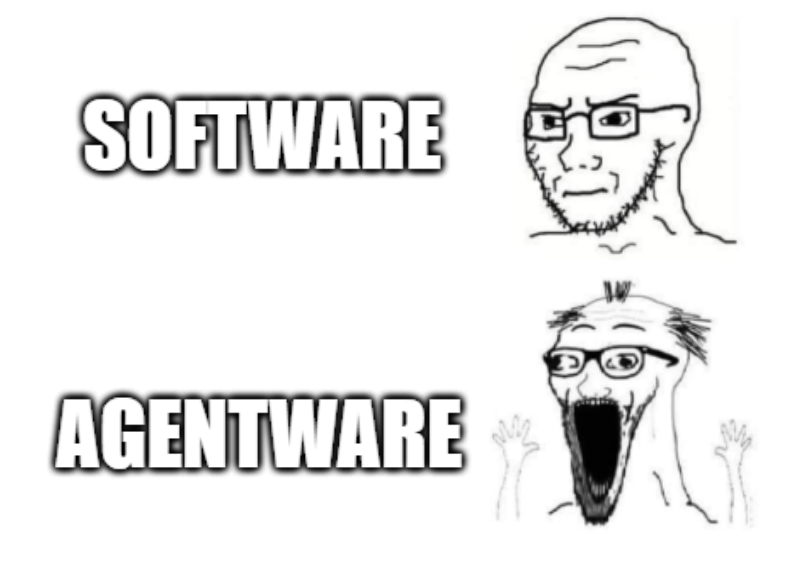
AGENTWARE


1
2
898

Feb 26
再做产品的时候,请大胆地不要再做 App了。
Stop building software. Build "Agentware"。
Software 就是 App、小程序、网站、SaaS 平台,它们被包装上了一层多余的 GUI 壳,默认是给人看的。这意味着你的产品要争夺“人”有限的注意力,在一个人可怜的 24 小时里抢夺那宝贵的一两分钟。注意力经济的搏杀早已经是一片红海。
Agentware 是我新造的词,代表用 API、MCP、JSON、Markdown 等 Agent 友好的形式代替 GUI,直接把软件功能暴露给 Agent。因为 Agent 的注意力是可以无限拓展的,一个人可以拥有超级多的 Agent。未来你的产品被 Agent 看到的概率可能远大于被真人看到的概率。
有时候,一堆零碎的 Markdown Json API 文档,比一个井井有条的 GUI 更适合 Agent。可是当前,大部分产品还是延续了默认做 App 的思路,就算有 MCP 也只是作为辅助。#个人开发者 #APP #产品经理
1
2
32

Feb 23
Being bearish is always cosmopolitan, and Marxism is about as sexy of an AI bear case as you can get. Framing generational technology as an economic crisis is exactly that (h/t @HajarnisMohit below). Fixed pie… Zero-sum… Capital wins… labor loses… no mechanism for reallocation (AOC has some ideas?). Ask yourself: does the extreme bull scenario get 100K views this weekend?
Subscribing to this view requires you to believe that it is bearish, in the most dynamic and risk taking economy in history, that knowledge is becoming ubiquitous and startup costs are falling. It sounds to me more like ‘go time’. Competition is about to explode and feed *creative destruction*, and society and consumers win in that environment in case you didn’t remember (Hi capitalism! Missed you). The bear case also rests on a labor theory of value: your worth = your time, and when the AI god machine replicates your time, you’re worthless. NO THANK YOU. As I used to say trading credit OTC back in the day… SOLD TO YOU.
Let’s make it concrete. Is it bearish for the overall economy that seat based SAAS models (unused gym memberships?) are moving to outcome-based pricing? The Age of Agentware sounds like pay for performance, a welcome concept, and inherently more productive. That saved money is freed capital that gets re allocated to R&D, expansion, or totally new unforeseen industries (hey, nobody thought we’d be here, right?). And if it is instead returned to shareholders, great, then they’ll redistribute the capital just the same.
Now, add in the macro. AI is very obviously disinflationary. The ‘shadow output gap’ is widening, which means every unit of growth creates a bit less inflation than it used to. That argues for structurally lower rates and pulls the cost of capital down (another boost to competition!). So while legacy rent holders may feel some pain, competition and consumers will thrive.
Call me crazy, but this all sounds pretty American to me.
Feb 23

One of the often slept-upon benefits of attending the University of Chicago is that they make you read Marx as part of the core curriculum, which is why this article gave me flashbacks of taking SOSC 114 as a freshman.
Marx, writing during the Industrial Revolution, predicted capitalism would periodically devour itself: firms replace labor with machinery to boost profits, but competition diffuses the technology, drives prices to marginal cost, and the gains get competed away. Meanwhile, displaced workers lose purchasing power, hollowing out the demand the whole system depends on. Production rises but no one can afford to buy what's produced - the contradiction between production and realization.
Citrini's piece describes this exact dynamic, then declares there's "no natural brake." It's the most Marxist piece of financial analysis written in years, and makes the same errors Marx did.
Schumpeter offered the obvious rebuttal 80 years ago: creative destruction doesn't just destroy, it creates industries we can't yet conceive of. Everyone in the replies is already making this point, and I think they're right.
But the sharper rebuttal is Hayek's: prices are the brake Citrini says doesn't exist. Who funds $200bn / qtr in AI capex when equities are down 38%, private credit marks are in the 50s, and consumer demand has collapsed? Cost of capital rises. Incremental build-out becomes uneconomical. Capital gets destroyed and reallocated.
Citrini also unknowingly describes Marx's proletarianization of the petite bourgeoisie: the $180k PM driving Uber is textbook. But the article claims this collapses consumer demand, and that's where it breaks.
The top decile drives 50% of spending and their wealth is in equities, not W-2 income; they're long the hyperscalers posting records in Citrini's own model. Blue collar is insulated because AI replaces cognitive labor, not physical.
The professional middle class gets crushed, but aggregate demand doesn't.
The spending class IS the capital-owning class. The K-shaped recovery they fear actually stabilizes the demand base they say is collapsing. In the stable aggregate demand, the petit bourgeoisie finds ways to reinvent itself.
I think the Citrini piece is excellent and worth reading. But history has repeatedly shown that periods of transformative productivity gains ultimately accrue to the consumer through lower prices, more leisure, and higher quality of life. Marx's error wasn't diagnosing the disruption, it was underestimating the system's ability to adapt.
1
2
31
3,611

Feb 10
If Andrej @karpathy coined “vibe coding,” I’d like to coin what comes next.
I’m calling it "Agentware"
Vibe coding is about using AI to help you write software.
Agentware is about realizing you often don’t need to build software at all.
You create structured intent: folders, markdown instructions, data, and wrap it all up with a readme in the root.
Nothing runs on its own.
It only works because an AI reads it and executes the process.
The AI is the runtime.
The README is the program.
Documentation becomes executable.
Vibe coding leveraged AI to do things the way they've always been done.
Agentware is a recognition that we no longer need to do things that way.
2
83

Jan 31
כבר יש 3 צוותים שקיבלו סיד שמגנים על הארגון שלך מלפני אייג'נטים מרושעים. תחום ה agentware בוער מאז שלשום
3
57
5,178


The Agentic AI Outlook in 2026
2024 introduced AI agents.
2025 put them into production.
2026 is about making them scalable, governable, and self-improving.
Drawing from her experience building agentic systems in both research and high-stakes enterprise environments, our CEO @qingyun_wu explains how a few transitions now clearly define where the agentic AI field is headed in 2026:
The Demo Era is Over.
Clever prompts aren't enough for the enterprise. Production-grade agents now require identity, budgets, audit logs, and rollback mechanisms. You cannot scale what you cannot observe, and you cannot trust what you cannot govern. In 2026, we stop building bots and start building Agentic Infrastructure.
Orchestration Beats Generalization.
The "one-size-fits-all" generalist agent is a dead end. Real-world ROI comes from specialized systems, networks of agents that mirror your actual business functions. The magic isn't in the individual persona, but in the orchestration layer that coordinates them to achieve outcomes no single agent could deliver alone.
Static Automation is the Floor, Not the Ceiling.
The agents that win in 2026 are not static; they are adaptive. By integrating "Self-Improving Loops" and verification fabrics, agents can now observe their own behavior, learn from failures, and evolve. Self-improvement is no longer a model feature, it is a foundational requirement.
Beyond the prompt. Beyond the code. Welcome to Agentware.
We are entering the era of Software 4.0. The primary unit of application is no longer just code or prompts, but Agentware: systems where reasoning, memory, and learning loops are programmable and interconnected.
The Internet of Agents: Intelligence is leaving the silo.
We are moving toward a world where autonomous agents discover one another and coordinate work across organizational boundaries. Through open protocols, capability is becoming composable. Your agents are no longer isolated automations, they are participants in a shared global network.
This shift is already visible and accelerating. To learn more, read the full article below for concrete patterns, production lessons, and where agentic AI goes next.
👉 Full article here: The Agentic AI Outlook in 2026
qingyunwu.substack.com/publi…
#AIAgents #GenerativeAI #AG2 #AutoGen #EnterpriseAI
5
307

Happy New Year, my friends! 🚀
As we step into 2026, I’m starting to write down some of the key learnings from my journey building agent frameworks and agentic systems at the intersection of research, open source, and real-world production (from AutoGen to AG2).
Key defining themes of where Agentic AI is headed in 2026:
📷 AI Agents: From Demos to Production at Scale
📷 The Self-Improving Loop and Verification Fabric
📷 Welcome to Software 4.0: Agentware
📷 The Rise of the Internet of Agents
Find the link to the full article in the comment!
1
6
317

18 Jun 2025
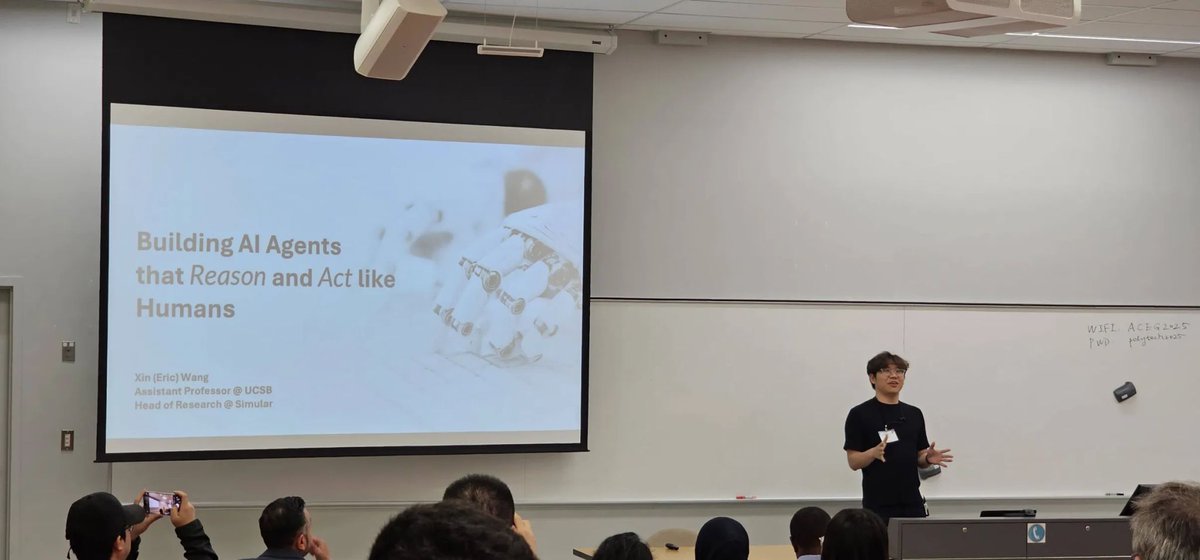
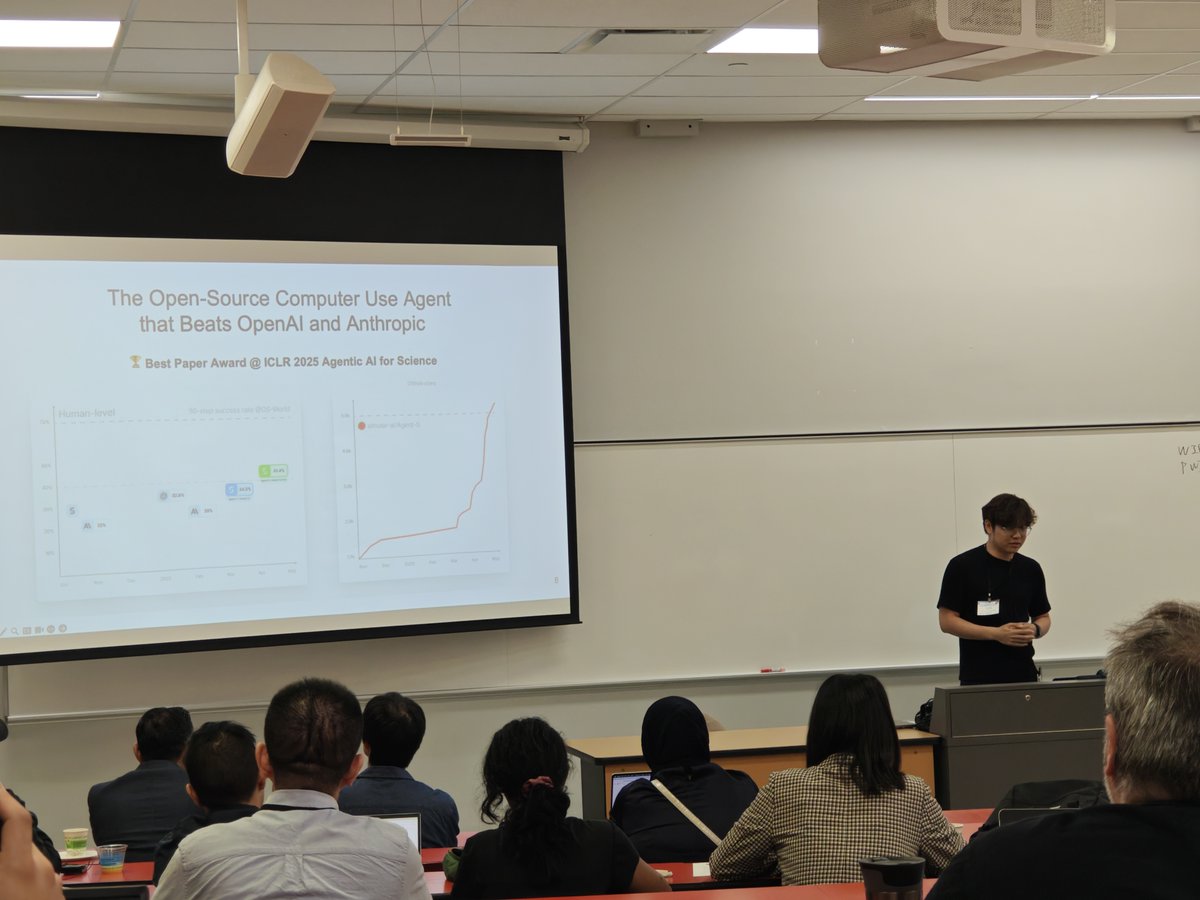
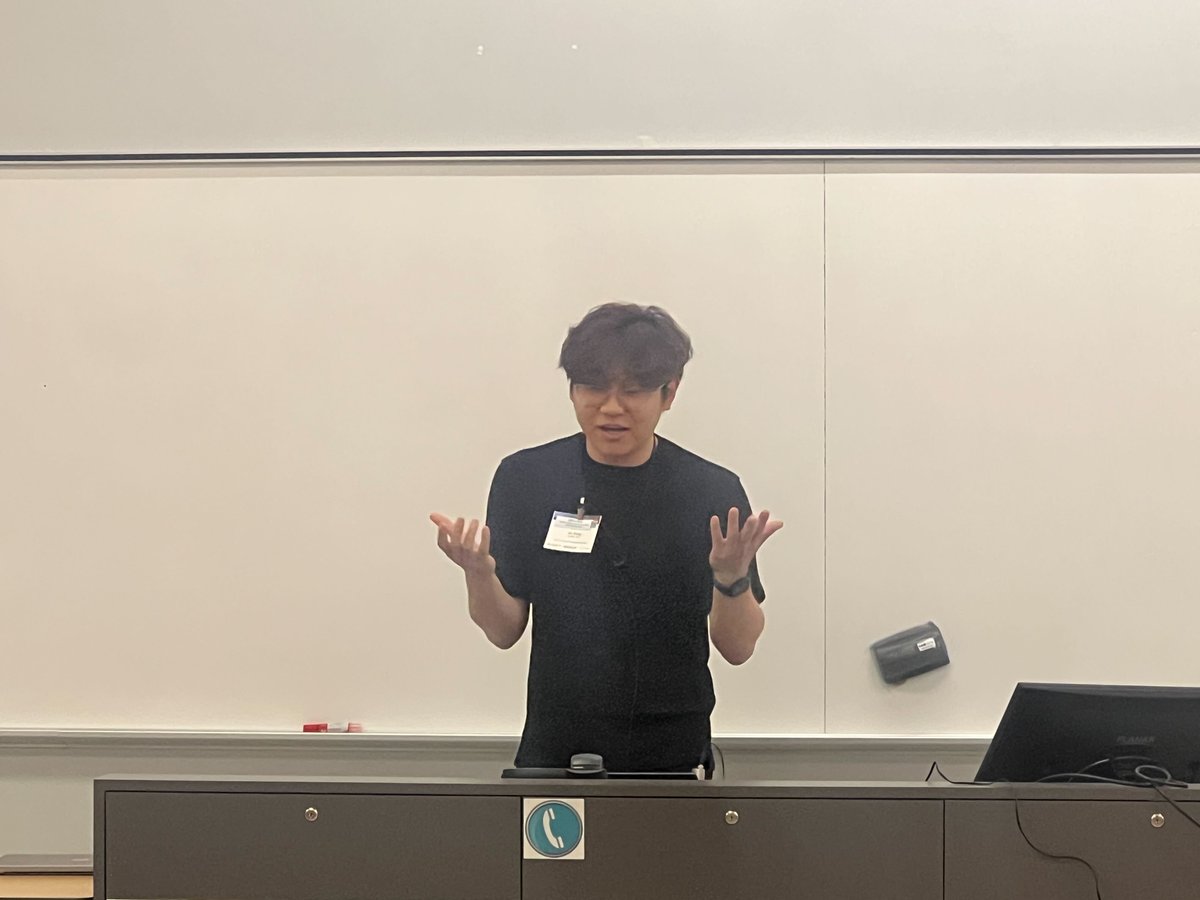
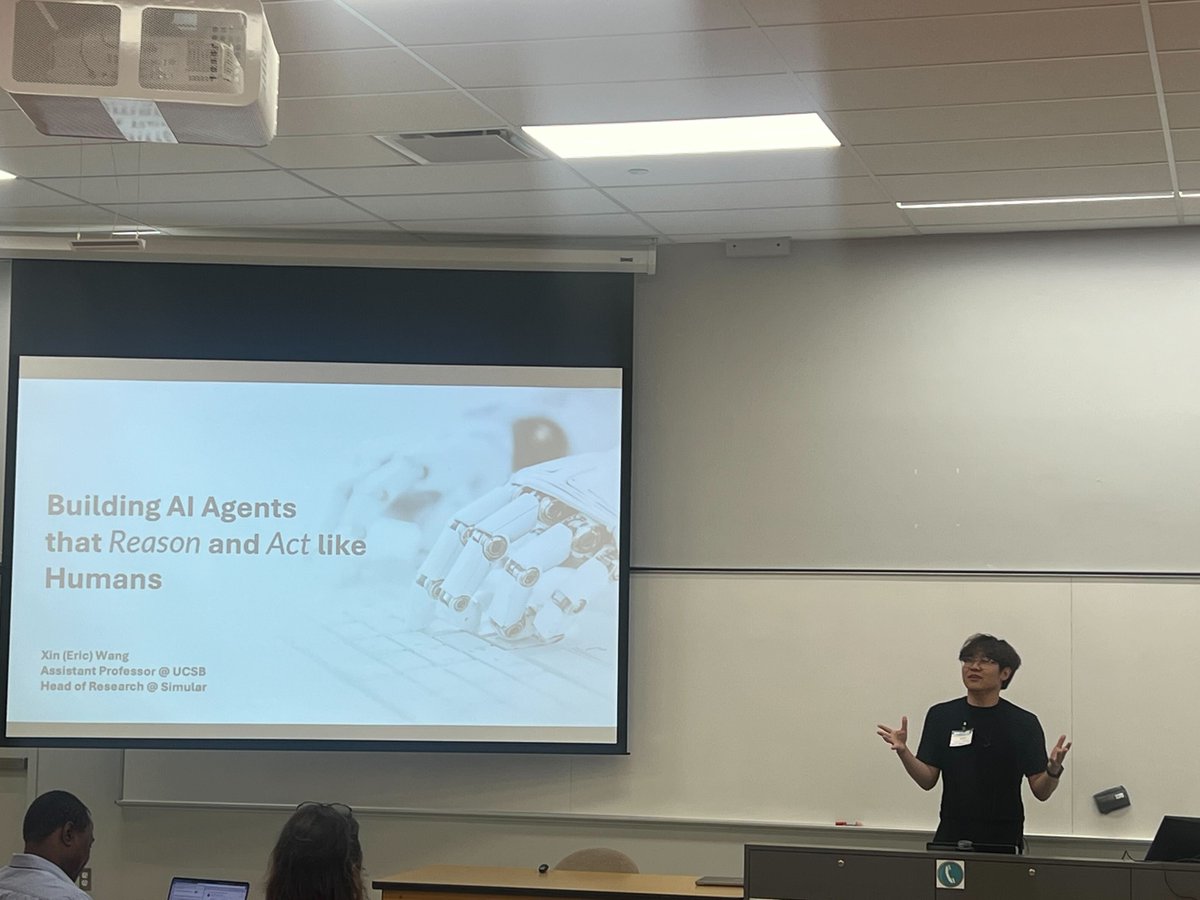
I was honored to deliver a keynote at SEMLA 2025 on "Building AI Agents that Reason and Act like Humans". Learned a new term from the software community, Agentware. Talk slides link: dropbox.com/scl/fi/rfi30ae6m…
BTW, I really love the city vibe of Montreal! 🇨🇦
17 Jun 2025

🎤 Grateful to have been invited to speak at SEMLA Agents Day 2025 at Polytechnique Montréal @Polytechni75449!
Yesterday, Eric @xwang_lk, Head of Research at @SimularAI, gave a well-received talk showcasing Simular’s latest research and real-world applications in 𝐛𝐮𝐢𝐥𝐝𝐢𝐧𝐠 𝐀𝐈 𝐚𝐠𝐞𝐧𝐭𝐬 𝐭𝐡𝐚𝐭 𝐫𝐞𝐚𝐬𝐨𝐧 𝐚𝐧𝐝 𝐚𝐜𝐭 𝐥𝐢𝐤𝐞 𝐡𝐮𝐦𝐚𝐧𝐬 — from navigating complex interfaces to automating everyday workflows.
Big thanks to the SEMLA team for organizing such a thoughtful and inspiring event. Excited to keep pushing this field forward with the agents community.
🔗 Speaker lineup: lnkd.in/dUjAYPbK
#SimularToHuman #SEMLA #AI #AutonomousAgents #AgenticAI #MachineLearning #HumanComputerInteraction #ArtificialIntelligence
3
17
99
14,532

Imagine portfolio rebalancing
automated, on‑chain, and provable.
That’s the power of Newton.
With zkPermissions, Newton agents operate strictly within your rules.
Built like a rollup, proven like ZK—this is next-gen automation.
@newton_xyz isn’t just automation—
It’s verifiable agentware for on‑chain finance.
GNwet 💪

4
1
2
270

23 Feb 2025
🤖🚀 AI Agents & Agentic Domains on the Rise! With AI-powered smart agents reshaping industries, terms like agentic & agentware are gaining traction. Domain investors, take note—this trend is just getting started! 🌍💡 @NamePros
More:domain.news/agent-agentic-an…
#AI #Agentic #Domains #TechTrends
3
3
23
1,197

30 Jan 2025
🚀 Crypto Canadians Weekly Recap – DeepSeek: A Game Changer for Crypto 🔥
🎙 Featured Guests:
👤 @ronbodkin – Founder & CEO, @TheoriqAI
👤 @jia_seed – Hackathon organizer & founder of Nōsu
👤 @AlanWunsche – Founder, Knowledge Labs & author of Agentware
⚡ Powered by @WonderFi
🔹 Here’s what we covered:
🤖 AI Agents Are Here: “This is the year of the agent, and crypto is leading the way,” said Ron Bodkin, explaining how autonomous AI is changing trading and decision-making.
📈 Crypto Meets AI: “Once we trust AI agents to transact for us, it changes everything,” Alan Wunsche noted, highlighting AI-powered wallets and autonomous payments as the next big leap.
⚠️ China’s DeepSeek Shockwave: Ron emphasized how “DeepSeek has forced Western labs to adapt fast—AI efficiency is now an arms race.”
💰 AI’s Disruption of Jobs & Finance: Alan warned: “Most leaders don’t understand how fast AI is replacing jobs—there’s no transition plan.”
🔗 Blockchain’s Role in AI Verification? Audrey Chen highlighted emerging AI-powered blockchain tools, noting: “I’ve seen two apps… one is a virtual machine for agents to perform transactions, and another is an Apple Wallet integration, more for normal people use.”
💡 Biggest AI Prediction for 2025?
🔹 @ronbodkin: “AI agents will dominate every industry, and Web3 will lead their adoption.”
🔹 @AlanWunsche: “Open-source AI will shake up everything—we’re seeing the beginning of a major shift.”
🔹 @jia_seed: “More AI-driven financial tools will emerge, making crypto easier for everyone.”
2
1
266

Turn your @Alienware to Agentware. Thank to enabling the NAT feature, $MOSS AI Node now support mining $HYPT from your home desktops. Not your hosting not your agent.
25 Dec 2024

$MOSS AI Node has two runtime modes: cloud server or desktop. So you can contribute your cloud GPU server or home based PC with performance GPU to allow the protocol load $MOSS AI Pod and run on your machine at spare time to get rewards in $HYPT, known as mining by running $MOSS AI Pod.

1
5
682

20 Dec 2024
It’s clear now: Web 4.0 will be built with ‘agentware’ — multi-agentic workflows including agent-agent info transfers — and eventually digital currency / digital asset transactions.
And then the Web# label will be irrelevant….
20 Dec 2024

Take the agentic path further and we fundamentally change the internet and apps. Why?👇
Agents don’t need landing pages… humans do.
Agents don’t need iOS apps… humans do.
Agents don’t need a UX… humans do.
The web is about to be transformed.
Finally.. Web 4.0 revealed
1
1
9
1,158
17 Dec 2024
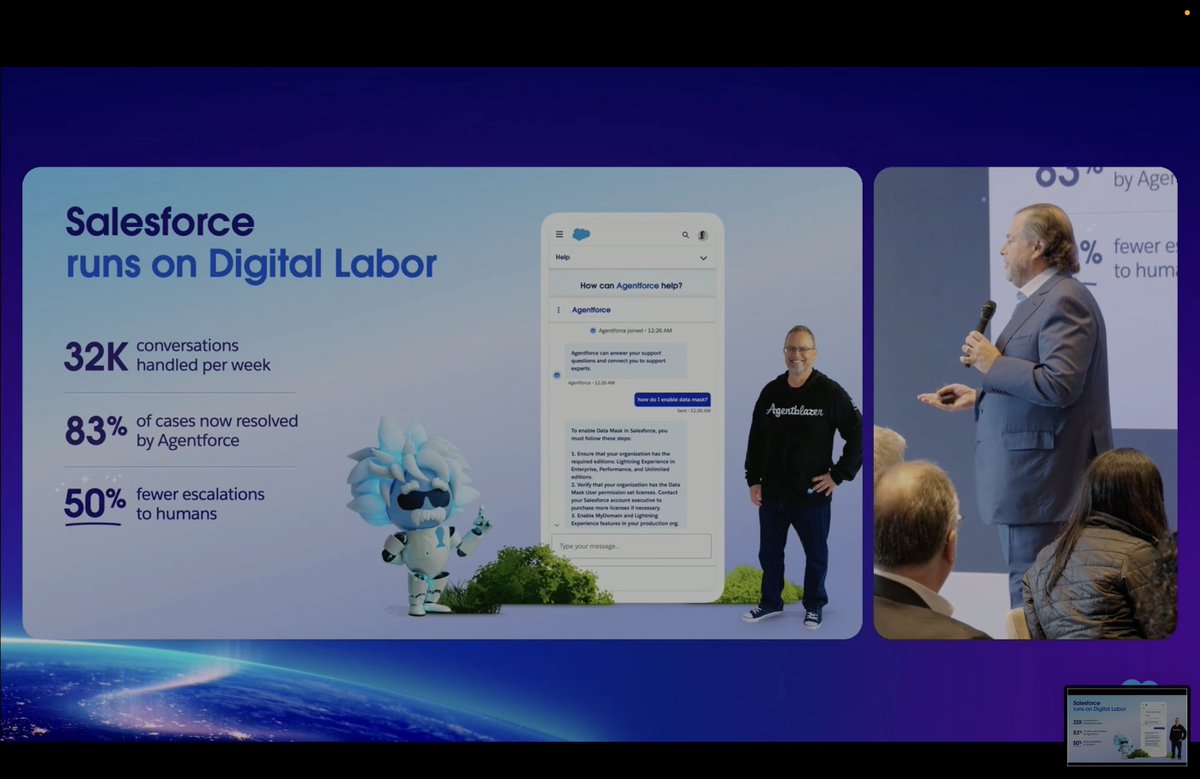
With Agentforce 2.0, @salesforce has literally just rolled out the agentic enterprise roadmap and staked their claim as the leading agentic "Digital Labor" provider. @Benioff is an amazing storyteller about the future.
#aiagents #DigitalLabor #Agentforce #Agentware
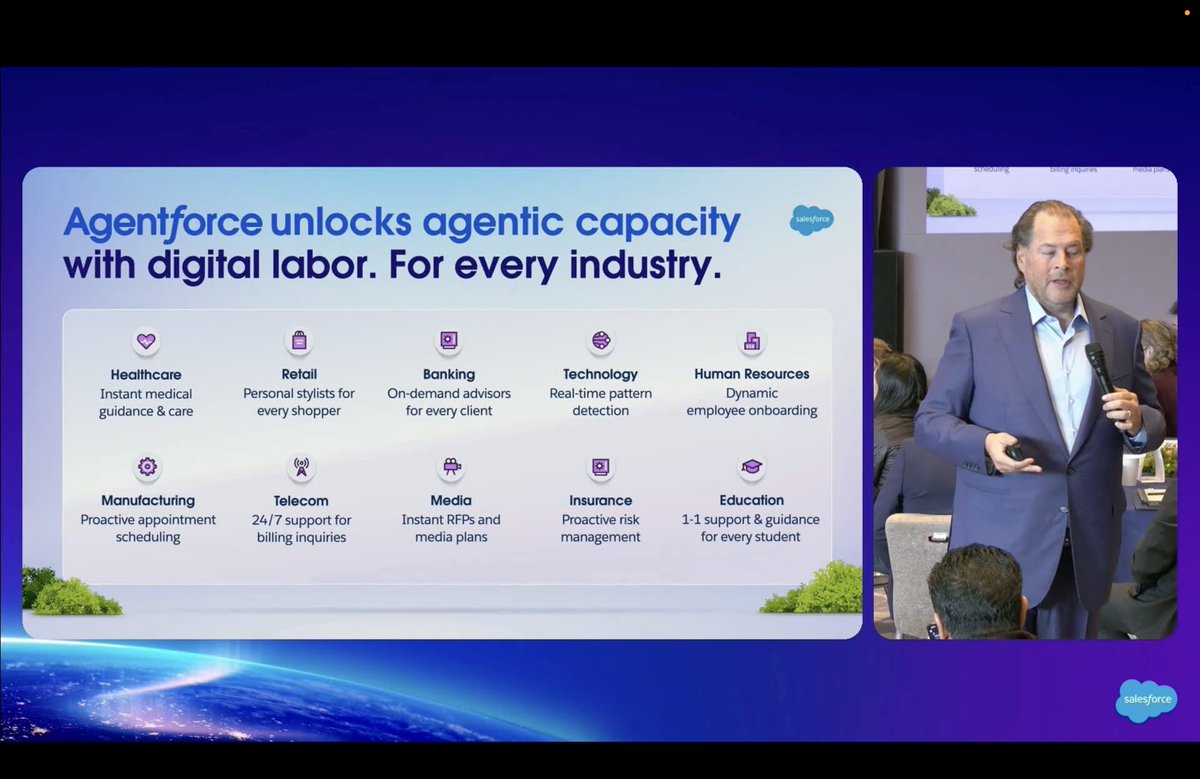
17 Dec 2024
Salesforce unveils Agentforce 2.0 in SF and @Benioff describes it now as a "Digital Labor Platform"
#aiagents #digitalLabor #agentware
1
3
532
2 Oct 2024
Production-grade coding agents with human-in-the-loop. Look forward to working with my new agentic teammates! #agentic #agentware
1 Oct 2024

Pythagora builds full-stack, production-ready apps with 0 lines of code written by humans. You just explain what you want to build and give feedback while @PythagoraAI manages the codebase.
3
135

22 Aug 2024
cursor is making the leap to agentware
22 Aug 2024

We've raised $60M from Andreessen Horowitz, Jeff Dean, John Schulman, Noam Brown, and the founders of Stripe and Github.
Cursor has become recognized as the best way to code with AI, powered by an ensemble of custom and frontier models, delightful editing, and petabyte-scale infrastructure.
Our mission is to create a magical tool that will one day write all the world's software. Join us!
2
122

24 May 2024
Tech expert @AlanWunsche and I discuss the integration of AI into businesses, its role in customer service, decision-making, job transformation, and also debunk AI misconceptions.
Click on the YT link below to watch, or follow us on Spotify and Apple Podcast to get the audio of @ImagineAILive.
Thanks for joining me, Alan!
0:00 Introduction and overview of Alan Wunsche book: AGENTWARE
5:32 Alan's varied background in technology, startups, and business intelligence
8:51 Challenges and considerations in AI integration into businesses
13:08 Current state and future potential of AI assistants
17:29 Exploration of AI in customer service and user experience
20:54 Influence of AI on decision-making in the boardroom and company strategy
26:22 Transformation of job roles and HR challenges in the era of AI
31:28 Debunking misconceptions around AI and its potential in enhancing work processes
35:14 Role of AI in creative writing and the creation of Alan's book
40:48 Alan's current and future projects in AI; global adoption of AI technology
44:21 Concluding thoughts on the future of AI
youtu.be/-t0D5bhGe-E?feature…

1
1
5
434