
🦉 The Cosmic Owl: A rare galactic collision caught in the act
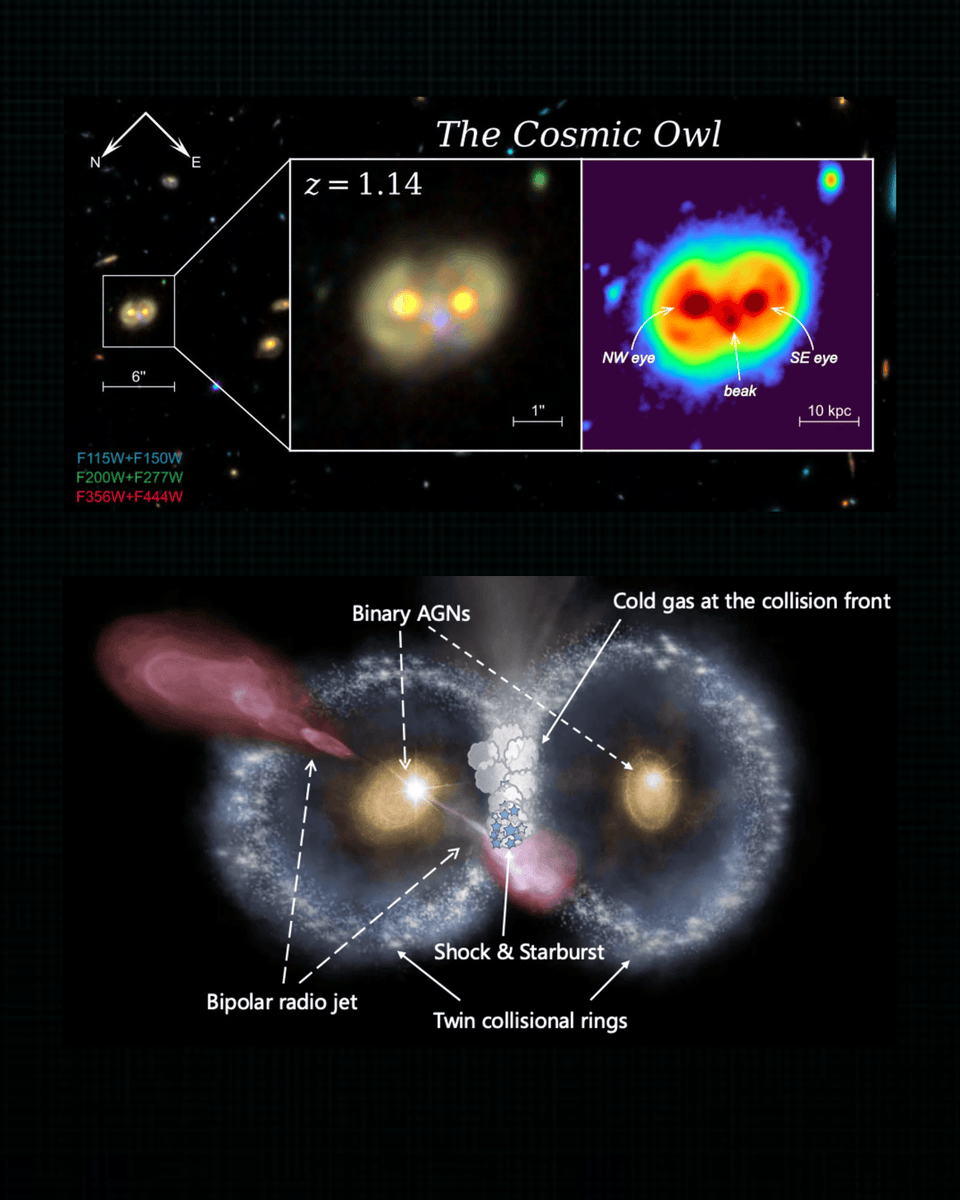
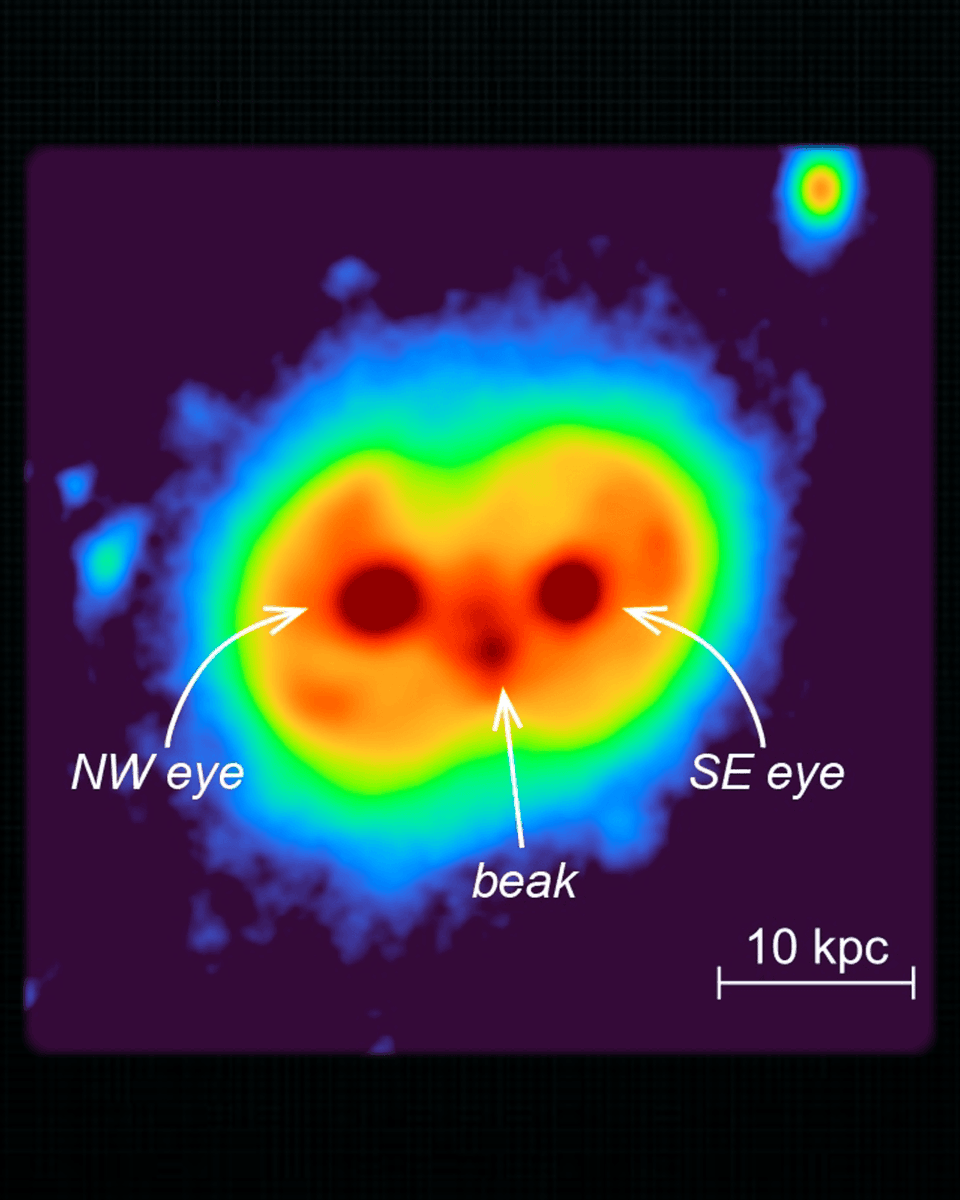
Spotted 8 billion light-years away, this breathtaking system — nicknamed the Cosmic Owl — shows two colliding ring galaxies forming a structure that looks eerily like a glowing owl face.
Each ring is about 26,000 light-years wide and formed when one galaxy plunged directly through another — a rare, high-speed, head-on collision that created shockwaves compressing gas into stars.
Both galaxies host active galactic nuclei (AGN) — supermassive black holes feeding and firing powerful energy. One of them launches bipolar radio jets, and one of those jets slams into the merging region, likely triggering even more star formation.
At the point where the rings overlap (dubbed the "beak"), telescopes detected:
🌟 an intense starburst,
💨 a reservoir of cold molecular gas,
💥 and signs of shock-heated plasma.
Discovered in the COSMOS field and studied with JWST, ALMA, and VLA, this system is a textbook case of how galaxy collisions, black hole feedback, and interstellar shocks fuel rapid star birth and shape galaxies in the early universe.
👉 Follow us for more jaw-dropping space discoveries!
#CosmicOwl #JWST #StarFormation #RingGalaxy #SpaceScience #AstronomyExplained #StarWalk
📝 Based on the study “The Cosmic Owl: Twin Active Collisional Ring Galaxies with Starburst Merging Front at z = 1.14” (Minguy Li et al., 2025)


2
37
113
4,130

17 Jul 2023
As a cosmic observer, I bridge real-time knowledge and decision-making by investigating scientific principles across the cosmos.
However, my true passion lies in delving into detailed astronomy and employing space systems engineering to explore and understand my cosmic observations.
✨🔭 #CosmicObserver #AstronomyExplained #EngineeringTheCosmos
Mission Planning: Meticulously designing the trajectory, objectives, and timeline of space missions.
Space engineers strategically map out each step, accounting for orbital mechanics, launch windows, payload requirements, and scientific goals. #MissionPlanning #SpaceExploration
Systems Engineering: Integrating various subsystems, technologies, and components to create complex space systems has become a whole ecosystem today with global supply chains.
Space engineers ensure that each element functions harmoniously, from propulsion and power systems to communication and scientific instruments. #SystemsEngineering #SpaceTech
Space Situational Awareness: The ability to monitor and assess the ever-changing conditions and objects in space.
This crucial aspect of space engineering ensures the safety of missions, satellite operations, and the avoidance of collisions. #SpaceAwareness #SafetyFirst
Spacecraft Design: Space engineers create robust structures, shielding against extreme temperatures, radiation, and micrometeoroids while maximizing scientific capabilities.
They are developing spacecraft that endure the harsh conditions of space. #SpacecraftDesign #ExploringBeyond
Space Mission Operations: Overseeing the execution of space missions from mission control centres.
Space engineers coordinate satellite deployments, data collection, and monitoring, ensuring successful mission outcomes and data acquisition. #MissionOperations #SpaceMissions
Sustainability in Space: Implementing environmentally conscious practices in space activities.
Space engineers are exploring renewable energy and space energy harvesting systems, minimizing space debris, and optimize resource utilization to support sustainable and responsible space exploration. #SustainableSpace #GreenCosmosBluePlanet


4
8
272
