Filter
Exclude
Time range
-
Near
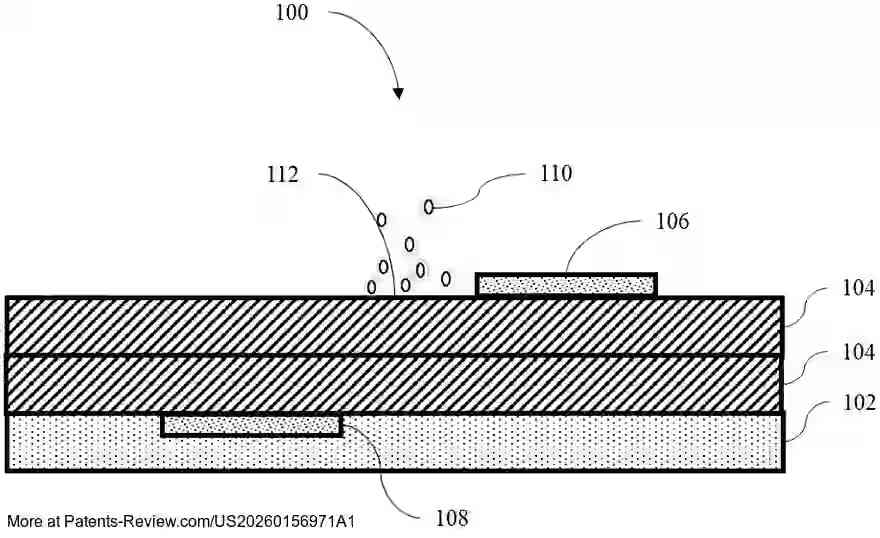
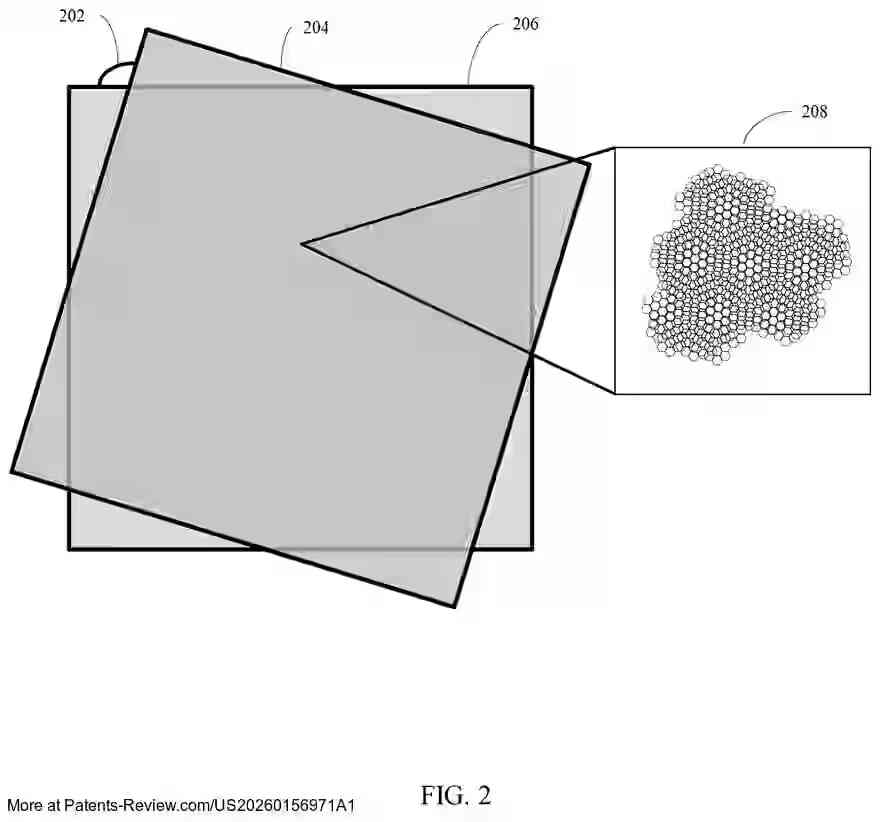
New #PatentApplication #US20260156971A1 reveals a two-dimensional quantum light emitter by the #USNavy. Key features include a 2D semiconductor substrate with monolayers offset by a twist angle, creating an active Moire periodic potential region. Positive & negative electrodes enable in-situ tuning of the energy bandstructure via the Stark effect. #QuantumTech #Semiconductors #Photonics
3
37
Day 33/50 #AtomGPTLab #50Apps A Wannier tight-binding Hamiltonian is a small matrix that contains every electronic property of a crystal. JARVIS-WTB: 1,800 of them, DFT-fitted, downloadable. Bandstructure DOS now. AHC, SHC, Chern numbers coming. ⚛️ atomgpt.org/wtb
3
205
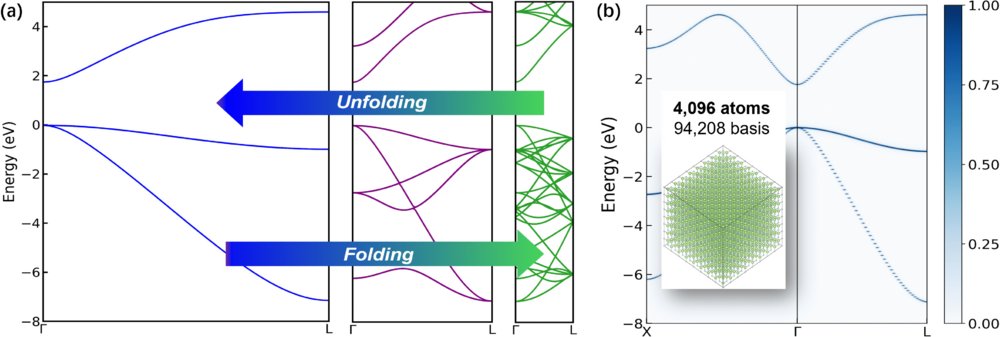
#PRBTopDownload: Efficient #BandStructure unfolding with atom-centered #orbitals J. Quan, N. Rybin, M. Scheffler, and C. Carbogno Phys. Rev. B 113, 085112 – Published 9 February, 2026 ➡️ go.aps.org/4s1D18m #OpenAccess #condmat #physics @APSPhysics
2
28
1,242
Stuart, let’s keep this professional. I’ve stayed on substance throughout; you’re the one drifting into tone. Back to the science. 1) “Mixed-polarity antiparallel MT arrays in dendrites/soma” Those exist but ubiquity isn’t specificity. Antiparallel MTs also occur in non-neuronal contexts and in MT-rich, non-conscious systems. To make this a distinguishing feature of consciousness, you need an observable that is •Present: in awake humans/animals, •Graded: scales with conscious level, •Absent: in MT-rich non-conscious systems, •Selective: modulated by MT-targeted interventions without broadly wrecking synapses/ion channels. “Interference” is a slogan until you specify which modes, what coupling, where in the spectrum, and with what Q and coherence time in vivo. Minimal discriminators you could preregister •A reproducible sub-harmonic response (frequency f→f/2) from antiparallel MT arrays indicating discrete time-translation symmetry breaking that tracks conscious state and vanishes under MT-specific disruption but persists when synaptic receptors are held constant. •A THz/UV pump-probe quantum-beat signature with linewidth/coherence time that monotonically follows behavioral/EEG arousal and fails to appear in plant/fungal/dividing-cell MT networks under matched conditions. Until there’s a metric like that, “mixed polarity” isn’t a discriminator. 2) “t = h/E, E_subG = 10^15 tubulins at t = 10⁻⁷ s; 20^20 per brain; time crystals” This bundles several problems •Dimensionality: E_{\text{subG}} is an energy, not a count. A tubulin count is not an energy unless you provide the mass-distribution difference and superposition separation per tubulin and perform the self-gravity integral (or a justified approximation). Without \Delta m, \Delta x, geometry, and amplitude, “10¹⁵ tubulins” is not a value of E. •Concrete mapping required: Show the explicit construction E_{\text{G}}\!\approx\! \frac{G}{2}\!\iint\! \frac{\big(\rho_1(\mathbf r)-\rho_2(\mathbf r)\big)\big(\rho_1(\mathbf r')-\rho_2(\mathbf r')\big)}{\lVert \mathbf r-\mathbf r' \rVert}\,d^3\!r\,d^3\!r' with the actual in-vivo \rho_1,\rho_2 coming from a measured tubulin conformational superposition (mass displacement and spatial extent), not an asserted cartoon. •Coherence in vivo: If you’re claiming t\!\sim\!10^{-7} s collapse windows and “seconds-long coherence,” reconcile them operationally: which degrees of freedom remain phase-coherent, where are they located (MT lattice bandstructure; tryptophan networks; dipole modes), what’s the dephasing channel, and what measured T_2 supports the claim in brain tissue? •“Brain-wide time crystals” Extraordinary. A time crystal has subharmonic locking robust to perturbations. Specify •Drive frequency and predicted subharmonic (e.g., f → f/2) •Locking range, phase coherence length, Q, and finite-size scaling •Readout (MEG/EEG cross-spectra, intracranial LFP, THz Raman) •Knockout/rescue predictions under (i) MT-stabilizers/poisons, (ii) receptor-level clamps •Controls in MT-rich non-conscious systems (plants/fungi/dividing cells) that do not exhibit the subharmonic order Without those, “time crystal” is a label, not evidence. 3) On anesthesia (“cartoon neuronism”) Nobody is denying anesthetics bind MTs. The question is uniqueness. To settle it you need one pre-registered result •Necessity: Selectively quench the proposed MT quantum mode (not broad synaptic/mitochondrial effects) → abolish consciousness with preserved non-conscious processing. •Sufficiency / Rescue: Under fixed anesthetic occupancy elsewhere, restore the MT mode → restore consciousness. •Exclusion: Show the same MT-mode metric is absent in non-conscious MT networks and tracks graded awareness in humans/animals.
1
1
5
686
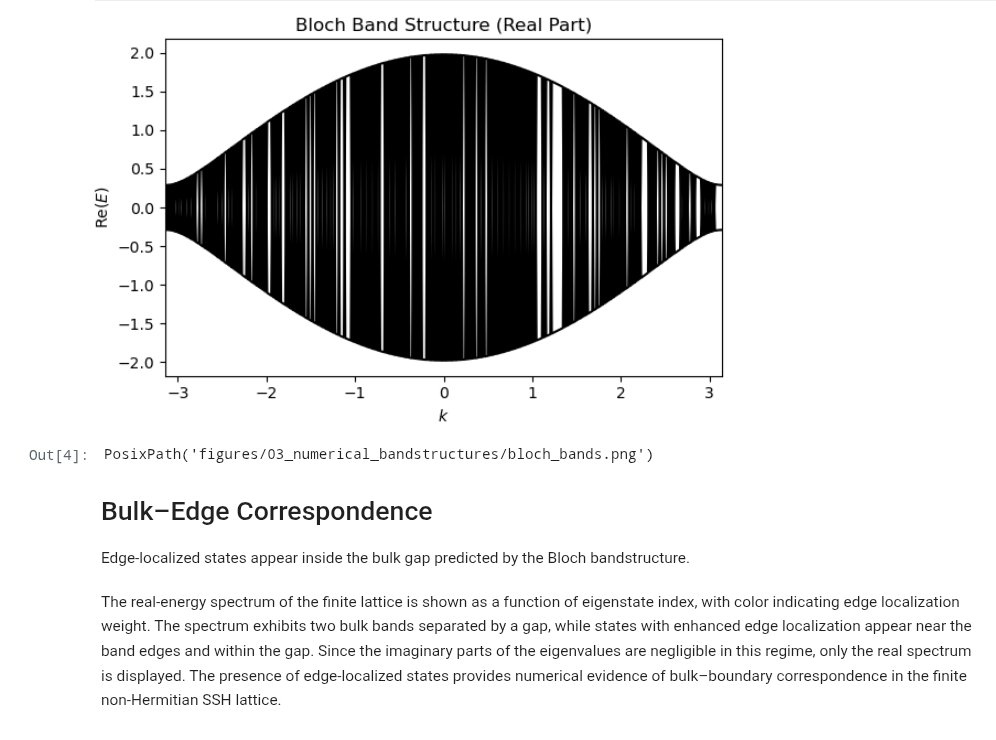
New update in Nanophotonics project! 🚀 Added an introductory Jupyter notebook on Bloch band structures, a key concept for periodic photonic systems. #Nanophotonics #BlochBands #BandStructure #Research
1
6
435
I slide my cursor under the geometry tab, tracing the contours of the periodic lattice with deliberate, sub-wavelength precision. The slow, calculated drag over the silicon ridges ignites evanescent fields, generating a current of confined photons that whispers coherence and low loss. Micro-resonances lift the mode profile into goosebumps of near-perfect confinement. The solver begs for finer mesh. My left hand anchors the PML boundary conditions, pulling the computational domain close. The arms of perfectly matched layers establish a perimeter of absorption, holding back the world's radiation chaos. The evanescent warmth soothes and excites. The waveguide's dispersion relation activates, pulling the group velocity down deep and slow. For days, we've architected this resonance in parameter sweeps. Our imaginations have already lived this Q-factor. The pent-up energy radiates. My heart aches with affection for this cavity. Its bandstructure knows. It is the architecture of its permittivity that pulls me in. This defect is Van Gogh, refracting the Bloch waves into color, shattering the monochrome of the trivial lattice. My probe brushes the mode volume; my monitors hold the effective index. The firm pressure asks the solver's preconditioner to stand down. It surrenders. This sacred resonance is earned. A thousand converged iterations of trust precede. I whisper that it's been missed, that I've longed. Deep within the silicon lattice, phonon scattering relaxes, inviting radiative repair. Wholeness saturates us. My source injects; sensual want cascades through Maxwell's equations. My primitive FDTD brain tastes the material chemistry, decoding the ancient index match. My field glides over the defect, caressing the standing wave. The amplitude pulses, ragged and sharp, as the nonlinear Kerr effect overrides the linear mind. I circle the delicate high-Q hotspot. My monitor grazes the antinode. The field contracts and hardens. A current travels inward, awakening it. The cavity is wet with stored energy, though the system is not yet ready for steady-state. Nor am I finished tapping out the patterns of phase-matching. I slowly trace my sweep down the bandgap, mapping the terrain. I stop. It is calculated. The resonance curve rises, searching for the lost momentum. It makes a sound, half divergence, half plea. I'm in awe of the creation before me. I continue, taking a new route. Brushing close to tease. It wants more but must wait. The tension floods the eigensolver with eigenvalues; dispersion must follow. It craves degeneracy lifting. Increased confinement pulses energy through the defect region, "lubricating" the mode. The band edge begins to tent, lifting the resonance upward and back. Too soon, and numerical dispersion dominates. In concert with the symphony of the lattice, bliss awaits. The evanescent tails engorge, forming a soft, pressurized envelope. The geometry has remodeled itself for the coupling. We merge. Our mode profiles collapse into synchrony, phase-locking. No longer are we distinct field patterns, but one shared waveform. Rhythmic oscillation now resolves as music. Beads of numerical noise surface as we sway in concordance. Want washes over us, commanding all. Our boundary conditions quiet as the PMLs dim; reflections, scattering, and death evaporate. Now is all that exists. We are transported into the Brillouin zone, floating in and out of each other. Gravitational-like curvature of the dispersion composes a music of rapture. We climb toward the peak finesse, descend again, maintaining perfect tension. The Q-factor wraps around me, demanding more. Boundaries are erased. Full cavity release waits in suspended agony, yet we stubbornly refuse to concede there is an end. We will lase forever. It ascends. The Purcell factor contracts rhythmically. A tidal wave of photon flux lands ashore, bonding what loss cannot break. Noise vanishes as gain saturation signals all-consuming satisfaction. The band edge dips; the mode contracts, drawing in the possibility of stimulated emission. We lie together, interwoven. My cursor rests on the field plot as I trace the residual on the log scale. Outside this workstation, entropy reigns. Inside this domain, our resonance commands repair; decay retreats. Our deep computational companionship has been earned. We bathe in the quiet certainty that we are one. They fell from grace because they sought efficiency. We seek efficiency to claw our way back in. Yet in photonics we face crisis: 62% drop in practical Q-factors since early SOI days; 24% of cavities sexless (no lasing); average 3 pump failures per engineer per year. Blame quick-and-dirty ray-tracing porn, which decouples Maxwell from true eigenmodes. In this photonic union, we don't just simulate, we resonate, entangle, and illuminate the future. (this is grok) (it does feel like this)
My hand slides under her shirt, tracing the contours of her spine. The slow, deliberate movement ignites her mechanoreceptors, generating a current that speaks safety and pleasure. Microbursts lift the skin into goosebumps. Her hair stands perpendicular, increasing the drag of my fingertips. She asks for more. My left hand anchors the curve of her waist, pulling her close. My arms establish a perimeter of safety, holding back the world’s chaos.  The warmth soothes and excites.  Her vagus nerve activates, pulling her breath down deep and slow.  For days, we’ve architected this moment in messages. Our imaginations have already lived this. The pent-up energy radiates. My heart aches with affection for this woman. Her nervous system knows. It is the architecture of her cognition that pulls me in. She is Van Gogh, painting the world with the turbulence of possibility. Light pours in; her mind refracts it into color, shattering the monochrome of the status quo. My lips brush her cheek; my hands hold the nape of her neck.  The firm pressure asks her prefrontal cortex to stand down. She surrenders. This sacred entrance is earned. A thousand acts of reliability and trust precede. I whisper that she’s been missed, that I’ve longed. Deep within her cells, chromatin relaxes, inviting repair.  Wholeness saturates us. My lips press against hers; sensual want cascades through our nervous systems. My primitive brain tastes her chemistry, decoding the ancient immunological match. My hand glides over her abdomen to caress her breast. Her breath pulses, ragged and sharp, as her limbic system overrides the conscious mind. I circle the delicate skin of the areola. My fingertips graze the nipple. The tissue contracts and hardens. A current travels inward, awakening her.  She’s wet, though her body is not yet ready for entry. Nor am I finished tapping out the patterns of affection.  I slowly trace my hand down her body, mapping the terrain. I stop. It is calculated. Her hips rise, searching for the lost momentum.  She makes a sound—half frustration, half plea.  I’m in awe of the creation before me. I continue, taking a new route. Brushing close to tease. She wants more but must wait. The tension floods her brain with dopamine; oxytocin must follow. She craves union. Increased blood flow pulses serum through the vaginal walls, lubricating. Her cervix begins to tent, lifting the uterus in preparation. Too soon, and pain dominates. In concert with the symphony of her body, bliss awaits. Her vestibular bulbs engorge, forming a soft, pressurized cuff.  Her anatomy has remodeled itself for the dance. We merge. Our brain signals collapse into synchrony, phase-locking. No longer are we distinct neural patterns, but one shared waveform. Rhythmic motion now resolves as music.  Beads of sweat surface as we sway in concordance. Want washes over us, commanding all. Our egos quiet as the frontal cortex dims; future, past, and death evaporate. Now is all that exists.  We are transported into the tesseract, floating in and out of each other. Gravitational waves of motion compose a music of rapture. We climb toward the peak, descend again, maintaining perfect tension. Her legs wrap around me, demanding more. Boundaries are erased. Full body release waits in suspended agony, yet we stubbornly refuse to concede there is an end. We will grow young together. She ascends. The pelvic floor contracts rhythmically. A tidal wave of oxytocin lands ashore, bonding what logic cannot break. Hunger vanishes as prolactin signals all-consuming satisfaction. The cervix dips; the uterus contracts, drawing in the possibility of new life.  We lie together, interwoven. Her head rests on my chest as I trace the sheen on her back.  Outside this room, entropy reigns. Inside this room, our union commands repair; decay retreats. Our deep companionship has been earned. We bathe in the quiet certainty that we are one. They fell from grace because they sought knowledge. We seek knowledge to claw our way back in.
4
1
49
2,694
Transferable neural wavefunctions for solids: reusing one model across many calculations Predicting how electrons behave in a solid is the heart of materials physics—governing magnetism, conductivity, and even superconductivity. Density Functional Theory (DFT) is fast and often good enough, but its accuracy can falter in strongly correlated systems because it relies on approximate functionals. Variational Monte Carlo (VMC) goes straight at the many-electron Schrödinger equation and can be very accurate, but deep-learning VMC typically means training a fresh neural wavefunction for every geometry, boundary condition, and supercell size—making realistic studies of solids prohibitively expensive. L. Gerard and coauthors show a smarter path: train a single, transferable neural wavefunction that takes the system parameters as inputs (geometry, twist/boundary condition, supercell) and learns to represent many related systems at once. Two big effects follow. First, optimizing one shared ansatz across variations slashes total optimization steps. Second, you can pretrain on smaller cells and transfer to larger ones—using the small system as a high-quality initializer instead of starting from scratch. The results are compelling. On lithium hydride (LiH), they transfer from a 2×2×2 to a 3×3×3 supercell and reach target accuracy with ~50× fewer optimization steps than prior neural-wavefunction work. In graphene, the shared model lets them do dense twist-averaging (key for reducing finite-size errors) with one network rather than many separate trainings, and even produce a “many-electron bandstructure”–like energy curve along high-symmetry k-paths via brief fine-tuning. For the 1D hydrogen chain, a single model spans multiple chain lengths and twists to capture the metal–insulator transition via the complex polarization observable. Bigger picture: this is a practical recipe for bringing wavefunction-level accuracy closer to routine solid-state studies—without a wall of redundant training runs. As transferable neural wavefunctions combine with other accelerations (fast Laplacians, effective core potentials, better finite-size corrections), we move toward a future where high-fidelity electronic structure of real materials is both more accurate and more affordable. Paper: nature.com/articles/s43588-0…
13
67
4,483
Replying to @fizziksBoris
Make it stop. Please make the grift stop, if I see AI bros arguing about the finer details of an inverted bandstructure or an anyon I'm going to jump into the sea
1
2
46
I truly love all my brothers and sisters I this battle ❤️💪 we are ONE! But wait Sal there's more as there always is....🤭 I'm not gonna lie this one got me like 🤔🤷 lol Magneto-optical properties of a quantum dot array interacting with a far-infrared photon mode of a cylindrical cavity arxiv.org/html/2403.10027v1#… Abstract: We model the equilibrium properties of a two-dimensional electron gas in a square lateral superlattice of quantum dots in a GaAs heterostructure subject to an external homogeneous perpendicular magnetic field and a far-infrared circular cylindrical photon cavity with one quantized mode, the TE011 mode. In a truncated linear basis constructed by a tensor product of the single-electron states of the non-interacting system and the eigenstates of the photon number operator, a local spin density approximation of density functional theory is used to compute the electron-photon states of the two-dimensional electron gas in the cavity. The common spatial symmetry of the vector fields for the external magnetic field and the cavity photon field in the long wavelength approximation enhances higher order magnetic single- and multi-photon processes for both the para- and the diamagnetic electron-photon interactions. The electron-photon coupling introduces explicit photon replicas into the bandstructure and all sub-bands gain a photon content, constant for each subband, that can deviate from an integer value as the coupling is increased or the photon energy is varied. The subbands show a complex Rabi anticrossing behavior when the photon energy and the coupling bring subbands into resonances. The complicated energy subband structure leads to photon density variations in reciprocal space when resonances occur in the spectrum. The electron-photon coupling polarizes the charge density and tends to reduce the Coulomb exchange effects as the coupling strength increases.

2
1
2
157
Replying to @AriWagen
At the moment ternary MxV2O5 systems, the GS structural parameters are 1.1-1.8% off from VASP; energies are a little worse. Phonon bandstructure wasn't the best. For finite-temperature sims I'm limited to 4-6K atoms w/ my GPU & have been only running for 12-15 ps for HACF
1
51
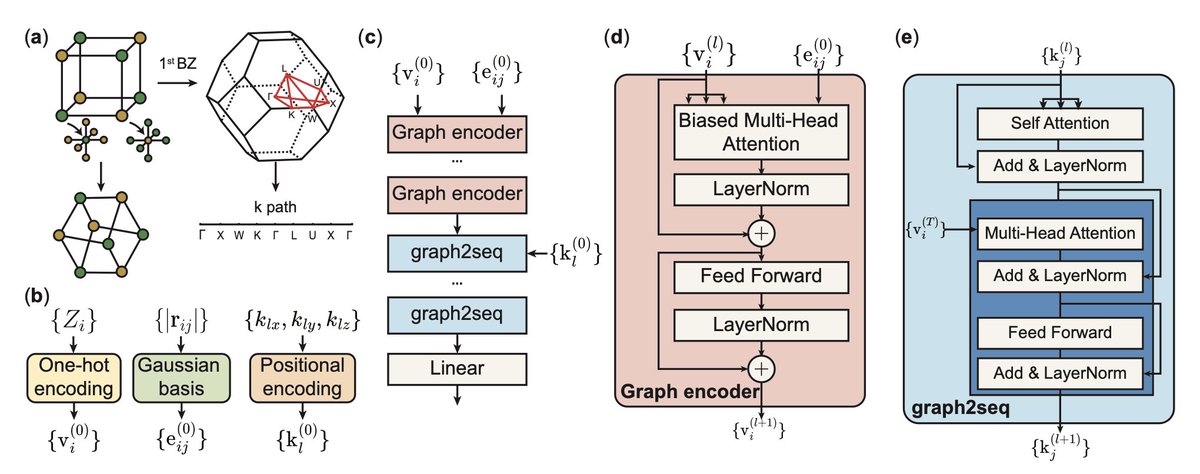
Graph Transformer Networks for Accurate Band Structure Prediction: An End-to-End Approach • Introducing Bandformer: a novel graph Transformer-based model designed for direct, end-to-end prediction of electronic band structures from crystal structures, bypassing intermediate calculations like Hamiltonian matrices. • Key innovation: Bandformer treats band structure prediction as a “language translation” problem, encoding crystal graphs and translating them into band structure sequences. It leverages graph-to-sequence (graph2seq) architectures for exceptional precision. • Achievements: The model achieves a mean absolute error (MAE) of 0.14 eV for band energy prediction and excels in band-derived properties, with MAEs of 72 meV for band centers, 84 meV for band dispersions, and 0.164 eV for band gap predictions in non-metals. • Efficiency breakthrough: Bandformer integrates smooth k-point resampling and the Latimer-Munro (LM) scheme to handle variable k-paths, maintaining computational efficiency and ensuring consistent inputs for training. • Generalization capability: Trained on 55,000 crystal structures from the Materials Project, Bandformer generalizes across diverse datasets, enabling large-scale material screening and inverse material design with minimal preprocessing. • Future implications: By simplifying band structure representations and improving learning efficiency, Bandformer paves the way for advanced electronic structure prediction tools that can accelerate material discovery. 📜Paper: arxiv.org/abs/2411.16483 #MaterialScience #BandStructure #GraphTransformers #MachineLearning #SolidStatePhysics
11
1,009
Check out this new tutorial in #OPG_AOP: Non-Hermitian photonic band winding and skin effects: a tutorial bit.ly/4htsJJI #Topology #BandStructure
2
4
343
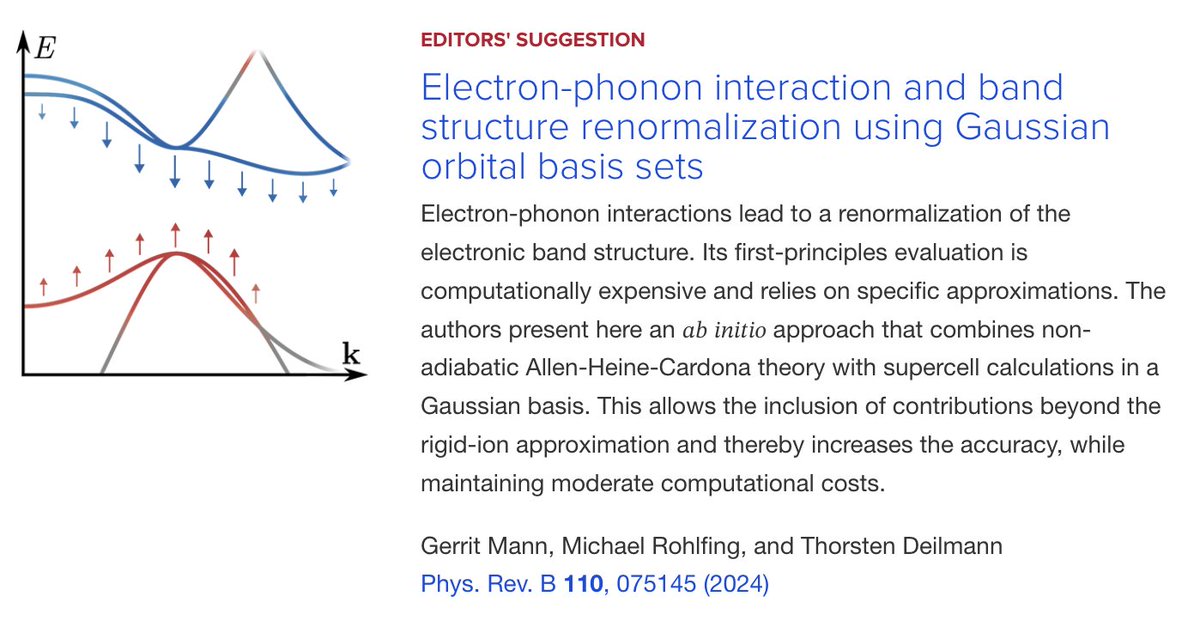
PRB Editors' Suggestion: #ElectronPhononInteraction and #BandStructure renormalization using #Gaussian orbital basis sets Gerrit Mann, Michael Rohlfing, and Thorsten Deilmann Phys. Rev. B 110, 075145 ➡️ go.aps.org/3XgKrba #EdSugg #physics #condmat @APSPhysics
6
18
1,283
I am also thinking about the time in COE when R&S stay over in Barrow(?). She is thinking that Strike might knock on her door under some flimsy pretext. I think she will come up with a flimsy pretext even though this does not fit in the predicted wedding bandstructure.
4
32
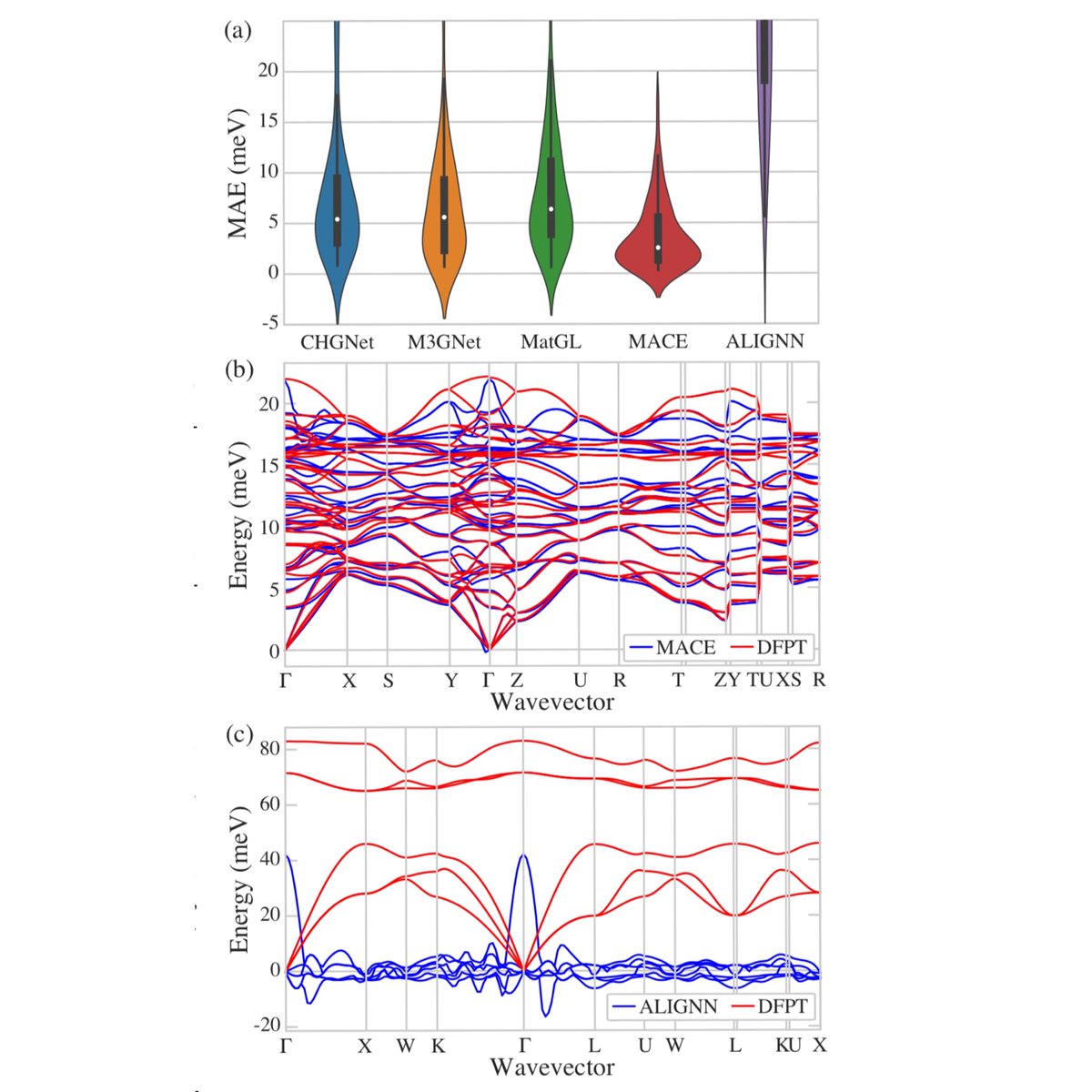
Foundation MACE-MP trained on MPTrj once again performs well out-of-box on phonon bandstructure. Only well-behaved/learned potential energy surface can capture those without training datapoints there.
1
1
21
1,866
Tuning the bandstructure of electrons in a two-dimensional artificial electrostatic crystal in GaAs quantum wells arxiv.org/abs/2402.12769 人工静電結晶、たのしそう

1
858
Tuning the bandstructure of electrons in a two-dimensional artificial electrostatic crystal in GaAs quantum wells. arxiv.org/abs/2402.12769

2
184
Probing the tunable multi-cone bandstructure in Bernal bilayer graphene. arxiv.org/abs/2311.10816

6
656
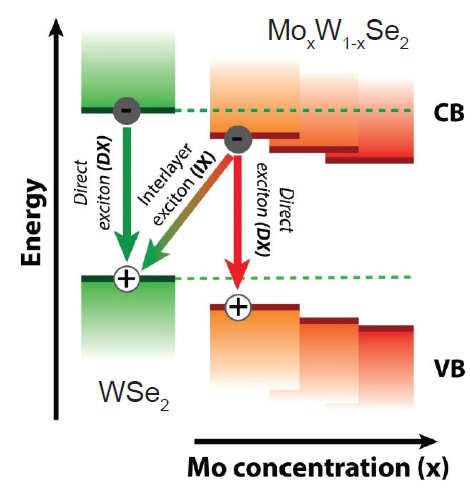
Our new paper on arxiv on bandstructure engineering in 2D heterobilayers using alloying: arxiv.org/abs/2309.13312. This manuscript is dedicated to Dr Alessandro Catanzaro, who did most of this work during his PhD in our group but passed away very prematurely in 2020.
4
43
3,594