
Oh, and for the "can bitcoin do the more modern version", the answer is... maybe.
It could emulate many parts of it if it had any working introspection, and maybe there are convoluted bitvm or off-chain-computation variations that could be made, but cost of making that is high.
4

Jun 13
Massage
in
Riyadh
Jeddah
khobar
dammam
Hofuf
abha
jubail
buraydah
al kharj
wa.me/ 966548381623
🤎 Hup Russian 🥧303 🐫🇰🇾
bItvm

13


Jun 12
Stahp, he's already dead 😂😂
I think the problem comes from his academic engineers who probably use all those manipulation tactics on him.
This is a whole conversation where someone who I assume is his engineer explain how they did scale Cardano, solving hypothetical problems that literally no one practically has.
At the time of the BOS announcement, I was in Bitcoin DeFi, and his engineer Riley kept explaining the whole workflow, describing the entire BitVM system that everyone is bearish on because it's a massive Rube Goldberg design.
If he wasn't such a retard, he'd be open to at least some of the ICP capabilities as one of the third parties 😂😂
x.com/CardanoAftrDark/status…
Jun 10

Dismissing proven scaling tech because it’s not a one click global miracle is moving the goalposts 😆
1
5
570

small block bitcoin was supposed to scale on higher layers. that never happened. no sidechains, LN is not scaling ownership, timeout trees arguably fail to custody in high congestion... BitVM seems far too impractical to actually see any use.
2
5
252

Jun 12
What if Bitcoin could do more than just HODL?
BitFlux is the first fully programmable platform secured by Bitcoin, using zero-knowledge rollups and the BitVM-based Clementine bridge.
Now live on mainnet, it brings lending, trading, and DeFi directly to the Bitcoin network.
1
189
Jun 12
How does BitFlux work?
1️⃣ Off-chain: Executes transactions in a zkEVM environment.
2️⃣ Proof: Generates zero-knowledge proofs for each batch.
3️⃣ On-chain: Posts the ZK proof & state diffs to Bitcoin for final, trust-minimized settlement via BitVM.
BTC stays protected by Bitcoin security, while developers build fully expressive ₿apps.
1
126


Jun 12
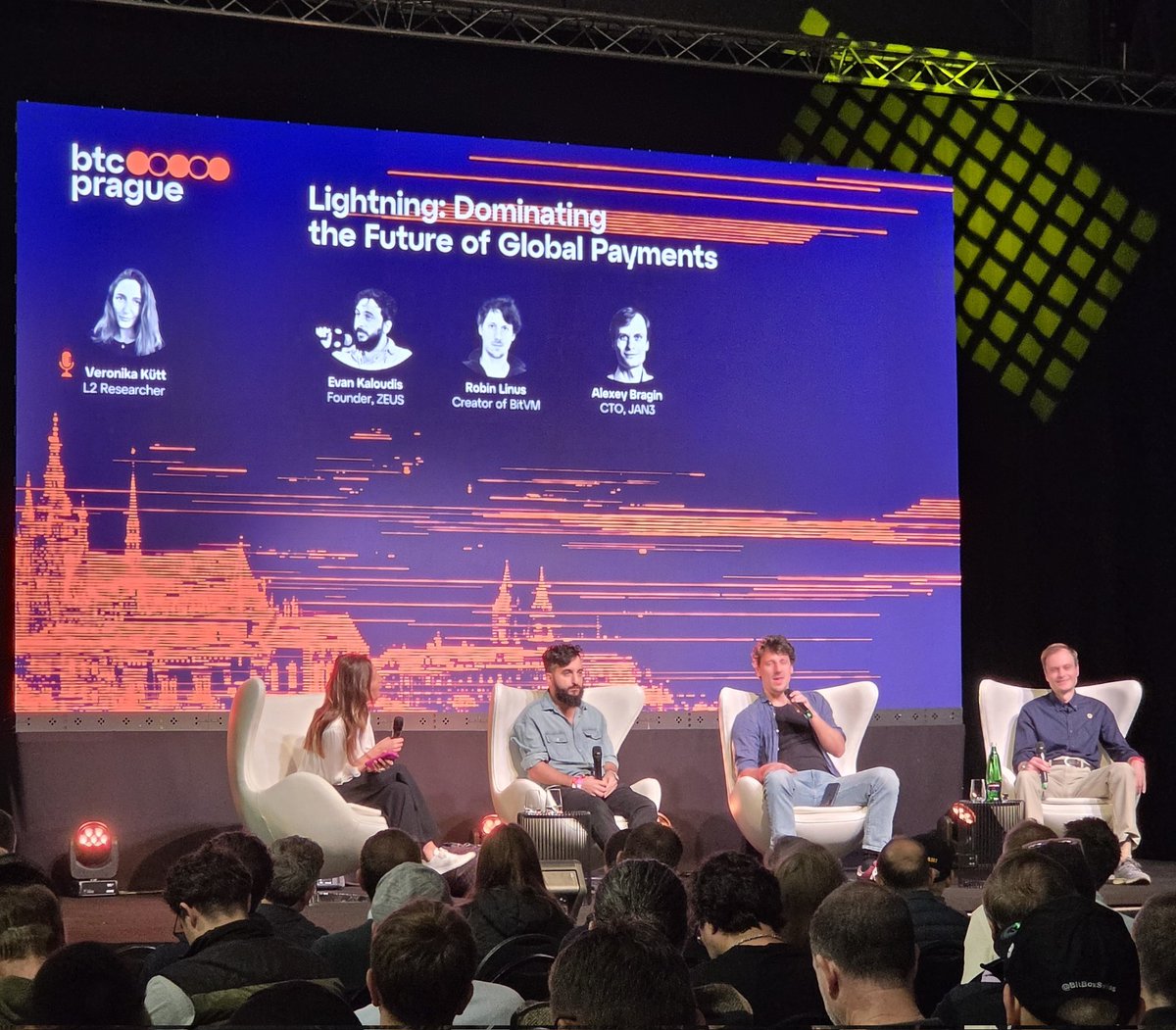
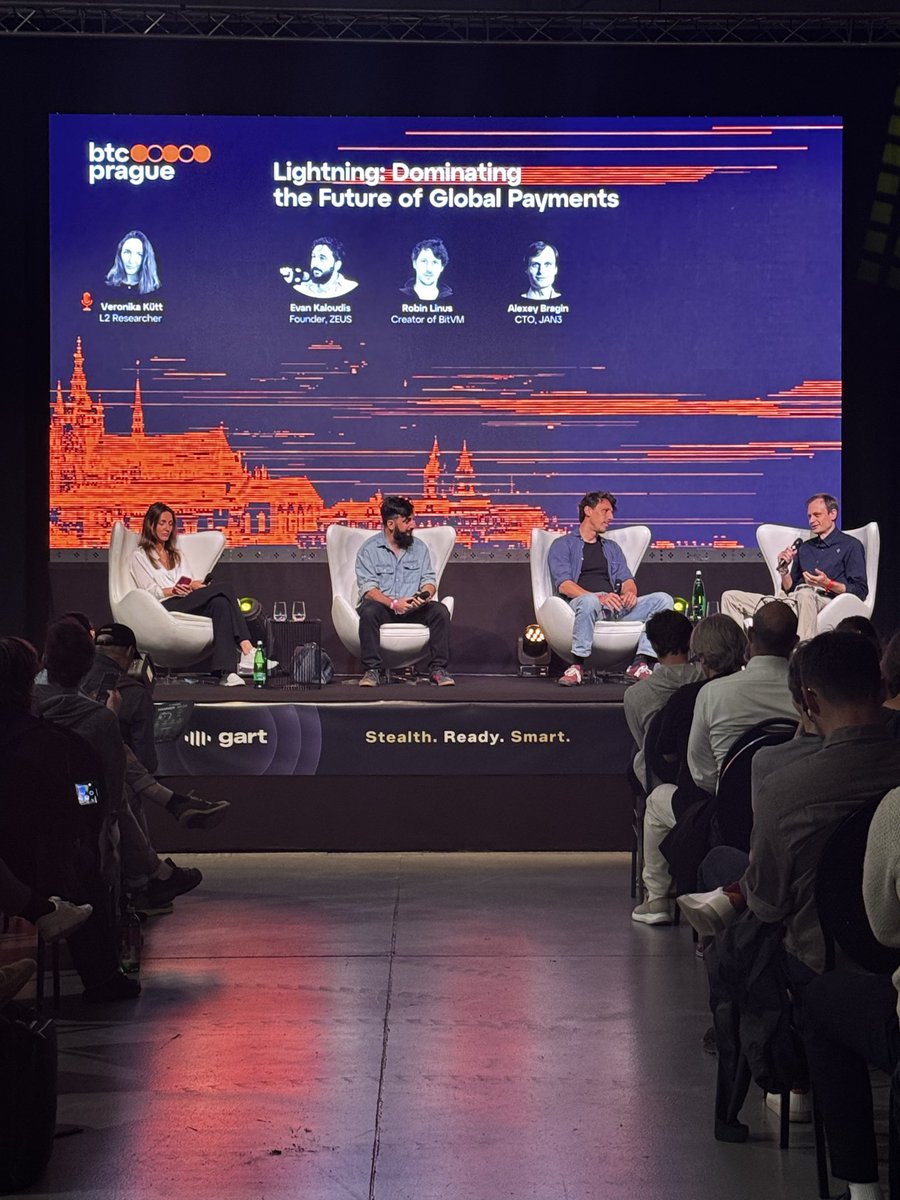
Alexey Bragin @JAN3com argues lightning is a great technology that serves its purpose, Evan Kaloudis, @ZeusLN says we’re just early, while @robin_linus w/BitVM, pushes back that the core Lightning narrative has failed. @BTCPrague
So what actually dominates the future of global payments?⚡️🌎
1
6
24
2,203

Botanix 关闭不代表 BTC 生态要完,恰恰说明粗放式跨链/L2 正在出清。RGB、BitVM、Alkanes、Ordinals……多条路线并行,废墟之上,价值会自己长出来 🌱
2
119
Aras retweeted

May 7
Don't worry this is not BitVM4!
But it is a significant achievement to make BitVM and Garbled Circuits style bridges a reality. Paper and code.
May 7

Introducing Mosaic 💥🔫
A practical fault-proof verifier implemented in Rust, with security strong enough to host financial markets on Bitcoin.
Mosaic realizes the Glock paper's vision at a low onchain cost.

2
2
24
1,707

Its because everything is coming home to the motherchain.
Have you been paying attention to Bitvm and what the @ZestProtocol team is doing?
3
161

How? Please explain how removing OP_IF in tapscript, breaking miniscript, breaking vaults and bitvm as well as breaking future upgrade paths for LN is "shitcoiner gymnastics"? And is it possible for you to even reply without the word "shitcoiner" since I'm not one?
14

Botanix关闭-BTC生态要完了?
Botanix 是当时在比特币生态最热闹的时候,非常受关注的西方二层扩展项目。它的关闭从侧面反映出,这个生态现在确实非常冷清。
当时在做比特币生态扩展时,其实有很多条路径,比如做 跨链桥,比如使用 BitVM 这种方式。这种跨链桥也包括中心化、半中心化和去中心化的方案,而目前最去中心化的方式应该是 BitVM,现在也还有很多团队在推进。我记得 Botanix 当时做的是一个联合方案,偏POS的方案。从投资阵容可以看出来,Botanix 曾是比特币生态在西方的一面旗帜,但今天它也停止运营了。
我个人觉得比特币生态一直都有希望和机会。但它到底会成长成什么样?因为比特币生态没有像 Vitalik 这样的人物,也没有一个统一的 Vision(愿景),所以它没有一个所谓更“正统”或更被认可的方向。
但从另一个角度来看,这其实是件好事,因为你会看到百花齐放、百家争鸣。关于比特币生态扩展到底该怎么做,目前有很多尝试:
1. 协议层:比如 Ordinals 或 Runes。
2. 创新技术:比如 BitVM。
3. 创新模式:比如多签的统一账户钱包。
4. 侧链模式:尝试最久的方案。
5. 语言或者脚本:因为可能会影响现有网络所以非常谨慎。(例如OP CAT;Simplicity语言)
我个人目前比较看好的还是 RGB 方向:
(a) 它比较受比特币“原教旨主义”的推崇,没有给网络带来额外负担。
(b) 它拥有全新的模式,比如基于 UTXO 的结构,这会导致它与账户模型有完全不一样的玩法。
(c)极致的隐私
(d)和闪电网络的完美兼容能解决性能问题
虽然 RGB 概念不算新,但因为它确实比较难做,从提出想法到现在,才刚刚开始有一些可以使用的设施或基建。接下来随着 RLN 的上线,整个 RGB 的这条路径可能会慢慢展现在众人面前,我很期待这件事的发生。
最近也看到了甲烷还有unisat的一些动作,看来大家也都没有放弃,挺好的。
风会吹回BTC生态,在之前狂欢过的废墟之上,有些真的有价值的东西正在成长,耐心一点,给他一点时间,能赢!
Jun 9

It is with a heavy heart that we announce we are winding down the Botanix network.
This decision is the hardest one we have made in four years, and we want to share the reasoning openly because the people who backed us, built with us, and used what we shipped deserve more than a quiet shutdown notice.
First off, an immediate practical consideration for the Botanix community: please withdraw your Bitcoin and other assets before July 9th, 2026.
When we started in 2022, the pitch was simple enough to say in a sentence: bring real utility to Bitcoin. What that actually meant in practice, and what we have spent nearly four years building toward, was more ambitious than that sentence made it sound. We were trying to build a Bitcoin-based blockchain that could find genuine product-market fit as a platform for Bitcoin applications, without using token incentives to drive growth, manufacture users, or simulate utility. Almost every chain that has launched in the last cycle has reached for the same playbook (issue a token without PMF, engineer the incentive surface, point at the resulting metrics), and we did not believe this route is a viable strategy in the long term. We wanted to know whether a Bitcoin chain could earn its users on the strength of what was built on top of it, the value it brings in the market with Bitcoin itself as the only meaningful economic primitive in the system.
And we built it. The Spiderchain went live and stayed live, a year of mainnet operation with one hundred percent uptime and zero security incidents on a genuinely novel cryptographic architecture. We built Dynafed, a dynamic federation that turned the Spiderchain from a static multisig set into a rotating, decentralized one, the technical milestone that most people in this space said could not be built on Bitcoin without compromising trust assumptions. Twenty-five million transactions, two hundred thousand wallets, and tens of millions of dollars in assets moved across the chain, every single number of that earned organically without a token, without airdrops, without points programs, or any of the manufactured-demand machinery. Chainlink, Morpho, GMX, Dolomite, Fireblocks, Alchemy, Galaxy, OKX Wallet, all integrated. We shipped a Bitcoin neobank with BINK on iOS and Android, with self-custodial email login for Bitcoin (something that had never existed before), native Bitcoin yield, and the lowest borrowing rates against Bitcoin anywhere in the world, all of it downstream of owning the infrastructure. The point of saying this is not to argue with our own conclusion. The protocol works, the product works, and our team and ecosystem worked in concert to do exceptional work.
We have run this experiment in earnest, with a working protocol, real applications, and a serious team, for over a year on mainnet and nearly four years in total. The honest answer we have arrived at, after living inside it every day, is that it did not work, at least not in this market and not on this timeline.
We want to share what we think we learned, with the caveat that some of this is conviction and some of this is still suspicion, and we would rather be transparent about the difference than pretend to have clarity we do not have.
The first thing I've had to sit with is timing. Bitcoin utility, making Bitcoin programmable, productive, and integrated into real financial activity, isn't where the real world users sit right now. The conversation is still on Bitcoin as a reserve asset, on its monetary and political positioning, on base-layer conservatism. Those questions are upstream of the ones a Bitcoin L2 needs people to be asking. I still believe Bitcoin gets there, but belief in the destination is not the same as being able to predict when, and nobody can. It's also possible the destination never materialises at all, and that Bitcoin's role as a reserve asset is simply where it settles. If that's true, there will never be a market for what we were building, and no amount of time or capital would change that.
The second is the token question. We intended to eventually launch a token. We saw it, and still see it, as a genuinely new form of equity, something closer to an IPO than an airdrop, to be done when you reach product market fit and the moment is right. That moment never came. What became clear over the last year is that the market largely stopped rewarding even the more considered versions of that playbook. Token launches across the board have broadly underperformed, and those that did go to market with tokens haven't seen the outcomes or PMF that the model is supposed to produce.
The third lesson is about where DeFi demand on Bitcoin actually lives. For most use cases that exist today, lending, yield, leveraged exposure, WBTC on a mature general-purpose L2 is genuinely sufficient. Users have voted with their behaviour, and the verdict is that the trust assumptions of a wrapped representation on Ethereum are acceptable to almost everyone who wants Bitcoin-denominated DeFi. Decentralisation matters to people in principle and in conversation; in practice, when something cheaper and easier is in front of them, they use it. The security case for a dedicated Bitcoin L2 is real, but it only matters for a narrower band of applications than our thesis required, one of the clearer lessons this market has taught us.
The fourth lesson is structural. The on-chain economy is consolidating around venues that own the user relationship: Hyperliquid, Robinhood, the major CEXes, and now TradFi participants absorbing an ever-larger share of attention, flow, and revenue. Convenience and institutional credibility win, every time, as soon as they're available. As retail participation thins, that concentration only deepens. We were, and still are, believers in decentralisation, but the current direction of on-chain growth is running through distribution, and any team building base-layer infrastructure today is rowing upstream against that current. We were no exception.
The fifth lesson is the most concrete. Both of the above played out directly in our economics. The users we attracted were primarily using Bitcoin as a store of value for yield, a legitimate use case, but not the high-frequency transaction volume that drives fee revenue on a network like ours. BINK was our answer to that: a Bitcoin neobank designed to bring daily usage of BTC and stablecoins on-chain, driving the transaction volume the network needed. It was the right strategic instinct, and one we never got the chance to fully test. BINK only landed on both app stores in the last few weeks, a product that by its nature could only be built once the underlying infrastructure was proven and live. When users choose the convenient option and economic gravity pulls toward distribution, what's left on a decentralised infrastructure layer is a user base that costs more to serve than it generates. Infrastructure costs are what they are, and the fee income never came close to covering them.
If you would like to see how we were imagining a Bitcoin future and what we have been working on since September, feel free to download BINK and give it a spin: it’s a full-fledged self-custodial Bitcoin Neobank with email login, one click borrowing, a Lightning integration and more.
App store: apps.apple.com/us/app/bink-b…
Play store: play.google.com/store/apps/d…
This UX is where we think Bitcoin is ultimately heading towards although it feels too early. You can use invite code 1SD31R, but remember to remove your funds by July 9th.
We could keep going. We have chosen not to, however, because continuing past the point where additional time stops producing additional learning is not conviction, it is something that looks like conviction from the outside while corroding into something else on the inside. We would rather stop now, with integrity intact and resources available to take care of the people who took a chance on us, than push the experiment past the point where it still has something to teach us.
Reminder: Please withdraw all your assets by July 9th. After this, the federation will sweep the remaining Bitcoin. Any other assets or tokens on the network from then onwards will unfortunately be unrecoverable.
After this, the federation will sweep the remaining Bitcoin. Any other assets or tokens on the network from then onwards will unfortunately be unrecoverable.
To our investors, who backed a thesis that was harder to defend than it should have been, to our partners who built alongside us and bet pieces of their own roadmaps on ours, to the developers who deployed on Spiderchain, to our users and the BINK community who showed up for something experimental and stayed, and most of all to the Botanix team who shipped a genuinely novel system with rigour and care and who made every hard day worth the difficulty: Thank you, more than the words available here can carry.
4
4
17
1,253

Jun 11
I wonder if the lack of market interest does not bode well though
DC/ecash will do much more and in a less complicated way than bitvm and ark based solutions, but some of the arguments still apply, such as the fact people don't care about the idealisms of crypto
1
19
eCashr retweeted

Jun 10
All Bitcoin L2s (BitVM, Arkade, Second Ark, Spark) will either grow enough to become serious SPOFs that can heavily harm the entire Bitcoin ecosystem in case of malfeasance or capture; or they will suffer from lack of funding and interest, and shut down.
There is literally no scenario in which they really help Bitcoin's mission.
Only Drivechain can do that.
Jun 9
It is with a heavy heart that we announce we are winding down the Botanix network.
This decision is the hardest one we have made in four years, and we want to share the reasoning openly because the people who backed us, built with us, and used what we shipped deserve more than a quiet shutdown notice.
First off, an immediate practical consideration for the Botanix community: please withdraw your Bitcoin and other assets before July 9th, 2026.
When we started in 2022, the pitch was simple enough to say in a sentence: bring real utility to Bitcoin. What that actually meant in practice, and what we have spent nearly four years building toward, was more ambitious than that sentence made it sound. We were trying to build a Bitcoin-based blockchain that could find genuine product-market fit as a platform for Bitcoin applications, without using token incentives to drive growth, manufacture users, or simulate utility. Almost every chain that has launched in the last cycle has reached for the same playbook (issue a token without PMF, engineer the incentive surface, point at the resulting metrics), and we did not believe this route is a viable strategy in the long term. We wanted to know whether a Bitcoin chain could earn its users on the strength of what was built on top of it, the value it brings in the market with Bitcoin itself as the only meaningful economic primitive in the system.
And we built it. The Spiderchain went live and stayed live, a year of mainnet operation with one hundred percent uptime and zero security incidents on a genuinely novel cryptographic architecture. We built Dynafed, a dynamic federation that turned the Spiderchain from a static multisig set into a rotating, decentralized one, the technical milestone that most people in this space said could not be built on Bitcoin without compromising trust assumptions. Twenty-five million transactions, two hundred thousand wallets, and tens of millions of dollars in assets moved across the chain, every single number of that earned organically without a token, without airdrops, without points programs, or any of the manufactured-demand machinery. Chainlink, Morpho, GMX, Dolomite, Fireblocks, Alchemy, Galaxy, OKX Wallet, all integrated. We shipped a Bitcoin neobank with BINK on iOS and Android, with self-custodial email login for Bitcoin (something that had never existed before), native Bitcoin yield, and the lowest borrowing rates against Bitcoin anywhere in the world, all of it downstream of owning the infrastructure. The point of saying this is not to argue with our own conclusion. The protocol works, the product works, and our team and ecosystem worked in concert to do exceptional work.
We have run this experiment in earnest, with a working protocol, real applications, and a serious team, for over a year on mainnet and nearly four years in total. The honest answer we have arrived at, after living inside it every day, is that it did not work, at least not in this market and not on this timeline.
We want to share what we think we learned, with the caveat that some of this is conviction and some of this is still suspicion, and we would rather be transparent about the difference than pretend to have clarity we do not have.
The first thing I've had to sit with is timing. Bitcoin utility, making Bitcoin programmable, productive, and integrated into real financial activity, isn't where the real world users sit right now. The conversation is still on Bitcoin as a reserve asset, on its monetary and political positioning, on base-layer conservatism. Those questions are upstream of the ones a Bitcoin L2 needs people to be asking. I still believe Bitcoin gets there, but belief in the destination is not the same as being able to predict when, and nobody can. It's also possible the destination never materialises at all, and that Bitcoin's role as a reserve asset is simply where it settles. If that's true, there will never be a market for what we were building, and no amount of time or capital would change that.
The second is the token question. We intended to eventually launch a token. We saw it, and still see it, as a genuinely new form of equity, something closer to an IPO than an airdrop, to be done when you reach product market fit and the moment is right. That moment never came. What became clear over the last year is that the market largely stopped rewarding even the more considered versions of that playbook. Token launches across the board have broadly underperformed, and those that did go to market with tokens haven't seen the outcomes or PMF that the model is supposed to produce.
The third lesson is about where DeFi demand on Bitcoin actually lives. For most use cases that exist today, lending, yield, leveraged exposure, WBTC on a mature general-purpose L2 is genuinely sufficient. Users have voted with their behaviour, and the verdict is that the trust assumptions of a wrapped representation on Ethereum are acceptable to almost everyone who wants Bitcoin-denominated DeFi. Decentralisation matters to people in principle and in conversation; in practice, when something cheaper and easier is in front of them, they use it. The security case for a dedicated Bitcoin L2 is real, but it only matters for a narrower band of applications than our thesis required, one of the clearer lessons this market has taught us.
The fourth lesson is structural. The on-chain economy is consolidating around venues that own the user relationship: Hyperliquid, Robinhood, the major CEXes, and now TradFi participants absorbing an ever-larger share of attention, flow, and revenue. Convenience and institutional credibility win, every time, as soon as they're available. As retail participation thins, that concentration only deepens. We were, and still are, believers in decentralisation, but the current direction of on-chain growth is running through distribution, and any team building base-layer infrastructure today is rowing upstream against that current. We were no exception.
The fifth lesson is the most concrete. Both of the above played out directly in our economics. The users we attracted were primarily using Bitcoin as a store of value for yield, a legitimate use case, but not the high-frequency transaction volume that drives fee revenue on a network like ours. BINK was our answer to that: a Bitcoin neobank designed to bring daily usage of BTC and stablecoins on-chain, driving the transaction volume the network needed. It was the right strategic instinct, and one we never got the chance to fully test. BINK only landed on both app stores in the last few weeks, a product that by its nature could only be built once the underlying infrastructure was proven and live. When users choose the convenient option and economic gravity pulls toward distribution, what's left on a decentralised infrastructure layer is a user base that costs more to serve than it generates. Infrastructure costs are what they are, and the fee income never came close to covering them.
If you would like to see how we were imagining a Bitcoin future and what we have been working on since September, feel free to download BINK and give it a spin: it’s a full-fledged self-custodial Bitcoin Neobank with email login, one click borrowing, a Lightning integration and more.
App store: apps.apple.com/us/app/bink-b…
Play store: play.google.com/store/apps/d…
This UX is where we think Bitcoin is ultimately heading towards although it feels too early. You can use invite code 1SD31R, but remember to remove your funds by July 9th.
We could keep going. We have chosen not to, however, because continuing past the point where additional time stops producing additional learning is not conviction, it is something that looks like conviction from the outside while corroding into something else on the inside. We would rather stop now, with integrity intact and resources available to take care of the people who took a chance on us, than push the experiment past the point where it still has something to teach us.
Reminder: Please withdraw all your assets by July 9th. After this, the federation will sweep the remaining Bitcoin. Any other assets or tokens on the network from then onwards will unfortunately be unrecoverable.
After this, the federation will sweep the remaining Bitcoin. Any other assets or tokens on the network from then onwards will unfortunately be unrecoverable.
To our investors, who backed a thesis that was harder to defend than it should have been, to our partners who built alongside us and bet pieces of their own roadmaps on ours, to the developers who deployed on Spiderchain, to our users and the BINK community who showed up for something experimental and stayed, and most of all to the Botanix team who shipped a genuinely novel system with rigour and care and who made every hard day worth the difficulty: Thank you, more than the words available here can carry.
2
1
10
726