Phoenix Heights retweeted

We’re building BlockPulse.
An AI assistant that helps people in Africa understand crypto and stay safe in Decentralized finance.
It helps users:
• Learn crypto and DeFi in simple terms
• Spot scams and risky projects
• Get basic market insights
• Learn step by step with AI support
Early MVP is live on Telegram: t.me/blockpulsehq_bot
More updates soon.
3
5
14
203

Jun 12
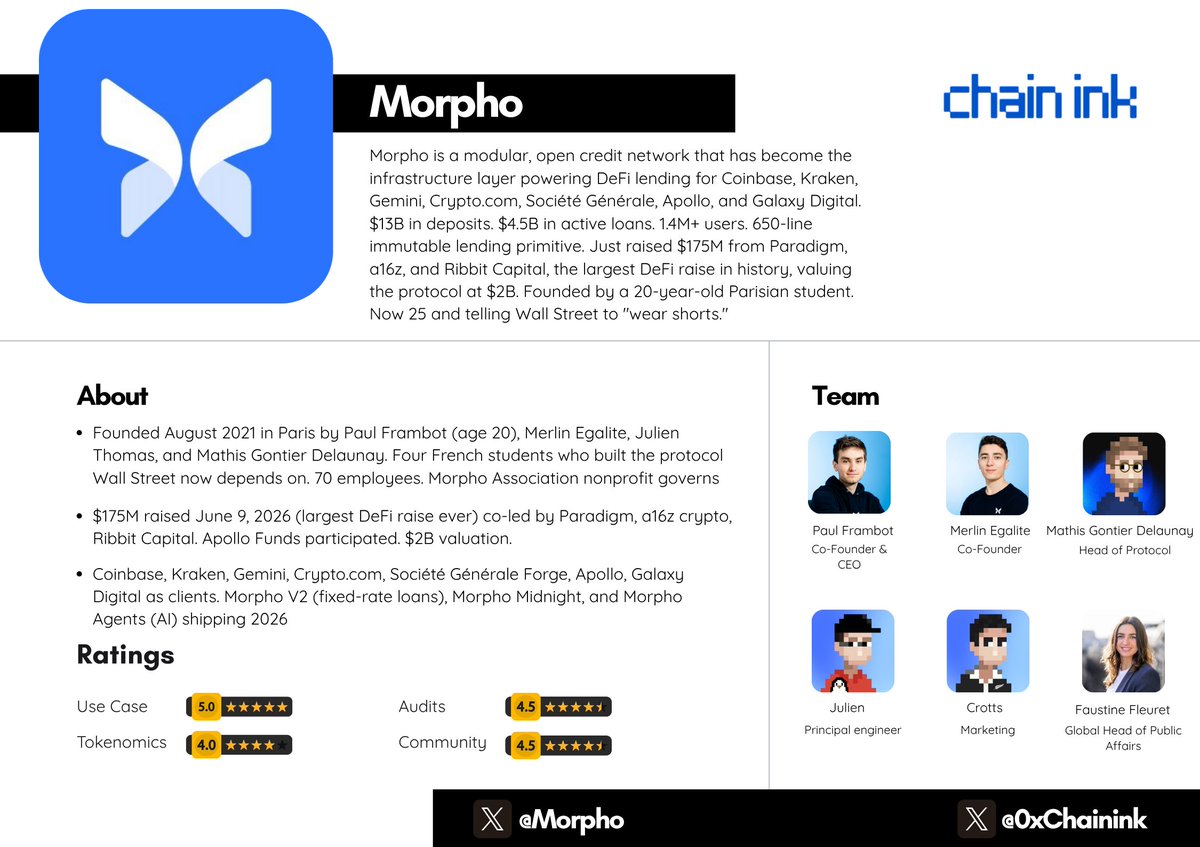
$MORPHO : Review 📜
What if a 20-year-old French engineering student built a lending protocol so good that Coinbase, Kraken, Gemini, Société Générale, and Apollo all chose it over Aave, and 5 years later he raised $175 million from Paradigm and a16z in the largest DeFi fundraise in history?
Meet Morpho - a modular, open credit network that reimagined how DeFi lending works. $13 billion in deposits. $4.5 billion in active loans. 1.4 million users. 320 vaults. Coinbase routes its USDC lending through Morpho.
Société Générale Forge uses it. Apollo, the $700 billion private equity giant, just invested. Paul Frambot started this in a Paris dorm room at age 20. He's now 25, valued at $2 billion, and telling Wall Street to "wear shorts." Two days ago, Paradigm, a16z crypto, and Ribbit Capital co-led a $175 million round. The largest raise DeFi has ever seen.
Let's explore how four French students built the credit infrastructure that institutions actually chose. 👇
⚪ Morpho at a Glance
Morpho is the modular lending stack that pulled $10B of TVL off monolithic lenders by reframing what a lending market is. Instead of one big shared pool like Aave or Compound, Morpho splits lending into two cleanly separated layers: Morpho Blue (a 650-line immutable primitive for isolated markets) and MetaMorpho Vaults (a curator layer that allocates deposits across those markets).
Marketplace Insight: The Morpho Association announced a landmark $175 million funding round co-led by Paradigm, a16z crypto, and Ribbit Capital. This marks the largest raise in DeFi history, valuing the lending protocol at approximately $2 billion. Paul Frambot described the new funding as fuel to bring a $200 trillion credit market onto the blockchain. When Paradigm, a16z, Ribbit, and Apollo all write checks to the same 25-year-old's DeFi protocol, that's not a funding round. That's a coronation.
⚪ Mission
"Credit is the bedrock of our civilization, but the infrastructure underneath is fragmented, extractive, and closed to most of the world," said Frambot. Morpho's mission is to rebuild the $200 trillion global credit market as open, permissionless, modular infrastructure where anyone can create a lending market, anyone can curate risk, and institutions can plug in without permission from a gatekeeper.
🔵 A Brief History
Morpho was founded in August 2021 in Paris by three students: Paul Frambot, Mathis Gontier Delaunay, and Merlin Egalité. Frambot started Morpho when he was only 20 years old. During his studies, Frambot took blockchain courses at Télécom Paris and Polytechnique, taught by Vincent Danos, a research director at CNRS. Julien Thomas joined as the fourth co-founder, bringing a Master's in Data from Polytechnique Montreal.
The idea quickly attracted investors: the team raised €1.2 million at the end of 2021, followed by an $18 million round in July 2022 led by a16z Crypto and Variant.
Morpho launched in June 2022 with V0, the "Morpho Optimizer," a peer-to-peer matching layer built on top of Aave and Compound that improved lending rates for both sides. The insight was simple: in pooled lending, most capital sits idle. Morpho matched lenders and borrowers directly for better rates.
But Frambot and his team realized the real opportunity was bigger. Instead of optimizing existing protocols, they would rebuild the lending primitive from scratch. In January 2024, Morpho Blue launched: a 650-line immutable smart contract that lets anyone create isolated lending markets with custom parameters. No governance needed. No permission required.
MetaMorpho Vaults followed, providing the curator layer where risk managers aggregate liquidity and allocate it across multiple Morpho Blue markets. Think of it as "build your own Aave" with professional risk management on top.
In August 2024, Ribbit Capital led a $50 million Series C with 40 investors.
Morpho usage grew from 67,000 users to 1.4M users in 2025. Deposits grew from $5B all the way to $13B. Active loans reached $4.5B. Total deposits of RWA on Morpho grew from nearly zero to $400M.
The institutional adoption wave was extraordinary. Coinbase launched USDC lending for US retail customers routing through a Morpho Vault, managing $1.6B in collateral. Kraken, Gemini, Crypto com, Bitget, Société Générale Forge, Anchorage Digital, and Galaxy Digital all integrated.
In 2025, Morpho Labs became a subsidiary of the Morpho Association, a nonprofit overseen by the DAO, shifting influence from equity holders to the community.
On June 9, 2026, Morpho announced the $175 million raise co-led by Paradigm, a16z crypto, and Ribbit Capital, with Apollo Funds participating. The largest raise in DeFi history. $2 billion valuation. Frambot has a message for traditional finance: "I think TradFi is going to have to wear shorts."
Morpho V2 is deploying in 2026 with fixed-rate, fixed-term loans, externalizing rate pricing so lenders and borrowers negotiate directly. Morpho Midnight (fixed-rate lending codebase) went public May 2026. Morpho Agents (AI tools for autonomous DeFi interaction) launched beta April 2026.
🔵 Ecosystem Narrative
Morpho's ecosystem is built on one architectural insight that changed DeFi lending: separate the primitive from the risk management. Let anyone create markets. Let professionals curate risk. Let institutions plug in on their terms.
Key dynamics include:
➛ Morpho Blue is a 650-line immutable smart contract. No governance. No upgradability. Anyone can deploy an isolated lending market with custom collateral, loan assets, oracles, liquidation parameters, and interest rate models. 180 unique markets deployed. The simplest and most powerful lending primitive in DeFi.
➛ MetaMorpho Vaults are ERC-4626 tokenized vaults that aggregate liquidity and allocate across multiple Morpho Blue markets. Curators (Steakhouse Financial, Gauntlet, Block Analitica) manage risk professionally. Depositors get diversified exposure through one deposit. 320 vaults live.
➛ Coinbase USDC Lending runs through Morpho. $1.6B in collateral
managed. The largest single DeFi integration in history. US retail customers lending USDC through Coinbase are using Morpho without knowing it.
➛ Institutional client roster: Coinbase, Kraken, Gemini, Crypto com, Bitget, Société Générale Forge, Anchorage Digital, Galaxy Digital, Apollo. The most impressive institutional DeFi adoption in the industry.
➛ $400M in RWA deposits grew from zero in one year, signaling Morpho's role as infrastructure for tokenized real-world asset lending.
➛ Morpho V2 (2026) introduces fixed-rate, fixed-term loans with externalized rate pricing, simplifies cross-chain deployment, and brings the protocol closer to matching traditional credit market structures.
➛ Morpho Midnight is a new fixed-rate lending protocol with codebase made public May 2026.
➛ Morpho Agents (April 2026) enables AI tools for autonomous interaction with DeFi lending markets, positioning Morpho for the agentic finance era.
➛ Multichain: Ethereum and Base live, with further expansion planned.
⚪ Token Utilities
$MORPHO powers governance and ecosystem alignment:
➛ Governance - MORPHO holders propose and vote on protocol upgrades, risk parameter adjustments, and treasury allocations through the Morpho DAO.
➛ Ecosystem Alignment - Token holders are aligned with the growth of the credit network. As deposits, loans, and institutional integrations scale, governance becomes increasingly valuable.
➛ Curator Incentives - Vaults and curators can distribute MORPHO rewards to attract liquidity and incentivize specific lending markets.
➛ DAO Treasury - The DAO controls treasury allocation for grants, development, and ecosystem growth.
➛ Future Value Accrual - As the protocol matures and the nonprofit structure solidifies, fee switches and staking mechanics may be introduced through governance.
⚪ Key Features
➛ $13B Deposits, $4.5B Active Loans, 1.4M Users - The most adopted modular lending protocol in DeFi. Growth from $5B to $13B in deposits in one year.
➛ $175M Raise (June 9, 2026) - Largest DeFi fundraise in history. Co-led by Paradigm, a16z crypto, Ribbit Capital. Apollo Funds participated. $2B valuation.
➛ Coinbase, Kraken, Gemini, Société Générale as Clients - Coinbase routes USDC lending through Morpho ($1.6B collateral). The most institutional DeFi client roster in existence.
➛ 650-Line Immutable Primitive (Morpho Blue) - The simplest lending primitive in DeFi. No governance. No upgradability. Anyone creates markets. Composable, auditable, eternal.
➛ 320 Vaults with Professional Curators - Steakhouse Financial, Gauntlet, Block Analitica curate risk across isolated markets.
➛ $400M in RWA Deposits - Grew from zero in one year. Infrastructure for tokenized real-world asset lending.
➛ Morpho V2 (Fixed-Rate Loans) - Fixed-rate, fixed-term lending with externalized rate pricing. Brings DeFi closer to traditional credit market structures.
➛ Founded by 4 French Students - Paul Frambot started at 20. Now 25, valued at $2B, and backed by every top-tier crypto and TradFi investor that matters.
🔵 Meet the Morpho Team
Morpho was founded by four French engineering students who built the lending protocol that Coinbase, Société Générale, and Apollo now depend on. They started in a Paris university. Five years later, they raised the largest round in DeFi history.
▶️ Co-Founders:
➛ Paul Frambot [ @PaulFrambot ] - Co-Founder & CEO | Started Morpho at age 20. Now 25. Blockchain engineering background from Télécom Paris and Polytechnique. Studied under Vincent Danos (CNRS research director). Secured $1M seed while still a 4th-year student. Led Morpho from a dorm room project to $13B in deposits and a $2B valuation. Told Fortune that "TradFi is going to have to wear shorts." The most impressive under-30 founder in all of DeFi.
➛ Merlin Egalite [ @MerlinEgalite ] - Co-Founder | Extensive software engineering experience from roles at The Commons Stack, Kleros, Blockpulse, and Paris Digital Lab. Leads smart contract architecture and protocol engineering. Publicly addressed the Stream Finance vault incident with transparency, defending Morpho's isolated market design.
➛ Mathis Gontier Delaunay [ @MathisGD_ ] - Co-Founder & Head of Protocol | Previously served as Vice President at Kryptosphere. Heads protocol research and Morpho Blue's market design, including oracle integration and liquidation mechanics.
➛ Julien Thomas [ @Julien_devatom ] - Co-Founder & Principal Engineer | Master's in Data from Polytechnique Montreal. Directs core engineering across Morpho Blue, MetaMorpho Vaults, and the V2 upgrade.
▶️ Core Team:
➛ Crotts [ @Crotts__ ] - Marketing | Drives Morpho's brand positioning, content strategy, and ecosystem communications across crypto and institutional audiences.
➛ Faustine Fleuret [ @faufleuret ] - Global Head of Public Affairs | Leads Morpho's regulatory engagement, institutional communications, and public policy strategy across global jurisdictions. Critical role as the protocol scales into regulated financial institutions and navigates compliance requirements across the EU, US, and beyond.
➛ Morpho Association (Paris, nonprofit) - Governs the protocol through the DAO. Morpho Labs became a subsidiary in 2025, shifting influence from equity holders to the community. 70 employees.
🔵 Ratings
➛ Use Case: ★★★★★ (5/5) - Morpho has become the default lending infrastructure for institutional DeFi. Coinbase routes $1.6B in USDC lending through Morpho. Kraken, Gemini, Crypto com, Société Générale Forge, Apollo, and Galaxy Digital all use it. $13B in deposits, $4.5B in active loans, 1.4M users, 320 vaults, $400M in RWA deposits. The 650-line immutable primitive is the most elegant lending design in DeFi: simple enough to audit in a day, powerful enough to support the world's largest exchanges. Morpho V2 brings fixed-rate, fixed-term loans. Morpho Agents bring AI. The $175M raise from Paradigm, a16z, Ribbit, and Apollo at $2B valuation confirms this isn't just a DeFi protocol. It's the credit infrastructure layer for the on-chain economy.
➛ Tokenomics: ★★★★ (4/5) - MORPHO is a governance token with increasing strategic value as the protocol scales. The DAO controls treasury allocation, curator incentives, and protocol parameters across $13B in deposits. As the nonprofit structure matures and institutional adoption deepens, the governance power over the largest modular lending protocol in DeFi becomes inherently valuable. Curator incentive distribution through MORPHO rewards creates organic demand. The transition from equity-holder influence to community governance via the Morpho Association strengthens long-term decentralization. The 1-point deduction is that ~73% of supply is still to be released, no direct fee capture mechanism exists yet (fee switches may come through governance), and the CEO has explicitly stated he prioritizes protocol growth over token holder returns in the near term. The tokenomics are designed for a decade-long credit network, and the $175M raise at $2B valuation signals that the smartest investors in crypto agree the governance value will accrue.
➛ Audits: ★★★★✦ (4.5/5) - Morpho Blue is a 650-line immutable smart contract, one of the most auditable codebases in DeFi by design. The simplicity is the security: fewer lines, fewer attack vectors. The protocol has been audited multiple times and operates without upgradability, meaning the code cannot be changed even by the team. Coinbase, Kraken, Gemini, and Société Générale all conducted their own internal security reviews before integrating. The fact that regulated financial institutions route billions through Morpho speaks louder than any third-party audit. $13B in deposits processed. 320 vaults operating. The 0.5 deduction is for the Stream Finance incident (one vault had temporary illiquidity during market stress), and the curator model introducing human risk management decisions that could fail under extreme conditions.
➛ Community: ★★★★✦ (4.5/5) - Morpho has built a community that spans DeFi degens, institutional allocators, professional curators, and traditional finance explorers. 1.4M users is remarkable for a lending protocol. The $175M raise generated massive attention across both crypto and mainstream finance (Fortune, Bloomberg coverage). Paul Frambot's youth and confidence ("TradFi is going to have to wear shorts") make him a compelling public figure. The DAO governance is active with meaningful proposals. The curator ecosystem (Steakhouse, Gauntlet, Block Analitica) creates a professional community layer. The 0.5 deduction is that most of the 1.4M users access Morpho through Coinbase without knowing they're using it, meaning the "community" is partially invisible. MORPHO's community skews more institutional and builder-focused than retail-engaged.
🔵 Conclusion
Morpho is the most important lending protocol in DeFi, and it just received the largest funding round in DeFi history to prove it. $175 million from Paradigm, a16z crypto, Ribbit Capital, and Apollo at a $2 billion valuation. $13 billion in deposits. $4.5 billion in active loans. 1.4 million users. Coinbase, Kraken, Gemini, Crypto com, Société Générale, Apollo, and Galaxy Digital as clients. All built by four French students who started in a Paris university at age 20.
The architecture is elegant in its simplicity. Morpho Blue: 650 lines of immutable code. Anyone creates a lending market. No permission. No governance. MetaMorpho Vaults: professional curators aggregate and allocate. Institutions plug in. Users deposit.
The two-layer separation solved the fundamental tension in DeFi lending: how do you have both permissionless innovation and professional risk management?
Morpho's answer: put them on different layers.
Here's what Paul Frambot understands that most DeFi founders don't: credit is a $200 trillion market, and the infrastructure underneath it is fragmented, extractive, and closed. Morpho doesn't need to replace Aave. It needs to replace the infrastructure that traditional credit markets run on. With Coinbase already routing billions through Morpho, Société Générale using it, Apollo investing, and a $175 million war chest from the three most respected crypto investors on earth, the 25-year-old in shorts might actually pull it off. "TradFi is going to have to wear shorts."
Given the last five years, they probably should.
6
54
66
2,800

May 15
Forward Industries voit ses revenus exploser grâce à Solana… mais affiche pourtant une perte nette massive.
Une leçon claire sur le risque de bilan quand une entreprise cotée transforme sa trésorerie en portefeuille crypto.
👉 blockpulsenews.fr/2026/Mai/a…
#Solana #Crypto #Finance #Bourse #SOL #Blockpulse
3
50

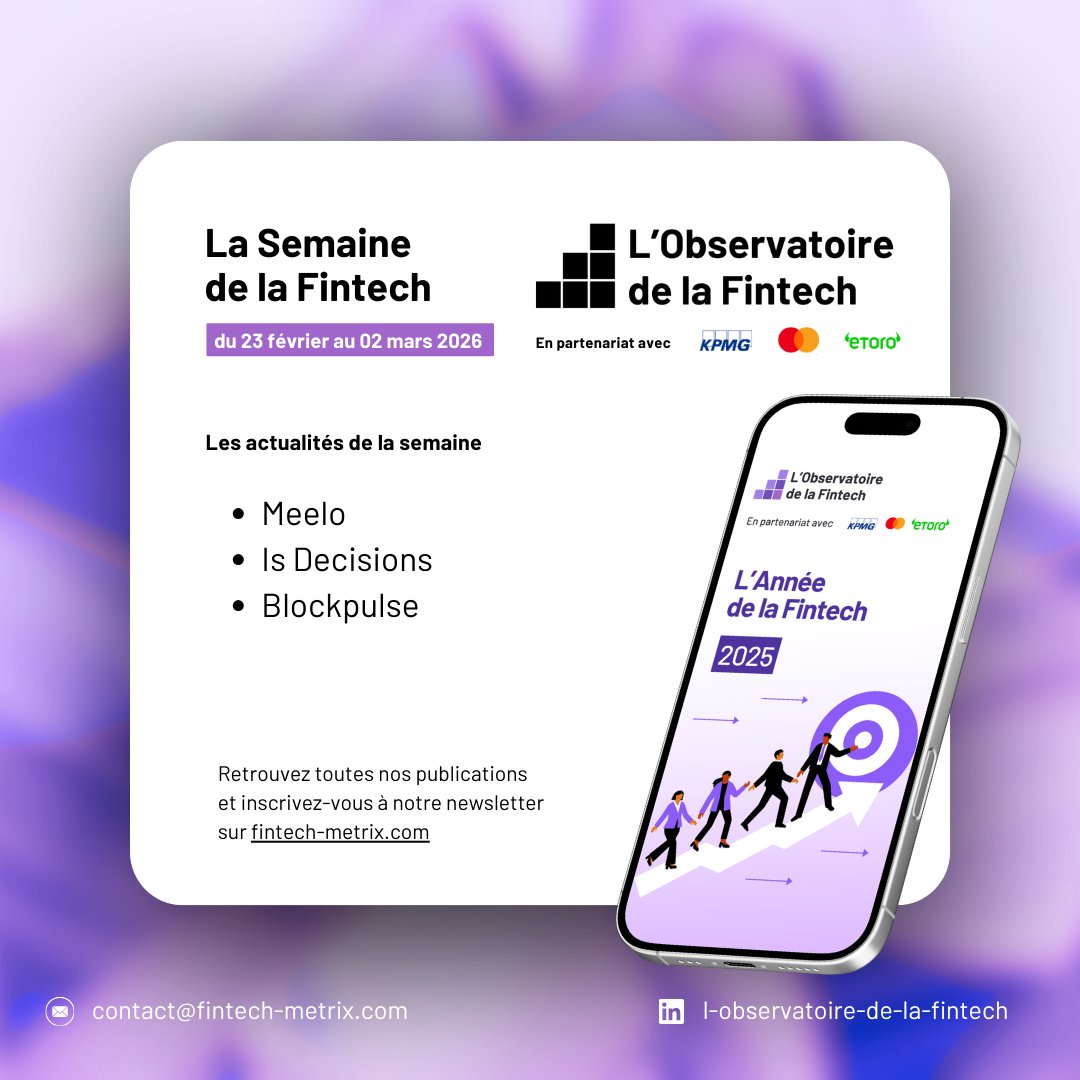
📈 Retour sur les opérations Fintech communiquées du 23 février au 02 mars 2026.
🟦 Levées de fonds et Financement
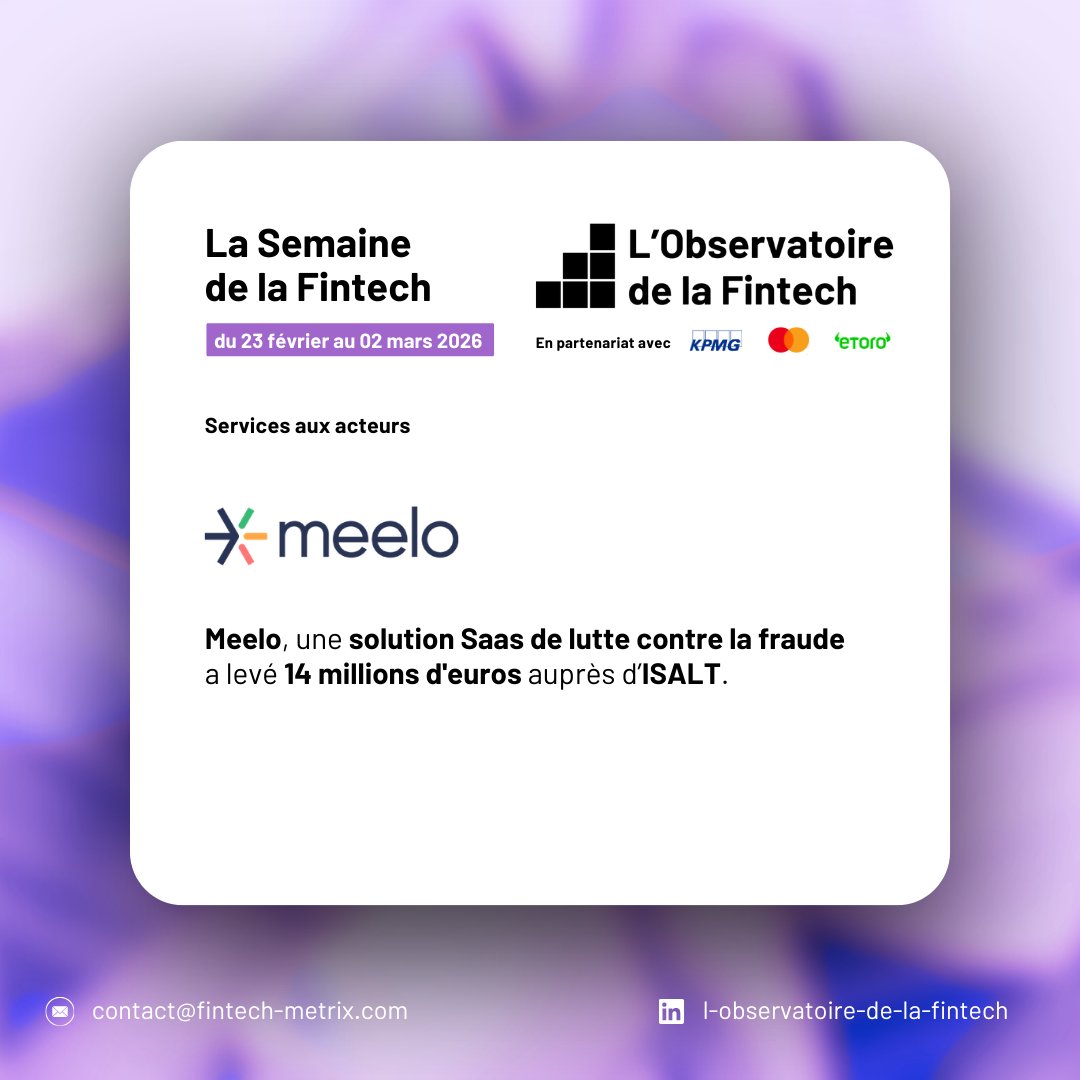
💸 Meelo, une solution Saas de lutte contre la fraude a levé 14 millions d'euros auprès d’ISALT.
👉linkedin.com/posts/l-observa…
🟦 Fusions, Acquisitions, Exits, Difficultés et Cessations
💸 IS Decisions, un éditeur basque expert dans la sécurisation des environnements Microsoft Active Directory, est acquis par le groupe londonien Aries Global.
👉linkedin.com/posts/l-observa…
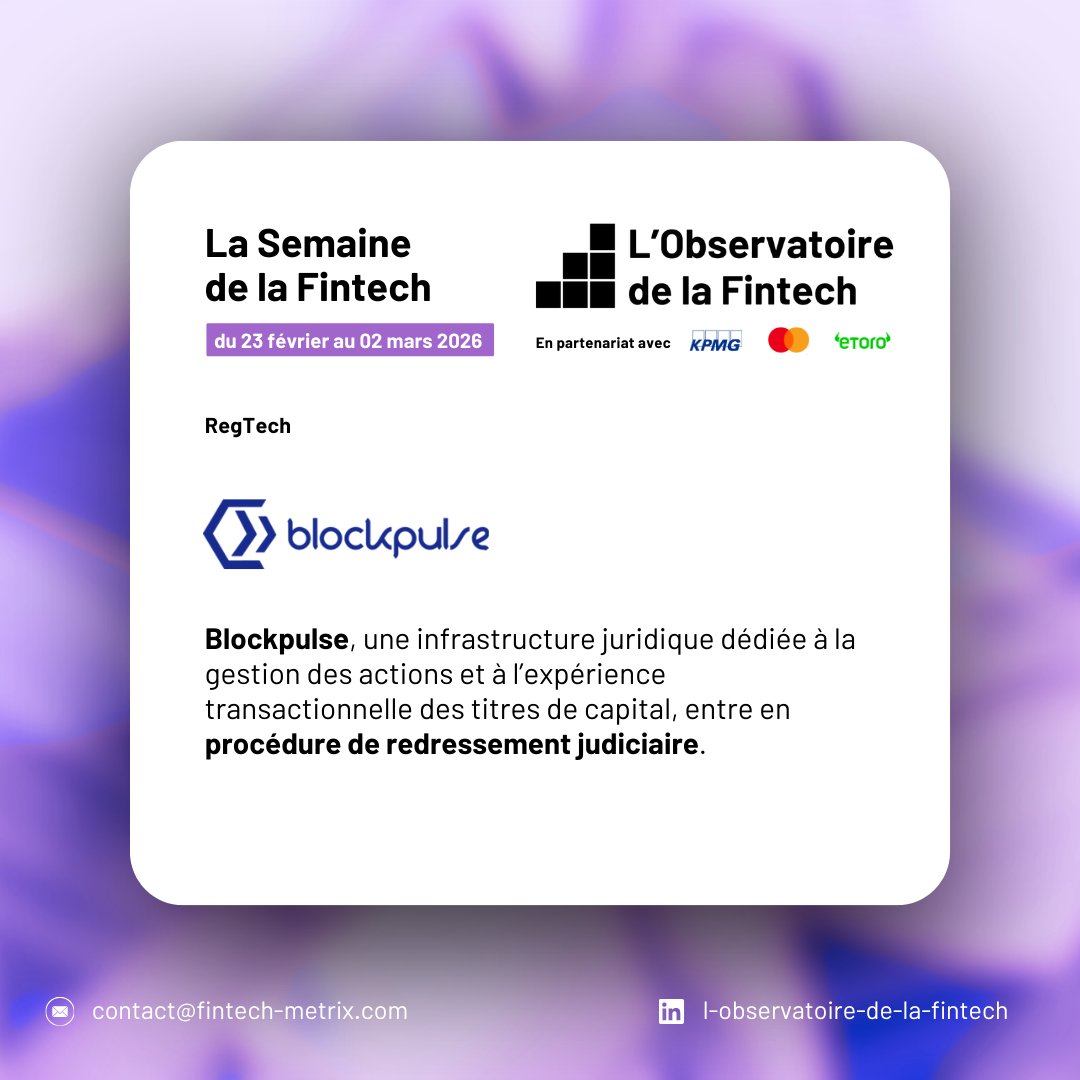
🔴 Blockpulse, une infrastructure juridique dédiée à la gestion des actions et à l’expérience transactionnelle des titres de capital, entre en procédure de redressement judiciaire.
👉pappers.fr/entreprise/blockp…
📥 Abonnez-vous à notre newsletter pour la recevoir tous les lundis et ne manquez aucune de nos actualités 👉 : fintech-metrix.com/newslette…
🤝Avec nos partenaires @MastercardFR, @KPMG et @eToroFr
@TonyFraysse @mPtachek @emmanuelps @WasfyTaj
@alex_R_78 @AugiasGnagli
#fintech #intelligenceartificielle #IA #banque #trading #assurance #paiement #financement #credit #neobanque #investissement #assurtech #regtech #legaltech #comptatech #blockchain #cryptomonnaies #cybersecurite #cyber #esg #greentech #data #analytics #offre #founders #startup #scaleup #Levéesdefonds #Financement #Fusions #Acquisitions #Exits #Difficultés #Cessations #LundiFintech

2
4
268

Jan 31
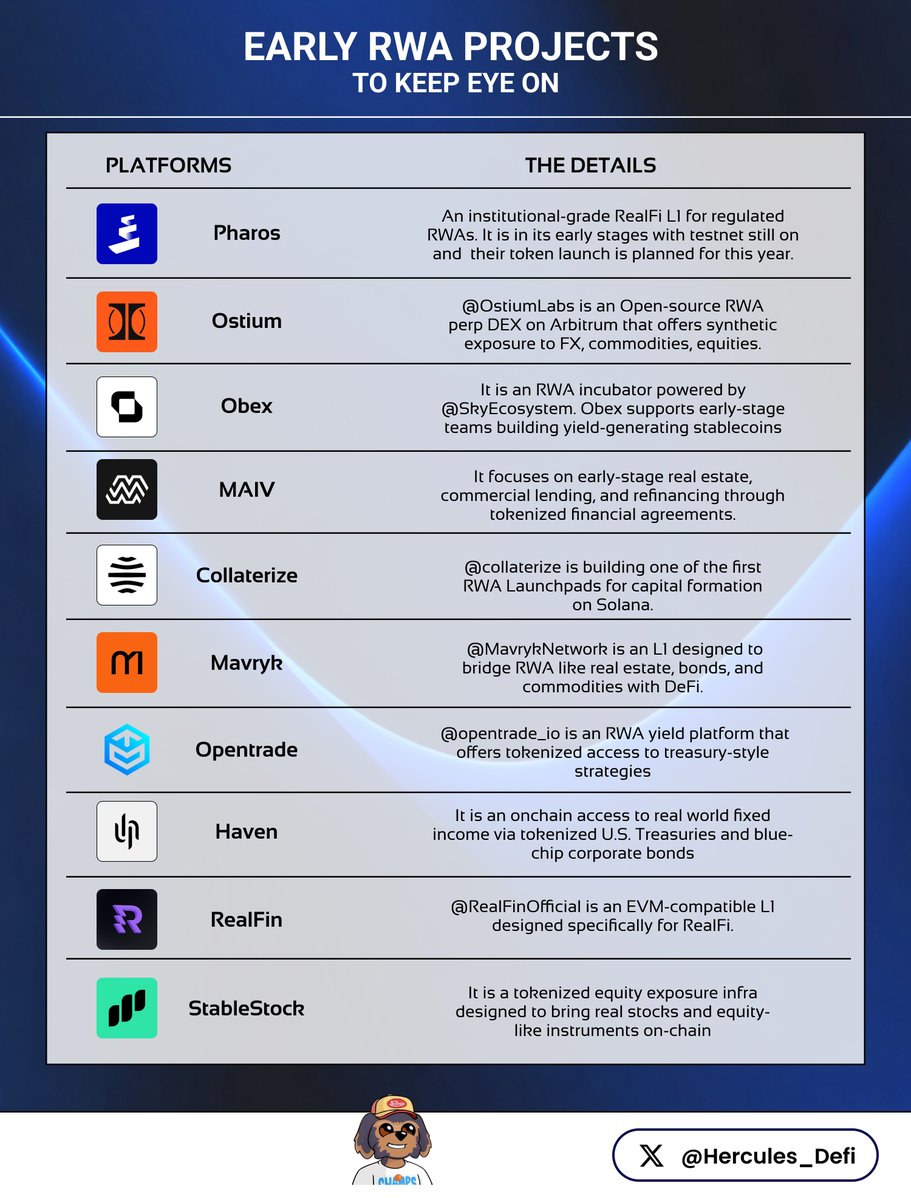
The RWA ecosystem keeps growing and we see new projects, features and so much more
𝘍𝘳𝘰𝘮 𝘵𝘰𝘬𝘦𝘯𝘪𝘻𝘦𝘥 𝘛𝘳𝘦𝘢𝘴𝘶𝘳𝘪𝘦𝘴 𝘢𝘯𝘥 𝘤𝘰𝘳𝘱𝘰𝘳𝘢𝘵𝘦 𝘣𝘰𝘯𝘥𝘴 𝘵𝘰 𝘦𝘲𝘶𝘪𝘵𝘺 𝘦𝘹𝘱𝘰𝘴𝘶𝘳𝘦 𝘢𝘯𝘥 𝘋𝘦𝘍𝘪-𝘯𝘢𝘵𝘪𝘷𝘦 𝘭𝘢𝘶𝘯𝘤𝘩𝘱𝘢𝘥𝘴.
These are the new RWA projects making waves and the ones you need to keep a close eye on this year👇
---------------------------
➢ @pharos_network is an institutional-grade RealFi L1 for regulated RWAs.
it is built for bringing real-world value onchain with accessibility focus and backed by Hack VC and Faction.
It is in its early stages with testnet still on and their token launch is planned for this year.
Pharos has announced some partnerships recently, this is just something to be bullish on.
---------------------------
➢ @ostium is an Open-source RWA perp DEX on Arbitrum that offers synthetic exposure to FX, commodities, equities, and crypto.
Ostium's total funding is now up to roughly $27.8 million and a reported valuation near $250 million. Backers also include Coinbase Ventures, Wintermute, GSR, and others.
Ostium has trading campaign going on its token should be launched this year.
---------------------------
➢ @obexincubator is an RWA incubator powered by @SkyEcosystem. Obex supports early-stage teams building yield-generating stablecoins backed by real world assets such as compute credits, energy projects, and large fintech loans
Obex has raised $37 million in its initial funding round, led by Framework Ventures, LayerZero, and the Sky ecosystem, giving it serious capital firepower to support strong stablecoin projects.
---------------------------
➢ @MAIV_FINANCE focuses on early-stage real estate, commercial lending, and refinancing through tokenized financial agreements, positioning itself as internet capital markets infrastructure for real-world deals.
MAIV officially launched its on-chain investment platform Dec last year, marking a major milestone in bringing institutional-grade private market opportunities onchain with features like staking, membership access, and fractional participation in real commercial deals.
---------------------------
➢ @collaterize is building one of the first RWA Launchpads for capital formation on Solana, enabling tokenization and instant trading of liquid RWA like real estate, private equity, collectibles and more, all with built-in liquidity and compliance features.
Collaterize still in is early stage with its testnet live and main capabilities rolling out, gaining traction as a key infra layer for Solana’s RWA ecosystem.
---------------------------
➢ @MavrykNetwork is an L1 designed to bridge RWA like real estate, bonds, and commodities with DeFi. Mavryk had a $15m pre mainnet.
Mavryk is powering the tokenization of over $10 B in premium UAE real estate, including luxury properties one of the largest announced real-world asset tokenization efforts to date.
---------------------------
➢ @opentrade_io is an RWA yield platform that offers tokenized access to treasury-style strategies and fixed-income products, bridging traditional yield-generating assets with onchain liquidity and composability.
Earlier this year, OpenTrade’s platform had surpassed $100 million in TVL. They might still be at an early stage but it's looking good from here.
---------------------------
➢ @haven_rwa is an onchain access to real world fixed income via tokenized U.S. Treasuries and blue-chip corporate bonds, available to global investors, DAOs, and institutions using USDC/USDT. Designed
Haven recently completed a $30 million seed round at a $300 M valuation, with participation from investors like Candaq, Apus Capital, ZC Capital, and BlockPulse Digital Asset Management
---------------------------
➢ @RealFinOfficial is an EVM-compatible L1 designed specifically for RealFi.
Its mission is to provide foundational infrastructure for traditional financial instruments such as bonds, real estate, commodities, and structured products using smart contracts and verifiable onchain data.
Real Finance recently raised $29 million in private funding led by Nimbus Capital with participation from Magnus Capital and Frekaz Group
They aim to tokenize up to $500 million worth of real-world assets within its first year of operation.
---------------------------
➢ @StableStock is a tokenized equity exposure infra designed to bring real stocks and equity-like instruments on-chain with simpler access, settlement, and composability.
The platform uses a three-layer product roadmap StableBroker for compliant stock access with stablecoin settlement, StableVault for tokenization and liquidity, and StableSwap for low-slippage trading.
Which did i miss? Lemme know in the comments
29
1
60
7,331

Jan 5
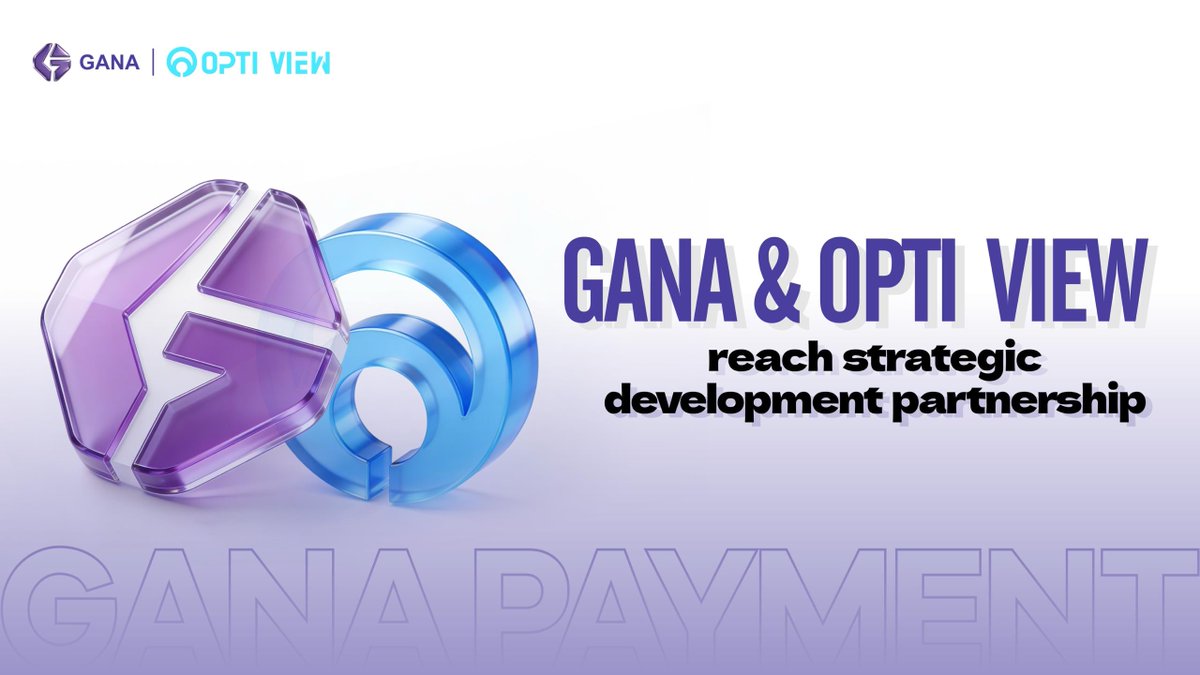
🤝 GANA × @optiview_x
Expanding the PayFi Asset Intelligence Frontier
Excited to partner with OptiView, the AI-powered multi-chain asset intelligence platform backed by Starbase, Onebit Ventures, Hotcoin Labs, Candaq Ventures, and BlockPulse (valued at $20M).
This collaboration connects GANA’s real-world PayFi infrastructure with OptiView’s unified analytics layer — enabling smarter spending, smarter earning.
#GANA #PayFi #Web3 #Partnership
16
2
7
51,346

The rise of $WOJAK is more than a pump. It's the embodiment of the "bagholder sentiment" turning into a tradable narrative.
In low-narrative markets, shared emotion becomes the strongest catalyst.
This marks a new phase of meta-meme: trading the trader's mood.
#WOJAK #MemeCoin #CryptoPsychology #Blockpulse
2
4
239
Happy first Friday of 2026!
Here are the 3 (slow week!) most interesting crypto fundraises for the week ending 1/2/26 (quick and dirty bc it’s the holiday):
1) HashKey Group
Asia-based digital asset financial services group HashKey Group raised $250M.
2) HodlHer
AI companion for crypto traders HodlHer raised $1.5M in a Strategic funding round from Chain Capital, Bitrise Capital, and CGV.
3) Haven
RWA platform Haven closed a funding round from Candaq Fintech Group, Apus Capital, ZC Capital, and BlockPulse. Amount raised not disclosed.
---
Congrats to all the teams on their fundraises!
If you enjoyed this post, please Comment, Like, and Repost!
And give me a follow @mikewchan for more crypto and fundraising content.
Thanks for reading!
5
5
166

Jan 2
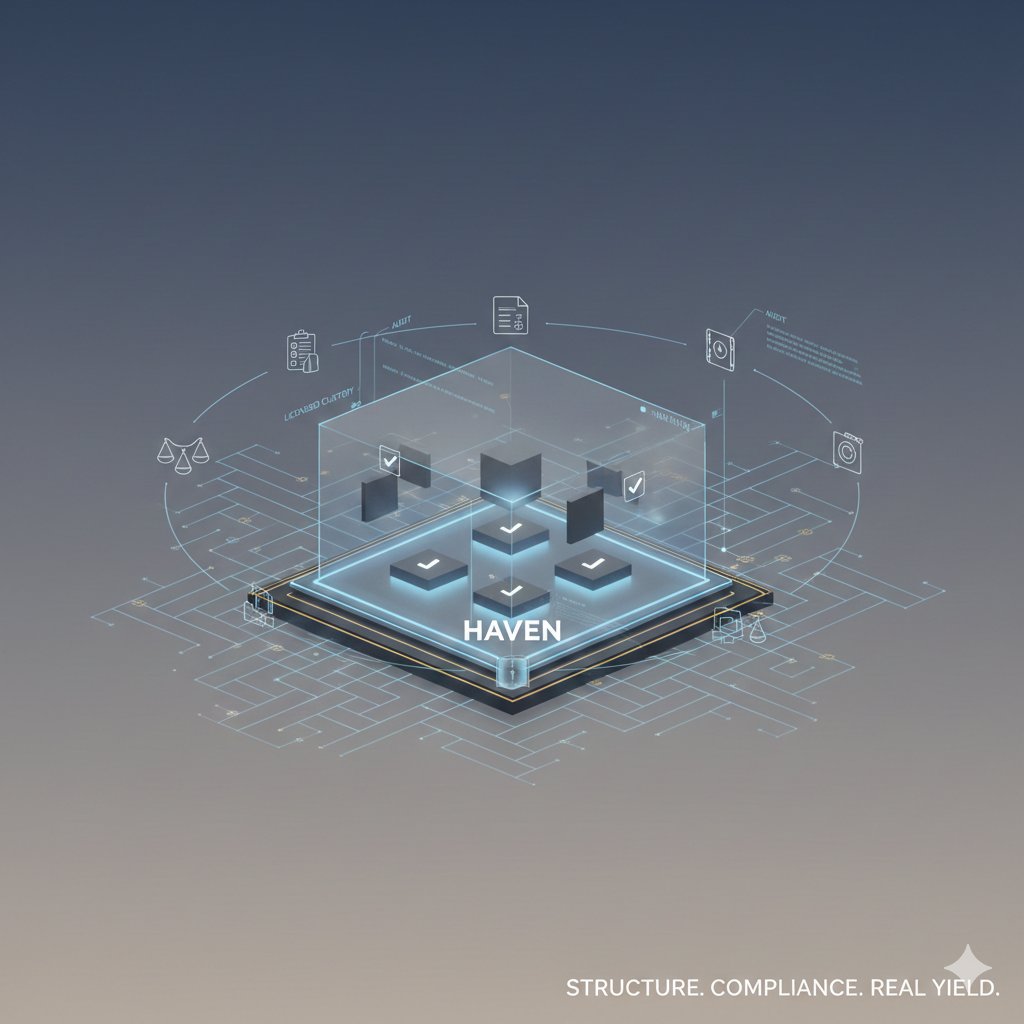
Why Institutions Back Haven
Institutional capital is cautious by nature. It doesn’t chase hype. It looks for structure, compliance, and long-term viability.
That’s why Haven’s Seed Round matters.
Backed by firms like Candaq, Apus Capital, ZC Capital, and BlockPulse Digital Asset Management, Haven attracted investors who understand both capital markets and emerging financial infrastructure.
This support signals confidence not just in the idea, but in the execution. Institutions don’t invest in concepts alone. They invest in systems that can scale responsibly.
Haven focus on licensed custody, transparent audits, and real assets aligns with how serious capital evaluates risk. These aren’t optional features. They’re foundational.
The funding enables Haven to expand its infrastructure, improve access, and continue building a compliant bridge between traditional finance and Web3.
For users, this backing translates into confidence. Confidence that the platform is built with durability in mind. Confidence that yield is real, verifiable, and managed responsibly.
Institutional trust doesn’t guarantee success, but it does raise the standard. Haven is building at that standard.
If you’re watching where serious capital is going in Web3, Haven is a name worth tracking. Learn more about the vision institutions are backing.
#Haven #RWA #OnChainYield #Web3Finance
18
18
77

Jan 1
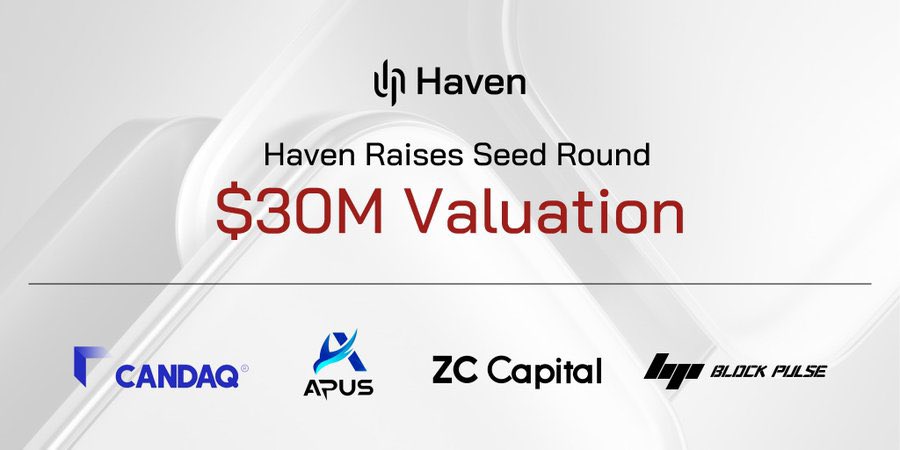
Haven hits two big milestones We should be watching closely:
⚡️ Seed Round closed at $30M valuation.
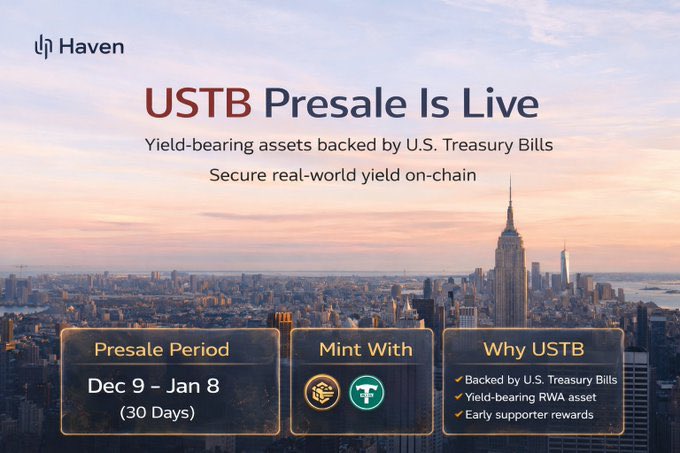
⚡️The USTB presale is live: a yield-bearing, Treasury-backed asset on-chain.
Here is the clean breakdown:
The raise:
• Seed round completed at a $30M valuation
• Backed by firms across Web3, digital assets, and capital markets
Seed partners
• Candaq
• Apus Capital
• ZC Capital
• BlockPulse Digital Asset Management
What this signals
• Focus on real world yield, not narratives
• On-chain structure tied to programmable finance
• Global access as a core design choice
What follows next
• USTB presale goes live
• Yield bearing on-chain asset backed by U.S. Treasury Bills
USTB presale details
• Dec 9 to Jan 8
• 30 day window
• Pre-mint on BSC
• USDT and USDC supported
• Early participants get added incentives!
I’m watching this Closely and Doing the Needful.
You are Welcome.
80
2
94
1,925

31 Dec 2025
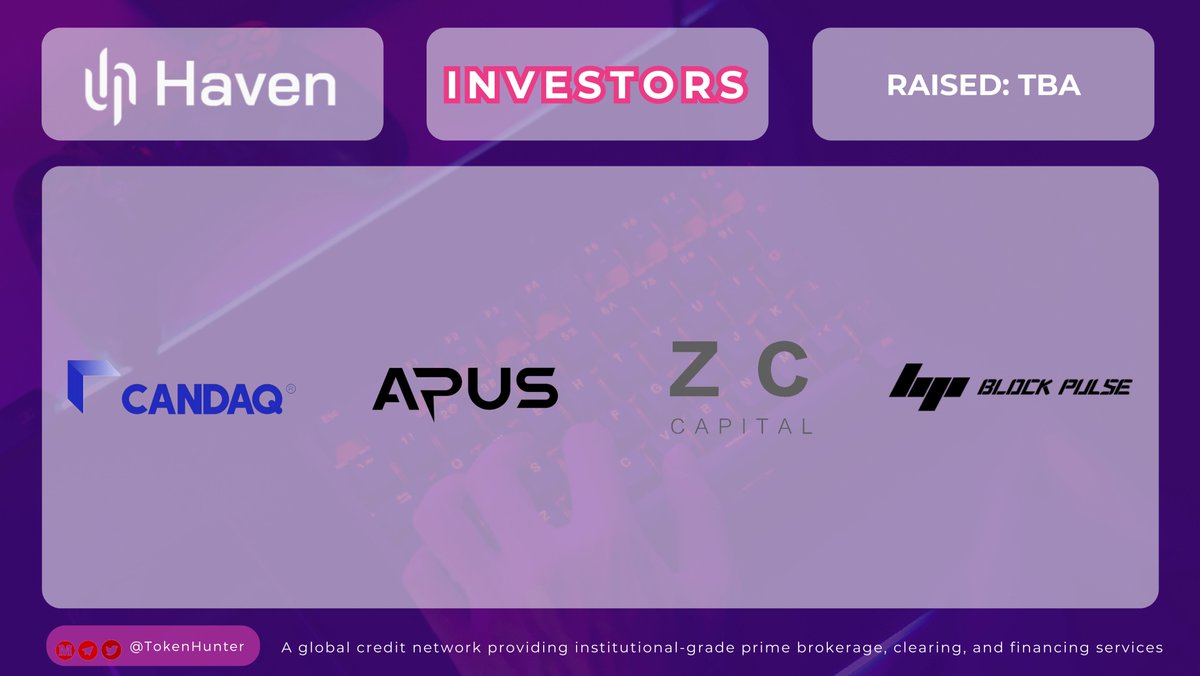
💜 @haven_rwa INVESTORS 💜
Strong backing speaks louder than words 🚀
@haven_rwa continues to gain momentum with the support of well-known strategic investors.
Backed By:
👉 #Candaq
👉 #Apus
👉 #ZCCapital
👉 #BlockPulse 🤝📈
Institutional confidence is building as Haven pushes forward in the RWA space 🌍✨
What do you think this strong investor lineup means for Haven’s future, #Investors? 👀💬
30
33
75
43,010

31 Dec 2025
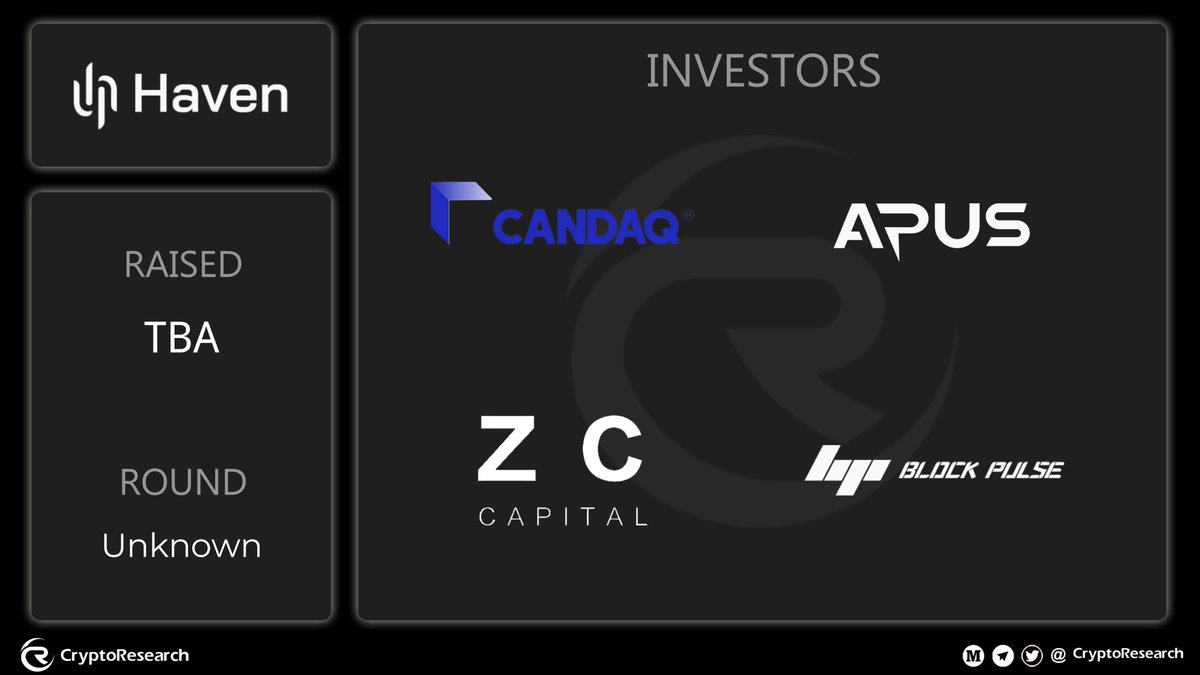
🚀 @haven_rwa Investor 🚀
Big moves happening at @haven_rwa 🔥
The project is backed by a strong lineup of strategic investors, showing serious confidence in its vision
🤝 Investors:
🔹 #Candaq
🔹 #Apus
🔹 #ZCCapital
🔹 #BlockPulse
💰 Raised: TBA
🌀 Round: Unknown
💭 With this caliber of backers, do you think Haven can become a major player in the RWA space? 👇#investors
29
31
74
35,212

30 Dec 2025
Haven’s Seed Round is backed by leading institutions across Web3 and capital markets, including:
Seed Round Backers include:
• Candaq (@CandaqCom)
• Apus Capital (@apus_capital)
• ZC Capital (@EstesMulloy)
• BlockPulse Digital Asset Management (@BlockPulse_Web3)
Strong validation for Haven’s long-term vision.
1
2
135

28 Dec 2025
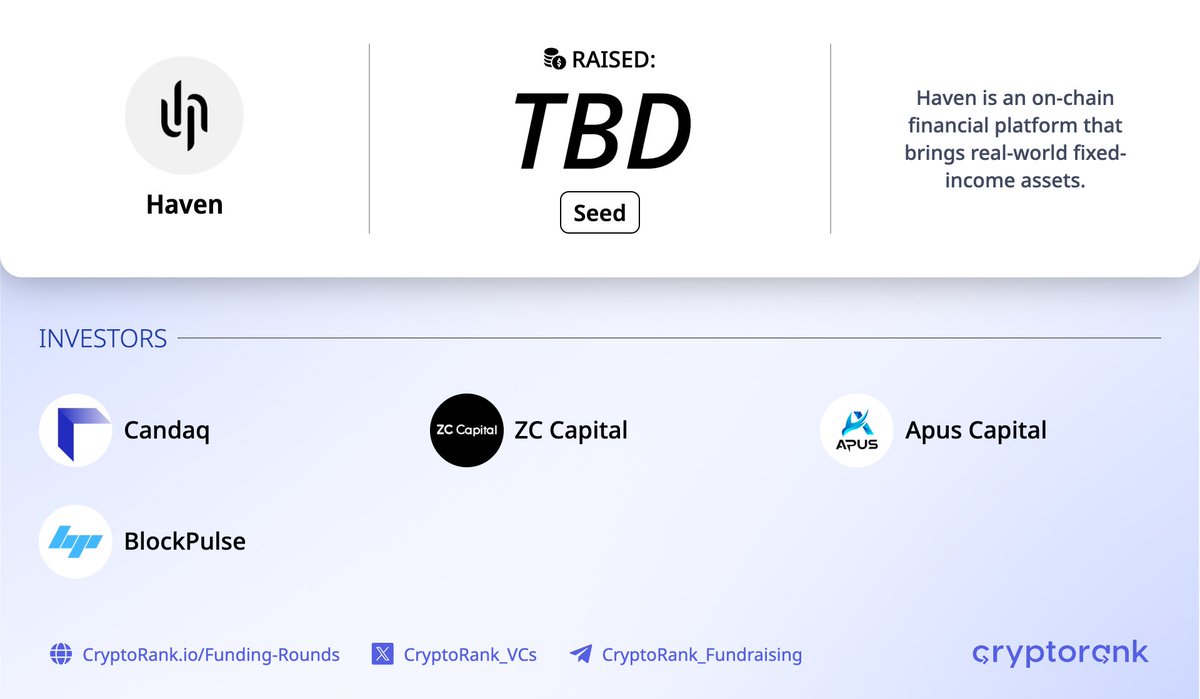
Haven Seed Round⚡️
📑 About:
@haven_rwa is an on-chain financial platform that brings real-world fixed-income assets.
🤝 Investors:
Candaq, ZC Capital, Apus Capital, and BlockPulse
🏷 Valuation: $30M
4
9
128
13,241

19 Dec 2025
Happy Friday!
Here are the 5 most interesting crypto fundraises for the week ending 12/19/25:
1) Fuse
Decentralized renewable energy network @fuseenergy raised a $70M Series B round from Lowercarbon Capital, Balderton Capital, Accel, and Ribbit.
Fuse is turning energy grid coordination into a DePIN protocol, using tokens as an economic layer on top of real-world energy retail and installation
Their goal is to reach 1 terawatt of renewable capacity globally!
2) ETHGas
Ethereum blockspace trading marketplace @ETHGasOfficial raised $12M in a Seed token round led by Polychain Capital with participation from BlueYard Capital, Stake Capital, Keyrock, and others.
ETHGas turns Ethereum blockspace into a tradable futures asset class, letting DeFi protocols and institutions hedge gas volatility while validators lock in future revenue.
Everything is a market, even gas payments!
3) RedotPay
Stablecoin payment and card platform @RedotPay raised $107M in a Series B round led by Goodwater Capital, with participation from Pantera Capital, Blockchain Capital, and others
RedotPay lets users spend USDT and USDC via virtual and physical cards across more than 100 countries and 130 million merchants.
It already processes over $10B in annualized volume from more than 6M users while operating profitably!
4) Deepbook
DeFi trading browser @deepbook_ai raised $2M in funding from Castrum Capital, BD Ventures, Alpha Capital, and BlockPulse.
Deepbook combines a multi‑chain wallet and advanced trading tools into a browser, aiming to give CEX‑like UX while keeping self‑custody and routing order flow across DeFi.
I love the wave of new browsers hitting the market!
5) Testmachine
AI‑powered blockchain security platform @testmachine_ai raised $6.5M in funding led by Blockchange Ventures, New Form Capital, Decasonic, Delphi Digital, and others.
It’s Predator engine performs automated smart contract penetration testing in a simulated EVM environment to uncover both code-level and economic vulnerabilities before deployment.
Predator is already fully integrated into Coinbase’s token security and deployment pipeline, monitoring over 1 million tokens and reportedly catching 100% of known rug pulls!
—
Congrats to all the teams on their fundraises!
If you enjoyed this post, please Comment, Like, and Repost!
And give me a follow @mikewchan for more crypto and fundraising content.
Thanks for reading!
8
7
229