
May 28
TopologicPy is a spatial-semantic graph framework
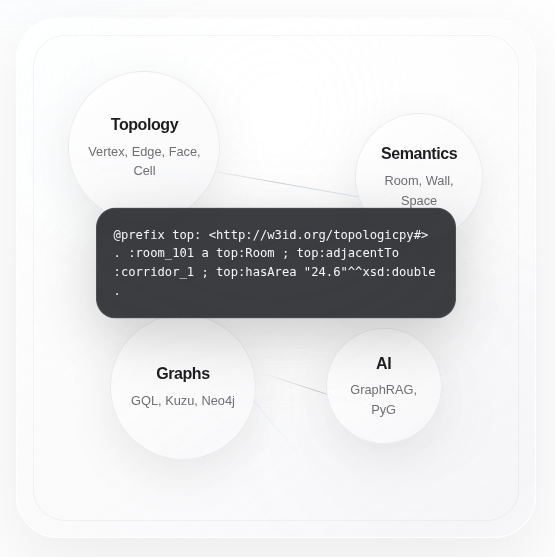
A computational environment where geometric entities, topological relationships, building semantics, graph analytics, databases, GQL, GraphRAG, RDF, and AI workflows can speak the same ontology.
With the help of LLMs, a formal, comprehensive, consistent and persistent semantic layer has now been added that defines and connects concepts such as:
* Vertex, Edge, Wire, Face, Shell, Cell, CellComplex, Cluster, Graph
* Space, Room, Wall, Door, Window, Storey, Building
* Relationships, metrics, provenance, and analysis results
* IFC-derived entities and their semantic classifications
* RDF/OWL classes and properties for linked-data workflows
This starts to connect several worlds that are often treated separately:
* IFC and BIM geometry
* Topological spatial models
* Graph databases such as Neo4j
* GQL-style graph querying
* RDF and OWL semantic web models
* Linked Building Data
* BOT, Brick, and related building ontologies
* Graph machine learning
* GraphRAG and AI-based spatial reasoning
TopologicPy has morphed into a spatial-semantic computing framework: one that can move between geometry, topology, BIM, graphs, RDF, OWL, Linked Building Data, graph databases, machine learning, and AI reasoning.
By Wassim Jabi
wassimj.github.io/topologicp…
#TopologicPy #SpatialComputing #BIM #LinkedBuildingData #GraphML #OpenSource
--
The Year of the Graph's Summer 2026 newsletter issue on all things #KnowledgeGraph, #GraphDB, Graph #Analytics / #DataScience / #AI and #SemTech is coming soon.
Subscribe and follow to be in the know. Reach out if you'd like to be featured 👇
yearofthegraph.xyz/newslette…
6
13
532

11 May 2025
HIGHER-ORDER MOLECULAR LEARNING: THE CELLULAR TRANSFORMER
1.This paper introduces the Cellular Transformer (CT), a topological deep learning (TDL) framework that generalizes graph transformers to operate on cell complexes, enabling the modeling of higher-order molecular structures like rings, fused motifs, and multi-bond systems.
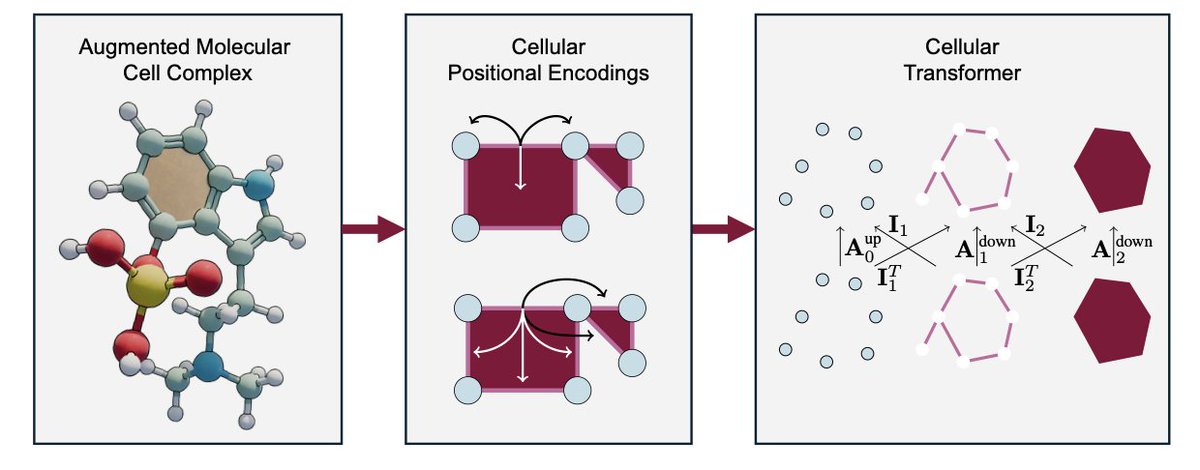
2.A key innovation is the augmented molecular cell complex (AMCC), a richer molecular representation where atoms, bonds, and rings are treated as 0-, 1-, and 2-cells, respectively—embedding chemical topology directly into the learning architecture.
3.CT performs attention not just over nodes or edges but across multiple structural ranks (0D, 1D, 2D) using a novel pairwise and general cellular attention mechanism, capturing multiscale interactions without relying on graph rewiring, virtual nodes, or ad-hoc biases.
4.The architecture employs tensor diagrams to formalize attention flow across cochain ranks, integrating both cross-rank and intra-rank attention, guided by neighborhood matrices derived from topological relations like incidence and adjacency.
5.To encode structure, CT introduces cellular positional encodings (CPEs), extending Laplacian and random walk encodings to the cellular domain. It also proposes a novel barycentric subdivision encoding (BSPe) that enhances topological locality.
6.Extensive benchmarking on MoleculeNet and the Graph Classification Benchmark (GCB) demonstrates that CT consistently outperforms GNNs, MPNNs, and graph transformers, especially in datasets where topological motifs matter most.
7.In GCB, CT achieved the highest accuracy (75.4%) compared to other message-passing and kernel-based methods, showing the benefit of high-order attention even in originally graph-based domains.
8.On MoleculeNet, CT ranked among the top across both classification (AUC) and regression (RMSE) tasks, performing particularly well in datasets like HIV, ClinTox, and ESOL, where higher-order features are vital.
9.The method is highly generalizable: lifting molecular graphs into CCs using tools like TopoX allows CT to apply broadly, even when only graph data is available, making it backward-compatible with existing pipelines.
10.This work positions CT as a foundation for topologically informed molecular modeling, offering a scalable, interpretable, and efficient alternative to current GNN-based methods, with applications across drug discovery and materials science.
📜Paper: openreview.net/pdf?id=GW3h79…
#MolecularModeling #TopologicalDeepLearning #GraphTransformer #DrugDiscovery #CellComplex #MoleculeNet #ICLR2025 #ChemicalML #AttentionMechanism #CellularTransformer
1
11
1,358
11 May 2025
HIGHER-ORDER MOLECULAR LEARNING: THE CELLULAR TRANSFORMER
1.This paper introduces the Cellular Transformer (CT), a topological deep learning (TDL) framework that generalizes graph transformers to operate on cell complexes, enabling the modeling of higher-order molecular structures like rings, fused motifs, and multi-bond systems.
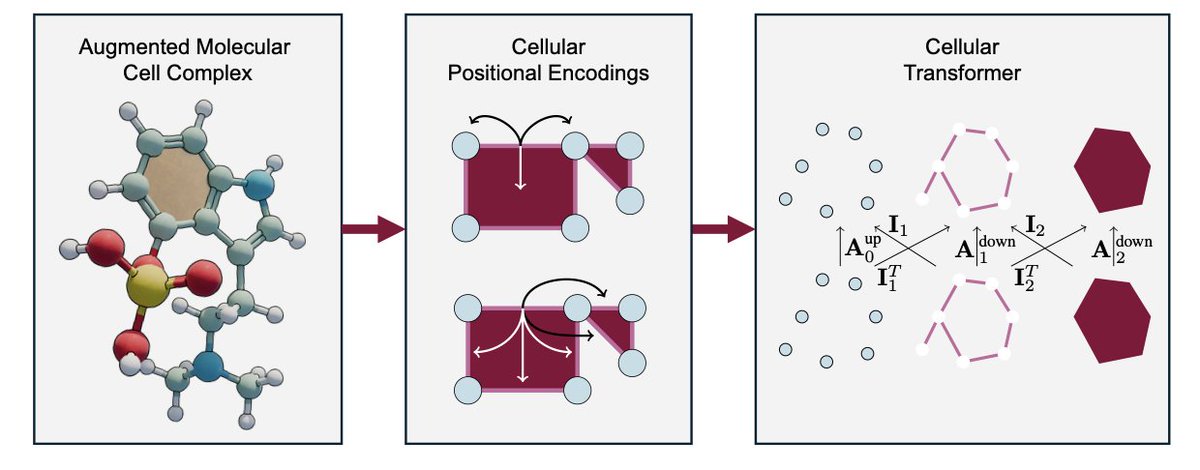
2.A key innovation is the augmented molecular cell complex (AMCC), a richer molecular representation where atoms, bonds, and rings are treated as 0-, 1-, and 2-cells, respectively—embedding chemical topology directly into the learning architecture.
3.CT performs attention not just over nodes or edges but across multiple structural ranks (0D, 1D, 2D) using a novel pairwise and general cellular attention mechanism, capturing multiscale interactions without relying on graph rewiring, virtual nodes, or ad-hoc biases.
4.The architecture employs tensor diagrams to formalize attention flow across cochain ranks, integrating both cross-rank and intra-rank attention, guided by neighborhood matrices derived from topological relations like incidence and adjacency.
5.To encode structure, CT introduces cellular positional encodings (CPEs), extending Laplacian and random walk encodings to the cellular domain. It also proposes a novel barycentric subdivision encoding (BSPe) that enhances topological locality.
6.Extensive benchmarking on MoleculeNet and the Graph Classification Benchmark (GCB) demonstrates that CT consistently outperforms GNNs, MPNNs, and graph transformers, especially in datasets where topological motifs matter most.
7.In GCB, CT achieved the highest accuracy (75.4%) compared to other message-passing and kernel-based methods, showing the benefit of high-order attention even in originally graph-based domains.
8.On MoleculeNet, CT ranked among the top across both classification (AUC) and regression (RMSE) tasks, performing particularly well in datasets like HIV, ClinTox, and ESOL, where higher-order features are vital.
9.The method is highly generalizable: lifting molecular graphs into CCs using tools like TopoX allows CT to apply broadly, even when only graph data is available, making it backward-compatible with existing pipelines.
10.This work positions CT as a foundation for topologically informed molecular modeling, offering a scalable, interpretable, and efficient alternative to current GNN-based methods, with applications across drug discovery and materials science.
📜Paper: openreview.net/pdf?id=GW3h79…
#MolecularModeling #TopologicalDeepLearning #GraphTransformer #DrugDiscovery #CellComplex #MoleculeNet #ICLR2025 #ChemicalML #AttentionMechanism #CellularTransformer
2
822

7 May 2023
Today's progress: Implemented Graph Colouring (colour a graph such that no two adjacent vertices have the same colour). In the image below, the graph is the dual graph of the (exploded) CellComplex. So no Cell has the same colour as an adjacent Cell.
2
2
8
1,622

27 Feb 2023
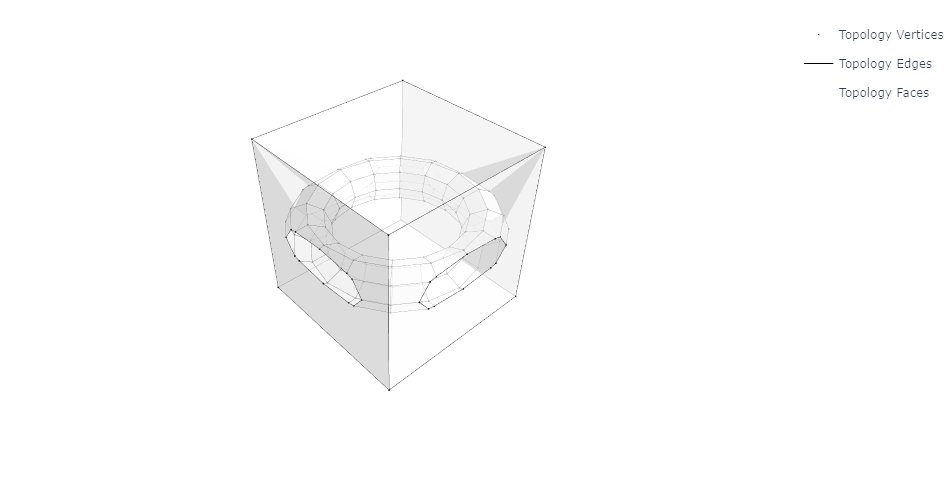
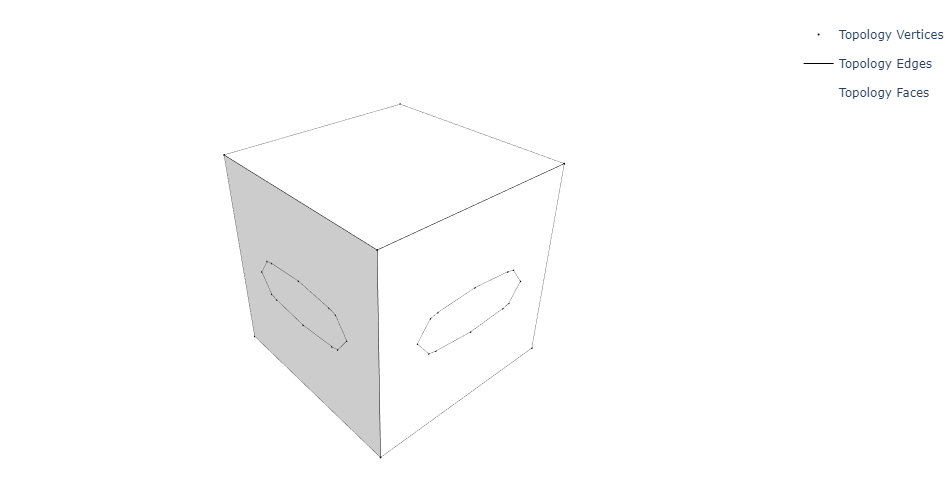
Did you know? Topologic includes boolean operations that manifold-only engines cannot handle. One such example is "imprint" that leaves an imprint (stamp) of one object on another. In the example below, a torus was imprinted on a cube creating a two-cell CellComplex.
2
6
1,690
3 Feb 2023
Did you know? This is a perfectly legal CellComplex with nine Cells. It is one object not nine objects and the spherical cells hover in the middle of the torus.
5
949