
We can’t wait to see your submissions! Full challenge guidelines and requirements are available here:
geometric-intelligence.githu…
Results announced at @TAGinDS Boston, Aug. 18–20. Participation does not require attending!
#TDLChallenge #TopologicalDeepLearning #AI #ML #TAGinDS
6
23
1,110

4 Dec 2025
新しいプレプリントを公開しました(2025年12月3日):
「LLM埋め込み空間における持続的トポロジー構造:
幾何学的分析から制御可能性へ」
(Meaning Unification Framework の Tier-I)
LLM の埋め込み空間に、アーキテクチャに依存しない
安定な persistent H₁ サイクルが存在しており、
強いノイズや層方向の摂動にも崩れないことを示しました。
これらのH₁サイクルは、
LLMをより堅牢にステアリング/アラインメントするための
“トポロジー的に保護された部分空間”として機能し得ることを提案しています。
オープンアクセス(再現コードつき):
zenodo.org/records/17785728
TDA / トポロジカルDLのコミュニティの皆さまから、
ご意見やフィードバックをいただけると嬉しいです。
#TDA #TopologicalDataAnalysis #TopologicalDeepLearning
#PersistentHomology #LLM #AIalignment

New preprint (Dec 3, 2025):
Persistent Topological Structures in LLM Embedding Spaces:
From Geometric Analysis to Controllability
(Tier-I in the Meaning Unification Framework)
We find architecture-agnostic persistent H₁ cycles in LLM embedding spaces that survive strong noise & layer perturbations — suggesting they can act as topologically protected subspaces for robust steering/alignment.
Open access full repro code:
zenodo.org/records/17785728
Would love thoughts from the TDA & Topological DL community — tagging a few people whose work heavily inspired this:
@ninamiolane @HajijMustafa @mathildepapillo @tolga_birdal
@svpino @LidaKanari @AlicePatania
#TDA #TopologicalDataAnalysis #TopologicalDeepLearning #PersistentHomology #LLM #AIalignment
2
263

New preprint (Dec 3, 2025):
Persistent Topological Structures in LLM Embedding Spaces:
From Geometric Analysis to Controllability
(Tier-I in the Meaning Unification Framework)
We find architecture-agnostic persistent H₁ cycles in LLM embedding spaces that survive strong noise & layer perturbations — suggesting they can act as topologically protected subspaces for robust steering/alignment.
Open access full repro code:
zenodo.org/records/17785728
Would love thoughts from the TDA & Topological DL community — tagging a few people whose work heavily inspired this:
@ninamiolane @HajijMustafa @mathildepapillo @tolga_birdal
@svpino @LidaKanari @AlicePatania
#TDA #TopologicalDataAnalysis #TopologicalDeepLearning #PersistentHomology #LLM #AIalignment
1
2
328

3 Dec 2025
Congratulations to the winners and all the participants for their impressive works!
And thank you to all you organizers
It was fun and inspiring for me to be part of the crew!
#topobench #topologicaldeeplearning
1
4
119

24 Sep 2025
A Review of Topological Data Analysis and Topological Deep Learning in Molecular Sciences
1. This comprehensive review by JunJie Wee and Jian Jiang explores the evolution and applications of Topological Data Analysis (TDA) and Topological Deep Learning (TDL) in molecular sciences. It highlights how TDA has transformed from qualitative tools to advanced predictive models, integrating with machine learning and AI for breakthroughs in areas like protein engineering and drug discovery.
2. The review traces the development of TDA, emphasizing innovations such as persistent homology and persistent Laplacians. It discusses how these techniques capture robust, multiscale features from complex molecular data, offering insights beyond traditional methods. The integration of TDA with AI is highlighted as a key factor in its success.
3. In the domain of biomolecules, TDA has significantly impacted the understanding of protein stability, flexibility, and interactions. The review details how TDA-based models predict protein folding stability, B-factors, and binding affinities with high accuracy. It also explores the role of TDA in studying viral evolution, particularly in predicting SARS-CoV-2 variants and their impact on vaccine efficacy.
4. For drug discovery, TDA and TDL have shown remarkable potential. The review covers applications in drug target identification, virtual screening, and protein-ligand binding predictions. It highlights how TDA enhances the accuracy of binding affinity predictions and accelerates the discovery of novel therapeutics through advanced AI models.
5. In materials science, TDA has been used to analyze crystalline materials, solar energy materials, and predict material properties. The review discusses how TDA-based descriptors improve the efficiency of material discovery by identifying materials with desired properties. It also explores the use of TDA in understanding the structure-function relationships in various materials.
6. The review concludes by discussing the limitations of current TDA approaches and outlines future directions, including the integration of TDA with advanced AI models and the development of new topological invariants. It emphasizes the need for further research to fully harness the power of TDA in molecular sciences and inspire further exploration in this interdisciplinary field.
📜Paper: arxiv.org/abs/2509.16877
#TDA #TopologicalDeepLearning #MolecularSciences #ProteinEngineering #DrugDiscovery #MaterialsScience #AI #MachineLearning
3
8
1,299
5 Sep 2025
Topotein: Topological Deep Learning for Protein Representation Learning
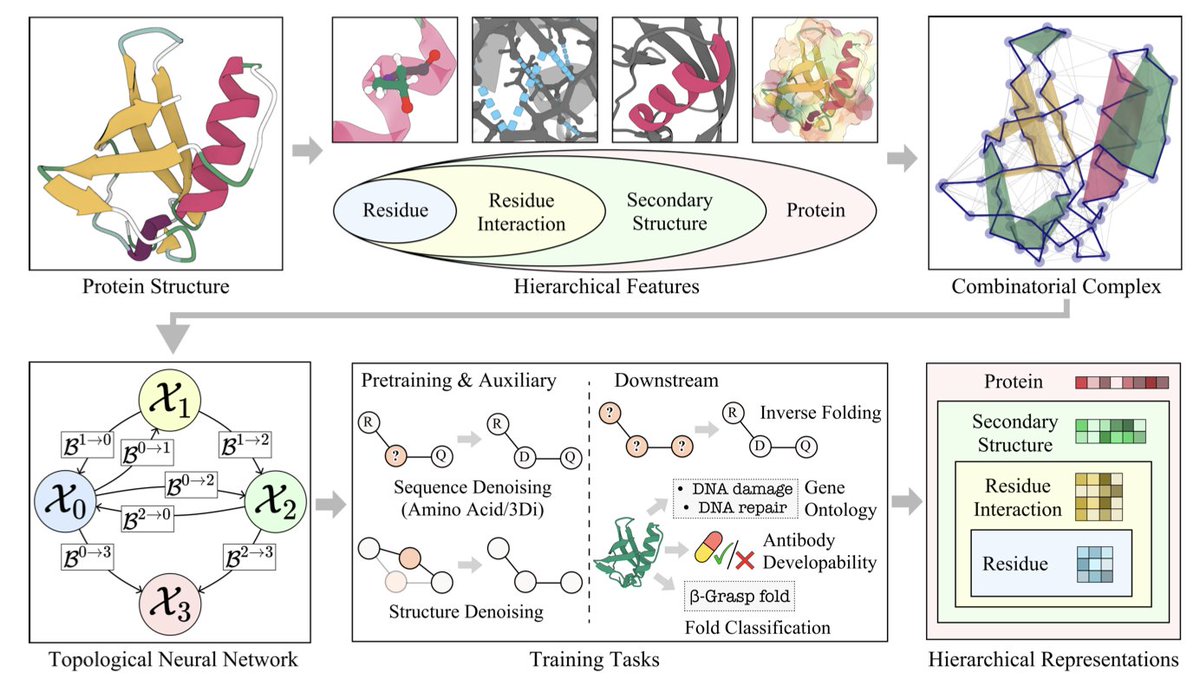
1. Topotein introduces a novel framework for protein representation learning, leveraging topological deep learning to capture the hierarchical organization of proteins from residues to secondary structures and beyond. This approach addresses a critical gap in current methods that often fail to fully represent the multi-scale structural patterns inherent in proteins.
2. The framework features the Protein Combinatorial Complex (PCC), a hierarchical data structure that represents proteins at multiple levels while preserving geometric information. This is complemented by the Topology-Complete Perceptron Network (TCPNet), which employs SE(3)-equivariant message passing across these hierarchical structures for more effective learning.
3. TCPNet consistently outperforms state-of-the-art geometric graph neural networks in extensive experiments across four protein analysis tasks. It demonstrates particular strength in tasks like fold classification, which require understanding secondary structure arrangements, highlighting the importance of hierarchical topological features.
4. The study provides comprehensive experimental validation, showing that TCPNet maintains robust performance even in structure-only scenarios, where other models often degrade significantly. This robustness is attributed to its ability to capture structural context through multi-rank message passing.
5. The authors also compare their approach against adapted versions of existing methods, demonstrating that effective topological deep learning requires careful architectural design. This work not only advances protein representation learning but also establishes a new paradigm for modeling hierarchical biological structures.
📜Paper: arxiv.org/abs/2509.03885v1
💻Code: github.com/ZW471/TopoteinWor…
#TopologicalDeepLearning #ProteinRepresentation #MachineLearning #Bioinformatics #ComputationalBiology
1
25
88
4,788

22 Jul 2025
If you like this kind of #TopologicalDeepLearning / #TDL research, also check out our research group's website:
👉 aidos.group/
Thanks for reading!
🧵7/7
1
5
481
11 May 2025
HIGHER-ORDER MOLECULAR LEARNING: THE CELLULAR TRANSFORMER
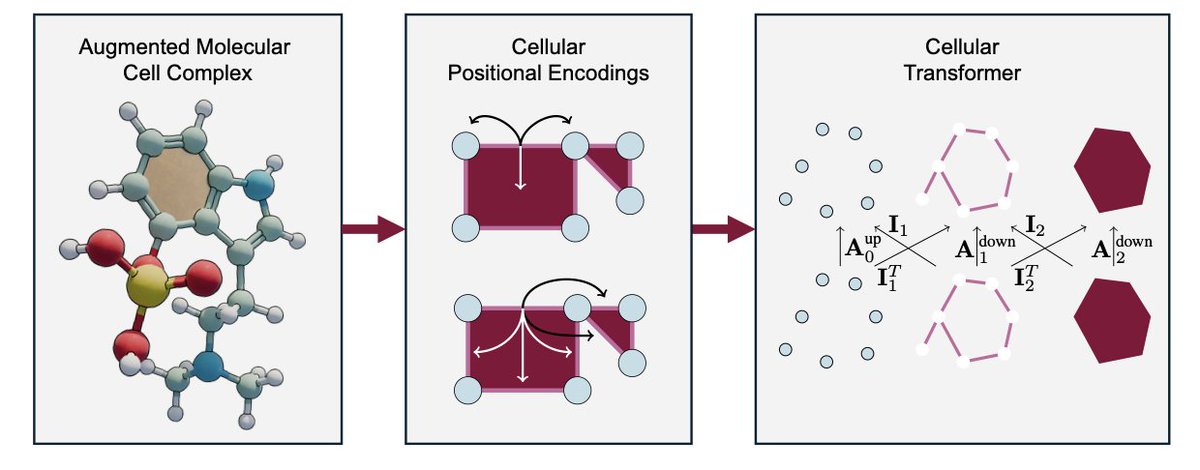
1.This paper introduces the Cellular Transformer (CT), a topological deep learning (TDL) framework that generalizes graph transformers to operate on cell complexes, enabling the modeling of higher-order molecular structures like rings, fused motifs, and multi-bond systems.
2.A key innovation is the augmented molecular cell complex (AMCC), a richer molecular representation where atoms, bonds, and rings are treated as 0-, 1-, and 2-cells, respectively—embedding chemical topology directly into the learning architecture.
3.CT performs attention not just over nodes or edges but across multiple structural ranks (0D, 1D, 2D) using a novel pairwise and general cellular attention mechanism, capturing multiscale interactions without relying on graph rewiring, virtual nodes, or ad-hoc biases.
4.The architecture employs tensor diagrams to formalize attention flow across cochain ranks, integrating both cross-rank and intra-rank attention, guided by neighborhood matrices derived from topological relations like incidence and adjacency.
5.To encode structure, CT introduces cellular positional encodings (CPEs), extending Laplacian and random walk encodings to the cellular domain. It also proposes a novel barycentric subdivision encoding (BSPe) that enhances topological locality.
6.Extensive benchmarking on MoleculeNet and the Graph Classification Benchmark (GCB) demonstrates that CT consistently outperforms GNNs, MPNNs, and graph transformers, especially in datasets where topological motifs matter most.
7.In GCB, CT achieved the highest accuracy (75.4%) compared to other message-passing and kernel-based methods, showing the benefit of high-order attention even in originally graph-based domains.
8.On MoleculeNet, CT ranked among the top across both classification (AUC) and regression (RMSE) tasks, performing particularly well in datasets like HIV, ClinTox, and ESOL, where higher-order features are vital.
9.The method is highly generalizable: lifting molecular graphs into CCs using tools like TopoX allows CT to apply broadly, even when only graph data is available, making it backward-compatible with existing pipelines.
10.This work positions CT as a foundation for topologically informed molecular modeling, offering a scalable, interpretable, and efficient alternative to current GNN-based methods, with applications across drug discovery and materials science.
📜Paper: openreview.net/pdf?id=GW3h79…
#MolecularModeling #TopologicalDeepLearning #GraphTransformer #DrugDiscovery #CellComplex #MoleculeNet #ICLR2025 #ChemicalML #AttentionMechanism #CellularTransformer
1
11
1,358
11 May 2025
HIGHER-ORDER MOLECULAR LEARNING: THE CELLULAR TRANSFORMER
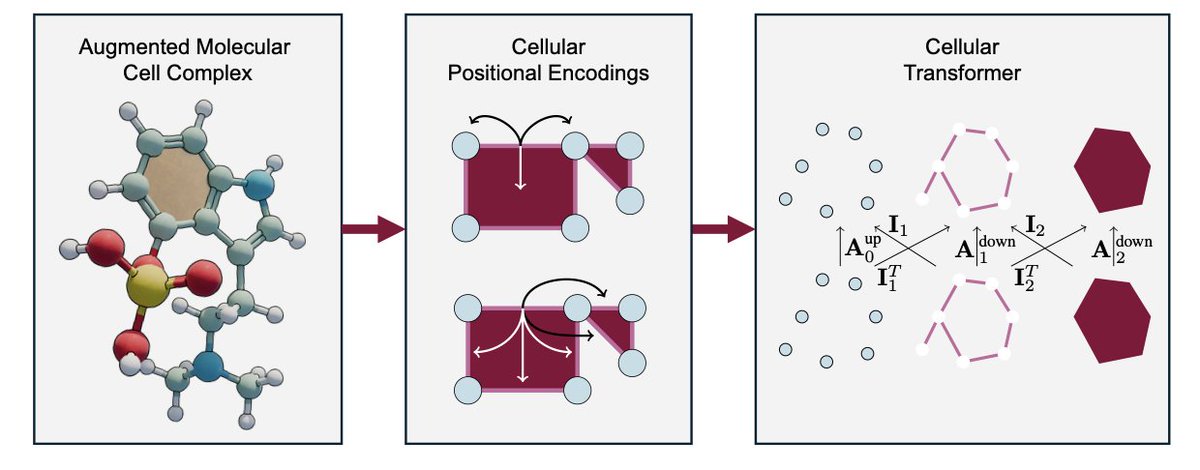
1.This paper introduces the Cellular Transformer (CT), a topological deep learning (TDL) framework that generalizes graph transformers to operate on cell complexes, enabling the modeling of higher-order molecular structures like rings, fused motifs, and multi-bond systems.
2.A key innovation is the augmented molecular cell complex (AMCC), a richer molecular representation where atoms, bonds, and rings are treated as 0-, 1-, and 2-cells, respectively—embedding chemical topology directly into the learning architecture.
3.CT performs attention not just over nodes or edges but across multiple structural ranks (0D, 1D, 2D) using a novel pairwise and general cellular attention mechanism, capturing multiscale interactions without relying on graph rewiring, virtual nodes, or ad-hoc biases.
4.The architecture employs tensor diagrams to formalize attention flow across cochain ranks, integrating both cross-rank and intra-rank attention, guided by neighborhood matrices derived from topological relations like incidence and adjacency.
5.To encode structure, CT introduces cellular positional encodings (CPEs), extending Laplacian and random walk encodings to the cellular domain. It also proposes a novel barycentric subdivision encoding (BSPe) that enhances topological locality.
6.Extensive benchmarking on MoleculeNet and the Graph Classification Benchmark (GCB) demonstrates that CT consistently outperforms GNNs, MPNNs, and graph transformers, especially in datasets where topological motifs matter most.
7.In GCB, CT achieved the highest accuracy (75.4%) compared to other message-passing and kernel-based methods, showing the benefit of high-order attention even in originally graph-based domains.
8.On MoleculeNet, CT ranked among the top across both classification (AUC) and regression (RMSE) tasks, performing particularly well in datasets like HIV, ClinTox, and ESOL, where higher-order features are vital.
9.The method is highly generalizable: lifting molecular graphs into CCs using tools like TopoX allows CT to apply broadly, even when only graph data is available, making it backward-compatible with existing pipelines.
10.This work positions CT as a foundation for topologically informed molecular modeling, offering a scalable, interpretable, and efficient alternative to current GNN-based methods, with applications across drug discovery and materials science.
📜Paper: openreview.net/pdf?id=GW3h79…
#MolecularModeling #TopologicalDeepLearning #GraphTransformer #DrugDiscovery #CellComplex #MoleculeNet #ICLR2025 #ChemicalML #AttentionMechanism #CellularTransformer
2
822

3 Mar 2025
Generative topological deep learning is an exciting new area of research with opportunities in applications in biology and chemistry. Interested? I highly recommend this new paper on Gen models on cell complexes @tolga_birdal #TDL #TopologicalDeepLearning #GenAI
9 Feb 2025

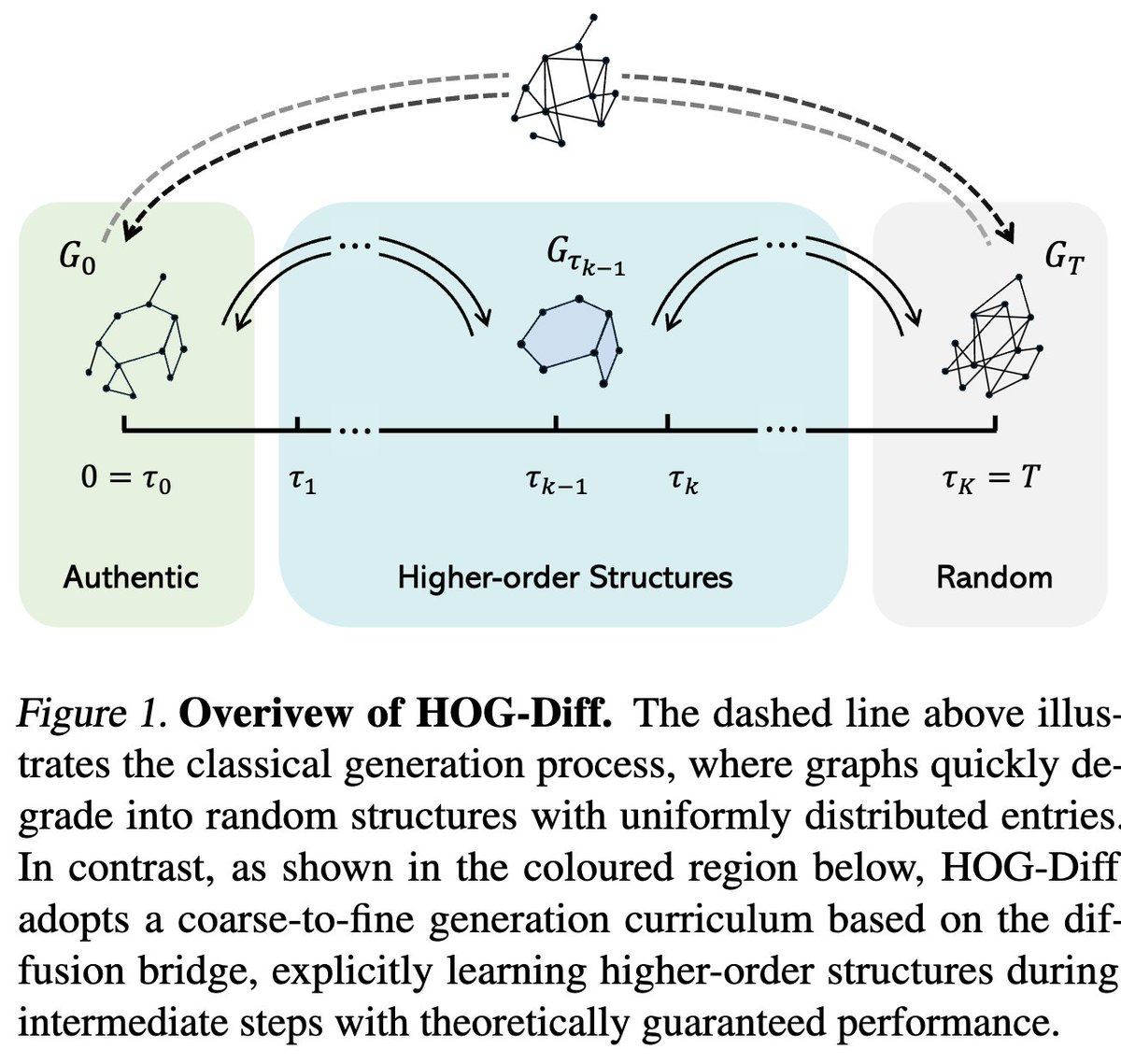
Our new topological, diffusion-bridge based graph generation framework, HOG-Diff [arxiv.org/abs/2502.04308], leverages higher-order information as a guide to progressively generate plausible graphs thru a coarse-to-fine curriculum. #TDL #TopologicalDeepLearning #GenAI #ML #AI 👇
27
134
5,621

25 Feb 2025
New Paper Alert!
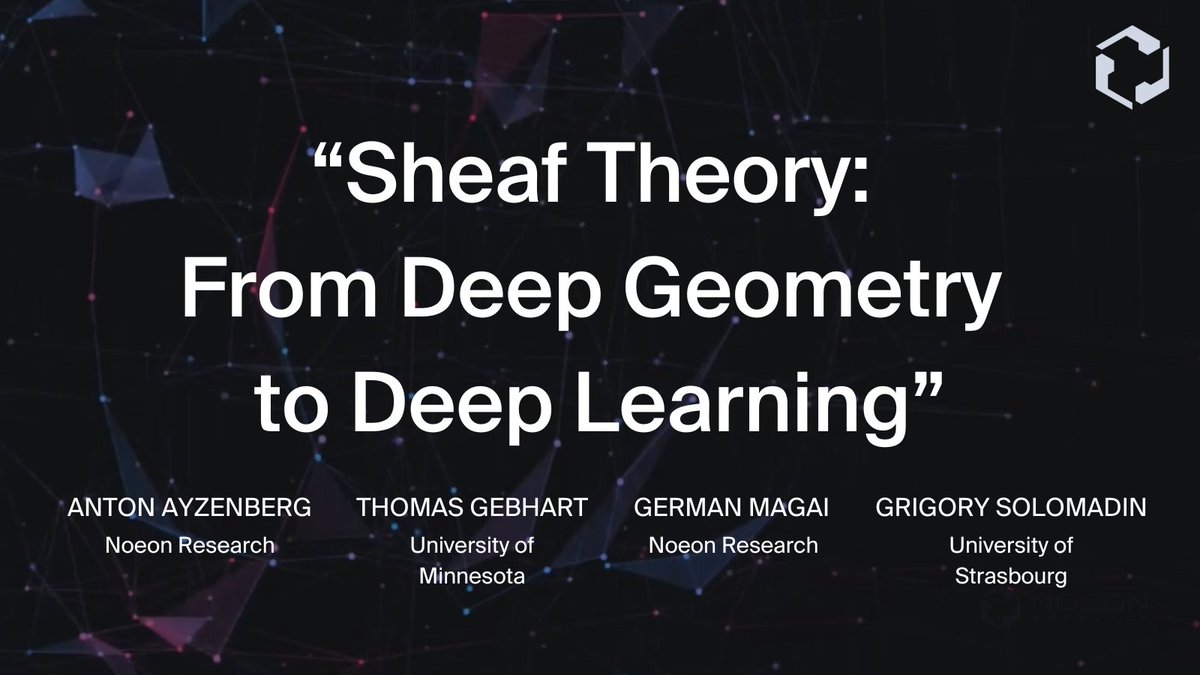
“Sheaf Theory: From Deep Geometry to Deep Learning” — where math reveals blindspots in current ML practices. Our researchers Anton Ayzenberg and German Magai (@MetatrolN) in collaboration with Thomas Gebhart at the University of Minnesota and Grigory Solomadin at the University of Strasbourg, give an overview into sheaf theory, using a nifty new algorithm for computing sheaf cohomology on finite posets (try saying that five times fast).
Read it on Arxiv: arxiv.org/abs/2502.15476
#MachineLearning #TopologicalDeepLearning #SheafTheory #CategoryTheory #Cohomology #MathMeetsML #AppliedTopology #AI
1
1
5
767

9 Feb 2025
Our new topological, diffusion-bridge based graph generation framework, HOG-Diff [arxiv.org/abs/2502.04308], leverages higher-order information as a guide to progressively generate plausible graphs thru a coarse-to-fine curriculum. #TDL #TopologicalDeepLearning #GenAI #ML #AI 👇
9
59
311
31,373
5 Dec 2024
Great opportunity if you are interested in topological deep learning applications to computer vision.
#TDL #TopologicalDeepLearning
4 Dec 2024
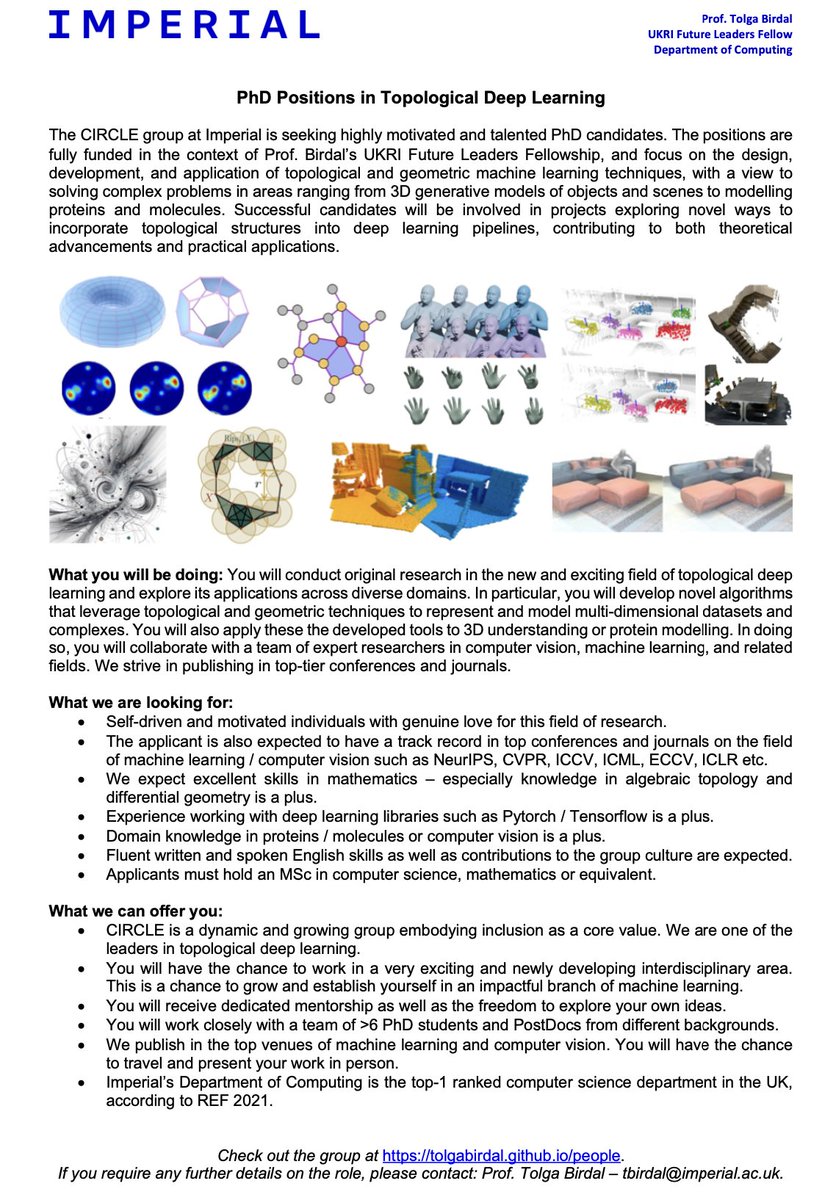
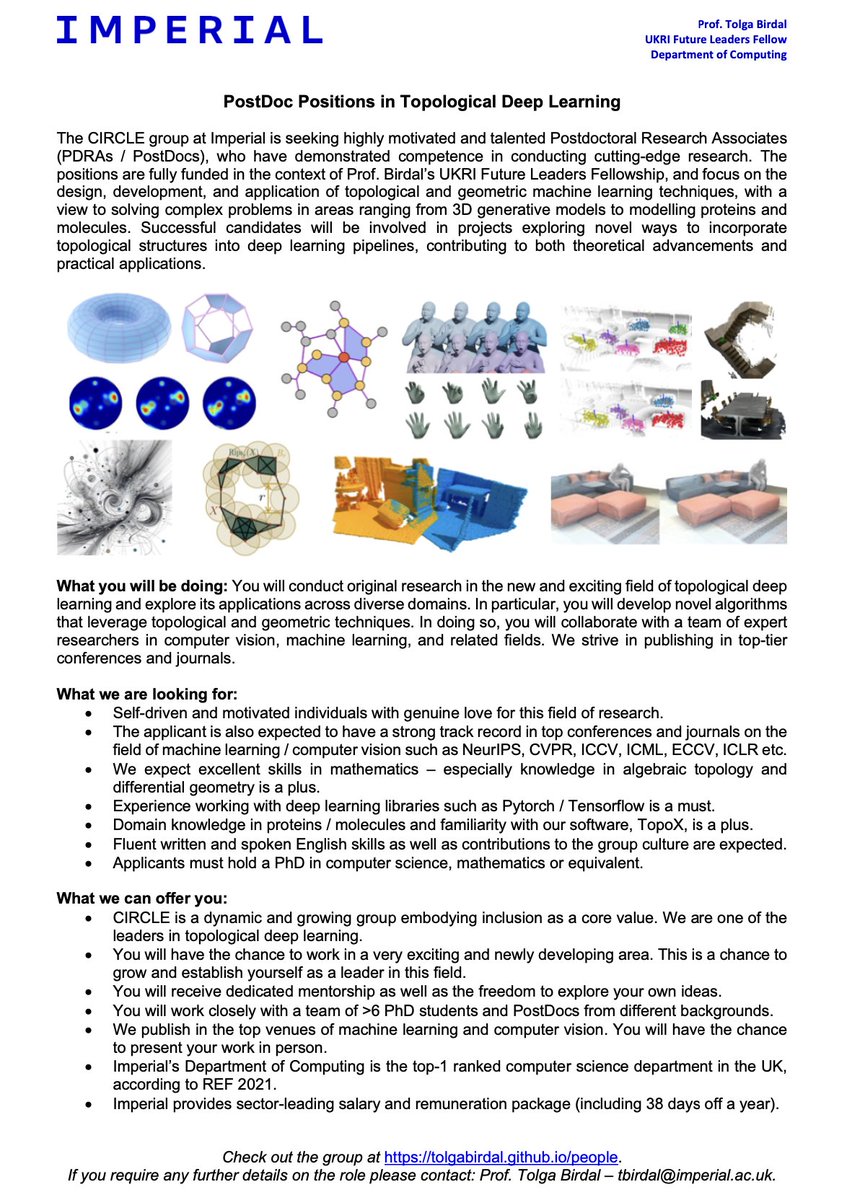
Within 2025, I will be hiring several PhD candidates and Postdoctoral researchers @ICComputing to work on various aspects of #TopologicalDeepLearning (#TDL). Posts are attached. The postdoc positions are also available to apply under:
imperial.ac.uk/jobs/search-j…
#CVPR #CVML #AI #ML
13
685
4 Dec 2024
Within 2025, I will be hiring several PhD candidates and Postdoctoral researchers @ICComputing to work on various aspects of #TopologicalDeepLearning (#TDL). Posts are attached. The postdoc positions are also available to apply under:
imperial.ac.uk/jobs/search-j…
#CVPR #CVML #AI #ML
4
49
191
26,794

Just a quick reminder to check out my Ph.D. thesis if you are looking for a comprehensive introduction to Topological Deep learning through the lens of signal processing 🎼
➡ theses.eurasip.org/theses/97…
#TopologicalDeepLearning
#GeometricDeepLearning
7
44
3,090

31 Jul 2024
Bayes TDL 😍 Thrilled with this achievement! Huge thanks to my incredible team @ClaBat9 @GDasoulas. This was one fun and well-organized competition! 🚀 #TeamWork #TopologicalDeepLearning
27 Jul 2024

This is a cool intuition of @mauriciogtec that for the first time tought about giving some Bayesian flavour to Topological Deep Learning 🎲
Team: @mauriciogtec @ClaBat9 @GDasoulas
4
8
1,155
17 Jun 2024
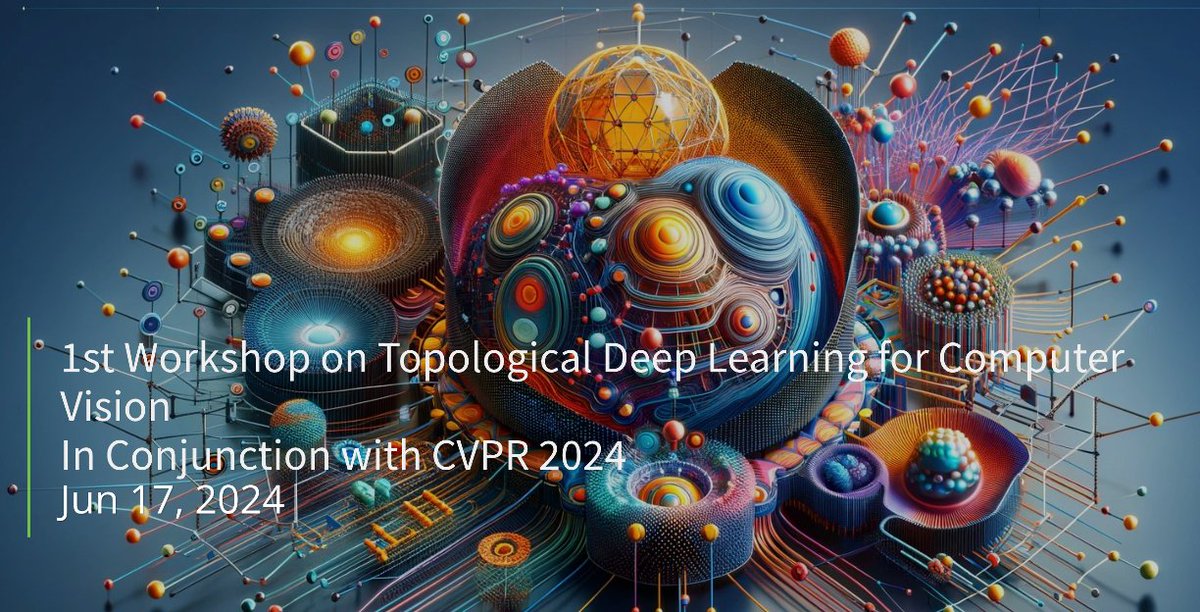
Topological Deep Learning for Computer Vision is happening this afternoon at #CVPR2024: tdl4cv.github.io/. Join us for fresh perspectives! We will introduce the field and delve deeper thanks to our great line-up of experts. #TDL #TopologicalDeepLearning #TDL4CV @CVPR
1
6
55
4,112
28 May 2024
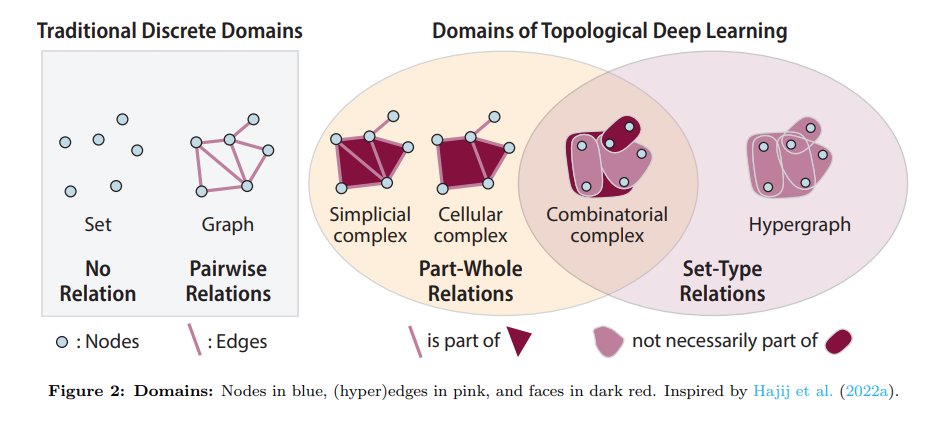
Curious about the future directions in (3D) computer vision? Join us at the 1st Workshop on #TopologicalDeepLearning for Computer Vision: tdl4cv.github.io (held in conjunction with #CVPR2024) in order to discover pioneering methods for representing relational data. @CVPR
2
23
112
14,168
24 May 2024
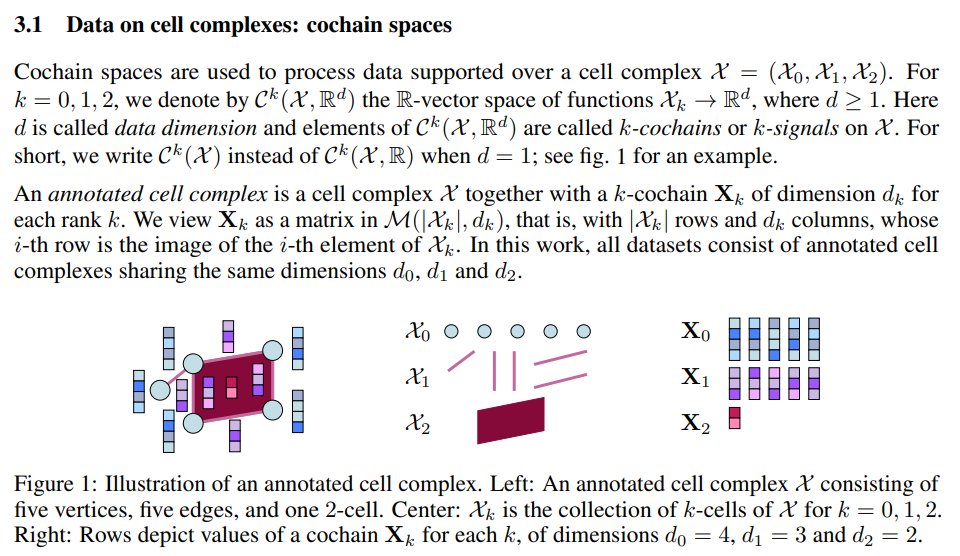
"Attending to Topological Spaces: The Cellular Transformer" by @rballeba, @mathildepapillo, @ClaBat9 , @ninamiolane, @tolga_birdal, @carlescasac, @SergioEscalera_ , @HajijMustafa et al.
Paper: arxiv.org/abs/2405.14094
#machinelarning #topologicaldeeplearning
2
19
110
14,173

12 Mar 2024
Listen to "Topological Deep Learning and Generative AI with Mustafa Hajij" by The USF Data Science Podcast podcasters.spotify.com/pod/s…
#MSDS #BSDS #USFCA #DataInstitute #TopologicalDeepLearning #DataScience #GenerativeAI #EmergingTechnologies
1
2
452