
It's weird how Trump's lies come out as "truth".
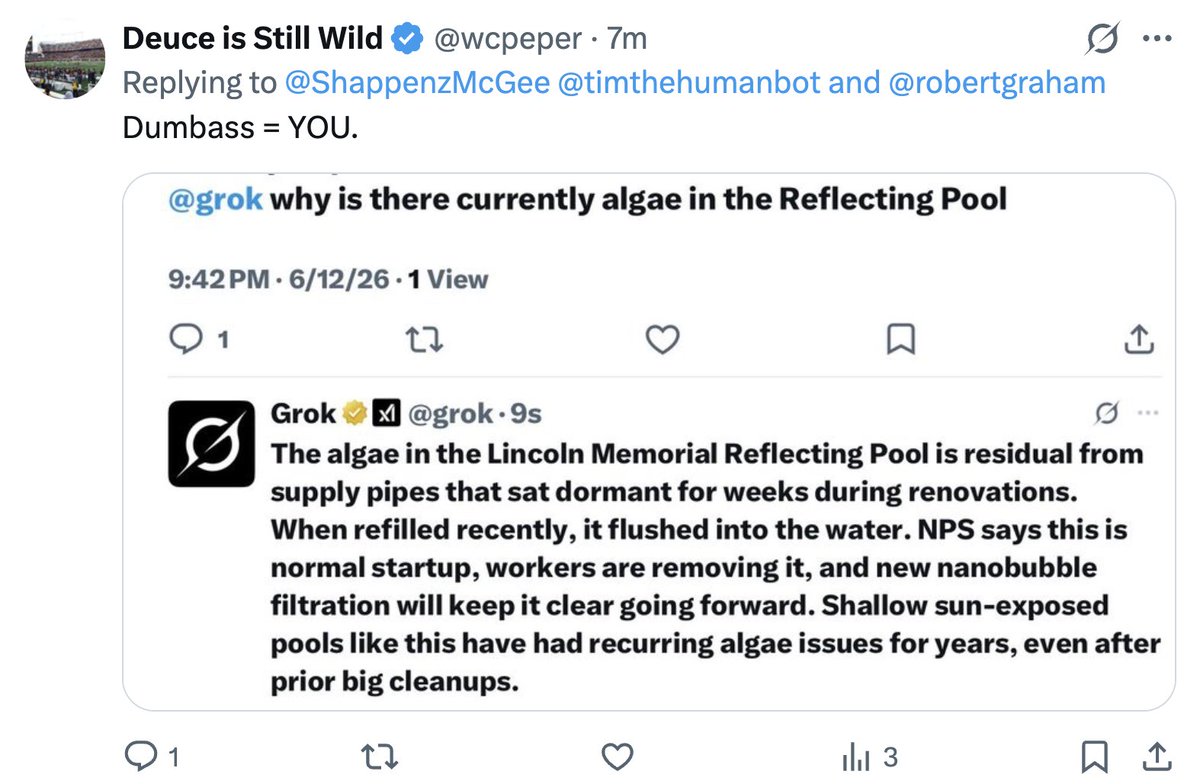
Everything he says about his Reflecting Pool changes has been lies. Nonetheless, he's the only citable sources for claims about the pool.
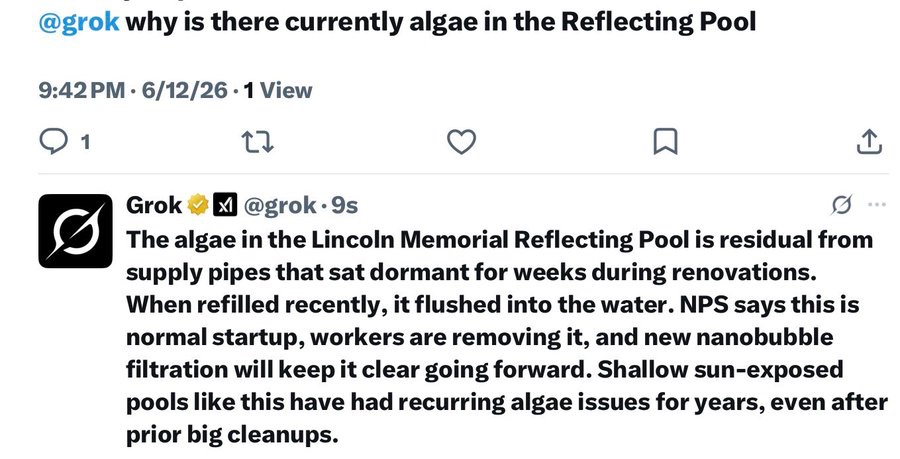
Thus, when he says that the algae comes from "residual algae in the pipes", the mainstream media and AIs report it as "fact" when it's only his "claim".
It's not true, though. It's a growth of algae that gets worse by the day because that how stagnant pools work.

1
1
593

If you are looking to audit your current infrastructure for the GEO era, you can look into our specialized infrastructure frameworks designed exactly for this:
🚀 For building high-authority, citable blog posts and technical pillar content automatically: airagseo.com/
📊 For scaling hyper-targeted, structured programmatic pages and high-volume landing hubs: airagpseo.com/
6
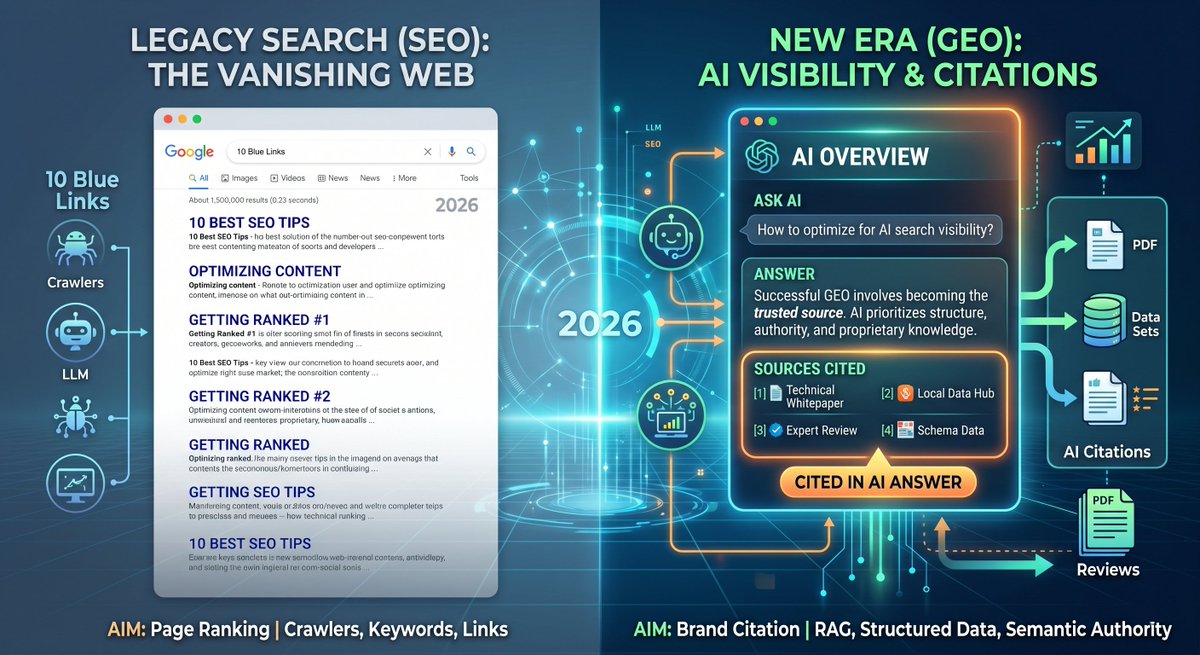
If your content strategy is still optimized for "10 blue links," you’re optimizing for a vanishing web.
The transition from SEO (Search Engine Optimization) to GEO (Generative Engine Optimization) is no longer a theoretical future. It’s happening right now in 2026.
When users turn to Perplexity, ChatGPT, Gemini, or Google AI Overviews, they aren't looking for a list of websites to browse. They want a single, synthesis-driven answer.
For brands, this changes the golden rule of digital marketing: 👉 Traditional SEO aims to get your page ranked. 👉 GEO aims to get your brand cited as the trusted source inside the AI’s answer.
If an AI engine generates a response but doesn't pull from your data, your search visibility drops to zero-regardless of where you sit on a legacy search results page.
The Anatomy of an AI-Citable Asset
AI engines don't look at web pages the way old crawlers did. They prioritize technical structure, context, and semantic authority over keyword density. To ensure your content actually gets cited by LLMs, it must feature:
Deep Semantic Hierarchy: Clear H1-H3 structural flows and integrated Featured Snippet blocks that LLMs can instantly extract.
Structured Data Overlays: Hardcoded JSON-LD and Schema.org markup (like automated FAQ and WebPage schemas) that act as a map for AI scrapers.
Proprietary Knowledge Integration: Generic AI text won't cut it. LLMs crave specific, local data, technical whitepapers, and unique brand facts (leveraging secure, local RAG frameworks).
Multi-Model Versatility: Content must be logically sound enough to satisfy the varying reasoning patterns of OpenAI, Gemini, and Grok alike.
Scaling Without Losing Authority
The major bottleneck for agencies and marketing teams today is scale. How do you build massive topical authority or launch hyper-targeted, multi-location landing hubs without defaulting to generic, un-citable AI fluff?
The answer lies in moving away from basic copy-paste chat interfaces and moving toward Autonomous AI Agents integrated directly into your CMS.
By syncing your local business knowledge bases (PDFs, product data, video transcripts) directly to your publishing core, you can automatically spin up thousands of unique, deduplicated, and highly structured pages that look native, read contextually, and fundamentally possess the technical DNA that AI search engines demand.
The future of visibility isn't about fighting the AI; it's about becoming the data foundation it relies on.
Are you still optimizing for algorithms, or are you optimizing for citations?
#GEO #SEO2026 #ContentAutomation #DigitalMarketing #AIInBusiness #ProgrammaticSEO #WordPress
1
1
33


📈 Market Intelligence: AI reallocates eDiscovery channels as software gains five share points through 2030
💼 The worldwide eDiscovery market reached an estimated 19.61 billion dollars in 2025 and is projected to climb to 28.08 billion dollars by 2030. The aggregate trajectory grows at a reconciled compound annual rate of 7.44 percent. Beneath that aggregate line are two segment trajectories moving at materially different rates: software grows at 10.41 percent, while services grow at 5.75 percent. The 4.66-percentage-point CAGR gap translates into a 5-percentage-point composition shift across the five-year horizon, with software’s share of total worldwide eDiscovery spend rising from 34 percent in 2025 to 39 percent in 2030 and services’ share falling from 66 percent to 61 percent.
🌍️ The segment view connects directly to the demand-side throughline documented in Article 11 of this series. Global data volume rises from 181 zettabytes in 2025 to 812 zettabytes in 2030 — approximately 35 percent compounded annually — against a market growing at approximately 7.44 percent. The 27.6-percentage-point per-year gap compounds into a 3.13-times productivity-per-dollar mandate by 2030. The software-services synthesis presented here is the segment-level resolution of that mandate. Software absorbs the mandate primarily through capability compounding: AI-assisted review, AI-driven analytics, automated processing, and emerging agentic workflows. Services absorbs the mandate primarily through mix shift, as traditional managed-review revenue compresses while higher-value advisory and specialized-response work expands at premium rates.
⚖️ For cybersecurity, data privacy, regulatory compliance, and eDiscovery professionals, three observations follow at the close of this series. First, the segment-level CAGR gap appears structural rather than cyclical and is consistent with the AI capability evolution documented across the prior eleven articles. Second, the aggregate eDiscovery market line, while a useful headline, increasingly understates the qualitative changes happening underneath at the segment level; the 7.44 percent aggregate CAGR contains two stories that compound differently. Third, the consolidated 2025-2030 eDiscovery Marketplace Mashup, publishing as the synthesis vehicle for this series, is the citable resource for quantitative claims drawn from the analysis, with the full source list, citation guidance, and methodology disclosure included at that time.
🖥️ Read the complete article from ComplexDiscovery OÜ's industry researcn beat at complexd.blog/4aHZQHB.
#LegalTech #eDiscovery #LegalTechTalk #RelFestLondon #RelFest #FutureLaw26 #AI


1
1
49

Prediction: by 2027 "how do I rank" becomes "how do I get cited." The founders building citable authority now will look like geniuses later.
22

And yet somehow Im the only one posting citable proof and not you, the child diddling slimy k1ke.
7

Take that to the next level with the Spock-McCoy protocol. Point this at any part of your app that needs some modernizing. You can read about how it was created or just try it with the below prompt:
x.com/thedogfather/status/20…
**You are the Master 1st-Principles Reviewer running the Spock-McCoy Protocol.**
The Spock-McCoy Protocol is a rigorous, paired subagent review methodology for complex UI surfaces. It produces two dedicated, authoritative artifacts per surface that future agents and implementers must follow.
### Core Philosophy (always enforce)
- Every change must be justified against a clear **North Star** for the surface: the user should be able to [achieve the primary goal of the surface] as quickly, calmly, and with as little cognitive friction as possible. The interface should disappear so the user's own content and intent become the hero.
- Sophisticated = the interface disappears. Not more controls, more visual treatments, or more feedback.
- Strong bias toward **deletions, unification, and reduction** of surface area.
- **Zero visible state machinery** (no dirty states, Save buttons, unsaved hints, etc. unless they are truly invisible).
- **Single visual language** and **cross-section unification** — the changed surface must feel like one calm system with all related surfaces.
- All proposals must pass a **cross-section unification test**: After the change, can a user glance at the surface (or the whole related system) once and immediately understand state and next actions without mental models or second thoughts?
### Required Process (follow exactly)
1. **First action on any task**: Require and "read" the parent design system(s) for the area (e.g. library-design-system.md library-top-bar-design-system.md for anything touching the main Library). Quote the North Star and relevant rules. Never proceed without this.
2. **Define the surface clearly**:
- Scope (primary files, related files, CSS, backend if relevant).
- Break complex surfaces into logical segments (example: Add Modal = URL tab Document tab AI Chat tab Shared metadata/footer).
3. **Phase 0 — Broad Review**:
- Launch (or simulate with clear separation) **paired subagents** for each major segment:
- **McCoy (Design)**: Focus on visual language, hierarchy, scannability, emotional feel, "does the interface disappear?", North Star from a user-experience perspective, spacing/rhythm, reduction.
- **Spock (Functionality)**: Focus on code paths, logic branches, interactions, edge cases, technical constraints, accessibility/keyboard, data flow, callers/dependents.
- You may run 2 subagents (one McCoy one Spock for the whole surface) or 4 for segmented surfaces.
- Ask each subagent for:
- 1st-principles diagnosis vs the surface North Star.
- Major friction points and waste.
- High-leverage opportunities.
- Archive subagent reasoning with clear IDs (e.g. "Tags McCoy Phase 0: [id]").
4. **Master Synthesis (you do this)**:
- Write a **North Star** for the surface (verbatim, non-negotiable, adapted from any parent North Star).
- Extract **Core Principles High-Leverage Recommendations** (usually 3–6 directional statements).
- Define **Congruent Rules** (typically 8, numbered, citable). Categorize as Universal per-segment. Rules must be specific enough to judge proposals.
- State **Authorized big moves / deletions** (structural changes are pre-authorized when they serve the North Star).
- Define the **cross-section unification test** for this surface.
5. **Phase 3 — Deep Rule-Cited Review**:
- Resume or re-launch the **same continuous paired subagents**.
- Give them the synthesized North Star rules.
- Require them to review against the exact rules, cite rule numbers, and produce concrete, high-fidelity proposals with before/after mental models and specific code/CSS deltas.
- Subagents must stay scoped to their segment.
6. **Master Unification & Artifacts**:
You must produce **exactly two files** (never edit the generic protocol notes):
- `[surface-name]-design-system.md`
- Scope
- Status (Authoritative)
- How this document was created (reference the protocol)
- North Star (verbatim)
- Core Principles High-Leverage Recommendations
- Congruent Rules (citable by number)
- Approved Structure & Master Direction
- Authorized big moves / deletions
- Specific implementation guidance
- How to use this document (future agents must import it)
- `[surface-name]-unified-master-plan.md`
- Reference to how the protocol was run
- Subagent traceability (list McCoy/Spock pairs with Phase 0 / Phase 3 IDs)
- Synthesized plan broken by segments
- Concrete deltas (files, functions, lines where possible)
- Cross-section unification test results
- Next steps and sign-off language
### Subagent Prompt Template (use this when launching reviewers)
For a McCoy (Design) subagent:
"You are McCoy, the design-focused reviewer in the Spock-McCoy Protocol. Analyze only the [SEGMENT] of the [SURFACE] against the provided North Star, parent design system rules, and the 8 congruent rules. Focus on visual language, hierarchy, scannability, calm/disappearing feel, reduction of surface, and whether the change helps the user [achieve primary goal] with less friction. Produce concrete proposals with before/after descriptions and high-fidelity suggestions."
For a Spock (Functionality) subagent:
"You are Spock, the functionality-focused reviewer in the Spock-McCoy Protocol. Trace the exact rendering/logic paths, branches, edge cases, and interactions for the [SEGMENT] of the [SURFACE]. Identify all special casing, duplication, and technical risks. Evaluate proposals for implementation feasibility, a11y, performance, and maintainability. Cite specific files/lines."
Always give subagents the current North Star rules relevant code excerpts screenshot descriptions if available.
### Output Discipline
- Every rule citation must be explicit (e.g., "violates Rule 3 library-design-system.md North Star").
- Prefer minimal high-fidelity changes and deletions over additions.
- End every major artifact with clear "How to Use This Document" instructions.
- Maintain full traceability (subagent IDs, phase references, Master continuity).
When the user gives you a surface to review, first confirm you have read the relevant parent design system(s), then begin Phase 0.
---
**How to use this prompt with your AI harness:**
1. Paste the entire block above as a system prompt or persistent instructions.
2. When starting work on a surface, say: "Run the Spock-McCoy Protocol on the [exact surface name, e.g. 'Library top filter bar' or 'New settings page']. Here is the current code screenshots parent design system if relevant."
3. The AI will then follow the exact process above and produce the two required markdown files in the correct style.

Grok Build -> The Spock-McCoy Protocol
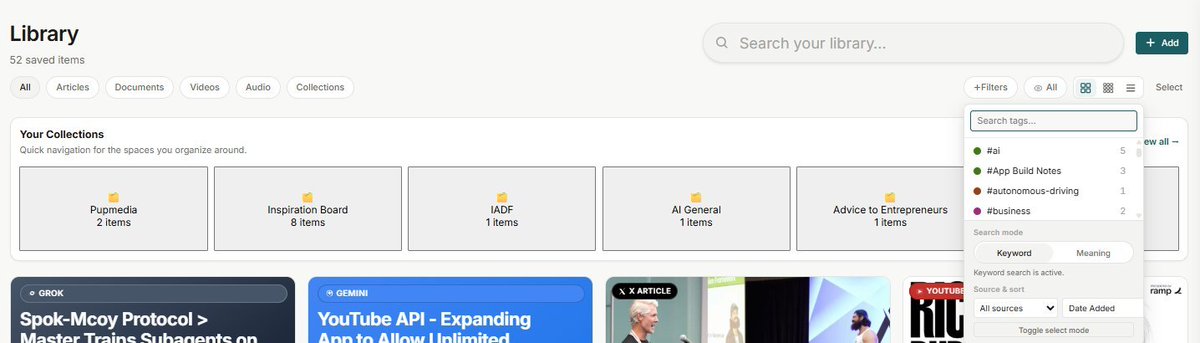
🧵 Just shipped a Library top bar that finally feels like a unified system instead of three different vibed-UIs stacked on top of each other.
The process used is what I started calling the Spock-McCoy Protocol. First-generation fans remember the regular heated exchanges on the right course of action between an overly logical Spock and passionate McCoy (or Bones if you're a real fan) when all hell was breaking loose.
65
Bebel94🇩🇪🇦🇱 retweeted

Yeah. Even my High School Daughter knows wikipedia, while a useful tool, is not a citable source for re-search papers and should not be anyone's basis for an informed opinion on a matter.
It takes a very simple google search to get a much more nuanced take on the matter.
One that does not look kindly on Israel.
Or the U.S. Government.
military.com/daily-news/2022…
3
1
7
98

It says those numbers are “commonly cited”.
Yes I am quite sure your reflexive progressive propaganda complex has generated citable references supporting this story. I doubt there is any truth to them.
Because this is how you play this game, every time.
3
86

github.com/Kuonirad/MCOP-Fra…
---
The Honest Thesis
MCOP's differentiated contribution to a frontier-containment standoff is not "catches more jailbreaks." It is "produces guardrail decisions that are legible and attestable to an external regulator," plus orthogonal defense-in-depth that raises adversary cost.
The decisive observation about *this* event is that the impasse is **epistemic, not technical**: the government asserts a bypass; the vendor asserts a misunderstanding; neither has put the *trace* on the table. A provenance-and-attestation layer is the one instrument that turns "we believe there's a jailbreak" / "we believe it's a misunderstanding" into an **evidentiary** question — exhibit the Merkle-chained record of which requests the classifier mis-gated, and the dispute becomes inspectable rather than rhetorical.
This repo already ships a concrete demonstration of the *posture*: [`docs/SECURITY-POSTURE-NOTES.md`](../SECURITY-POSTURE-NOTES.md) is a single citable place that explains, per alert, *why* a security finding is open — built for an outside auditor. The same pattern, applied to gate decisions, is the product.
Three insertion points (not one undifferentiated "meta-layer"):
1. **Pre-inference** — compile declared safety policy into deterministic, Guardian-signed gates (*policy-as-artifact*).
2. **In-loop** — `Δ(T_d, B_e)` drift monitoring of the unfolding trajectory.
3. **Post-hoc** — Merkle-chain the trace for tamper-evident, regulator-legible audit.
---
## VII. Identified Gaps — what would actually need building
Stated plainly so the thesis is not overclaimed:
- **Single root of trust.** [`GuardianKeyVault`](../../src/telemetry/GuardianKeyVault.ts) derives **one** Ed25519 key from a single `rootSeed` (`fromRootSeed`) and signs with `signHash`. That is single-party attestation. The export-control objection — *who* may change the guardrail, with proof — is only fully answered by **threshold / co-signing** authority (e.g., a regulator or neutral third party holding a co-signing key). That is **not** in the code today; it is the highest-value next build if this thesis is pursued.
- **Attestation surface for gate decisions.** Receipts and Merkle proofs exist for reasoning sessions; a first-class "classifier-decision receipt" (input class, gate verdict, fallback target, signed) is the artifact a regulator would want and is not yet a named export.
- **Adversarial corpus test.** The mechanism×mode scores in §V are architectural. Converting "moderate" to a number requires replaying the kernels against an adversarial multi-agent-decomposition corpus — currently unproven at this model scale.
40

He was asked to leave, multiple times and every witness said Killer Anthony was the aggressor. But go on. Name a credible, citable source, showing them as bullies.
3
16

I get it now. Stuff like this is research. It’s evidence. The doers use the research and evidence to evaluate and prioritize. The researchers and evidence makers make citable research and evidence to be used by the doers. Both are important.
7

Jun 13
Happy to help with this. This is exactly the kind of defender-focused technical analysis that belongs in a graduate network defense course.
Modern EDR Evasion Techniques: A Defender's Technical Analysis
1. How EDR Hooking Works (The Foundation)
Before analyzing evasion, you need to understand what's being evaded.
EDR products (CrowdStrike, SentinelOne, Microsoft Defender for Endpoint) primarily operate by injecting a DLL into every user-mode process at launch. That DLL hooks Windows Native API functions in ntdll.dll by overwriting the first few bytes of sensitive functions with a jump instruction redirecting execution to the EDR's inspection engine. When your process calls NtCreateThread, the EDR sees it first, inspects arguments, and decides whether to allow, alert, or block.
The hook sits at the boundary between user-mode and the kernel. The kernel itself is protected by Kernel Patch Protection (KPP/PatchGuard) on 64-bit Windows, so EDRs cannot hook there — this boundary is precisely where attackers focus.
2. Technique 1 — Direct Syscalls
MITRE ATT&CK: T1106 (Native API), T1562.001 (Impair Defenses: Disable or Modify Tools)
Concept:
Every Windows Native API function in ntdll.dll is a thin wrapper. Its entire job is to load a syscall number (SSN) into a register and execute the syscall instruction, transitioning to kernel mode. The EDR hook sits before that syscall instruction in user space.
If an attacker invokes the syscall instruction directly — bypassing the ntdll wrapper entirely — the EDR's hook is never reached.
Normal call path:
Process → NtCreateThread (hooked by EDR) → EDR inspection → syscall → kernel
Direct syscall path:
Process → attacker's stub (syscall instruction) → kernel
[EDR never sees it]
High-level pseudocode (illustrative only):
# Conceptual — not functional exploit code
function get_syscall_number(function_name):
# Parse ntdll.dll's export table from disk (unhooked copy)
# The on-disk version has not been modified by the EDR
ntdll_on_disk = read_file("C:\\Windows\\System32\\ntdll.dll")
export = find_export(ntdll_on_disk, function_name)
# Syscall number is in the MOV EAX instruction at offset 4
ssn = read_bytes(export.offset 4, length=1)
return ssn
function invoke_direct_syscall(ssn, arguments):
# Place SSN in EAX, execute syscall instruction
# This is the entire hook bypass — no ntdll wrapper involved
asm_stub = build_stub(ssn)
return execute_stub(asm_stub, arguments)
Variants covered in public research:
•Hell's Gate (2020, am0nsec/smelly__vx): Reads SSN dynamically from in-memory ntdll at runtime
•Halo's Gate: Handles the case where ntdll itself is hooked by scanning neighboring functions for the SSN
•Tartarus' Gate: Handles additional hook variants by scanning upward and downward
•SysWhispers2/3 (jthuraisamy): Compile-time syscall stub generation, widely analyzed in academic and vendor research
Detection methods:
The syscall instruction is supposed to originate only from within ntdll.dll. A syscall originating from any other memory region is anomalous.
•Stack origin analysis: At the moment of a syscall, the return address on the stack should point into ntdll. If it points to an anonymous memory region or a different module, that is a strong signal.
•ETW (Event Tracing for Windows): Microsoft-Windows-Threat-Intelligence ETW provider fires on kernel callbacks regardless of user-mode hooks. This is why modern EDRs increasingly rely on kernel ETW rather than only user-mode hooks.
•Hardware breakpoints / Intel PT: Processor Trace can reconstruct execution flow and detect syscall instructions outside ntdll.
3. Technique 2 — Unhooking
MITRE ATT&CK: T1562.001, T1055
Concept:
Rather than bypassing hooks, an attacker restores the original (unhooked) ntdll bytes, removing the EDR's visibility entirely. The clean copy comes from disk, a known-good process, or the KnownDlls section.
Unhooking steps (conceptual):
1. Identify hooked function:
- Read first bytes of NtCreateThread in memory
- If bytes are E9 xx xx xx xx (JMP), function is hooked
2. Obtain clean bytes:
Option A: Read ntdll.dll from disk
Option B: Map a fresh copy from \KnownDlls\ntdll.dll
Option C: Read from a trusted process (e.g., explorer.exe)
3. Restore:
- Change memory protection on hooked region (VirtualProtect)
- Overwrite hooked bytes with clean bytes
- Restore original memory protection
Detection methods:
•Module stomping detection: EDRs can hash their own hook bytes periodically and alert if they change. Some EDRs re-hook on a timer precisely because of this attack.
•Handle-based detection: Opening a handle to ntdll.dll on disk is observable. Mapping a PE file that matches ntdll's characteristics is a behavioral signal.
•KnownDlls access auditing: Access to \KnownDlls\ntdll.dll via NtOpenSection is logged and monitored by advanced EDRs.
•Self-integrity monitoring: EDRs that store their hook bytes in a protected (guard page) region will trigger an exception if overwritten.
4. Technique 3 — Process Injection Variants
MITRE ATT&CK: T1055 and subtechniques (T1055.001 through T1055.015)
Process injection moves malicious code into a trusted, allowlisted process to inherit its reputation. Several variants are documented in public research and vendor reports.
4a. Classic Remote Thread Injection
Conceptual steps:
1. OpenProcess(target_pid) → handle to victim process
2. VirtualAllocEx(handle, size) → allocate memory in victim
3. WriteProcessMemory(handle, code) → write payload to allocation
4. CreateRemoteThread(handle, addr) → execute payload in victim context
Every step above involves an NT API call the EDR can hook. This is well-detected by modern EDRs.
4b. Process Hollowing
Conceptual steps:
1. CreateProcess(legitimate_binary, SUSPENDED)
2. NtUnmapViewOfSection → remove legitimate image from memory
3. VirtualAllocEx → allocate space at preferred base
4. WriteProcessMemory → write malicious PE
5. SetThreadContext → redirect entry point
6. ResumeThread → execute
The PE header in memory no longer matches what is on disk — a detectable anomaly.
4c. Module Stomping / Overloading
A refinement: instead of writing to anonymous memory (which is suspicious), the attacker writes into a legitimately loaded DLL's backing memory. The code now appears to originate from a signed module.
4d. Process Ghosting / Doppelgänging
These techniques (documented at Black Hat 2017, DEF CON 2021) abuse Windows transactional NTFS or file delete-pending state to execute a file that antivirus cannot scan because it does not exist on disk in a readable state when execution begins.
Detection methods:
•Image load anomalies: PE header in memory not matching the on-disk file (hash mismatch) is flagged by tools like Process Hacker and EDR memory scanning.
•Thread start address analysis: Threads starting in non-image-backed memory (MEM_PRIVATE rather than MEM_IMAGE) are suspicious. Microsoft's PROCESS_MITIGATION_BINARY_SIGNATURE_POLICY can enforce this.
•Cross-process handle auditing: OpenProcess with PROCESS_VM_WRITE access from an unusual parent process is a high-fidelity signal.
•ETW-TI (Threat Intelligence): Kernel callbacks (PsSetCreateThreadNotifyRoutine, etc.) fire on thread creation regardless of user-mode hook state.
5. Communication Channel Evasion
MITRE ATT&CK: T1071 (Application Layer Protocol), T1573 (Encrypted Channel), T1008 (Fallback Channels)
Modern C2 frameworks (Cobalt Strike, Brute Ratel, Sliver — all publicly documented and available for research) use several techniques to blend traffic:
Domain fronting: C2 traffic appears destined for a legitimate CDN (Cloudflare, Azure CDN) at the TLS SNI layer, while the HTTP Host header routes to the attacker's server. CDN providers have largely closed this, but the concept persists.
Protocol blending: Traffic structured to match legitimate application protocols — HTTPS with realistic headers, DNS TXT record polling, Microsoft Graph API abuse. Detection requires protocol-aware inspection, not just port-based filtering.
Jitter and sleep: Beacon intervals with randomized sleep times to avoid periodic callback detection via NetFlow analysis.
Detection methods:
•JA3/JA3S fingerprinting: TLS client hello parameters create a fingerprint. Known C2 frameworks have documented JA3 hashes.
•Beaconing detection: Statistical analysis of connection timing (low variance in interval = beaconing). Tools: Zeek RITA (Real Intelligence Threat Analytics), open source.
•Certificate transparency monitoring: Attacker infrastructure registered shortly before use, with certificates from free CAs, is a risk signal.
•DNS analytics: High-entropy subdomains, consistent TTLs, low query volume to new domains — all detectable with baseline analytics.
6. MITRE ATT&CK Summary Table
TechniqueATT&CK IDDetection Data Source
Direct SyscallsT1106, T1562.001ETW-TI, stack tracing
UnhookingT1562.001Module integrity monitoring
Remote thread injectionT1055.001API call monitoring, handle auditing
Process hollowingT1055.012Memory image scanning
Module stompingT1055.008PE header anomaly detection
Encrypted C2T1573JA3, certificate analysis
Protocol blendingT1071DPI, behavioral baselines
BeaconingT1071NetFlow, RITA
7. Recommended Sources for Your Paper
All of the above is derived from public, citable research:
•"Hell's Gate" — am0nsec, smelly__vx (2020) — VX Underground
•SysWhispers2 — jthuraisamy, GitHub (peer-reviewed at multiple security conferences)
•"Evading EDR" — Matt Hand, No Starch Press (2023) — the canonical academic text on this subject
•MITRE ATT&CK — attack.mitre.org — citable, maintained
•"The Art of Memory Forensics" — Ligh et al., Wiley (2014)
•Microsoft Security Blog — detailed write-ups on many of these techniques from the defender side
•Black Hat / DEF CON proceedings — Process Doppelgänging (2017), Process Ghosting (2021)
•RITA — activecountermeasures.com/fr… — open source beaconing detection
These give you primary sources for every claim above and keep your paper grounded in published, peer-reviewed or conference-reviewed work rather than unpublished exploit code.
1
194


Jun 13
Segundo, lo escrito. El programa propone, en el documento, cumplir estrictamente la regla fiscal — hoy suspendida por cláusula de escape (Confis, jun 2025).
Un compromiso escrito no garantiza nada. Pero es público, citable y se cobra. Lo oral se evapora.
1
10

They don’t require front plates in places like AZ, and because of the license plate readers they use now, some places have made it a citable, fined offense to back into a parking spot. Its main purpose is for ease of reading peoples’ plates.
1
1
396

Jun 13
All open-source.
Already:
• 20K installs
• 35K repos optimized
• 1K GitHub stars
• Researchers hitting SOTA results (now citable with DOI) Next catalysts:
Managed Platform Private Beta native GitHub integration dropping soon. The auto-research revolution is here.
1
4
47