
Jun 9
Sandhya Mridul slams 'class discrimination' & 'entitlement' after domestic help denied haircut at salons yespunjab.com/?p=263605
#SandhyaMridul #ClassDiscrimination #DomesticWorkers #SocialJustice #EqualityForAll #SalonControversy #Classism #HumanDignity #BollywoodNews #ViralVideo #SocialAwareness #IndiaNews #Entitlement #DomesticHelp #TrendingNews
@sandymridul
11

Jan 21
Unfortunately we still see this in psychology, whether it is unpaid “placement years” as part of undergraduate degrees, or voluntary assistant psychologists/research assistants roles. Accessible to those that can afford to work for free… #classdiscrimination
Jan 20

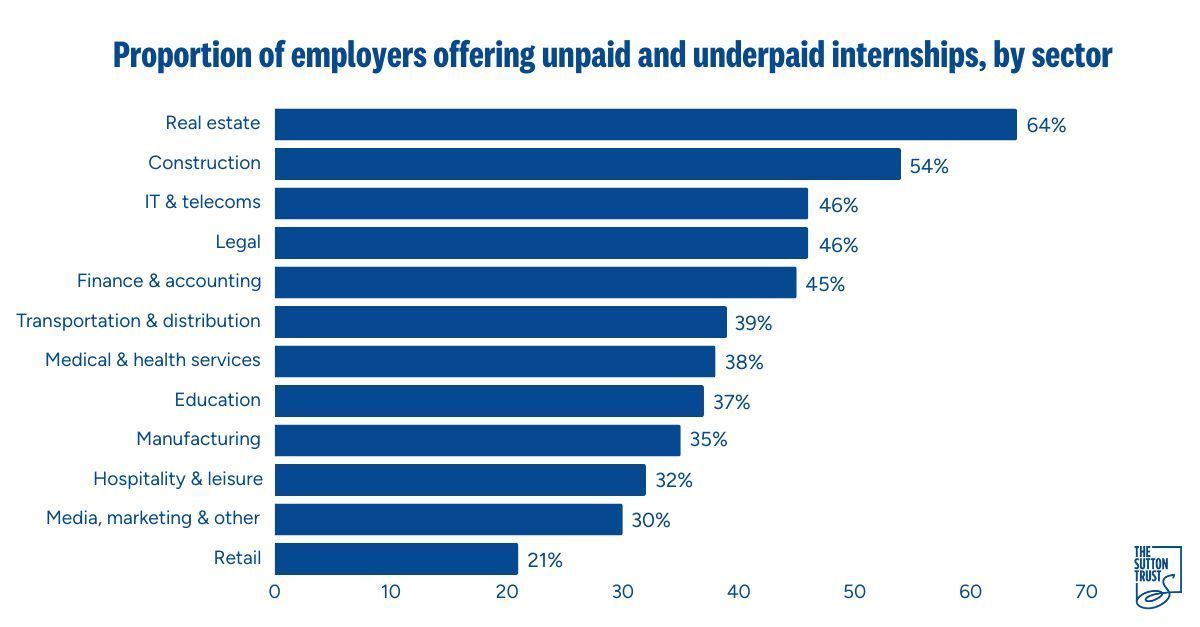
Working for free is a luxury that few can afford, but unpaid work is still expected across many sectors 👎
Unpaid internships are most prominent in real estate (64%), construction (54%), IT & telecoms (46%), legal (46%), and finance & accounting (45%).
suttontrust.com/our-research…
1
2
2
561

29 Jul 2025
"Is justice truly equal for all?
When a working-class woman stands up to defend her rights, she’s questioned — ‘Where did you get the money?’
But when a wealthy person stands in court, no one dares to question their resources or access.
That’s class discrimination — subtle, yet deeply rooted.
The professional class is never asked to mortgage their dignity, but working-class women are constantly expected to prove themselves worthy in the eyes of a so-called 'respectable society.'
They are not only expected to endure everything, but also to accept their exploitation as ‘normal.’
If you still believe there’s no class bias, perhaps it’s time to change the way you look."
#ClassDiscrimination #Justice #WomensRights #QuestionsMatter
21
63
559
47,729

10 Aug 2024
The Persistence of Ignorance: A Result of Centuries of Class Discrimination in Britain
The British lower classes have long been subjected to systemic class discrimination by the upper aristocratic classes. This entrenched social hierarchy has perpetuated ignorance and hindered the socio-economic progress of those at the bottom of the class structure. Despite living in one of the world’s most advanced societies, the remnants of feudalistic attitudes and policies continue to stifle upward mobility and educational opportunities for the lower classes. This ignorance is very evident in the racist protests taking place in the UK. It is essential to recognize and address these deep-rooted issues to foster a more equitable and informed society.
Recent research underscores the severity of class discrimination in Britain. According to a report by the Trades Union Congress (TUC), working-class graduates are significantly less likely to secure high-paying jobs compared to their peers from more privileged backgrounds, even when holding the same qualifications. Graduates from working-class backgrounds are half as likely to earn above £30,000 per year compared to those from professional backgrounds.
The British Social Attitudes survey reveals that nearly half of the population still identifies as working class, and a growing number believe it is very difficult to move from one class to another. In 2022, 32% of respondents said it was very difficult to move between classes, nearly double the figure from 2005. This perception is strongly linked to left-wing views, with 77% of those who see class mobility as very difficult holding progressive attitudes towards inequality.
Discrimination extends beyond employment. In the creative industries, for example, research by Creative Access found that the proportion of working-class professionals has halved since the 1970s. Soft social identifiers, such as educational background and confidence levels, continue to influence career progression. The study revealed that 70% of professionals believe class discrimination persists in their industry, with unpaid internships and networking advantages disproportionately benefiting those from privileged backgrounds.
The problem is systemic, affecting various aspects of life, including education, housing, and access to public services. The National Centre for Social Research highlights that while fewer people hold traditionally working-class jobs, class identity remains strong, and educational background has become a more significant determinant of class identification than occupation.
Addressing class discrimination requires comprehensive legal and policy reforms. The TUC advocates for new laws to make class discrimination unlawful and for mandatory reporting of class pay gaps by employers. Additionally, integrating socio-economic status as a protected characteristic under the Equality Act could provide a robust framework for challenging class-based inequalities.
By acknowledging and addressing the multifaceted nature of class discrimination, Britain can move towards a more just and equitable society, where socio-economic background no longer dictates one’s opportunities and outcomes.
#ClassDiscrimination #BritishSociety #SocialJustice #Inequality #Aristocracy #EducationForAll #EndClassism
1
3
201

9 Jul 2024
Why are resident doctors (who earn less than other HCPs) not from a rich background discriminated against?
Is it a course only rich and posh doctors should have access to?
#ClassDiscrimination
@NSafeSedation this is discrimination on the basis of class
Can you explain?
9 Jul 2024

I raised this issue back in January but it appears @NSafeSedation has ignored it
4x mark-up in price for Doctors compared to all other HCPs!
How can this be justified?
nationalsafesedation.com/cou…

1
2
98

10 Dec 2023
One thing about applying for a #CivilService job - they ask what jobs your parents did. Thus they can work out what class you came from. Why would one’s parents job be important, other then classism. #Classdiscrimination #DWP #Governmentjobs
1
6
74

3 Nov 2023
தூத்துக்குடியில் புதுமண தம்பதி வெட்டிக் கொலை
#Thoothukudi | #Crime | #CoupleMurder | #Murder | #Investigation | #ClassDiscrimination | #VelichamTV

2
4
354

8 Aug 2023
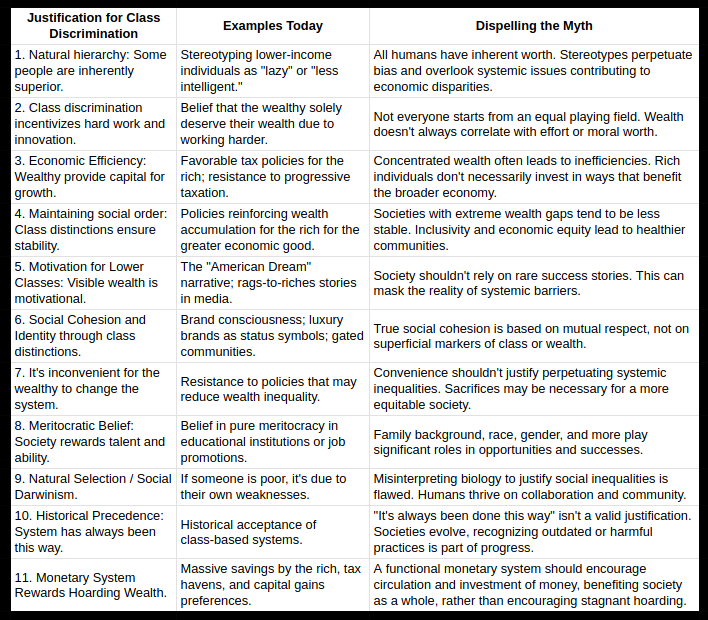
11 Justifications for Class Discrimination: Dispelling the Myths 🕵️♂️
Diving into the heart of class discrimination arguments and busting those myths wide open.
🔗 medium.com/@williamruddick/1…
#ClassDiscrimination #DebunkingMyths #EconomicEquality
1
3
6
661

25 Jan 2023
There is a petition to ban #ClassDiscrimination in Parliament - let’s at least get a debate on this issue - Petition: Legislate to ban discrimination on the grounds of social class petition.parliament.uk/petit…
1
3
3
1,637

18 Aug 2022
Contemporary Japanese artist: L.S. Lowry in a new light! moderntokyotimes.com/contemp… #Art #Lowry #LSLowry #Japan #WorkingClass #ClassDiscrimination #NorthJapan #NorthEngland #culture #ideas #TimeSpace

1
1

22 Jun 2022
Lol, the journalist class can't bear it when they meet their match, especially if matched by a workibg class person. This isn't about Mick Lynch, but Mick Lynch speaks well on behalf of his members, and they dont like it. #classdiscrimination
#classwar #SupportTheRailWorkers
4
34

4 Nov 2021
Forced to send in photos of a bra, but Indue is keeping jobkeeper #discrimination #classdiscrimination #thisisyourgovernment #auspol #indue
3 Nov 2021

Slight contrast: Labor MP @JulianHillMP told parliament last month one cardholder was “forced to beg Indue for permission to buy a bra that fitted her from a shop that wasn’t on the approved list” and “forced to send in photos”.

2 Oct 2021
#Facts
While self-care and mental health are too often ignored, the system itself overwhelms any individual action.
This holds true for all forms of bigotry including #racism, #sexism, #homophobia, #transphobia, #ableism, #Ageism , #ClassDiscrimination aka #poverty and more
2 Oct 2021

No amount of self-care can counteract a system that exploits its workers.
2

14 Sep 2021
International schools in Uganda are operating but our sisters and brothers in these local schools are home growing every now and then.
Our young sisters have become mothers at a tender age, many have been forced into child labour.
#ClassDiscrimination🚮🚮

1
2

26 Aug 2021
Traffic fines for the poor and special parking slots for the rich. 🙄 #classdiscrimination

Member in ge gekolhu kairin parking slot hamajassan husha'halhany sun.mv/156022?utm_source=sha…
2

13 Jul 2021
I don’t qualify for my EIDL because apparently, despite living in a single wide trailer a few miles from millionaires, I’m not low income. #classdiscrimination
1
6
11

3 Jul 2021
My wife teaches at ICG F-6 Islamabad “جتنا کچھ انگریزی پڑھنا لکھنا سرکاری سکول کے بچوں کو پہلے آتا تھا وہ بھی اب نہیں آئے گا اور وہ پرائیویٹ سکولوں کے بچوں سے مقابلہ نہیں کر پائیں گے جس سے معاشرتی تفریق بڑھے گی” #classdiscrimination
3 Jul 2021

SNC books for Grade 1-5 are available at book stores.
Minorities say there is heavy inclusion of religious content in non-religious textbooks, which is a violation of their constitutional rights.
We give examples of these violations in the link:
youtube.com/watch?v=9lmqfN9r…
6

Taking on #classdiscrimination. An authoritative intervention
14 Feb 2021

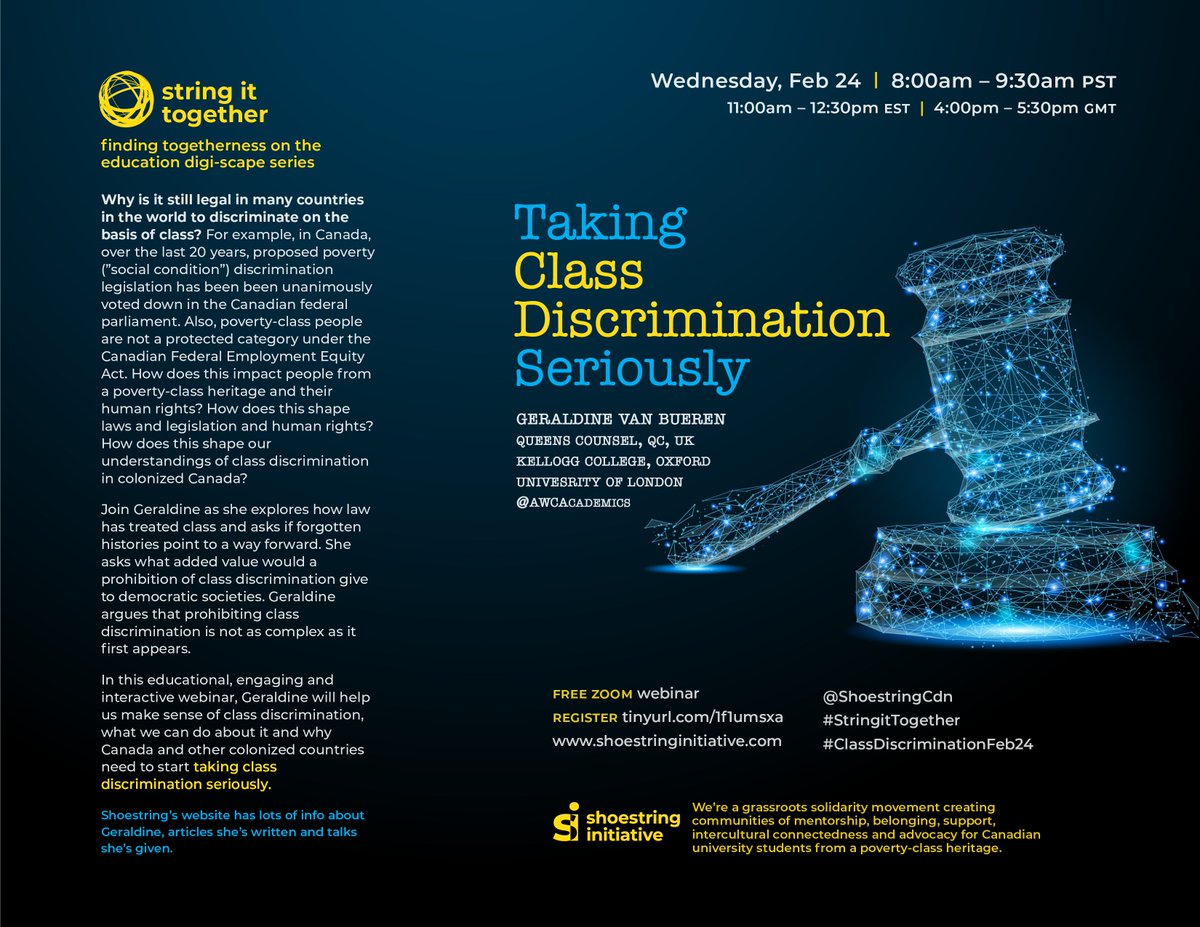
Buckle up. Feb 24th #StringitTogether FREE webinar takes on #classdiscrimination with @QMUL @AWCAcademics Geraldine Van Buren, Queens Counsel, UK. #Colonized nations such as #Canada pull up a chair. Details & pre-learning shoestringinitiative.com Register tinyurl.com/1f1umsxa
3

14 Feb 2021
Buckle up. Feb 24th #StringitTogether FREE webinar takes on #classdiscrimination with @QMUL @AWCAcademics Geraldine Van Buren, Queens Counsel, UK. #Colonized nations such as #Canada pull up a chair. Details & pre-learning shoestringinitiative.com Register tinyurl.com/1f1umsxa
2
3

26 Jan 2021
Another reason for the introduction of the socioeconomic bill to be past @PaulFMcKeon @chrisandrews64. I cannot think of any other logical reason why this is being stalled/stopped when so much money has already been spent . #classdiscrimination limerickpost.ie/2021/01/26/m…
2
6