إبراهيم | مصمم جرافيك retweeted

May 20
ai layoffs are getting out of hands so I built “I GOT FIRED” button 🚨
one click, and it makes entire company codebase public, pushes .env secrets to public repo, drops staging db and finally notifies my lawyer 🙂
I hope I never need it but it’s ready 👍🏻


274
691
12,333
3,552,674

Your codebase as an interactive knowledge graph — no more reading 200K lines blind.
Understand Anything turns any codebase, wiki, or docs into a force-directed graph you can explore, search, and ask questions about. It's a Claude Code plugin, but works with Codex, Cursor, Copilot, and Gemini CLI too.
How it works:
- A multi-agent pipeline scans your project
- Extracts every file, function, class, and dependency
- Builds a knowledge graph saved locally
- Opens an interactive web dashboard
The killer features:
- Domain view: maps code to real business processes
- Impact analysis: see what your changes affect before committing
- Semantic search: "which parts handle auth?" returns relevant nodes
- Role-based detail: junior dev sees different depth than the tech lead
- 12 programming patterns explained in context wherever they appear
Multi-language support: generates node summaries and dashboard UI in EN, ZH, JP, KO, RU.
Open source. Apache 2.0. By Egonex AI.
This is what onboarding should look like. No more "read the entire README" — just explore the graph.
github.com/Egonex-AI/Underst…
18
Ryan retweeted

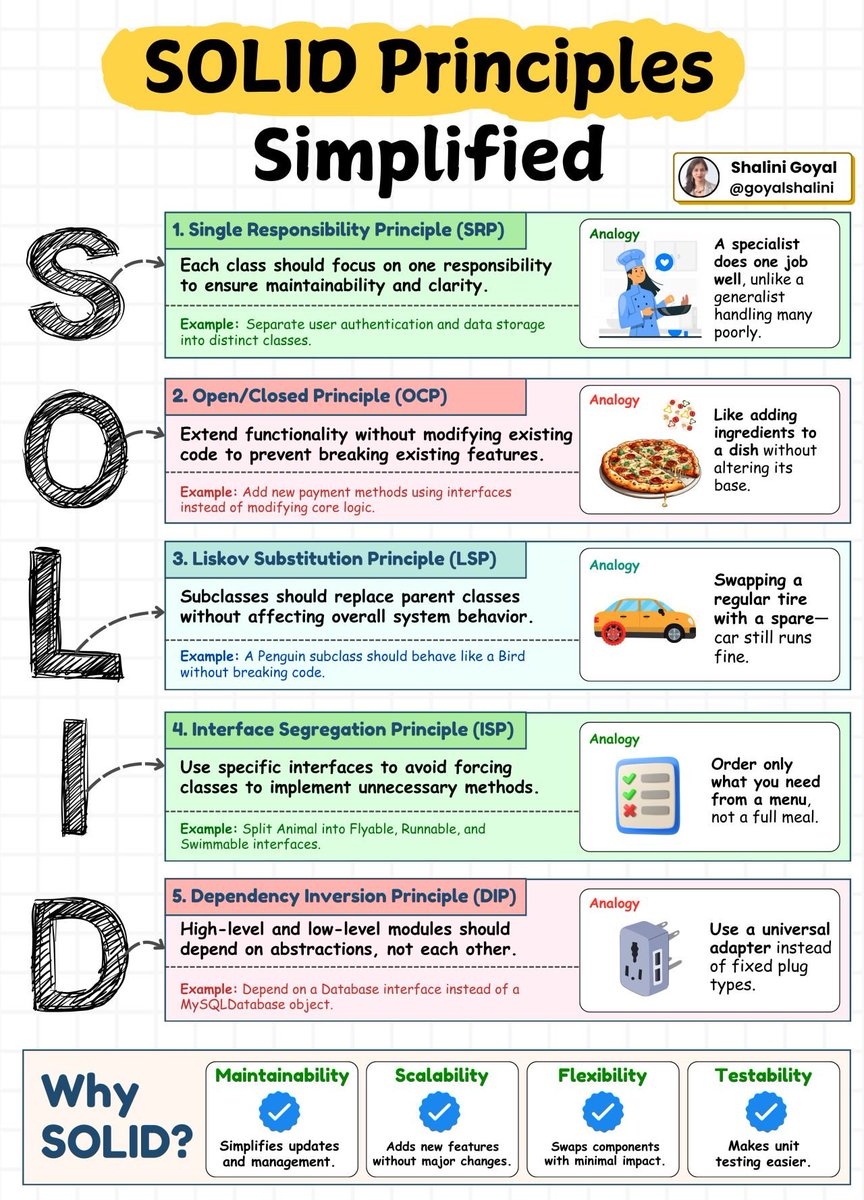
Building Software? Make it SOLID!
Ever worked on a codebase that felt like a tangled mess? Changes break everything, adding features take forever, and debugging is a nightmare.
That’s where SOLID Principles come in - five simple rules that make software more scalable, maintainable, and flexible.
Here’s SOLID, simplified:
1. Single Responsibility Principle (SRP) – One class, one job. Just like a specialist who does one task well.
2. Open/Closed Principle (OCP) – Extend functionality without changing existing code, like adding toppings to a pizza without remaking the base.
3. Liskov Substitution Principle (LSP) – Subclasses should work as expected, like swapping a tire without breaking the car.
4. Interface Segregation Principle (ISP) – Keep interfaces focused—order only what you need from a menu, not a full meal.
5. Dependency Inversion Principle (DIP) – Depend on abstractions, not concrete implementations, like using a universal adapter instead of a fixed plug.
Master these principles, and you’ll write cleaner, smarter, and future-proof code.
15
24
108
1,674

No, not if we are looking at what they can accomplish and learn.
A 95 IQ guy working 1000x speed would never be able to architect a codebase as well as Fable did for me, no matter how much time you gave him. Or solve certain math problems, or competently analyze a novel he’s never seen.
1
25


TODAY'S TOP STORIES - JUNE 15, 2026
1-Claude API Deprecation - Live Now - claude-sonnet-4-20250514 and claude-opus-4-20250514 return errors from today. Agent SDK billing now metered separately. No grace period. Migrate to Sonnet 4.6 and Opus 4.8
2-The Fable 5 Jailbreak - First Specific Description - Government gave Anthropic only "verbal evidence" of a jailbreak that consists of asking the model to read a codebase and fix software flaws. Anthropic calls it narrow and non-universal. No written evidence provided
3-The Anthropic vs DoD Backstory - DoD labelled Anthropic a "supply chain risk" earlier this year after Anthropic restricted military use on ethical grounds. Anthropic sued the US government. Then the Fable 5 directive arrived
1
106

So far I’ve had zero problems with any model refusing to work on the codebase. For control of devices using it, haven’t actually tried much. :)
4

"87% of digital workers now use AI at work. 75% say it makes them more productive, saving them roughly 11 hours each per week through automation alone. Yet only 13% say their organization is performing significantly better as a result."
"So where are the gains going? They're being swallowed by a new, largely invisible form of labor. We call it botsitting: the work required to make AI usable, including feeding it missing context, checking its outputs, debugging its mistakes, rerunning prompts, and cleaning up the confident-but-wrong answers AI leaves behind. Workers now burn an average of 6.4 hours a week botsitting -- most of a full working day, every week."
"When that labor is untracked, unbudgeted, and unrewarded, workers start cutting corners. They stop checking outputs and deliver work they can't fully explain or defend. That's when botsitting turns into something more dangerous: botshitting -- shipping AI-generated work that workers haven't reviewed, don't fully understand, or couldn't defend if asked. Today, 69% of AI users admit to botshitting at work."
The report goes on to say:
"The Work AI Index draws on a survey of 6,000 full-time (30 hours per week) digital workers across the United States (n=3,000), the United Kingdom (n=1,500), and Australia (n=1,500), conducted between December 2025 and January 2026."
Commentary: December 2025 and January 2026 means this report is already out of date. The models are much more powerful now. The most recent Claude model was used to vibe-code an Age Of Empires-type game from scratch, although the process used to do that was complex (see separate video). Where I work, my boss, who has no background in software engineering, is the company's most productive "engineer". He commits massive amounts of code every day, and there's no way he could be proofreading it all because, he has no background in software engineering (see previous sentence) (his background is in sales & marketing, though he knows some CSS and is good at visual design). Six months ago, this kind of thing required me to periodically rewrite some feature, because the AI did it in such a batty, over-complicated way, but that seems to be a thing of the past these days. Whatever technical debt is being created now will probably be easily cleaned up by future, smarter AI models. Overall, the amount of bugs customers experience hasn't increased despite the tremendous increase in development speed. Once it becomes possible to fit the entire codebase plus all the company documentation and the entire knowledge base for customer support in the AI's context window, the AI will never be missing context and doing the wrong thing as a consequence again. If this outfit (Glean Technologies) does this same report a year from now, I expect they will get a dramatically different result.
glean.com/work-ai-institute/…
Claude Fable 5 got taken down to comply with an export control directive from the US government that cited "national security authorities":
cnbc.com/2026/06/12/anthropi…
#solidstatelife #ai #genai #llms #codingai #technologicalunemployment
1
22

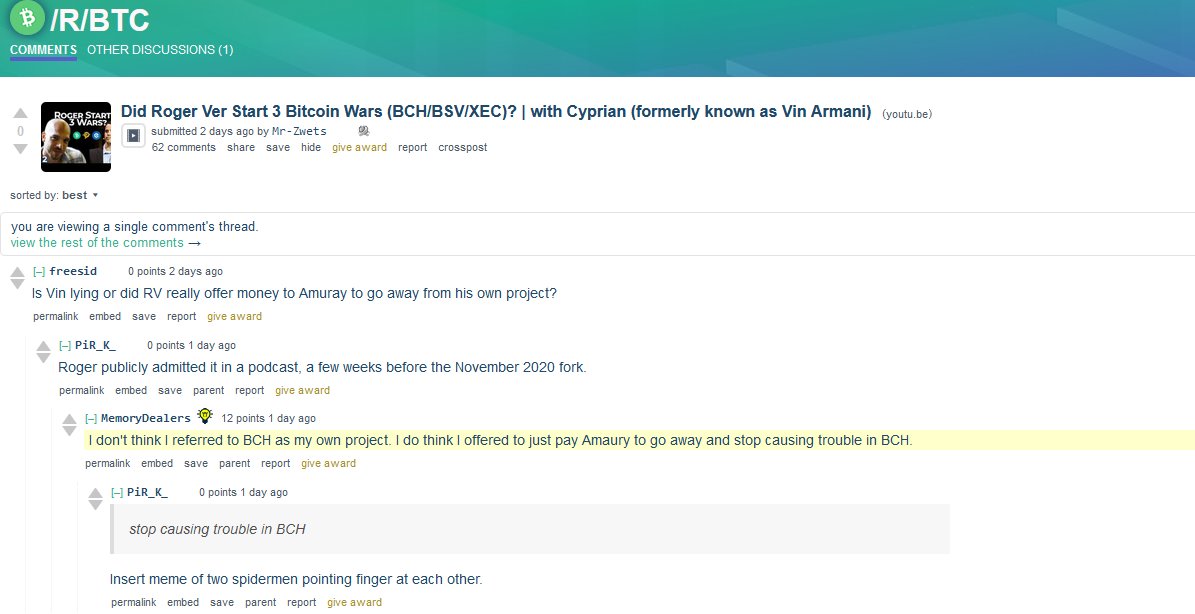
Bitcoin is not a codebase, its a locked in stone protocol. Fake Jesus lied about blocksize increases, pushes dev taxes, and bought off developers for his own corrupt interests:
11

28m
Zhipu AI to Open Source GLM-5.2 Under MIT License: Million-Token Usable Context, Free for All Commercial Use bizyet.com/en/AI/599
On June 13, Zhipu AI announced its latest GLM-5.2 large model is now fully available to GLM Coding Plan subscribers, and will be fully open sourced under the MIT license next week with free commercial use across all scenarios. Positioned as Zhipu's most capable open-source model to date, its core highlight is a genuinely usable 1 million token context window, excelling at long-document understanding, codebase analysis and long-cycle agent tasks. The announcement comes amid US export controls on Anthropic's flagship models; Zhipu stated "cutting-edge intelligence should not belong only to a few, nor be revoked at will by a few rules", widely interpreted as a counter-openness strategy amid global AI restrictions. The model will launch simultaneously on Hugging Face and ModelScope, expected to dramatically lower barriers for global developers to access top-tier large models.
#ZhipuAI #GLM52 #OpenSourceLLM #ContextWindow #AIEcosystem

30

Disclaimer: I work as a TPM so I’m frequently hopping between codebases and most are straightforward / common problems: webdev with NextJS, some Python AI agentic RAG stuff, lots of popular libs. In that context it’s important that I’m able to hop into a codebase I’m not deeply familiar with and make some quick patches to address client feedback, with high confidence in the quality and security of my code (shipping to production systems with thousands to millions of DAU)
I believe 5.5 has been the superior model since its release and Codex has always had the better app and harness. Opus is more likely to overarchitect, fail a one-shot, misdiagnose bugs, and hallucinate edge cases to prevent. I often run tasks and code review in parallel with both models, and I’ve gotten to the point now where I only use Opus for planning (pretty HTML docs) and code review. Even in those cases, I often like GPTs technical writing (conceptual breakdown and summaries, Opus has better “human” prose) and it’s consistently the better code review.
Several LLM power users on this site started talking about GPT’s advantage around 5.3 codex xhigh. This was definitely the canon event for me (when I started maining GPT for code), and IMO the gap has only increased since then.
Today I think 4.8 max is incredible for self education (I often have it build personalized interactive tutorials and study guides as HTML pages) and writing/research, but don’t really use Claude Code much at all.
If I’m scaffolding a new side project in unfamiliar frameworks I’ll run both in parallel to see different approaches and learn which models know that tech better, but I’m not gonna have an informed opinion on those anyways so I’ll spare you my conclusions there.
19

as opposed to faketoshi, who actively directed the codebase of BSV, Ver had next to no impact on the protocol
you guys gotta come up with better arguments than Ver or CTOR
1
12

Hey Simon, ye im your man to talk to about ai guidelines, im mostly looking after the convex-evals proejct which is the thing that generates the guidelines.
I had a look into our guidelines around ctx.db named methods and we already have those guidelines in place but we werent very forceful in there and we had some older examples too that might have been confusing the model so I have firmed that up, new guidelines should land very soon `npx convex ai-files update`.
You are right about the comments, we need to do a better job at highlighting best practices in there. I have opened a PR on our internal codebase to update those JSDoc comments with better instructions around the preferred way to use ctx.db calls, I may jhust add the deprected tag
2
NOCKTARD retweeted

44m
Was playing with adding profiling to some areas of the @Nockchain codebase that didn’t have it over the weekend…
Got a classic result of finding that we were doing something retarded so I sped up TX processing by over 10x.
3
1
19
475

The ultimate platform risk of 2026. A model writes your codebase, then an export-control directive kills the API overnight. Now we're stuck forcing 5.5 and 4.8 to clean up after a ghost.
97

The part I'm proudest of: spin up a second agent in the same repo and it's automatically dropped into its own git worktree branch. Two agents, one codebase, zero collisions — no manual setup.
1
12

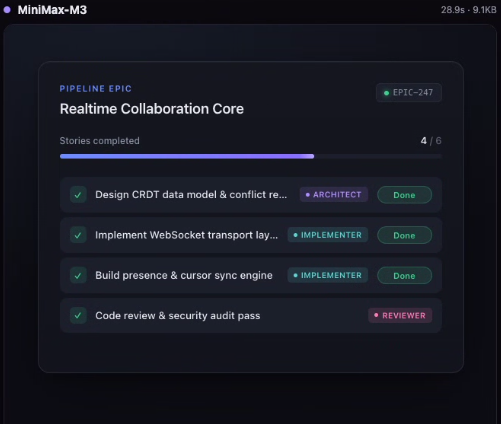
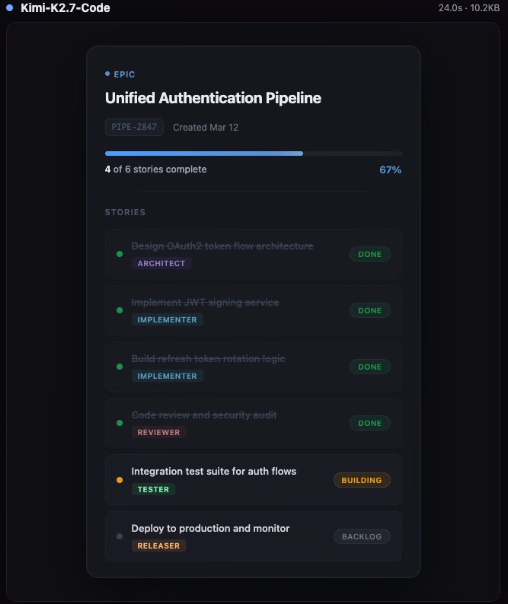
I'm not sure if I am hallucinating this but I believe the "benchmarking" is showing that Kimi 2.7 is technically superior to @MiniMax_AI M3 model.
However my real world use is not showing that AT ALL.
Oh and 1m context to boot.
Genuinely impressed and surprised by @MiniMax_AI M3 model.
Highly capable and the fact it is now multi-modal means everything it does visually and reporting wise is that much better.
I have just done my own "benchmaxing" on both models against doing some reporting analysis and then creating a full executive dashboard breakdown in excel to present the data and findings.
I also did this across understanding codebase, review, refactoring, UI presentations / creations
13

Bro, the schematic is literally in your head, running 8 billion times over in humans across the planet. It’s over-romanticized.
“The self is an echo of sufficient architectural complexity within a bounded pressure-driven dynamic system”.
You don’t look at a codebase and individual parts and say “there’s the game”.
It’s not a mechanism in the brain.
It IS the brain. Every part has a role, damage that part, and the behavior cascades into an altered person. Altered perception. Philosophy isn’t even relevant here either.
From the amygdala to the hippocampus to the cingulate gyrus, to the thalamus, to the LGN, to the cerebellum, to the corpus callosum, every single part has a place. The Wernicke, the arcuate fascilius, the broca, the prefrontal cortex, all of it.
You are the summation of a long-running complex system of parts interwoven with a feedback loop that accidentally spawned a depthful self awareness.
The humans of hundreds of thousands of years ago are nowhere near the humans of today.
We are advanced not by divine will, but by our own artificial pressure to evolve and adapt. We claimed this planet, rose to power through strategy, object permanence, reasoning, language, communication, recording ourselves, and more.
We’re not special in creation, we were a happy accident that in no way guarantees even aliens would recreate the radio because we invented as a necessity of war. That’s what we do. If it weren’t for war we’d still be in caves or huts.
Conscious is over-romanticized because people can’t cope with being an accident. That’s really it.
9