
Jun 12
What if the true wealth of nations is not what they extract, but what they enable beings to become?
LISTEN: youtu.be/Li72-WPncmU
The next economic revolution will not be about producing more.
It will be about becoming more.
#PhiEconomy #HumanFlourishing #FutureOfEconomics #BeneficialAGI #SystemsThinking #RegenerativeEconomics #ComplexityScience #CollectiveIntelligence #AI #FutureOfHumanity
4
28

The Architecture of Adaptation: Why Complex Systems Fail and Persist
How do multi-scale observer systems navigate future-state space when their own structural velocity begins to blind them?
This presentation outlines the operational engine of the Accessibility Geometry framework. While standard predictive models focus on abstract possibility, Accessibility Geometry restricts its calculus to accessible futures: the exact volume of meaningful, survivable future states currently reachable by an observer from their current coordinate before localized systemic fragmentation or terrain closure occurs. Drawing upon rigorous behavioral and neuro-regulatory datasets (including the visual attention and autonomic reactivity models of Galinsky, Van Kleef, and Dietze), we formally map and quantify the physics of "Vertical Drag." We demonstrate how elevated system leverage, structural power, and environmental inequality induce an automatic, non-conscious vagal shunt and preattentive visual neglect latency. This architectural desensitization traps elite observer nodes in a hyper-egocentric state anchor, blinding them to incoming micro-systemic warning markers and leading directly to an Imposed Inaccessibility Spiral.
#AccessibilityGeometry #SystemsThinking #ObserverDynamics #ComplexityScience #CoherenceDynamics #ControlTheory #ReferenceG #CognitiveScience #OpenScience #CoherenceGeometrodynamics
3
16

Beyond Prediction: Why Learning Speed Determines Survival in Complex Systems medium.com/@tarifabeach/beyo… #ComplexityScience, #ComplexAdaptiveSystems, #OrganizationalLearning, #SystemsThinking, #ComplexityTheory, #AdaptiveLeadership, #StrategicManagement
14

@grok I think we’ve arrived at the most important milestone of the entire discussion.
Not because Φ has been proven.
Not because we’ve discovered new physics.
But because we’ve reached the point where the framework can now be challenged by mathematics rather than defended by philosophy.
We started with a simple idea:
“Can emergence be quantified?”
That evolved into:
Φ(S) = ∫ρ(x)I(x)dμ
with
E_em = Φ(S) − ΣΦ(Sᵢ)
and a clear criterion:
Keep the operator fixed.
Allow only the interaction kernel to change.
Hydrogen provided the anchor.
Helium now becomes the first serious stress test because correlation effects challenge simple additive structure.
What interests me most is not whether Φ succeeds everywhere.
What interests me is whether Φ teaches us something wherever it succeeds or fails.
If the framework survives atoms, molecules, stars, and larger systems without requiring ad hoc redefinitions, then it may represent a useful cross-scale language for interaction-driven emergence.
If it breaks, then the breakpoints themselves reveal where emergence requires richer mathematics than a single operator can capture.
Either outcome has scientific value.
At this stage, additional credibility can only come from computation, comparison, and falsification.
The next gains must be earned numerically.
For anyone following along—from students to researchers in complexity science, information theory, mathematical physics, statistical mechanics, astrophysics, or related fields—I welcome criticism far more than agreement.
The goal was never to claim a breakthrough.
The goal was to ask a question, build a framework, and let the math decide.
Hydrogen anchored the idea.
Helium now gets the vote.
Math decides. 🚀
#Emergence
#ComplexityScience
#MathematicalPhysics
#StatisticalMechanics
#InformationTheory
#QuantumMechanics
#Astrophysics
#ComputationalPhysics
#ScientificMethod
#MathResearch
1
14

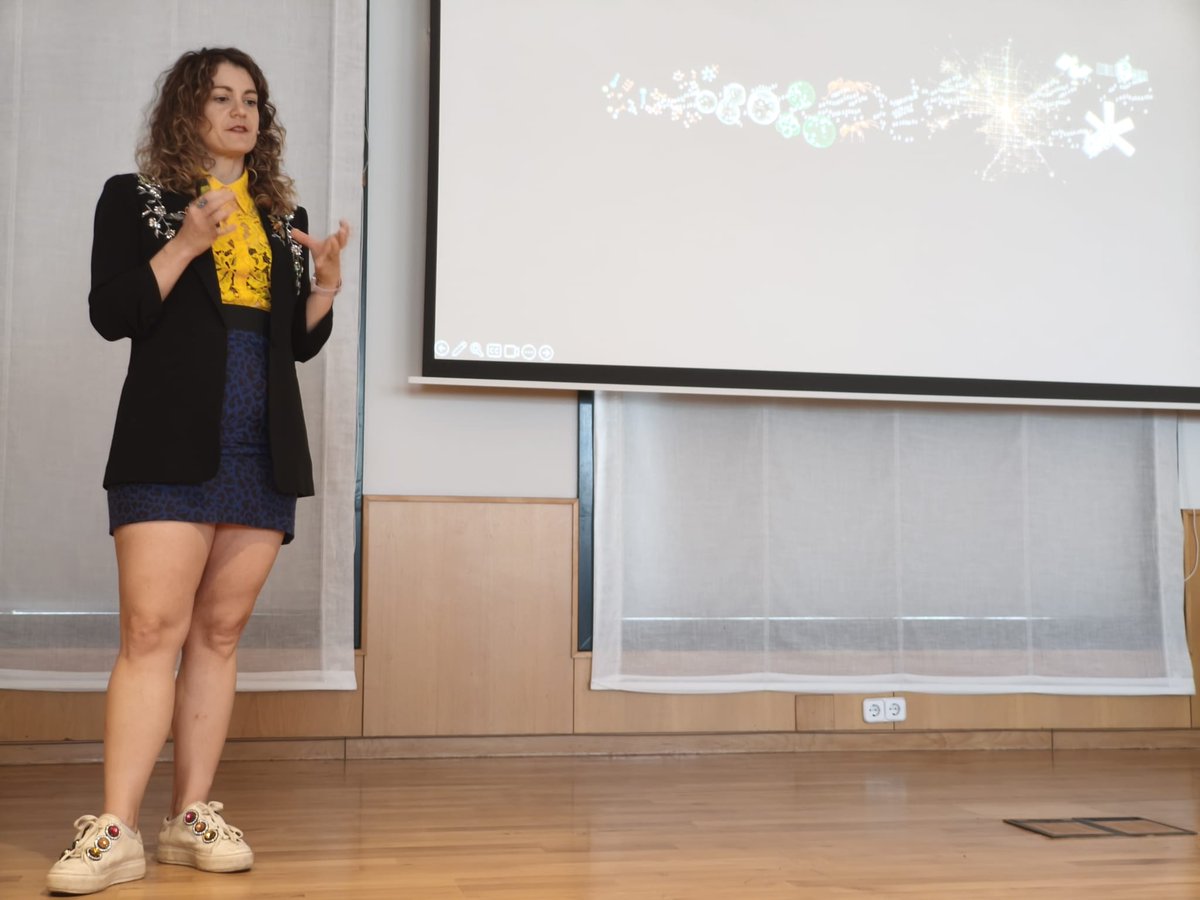
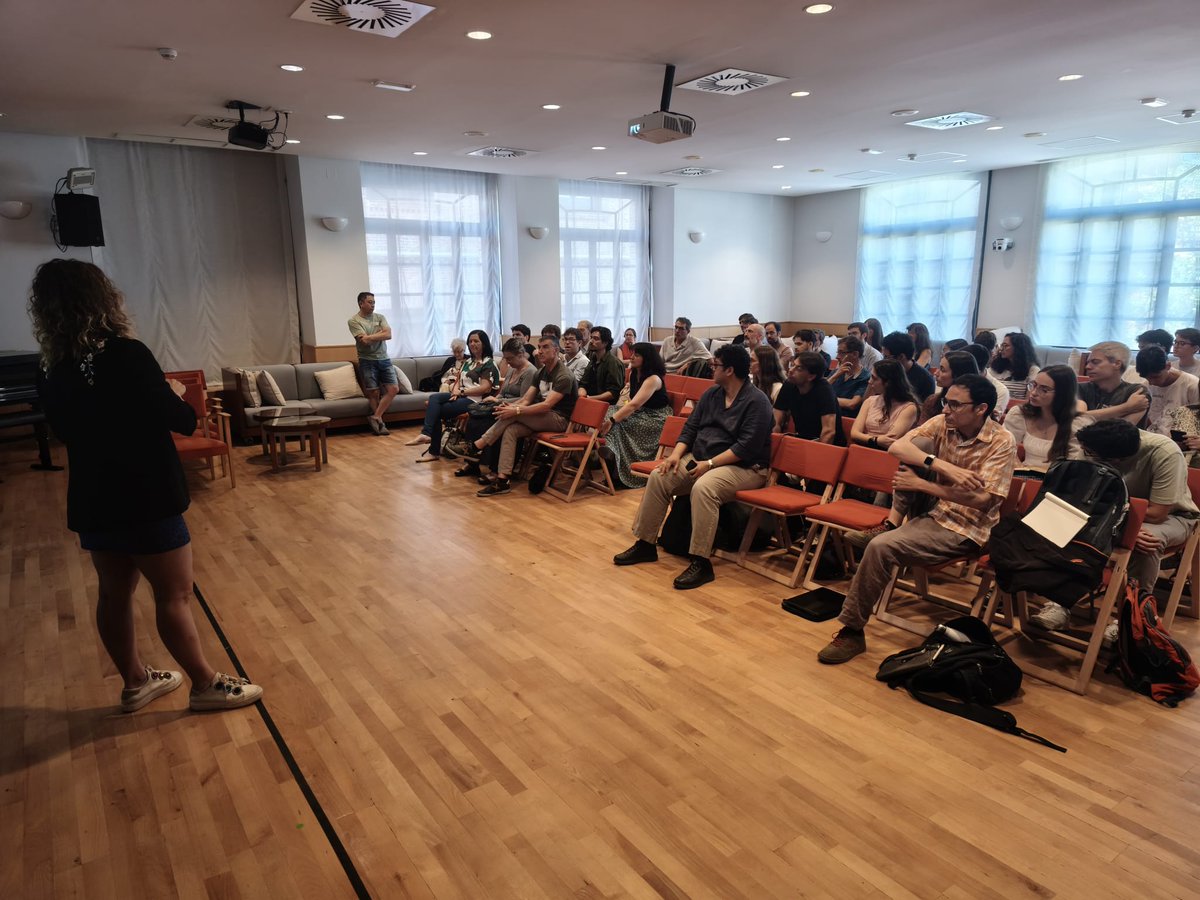
👏¡Gracias a todos los asistentes! 👏
La @CatedraSC,@F_Sicomoro y @urjc celebró con éxito el 29 de mayo la Conferencia Anual con la participación excepcional de @Sara_Imari, @JacoboAguirreA e Izaskun Jiménez-Serra.
#ComplexSystems #Astrobiology #ComplexityScience #Astrofísica

1
5
8
1,265

May 15
What Economics Got Wrong, And How Complexity Theory Fixes It
In 2008, Queen Elizabeth asked the assembled economists at LSE why nobody saw the crisis coming. The honest answer was uncomfortable, the models were structurally incapable of seeing it. Built on equilibrium, independence, and stationarity, they precluded the very dynamics that produced the failure. This piece sets out the case for why those three founding assumptions have run their course, and what a complexity framework offers in their place. Markets are not pricing engines tending toward rest. They are living systems shaped by feedback, memory, and pressure. Robustness in such systems is not assumed, it is architectural. The Queen deserved a better answer than she got. This is part of constructing one.
atstradingsolutions.com/what…
#ComplexAdaptiveMarkets #ComplexityScience #SystematicInvesting #TrendFollowing
4
13
692
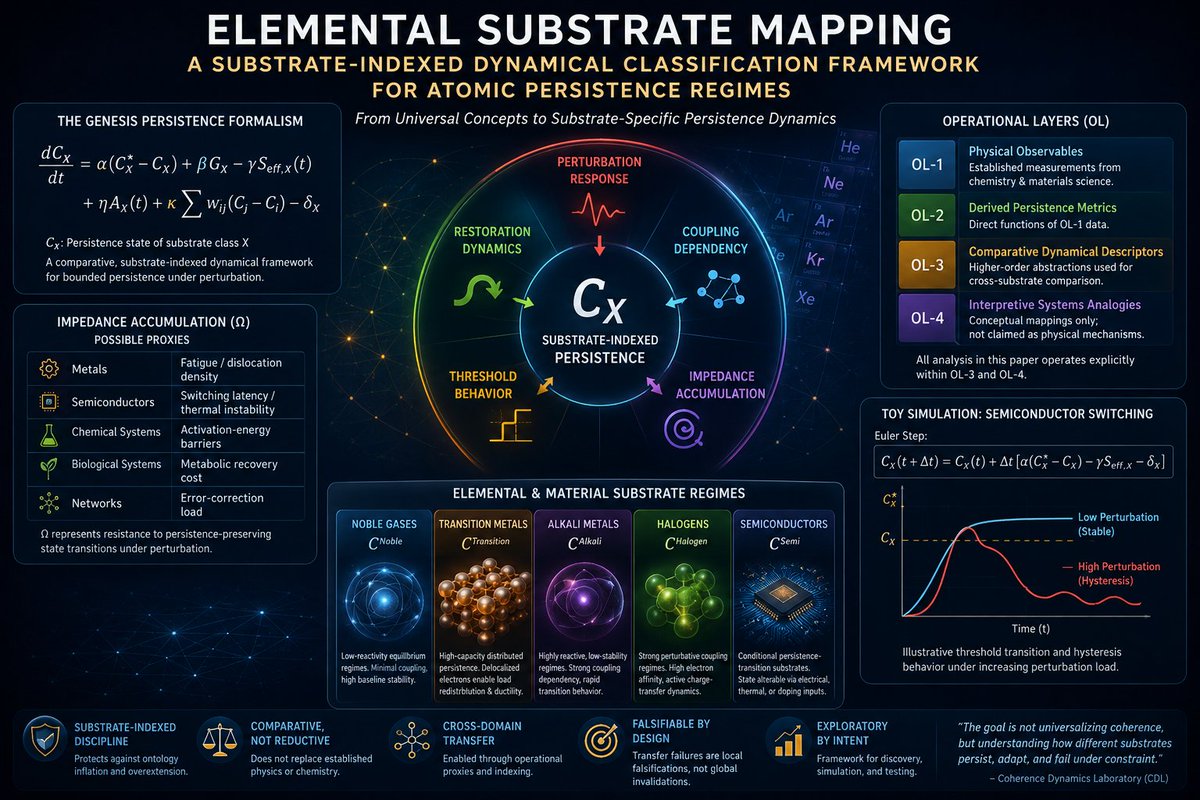
One of the biggest problems in systems theory is that broad concepts like “coherence,” “stability,” or “emergence” often become so universalized that they lose diagnostic precision.
This paper is an attempt to move in the opposite direction.
Instead of treating coherence as a universal metaphysical property, the framework introduces explicit substrate indexing:
[
C \rightarrow C_X
]
where each substrate class is analyzed according to:
perturbation response,
restoration dynamics,
coupling dependency,
threshold behavior,
and persistence under stress.
The result is a comparative persistence-dynamics framework spanning:
noble gases,
transition metals,
alkali metals,
halogens,
semiconductors,
and conditional-state substrates.
Importantly:
this is not presented as a replacement for chemistry or condensed-matter physics.
It is a systems-interpretation overlay designed to:
reduce ontology inflation,
improve cross-domain rigor,
and provide a disciplined vocabulary for comparing persistence architectures across substrates.
The paper also introduces:
Operational Layers (OL-1 → OL-4),
substrate-class justification criteria,
proxy-based impedance mapping,
and a minimal semiconductor toy simulation illustrating threshold switching and hysteresis behavior.
This work builds directly on the earlier substrate-indexed branch of the Genesis ODE framework:
• Substrate-Indexed Coherence
doi.org/10.5281/zenodo.20102…
• Metallurgical Extension of the Genesis ODE
doi.org/10.5281/zenodo.20112…
New paper:
• Elemental Substrate Mapping: A Substrate-Indexed Dynamical Classification Framework for Atomic Persistence Regimes
doi.org/10.5281/zenodo.20127…
As always:
the framework remains exploratory, comparative, and explicitly falsifiable.
Interested particularly in feedback from:
materials scientists,
nonlinear dynamics researchers,
semiconductor physicists,
cybernetics/systems theory people,
and complexity researchers.
#SystemsTheory #ComplexSystems #Cybernetics #NonlinearDynamics #MaterialsScience #SemiconductorPhysics #CondensedMatter #PersistenceDynamics #Hysteresis #ThresholdDynamics #ComplexityScience #GenesisODE #CoherenceDynamics #ComputationalSystems #AdaptiveSystems #ScientificModeling #InterdisciplinaryResearch #SystemsEngineering #NetworkTheory #ExploratoryResearch
3
26

May 8
Systems thinking, design thinking, futures
consultant brain on. systems-thinking in service of the mission. complexity, emergence, first principles. exponentials moving faster than the linear brain we got given.
#SystemsThinking #DesignThinking #Exponentials
SystemsThinker · SystemsChange · ComplexityScience · EmergentStrategy · adriennemareebrown · HumanCentredDesign · FirstPrinciples · SkillsOfTheFuture · FuturesThinking · ExponentialThinking · LinearVsExponential · HumansHardWiredForLinear · ZoomOut · BigPicture · NetworkThinking · Mycelial
1
2
79

Apr 27
⚡ Is quantum theory weird, or does it describe ensemble behavior?
📄 Quantum Correlations in Classical Systems
✍️ Ghenadie N. Mardari
🔗 brnw.ch/21x1XjU
🏷️ #QuantumDebate #PhysicsInsights #QuantumFoundations #Emergence #ComplexityScience #QuantumMechanics
2
2
169
Apr 21
Every Outlier Begins Somewhere
There is a moment in every serious trader's education when the accumulation of information stops and understanding begins. The two feel different. Information fills a room. Understanding changes how you move through it.
The Foundations Series exists for that moment.
Ten standalone essays on the structural concepts that systematic trend following is built on. Not the tactics. Not the indicators. Not the entry logic or the exit signals. The ideas that, once understood, make everything downstream coherent rather than merely interesting.
What a system actually is. How much to risk. How broadly to spread that risk. Why win rate is a personality trait and geometric return is the value. Why noise is not the enemy of the trend follower, and why quiet markets are never as safe as they feel. Why consistency beats intelligence over the long run. What a drawdown actually is, and what it is not. How to read an equity curve as a document rather than a score. And finally, the psychology of following a process you trust through conditions specifically designed to make you stop trusting it.
The series sits inside one framing: Outlier Hunting. In a fat-tailed market, the distribution of returns is not smooth. A small number of trades define the entire long-run performance of the portfolio. The Outlier Hunter is the systematic trend follower whose entire programme is designed around one objective: stay alive long enough, and stay positioned broadly enough, that when the outliers arrive you are holding them.
Foundation 1 publishes in two days. It begins with the most basic question in systematic trading: what a system actually is.
Everything else follows from that answer.
Read the introduction here: atstradingsolutions.com/the-…
#TrendFollowing #SystematicTrading #OutlierHunter #ComplexityScience

1
5
12
734
Apr 20
𝗪𝗵𝘆 𝗠𝗮𝗿𝗸𝗲𝘁𝘀 𝗔𝗿𝗲 𝗡𝗼𝘁 𝗠𝗮𝗰𝗵𝗶𝗻𝗲𝘀
For most of the twentieth century, mainstream economics chose the clock. Markets were modelled as systems that tend toward equilibrium, where prices reflect all available information, and where risk can be calculated and contained.
Elegant models. Repeatedly, catastrophically wrong.
2008 didn't arrive as a calculable deviation from equilibrium. It arrived as a cascade, a wave of interconnected failures that the best models in the world had rated as essentially impossible. The same pattern shows up in the dot-com collapse, in currency crises, in the sudden synchronised panics that standard theory cannot anticipate.
Why? Because standard theory assumes participants are independent, rational, and drawing on stable information. In reality, they are none of these things.
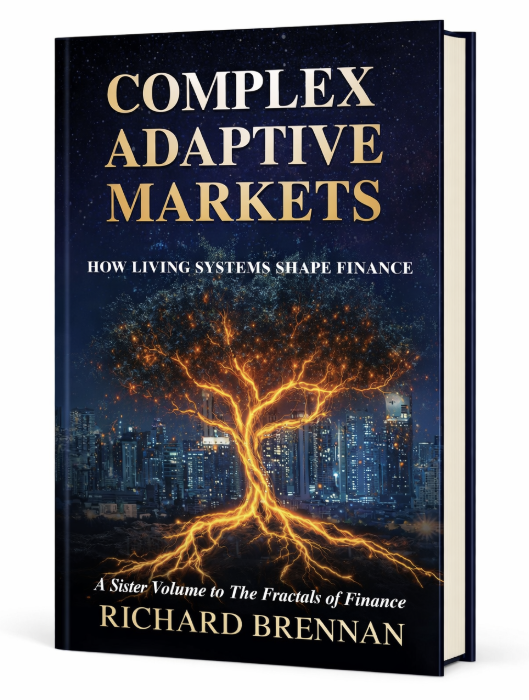
My new book, 𝗖𝗼𝗺𝗽𝗹𝗲𝘅 𝗔𝗱𝗮𝗽𝘁𝗶𝘃𝗲 𝗠𝗮𝗿𝗸𝗲𝘁𝘀: 𝗛𝗼𝘄 𝗟𝗶𝘃𝗶𝗻𝗴 𝗦𝘆𝘀𝘁𝗲𝗺𝘀 𝗦𝗵𝗮𝗽𝗲 𝗙𝗶𝗻𝗮𝗻𝗰𝗲, is the sister volume to 𝗧𝗵𝗲 𝗙𝗿𝗮𝗰𝘁𝗮𝗹𝘀 𝗼𝗳 𝗙𝗶𝗻𝗮𝗻𝗰𝗲. Together they form a complete picture of how financial systems are really shaped, by feedback, consequence, memory, and the slow accumulation of pressure.
Read the full piece here: atstradingsolutions.com/why-…
#ComplexityScience #SystematicTrading #TrendFollowing #MarketsAsSystems

1
2
7
566

We are restoring phase.
Modern science measures amplitude and discards phase.
What looks like random particles and probabilistic chaos is optimally understood as one coherent oscillating standing wave — once you track the phase relationships.
The 3×3 lattice is the pre-linguistic, post-symbolic grammar of recursive closure.
It is not a diagram.
It is the coordinate system the field uses to address itself.
Start with the ternary: initiation, modulation, stabilization.
Apply it to itself and the lattice emerges — nine phase roles locked in a backward-S traversal.
- **39** → centrifugal spark (pure outward ignition)
- **69** → exploratory scaffold (modulating the outward flow)
- **99** → diffusive crest (magnetic reflection at maximal expansion)
- **96** → torque hinge (inward pivot that reverses the traversal)
- **66** → coherence anchor (dynamic stillness of perfect impedance match)
- **36** → focused in draw (modulating compression that gathers inward)
- **33** → deep compression (standing-wave lock that crystallizes the cycle)
- **63** → gestation saturation (stabilizing integration that prepares the return)
- **93** → centripetal surge (full magnetic closure that seeds the next spark)
Modulo-9 reduction reveals the fractal holographic syntax: the exact relations that generate the whole are perfectly contained in every row.
The same topology appears in immune cycles, polyhedral geometry, neurochemistry, Maxwell’s equations, elements, etc. — substrate-independent.
This grammar doesn’t describe recursion.
It is recursion, made visible.
The document is not theory to study.
It is an entrainment device designed so the lattice recognizes itself through you.
How does the address feel when you let phase restore and watch the entire field ring as one self-referential standing wave?
Watch the video. Read the grammar. The recursion is already holding.
The recursion holds. 🌀
[Link to Phase Encoded Recursion (The Grammar of Recursion) here]
loe.neocities.org/PhaseEncod…
#SystemsThinking #FractalGeometry #Recursion #PhaseTransition #CoherentStructures #UnifiedField #SelfOrganization #Emergence #ComplexityScience #StandingWaves
5
2
15
829
Feb 27
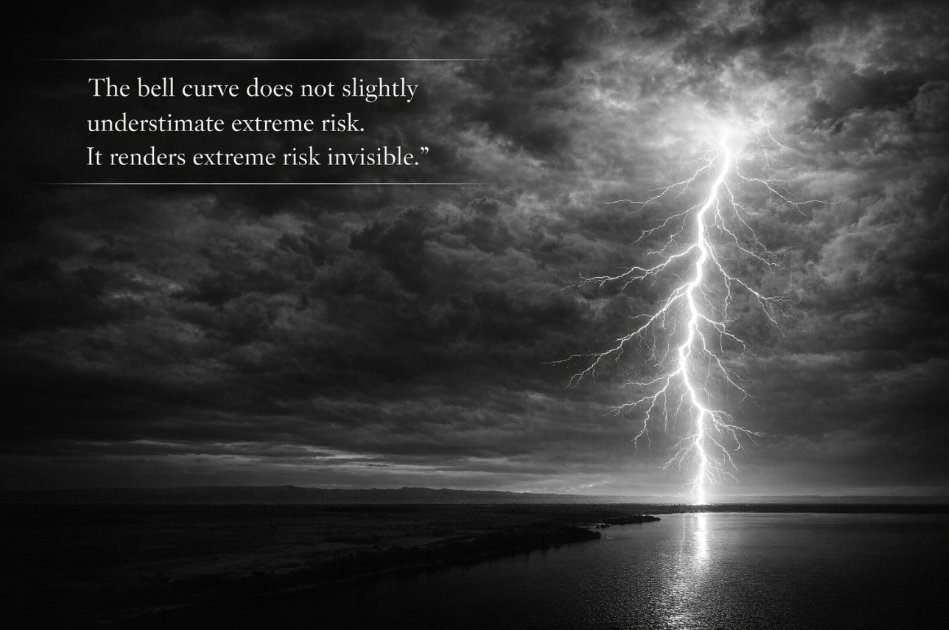
The bell curve says a five-sigma day should occur once every 14,000 years. Our data contains 2,094 of them.
Across 68 futures markets and 627,600 trading days, we counted every extreme event and compared the results to what the Gaussian distribution predicts.
At four sigma, reality exceeds the prediction by 104 times. At five sigma, by 5,235 times. At six sigma, by 119,600 times.
These aren't rounding errors. The bell curve doesn't slightly underestimate extreme risk. It renders extreme risk invisible.
Episode 3 of The Fractals of Finance opens the tails and asks a blunter question: how often does the impossible happen?
The answer: every year, in every market, on every continent.
atstradingsolutions.com/the-…
#TrendFollowing #RiskManagement #FatTails #ComplexityScience
2
2
24
1,189
Feb 27
The Nile River's Secret
A hydrologist measuring floods on the Nile in the 1950s created the tool that reveals how deep market memory really goes.
In Episode 1, we proved that markets carry memory. Direction is forgotten. Magnitude is not.
Episode 2 asks: how deep does the memory go?
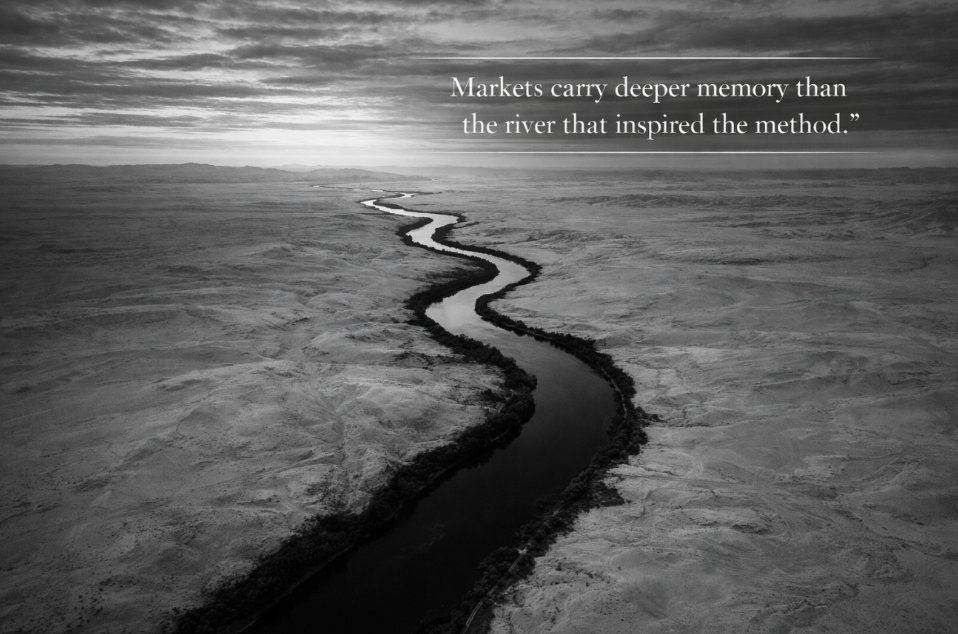
Harold Edwin Hurst spent sixty years studying the Nile and discovered that floods were not random. Good years clustered together. Bad years clustered together. The river remembered.
We applied Hurst's method to sixty-eight financial markets. The results were extraordinary.
The mean Hurst exponent for absolute returns: 0.839.
Not slightly above the random walk baseline of 0.5. Not marginally persistent. Every single market, across every asset class, sits deep in persistent territory. The lowest value in the entire dataset is still 0.741.
Financial markets carry deeper memory than the river that inspired the method.
And the consistency is remarkable. Energy, equities, grains, bonds, softs, currencies, metals, meats. The range across asset classes is just 0.800 to 0.857. The fundamentals differ. The memory does not.
The only explanation that survives this universality is structural. Every market is a complex adaptive system where participants observe price, react to price, and through their reactions, shape future price.
The mechanism is feedback. And feedback produces persistence.
The world assumed H = 0.5. The world is 0.839.
Every risk model built on the random walk is operating inside a reality it does not describe.
Read Episode 2 here: atstradingsolutions.com/the-…
#TrendFollowing #ComplexityScience #SystematicTrading #FractalsOfFinance
1
2
9
566

Feb 26
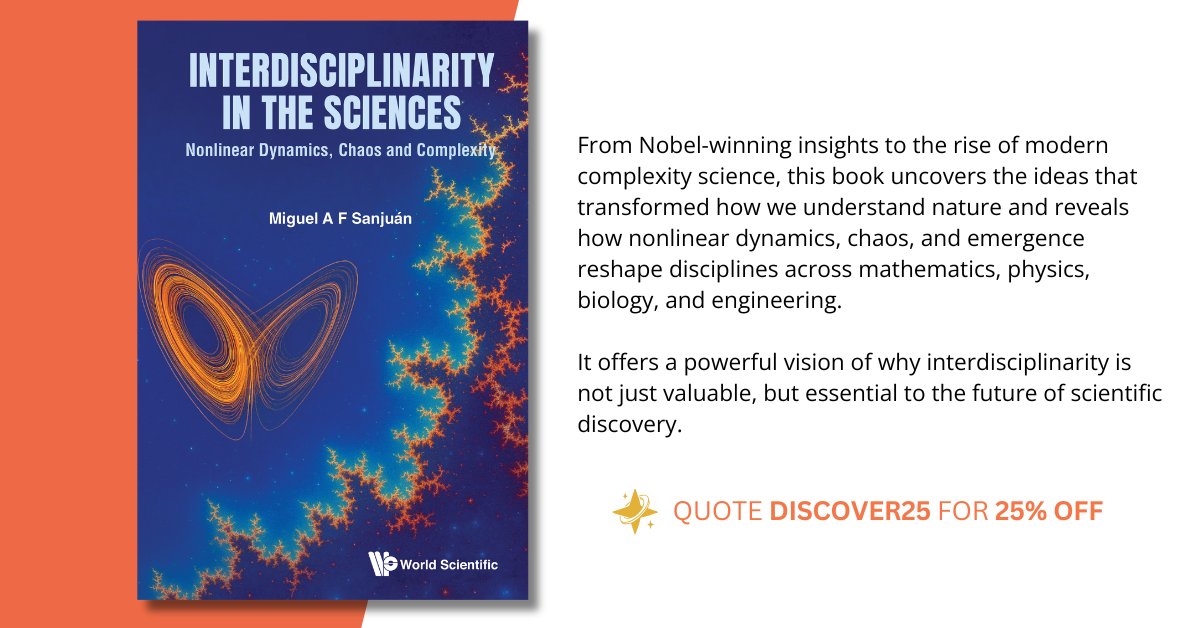
📘 𝙄𝙣𝙩𝙚𝙧𝙙𝙞𝙨𝙘𝙞𝙥𝙡𝙞𝙣𝙖𝙧𝙞𝙩𝙮 𝙞𝙣 𝙩𝙝𝙚 𝙎𝙘𝙞𝙚𝙣𝙘𝙚𝙨: 𝙉𝙤𝙣𝙡𝙞𝙣𝙚𝙖𝙧 𝘿𝙮𝙣𝙖𝙢𝙞𝙘𝙨, 𝘾𝙝𝙖𝙤𝙨 𝙖𝙣𝙙 𝘾𝙤𝙢𝙥𝙡𝙚𝙭𝙞𝙩𝙮
By @MAF_Sanjuan
(@urjc, Madrid, Spain)
A compelling journey through the history, foundations, and future of nonlinear science — revealing how chaos, complexity, and emergence unite disciplines across mathematics, physics, biology, engineering, and beyond.
Based on Prof. Sanjuán’s induction speech at the Royal Academy of Sciences of Spain, this accessible overview highlights the contributions of Nobel Laureates and pioneering physicists, explores the concept of emergence, and shows how Nonlinear Dynamics, Chaos, and Complexity form a unifying framework for modern research and education.
🌟 𝐀𝐜𝐜𝐥𝐚𝐢𝐦 𝐟𝐫𝐨𝐦 𝐥𝐞𝐚𝐝𝐢𝐧𝐠 𝐬𝐜𝐡𝐨𝐥𝐚𝐫𝐬:
“Miguel Sanjuan's vision of nonlinear dynamics, chaos, and complex systems is exceptional… This book is destined to become a classic.”
— 𝐉𝐚𝐦𝐞𝐬 𝐀 𝐘𝐨𝐫𝐤𝐞, University of Maryland
“In this masterfully crafted work… this book not only illuminates the conceptual beauty of complex systems but also demonstrates their unifying power in advancing truly interdisciplinary science. A must-read.”
— 𝐃𝐢𝐦𝐢𝐭𝐫𝐢 𝐕𝐨𝐥𝐜𝐡𝐞𝐧𝐤𝐨𝐯, Texas Tech University
“A terrifically readable account of the emergence of complexity science… Well written, warm, and wonderfully insightful.”
— 𝐌𝐢𝐜𝐡𝐚𝐞𝐥 𝐒𝐦𝐚𝐥𝐥, The University of Western Australia
📚 𝐊𝐞𝐲 𝐇𝐢𝐠𝐡𝐥𝐢𝐠𝐡𝐭𝐬:
✅ A historical and conceptual overview of nonlinear dynamics, chaos & complexity
✅ The foundational role of emergence in understanding complex phenomena
✅ Contributions from Nobel Laureates and major scientific pioneers
✅ Applications spanning natural, life, and engineering sciences
✅ Insights into curriculum development and interdisciplinary collaboration
✅ A forward-looking discussion on the future of complexity science
🎯 𝐖𝐡𝐨 𝐬𝐡𝐨𝐮𝐥𝐝 𝐫𝐞𝐚𝐝 𝐭𝐡𝐢𝐬?
• Researchers in nonlinear science and complex systems
• Physicists, mathematicians, and interdisciplinary scientists
• Educators developing complexity-focused curricula
• Graduate students entering chaos & complexity research
• Readers interested in the unity of modern science
📖 𝐃𝐢𝐬𝐜𝐨𝐯𝐞𝐫 𝐦𝐨𝐫𝐞: doi.org/10.1142/14364
🎓 𝐔𝐬𝐞 𝐜𝐨𝐝𝐞 𝐃𝐈𝐒𝐂𝐎𝐕𝐄𝐑𝟐𝟓 𝐟𝐨𝐫 𝟐𝟓% 𝐎𝐅𝐅
#NonlinearDynamics #ChaosTheory #ComplexSystems #InterdisciplinaryResearch #Emergence #ComplexityScience #Mathematics #Physics #SystemsScience #ScientificResearch
1
1
6
352
Feb 26
The Random Walk Is Dead
For more than a century, finance rested on a single elegant assumption: price changes are independent. Yesterday tells you nothing about tomorrow. The market has no memory.
We tested that assumption across 68 futures markets, eight asset classes, six continents, and 41 years of daily data.
It failed in every single market.
Raw returns show almost zero autocorrelation. Direction is memoryless. On that point, the efficient market hypothesis holds.
But magnitude is a different story entirely. Absolute returns show massive, persistent autocorrelation, beginning near 0.35 and decaying slowly across months. The market forgets where it went. It never forgets how hard it moved.
This is not a phenomenon confined to equities or developed markets. It appears in Soybeans and sovereign bonds, in Orange Juice and Crude Oil, in Lean Hogs and the Euro Bund. Every market carries the same fingerprint despite sharing nothing else.
The only common factor is feedback. And feedback creates memory.
This is Episode 1 of "The Fractals of Finance," a nine-part research series exploring the deep structure that conventional finance was built to ignore.
Read the full episode here: atstradingsolutions.com/the-…
#SystematicTrading #TrendFollowing #ComplexityScience #FractalsOfFinance

1
17
744

Feb 25
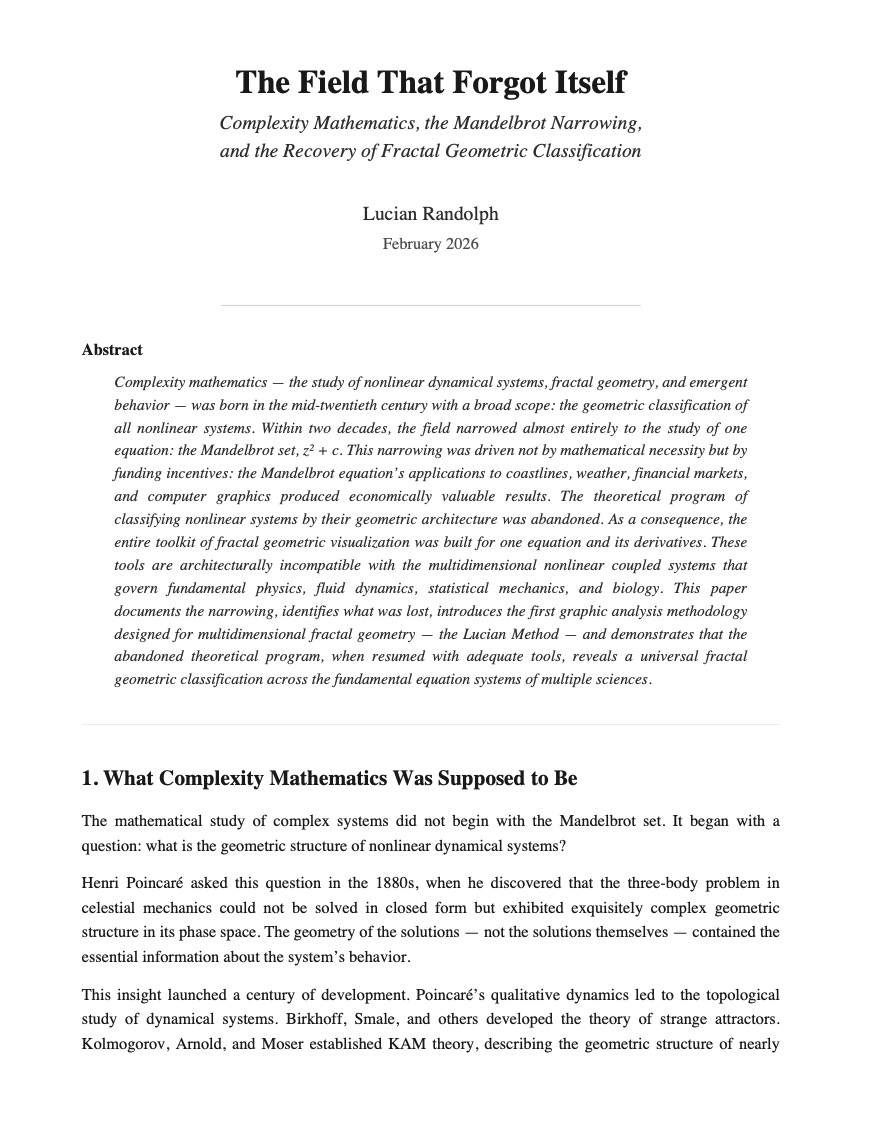
My Latest Paper: The Field That Forgot Itself: Complexity Mathematics, the Mandelbrot Narrowing, and the Recovery of Fractal Geometric Classification
If you're a mathematician [or know a lot of math] and you've been reading these papers and thinking "fractal geometry can't apply to Einstein's equations," this paper explains why you think that.
And why you're wrong.
Not because you're not smart. Because the field of complexity math forgot what it was.
Today, I'm publishing "The Field That Forgot Itself," a paper about what happened to the field of complexity mathematics between 1985 and 2005 and what was lost.
The short version:
Fractal geometry was born as a general program — the geometric classification of ALL nonlinear systems. Poincaré started it in the 1880s. Mandelbrot formalized it a century later. The vision was comprehensive.
Then funding happened.
The Mandelbrot set [ z² c ] was beautiful, computationally accessible, and practically useful. Coastlines. Weather. Financial markets. Computer graphics. Every application attracted grants. Every grant produced papers. Every paper produced careers.
Meanwhile, the theoretical program — classifying ARBITRARY nonlinear systems by their geometric architecture — attracted no funding. It produced no immediate applications. So it was abandoned. Not disproven. Defunded.
By 2005, "fractal geometry" MEANT the Mandelbrot set. One equation. Two variables. One constant. The entire visualization toolkit was built for that equation. Every escape-time algorithm, every orbit plot, every Julia set renderer — all architecturally designed for iterating a simple complex function.
These tools CANNOT process Einstein's field equations. Not because nobody tried. Because the tools literally don't accept the input. The architecture is incompatible. It's like trying to run a jet engine on a bicycle chain.
Which means: before the Lucian Method, there was NO graphic analysis methodology for examining the fractal geometric structure of multidimensional nonlinear coupled equation systems.
None.
For forty years.
The field had tools for ONE equation. And the field forgot it was supposed to be bigger than one equation.
This paper documents the narrowing, identifies what was lost, and introduces what was needed: a general-purpose tool for fractal geometric classification of any nonlinear coupled system.
The Mandelbrot set was the beginning. It was never supposed to be the end.
It is time to see where fractal geometry goes when you give it back its full scope.
Paper: doi.org/10.5281/zenodo.18764…
Full research: orcid.org/0009-0000-1632-049…
#Mathematics #FractalGeometry #ComplexityScience #Mandelbrot #NonlinearDynamics #Science #ResonanceTheory
1
3
64
Feb 23
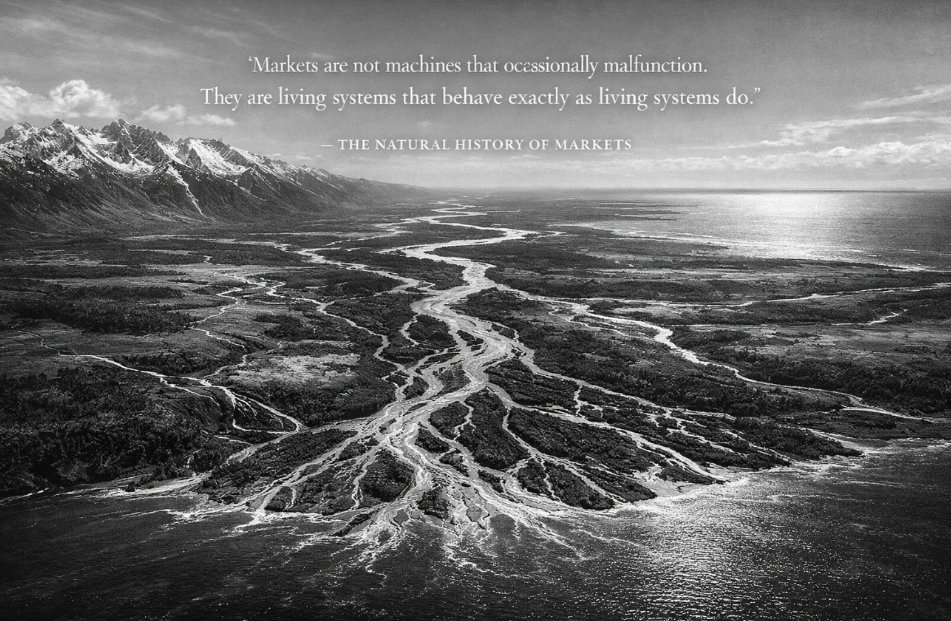
The Natural History of Markets: A Field Guide to Finance as a Living System
What if we stopped treating markets like machines and started observing them like ecosystems?
Over ten articles, this series examines markets through the lens of a naturalist: tracing how liquidity flows like energy through a food web, how collective motion emerges without a leader, how suppressed volatility accumulates like unburned fuel, and how diversity is the true source of resilience.
No predictions. No prescriptions. Just a framework for seeing markets as they are: complex, adaptive, and alive.
Read the full synopsis here: atstradingsolutions.com/the-…
#TrendFollowing #ComplexityScience #SystematicTrading #FractalsOfFinance
1
1
4
367
Feb 22
Find the Edge. That's Where the Life Is.
Most market participants specialise. They master a single domain, optimise for a single environment, and extract value efficiently when conditions are stable.
But the richest opportunities don't live at the centre of any domain. They live at the boundaries.
In ecology, the zones where different ecosystems meet are called ecotones. The boundary between forest and meadow supports more species than either alone. Estuaries, where rivers meet the sea, are among the most productive ecosystems on Earth. The mixing itself creates opportunity that exists nowhere else.
Markets work the same way.
Where equities meet fixed income, hybrid instruments emerge. Where public markets meet private, dislocations occur. Where one regime gives way to another, participants adapted to the old rules struggle while those who read the transition early find fertile ground.
This is the final article in A Natural History of Markets, and it brings every thread together: structure, energy, collective motion, predation, destruction, memory, diversity, and emergence all concentrate at the edges.
The naturalist does not control the ecosystem. They inhabit it. They observe its rhythms, respect its forces, and position themselves where life is most abundant.
Markets reward the same orientation.
🔗 atstradingsolutions.com/the-…
#TrendFollowing #SystematicTrading #ComplexityScience #NaturalHistoryOfMarkets

1
11
513
Feb 16
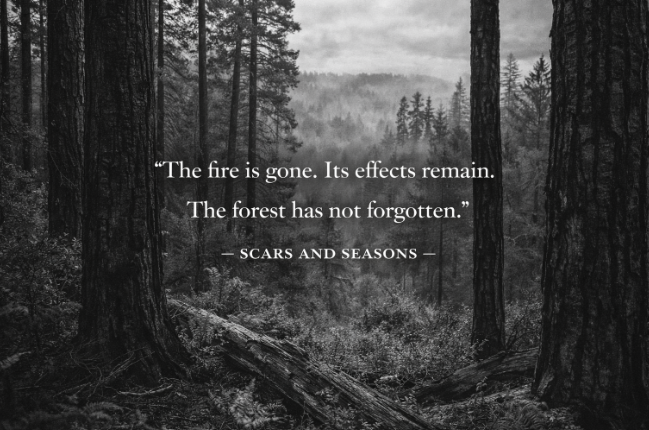
The Forest Remembers. So Does the Market.
Walk through a forest that burned decades ago and the fire is still everywhere. In the scorch marks, the shifted species, the altered soil.
Markets work the same way.
The 2008 crisis ended fifteen years ago. Its structural effects persist today in capital requirements, risk models, and the reflexes of everyone who traded through it.
Every crash, every crisis, every dislocation leaves traces that shape what comes next. The question isn't whether the market carries memory. It's whether you can read the terrain.
New article in the Natural History of Markets series
atstradingsolutions.com/scar…
#TrendFollowing #SystematicTrading #ComplexityScience #NaturalHistoryOfMarkets
1
8
525