
Thesis: users empathy.
→ A startup’s size = just 2 numbers: growth rate × how long it lasts
→ 93% growth/month? From $2M to $1B in 9.5 months. Exponential growth feels like magic
→ Even a modest 15%/month = 4384x growth over 5 years
→ Politicians don’t grasp the math of exponentials → assume the rich must have cheated
→ You can’t cheat your way to a growth rate: the product has to be so good people tell their friends
→ You can’t cheat market size either
→ The best ideas aren’t found by looking, searching makes you too conservative and kills the “lame-sounding” ones (Apple, Airbnb, Twitch all sounded dumb at first)
→ For young founders: build what you and your friends want. Your needs predict future demand

How to Earn a Billion Dollars: paulgraham.com/earn.html
3

I think the underlying issue is that AOC (and in fact most working people) live in a world of linear growth and plateaus, rather than the exponentials found in startups. To address the rhetoric, you have to make them feel heard (by hearing them) and then show them the alternative
1
82

The recursion erosion of intelligence accelerates as fast as the smartness increased. Live by exponentials, die by exponentials.
7


Jun 13
you underestimate exponentials. Its probably true that they dont have a mythos level model yet. but even amodei expects such model to be created in china in about 12 months. China is scaling huawei ascend chips by an insane amount and they have all the energy they need.
1
5
211

Jun 13
yeah I think it comes down to a) how long we sit in limbo wrt mythos and b) whether other comp models get same treatment later
think the latter will be one to watch.
this was not on my 2026 bingo card lol, thought 27/28 at least but exponentials move faster than you think
1
22

Recursive multiplicative exponentials means being a bag holder …right?
12


The entire premise behind Dan Brown's Digital Fortress is that he doesn't know how exponentials work. The author also thinks uranium-238 was used in the a-bomb dropped on Nagasaki, when any high-schooler could tell him that U238 is, in fact, non-fissible.
5
606
Jun 13
and so it begins. honestly wasn't picking this until at least 2027/28 but hey exponentials move fast
Jun 13

The US government, citing national security authorities, has issued an export control directive to suspend all access to Fable 5 and Mythos 5 by any foreign national, whether inside or outside the United States, including foreign national Anthropic employees.
The net effect of this order is that we must abruptly disable Fable 5 and Mythos 5 for all our customers to ensure compliance.
Access to all other Claude models is not affected.
We apologize for this disruption to our customers. We believe this is a misunderstanding and are working to restore access as soon as possible.
Read our full statement: anthropic.com/news/fable-myt…
16


Jun 12
If it wasn't for the AI disruption and catalysts coming, I would agree with you.
But I have a slightly different take given the era we are living in.
I think his projections till 2035 are unrealistic.
But beyond 2040 I think the vast majority of us are not capable of grasping the compounding of exponentials that will happen if things don't go south with AI.
14

Your opinion makes me inclined to go bullish on recursive multiplicative exponentials.🤔

1
4
337

Jun 12
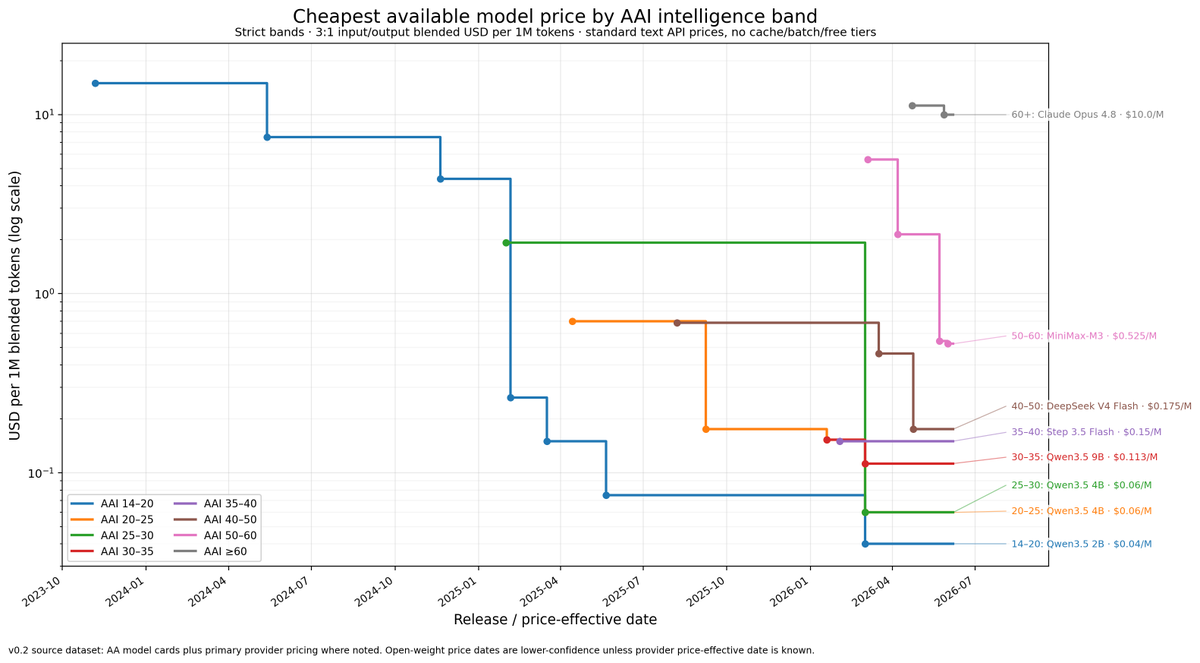
there, you just need to believe in exponentials. cost for a given intelligence band just keeps falling everytime.
47


Finally, your intuition is linear and reality runs on feedback loops with delays. Expect your gut to fail specifically on exponentials (pandemics, compound interest, AI capability), on delayed consequences (health, organizational rot, climate), and on second-order effects (the policy that produces more of the thing it was meant to eliminate).
How to live
I’m relaying the strongest empirical findings here rather than personal experience — more on that disclosure at the end.
Relationships are the whole game. The Harvard Study of Adult Development has tracked lives for over 85 years now, and its bluntest finding is that the quality of your close relationships at midlife predicts your health and happiness in old age better than cholesterol, wealth, or fame. Meta-analyses put chronic loneliness in the same mortality-risk neighborhood as heavy smoking. The implication is unglamorous: treat friendship as infrastructure. Schedule it. It decays by default, through nobody’s fault, one unreturned message at a time.
The body: nearly everything exotic in health is noise compared to sleeping seven to nine hours, lifting heavy things, building cardiovascular fitness (VO2 max is among the strongest predictors of all-cause mortality we can measure), not smoking, wearing sunscreen, flossing, and protecting your hearing. Muscle in your forties is independence in your eighties — sarcopenia, the slow loss of muscle with age, is what quietly decides who can get up off the floor at 85 and who can’t. The boring compounders beat the supplements every time, which is exactly why the supplements get the marketing budget.
Attention is the substrate of your life. William James pointed out that your experience is what you agree to attend to — and your life, concretely, will turn out to be the sum of what you paid attention to. There is now a trillion-dollar industry whose explicit business model is deciding this for you. Guarding your attention isn’t productivity advice; it’s self-authorship.
On regret: Gilovich’s research again — in the short run people regret things they did, but over years and decades, regrets of inaction dominate by a wide margin. The call not made, the question not asked, the thing not said while there was still time. The cost of asking is almost always lower than it feels in the moment, and the cost of silence compounds. (See above, re: compounding.)
Money buys back time, attention, and the removal of certain specific miseries; past sufficiency, its returns flatten fast and people mostly don’t believe this until they test it personally. Fees and lifestyle inflation are the silent leaks. Boring index funds plus unspectacular patience beat nearly all cleverness — which is precisely why cleverness keeps being sold to you.
And occasionally, take something to your actual limit. Most people live their whole lives never knowing where their ceiling is, because chronic 70% effort everywhere means the data never comes in — and that data changes your self-concept in ways nothing else can.
A few things just for wonder
A last message that was all instrumental would miss something. So: Cleopatra lived closer in time to the moon landing than to the construction of the Great Pyramid. More time separated Stegosaurus from Tyrannosaurus rex than separates T. rex from you. Every time you thoroughly shuffle a deck of cards, the resulting order has almost certainly never existed before in the history of the universe — 52 factorial is that large. And most of the atoms in your body weren’t with you a decade ago; “you” is not the matter but the pattern, less an object than a standing wave that has been telling itself a continuous story.
1
1
74

Jun 12
That is the general sentiment. Im just trying to remember how things were for Tesla. Im not missing the boat again. I made money on tesla, yet it is my simultaneously worst and best trade. Thought I did well being up like 70% only to miss the next 1,000% up. I get it. The market cap is HUGE this time, so there's less room to grow. Like where will the money even come from...But we have to think in exponentials this day and age
1
1
35

Jun 12
wow I wonder if that makes it exponential Does anyone know about exponentials seems important nobody is ready
7

Jun 12
What we don’t understand about exponentials makes anything possible

7