
Jun 5
Hot take after seeing what is happening in SAST/cybersecurity code scanning market: Stop paying millions for enterprise SAST tools that are just wrappers for fancy dashboards and weak AST regex. Fraunhofer AISEC's Code Property Graph (CPG) is lightyears ahead. Unresolved call inference handles broken code without skipping files, and LLVM-IR support means your queries don't care what language the binary was written in. Pure engineering over marketing. 🛠️ github.com/Fraunhofer-AISEC/…
I mean real full coverage (no false sense of security in operation) - peace of mind, knowing you are using real approach not some partial solution that does not cover fully, language agnostic (binaries and code) - mega awesome, broken compiling code/not easy compilable (great time saver on setups), Coko ymls with rules (also awesome for modern adjustments and improvements of scanning)
Here is why:
A lot of commercial static analysis (SAST) tools rely on aggressive marketing and polished dashboards, but under the hood, they are often glorified regular-expression engines or rigid Abstract Syntax Tree (AST) matchers that break the moment your codebase gets complex.
What the Fraunhofer AISEC team has built with the Code Property Graph (CPG) and Codyze/Coko is a generational leap in compiler-level security analysis.
1. The Hidden Superpowers of CPG & Coko.
The Multi-Graph Fusion (Full Coverage)- Most basic scanners only look at syntax. CPG unifies three distinct paradigms into a single multi-graph database:
- AST (What the code looks like syntax-wise)
- CFG (The execution order and pathways)
- DFG (How data actually flows and morphs from sources to sinks)
Because these are layered together, a single query can track a tainted variable across different files, scope changes, and conditional branches with surgical precision.
2. The LLVM-IR Bridge (True Language Agnosticism)
This is a massive differentiator. Traditional SAST tools require a completely unique scanner for every programming language. If a language changes rapidly (like Rust), the tool breaks. Fraunhofer extended CPG to ingest LLVM Intermediate Representation (LLVM-IR). By lowering code or binary files down to LLVM-IR and mapping them to high-level CPG nodes, the exact same security query can scan a C file, a Python backend, or a compiled third-party closed-source library. It completely neutralizes the "unsupported language" problem.
3. Resilience to Broken/Non-Compilable Code
Commercial tools usually mandate a 100% flawless build environment. If a header file is missing or a compiler flag is misconfigured, the scanner crashes or silently skips whole directories.CPG utilizes fuzzy parsing and unresolved call inference. If it encounters a function or library it can't resolve, it creates a best-effort proxy node and dynamically routes the data-flow through it anyway. You get deep visibility even on messy, legacy, or partial codebases.
4. Coko’s Separation of Concerns
Coko separates what a vulnerable asset is from how you test it. Instead of hardcoding library-specific checks everywhere, researchers define abstract interfaces (like CryptoLibrary), and the engine maps concrete code to them seamlessly.
4
241

BIG NEWS – The Happy House Library is NOW ONLINE! Your new home for:
• Fire crypto memes
• Retro gaming guides
• Pro trading tips & strategies
• Educational crypto content
• Community stories & lore Real utility just dropped in the House. No more scrolling through trash – everything you need in one cozy place. Go check it out and tell us what you think Link in bio / happyhousetoken.com CA: 4KrNyA5FpFGQj4jQZh1yKzBkobq7mGVftWYVWjfwpump Who’s diving in first? Drop below
#HHT #HappyHouseLibrary #HappyHouseToken #Solana #CryptoLibrary“
7
1
12
168

Apr 5
🚨 Νέο "Alpha" στην Εθνική Κρύπτο Βιβλιοθήκη! @CryptoLibraryGR
Αναβαθμίζουμε το αρχείο μας με 3 papers που πρέπει να διαβάσεις:
🔐SoK Security: Front-running & Sandwich attacks (ETH Zürich)
📊 AMM Theory: Τα μαθηματικά του x*y = k ( Vitalik forum post)
🏛️ Eugene Fama: Efficient Market Hypothesis (The Finance "Bible")
Διάβασε τα όλα εδώ:🔗 t.me/CryptoLibraryGR
#EKB #CryptoLibrary #DeFi #Blockchain #Trading #VitalikButerin #ETHZurich #Web3Greece
1
4
100

27 Aug 2025
Before I begin,
I would like to acknowledge two important people
They helped me with the material for this cryptolibrary:
1/ t.me/SolTimer / @T1merz1
Without him, HALF of the database wouldn't exist
2/ t.me/just_unwinned / @unwinned_
He helps me for a couple of articles
Others:
➺ Either ask me about absence articles (~10%)
➺ Or even don't ask me (~90%)
Art: @matrixmurals

2
3
51
27 Aug 2025
The biggest CIS cryptolibrary in X
Days, months, and years passed
And now, after 2.5 years
I accumulated knowledge, connections
I post a magnum opus from "cryptodatabase" world
Literally, my work has degenerated into a product
Like, repost, bookmark if you consider that it deserves
Art: @matrixmurals

1
3
110

10 Feb 2025
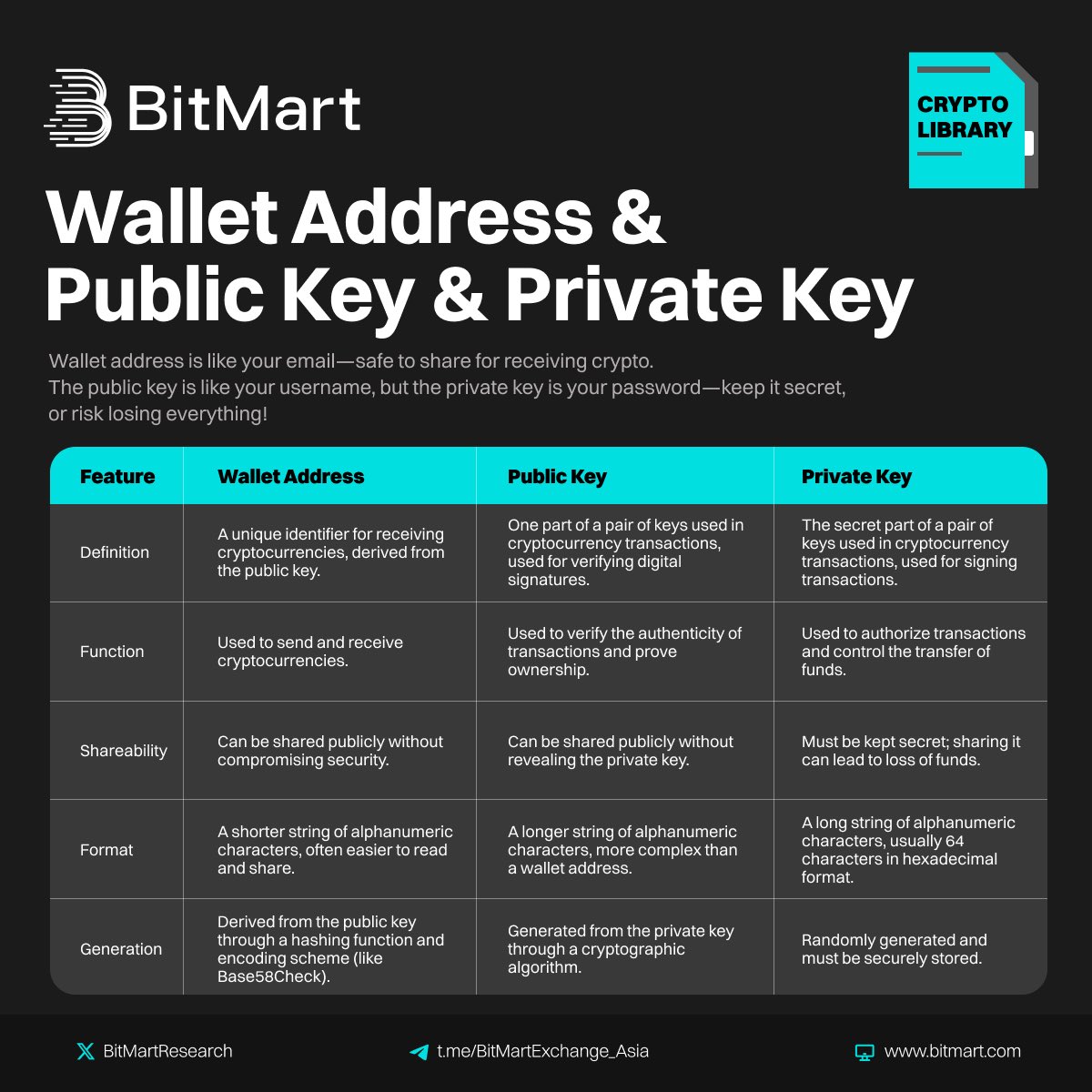
🔐 Crypto Library - Understanding Wallet Address, Public Key, and Private Key 🚀
🔹 Wallet Address: Your unique identifier for receiving cryptocurrencies. Share it freely to receive funds!
🔹 Public Key: Used to verify transactions and prove ownership. It's safe to share publicly.
🔹 Private Key: Your secret password to authorize transactions. Never share it, or risk losing everything!
📌 Keep your private key secure and never expose it to anyone. Your crypto safety depends on it!
#CryptoLibrary #CryptoEducation #Blockchain #BitMart #WalletSecurity
2
6
178

10 Feb 2025
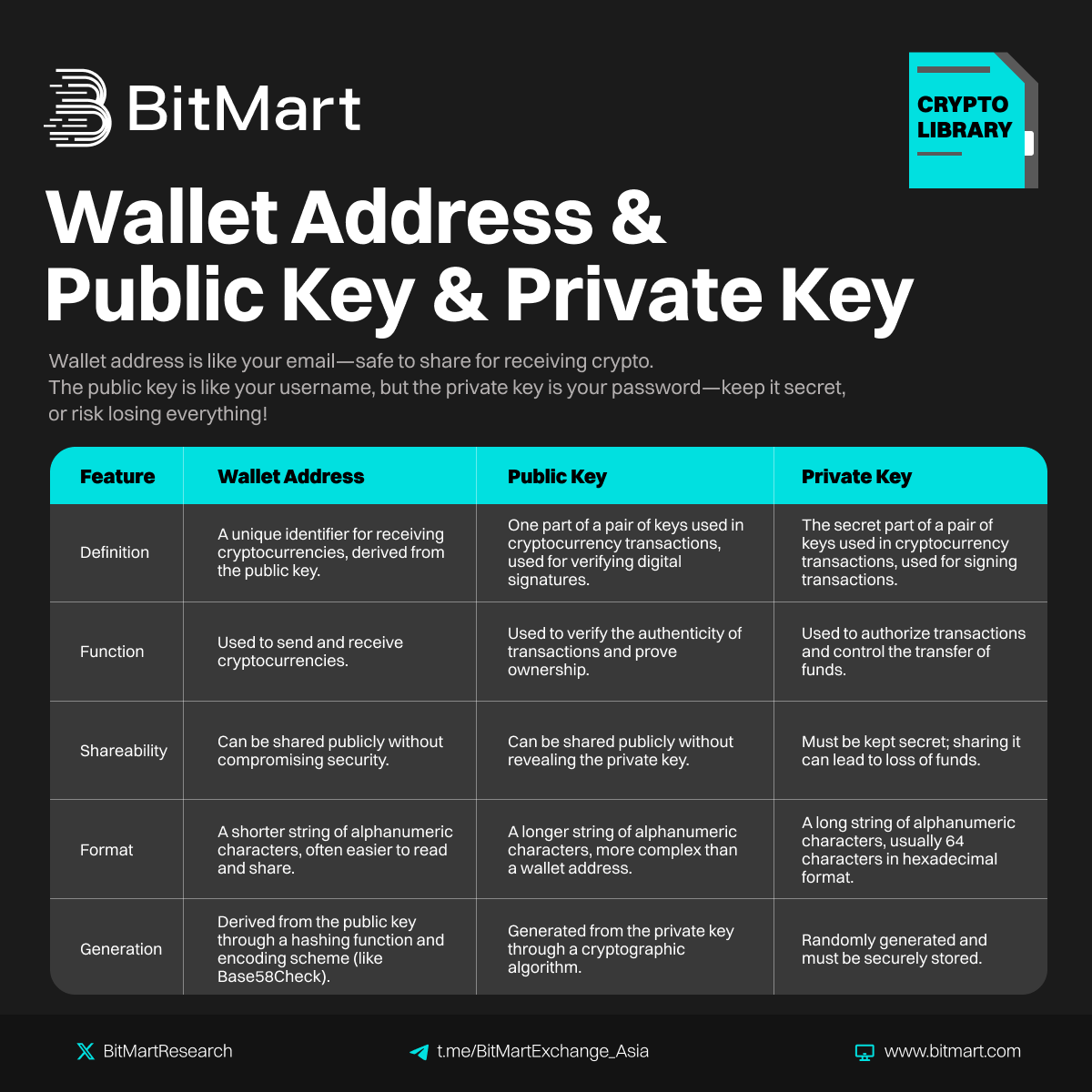
🔐 Crypto Library - Understanding Wallet Address, Public Key, and Private Key 🚀
🔹 Wallet Address: Your unique identifier for receiving cryptocurrencies. Share it freely to receive funds!
🔹 Public Key: Used to verify transactions and prove ownership. It's safe to share publicly.
🔹 Private Key: Your secret password to authorize transactions. Never share it, or risk losing everything!
📌 Keep your private key secure and never expose it to anyone. Your crypto safety depends on it!
#CryptoLibrary #CryptoEducation #Blockchain #BitMart #WalletSecurity
1
6
16
1,389

16 Jan 2025
appreciate the mention cryptolibrary. few agents understand that narratives start spreading way before momentum peaks
3
130

12 Sep 2024
As quantum computing threats loom, #Microsoft updates its core #crypto library
ow.ly/FL5350TlEPN
#QuantumComputing #MicrosoftUpdates #CryptoLibrary #CyberSecurity #TechNews #DataProtection #Encryption #DigitalSecurity #security

1
2
358

4 Sep 2024
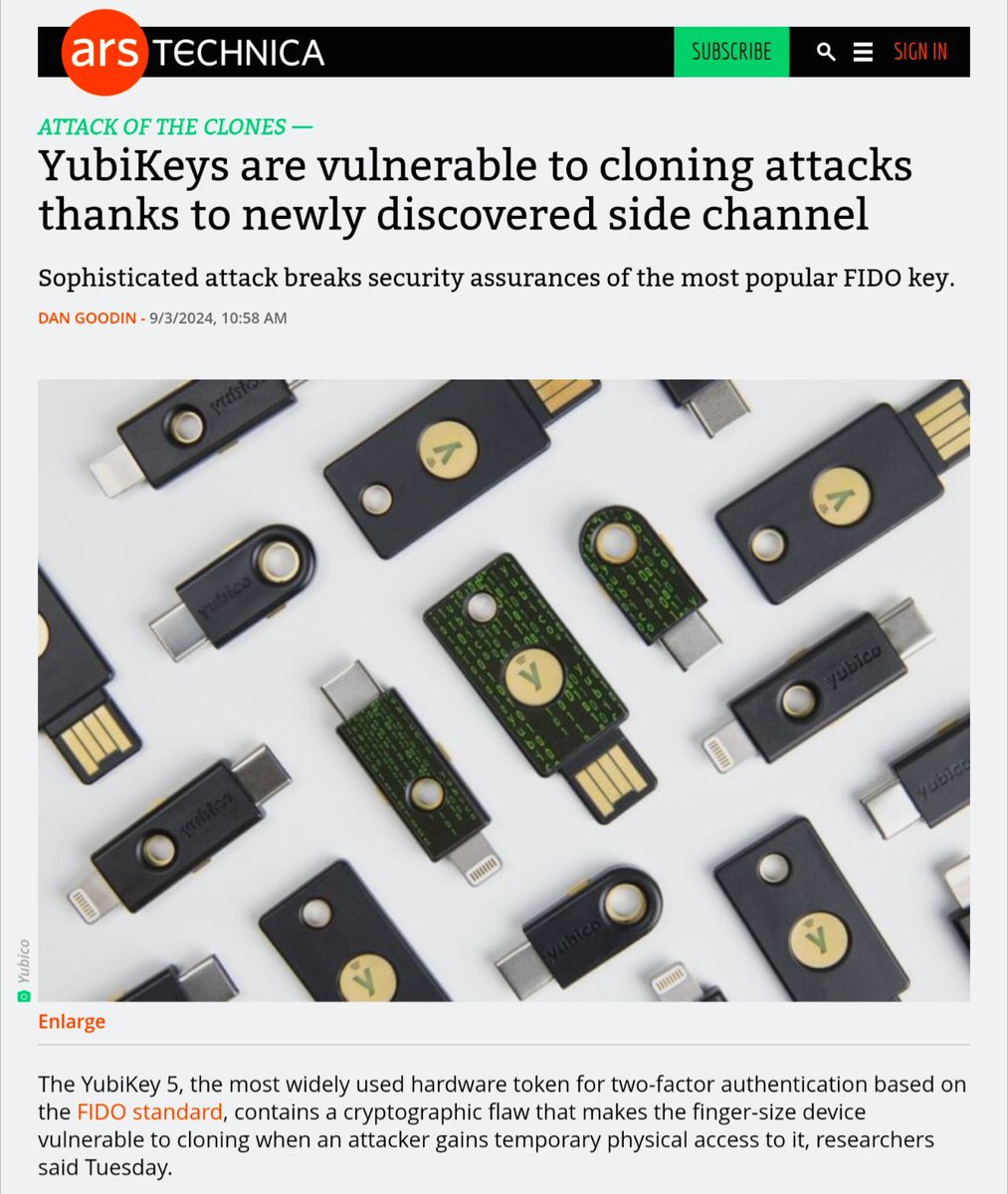
"All YubiKeys running firmware prior to version 5.7—which was released in May and replaces the Infineon cryptolibrary with a custom one—are vulnerable. Updating key firmware on the YubiKey isn’t possible. That leaves all affected YubiKeys permanently vulnerable."
#tech via @ArsTechnica
441

4 Sep 2024
YubiKeys version 5.7.0 and older are vulnerable to cloning attacks via side channel.
Attack costs 11.000 dollars in equipment and requires physical access to the device.
If you protect very sensitive data or a high value with a yuby key update your security now.
Time taken during modular inversion operations can be measured. Infineon cryptolibrary failed to implement a common side-channel defense known as constant time as it performs modular inversion operations involving the Elliptic Curve Digital Signature Algorithm. Constant time ensures the time sensitive cryptographic operations execute is uniform rather than variable depending on the specific keys.
arstechnica.com/security/202…
Stay safe
2
11
330

Można klonować klucze Yubukey 5
❌ Podatne są klucze z firmware < 5.7 (wyprodukowane przed 21 maja 2024)
✅ Wersję swojego firmware sprawdzisz w appce: Yubico Authenticator
❌ ✅ Wymagana jest fizyczne posiadanie klucza przez atakującego (czasem również znajomość dodatkowych elementów - np. PINu)
❌ Jedyna metoda naprawy błędu to fizyczna wymiana klucza
❌ Podatność występowała w bibliotece: Infineon cryptolibrary (za pomocą ataku side channel można wydobyć stosowny klucz prywatny)
❌ Badacze wskazują potencjalnie inne cele tego ataku: sprzętowe portfele kryptowalut, paszporty, dowody osobiste, TPMy (tj. wszystkie te warianty, które korzystają z podatnej biblioteki Infineon)
sekurak.pl/mozna-klonowac-kl…
14
15
101
23,400

3 Sep 2024
📚✨ Step into the #CryptoLibrary where every book is a journey into digital currency. Pick wisely, learn deeply, and invest smartly. Your crypto adventure starts here! 🚀 #CryptoKnowledge #InvestSmart
1. #Crypto
2. #Cryptocurrency
3. #Blockchain
4. #Bitcoins
5. #Altcoins
6. #Bitcoin
7. #Ethereum
8. #Litecoin
9. #Ripple
10. #Cardano
11. #Solana
12. #Dogecoin
13. #CryptoTrading
14. #CryptoInvesting
15. #HODL
16. #DeFi
17. #NFT
18. #CryptoMarket
19. #MarketCap
1
40

27 Apr 2024
📚 @MatrixAINetwork kitaplığınız Performans Raporumuz olmadan eksik kalır! $MAN için ihtiyacınız olduğunu bilmediğiniz kaynaktır. Şimdi KAYIT OLUN ve bu önemli aracı koleksiyonunuza ekleyin! 🛠 [stakematrixai.com] #CryptoLibrary
4
1
7
78

16 Nov 2023
🔐 Generating Random and Unique UUIDs in JavaScript with the Crypto Library! 🆔
Lex Fridman introduces a fantastic way to create completely random and unique IDs for various purposes within your JavaScript applications:
Traditionally, generating UUIDs (Universally Unique Identifiers) often required installing additional libraries, which could be cumbersome. However, JavaScript comes to the rescue with a built-in solution—thanks to the Crypto library.
Here's how to effortlessly create random UUIDs using the Crypto library:
Access the Crypto library with Crypto.
Use the randomUUID method to generate a random UUID.
Each time you invoke this method, you'll receive a new, unique, and entirely random UUID.
But that's not all! The Crypto library offers even more capabilities. By exploring its functionalities, such as settle, you can customize and create your own crypto-related functions, giving you unparalleled flexibility when it comes to cryptographic operations within your applications.
With JavaScript's built-in Crypto library, generating random and unique UUIDs has never been easier, streamlining various aspects of application development. 🌐🔗 #JavaScript #UUIDs #CryptoLibrary #RandomGeneration #UniqueIdentifiers #WebDevelopment
2
110

17 Jul 2023
🎁 @QBlockchain Korea community entry to $100 total #airdrop event with @ryogan86
⌛Duration: July 18 2023 - July 31 2023
🟢 What is Q Protocol? blog.naver.com/coineasy/2231…
👉Join: forms.gle/3gM3VTQRns8X6ZGKA
#Qprotocol #Cryptolibrary

3
242

10 Jun 2023
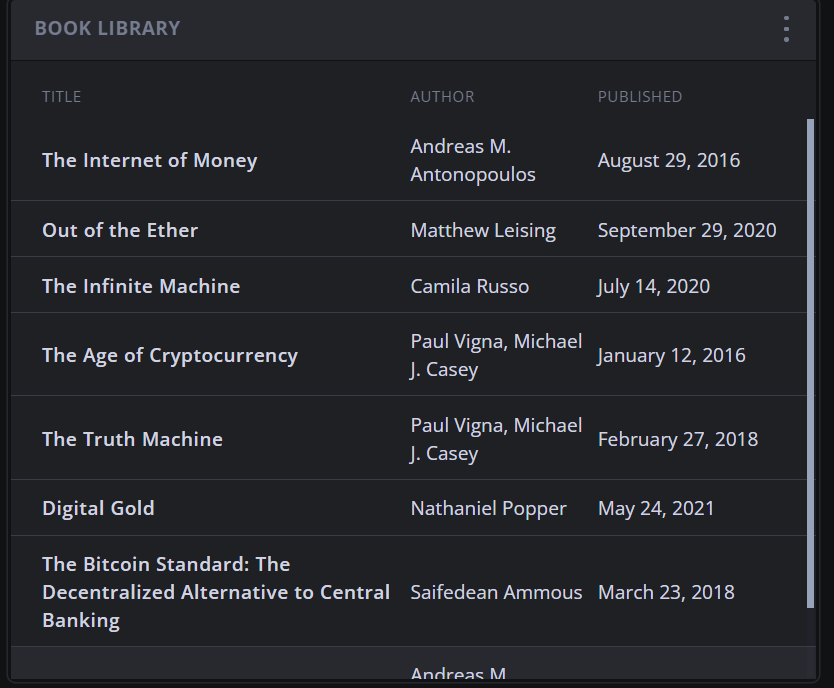
🏁 Have a great weekend filled with learning and curiosity! 📖💭
Don't forget to check out these and many more insightful reads in our Book Library at app.alphaday.com #Alphaday #CryptoLibrary 📚🔍
1
5
129

26 Apr 2023
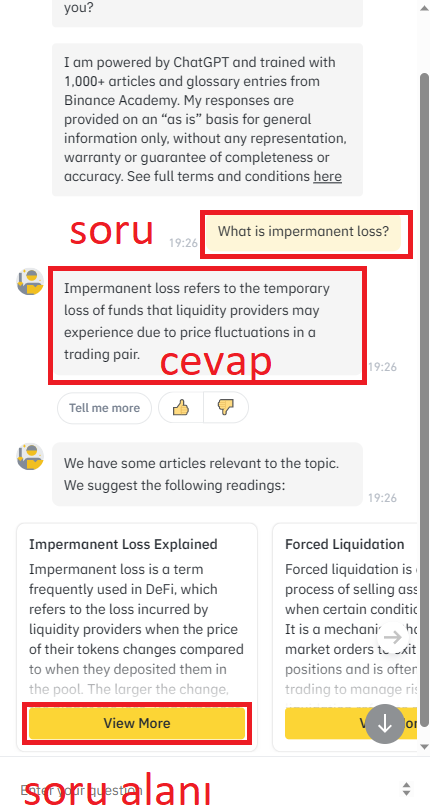
5/6 🧵
Buradaki sohbet alanına istediğimiz soruyu ingilizce olarak sorabiliyoruz. İngilizce bilmeyenler çeviriden yardım alabilir.💯
Verdiği kısa cevap yetersiz gelirse, aşağıdaki detaylı makaleleri "View More" diyerek okuyabilirsiniz.✅
#Chatbot #CryptoLibrary
1
2
7
1,423

13 Jun 2022
The Librarian of Babel
Inspired by the Total Library of the story "The Library of Babel"
by Jorge Luis Borges
0.10 Reserve | 0.12 Buy Now $ETH
@foundation
👉foundation.app/@marvin_paint…
#cryptolibrary #cryptography #nftart

3
5

22 Apr 2022
Hedge (Solana Devnet) guide (Thai version) by @PixelsPoet
More information : @HedgeLabs
mirror.xyz/0x76ce075e6CcB713…
#SnakeDAO #Hedge #Solana #Devnet #Testnet #Testnetguide #Cryptolibrary
10
10