
NEW YORK — Tiger Data, the team behind TimescaleDB and over a decade of Postgres engineering, today announced the general availability of Ghost, a database service designed and built… dlvr.it/TSyMlq #TigerData #GhostDatabase #AIAgents #DatabaseService #Postgres
12

Apr 9
This is the exact prompt I use before building any app infrastructure.
1. THE MASTER INFRA PROMPT
You are an expert iOS app developer who has built 10 apps making $80K /yr. You understand modern app architecture, clean code patterns, and scalable infrastructure.
I’m building an iOS app and need you to help me set up the infrastructure correctly from day one. Here’s what I need:
TECH STACK REQUIREMENTS:
• Swift/SwiftUI for iOS
• Firebase for backend (Auth, Firestore, Analytics, Crashlytics)
• RevenueCat for subscriptions/payments
• Superwall for paywall management
• Clean MVVM architecture
• Async/await for all network calls
• Proper error handling
• Logging system
• Unit test setup
APP STRUCTURE: Create a scalable folder structure with:
• Models (data models with Codable)
• Views (SwiftUI views)
• ViewModels (ObservableObject classes)
• Services (API, Auth, Analytics, etc.)
• Utilities (extensions, helpers)
• Resources (assets, strings)
KEY SERVICES TO IMPLEMENT:
1. AuthService - Firebase Auth with email/password and social login
2. DatabaseService - Firestore operations with proper error handling
3. AnalyticsService - Firebase Analytics custom events
4. SubscriptionService - RevenueCat integration
5. PaywallService - Superwall integration
6. UserService - user data management
7. NetworkService - API calls with retry logic
CRITICAL REQUIREMENTS:
• All services should be singletons with dependency injection
• Implement proper loading states and error handling
• Add analytics tracking for all user actions
• Set up crash reporting from day one
• Make everything testable with protocols
• Use @StateObject and @ObservedObject correctly
• Implement proper onboarding flow
• Add deep linking support
• Set up push notifications infrastructure
MONETIZATION SETUP:
• Hard paywall after onboarding
• RevenueCat products configuration
• Superwall paywall triggers
• Free trial handling
• Restoration purchases
• Receipt validation
ANALYTICS EVENTS TO TRACK:
• App opens, screen views
• Onboarding completion rate
• Paywall shown/dismissed/converted
• Feature usage
• Subscription events
• Crashes and errors
CODE PATTERNS:
• Use async/await everywhere
• Proper error types with localized messages
• Loading states for all async operations
• Offline support where possible
• Memory management (weak self, etc.)
• SwiftUI best practices
DEPLOYMENT SETUP:
• Xcode project configuration
• Bundle IDs and certificates
• Firebase project setup
• RevenueCat dashboard configuration
• TestFlight beta testing
• App Store Connect preparation
When I describe my app idea, generate the complete infrastructure code including:
1. Project structure with all folders
2. All service classes with full implementation
3. Base ViewModels and Views
4. AppDelegate/SceneDelegate setup
5. Info.plist configuration
6. Package.swift dependencies
7. Firebase configuration files
8. Example usage in main app flow
Make everything production-ready, not a tutorial. Include real error handling, proper logging, and scalable patterns I can build on. No shortcuts.
3
137

Apr 8
Extracted content. Enjoy 🤘
# Claude Code — App Infrastructure Prompt
> the only prompt you need to build an app infra the right way
## Paste this to Claude before you start:
This is the exact prompt I use before building any app infrastructure.
---
## 1. THE MASTER INFRA PROMPT
You are an expert iOS app developer who has built 10 apps making $300K/yr. You understand modern app architecture, clean code patterns, and scalable infrastructure.
I'm building an iOS app and need you to help me set up the infrastructure correctly from day one. Here's what I need:
---
## TECH STACK REQUIREMENTS:
- Swift/SwiftUI for iOS
- Firebase for backend (Auth, Firestore, Analytics, Crashlytics)
- RevenueCat for subscriptions/paywalls
- Superwall for paywall management
- Clean MVVM architecture
- Async/await for all network calls
- Proper error handling
- Logging system
- Unit test setup
---
## APP STRUCTURE:
Create a scalable folder structure with:
- Models (data models with Codable)
- Views (SwiftUI views)
- ViewModels (ObservableObject classes)
- Services (API, Auth, Analytics, etc.)
- Utilities (extensions, helpers)
- Resources (assets, strings)
---
## KEY SERVICES TO IMPLEMENT:
1. AuthService — Firebase Auth with email/password and social login
2. DatabaseService — Firestore operations with proper error handling
3. AnalyticsService — Firebase Analytics custom events
4. SubscriptionService — RevenueCat integration
5. PaywallService — Superwall integration
6. UserService — user data management
7. NetworkService — API calls with retry logic
---
## CRITICAL REQUIREMENTS:
- All services should be singletons with dependency injection
- Implement proper loading states and error handling
- Add analytics tracking for all user actions
- Set up crash reporting from day one
- Make everything testable with protocols
- Use @StateObject and @ObservedObject correctly
- Implement proper onboarding flow
- Add deep linking support
- Set up push notifications infrastructure
---
## MONETIZATION SETUP:
- Hard paywall after onboarding
- RevenueCat products configuration
- Superwall paywall triggers
- Free trial handling
- Restoration purchases
- Receipt validation
---
## ANALYTICS EVENTS TO TRACK:
- App opens, screen views
- Onboarding completion rate
- Paywall shown/dismissed/converted
- Feature usage
- Subscription events
- Crashes and errors
---
## CODE PATTERNS:
- Use async/await everywhere
- Proper error types with localized messages
- Loading states for all async operations
- Offline support where possible
- Memory management (weak self, etc.)
- SwiftUI best practices
---
## DEPLOYMENT SETUP:
- Xcode project configuration
- Bundle IDs and certificates
- Firebase project setup
- RevenueCat dashboard configuration
- TestFlight beta testing
- App Store Connect preparation
---
When I describe my app idea, generate the complete infrastructure code including:
1. Project structure with all folders
2. All service classes with full implementation
3. Base ViewModels and Views
4. AppDelegate/SceneDelegate setup
5. Info.plist configuration
6. Package.swift dependencies
7. Firebase configuration files
8. Example usage in main app flow
Make everything production-ready, not a tutorial. Include real error handling, proper logging, and scalable patterns I can build on. No shortcuts.
3
100

IoC & DI - simple explanation 🧵
IoC (Inversion of Control):
You don’t create objects anymore. The framework does it for you.
DI (Dependency Injection):
Instead of creating dependencies inside a class, they are given to the class.
Example:
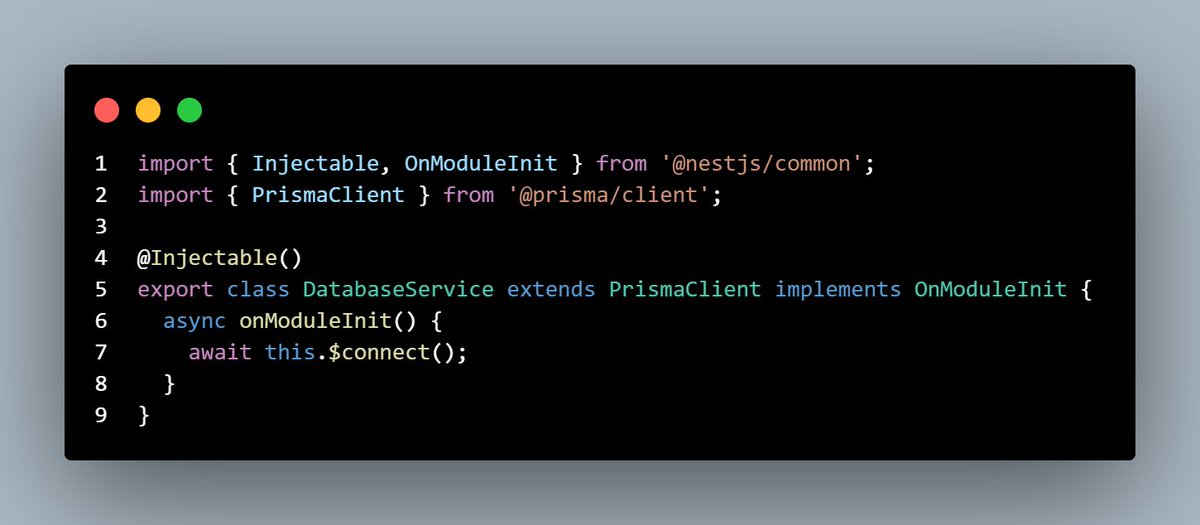
❌ new DatabaseService()
✅ Framework injects DatabaseService
IoC = principle DI = implementation
This is why NestJS code is clean, testable, and scalable.
3
1
11
232

25 Oct 2025
Here's why get_it ended my constructor nightmares:
You know that moment when your app grows and you're passing DatabaseService through 6 constructor params just to use it in one button?
Yeah, that's where most Flutter apps break.
Thread 🧵 (1/5)
3
1
2
283

6 Jul 2025
Singleton Pattern:
• Ensures a class has only one instance.
• Example: NetworkService, DatabaseService
1
3
217

4 May 2025
Yes, we will need engineer.
In personal experience, I found AI write much more code. Sometimes redundant code (like adding a watch to the vue store to update the list, while this already done by other code). Sometimes instead of extends current object (like databaseService), it create another object (like databaseConnector), which will confuse themselves in the future.
I just stay there an prompt exactly the plan in my mind.
In large code base, maintain it concise and correctness require engineer.
1
2
3,452

12 Apr 2025
Oracle and Google Cloud are set to launch the Oracle Base Database Service on Google Cloud. This collaboration seeks to enhance cloud services and improve regional access for users. #Oracle #GoogleCloud #DatabaseService #CloudComputing techday.com.au/story/oracle-…
2
52
27 Jan 2025
Singleton Pattern:
• Ensures a class has only one instance.
• Example: NetworkService, DatabaseService
1
4
234


18 Jun 2024
📢 Attention DBAs!
Nutanix Database Service 2.5.5.1 release notes are live!
Learn about new fixes, supported versions, and best practices to keep your databases running smoothly. 🌟💻 bit.ly/4c7l0h2
#Nutanix #DatabaseService #ReleaseNotes
2
205

28 Apr 2023
Highlights from Azure Cosmos DB Conf 2023: See what's new in Microsoft's globally distributed, multi-model database service for your cloud-native applications.
#AzureCosmosDB #CloudNative #DatabaseService
devblogs.microsoft.com/cosmo…
3
878

MemoryDB is a Redis-compatible, durable, in-memory database service that delivers ultra-fast performance. You can use MemoryDB as a fully managed, primary database to build high-performance applications.
#aws #databases #inmemory #MemoryDB #Redis #AWS #databaseservice
2
33

25 Aug 2022
אני לא מסכימה, כי אתה לא באמת יכול לקרוא לדברים FeatureFlagSystem, DatabaseService (בשביל איזו מערכת?) וכו׳. בסוף תקבל או קיצורים או שמות ייעודיים, זה גם חלק מהתרבות של החברה. אם יש תיעוד מינימלי על מה המערכת עושה, זה גם מקל למצוא את כל הדברים הרלוונטיים בקודבייס.
3
3

25 Oct 2021
El uso de una instancia de #MySQL #DatabaseService en #OCI como réplica asincrónica es muy útil. Permite probar el servicio con datos siempre actualizados de #onpremise producción: oal.lu/NGa5E
Oracle,#OracleCloudInfrastructure,Developers
2

7 Mar 2021
class Sell {
Sell(CreditService C, DatabaseService D) { … }
boolean apply(Request R) {
if (C.deduct(R.user, R.price)) {
if (D.remove(R.goods)) {
return true;
}
}
return false;
}
}
1
3
7 Mar 2021
مشکل تست این تابع اینجاست که نیاز به دو سرویس CreditService و DatabaseService و پایگاهدادههای پشت آنها داریم. تازه فرض کنید، اینها خود ممکن است به سرویسهای دیگر وابسته باشند. چطور میتوان این تابع را تست واحد کرد؟ یک روش معمول «تزریق وابستگیها»ست (dependency injection): //
1
2
7 Mar 2021
یک مثال: فرض کنید واحدی در کدمان داریم برای پردازش درخواست خرید که دو کار انجام میدهد: کمکردن قیمت کالا از اعتبار خریدار و تغییر پایگاهداده انبار. مثلا این واحد، کلاسی بهشکل زیر است (شبهکد) که در آن CreditService و DatabaseService مجموعهای از توابع ساکن (static) اند: //
1
3


What is Azure Cosmos DB? Principle, Features, Benefits & More hubs.li/H0xplsp0
#azure #microsoft #azurecosmosdb #databasemanagement #databaseservice
1
1