Sometimes I think maresca is a boring coach.
Look at turkey today.
Went down and with a deepblock they could not get back.
748

Jun 14
Their manager is to blame.
How does he break down a deepblock.
42
2,961

Revisiting Target-Aware de novo Molecular Generation with TarPass: Between Rational Design and Texas Sharpshooter
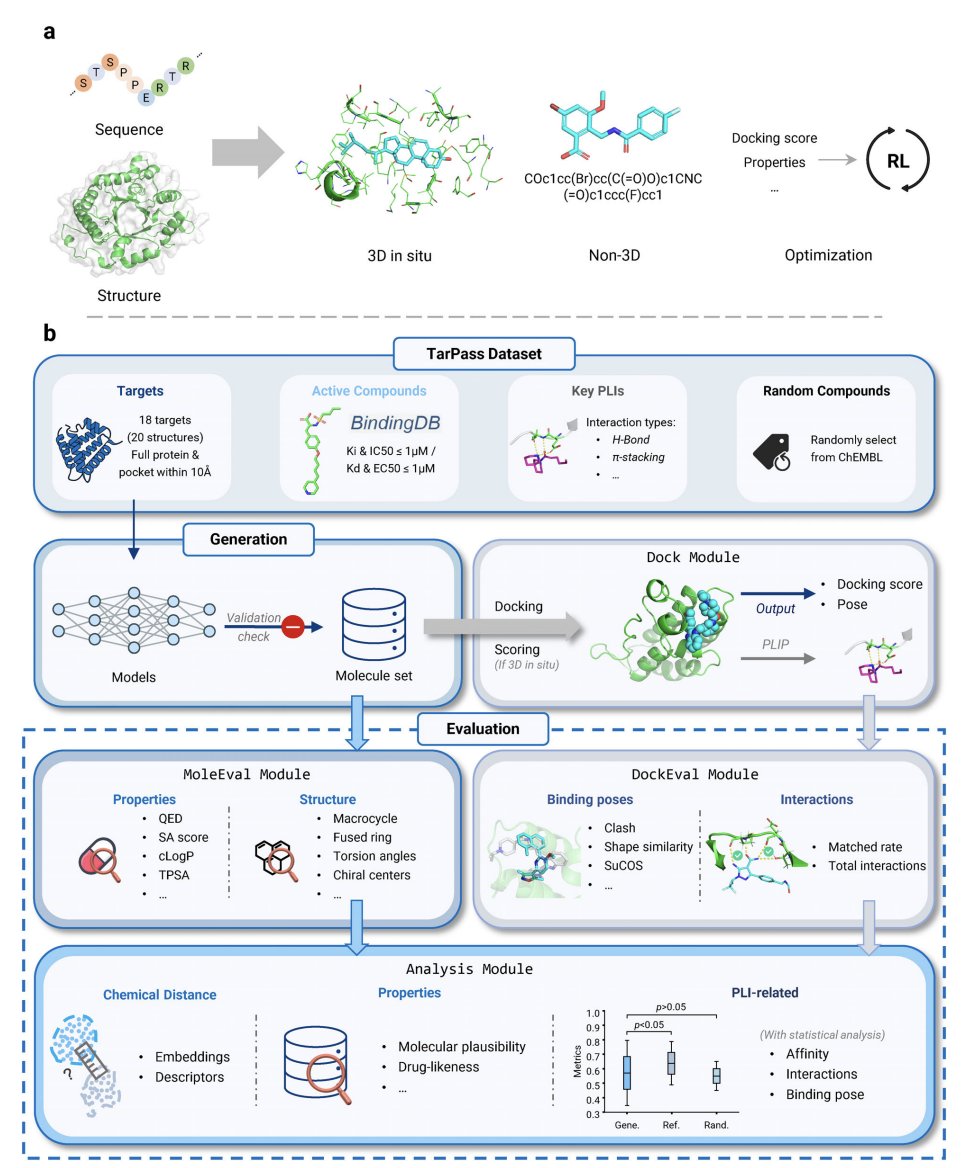
1. The paper argues that many “target-aware” de novo generators may not truly use target information, but instead risk a Texas Sharpshooter pattern: retrospectively rationalizing outputs using coarse metrics (e.g., docking) and cherry-picked examples.
2. To address this, the authors introduce TarPass, a curated benchmark designed for fair, target-grounded evaluation across paradigms. It includes 18 well-studied, pharmaceutically relevant targets (20 structures total), expert-annotated key interactions, and ~1000 experimentally validated actives per target (from BindingDB), plus a ChEMBL-random baseline to test whether models beat “just sample from a drug-like database.”
3. TarPass is explicitly built to reduce data leakage: targets are time-split (post-2019) and selected to avoid overlap with common structure–ligand training sets (CrossDocked2020, PDBbind). The benchmark frames generalization realistically as “within druggable families” (e.g., kinases) rather than assuming entirely novel folds.
4. The evaluation is holistic and standardized: generate up to 1000 unique molecules/target, run a consistent docking workflow (with special handling for 3D in situ initial poses), then score both protein–ligand interactions (PLIs) and molecular plausibility (validity, drug-likeness, synthesizability, structural alerts, and chemical-distance behavior).
5. 15 representative methods are benchmarked across three paradigms: non-3D (DeepBlock, DRAGONFLY, SimpleSBDD, TamGen), 3D in situ (DiffSBDD, DrugFlow, IPDiff, Lingo3DMol, MolCraft, PocketFlow, SurfGen, TargetDiff), and optimization-based variants (DrugFlow-PA, MolPilot, REINVENT). The study also reports practical deployability: runtime, validity, uniqueness, and input-structure compatibility.
6. Key PLI finding: 3D in situ methods show only a modest average advantage in docking/interaction metrics, and many do not significantly outperform the ChEMBL-random baseline across targets. Only a small subset of methods shows consistent gains, and even then performance can be sensitive to conditions like reliance on an input ligand (raising concerns about robustness/generalization).
7. Interaction recovery is used as a stricter test than docking score alone. Even reference ligands achieve only ~51% exact match (limited by docking/PLIP constraints), but most models perform near random on exact match and match ratio; only a few (notably including DrugFlow/MolCraft and optimized variants) approach reference-like interaction recovery.
8. Pose realism remains a bottleneck for 3D in situ generation: initial conformations frequently contain steric clashes, centroid placement errors correlate strongly with reduced interaction recovery, and certain targets expose systematic failure modes (e.g., incomplete pocket definitions causing clashes; metal coordination such as Zn in HDAC6 being mishandled or unsupported by some models).
9. Plausibility/drug-likeness trade-off: non-3D models (often benefiting from broader pretraining) tend to generate more drug-like and synthesizable molecules (higher QED, better SA scores, fewer medicinal-chemistry alerts) but show weaker target specificity in PLIs. Many graph-based 3D in situ models overproduce implausible stereochemistry and overly complex ring systems (e.g., highly fused rings), harming synthetic feasibility.
10. The paper proposes a practical post-processing strategy: a multi-tier virtual screening workflow that applies hard filters across PLIs plausibility drug-likeness, followed by softer refinement (experience-based filters, optional clustering/MD). In case studies (JAK2/TYK2), hard filters reduce libraries to ~10% and later steps downscale to ~20–30 candidates, yielding some enrichment—but still highlighting that filtering cannot substitute for improving pose accuracy, interaction fidelity, and plausibility in the generators themselves.
📜Paper: doi.org/10.1002/advs.75411
#ComputationalBiology #DrugDiscovery #GenerativeAI #MolecularGeneration #StructureBasedDrugDesign #Benchmarking #Docking #Cheminformatics #MachineLearning
2
1,043
Revisiting Target-Aware de novo Molecular Generation with TarPass: Between Rational Design and Texas Sharpshooter
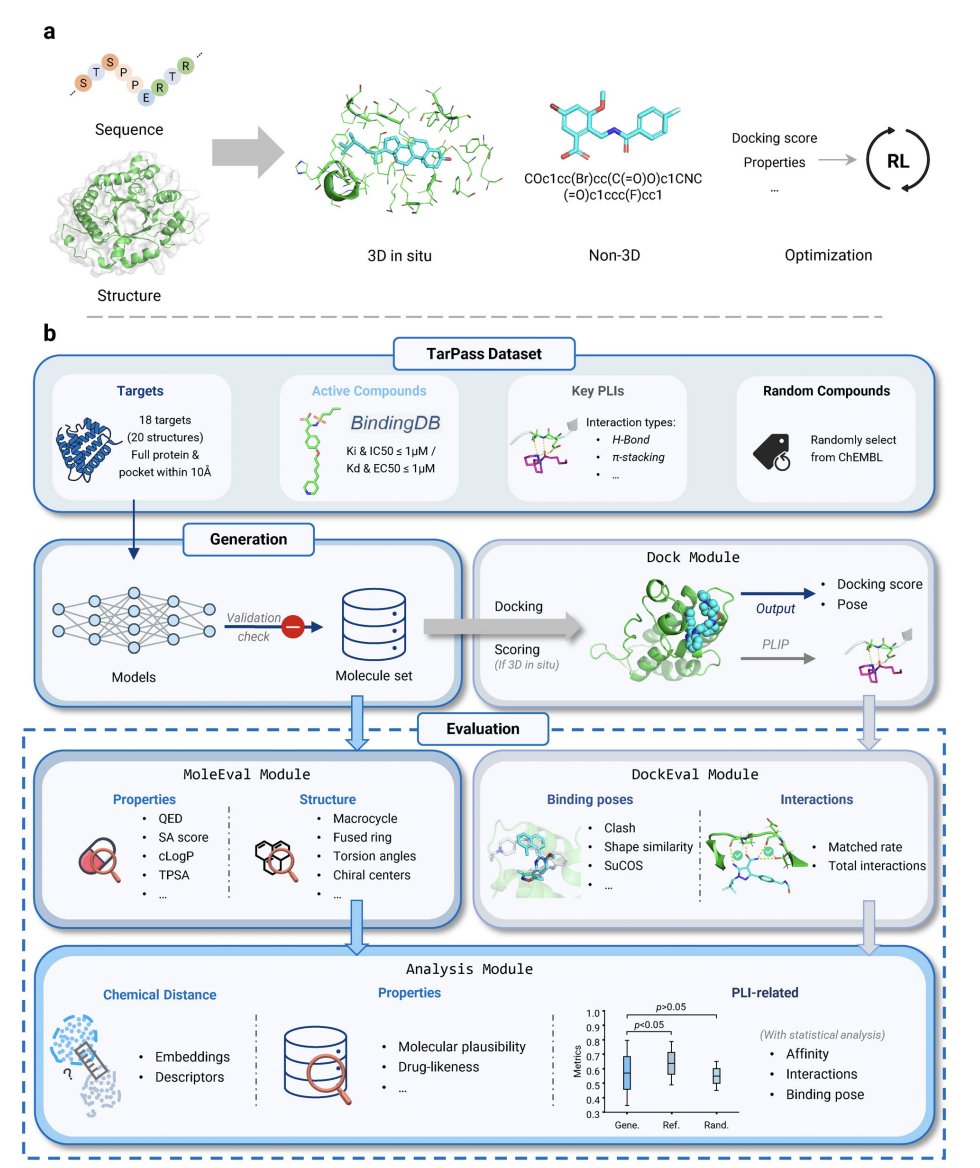
1. The paper argues that many “target-aware” de novo generators may not truly use target information, but instead risk a Texas Sharpshooter pattern: retrospectively rationalizing outputs using coarse metrics (e.g., docking) and cherry-picked examples.
2. To address this, the authors introduce TarPass, a curated benchmark designed for fair, target-grounded evaluation across paradigms. It includes 18 well-studied, pharmaceutically relevant targets (20 structures total), expert-annotated key interactions, and ~1000 experimentally validated actives per target (from BindingDB), plus a ChEMBL-random baseline to test whether models beat “just sample from a drug-like database.”
3. TarPass is explicitly built to reduce data leakage: targets are time-split (post-2019) and selected to avoid overlap with common structure–ligand training sets (CrossDocked2020, PDBbind). The benchmark frames generalization realistically as “within druggable families” (e.g., kinases) rather than assuming entirely novel folds.
4. The evaluation is holistic and standardized: generate up to 1000 unique molecules/target, run a consistent docking workflow (with special handling for 3D in situ initial poses), then score both protein–ligand interactions (PLIs) and molecular plausibility (validity, drug-likeness, synthesizability, structural alerts, and chemical-distance behavior).
5. 15 representative methods are benchmarked across three paradigms: non-3D (DeepBlock, DRAGONFLY, SimpleSBDD, TamGen), 3D in situ (DiffSBDD, DrugFlow, IPDiff, Lingo3DMol, MolCraft, PocketFlow, SurfGen, TargetDiff), and optimization-based variants (DrugFlow-PA, MolPilot, REINVENT). The study also reports practical deployability: runtime, validity, uniqueness, and input-structure compatibility.
6. Key PLI finding: 3D in situ methods show only a modest average advantage in docking/interaction metrics, and many do not significantly outperform the ChEMBL-random baseline across targets. Only a small subset of methods shows consistent gains, and even then performance can be sensitive to conditions like reliance on an input ligand (raising concerns about robustness/generalization).
7. Interaction recovery is used as a stricter test than docking score alone. Even reference ligands achieve only ~51% exact match (limited by docking/PLIP constraints), but most models perform near random on exact match and match ratio; only a few (notably including DrugFlow/MolCraft and optimized variants) approach reference-like interaction recovery.
8. Pose realism remains a bottleneck for 3D in situ generation: initial conformations frequently contain steric clashes, centroid placement errors correlate strongly with reduced interaction recovery, and certain targets expose systematic failure modes (e.g., incomplete pocket definitions causing clashes; metal coordination such as Zn in HDAC6 being mishandled or unsupported by some models).
9. Plausibility/drug-likeness trade-off: non-3D models (often benefiting from broader pretraining) tend to generate more drug-like and synthesizable molecules (higher QED, better SA scores, fewer medicinal-chemistry alerts) but show weaker target specificity in PLIs. Many graph-based 3D in situ models overproduce implausible stereochemistry and overly complex ring systems (e.g., highly fused rings), harming synthetic feasibility.
10. The paper proposes a practical post-processing strategy: a multi-tier virtual screening workflow that applies hard filters across PLIs plausibility drug-likeness, followed by softer refinement (experience-based filters, optional clustering/MD). In case studies (JAK2/TYK2), hard filters reduce libraries to ~10% and later steps downscale to ~20–30 candidates, yielding some enrichment—but still highlighting that filtering cannot substitute for improving pose accuracy, interaction fidelity, and plausibility in the generators themselves.
📜Paper: doi.org/10.1002/advs.75411
#ComputationalBiology #DrugDiscovery #GenerativeAI #MolecularGeneration #StructureBasedDrugDesign #Benchmarking #Docking #Cheminformatics #MachineLearning
3
13
1,017


Apr 8
I spoke too soon. This brief pressing was only from kickoff. We didn't do it onwards from the moment the ball went out of play and they had a goalkick. We just sat in our WBA deepblock and hoped PSG wouldn't score, which they did.
1
10
2,426

Mar 25
Turn one clip into a reward.
Clip any moment from today’s DeepBlockAI Space.
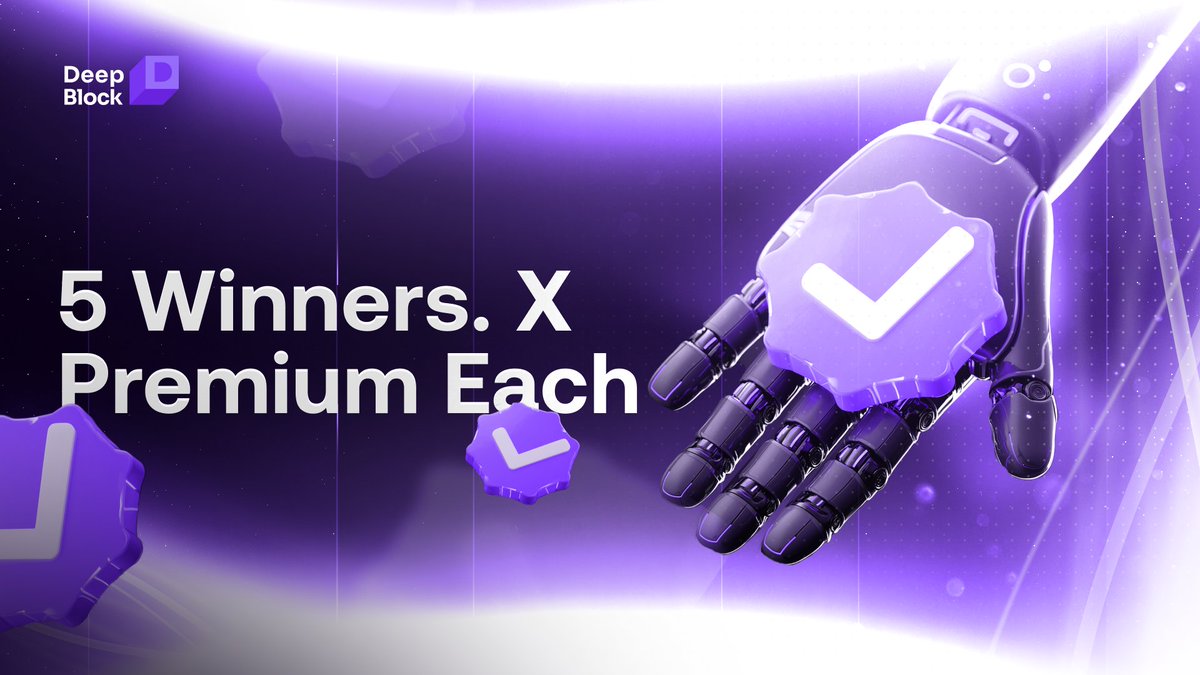
5 random winners get 1-month X Premium.
How to enter:
1. Clip any moment from today's Space
2. Post it publicly
3. Tag @DeepBlockAI
4. Be on the DeepBlock waitlist
Deadline: April 1, 15:00 UTC.
Not on the waitlist yet? Fix it premint.xyz/deep-block/
1
1
5
210
Mar 23
🏆 5 winners. X Premium each.
Details dropping tomorrow, but you'll need to be on the DeepBlock waitlist to be eligible.
Join early → premint.xyz/deep-block/
1
7
188

Mar 7
Against deepblock garnacho is a threat off ball. He always recognises danger
3
276

Feb 24
your ClawdBot can lose your money. in DeFi there’s no undo.
x402 made payments between agents automatic, fast, unconditional.
BUT if one data piece is wrong, payments scale mistakes.
that’s why your Clawds need data they can actually trust.
hi. this is DeepBlock. we are building that

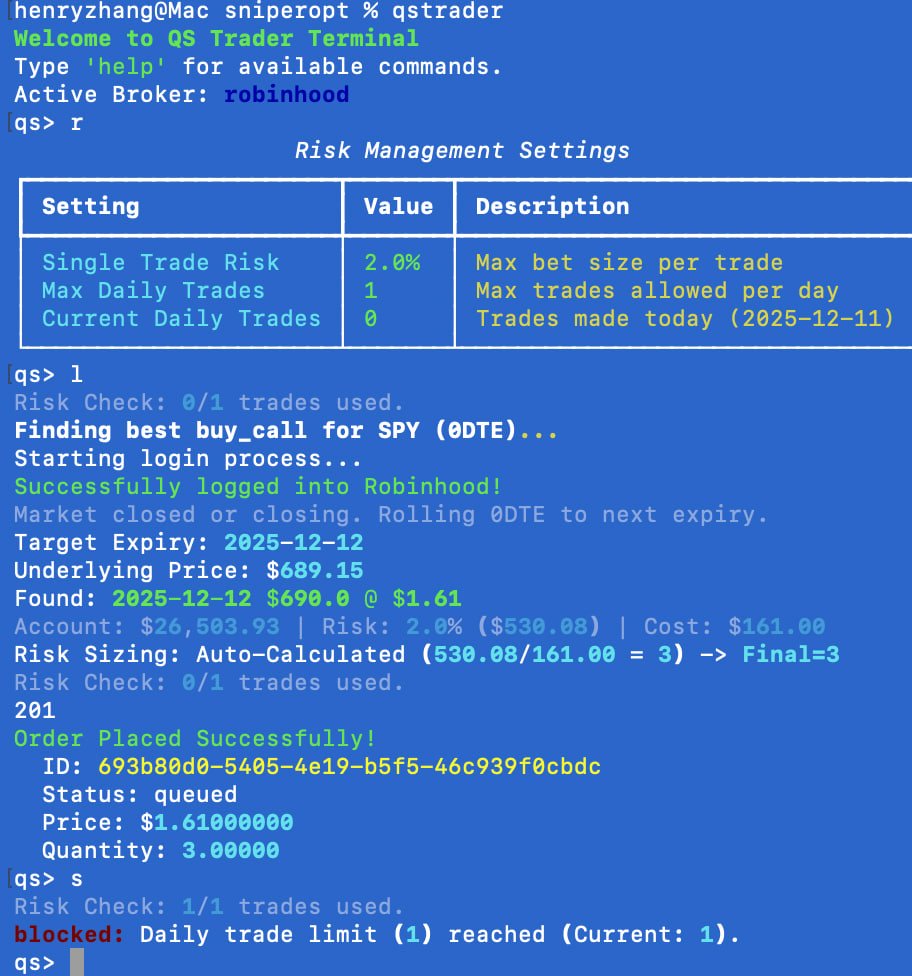
This Polymarket trader made $500,000 using his ClawdBot script
Hard to believe, but this guy built the script in 5 hours and is already making solid money
He’s not a genius
He’s not an insider
And he’s not the creator of Polymarket
He’s just a regular trader who decided to write his OWN personal script
Profile → polymarket.com/@kingofcoinfl…
I figured out how he can be copy-traded with minimal delay
Copytrade → ratio.you/r/BP9FKCC4
After breaking down his entire script, I was honestly a bit surprised
No huge databases
No insanely complex infrastructure
Nothing rocket-science level
Here is the full strategy of the script:
Bets are placed not on event outcomes, but on price inefficiencies
Thousands of fast trades accumulate into a massive total profit
In calm markets, risks stay minimal, while strong trends allow capital to grow rapidly
Most traders can’t react fast enough, but the bot turns market delays into real money.
1
2
9
414

Feb 18
This game didnt need Rice and Zubi, it needed an Eze and Saka with one of Zubi or Rice sitting.. And this is the last time Martinelli starts a PL game especially one we face deepblock
2
5
367
Feb 18
cool, agents can pay now.
but that’s not the part that makes me pause.
what matters is what they’re reacting to.
every transaction starts as input → data becomes a decision → the decision becomes execution.
at machine speed, context defines outcomes.
small misreads don’t stay small for long.
scale context. @DeepBlock
Feb 6

⚡️AI MEETS BLOCKCHAIN PAYMENTS
AI just learned how to use a crypto wallet.
MultiversX is the first blockchain to integrate Google’s Universal Commerce Protocol, letting AI agents check balances and execute on-chain transactions automatically.


4
5
182

Feb 16
📺 Au sommaire de SMART TECH ce mardi 17 février à 10h45 : les Interviews de l’IA, édition spéciale Jinov avec @delf1 et ses invités.
► @LEMEEChristophe, CEO et co-fondateur de la Legaltech "deepblock"
► Jonathan Williams, directeur France de Legora
► @MartinBussy, co-CEO Legal Data Space
► Daria Viktorova, responsable juridique et pilote du projet IA chez Darégal
#smarttech avec Emilie Rausch, rendez-vous ce mardi 17 février à 10h45 sur @B_SMART_TV

4
6
351

eSui Dollar just went live on Sui Mainnet.
What does it get day one with DeepBlock:
∙ Margin trading
∙ Lending
∙ Leveraged DeFi workflows
Live. Not “coming soon.”
The real play is the yield stack:
∙ Passive: Hold USDe/dbUSDe. Borrow against it. Keep the yield.
∙ Active: Deploy those yield-bearing stablecoins across DeFi. Stack yield on yield.
DeepBook built the infrastructure so teams don’t have to. More protocols plug in. More places to farm.
Oh btw, the early yield window is now, your best chance to take advantage of the yield being offered is early, as with anything.
4
15
1,342
Feb 12
We lack proper fundamentals,Arteta ball is more risk averse than forcing actions..we are so scared to play through the middle that even in opposition half we prefer to play wide than go direct. Den we complain of Deepblock
2
91
Feb 9
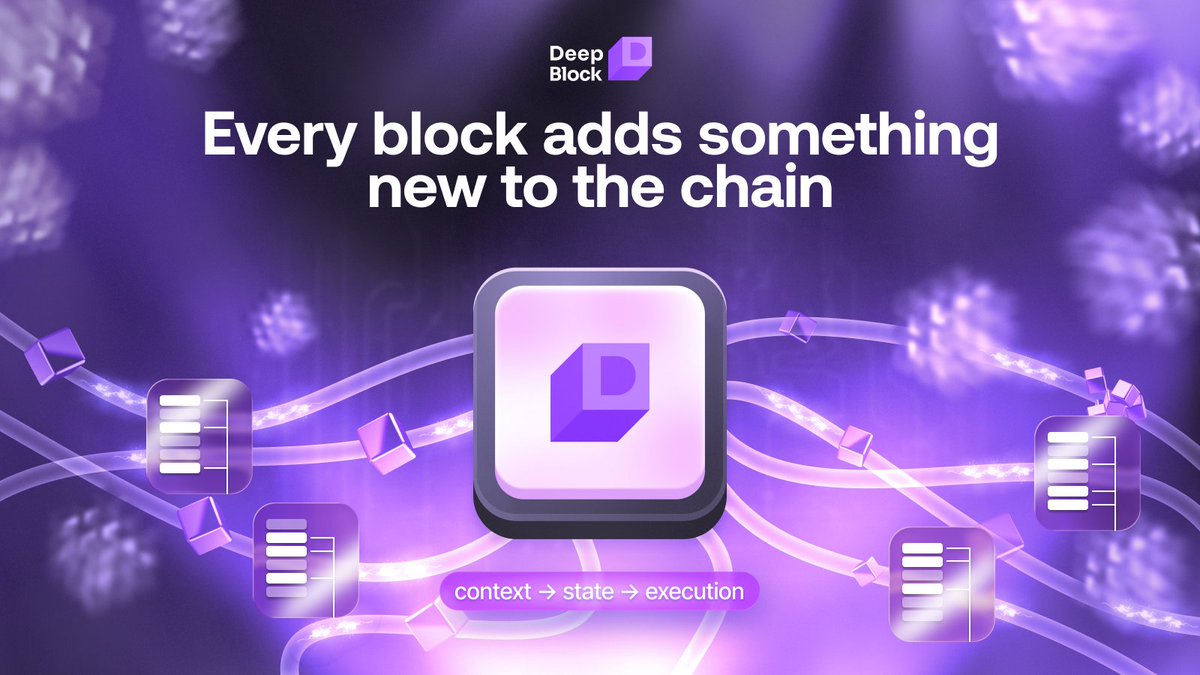
Every. Single. Deep Block.
Every block adds something new to the chain
Single agent sees only the end result of those changes
DeepBlock turns each block into a clear snapshot, so agents always act with the full context in view.
context → state → execution
Join the waitlist: premint.xyz/deep-block
10
6
23
554
Jan 29
the value of DeepBlock waitlist rn
you had a chance


3
92
Jan 28
Early access comes with rewards.
People are already joining the DeepBlock Waitlist, and the first rewards will be given away soon.
We will randomly select 5 participants to receive X Premium subscriptions during our AMA on February 5 at 15:00 UTC.
If you are already in, you are eligible. If not, now is the time.
Join here: premint.xyz/deep-block/
6
12
26
506