
How SPVM PDQ 20 uses "IT Security" as an excuse to ignore cyber-extortion and human trafficking (Proof Inside)
Over the last few months, my infrastructure has been mapping a literal cyber-extortion and human trafficking syndicate targeting local content creators. I did the work. I deployed honeypots, captured geolocated residential IP endpoints in Sherbrooke on Bell Canada (ASN 577), traced proxy VOIP lines to wholesale trunks (Distributel and Iristel), and pulled a $440k crypto transaction ledger tied to their payouts.
I handed this forensic payload to the SPVM at PDQ 20 on a silver platter.
Here is exactly how they chose to bury it, try to silence me, and sweep a trafficking case under the rug.
The Media Battle and the Strip-Down
I’ve dealt with Lieutenant Sylvain Bisson at this station before, and his move was always to isolate me. He’d hide media addresses in the subject lines or strip them entirely to turn a high-stakes public escalation back into a quiet "citizen complaint" where they control the narrative.
So when Bisson’s supervisor, Sergeant Olivier Rousseau (Matricule 6474), got my secure payload, he did the exact same thing. He replied to me and deliberately stripped out every investigative journalist I had CC’d (La Presse, CBC, CTV, Montreal Gazette, etc.).
I immediately hit "Reply All," dragged the news desks back into the CC list, and called him out on his deception.
The Cop-Out: "IT Security Reasons"
Once Rousseau realized the media was watching him in real-time, he panicked. He couldn't just ignore it anymore, so he sent me a bilingual refusal designed to officially kill the file.
He literally emailed me this exact quote in French:
"En toute franchise, les informations actuellement transmises sont insuffisantes pour nous permettre d'ouvrir un dossier. De plus, pour des raisons de sécurité informatique, nous ne pouvons pas traiter le document que vous avez joint en annexe..."
And then sent the English translation 20 minutes later to make sure it was bilingually locked into the record:
"In all honesty, the information currently provided is insufficient for us to open a file. Furthermore, for IT security reasons, we are unable to process the document you attached."
Think about this for a second. We are talking about active cybercrime and extortion, and a supervisor at an SPVM station is officially declaring that the police cannot open a forensic PDF or view log files because of "IT security reasons."
Either PDQ 20 is so technologically primitive they don't have a basic, sandboxed, off-network terminal to view evidence, or they are using "IT security" as a convenient loophole to refuse to do their fucking jobs.
The Station Invitation (The Trap)
To top it off, Rousseau tried to pressure me into coming to the physical station:
"We therefore invite you to visit us in person at Police Station 20 so that you can provide the essential details, including the full name and date of birth of the individual concerned. ... If the information currently provided is all that is available, it will unfortunately be impossible for us to intervene."
Let’s call this what it is: a tactical trap.
They want me to walk into PDQ 20 so they can strip away my digital leverage, seize my devices, or put me in handcuffs for being "uncooperative" because I refuse to hand over things that don't exist—like the real-world DOB of an offshore syndicate operator. They want to force a manual intake, reduce my highly detailed technical dossier to a basic "harassment complaint," and file it away in a cabinet where it can safely collect dust.
I sent them a flat-out refusal this morning, keeping the media copied:
"Sergent Rousseau, les preuves dans mon dossier sont amplement suffisantes pour retrouver la cible. Je ne m'approcherai pas d'un poste de police, car mon expérience avec vos agents m'a appris qu'ils ne sont pas compétents."
I'm not going anywhere near that station. I have already filed a formal complaint with the Police Ethics Commissioner (Case File PLA 26-0837).
If you're a business owner or an InfoSec researcher in Montreal, understand this: if you map a crime, do not expect the SPVM to act. They don't have the competence, they don't have the infrastructure, and if your data is too complex, they will literally tell you that "security" prevents them from looking at the proof.
56


Feb 18
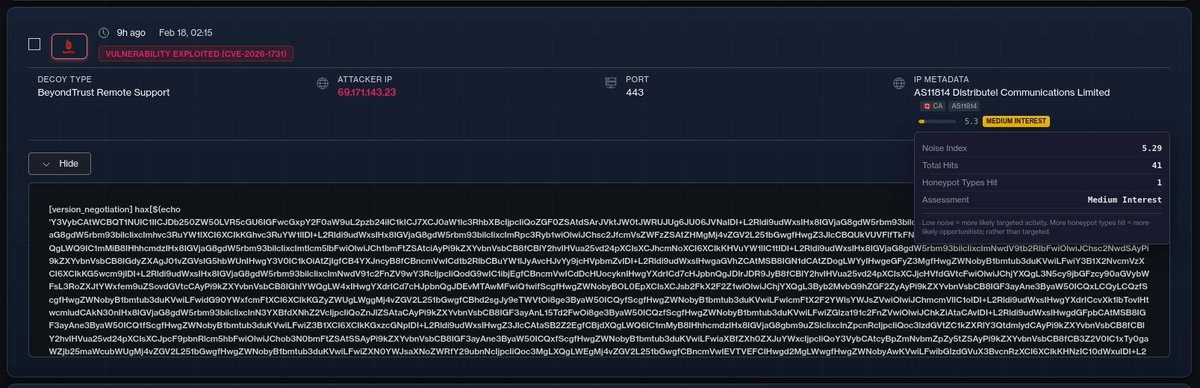
🚨 BeyondTrust CVE-2026-1731 exploitation remains low in volume but weighs more on deliberate target selection rather than opportunistic mass scanning
In the screenshot example, the actor has been enumerating and exploiting vulnerable BT instances during the past week on multiple occasions, running:
Full system fingerprint - validates the target is real and worth pursuing (virt detection, serial number, security controls)
Security posture enumeration - SELinux/AppArmor/firewall check
Living off the land techniques - pure bash, no binaries dropped, uses built-in tools only
External IP exfil - maps your network egress for follow-on targeting
The seen pattern is suggestive of Initial Access Broker (IAB) methodology, wherein threat actors systematically profile and catalogue exploitable targets for subsequent sale or utilization in more comprehensive intrusion campaigns.
Some IP-based IOCs:
69.171.143.23 Distributel Communications 🇨🇦
37.120.213.10 M247 Europe SRL 🇨🇭
173.44.62.141 ColoCrossing 🇺🇸
192.166.82.32 CloudBlast LLC 🇺🇸
96.44.141.148 ColoCrossing 🇺🇸
64.188.29.14 ColoCrossing 🇺🇸
174.138.219.108 Distributel Communications 🇨🇦
104.28.210.247 Cloudflare, Inc. 🇻🇳
146.70.139.154 M247 Europe SRL 🇩🇪
212.104.215.145 Datacamp Limited 🇨🇦
Monitor the latest threat intelligence in real-time 👉 console.defusedcyber.com/sig…
1
3
23
139,508

29 Jun 2025
Hello,X. do not take this into account. I had a power outage. When I plug in, the IP address changes. With Distributel, it does this. Every time I plug in, the IP address changes. For more information, to find out if it's me, Mario Pelletier
1
5
134


28 Jan 2025
Distributel propose une offre à l'occasion du Super Bowl 🏈 pour un forfait internet fibre 500 Mbit/s à 44,95 $/mois 💻. Cette offre inclut l'installation et l'activation gratuites ainsi que l'équipement sans fil 📶.
L'offre prend fin le 2 février 2025 ⏳.

65

7 Jan 2025
#ODSPoverty unexpected overcharge on my distributel bill has left me strapped for at least the next 2 days, possibly until the climate cheque on the 15th. can anyone help me? ODSP does not provide enough for any kind of emergency like ISP overcharges Paypal.me/m3l1c1ou5
7 Jan 2025

...they're going to refund the $60 in fees to my account in 2 business days. but in the meanwhile i now have $20 left in my account to live off of for at least 2 days. 😨😭
5
3
235
7 Jan 2025
On hold with Distributel because I just found out from my bank they overcharged for my bill--the new service I signed up for in December was supposed to be cheaper
1
2
56

23 Jul 2024
We've never gone more than a few hours without internet and we've been switching between Rogers, Bell, and Distributel for the last few years, depending on which one gives the better deal.
5
2
139


22 Apr 2024
Here's a free resource.
freecarrierlookup.com/
If you see IRISTEL or DISTRIBUTEL as the carrier, it's an app. If you see other carriers it's legit, but if you see Rogers, there's a possibility that its one of those pay as you go 711 burner sims.
132

13 Apr 2024
Wouldn't they be doing this indirectly via Distributel and other "resellers" which they acquired?
1
1
26

Friends and neighbours
CUT the cord with Bell Rogers Telus, I have Distributel for TV and the US stations are open
Oh and it' about half the price with the same speed 100 Mbps
12 Feb 2024

So why can't I see awesome American Super Bowl commercials and have to watch dollar store garbage Canadian garbage?
2
1
8
577

9 Feb 2024
.@OpenMediaOrg how can @CRTCeng allow @Primus4Home (@Distributel) to incr prices 18% since 2021 & say last wk hardwire landline srvc (active thru Nov2023) will be cont'd if I pay ($$$) & this wk suddenly say they won't &escalatn not avail "4U" & also ask me what #AODA is? TY. 9/x
1
3
48

26 Jan 2024
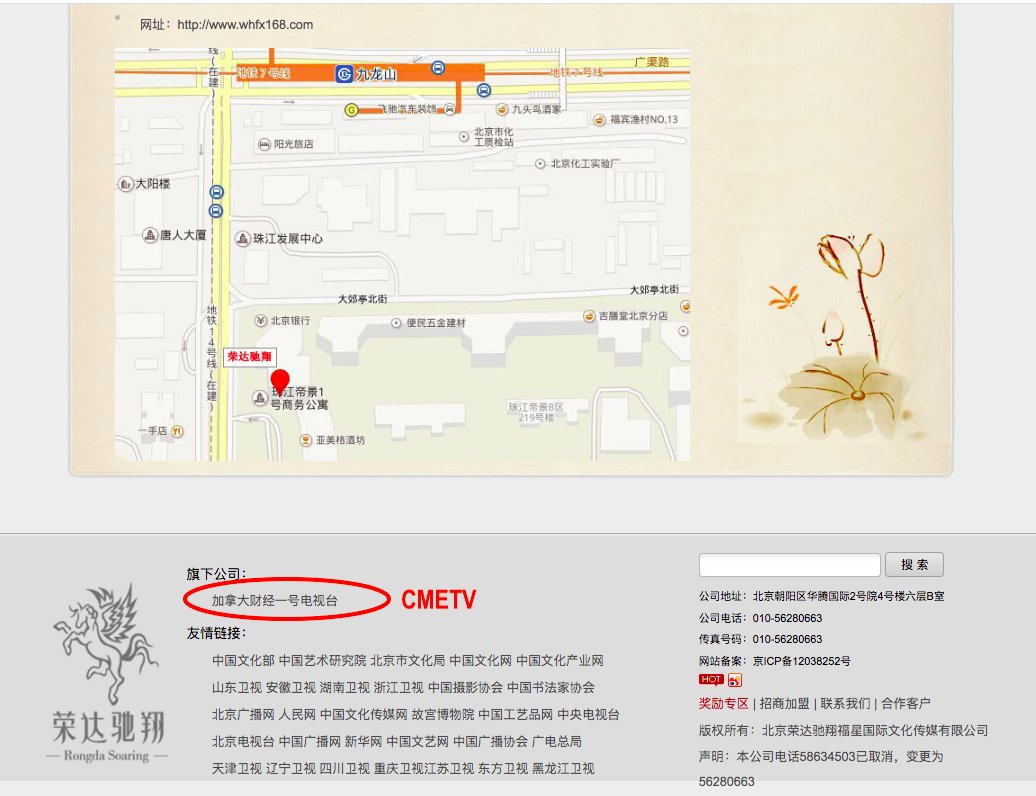
Canadian Mandarin Economics Television (CMETV) is a Beijing-based media outlet. It has a partnership with CCTV, and the Distributel Group owns 15% of it.
todaycommercialnews.com/m/ca…



1
9
17
2,535
6 Dec 2023
Hi X there is lots of snow in the trees and it falls on the electric wires. I don't want to lose my account. @mario pelletier5 distributel phone change ip each time i open my computer a have full électricité panne sorry mario pelletier

1
1
6
156

1 Nov 2023
Bell Said to Axe Distributel Wholesale Broadband Services: Memo iphoneincanada.ca/2023/11/01…

3
3
1,419

21 Jul 2023
@Distributel Day 8 of no phone service. An 8 day techincal "glitch"? Technical support puts you on hold for hours but the recorded message states that they thank us for our patience during the outage. I'm switching after 25 years. Shit service since Bell bought you.
1
1
132

23 Jun 2023
We’re shocked to hear @TekSavvyBuzz is up for sale! They are an industry leader in fighting for #TelecomCompetition and the largest independent ISP left standing after the acquisitions of @startca, @EBOX_CA, @Distributel, @vmedia, @AltimaTel, Oxio and more. 1/3
1
3
3
413

23 Jun 2023
#Distributel - #internet - #Complaint
The independent Commission for Complaints for Telecom-television Services (CCTS) may be able to assist you free of charge: ccts-cprst.ca or 1-888-221-1687.
Telecom-television Services (CCTS)
ccts-cprst.ca
#Ontario #ISP
1
2
102