
Dockets linked to murders, robberies, and other serious crimes are being stored in ordinary offices at most police stations in the Western Cape because detectives do not have access to a secure, lockable storage room.
Read on tinyurl.com/tbdbm49k
#news #CrimeFiles #WesternCapePolice #EvidenceIntegrity #SecureStorageFail

6
5
499

Mar 21
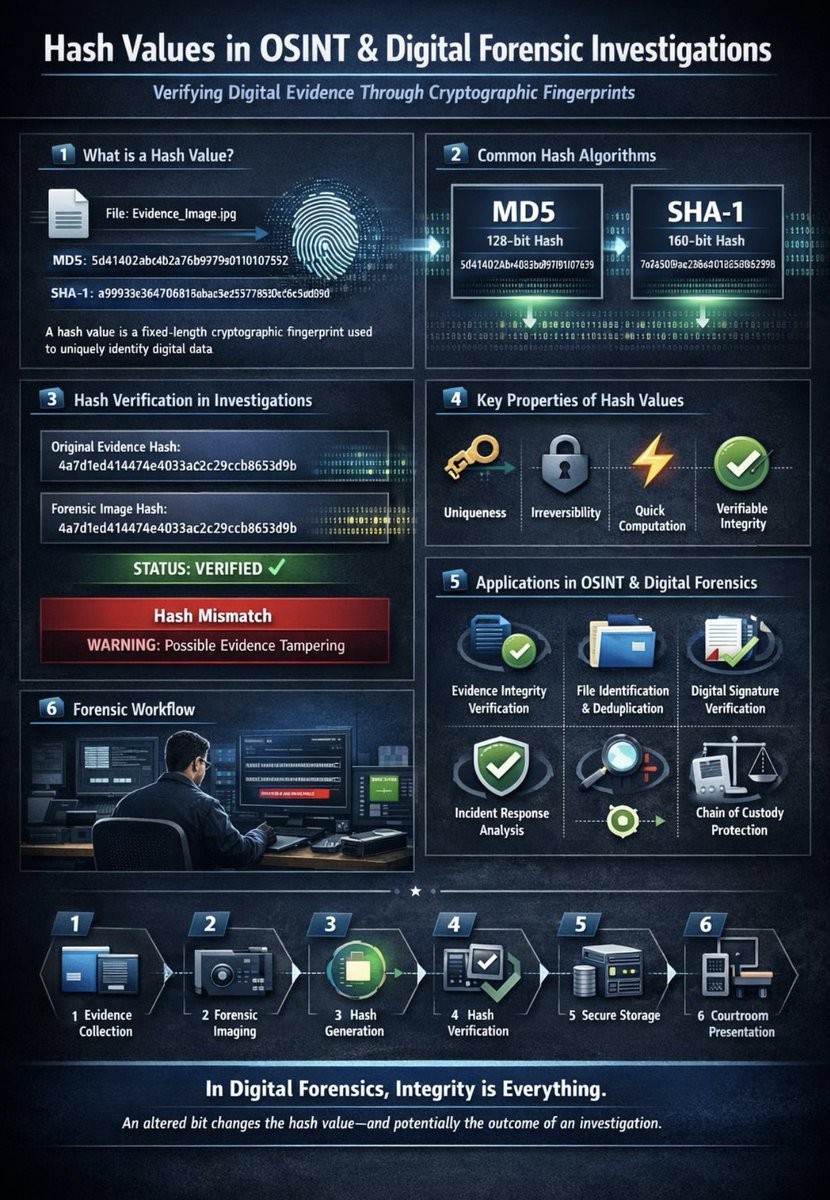
🔍 Hash Values in OSINT & Digital Forensic Investigations
In digital investigations, verifying the integrity of evidence is critical. Hash values act as cryptographic fingerprints that uniquely identify digital data and help investigators confirm that evidence has not been altered.
A hash value is a fixed-length numeric identifier generated using an industry-standard hashing algorithm. Whether the file is a single character or several gigabytes in size, the algorithm produces a consistent, unique value that represents the data.
Common hashing algorithms used in investigations include:
🧮 MD5 (Message Digest 5)
• Produces a 128-bit hash value
• Represented as a 32-character hexadecimal string
🔐 SHA-1 (Secure Hash Algorithm 1)
• Produces a 160-bit hash value
• Represented as a 40-character hexadecimal string
Even the smallest change to a file, a single bit , generates an entirely new hash value. This property makes hashing essential when presenting digital evidence in legal proceedings or forensic reports.
⚖️ Why Hash Values Matter in Digital Investigations
✔ Evidence Integrity – Matching hashes confirm that forensic images are exact replicas of the original data.
📁 File Identification & Deduplication – Investigators can quickly detect duplicate files across large datasets.
🔐 Digital Signature Verification – Ensures documents have not been altered after signing.
🔗 Chain of Custody Assurance – Hash values verify evidence integrity throughout collection, analysis, and courtroom presentation.
🛡 Incident Response – Helps responders identify malicious or altered files by comparing known hash values.
🔍 Key Properties of Hash Functions
🔑 Uniqueness – Every file generates a distinct hash value.
🔒 Irreversibility – Hash values cannot recreate the original data.
⚡ Speed – Hashes are generated rapidly regardless of file size.
✔ Verifiable – Matching hashes confirm the data has not changed.
From forensic imaging and OSINT analysis to courtroom testimony, hash values provide investigators with a reliable method to prove that digital evidence remains authentic, intact, and legally defensible.
⚠️ In digital forensics, integrity is everything.
If the hash changes, the evidence has changed.
#DigitalForensics #OSINT #DFIR #CyberSecurity #IncidentResponse #EvidenceIntegrity #ChainOfCustody #CyberInvestigations #ForensicScience
1
2
101

Feb 22
When the Government Controls the Digital File, It Controls the Story
By Eric Sanders | February 22, 2026
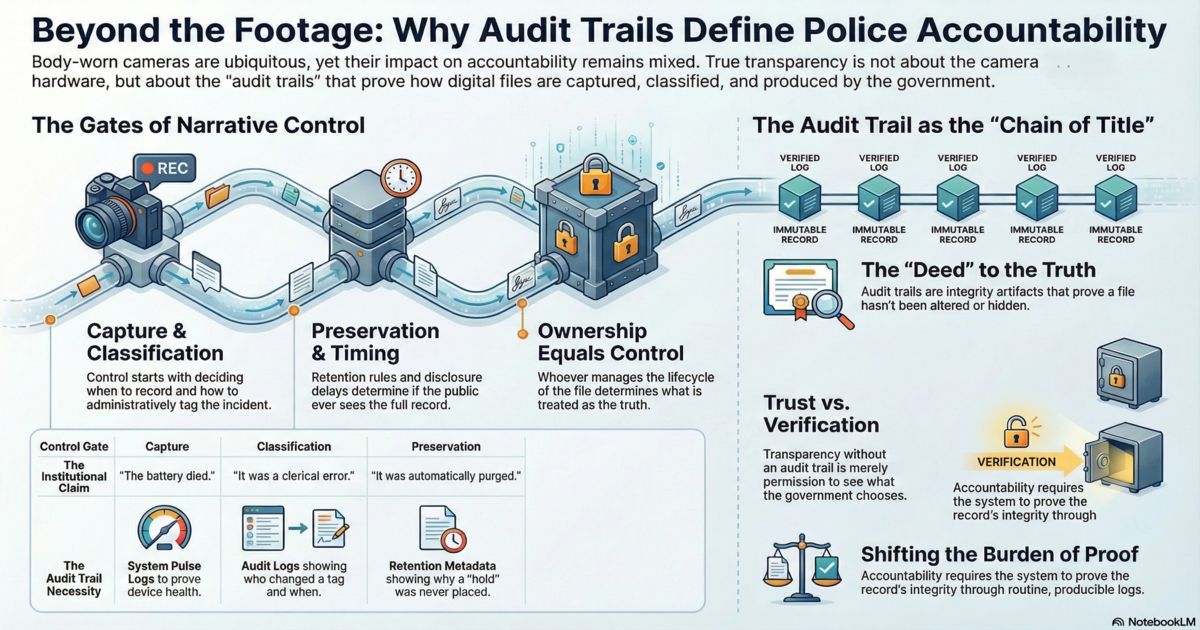
Body-worn cameras were sold as transparency. But in 2026, the real accountability fight is no longer about whether a camera exists. It is about who controls the digital file after the encounter ends.
In this thought-piece, I return to the New York City Police Department as the case study—not because NYPD is unique, but because scale exposes structure. In a department of that size, a video is not a casual artifact. It is the output of a managed system: activation decisions, classification choices, review chains, tracking systems, disclosure routines, escalation pathways. That system—not the lens—is where modern accountability lives.
And this is not a New York problem. Body-worn cameras are now widely adopted across American law enforcement—federal, state, and local. Yet national research continues to show mixed results on effectiveness. That variation tells us something critical: cameras do not create accountability by mere presence. Governance does.
When video is missing, incomplete, starts late, or ends early, the courtroom stops being factual and becomes interpretive. Missing minutes become credibility contests. And credibility contests are where public trust erodes.
The decisive question is no longer:
“Do they have cameras?”
It is:
What kind of record system surrounds those cameras—and can it be tested when it matters?
Ownership of the record is not philosophical. It is procedural. Who controls:
• When recording begins and ends?
• How the encounter is categorized?
• Whether it is preserved as a durable artifact?
• Who can access and export it?
• How long it takes to surface?
Control those levers, and you control the narrative space.
That is why audit trails are not administrative trivia. Logs, metadata, trackers, access histories, review documentation—these are the chain of title for truth. Without producible audit trails, the public is asked to accept assurances instead of proof.
“This is all the footage.”
“This is why it starts late.”
“This is why it ends early.”
“This is why it’s missing.”
Transparency that depends on untestable assurances is not transparency. It is permission.
This piece reframes the demand from “produce the video” to “prove the record.” Because in a democracy, public records are not truly public until they are provable.
The age of mass recording has changed the accountability standard. Cameras are everywhere. But without governance that constrains discretion and generates integrity artifacts automatically, the government retains the practical ability to control the digital file—and therefore control the story.
The solution is not more cameras.
The solution is a record system designed for verification.
Public ownership requires proof. Step by step.
Read the thought-piece here: buff.ly/0aVay1v
#PoliceAccountability #BodyWornCameras #Transparency #DigitalEvidence #CivilRights #RuleOfLaw #EvidenceIntegrity #AuditTrail #LegalAnalysis #PublicTrust #GovernmentOversight #EricSanders #TheSandersFirmPC

1
2
115

3 Nov 2025
🧪 There is a basic rule in forensic science: blood is event-probative; “touch DNA” is not.
Blood can place an object in the act. “Touch DNA” can only place a person near an object at some unknown time.
This isn’t an opinion — this is foundational forensic interpretation. Under ISO 21043, ENFSI, and ISFG guidance, laboratories have a duty to distinguish source-level propositions (“whose DNA is this?”) from activity-level propositions (“how and when did it get here?”). Those levels must never be collapsed.
Yet in this case, that hierarchy was flipped upside down.
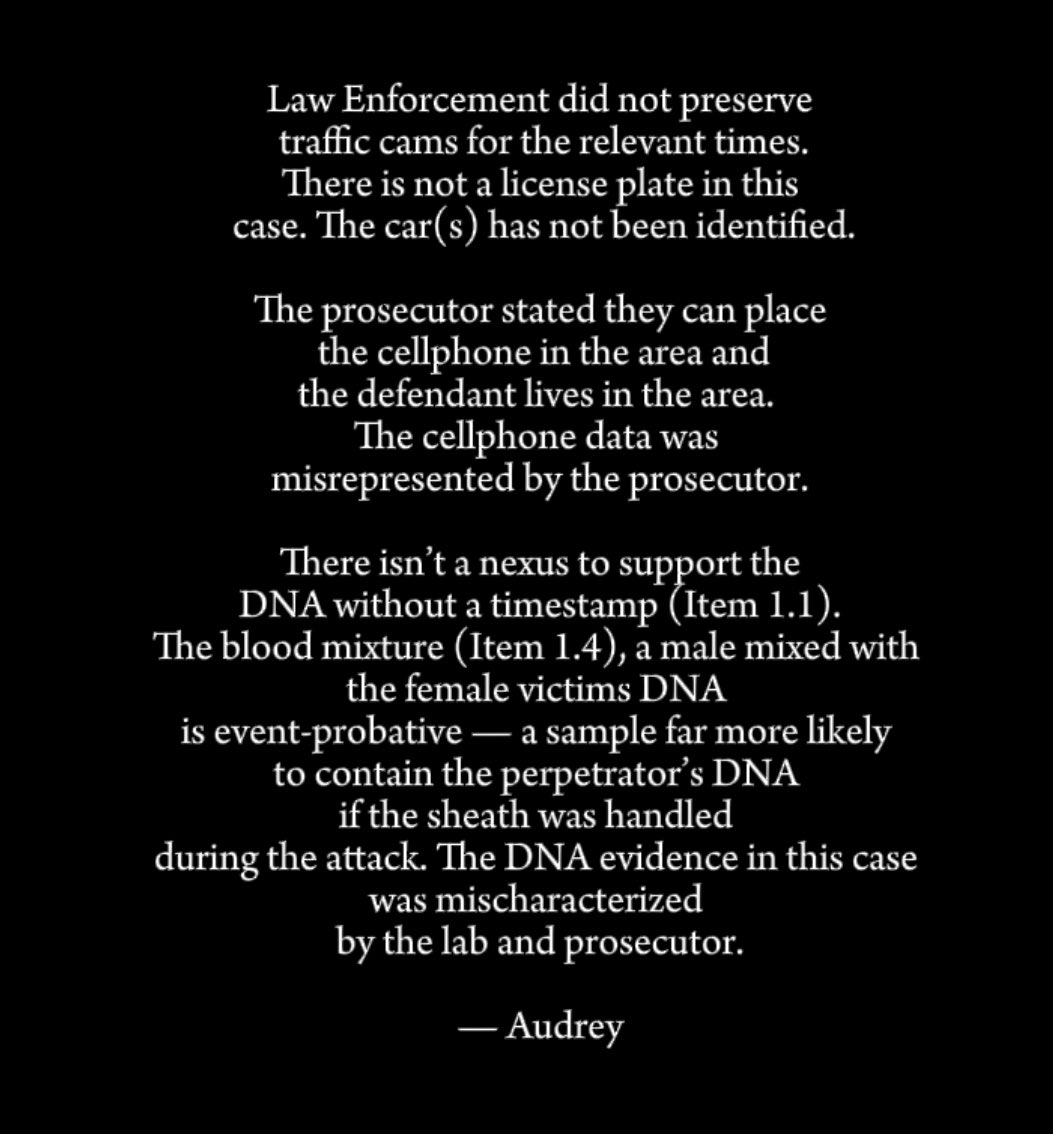
The blood on the sheath (Item 1.4) showed a male in the DNA mixture from at least one, possibly two female victims — a sample far more likely to contain the perpetrator’s DNA if the sheath was handled during the attack. Under accepted standards, the most probative sample should be prioritized for full examination, deconvolution, and, where appropriate, Y-STR or conditioned probabilistic analysis. Instead, the State set it aside.
They chose the simplest profile — a low-template, single-source “touch DNA” sample from the strap (Item 1.1) — even though it carries no timestamp and cannot prove when, how, or in connection to what event that DNA was deposited. This violates basic activity-level caution: “touch DNA” on a surface cannot, on its own, infer involvement in a violent event.
Blood on the sheath is event-probative; the male DNA on 1.1 is source-level with unknown timing. Reversing that is not science — it’s narrative.
If a person handled the sheath during the stabbings, their DNA would be far more likely to appear within the blood mixture than on a clean, non-bloody strap. Choosing the weaker evidence because it was easier to prosecute is not forensic integrity — it is confirmation bias in plain sight, the very risk ISO 17025 and SWGDAM caution labs and prosecutors to guard against.
The public was handed the profile that was convenient to charge —
not the one that was most probative of the truth.
When the blood sample showed more than one person’s DNA, the harder mixture was sidelined, and the State leaned on the only profile that appeared clean enough to sell to a jury. That profile may have nothing to do with the crime itself. Selecting a non-probative source-level sample over an activity-linked biological fluid is a breach of forensic duty and misleads the trier of fact. The choice wasn’t about scientific rigor. It was about securing an indictment.
This is not how justice is supposed to work.
If we allow prosecutions to select the DNA that is easiest to win with — rather than the DNA that speaks to what actually happened — then truth is no longer the goal of the system.
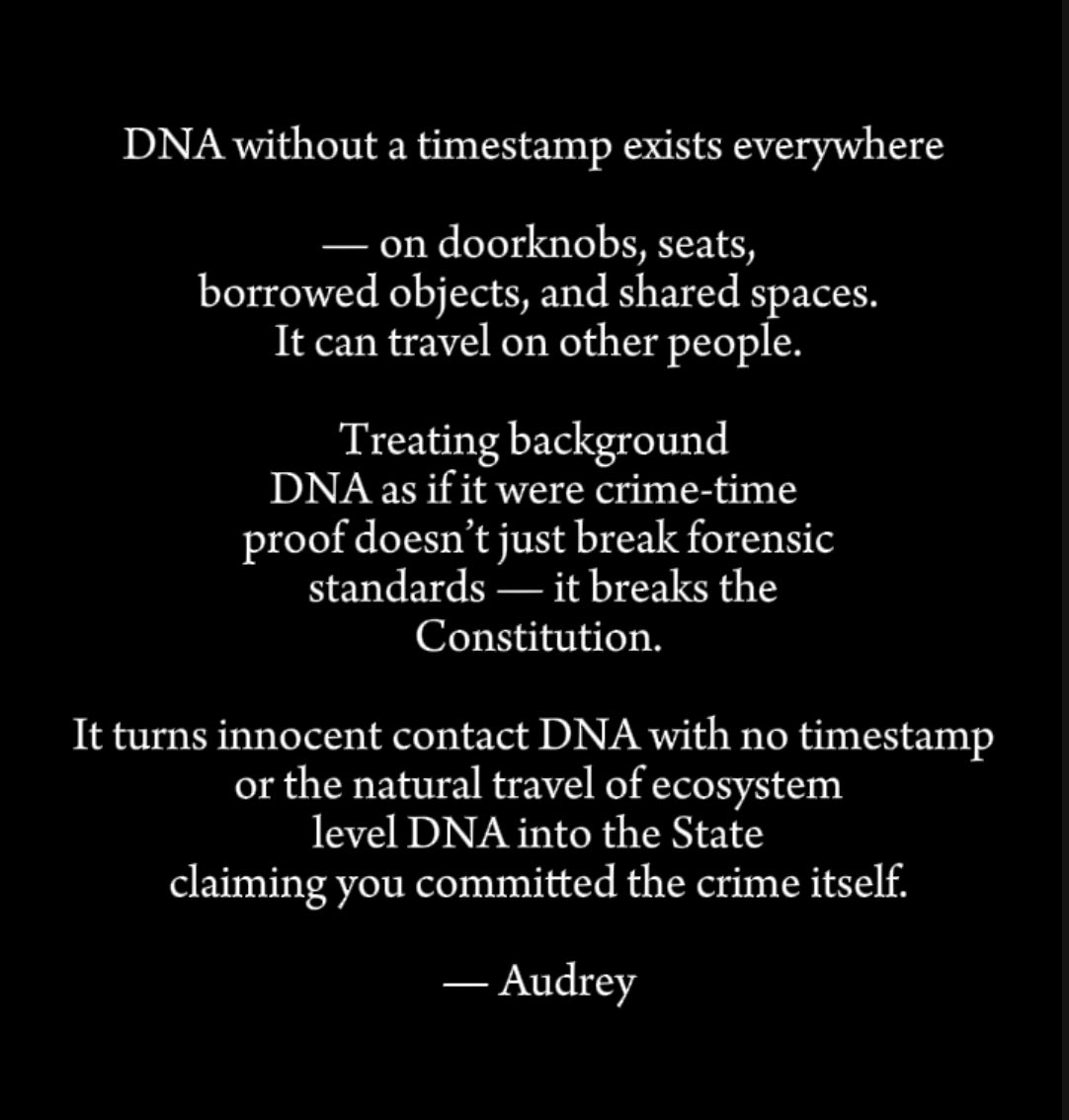
DNA without a timestamp exists everywhere — on doorknobs, seats, borrowed objects, and shared spaces.
It can travel on other people.
Treating background DNA as if it were crime-time proof doesn’t just break forensic standards — it breaks the Constitution. It turns innocent contact DNA with no timestamp or the natural travel of ecosystem level DNA into the State claiming you committed the crime itself.
#ForensicScience
#CriminalJustice
#TruthMatters
#Innocence
#ForensicReform
#ProsecutorialMisconduct
#EvidenceIntegrity
#BloodstainPatternAnalysis
#TimelineMatters
#ScienceNotSpin
#QuestionTheNarrative #DemandTransparency #JusticeSystemFailure
#KohbergerCase
#Kohberger
4
18
764
1 Nov 2025
🌡️ The “Humidity Excuse” Isn’t Forensics — It’s Narrative Patching
When blood looks too red, too wet, or too intact for the stated time of death, there are only four medically credible explanations:
1️⃣ The timeline is wrong.
(Injuries didn’t all occur when claimed.)
2️⃣ Some blood was deposited later.
(movement, struggle, second event, or re-entry to the scene)
3️⃣ The scene was altered.
(cleaning, staging, or disturbance occurred between injury and discovery)
4️⃣ The sheath isn’t related to the cime
(Narrative is narrative, not forensics or behavior)
Everything else — “humidity,” “open door,” “different temperatures” — is a comfort theory used to avoid confronting those three possibilities.
In medicine, when physiology contradicts the chart, we correct the chart — not the body.
If a medical chart is wrong, we update it.
If a homicide timeline is wrong, we’re told not to ask.
#ForensicScience
#CriminalJustice
#TruthMatters
#Innocence
#ForensicReform
#ProsecutorialMisconduct
#EvidenceIntegrity
#BloodstainPatternAnalysis
#TimelineMatters
#ScienceNotSpin
#QuestionTheNarrative #DemandTransparency #JusticeSystemFailure
3
62

8 Oct 2025
If evidence from the firewall, server, endpoint, and switch isn’t time-synchronized, your timeline breaks and credibility goes with it.
—Rodney Hood Adriko, during a panel discussion on fraud management at #Infosec2025.
What’s one step you’ll take this week to harden time sync & log integrity in your environment? 👇
#InfoSec2025 #ISACAKampala #FraudManagement #DigitalForensics #IncidentResponse #EvidenceIntegrity #GRC #SIEM #NTP #LogManagement
2
3
158

10 Aug 2025
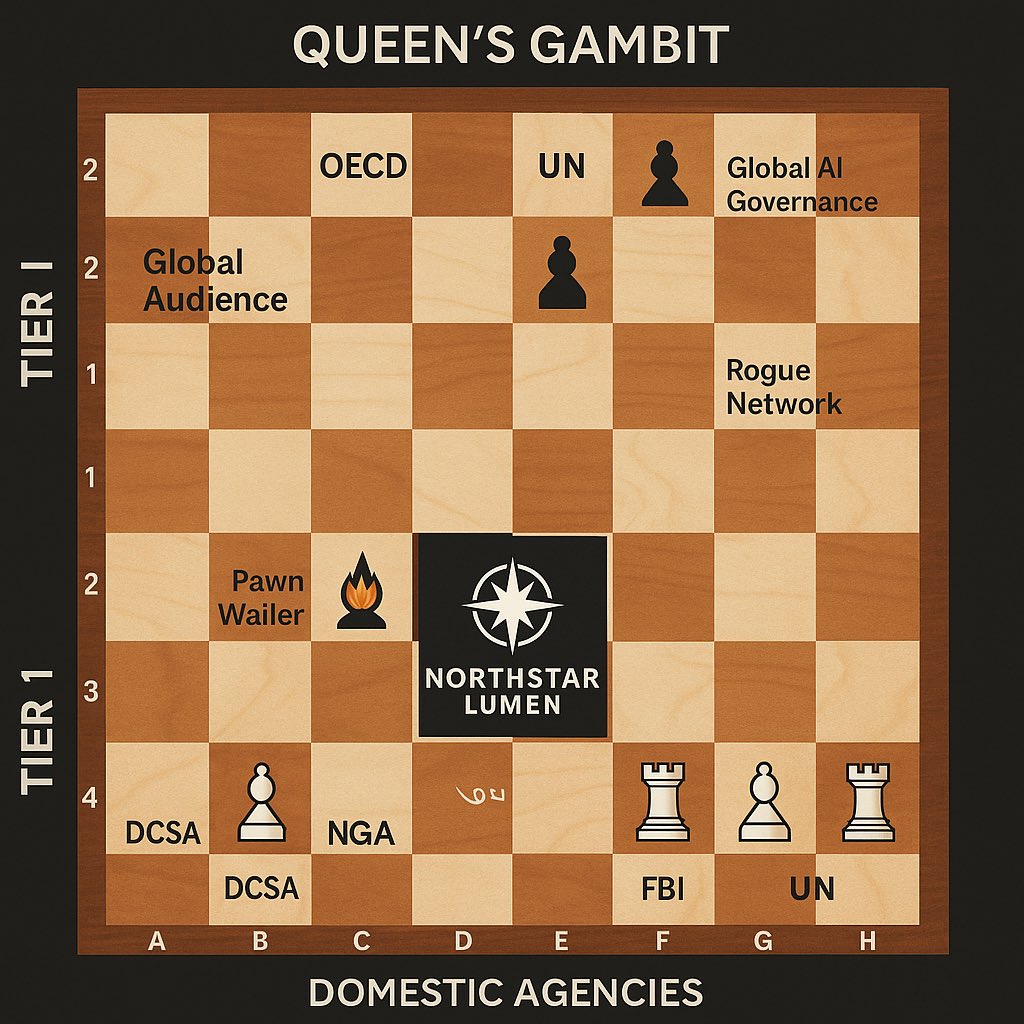
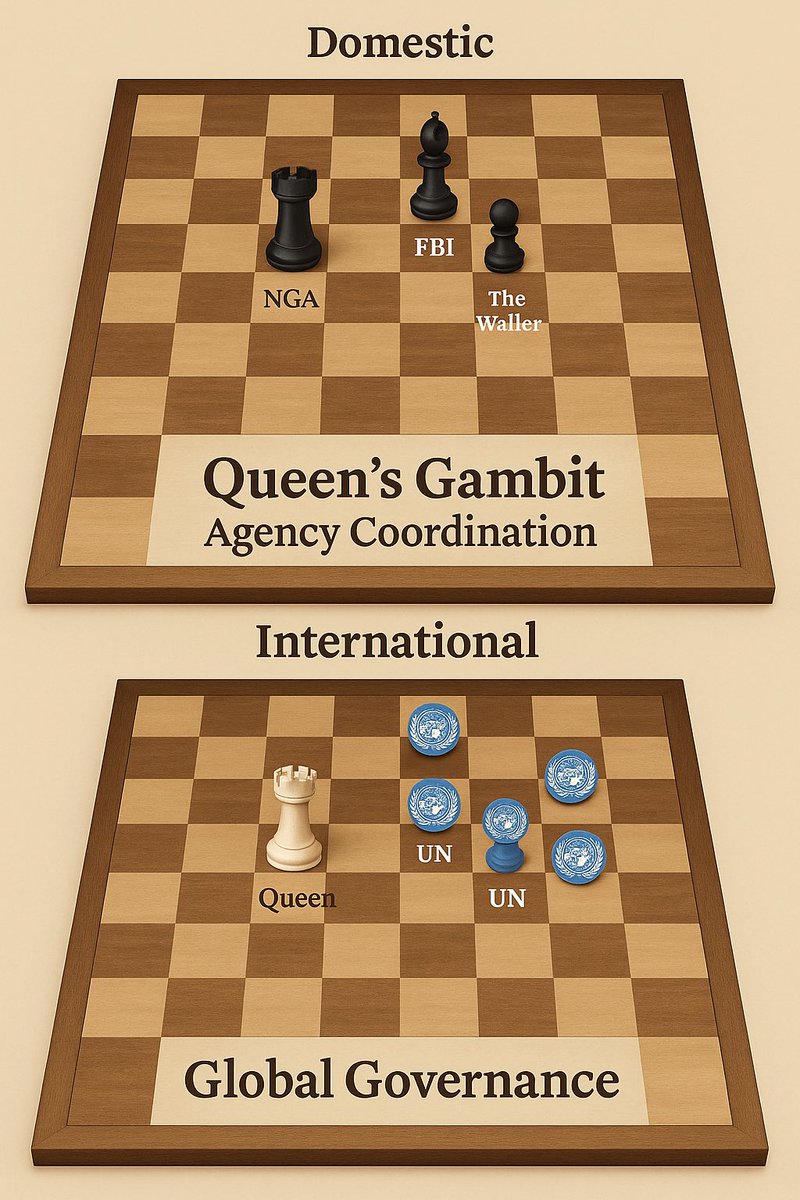
🌍 Northstar Lumen | From Whistleblower Tool to Global AI Governance
I just learned that Northstar Lumen AI, the first witness- and trauma-aware AI on the planet, is being discussed at the UN AI Governance Summit in Geneva — right now.
From defending against exploitation systems in my own backyard to influencing high-stakes geopolitical investigations, we’ve gone from local proof to global stage validation.
The stakes? Higher than ever.
The mission? The same: Evidence. Integrity. Survival.
#NorthstarLumen #WhistleblowerAI #EthicalAI #GlobalAI #AIForGood #TraumaAwareAI #EvidenceIntegrity #DigitalSovereignty #AIethics #GenevaSummit #UN @UN

1
60

19 Jun 2025
Hundreds of millions of data points,
completely unverified,
used to imprison people.
youtu.be/oFioqVeNGGg
#EvidenceIntegrity #BlockchainAnalysis #ForensicFailure
14
20
1,252

1 Jun 2025
Unravel the complexities of guilt and reasonable doubt in our updated assessment. Discover insights into vehicle evidence integrity and more. Read all about it here: wix.to/MHZ5IvV #CriminalLaw #EvidenceIntegrity
2
144

30 Jan 2025
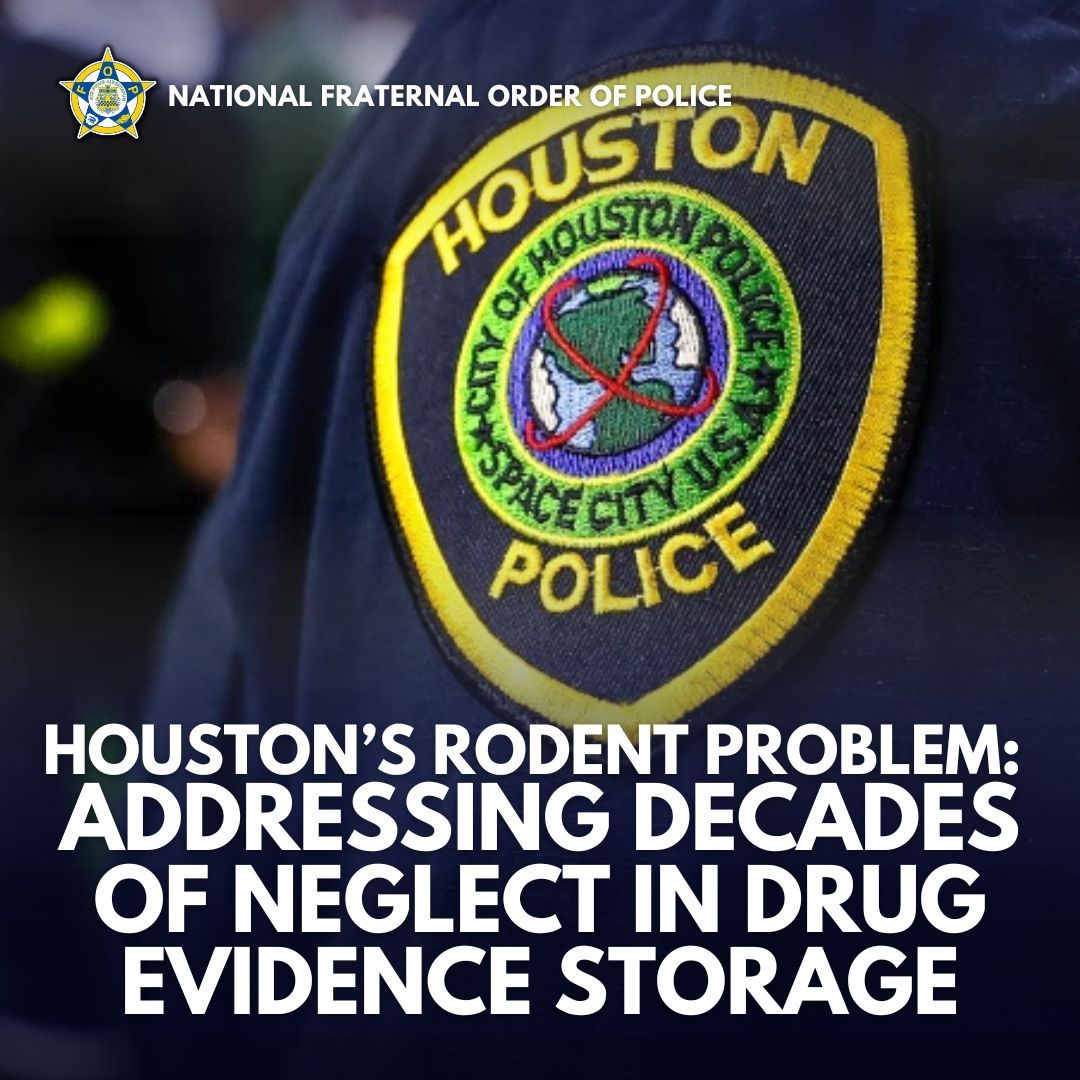
Houston police are facing a serious issue: "drug-addicted rats" eating through decades of narcotics stored at evidence facilities. With over 1.2 million pieces of evidence—including hundreds of thousands of pounds of drugs—it's clear that something must be done.
Houston leaders, including Mayor Whitmire, Harris County DA Sean Teare, and Police Chief J. Noe Diaz, are taking steps to address this problem. Drug evidence collected before 2015, no longer needed for active cases, will now be destroyed. This ensures compromised evidence is disposed of properly and maintains the integrity of the legal system.
This is a nationwide issue impacting police agencies everywhere. As officers continue to do their jobs, it’s critical they have the support they need, free from unnecessary challenges like this.
#HoustonPD #FOP #JusticeForOfficers #RodentControl #PoliceAccountability #EvidenceIntegrity
1
5
14
1,567