The wholesale deposit trap in India..
Faced with the deposit shortfall, Indian banks did what bankers typically do under pressure: they improvised. Over the past two years, banks have aggressively mobilized wholesale deposits — large-ticket certificates of deposit (CDs) and bulk fixed deposits typically placed by corporates, mutual funds, and other institutional investors. These deposits are easier to raise, faster to mobilize, and carry no branch overhead. They are also deeply problematic.
The IMF, in its Article IV consultation and Financial Sector Assessment Programme (FSAP) report for India in 2025, flagged systemic risks from concentrated deposit structures and wholesale funding reliance among NBFCs. The same logic applies, with some modification, to commercial banks. When a bank’s deposit book is dominated by a small number of large depositors, its vulnerability to liquidity stress increases dramatically. A handful of institutional depositors pulling funds — in response to a market event, a rating action, or simply a better rate elsewhere — can create an outflow event of a magnitude that retail deposit bases rarely produce.
As per the latest data, 0.05% accounts hold ~35% of India’s term deposits. All these deposits are Rs5cr and above. Deposits of Rs1cr and above are now ~46%. Moreover, Term deposits paying below 7% are now up at ~62% from ~27% a year earlier.
The concentration problem is further compounded by the incentive structure. Wholesale depositors are rate-sensitive and relationship-agnostic. They move quickly and in large sizes. Banks that have used wholesale deposits to bridge the CD gap have, in effect, borrowed structurally short to lend long. This is the classical maturity mismatch that precedes funding crises. The risk is not imminent, but it is real and growing. The RBI has taken note.
A material rise in yields in alternative sources could potentially see a sharp deceleration in the bank’s deposit base.
5
15
2,771

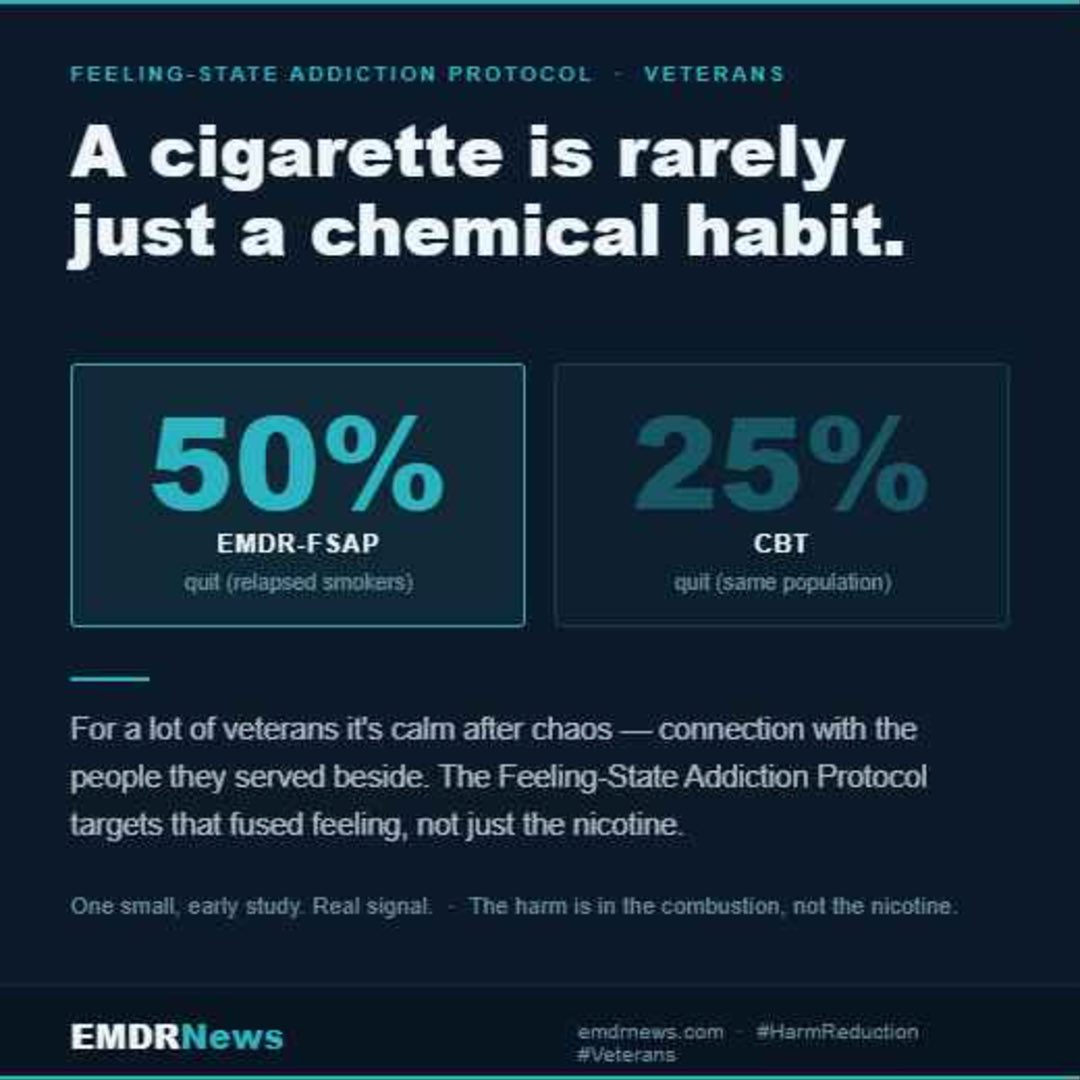
Getting Veterans and adults away from cigarette smoke is a sure-way to save lives. EMDR can help do that.
#veterans #tobaccoharmreduction #FSAP #EMDR
1
41


Jun 12
Sources/context:
ODNI’s June 12, 2026 release says Gabbard identified U.S. funding for more than 120 overseas biolabs in 30 countries, including Ukraine. That establishes U.S. funding/support, not the conclusion that they were U.S.-run bioweapon labs.
dni.gov/index.php/newsroom/p…
FSAP’s 2024 annual report lists 230 registered U.S. entities handling select agents/toxins; the FSAP infographic gives the entity-type breakdown used in the first graphic.
selectagents.gov/resources/p…
selectagents.gov/resources/p…
CDC’s FSAP fact sheet says the program regulates possession, use, and transfer of select agents/toxins and allows lifesaving research while requiring it be done safely and securely.
stacks.cdc.gov/view/cdc/1400…
Most of us live within 100 miles of a 'biolab'.
cdc.gov/laboratory-response-…
DoD/DTRA’s Ukraine BTRP fact sheet says the program has partnered with Ukraine since 2005, invested about $200M, supported 46 Ukrainian labs/health/diagnostic sites, and improved biosafety, biosecurity, and surveillance for human and animal health.
media.defense.gov/2022/Mar/1…
/end
2
41
Jun 12
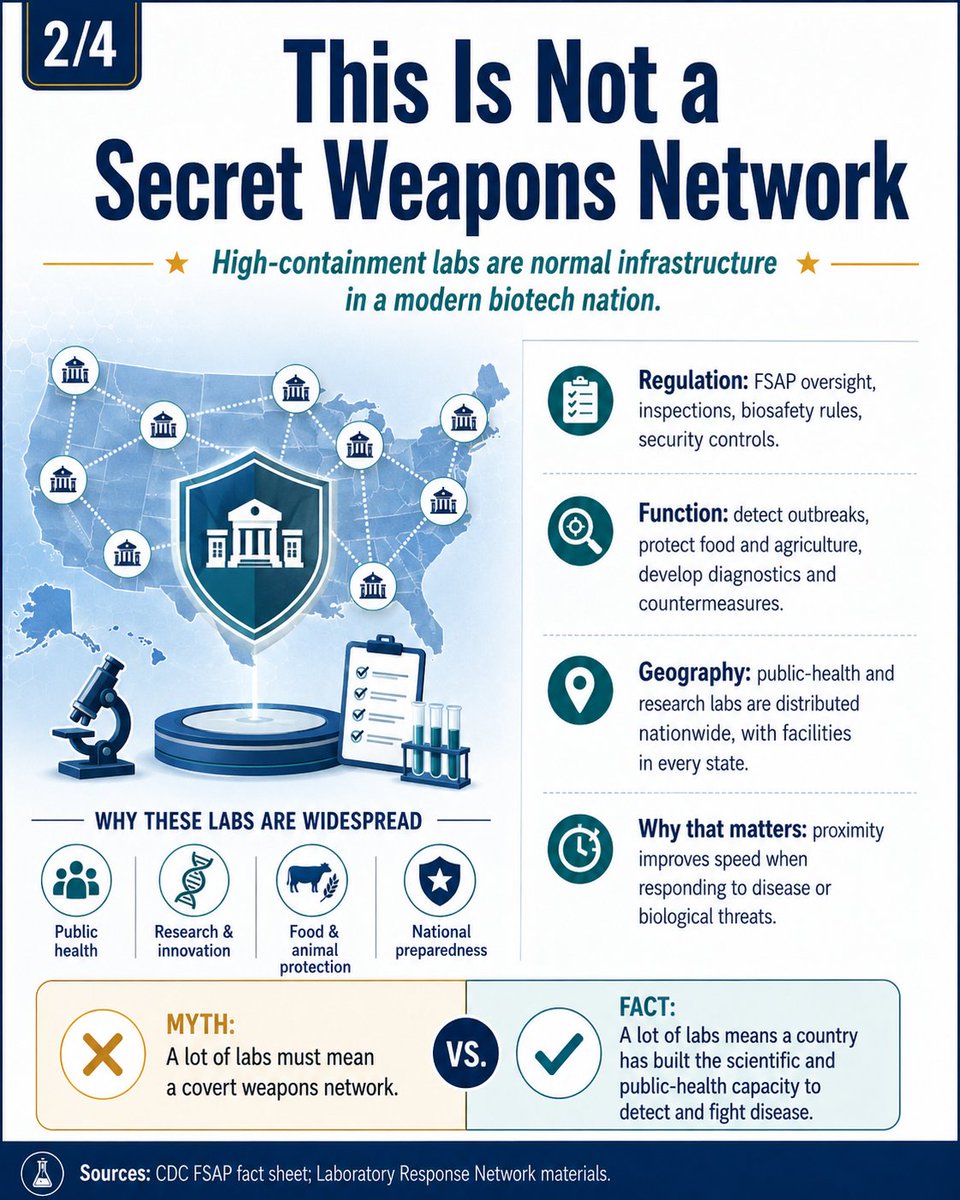
The conspiracy version depends on people not knowing how normal this infrastructure is.
In 2024, the U.S. had 230 FSAP-registered entities handling select agents/toxins. Academic, state/local, commercial, federal, and nonprofit labs all appear in that system.
The CDC currently says 84% of Americans live within 100 miles of a Laboratory Response Network lab; earlier congressional testimony put the figure at about 90%. Of course, if you consider all the other types of lab the CDC did not put into their figure, the percentage of people living within 100 miles of a 'biolab' is much higher.
No sane person believes the US has a secret weapons network.
This is simply what a country builds when it wants to detect anthrax, avian flu, foot-and-mouth disease, or a dangerous outbreak before it spreads.
Lots of labs ≠ lots of weapons.
Lots of labs = lots of detection capacity.
/2
1
2
63

Jun 10
.80 only in the smoothest of air. Filling out an FSAP for setting off the clacker is downright humiliating.
3
120

Jun 8
Conférence-débat : L’Union européenne à l’écoute de la jeunesse
Rejoingnez-nous pour une conférence-débats sur le thème : Participation citoyenne, information responsable et cohésion sociale le 10 juin 2026 à la FSAP à 10 heures.
ENTREE LIBRE!
#Kafo

3
7
282


May 26
Food security is no longer just an agriculture discussion. It is now a logistics discussion. An energy discussion. A fertiliser discussion. A geopolitics discussion. And increasingly, a working capital and inventory discussion.
This week alone: 44 fertiliser vessels stranded around Hormuz, China restricting urea exports, Qatar halting production, global freight costs surging, rice production risks increasing across Asia, and African countries remaining heavily dependent on imported fertiliser and food supply chains.
The result? The world is quietly moving toward another food cost shock.
The institutions, manufacturers, millers, wholesalers, retailers, NGOs, governments, hotels, hospitals, and large consumers that survive and outperform during these cycles will not necessarily be those with the most money.
They will be the ones with: secured supply, buffer stock, structured procurement, protected pricing, and inventory visibility.
This is exactly why we built the HOP GLOBAL Food Supply Assurance Program (FSAP).
Our model is simple: We buy. We secure the stock. We hold it here for you. You pick when you need.
And you never pay above the prevailing best average market price — often lower through aggregation and structured procurement.
No panic buying. No supply shocks. No unnecessary working capital pressure. No scrambling during crises.
Just structured, visible, dependable supply. Because in the next global cycle, the winners will not be those searching for stock. They will be those who already secured it.
Benard ODOTE
The Thinking Rhino 🦏 | ONAGI ODOTE
House of Procurement Global

2
42

May 19
She knowingly violated 14 CFR Part 121 numerous times, then tried to save her job using a safety reporting system when she realized the video was on social media. The FSAP system provides no protection when the violation was intentional. End of story.
1
4
275
May 18
Non-employee in cockpit/pilot seat with consent of CA/FO. Photo taken, put on social media. These charters are under Part 121. Numerous violations here.
Crew uses FSAP to avoid termination. Acts are intentional, FSAP not applicable.
Seriously, please tell me what I missed.
1
7
895
What if we bought @AIRTEL_KE?
Would Kenyans finally feel: “This one is ours too.”
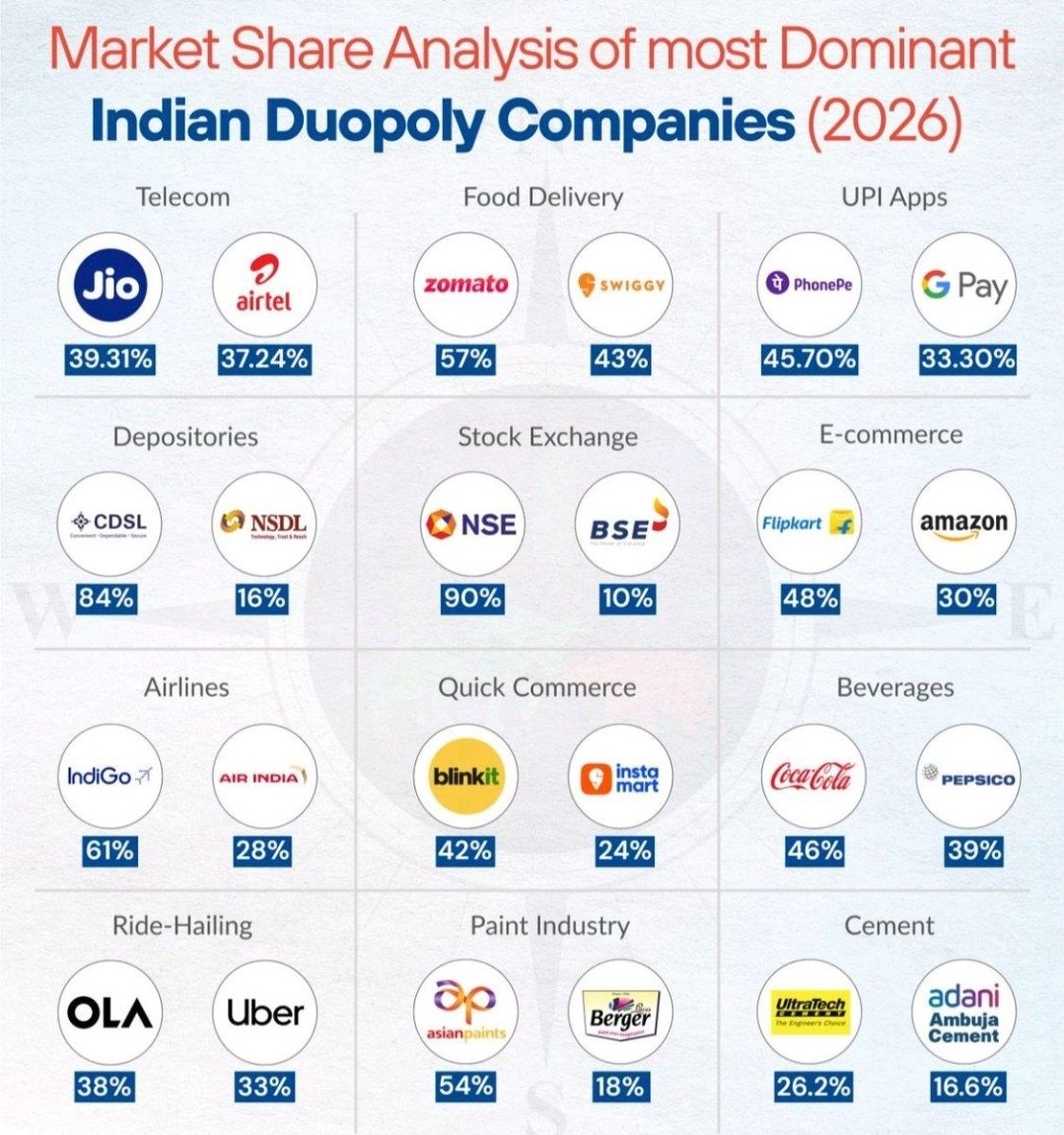
And if we acquired 50.1%… could we now create a true duopoly similar to India’s Jio vs Airtel dynamic?
Not just in telecoms. But across the entire flow of daily life. Because the future is no longer about SIM cards alone.
It is about who controls:
- payments,
- utilities,
- healthcare,
- food systems,
- commerce,
- SME supply chains,
- merchant rails,
- collections,
- data,
- and everyday affordability.
Safaricom understood this early. That is why it became more than a telecom company. It became infrastructure.
But there is now a massive opening in Kenya: Millions of people and businesses desire a credible alternative — economically, operationally, psychologically, and sometimes politically.
The mistake would be trying to “fight M-PESA.” No. You integrate with it. Flow with it. Use it. Alongside Airtel Money. Alongside BEFOREPAY. Alongside banks. Alongside merchants.
Then quietly build a lower-cost economic operating system around the customer.
Imagine this ecosystem:
- Q-GRID™ | Smart Utilities Aggregation Platform reducing electricity, water, gas, and internet costs,
- GET DEALS | BEST PRICES. NEARBY. EVERYDAY. lowering household and SME shopping costs,
- UZIMA MedGuard ➕️ Yodawy reducing healthcare costs and access friction,
- FSAP ➕️ The Trade Financial Solutions & Equipment Group (TFSEG) stabilizing food supply, aggregation, raw material access, and affordability,
- MAPATO MAX | Built for Hustlers SME procurement and distribution rails,
- embedded merchant finance,
- landlord ecosystems,
- utility-backed affordability systems,
- agriculture aggregation and supply assurance,
- and Airtel becoming the infrastructure layer connecting all of it.
Now Airtel is no longer “the second telecom.”
It becomes: The second national economic infrastructure platform. That changes perception completely.
India’s @reliancejio did not become powerful because of data bundles alone. It became powerful because it embedded itself into:
- commerce,
- payments,
- retail,
- distribution,
- affordability,
- and the daily economic behavior of ordinary people.
Kenya is approaching the same inflection point.
Personally? I think this is big enough for a @NSE_PLC SPAC-level acquisition and ecosystem play.
Not to replace what exists. But to create a true alternative infrastructure layer that lowers the cost of living and the cost of doing business at scale.
The future winners will not simply own networks.
They will orchestrate economic life itself.
The Thinking Rhino (TTR) 🦏 | ONAGI ODOTE
@TheODOTEGroup @hopinafrica @GetDeals_Daily
1
6
117

May 4
Lijst van Bronnen:
-- Eerste onderzoek (HRA kosten, kapitalisatie, geschiedenis): --
CPB — Vergrijzingsstudie, woningmarktdoorrekeningen, Keuzes in Kaart 2027-2030
CBS — Eigenwoningbezit, huizenprijsindex, hypotheekschuldcijfers
DNB — Hypotheekmarkt dashboard, Occasional Studies 13-2 (2015) en 15-1 (2017), Financial Stability Report
DNB — Eijsink & Van Dijk (2023), Borrowing capacity and house prices
IMF — FSAP Country Report 24/171 (2024), Article IV 2018, Article IV 2025
OECD — Economic Survey Netherlands 2025 (woningmarkt fiscaal hoofdstuk)
OECD — Affordable Housing Database (HM1.2, HM1.3)
OECD — Johansson & Sánchez (2011), housing supply elasticity ranking
BIS — CGFS Paper No 69, Macroprudential policies Netherlands
ESB — Verheuvel (2025), budgettair belang HRA
ESB — Bijlsma, Rougoor & Verheuvel (2021), lange-termijn projectie HRA
ESB — Swank & Van der Windt (2025), afschaffing voor nieuwe leningen
ESB — Bezemer (2025), kapitalisatie-effect
ESB — Gradus (2024), Kabinet-Schoof en EU RRF-commitment
ESB — Van Denderen (2025), vermogensongelijkheid
ESB — Toussaint et al., ongelijkheidsanalyse
Damen, Vastmans & Buyst (2016), Journal of Housing Economics
Damen & Goeyvaerts (2021/2023), Housing Market Responses to the MID
Rouwendal & Damen (2024), SSRN, Flemish-Dutch border municipalities
SEO (2019) — Evaluatie doeltreffendheid en doelmatigheid eigenwoningregeling
IBO Vermogensverdeling (2022)
Hilber & Turner (2014), CPB seminar, MID and homeownership
Glaeser & Shapiro (2002), MID effects US
Hassink & Van Leuvensteijn (2007), mortgage market competition
Hochstenbach & Aalbers (2023), tenure wealth gap
Korevaar (2024/2025), Instituut voor Publieke Economie, eigenwoningforfait
Parlement.com — Hypotheekrenteaftrek: een woelige geschiedenis
Historisch Nieuwsblad — Geschiedenis van de hypotheekrenteaftrek
Ministerie van Financiën — Miljoenennota 2026, Annex 4.3
Nextens — Fiscale regelingen €188 miljard
Hypotheker — €9,5 miljard belastingvoordeel 2024
Taxence / TaxLive — Kabinet verhoogt HRA hogere inkomens
EY — De toekomst van de huidige hypotheekrenteaftrek
Accountancy Vanmorgen — Doorrekeningen CPB fiscale observaties
Business Insider NL — Afschaffing HRA effect huizenprijs (CPB-samenvatting)
NL Times — OECD cutting mortgage deductions (juli 2025)
NL Times — Scrapping MID cost new homeowners €5,000/year
Rabobank — Housing Market Quarterly 2024
Statista — Netherlands mortgage debt 2012-2023, homeownership Europe
Trading Economics — Netherlands household debt to GDP, home ownership rate
Wikipedia NL — Hypotheekrenteaftrek (Nederland)
Rijksoverheid — Hypotheekrenteaftrek Q&A
HUD User — Why Germany Eliminated Large-Scale Subsidies (Cityscape)
Suerf — Measuring affordability for first time buyers (DNB)
NVB — The Dutch Mortgage Market (2014)
-- Tweede onderzoek (vergelijking BE/DE/FR): --
Eurostat — Homeownership rates 2024 (ddn-20260205-1)
Eurostat — Living conditions in Europe, housing (2024)
Eurostat — Housing in Europe 2025 interactive publication
OECD — Economic Survey Netherlands 2025, woningmarkt hoofdstuk
OECD — Economic Survey Netherlands 2025, fiscaal hoofdstuk
OECD — Affordable Housing Database HM1.2 (price-to-income, price-to-rent)
CPB — Keuzes in Kaart 2027-2030 (woningprijsmodel doorrekeningen)
CPB — Woningmarktdoorrekening 2021, Brede Maatschappelijke Heroverwegingen 2020
BIS — CGFS Paper No 69, Netherlands country annex
DNB — Hypotheekmarkt dashboard (LTV, interest-only share)
Damen & Goeyvaerts (2021/2023) — Housing Market Responses to the MID
Rouwendal & Damen (2024), SSRN — Flemish-Dutch border study
KBC (2021) — The housing market in the three Belgian regions
EMF Hypostat 2025 — Belgium country report
Statbel — Type of ownership Belgium
Deloitte — Property Index 2025 Belgium
ING Think (2021) — Outlook Belgian and Dutch housing markets
Wikifin.be — Woonbonus fiscaal regime per gewest
Notaris.be — De woonbonus: hoe zit de vork aan de steel
VRT NWS — Afschaffing woonbonus en huizenprijzen (2020)
Archyde — Flanders reduces registration fees to 3%
HUD User — Why Germany Eliminated Large-Scale Subsidies
The Local DE — Tax benefits for mortgage in Germany
Kaas et al. (CESifo 2017 / OUP 2021) — German homeownership simulation
Voigtländer (2009) — Why Germans do not own their homes
French-Property.com — French mortgage tax relief abolished (2011)
INED — Homeownership in France
INSEE — Housing stock January 2024
Global Property Guide — Netherlands residential property market 2025
Rabobank — Dutch Housing Market Quarterly 2025
CEIC Data — Netherlands household debt to GDP
Trading Economics — France/Netherlands home ownership rate
Eulerpool — Belgium/Netherlands home ownership rate
NL Times — Social housing wait average 7 years (2023)
NL Times — OECD cutting mortgage deductions (2025)
Housing Europe — Social housing data
Korevaar (2024/2025), Instituut PE — Eigenwoningforfait als alternatief
ESB — Swank & Van der Windt (2025), stop per direct
ESB — Kabinet-Schoof verhoogt HRA hogere inkomens
ESB — Kabinet-Jetten dreigt HRA verder te verhogen
Business Insider NL — Afschaffing HRA kosten effect
TaxLive / Wolters Kluwer — Doorrekening verkiezingsprogramma's CPB
Housingstandardisation.com — Netherlands housing system
Voronoi — Home affordability eroding OECD nations
4
521


Apr 26
They say MY PROBLEMS GON GET BETTER BUT It AINT SEEMING LIKE it AINT SEEMING LIKE IT……
2
38