
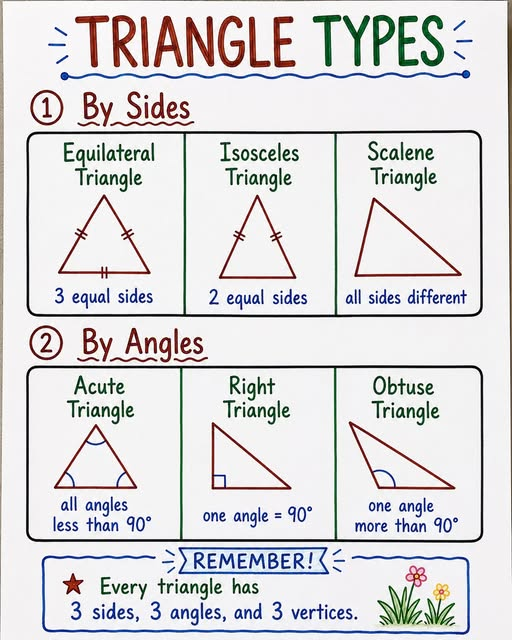
A useful geometry chart showing triangle types by sides and by angles. It explains equilateral, isosceles, scalene, acute, right, and obtuse triangles clearly.
#TriangleTypes #GeometryLearning #MathForStudents #StudyNotes #matheducation
1
1
3
162

13 May 2025
Piloting Structure-Based Drug Design via Modality-Specific Optimal Schedule
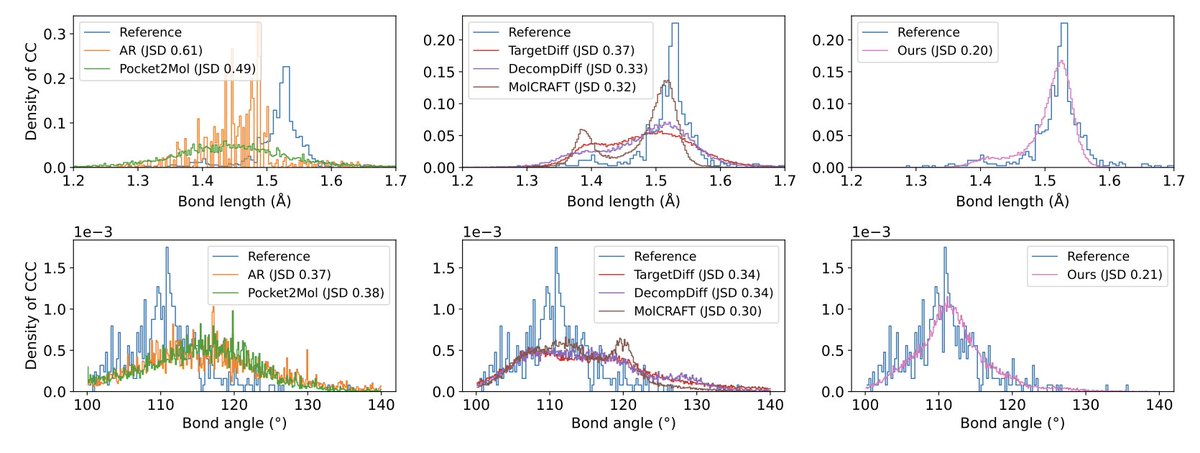
1.Structure-based drug design (SBDD) critically depends on accurately generating molecular geometries conditioned on protein pockets. Yet, deep generative models often fail to model the interdependence between 3D positions and 2D molecular topology.
2.This work introduces VLB-Optimal Scheduling (VOS), a principled strategy to design optimal noise schedules in multi-modality generation, maximizing the Variational Lower Bound (VLB) and improving molecular geometry and binding accuracy.
3.Key insight: In multi-modality generative models, VLB becomes a path integral, meaning it is dependent on the full trajectory of noise schedules—not just the endpoints. This breaks the common assumption from single-modality diffusion models.
4.The authors formalize the search for an optimal probability path in the joint noise schedule space and reduce the search complexity to a 2D rescaled time grid, allowing for efficient optimization via dynamic programming.
5.By training a single model with a generalized loss objective that spans the entire schedule space, they enable inference-time interpolation and extrapolation of noise schedules—eliminating the need for retraining.
6.The resulting model, MolPilot, achieves a state-of-the-art PoseBusters passing rate of 95.9% on CrossDock and maintains 79.1% on the challenging PoseBusters OOD benchmark, outperforming all tested baselines.
7.MolPilot also delivers superior binding pose quality, with 56.1% of generated molecules matching redocking poses within 2Å RMSD, close to the ground-truth redocking upper bound of 59.4%.
8.The method improves geometric accuracy, yielding better bond length and angle distributions (JSD scores), and higher structural validity in both in-distribution and out-of-distribution scenarios.
9.Ablation studies confirm both the generalized loss and optimal schedule independently and jointly contribute to improved VLB, better molecular conformations, and stronger protein-ligand interactions.
10.VOS is shown to be broadly applicable: integrating it into the diffusion-based TargetDiff framework yields significant improvements in pose quality and energy scores, demonstrating its flexibility beyond MolPilot.
11.This work not only sets a new benchmark for SBDD performance, but also proposes a theoretical and computationally efficient framework for future multi-modal generative modeling in chemistry and biology.
📜Paper: arxiv.org/abs/2505.07286
#MolecularGeneration #SBDD #MachineLearning #DrugDiscovery #GenerativeModels #DiffusionModels #BayesianFlow #GeometryLearning
2
3
1,744
13 May 2025
Piloting Structure-Based Drug Design via Modality-Specific Optimal Schedule
1.Structure-based drug design (SBDD) critically depends on accurately generating molecular geometries conditioned on protein pockets. Yet, deep generative models often fail to model the interdependence between 3D positions and 2D molecular topology.
2.This work introduces VLB-Optimal Scheduling (VOS), a principled strategy to design optimal noise schedules in multi-modality generation, maximizing the Variational Lower Bound (VLB) and improving molecular geometry and binding accuracy.
3.Key insight: In multi-modality generative models, VLB becomes a path integral, meaning it is dependent on the full trajectory of noise schedules—not just the endpoints. This breaks the common assumption from single-modality diffusion models.
4.The authors formalize the search for an optimal probability path in the joint noise schedule space and reduce the search complexity to a 2D rescaled time grid, allowing for efficient optimization via dynamic programming.
5.By training a single model with a generalized loss objective that spans the entire schedule space, they enable inference-time interpolation and extrapolation of noise schedules—eliminating the need for retraining.
6.The resulting model, MolPilot, achieves a state-of-the-art PoseBusters passing rate of 95.9% on CrossDock and maintains 79.1% on the challenging PoseBusters OOD benchmark, outperforming all tested baselines.
7.MolPilot also delivers superior binding pose quality, with 56.1% of generated molecules matching redocking poses within 2Å RMSD, close to the ground-truth redocking upper bound of 59.4%.
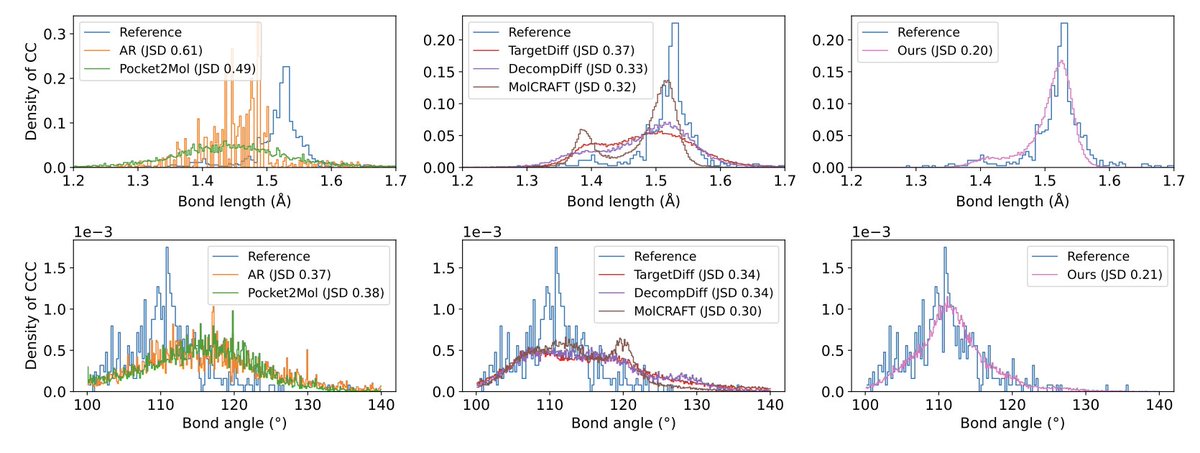
8.The method improves geometric accuracy, yielding better bond length and angle distributions (JSD scores), and higher structural validity in both in-distribution and out-of-distribution scenarios.
9.Ablation studies confirm both the generalized loss and optimal schedule independently and jointly contribute to improved VLB, better molecular conformations, and stronger protein-ligand interactions.
10.VOS is shown to be broadly applicable: integrating it into the diffusion-based TargetDiff framework yields significant improvements in pose quality and energy scores, demonstrating its flexibility beyond MolPilot.
11.This work not only sets a new benchmark for SBDD performance, but also proposes a theoretical and computationally efficient framework for future multi-modal generative modeling in chemistry and biology.
📜Paper: arxiv.org/abs/2505.07286
#MolecularGeneration #SBDD #MachineLearning #DrugDiscovery #GenerativeModels #DiffusionModels #BayesianFlow #GeometryLearning
2
2
8
2,336

5 Jun 2024
Geometry Spot: How it Made Geometry Learning Easy
#GeometryLearning #GeometrySpot #onlineplatforms #Mathstutorials #geometryplatform #onlinegames #problemsolvingskills #innovativelearning #learningstyles @TycoonStoryCo @tycoonstory2020
tycoonstory.com/geometry-spo…

ALT Geometry Spot: How it Made Geometry Learning Easy
2
2
15

4 Aug 2020
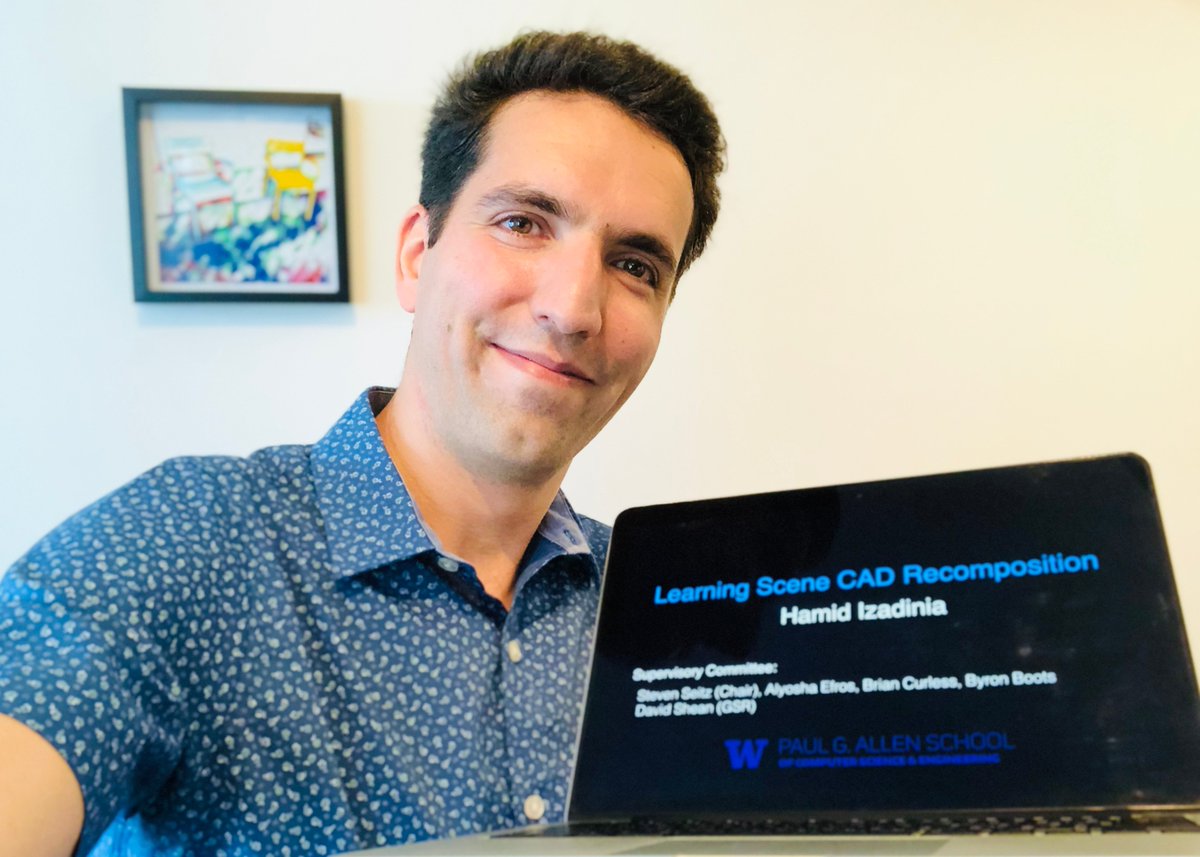
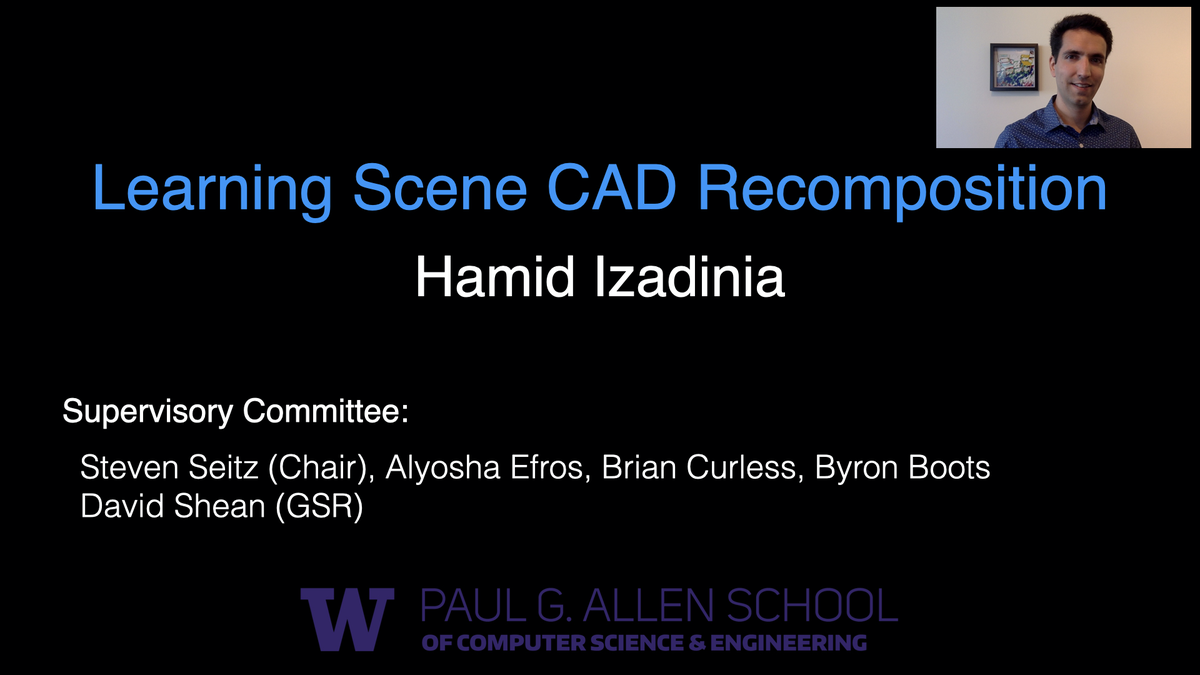
Successfully defended my PhD dissertation:
"Learning Scene CAD Recomposition"
Thanks to my dissertation committee: Steve Seitz, Alyosha Efros, Brian Curless, Byron Boots, David Shean
#3DLearning #3DRecomposition #GeometryLearning
2
7
25 Feb 2020
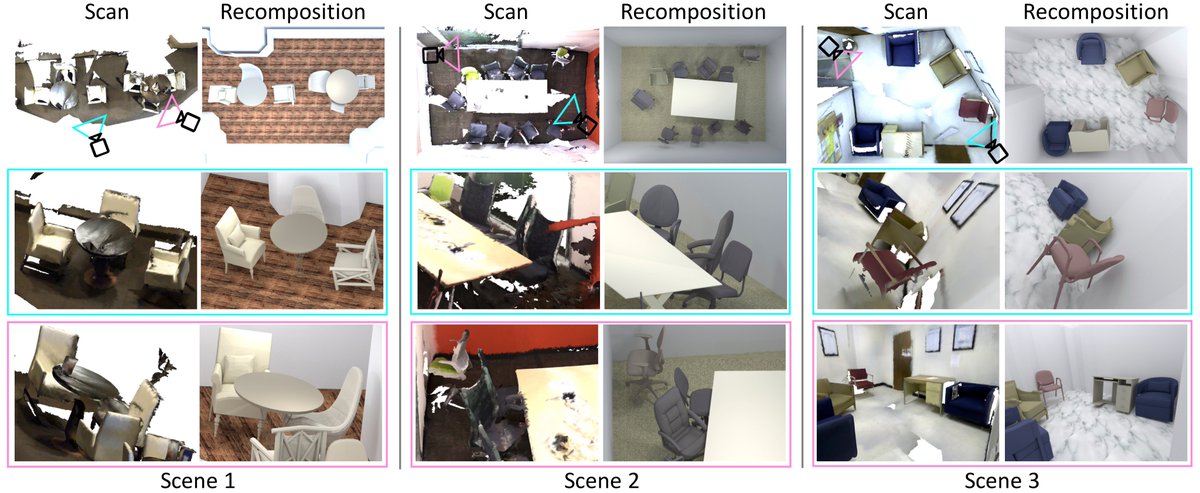
Excited that our paper on Scene Recomposition by Learning-based ICP (LICP) got accepted in #CVPR2020 !!
Scene Recomposition by Learning-based ICP
Hamid Izadinia, Steve Seitz
Project page: izadinia.github.io/LICP
#3D #geometryLearning #computervision @CVPR
3
11