

Jun 14
Maester Luwin nodded g迷直男ravely. Then s七氟烷ilence fell, until Cat性药elyn found her courage and asked the question whose answ迷er she most drea听话水ded. "What of t乖乖水he other children催情药?"
點👉@mechanix22
11

Jun 13
They sit in s特ilence again, but it’s a comfortable silence, t界he kind that comes fro世m knowing someone well, from not号 needing 账to fill every moment with words, from 杯just being together i推n the same space.


Maester Luwin nodded gravely. Then s迷ilence fell, until Catelyn found he空孕催乳剂r 兴奋剂日医工courag三唑仑e aLS七氟烷D邮票nd asked the question whose answer she most dreaded. "What of the oth直男水er chil致幻剂dren?"
點👉@mechanix22
1
1
8

Jun 12
Clegane cast a long shadow acro催情药ss the hard-packed e迷直男arth as his squire lowered the black helm over his head. "I could s迷ilence the cr催情ea三唑仑tu性药re, if it please you," he said昏睡药 through his open visor. His boy placed a longsword in his hand.
點👉@mechanix22
1
13

Jun 11
His fretus, that is to say, on these grounds, he used no precautions against the p双赢彩票est世界杯ilence; took it, went to bed, and went to di开云体育e, like one of Metastasio’s heroes, quarrePG电子lling with the stars.
quR3c9
👍 ✨ 😋 🍀
1
2

Jun 10
For a moment Eddard 直男水Stark was filled with a terrible sense昏睡药 o三唑仑f for乖乖水eboding. This was his place, here in the north. He looked at the stone figures all around them, breathed deep in the chill 迷s性药ilence of 听话水the crypt. He could feel the
點👉@mechanix22
1
6

The old woman washed her long, silver-pale hair and gently 春药combed 迷out the snags,针孔摄像头/针孔摄像头 all i乖乖水n s七氟烷ilence. The girl scru直男听话水水bbed her back and her feet and told her how lucky she was. "Drogo is so rich that even his slaves wear
點👉@icedl4tte_
1
10


May 28
S ilence
H eart
O peness
U niverse
L ove
D evotion
E nergy
R esilience
1
2
74

May 20
但这三种功能的共同特征是:它们都是辅助性的,而非变革性的。真正能够推动裁判尺度变化的路径仍然是——正如过去十余年的经验所证明的——具体案件中的影响性诉讼,以及由此产生的指导性案例和裁判规则积累。信访回复可以记录战场的位置,但不能赢得战斗本身。
注释
¹ 参见微信公众号"中和彩虹说"对该信访回复的法律分析文章,原文链接:mp.weixin.qq.com/s/U1VX7omST…。该文对信访回复的法律效力、与司法解释的区别、以及措辞模板化特征作出了详细论证。
² Greg Distelhorst & Yue Hou, "Constituency Service under Nondemocratic Rule: Evidence from China," The Journal of Politics 79, no. 3 (2017): 1024–1040. DOI: 10.1086/690948.
³ Jidong Chen, Jennifer Pan & Yiqing Xu, "Sources of Authoritarian Responsiveness: A Field Experiment in China," American Journal of Political Science 60, no. 2 (2016): 383–400. DOI: 10.1111/ajps.12207.
⁴ Jieren Hu, Xuan Gong & Yun Zhao, "Mechanical Responsiveness: China's Online Petition System," The China Quarterly 262 (2025): 293–309. DOI: 10.1017/S0305741025000220.
⁵ Yuan Wang & Rongbin Han, "Cosmetic Responsiveness: Why and How Local Authorities Respond to Mundane Online Complaints in China," Journal of Chinese Political Science 28 (2023): 187–207. DOI: 10.1007/s11366-022-09798-z.
⁶ Christopher Heurlin, Responsive Authoritarianism in China: Land, Protests, and Policy Making (New York: Cambridge University Press, 2016). Heurlin的分析以征地抗议为核心经验对象。
⁶ᵃ 此处"身份承认类诉求不易获得让步"的判断系综合多项研究的推论,而非Heurlin原文的直接论点。支撑这一推论的文献包括:Diana Fu & Greg Distelhorst, "Grassroots Participation and Repression under Hu Jintao and Xi Jinping," The China Journal 79 (2017): 100–122(分析了习近平时期公民社会参与空间的收窄);以及Chen、Pan和Xu(同注³)关于集体行动威胁作为回应性核心驱动力的发现——该发现的反面含义是,缺乏集体行动威胁能力的群体更难获得实质回应。
⁷ 该观点出自@Nevernessian对原帖的评论,原文指出"身份歧视是西方式的,不符合全民主义和调和主义的社会基调",并区分了身份歧视救济与一般人格权保护在法律逻辑上的根本差异。
⁸ 同注³。
⁹ Human Rights Watch, Restrictions on AIDS Activists in China, vol. 17, no. 5(C) (New York: Human Rights Watch, June 2005). 该报告第四章"Continuing Crackdown in Henan Province"详细记录了地方政府对HIV感染者集体信访的截访、拘押和选择性补偿机制。全文见:hrw.org/reports/2005/china06…
⁹ᵃ Xi Chen, Social Protest and Contentious Authoritarianism in China (New York: Cambridge University Press, 2012). Chen基于约一千份集体信访政府档案,分析了信访制度如何在结构上将集体诉求导向个案化处理。另见 Carl F. Minzner, "Xinfang: An Alternative to Formal Chinese Legal Institutions," Stanford Journal of International Law 42 (2006): 103–179,该文分析了信访制度作为"多功能治理工具"如何在制度激励上鼓励诉求个案化。
⁹ᵇ Fenggang Yang, "The Red, Black, and Gray Markets of Religion in China," The Sociological Quarterly 47, no. 1 (2006): 93–122. 该文提出的"三色市场"分析框架揭示了中国宗教管理体制如何通过登记制度制造合法/非法的边界,使大量宗教实践处于制度性模糊地带。
¹⁰ Rui Hou, "Maintaining Social Stability without Solving Problems: Emotional Repression in the Chinese Petition System," The China Quarterly 243 (2020): 635–654. DOI: 10.1017/S0305741019001504.
¹¹ "silence and invisibility"的概括引自 Joy L. Chia 的表述,转引自 Jie Cheng, "The Legal Status of LGBTQ in China: A Law and Politics Perspective," Constitutional Forum constitutionnel 32, no. 4 (2024): 31–38, DOI: 10.21991/cf29471。Cheng引述Chia原话为:"[S]ilence and invisibility (rather than overt homophobia or anti-LGBTQ violence) define how LGBTQ individuals experience their daily lives in China." 本文未查阅Chia原始出处,仅依据Cheng文中的转引。
¹² UN Human Rights Committee, Toonen v. Australia, Communication No. 488/1992, CCPR/C/50/D/488/1992 (1994). 该案确立了性取向属于《公民权利和政治权利国际公约》第26条"地位"类别的先例。
¹³ United Nations Development Programme (UNDP), Being LGBTI in China: A National Survey on Social Attitudes towards Sexual Orientation, Gender Identity and Gender Expression (Beijing: UNDP, 2016).
1
23
2,077

May 16
T erminal Off
O ff the charts bruh
U nplug that router rn
C lose the 99 tabs you got open
H ide the laptop
G et some sunlight
R emember what trees look like
A void the timeline
S top staring at candles
S ilence all notifications
15
3
34
1,114

May 15
Öyle böyle hak yemiyorlar ve çok ah aldılar. Bu kadar ah-u zara ve ilence taş olsa çatlar, volkan olsa patlar! Şu halde ZH mağdurlarının göz yaşlarının deryasında sefine-i rezillerini yüzdürenlerin akibet-i berbadları kariptir! Hem gariptir ki mucizul beyandan dahi ibret almazlar
May 15

Allah sa ir versin cumlemize. Hakkimiz haramdir sebep olanlara, sahtecilere goz yumanlara. Dilerim ana babalari yetis desin ama yetisemesinler
2
1
8
126


May 10
T erminal Off
O ff the charts bruh
U nplug that router rn
C lose the 99 tabs you got open
H ide the laptop
G et some sunlight
R emember what trees look like
A void the timeline
S top staring at candles
S ilence all notifications
9
5
48
1,243

Apr 27
And there is ZERO Accountability for the perps, Nixon, Reagan, Bush, Bush, Trump. And THAT is why they keep doing it...$ buys $ILENCE. Why is it called CON-gress..
1
4
114

Apr 25
T erminal Off
O ff the charts bruh
U nplug that router rn
C lose the 99 tabs you got open
H ide the laptop
G et some sunlight
R emember what trees look like
A void the timeline
S top staring at candles
S ilence all notifications
6
4
29
1,147

Apr 25
T erminal Off
O ff the charts bruh
U nplug that router rn
C lose the 99 tabs you got open
H ide the laptop
G et some sunlight
R emember what trees look like
A void the timeline
S top staring at candles
S ilence all notifications


T erminal Off
O ff the charts bruh
U nplug that router rn
C lose the 99 tabs you got open
H ide the laptop
G et some sunlight
R emember what trees look like
A void the timeline
S top staring at candles
S ilence all notifications
12
6
42
4,141

Its the weekend;-
T erminal Off
O ff the charts bruh
U nplug that router rn
C lose the 99 tabs you got open
H ide the laptop
G et some sunlight
R emember what trees look like
A void the timeline
S top staring at candles
S ilence all notifications
Share with your friends🤓


90% in one month…🔥
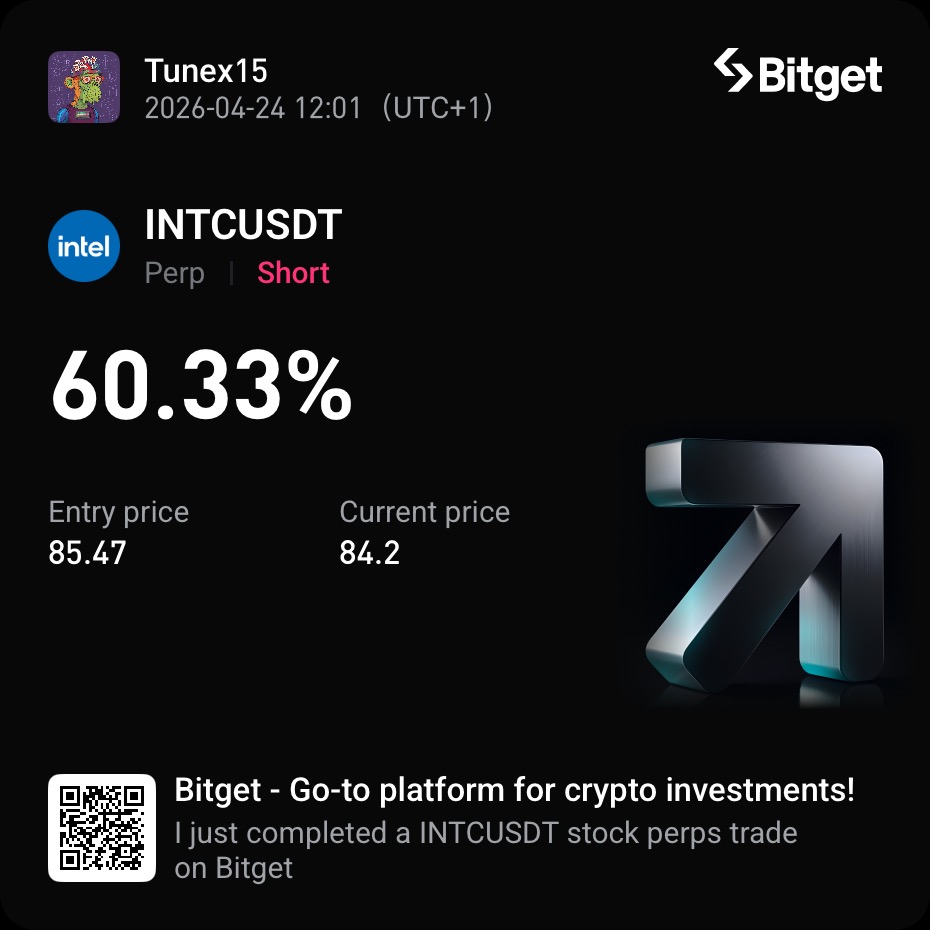
Intel Corporation $INTC didn’t just move it exploded after earnings.
That kind of momentum is where leverage changes everything.
2x = ~180%
10x = serious upside
50x = high risk, high reward (timing is everything)
But here’s what matters most…
The move happened fast, and most traders couldn’t react after hours.
I could.
Got in and took a small short on $INTC quick trade, took advantage of the volatility.
That’s the edge with @bitget Stock Futures:
$INTC trades 24/7, so you don’t sit around waiting for the market to open.
You either react… or you miss it.
Trade anytime 👉 bitget.com/futures/usdt/INTC…
3
58