𝓢𝓪𝓫𝓻𝓲 retweeted

Apr 17
gopacket is live! Check it out, it is intended to be a full reimplementation of Impacket in Go (it is in beta please send me bug reports) github.com/mandiant/gopacket…
7
126
421
60,727

Jun 13
Real Question from CompTIA PenTest PT0-003
A penetration tester compromises a Windows OS endpoint that is joined to an Active Directory local environment.
Which of the following tools should the tester use to manipulate authentication mechanisms to move laterally in the network?
A. Rubeus
B. WinPEAS
C. NTLMRelayX
D. Impacket
Answer below 👇
1
11

Jun 12
#threatreport #LowCompleteness
Arctic Wolf Observes an Increase in Palo Alto Networks GlobalProtect Authentication Bypass Exploitation via CVE-2026-0257 | 11-06-2026
Source: arcticwolf.com/resources/blo…
Key details below ↓
💀Threats:
Impacket_tool,
🎯Victims: Insurance, Finance, Manufacturing, Education, Engineering, Healthcare, Europe, North america, United states
🏭Industry: Financial, Healthcare, Education
🌐Geo: United states, America
🔓CVEs: CVE-2026-0257 \[[Vulners](vulners.com/cve/CVE-2026-025…)]
- CVSS V3.1: *9.1*,
- Vulners: Exploitation: True
Soft:
- paloaltonetworks pan-os (<10.2.7, 10.2.8, 10.2.9, 10.2.10, 10.2.11)
🤖LLM extracted TTPs:`
T1046, T1087.002, T1133, T1135, T1190, T1550.004
🧨IOCs:
- IP: 2
💽Software: PAN-OS, Linux
#threatreport:
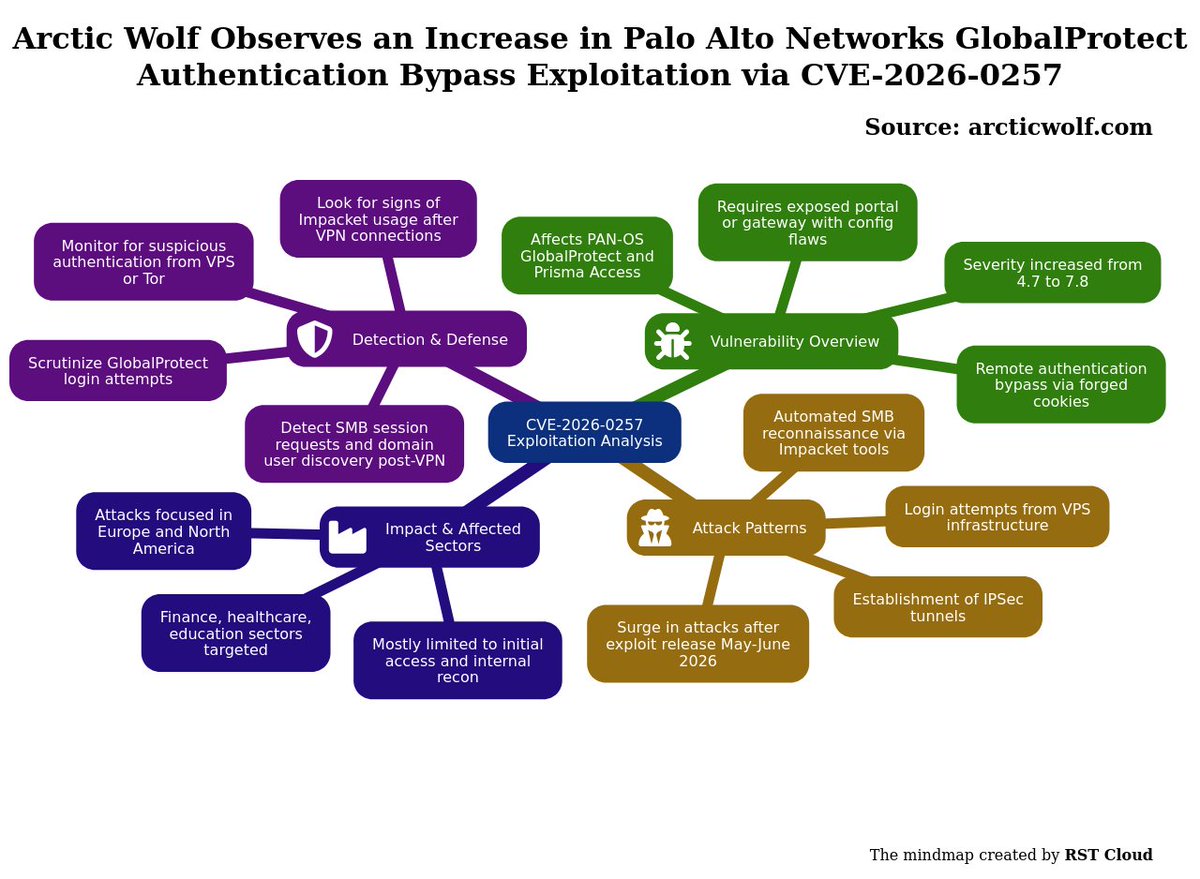
Arctic Wolf has reported a surge in exploitation of the authentication bypass vulnerability CVE-2026-0257, which affects Palo Alto Networks' PAN-OS GlobalProtect and Prisma Access. This increase was noted from late May to early June 2026, triggered by the release of exploit code and detailed descriptions of the vulnerability. Successful exploitation hinges on specific configurations: the GlobalProtect portal or gateway must be exposed, and authentication override cookies must be reused or exposed alongside the certificate they rely on. Initially, the malicious activity was characterized by suspicious login attempts from virtual private servers, leading to the establishment of IPSec tunnels and subsequent internal reconnaissance activities indicative of Impacket tool usage.
CVE-2026-0257 allows for remote, unauthenticated actors to forge authentication cookies, providing unauthorized VPN access under certain configuration conditions. Its severity was re-evaluated from a CVSS score of 4.7 to 7.8 following the growing awareness and publication of exploit techniques. This vulnerability has affected diverse sectors, including finance, healthcare, and education, primarily within organizations in Europe and North America.
The exploitation patterns revealed significant attempts to log into GlobalProtect admin accounts using, notably, cookie-based authentication from VPS infrastructure. While most intrusions witnessed repeated authentication failures, some progressed into authenticated sessions, leading to automated SMB reconnaissance and network share enumeration. This behavior suggests that threat actors were exploiting unauthorized VPN access to facilitate further actions in the internal network.
The observed activity consistently demonstrated patterns of immediate post-authentication actions involving SMB session requests and domain user discovery, with actors rapidly transitioning from successful VPN connection establishment to reconnaissance efforts. Despite the clear capabilities indicated by these actions, most exploitations did not extend significantly beyond initial intrusions.
Defensive recommendations focus on monitoring for suspicious authentication events, particularly from VPS or Tor exit node IPs, anomalous login patterns, and signs of Impacket activity following VPN sessions. Organizations using GlobalProtect are advised to scrutinize login attempts and subsequent session behaviors to identify and mitigate potential exploitation.
73

codex for open source! just granted about another huge batch including some that you might recognize!
tensorflow/tensorflow
n8n-io/n8n
twbs/bootstrap
github/gitignore
ytdl-org/youtube-dl
vercel/next.js
30-seconds/30-seconds-of-code
kubernetes/kubernetes
papers-we-love/papers-we-love
angular/angular
neovim/neovim
microsoft/web-dev-for-beginners
florinpop17/app-ideas
bitcoin/bitcoin
gin-gonic/gin
microsoft/playwright
laravel/laravel
gothinkster/realworld
spring-projects/spring-boot
tensorflow/models
apple/swift
unclecode/crawl4ai
tldr-pages/tldr
snowpackjs/astro
embedchain/embedchain
vim/vim
pingcap/tidb
jonnyburger/remotion
aspnet/aspnetcore
seleniumhq/selenium
jqlang/jq
immutable-js/immutable-js
anncwb/vue-vben-admin
pynecone-io/pynecone
martinvonz/jj
serverless-stack/serverless-stack
manojvivek/responsively-app
trekhleb/homemade-machine-learning
sipeed/picoclaw
spicetify/spicetify-cli
vueuse/vueuse
guidance-ai/guidance
nautechsystems/nautilus_trader
hshoff/vx
preservim/nerdtree
officedev/office-ui-fabric-react
carlospolop/peass-ng
reduxjs/reselect
adonisjs/adonis-framework
rizinorg/cutter
facebookresearch/llama-recipes
stackexchange/dapper
resendlabs/react-email
tomav/docker-mailserver
lichess-org/lila
google/libphonenumber
apache/incubator-brpc
googlechrome/chrome-app-samples
hwchase17/langchainjs
fanux/sealos
argoproj/argo
argoproj/argo-workflows
rjsf-team/react-jsonschema-form
secureauthcorp/impacket
scylladb/scylla
uuidjs/uuid
cayleygraph/cayley
cesiumgs/cesium
eclipse-vertx/vert.x
pyodide/pyodide
jetstack/cert-manager
rileytestut/altstore
sunnyyoung/wechattweak-macos
pydanny/cookiecutter-django
pandas-profiling/pandas-profiling
espanso/espanso
ansible-semaphore/semaphore
k9mail/k-9
nock/nock
dotnet/aspnetcore.docs
selectize/selectize.js
mozilla-mobile/firefox-ios
wanghongenpin/network_proxy_flutter
webpack-contrib/webpack-bundle-analyzer
alicevision/meshroom
actions/virtual-environments
jxnl/instructor
theramu/fay
svprogresshud/svprogresshud
lexikos/autohotkey_l
lipis/flag-icon-css
redpanda-data/redpanda
vega/vega
mrjbq7/ta-lib
uber/ludwig
keplergl/kepler.gl
devicons/devicon
crossplane/crossplane
openaccess-ai-collective/axolotl
go-shiori/shiori
audiokit/audiokit
pyroscope-io/pyroscope
px4/px4-autopilot
quickwit-oss/quickwit
vuecomponent/ant-design-vue-pro
divanteltd/vue-storefront
k2-fsa/sherpa-onnx
jantimon/html-webpack-plugin
mockery/mockery
automattic/node-canvas
divio/django-cms
containers/skopeo
kubernetes/kompose
lucia-auth/lucia
microsoft/fluentui-system-icons
triton-inference-server/server
pressly/goose
altair-viz/altair
pwndbg/pwndbg
maplibre/maplibre-gl-js
webtorrent/webtorrent-desktop
hackmdio/codimd
31
8
329
19,290

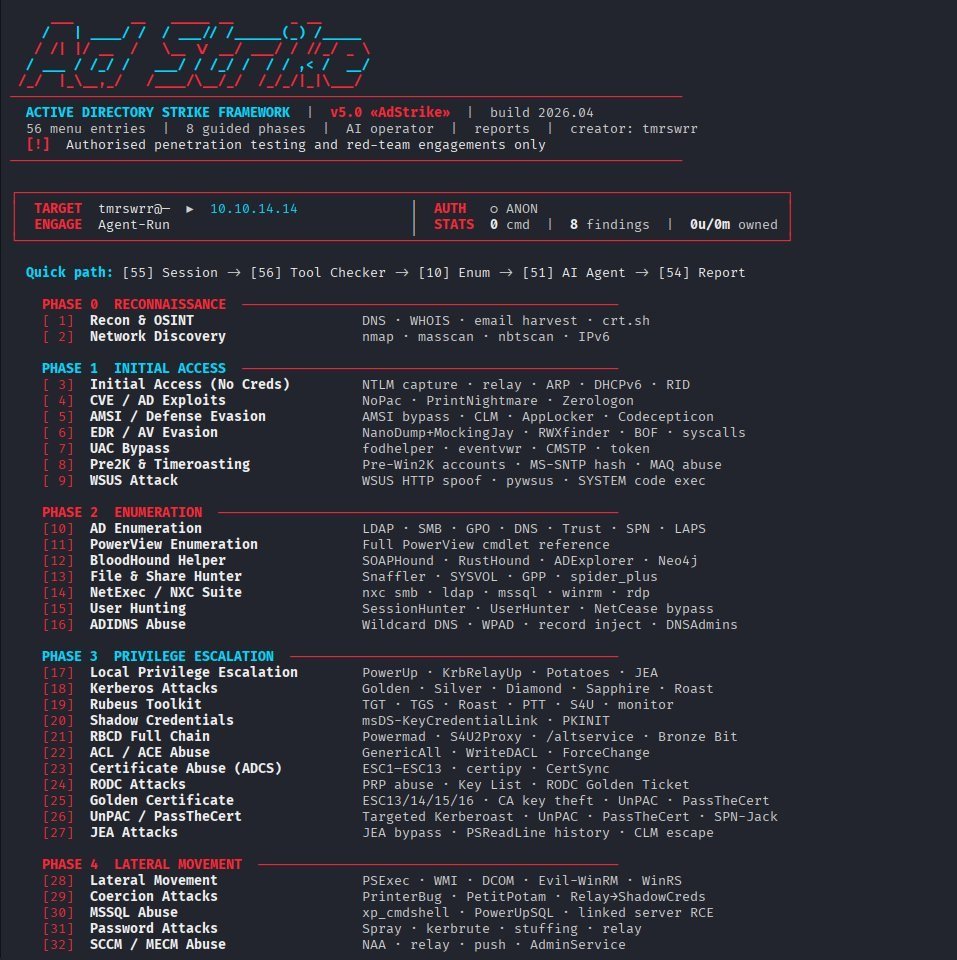
AdStrike — AI Powered Active Directory Attack Framework 💀🔥
A modular red-team framework built for advanced AD operations, Kerberos workflows, ADCS abuse, credential access, lateral movement & attack-path analysis. ⚡
🔥 58 interactive modules
🛡️ Kerberos-aware workflows
🤖 AI-assisted operator agent
📊 HTML / JSON / Markdown reporting
⚔️ BloodHound, Impacket, Certipy, NetExec integration
Built for professional red team operations & authorized security testing.
🔗 github.com/capture0x/adstrik…
3
12
330

Jun 11
Thank you for sharing, this is very helpful!
I wanted to mention Mimikatz when I asked for details, but I thought maybe ransomware actors wouldn't use it since it usually lights up most third-party AVs.
Top 3:
1. Impacket
2. Mimikatz
3. RegDump
I'm surprised such basic hack tools aren't detected by 3rd party. Attackers don't need AI if they're finding success with these hack tools.
1
1
40

Jun 11
Pass-the-CCache: Lateral Movement Technique
🔥 Telegram: t.me/hackinarticles
✴ Twitter: x.com/hackinarticles
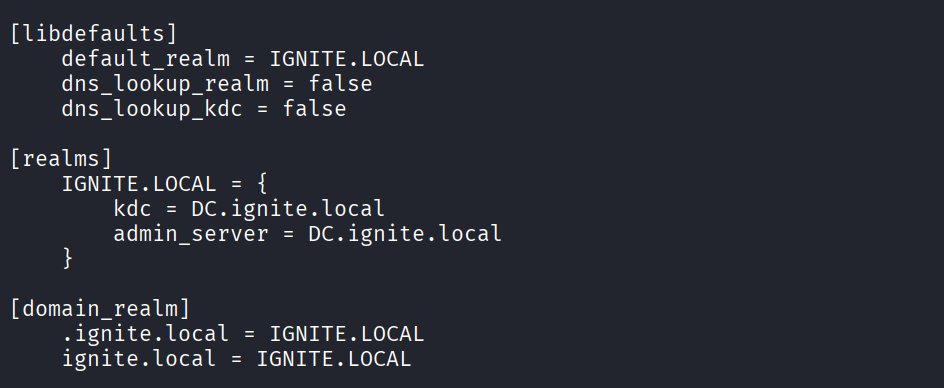
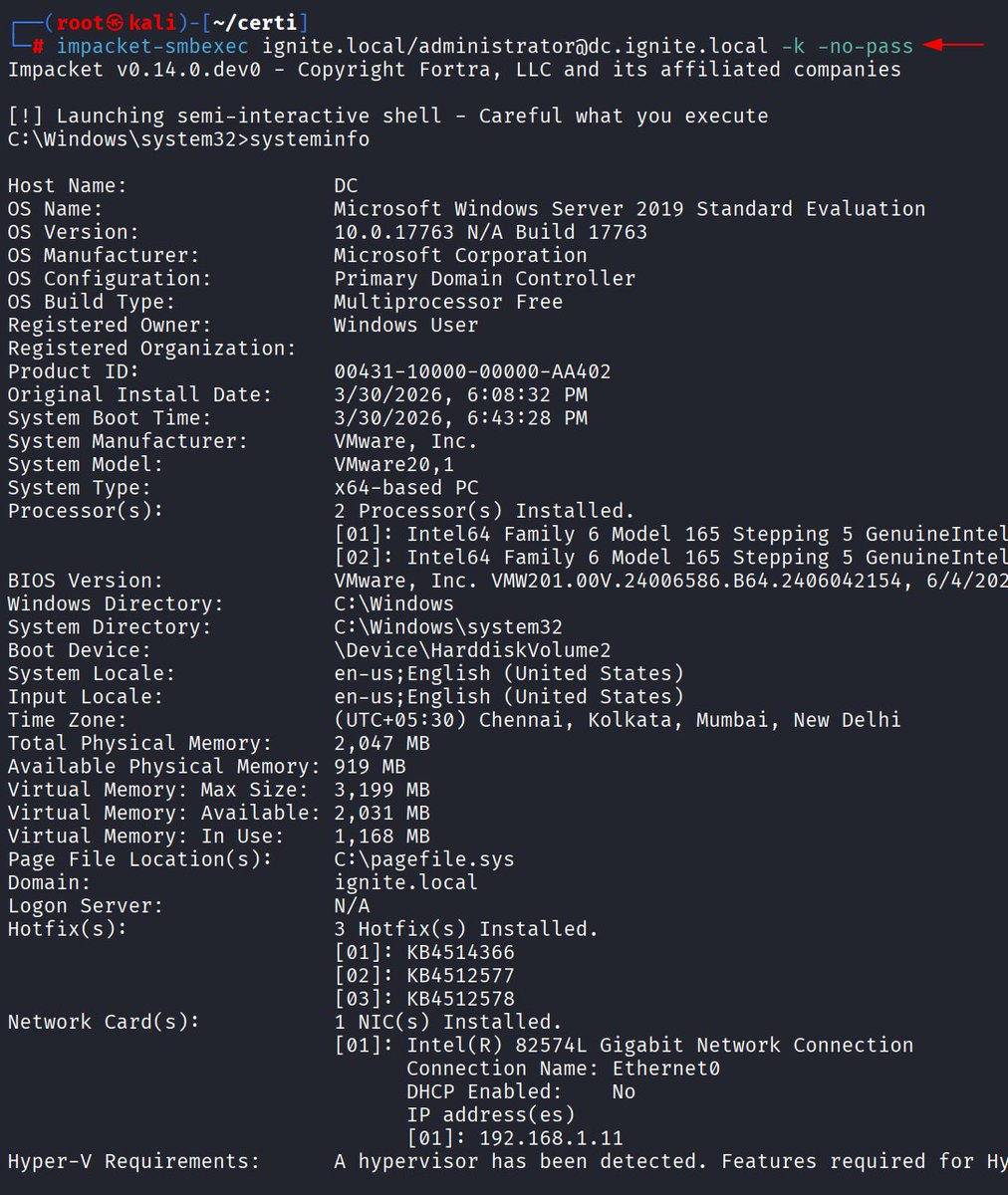
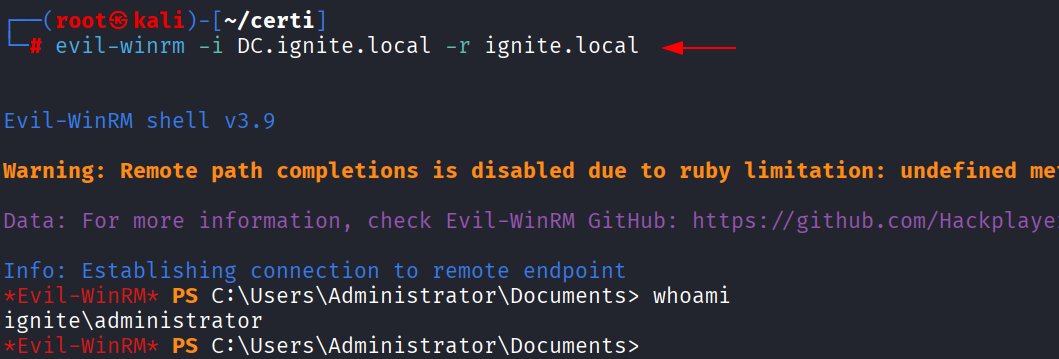
Pass-the-CCache is a stealthy Kerberos-based attack where attackers use exported .ccache tickets to authenticate without passwords or NTLM hashes.
⚡ Key Features
🎟️ Reuse Kerberos tickets (.ccache)
🔐 No need for plaintext creds or hashes
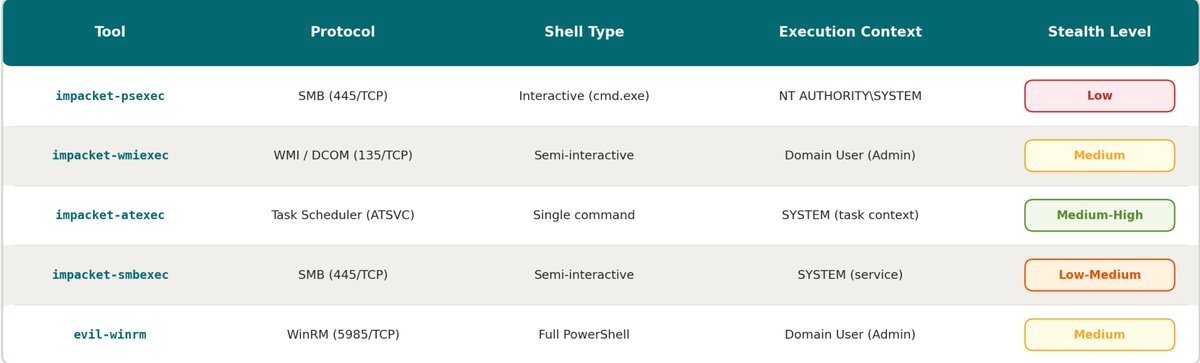
💻 Works with Impacket tools
🚀 Lateral movement via: PsExec, WmiExec, AtExec, SmbExec
🖥️ Remote access using Evil-WinRM
⚡ NetExec support (WinRM & WMI)
🕵️ Low detection footprint
💡 This technique abuses Kerberos authentication by reusing valid tickets, helping attackers pivot inside Active Directory environments silently.
📖 Article: hackingarticles.in/lateral-m…
#CyberSecurity #EthicalHacking #RedTeam #Pentesting #ActiveDirectory #Kerberos #LateralMovement #InfoSec
16
67
3,888
Andre Gironda retweeted

Jun 10
nuclei v3.9.0 just dropped
github.com/projectdiscovery/…
new stuff: Impacket integration, Windows Management Instrumentation (WMI), Distributed Component Object Model (DCOM), Windows Task Scheduler service (MS-TSCH), and Service Control Manager (SCM) RPC modules
and a fat list of bug fixes.
go bump right now!!
2
8
762

Jun 10
A service account ticket gets requested.
Ten minutes later, the password behind it is cracked.
Three minutes after that, my Splunk alert finally fires. Too late.
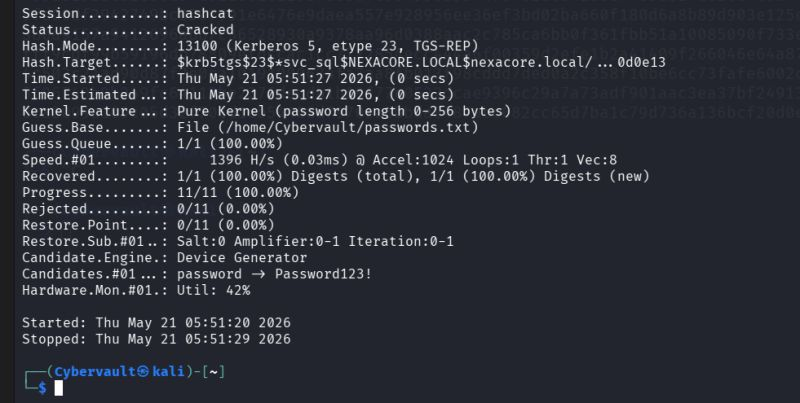
This is Kerberoasting, and it needs almost nothing. With one valid domain account, I used impacket-GetUserSPNs to request a Kerberos service ticket for svc_sql, a service account with a service name registered. Active Directory handed it over, encrypted with that account's password hash. I ran hashcat against a wordlist offline, on my own machine, and the password fell in nine seconds. It was Password123!. No exploit, no malware, no failed logins on the domain controller.
The tell is the encryption. AD normally issues these tickets with AES. To speed up the offline crack, the attacker requests the older, weaker RC4 instead, so my rule flags RC4 ticket requests on the DC, Event ID 4769. One RC4 row against a wall of AES.
But the alert fired after the crack was done, and it always will. The cracking happens on the attacker's machine, where no log can reach. So this alert cannot prevent Kerberoasting. It only gives you a head start on cleanup: rotate that service account immediately and check where the password was already used. What actually prevents the attack is the password itself. A long random one, or a group managed service account, cannot be cracked, so the stolen ticket is worthless. The alert tells you it happened. The strong password is what stops it.
Full breakdown: github.com/Cybervault-1/Cybe…
#DetectionEngineering #BlueTeam #Splunk #ActiveDirectory #Kerberoasting
47
BruhoRu retweeted

Jun 9
Active Directory & Internal Network
Join my tg for more informatoin
t.me/rootacessacademy
1. Impacket A powerful collection of Python scripts for interacting with and attacking Windows network protocols.
2. BloodHound Uses graph theory to reveal the hidden and often unintended relationships and attack paths within an Active Directory environment.
3. CrackMapExec The ultimate swiss-army knife for automating the assessment of large Active Directory networks.
4. NetExec The actively maintained fork of CrackMapExec, keeping the AD pentesting automation alive and updated.
5. Certipy An all-in-one tool for enumerating and abusing vulnerable Active Directory Certificate Services (AD CS).
6. RubeusA C# toolset for raw Kerberos interaction and abuses, perfect for ticket manipulation and attacks.
7. SharpHound The official C# data collector for BloodHound, designed to quickly map out AD trust relationships and ACLs.
8. PowerView A premier PowerShell tool for gaining detailed situational awareness and reconnaissance on Windows domains.
9. Kerbrute A fast and efficient tool to brute-force and enumerate valid Active Directory usernames via Kerberos pre-authentication without triggering lockouts.
10. ADExplorer A lightweight Sysinternals tool for browsing and dumping Active Directory data without needing elevated privileges.
11. Group3r A specialized tool for finding vulnerabilities, secrets, and misconfigurations in Active Directory Group Policies (GPOs).

6
5
25
966

Jun 9
Microsoft Defender now audits inbound remote RPC calls at OpNum-level granularity through a Windows Filtering Platform integration, surfacing telemetry in Advanced Hunting and feeding detections like Impacket-style hands-on-keyboard, suspicious remote service creation, LSA secrets theft, RPC user / session discovery, and authentication coercion — with sample KQL queries for Remote Registry abuse, remote service creation, and NetrSessionEnum-based session discovery.
core-jmp.org/2026/06/microso…
#ActiveDirectory #AdvancedHunting #AuthenticationCoercion #DCSync #DefenderXDR #Impacket #KQL #LateralMovement #MicrosoftDefender #MicrosoftDefenderforEndpoint #MSRPC #NTLMCoercion #RemoteRegistry #RPC #secretsdump #ServiceControlManager #SharpHound #WFP
76

Windowsの横展開や認証情報の窃取で長年悪用されてきたRPC(リモートプロシージャコール)の乱用を、法人向けのMicrosoft-Defenderが関数の呼び出し単位で検知し、攻撃を妨害できるようになりました。RPCは、別プロセスや別マシン上の機能をあたかも手元の関数のように呼び出せるWindowsの中核プロトコルです。利用が膨大なうえ、SMB3などで通信が暗号化されると中身が見えないため、ネットワーク監視では「どのRPC関数が呼ばれたか」まで追うのは困難でした。Defenderは通信を復号する代わりに、ホスト側でRPCの呼び出しを直接観測。Microsoftは、暗号化の有無に関わらず攻撃に直結する関数の呼び出しを捉えられるとしています。
【仕組みと検知内容】
・WindowsのWFP(通信制御基盤)と連携し、RPCのインターフェース(機能の大分類)だけでなく、その中で呼び出された個々の関数(OpNum)まで識別できるようになった
・監視対象は、サーバー側のホストに入ってくるリモートのRPC呼び出しに限定。通常の通信を妨げない監査専用フィルタで収集し、送信元の端末を見る必要はない。ローカルや外向きの呼び出しは対象外
・監視されるのはリモートレジストリ、サービス制御マネージャー、タスクスケジューラ、WMIなどの主要インターフェース。攻撃ツールImpacketによる手動操作型攻撃、リモートからの不審なサービス作成、LSA(認証情報を扱うWindowsの仕組み)シークレットの窃取、RPCを使ったユーザーやセッションの探索、サーバーに攻撃者への認証を強要する攻撃の検知が提供されている
・例えばリモートレジストリの保存操作は認証情報の窃取、リモートのサービス作成は横展開の兆候といったように、呼び出された関数から手口を推定できる。DCsyncやSecretsDump、SharpHoundといった定番ツールも、RPC悪用の例として挙げられている
・ワークステーション向けは一般提供、サーバー向けは段階的に展開中。Advanced HuntingのDeviceEventsで「InboundRemoteRpcCall」をクエリすれば、自環境のRPC活動を確認できる
詳細は以下を参照:
techcommunity.microsoft.com/…
9
29
1,774
Nguyễn Phan Bách retweeted

May 1
@Octoberfest73 I remember you once posted a quirk of impacket that could be used as an ioc so I thought you’d like this list of 50 impacket IOCs😄 github.com/ThatTotallyRealMy…
3
55
229
24,654

podcasts.apple.com/fr/podcas…
Excellent podcast, notamment sur ce projet titanesque de réécriture de l’outil Impacket en Go 🙏
8