
POLE O: The 5-Type Ontology That Solves the Hardest Part of Building a Knowledge Graph
Every knowledge graph project starts the same way. Someone opens a whiteboard and asks: "So... what are our entities?" What follows is a multi-day debate about whether a "meeting" is a node or a relationship, whether "location" deserves its own type or is just a property, and whether the schema should mirror the source database or represent some idealized domain model.
There's an anchor that solves this.
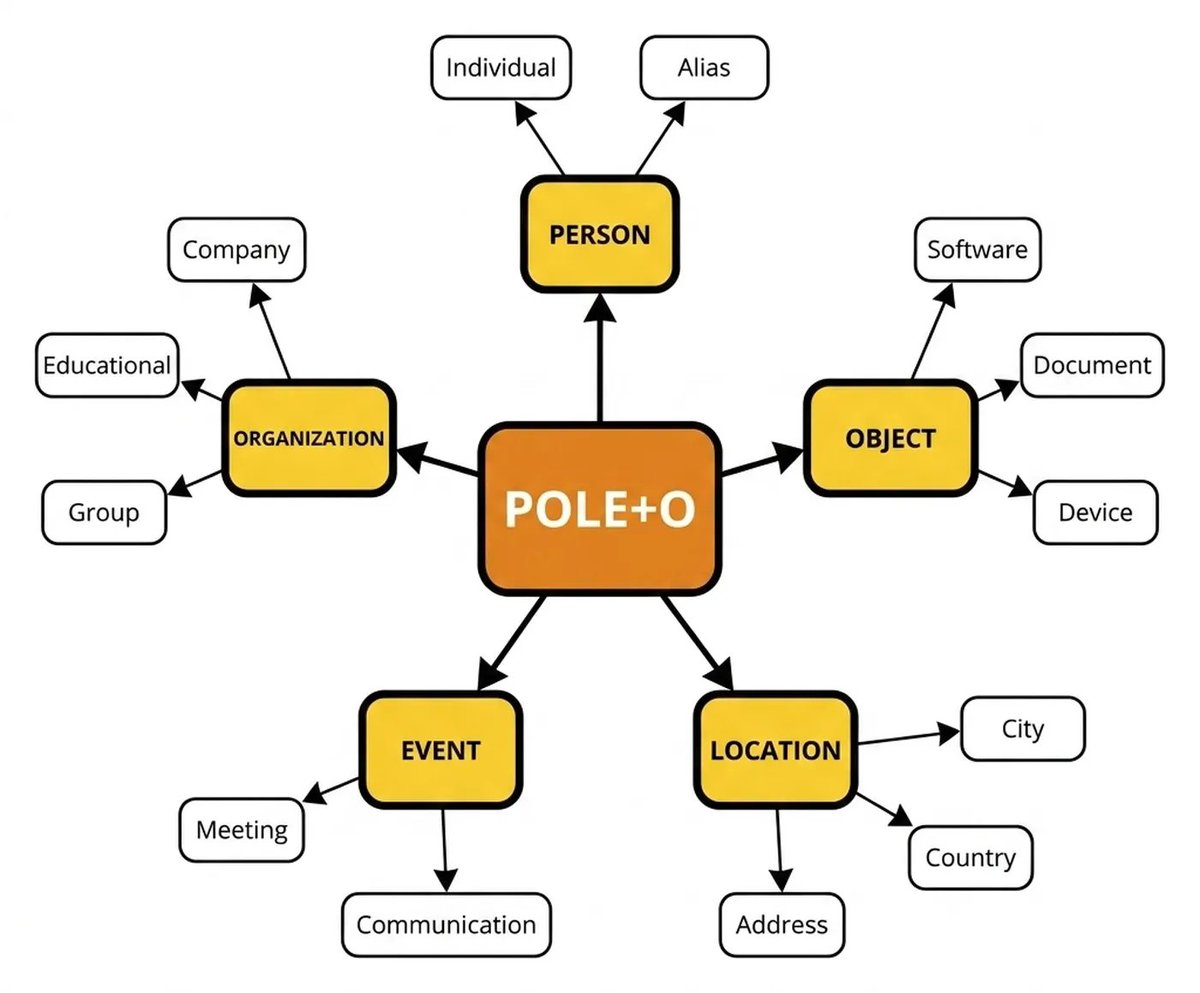
POLE O defines five base entity types drawn from decades of use in intelligence analysis:
Person - Any human entity
Organization - Groups and companies
Location - Places, physical or logical
Event - Things that happen
Object - Everything else
The power isn't the five types themselves. It's how domain-specific types layer on top using a multi-label system. A Patient is a :Person:Patient. A Sprint is an :Event:Sprint. The base type is always there. The domain type adds specificity.
This gives you two things flat schemas don't: the ability to query across domains at the base level, and automatic unification when connecting data from multiple sources.
POLE O doesn't answer every modeling question. But it answers the first one. And starting matters. A knowledge graph you can query in week one teaches you more about your domain than a schema you've been debating for a month.
When Paul Paul Iusztin first encountered the ontology concept, he assumed he had to study his domain in depth. To model all of finance, for example, and design the ideal ontology before working with any real data.
You can’t actually do that before you have a system running and data to look at. You just pile up assumptions that mostly turn out wrong.
Every knowledge graph solution stayed on the laptop and never got used, because he was waiting on an ideal ontology he could never reach. Without understanding the ontology, he couldn’t even write a decent extraction step to populate it. He was deadlocked, bringing 0 value.
The breakthrough was realizing you need a couple of models that let you start generic and extend over time. As I get more data, analyze it, and actually understand my problem, the schema evolves.
decodingai.com/p/ship-a-know…
By Konrad Kaliciński
medium.com/neo4j/pole-o-the-…
#KnowledgeGraphDesign #OntologyEngineering #DataModeling #GraphSchema #InformationArchitecture
--
Connected Data London 2026 | 11–12 November | Leonardo Royal Hotel London Tower Bridge
🎤 Share your work with the world's most passionate data community. The Call for Submissions is open.
connected-data.london/2026-c…
🎟 Tickets on sale now. Early bird discounts up to 30%. 2026.connected-data.london?u…
📺 Sponsorship opportunities available. Contact info@connected-data.london for details.
#KnowledgeGraph #GraphRAG #Ontology #Graph #AI #DataScience #GraphDB #SemTech
5
110