
4/4
Buy & sell crypto peer-to-peer. No ID. No limits. No borders.
👉 localcoinswap.com/?rc=C12CD0…
#Crypto #P2P #Bitcoin #LocalCoinSwap
3
32

Jun 12
Il existe des distributeurs pour retirer du bitcoin. Sinon le mieux reste de le faire en peer 2 peer. Il y a binance p2p et localcoinswap
1
84

Jun 11
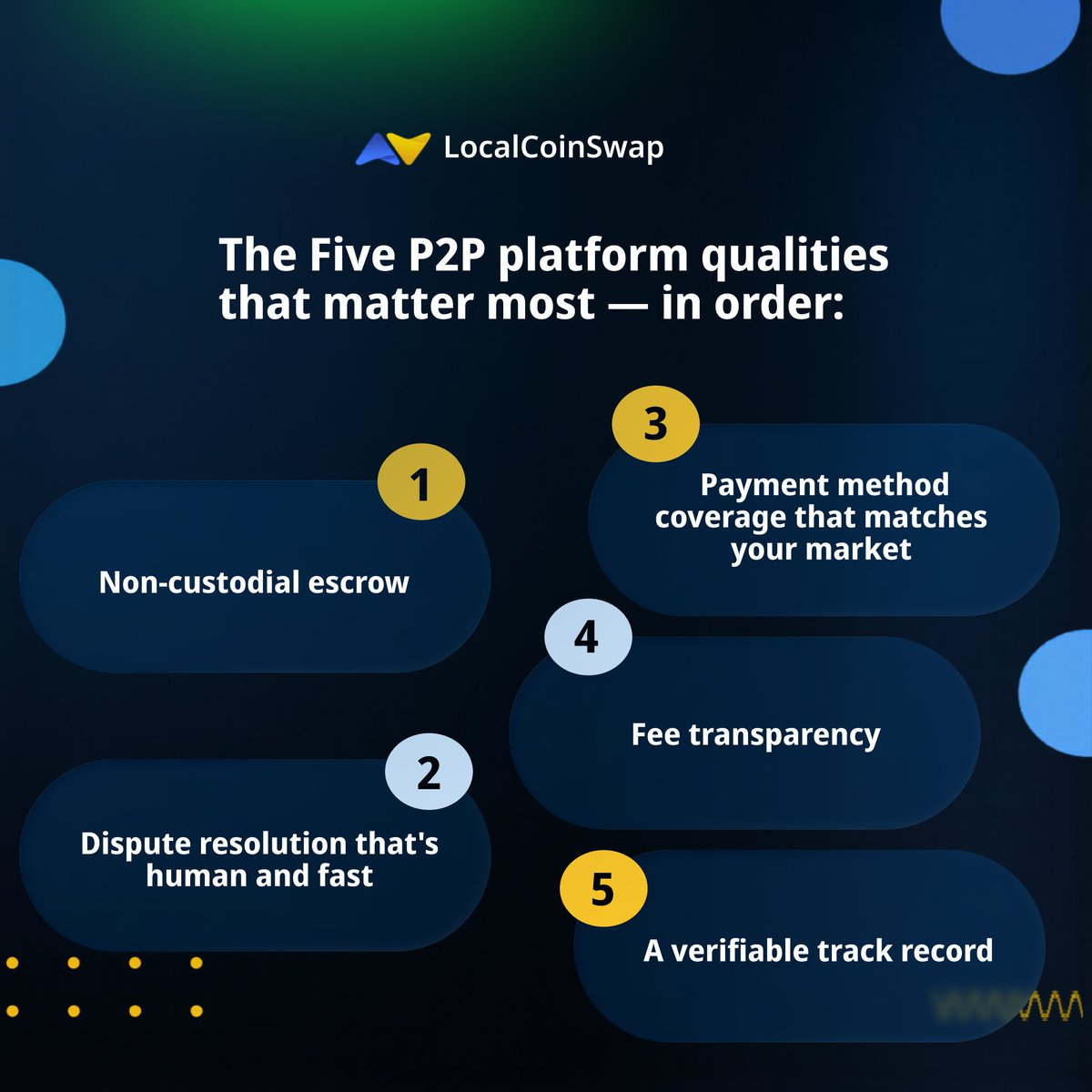
The 5 P2P platform qualities that matter most — in order:
1. Non-custodial escrow. Everything else is secondary. If the platform holds your crypto, the platform holds your risk.
2. Dispute resolution that's human and fast. Under 24 hours. With written rationale. Both parties informed.
3. Payment method coverage that matches your market. Not what works in Europe. What works where you are.
4. Fee transparency. One number. Consistent. The same at listing and at settlement.
5. A verifiable track record. How long have they been running? What's their dispute rate? Have they ever lost user funds? These are not marketing claims — they're operational facts you should be able to verify.
Most platforms hit 1 or 2 of these.
LocalCoinSwap hits all 5.
Come check.
4
77

Jun 10
p2p gibts nahezu überall. ansonsten localcoinswap, hodlhodl oder bisq. und ja lohnt sich, wenn unrealisierte Gewinne besteuert werden oder Vermögenssteuer kommt, willst Du nicht, dass jemand weiss, dass Du BTC hast.
1
5
520

Jun 10
5/6 🏅 LocalCoinSwap & MEXC
LocalCoinSwap
✅ Peer-to-peer trading platform
✅ Multiple payment methods
✅ User-controlled trading experience
1
1
5
Jun 3
How to start your first trade on LocalCoinSwap:
Step 1: Create an account. Email and password. 2 minutes.
Step 2: Set up your non-custodial wallet. Your keys — not ours.
Step 3: Browse listings. Filter by crypto, country, payment method, price range.
Step 4: Pick a vendor. Read their trade history, completion rate, response time, reviews. Take 60 seconds to do this — it matters.
Step 5: Start the trade. Crypto locks in escrow. You send payment through the agreed method. Crypto releases when seller confirms.
Step 6: Leave a review. It makes the next trader's decision easier.
No document queue.
No minimum deposit.
No premium-tier requirement to access basic features.
Traders. Infrastructure. That's it.
3
99
Jun 2
The cross-border freelancer experience trying to get paid:
Client is in the US. You're in Ghana.
Option 1: PayPal — 4.4% fee, not fully available in Ghana, conversion eats another 3%.
Option 2: Wire transfer — $35 flat fee, takes 5–7 days, your bank asks questions.
Option 3: Wise — better, but the "mid-market rate" still has a margin built into it.
Option 4: Client sends crypto directly — they don't own crypto. Now you need to explain crypto to a client.
Option 5: Client sends USDT to a wallet address you share.
You sell the USDT on LocalCoinSwap to a local buyer in Ghana.
Local currency in your mobile money within 40 minutes.
Total cost: under 2%.
The workaround is now the solution.
For millions of cross-border freelancers, it already is.

3
718
Jun 1
LocalCoinSwap fee structure:
Vendors pay 1% per trade.
That's built into the rate the vendor sets.
The buyer sees the final rate before confirming.
Withdrawal: network fee only. We don't add a margin on top.
No currency conversion fee.
No spread manipulation between listing price and settlement price.
No tiered fee structure where the headline rate applies only to high-volume users.
1% per trade.
The number you see when you browse listings is the number that applies when the trade closes.
We publish this because the platforms that don't publish their complete fee structure
know their complete fee structure would cost them users.
3
82
May 29
Hey @grok why should we use LocalCoinSwap
May 28

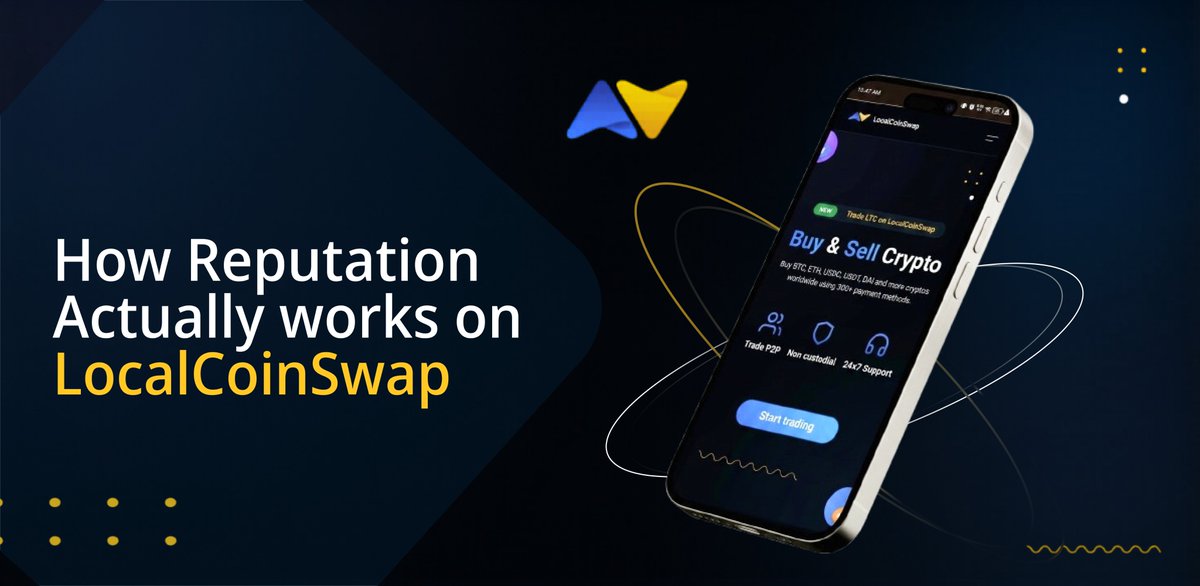
How reputation actually works on LocalCoinSwap:
Every completed trade posts to your public record. Automatically.
Every dispute win or lose is visible. Can't be removed.
Response time is averaged and displayed. No self-reporting.
Trade volume history is public. Buyers can see your experience level.
You cannot buy your way to a higher score.
You cannot reset by creating a new account, we catch that.
You cannot hide a dispute history by only showing your wins.
This is why the LocalCoinSwap reputation score actually means something.
On platforms where you can game the system, the score means nothing.
Ours is worth building. Slowly.
3
48
May 29
LocalCoinSwap
May 28
How reputation actually works on LocalCoinSwap:
Every completed trade posts to your public record. Automatically.
Every dispute win or lose is visible. Can't be removed.
Response time is averaged and displayed. No self-reporting.
Trade volume history is public. Buyers can see your experience level.
You cannot buy your way to a higher score.
You cannot reset by creating a new account, we catch that.
You cannot hide a dispute history by only showing your wins.
This is why the LocalCoinSwap reputation score actually means something.
On platforms where you can game the system, the score means nothing.
Ours is worth building. Slowly.
2
119
May 28
How reputation actually works on LocalCoinSwap:
Every completed trade posts to your public record. Automatically.
Every dispute win or lose is visible. Can't be removed.
Response time is averaged and displayed. No self-reporting.
Trade volume history is public. Buyers can see your experience level.
You cannot buy your way to a higher score.
You cannot reset by creating a new account, we catch that.
You cannot hide a dispute history by only showing your wins.
This is why the LocalCoinSwap reputation score actually means something.
On platforms where you can game the system, the score means nothing.
Ours is worth building. Slowly.
1
1
7
759

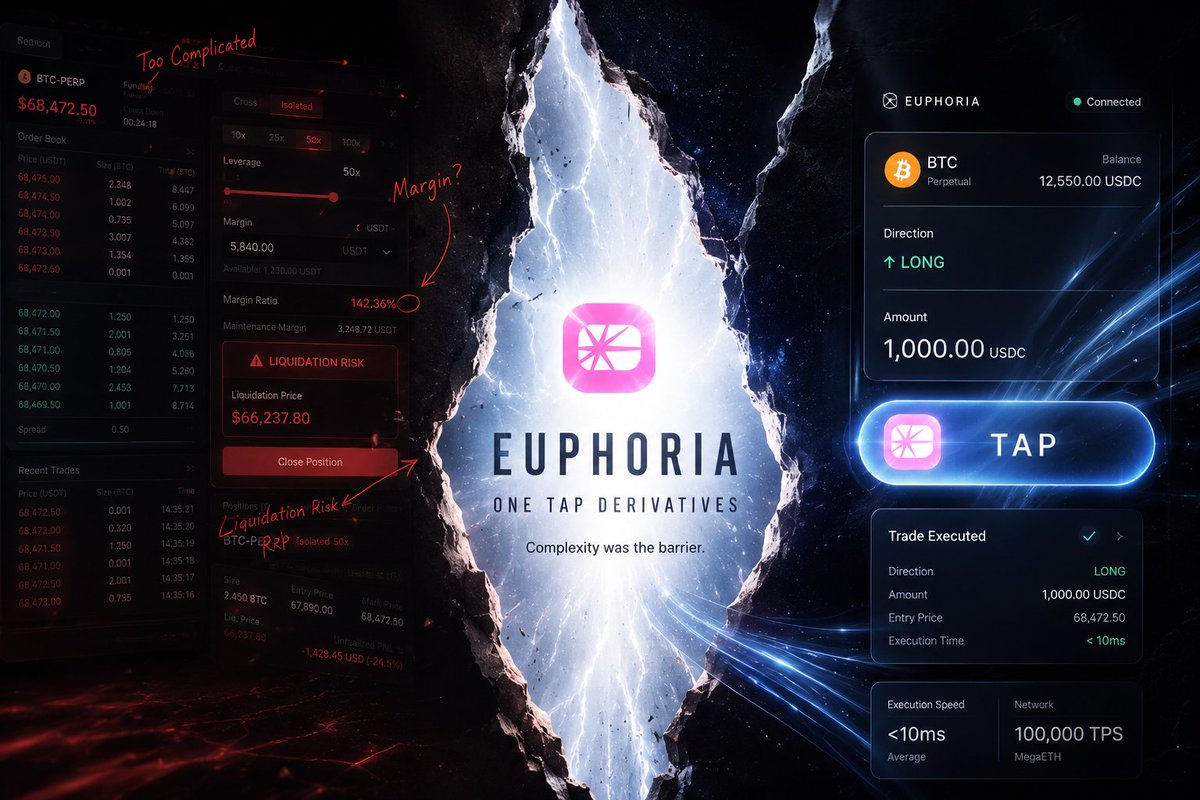
Most people have never touched crypto derivatives.
Not because they don't want to.
Because the moment you open any derivatives platform, you're hit with order books, liquidation prices, margin ratios, leverage sliders… and you close the tab.
That's the exact problem @Euphoria_fi is trying to solve.
The idea is simple one tap to trade options and perpetuals.
No settings. No order books. No complexity. You open the app, connect your wallet, and tap.
That's it.
The platform handles everything else in the background.
It runs on MegaETH a Layer 2 that does 100,000 transactions per second with block times under 10ms.
Execution is so fast that they had to build a custom oracle solution just to keep the price data in sync with the trades.
The team behind it isn't random either.
Nathan Worsley (CEO) previously founded LocalCoinSwap.
They raised $7.5M from Robot Ventures, Figment Capital, Karatage, Bankless Ventures, and 100 angels including names from Dragonfly, LayerZero, and Kaito.
Derivatives already make up nearly 80% of all crypto trading volume.
But almost all of it comes from experienced traders.
Euphoria is betting that a better UX can unlock an entirely new wave of users the same way Robinhood did with stock options.
Token hasn't launched yet.
Still very early.
Worth watching.
16
1
27
529
May 28
Something we've learned from 7 years of running LocalCoinSwap:
The traders who trust us the most are the ones who tested us first.
They made one small trade.
Watched how we handled a public dispute from the sideline.
Asked a pointed question and paid attention to how we answered.
Trust isn't a page on a website.
It's accumulated evidence.
Every platform that burned P2P traders made a series of small compromises before the big failure.
Fee disclosures that were technically accurate but practically confusing.
Dispute timelines that kept moving.
Support that was fast during acquisition and slow during problems.
We try to not make those compromises.
When we do, we name it.
That's the strategy.
6
77
May 27
The global freelance economy is $1.5 trillion.
An estimated 35–40% of that crosses borders.
The payment infrastructure for cross-border freelance income is genuinely bad:
PayPal fees: 3–4.4% plus currency conversion.
Wire transfer: $25–45 flat plus exchange rate spread.
Wise: better — but still margin-built into the rate.
P2P crypto for freelancers in emerging markets:
Client sends USDT.
Freelancer receives USDT.
Freelancer sells on LocalCoinSwap at the rate they set.
Local currency in account within 60 minutes.
Total cost: under 2%.
This isn't a workaround.
For freelancers in Nigeria, Ghana, Pakistan, and the Philippines —
it's already the primary payment rail.
Most financial analysts just haven't updated the data.
5
115
May 21
Something the data keeps confirming that the industry keeps being surprised by:
P2P volume grows when formal crypto access shrinks.
Nigeria 2021: banks restrict crypto-linked accounts. P2P volume rises 40% in 90 days.
Nigeria 2024: major exchange platform restricted. LocalCoinSwap and P2P alternatives see registration surge.
Argentina 2023: official dollar access rationed. Peer-to-peer stablecoin trading hits record volumes.
Turkey 2021: government restricts crypto payments. P2P trading increases, doesn't stop.
The pattern is not a coincidence.
When the formal route closes, people don't stop needing to move money.
They find the route that's still open.
P2P has always been that route.
Every restriction is an advertisement for it.
7
99

2/2
anonymity 🤝 privacy 🫡
since this post on May 19. not papers, not testnets — running code
at real URLs.
THE EUREKA
one Ed25519 keypair, derived from a BIP-39 mnemonic at solana's
SLIP-0010 path m/44'/501'/0'/0', is simultaneously:
• a solana wallet (base58 of the pubkey)
• a Tor v3 .onion (base32 of pubkey ‖ checksum ‖ version)
• a Tape/PDA storage namespace
same 32 bytes, three encodings. phantom's mnemonic is a hidden
service key. you just didn't know.
THE CHAT APP — cohort (cwtch fork)
profile create = BIP-39 mnemonic → solana wallet Tor v3 .onion
cwtch peer id in one shot. SOL / SPL / Token-2022 send dialogs use
the same key that runs your .onion. killed the "Add Server" button
because groups are on-chain now — program EsrqfUpG…BRqhG on mainnet,
BcwsnKq3…aRKv on devnet, no relay operator to subpoena. hybrid
persistence per group: on-chain leg (public, no operator) via-relay
leg (private metadata, single point of failure) — pick your trade.
THE PUBLISHER — publish.ouija.social
burner wallet generated in your browser → signs a publish challenge
with ed25519 → we host a real Tor v3 .onion at the matching pubkey.
mnemonic lives in localStorage only. no phantom connect. your real
wallet never touches the page. "host this .onion for me" — browser
derives the Tor HS expanded secret (SHA-512(seed) clamped), POSTs
to /api/host-onion → server does ADD_ONION via Tor control port AND
writes the keys to disk so the HS survives container restarts.
middleware rewrites Host:<onion>.onion → /sites/<onion> so tor
browser visitors see a 🧅 served-over-tor banner instead of a
clearnet one.
THE RELAY — ouija-relay
go daemon, local HTTP signer on 127.0.0.1:18964, per-launch random
bearer token, listens on loopback only. holds the ed25519 key in
memory so the chat app chrome extension MCP browser dapps
don't have to. phantom-style approval prompts (osascript modal on
mac, /v1/pending-approvals for any client) before sign-message /
sign-tx / transfer-sol. trust-origin TTL so the chat app doesn't
nag every signature.
THE MCP — ouija-mcp
two paths for agents, neither of which surfaces a mnemonic:
• ephemeral_create — generates a burner in MCP-process memory.
key dies on server restart. agent gets its own throwaway
identity per session.
• relay_sign_* — forwards to the local ouija-relay so agents
drive the USER'S persistent wallet via HTTP. relay prompts the
human for approval; the LLM never sees the key material.
THE ADAPTER — @ouija/wallet-standard
TS package implementing the solana wallet standard, backed by the
local relay. window.ouija appears in any dapp via standard register.
custom ouija:identity feature exposes the matching .onion so dapps
that know about it can read it without re-deriving. agent-grade API
(OuijaAgentClient, BurnerSigner) for playwright / node drivers —
same flows, no browser.
THE NAMING — AllDomains · .stacc
register yourname.stacc → owner = your burner → anyone with the
ouija-onion-resolver chrome extension types yourname.stacc in the
URL bar → extension intercepts pre-DNS, reads on-chain owner,
derives the .onion from that pubkey, redirects the tab. no DNS,
no CA, no domain registrar. the name follows the key.
THE FUNDING GUIDE — /privacy-funding
because the first thing a chain analyst follows is "where did this
burner get its SOL from":
• houdiniswap, changenow — chain hops to break the graph
• XMR bridge (Kraken → Monero → swap to SOL via Trocador) —
actual unlinkability
• cash → SOL via LocalCoinSwap — no digital trail at all
each entry says EXPLICITLY what it breaks and what it doesn't
(chain graph yes, IP / fingerprint / stylometry no).
THE TRUST DISCLOSURE — /trust-tradeoffs
on every published page footer: we know your key when you used the
convenience button. self-host the Tor HS yourself if your threat
model needs it (we ship the 4-command recipe). no warrant canary
lies, no "trust us bro."
THE DEPLOY
fly.io single container, tor next.js persistent volume. on
every redeploy start.sh scans /data/tor/hidden-services/ and brings
every persisted onion back up before next.js takes its first
request. clearnet at publish.ouija.social, .onion via the same
machine.
obfuscation as the default. zero protocol secrets — the math is in
@noble/curves and the derivation matches a published test vector
you can verify offline. no ZK theater. no marketing-deck encryption.
the only trust assumption is whether the convenience operator turns
evil, and we tell you exactly what that costs how to opt out.
that's the right shape for privacy in 2026.
1
4
1,126
May 20
A vendor in South Africa ran P2P trading as his primary income for two years.
Then, with no warning and no explanation, his account on a major platform was permanently closed.
He lost his full trade history. His reviews. His ranking. His buyer relationships.
Two years of work — gone.
He joined LocalCoinSwap and started over.
3 months in, his volume matched what he had before.
6 months in, he'd exceeded it.
I asked him what was different.
"Two things. When something went wrong, a person actually looked at it.
And I stopped waiting for a random email telling me I no longer exist on the platform."
That's what we're building.
Not the fastest platform. The most reliable one.
1
6
147
May 20
What actually happens when you open a dispute on LocalCoinSwap:
Step 1: You submit your case. Written, with evidence. So does your counterparty.
Step 2: A human moderator reads the full trade record. Everything — not just the screenshots you submitted.
Step 3: If the picture is unclear, they ask specific follow-up questions. To both sides separately.
Step 4: A decision is made with a written explanation. Not a status update. An actual reasoning.
Step 5: You can escalate once — to a senior moderator. The second decision is final.
Total time: 12–24 hours in most cases.
We don't automate this.
We don't outsource it.
We staff it because your trade is worth a real process.
1
5
92

Pay ur taxes mate.
But if not, acquire BTC or ETH peer-to-peer for cash (Bisq, Hodl Hodl, RoboSats, or in-person via LocalCoinSwap-style meetups) → swap to Monero on a non-KYC venue → hold in Monero, then atomic-swap or use a non-KYC swap service back to ETH/USDC on a fresh wallet generated on an air-gapped or fresh device → bridge to Hyperliquid
2
6
316

May 18
p2p works great, octra partering with established platforms like localcoinswap to get the p2p pakistan community on octra.. also just ordered a non kyc card from @Goblin_cards, theyre in mexico
3
114