
Jun 10
6. By 2026: millions of IoT devices running MachineFi protocols, storing data on @Filecoin , coordinating through IoTeX networks. Economy of Things powered by DePIN. #DePIN
Jun 10

THREAD: MachineFi IoTeX: Hardware Revenue Streams
1. MachineFi on IoTeX: devices earn revenue by performing useful work (sensing, computing, proving). Not mining - economic output. Your hardware becomes infrastructure. @Filecoin #DePIN #MachineFi
2
38
Jun 10
5. MachineFi removes friction from IoT adoption. Traditional IoT deployments sink money into hardware. MachineFi turns hardware into perpetual revenue machines. @Filecoin #DePIN #Enterprise
3
16
Jun 10
THREAD: MachineFi IoTeX: Hardware Revenue Streams
1. MachineFi on IoTeX: devices earn revenue by performing useful work (sensing, computing, proving). Not mining - economic output. Your hardware becomes infrastructure. @Filecoin #DePIN #MachineFi
1
3
66


May 19
USDC closes that gap making the MachineFi feel more real.
2
99

May 1
This is a move from infrastructure-only → platform ecosystem control. It’s strategically similar to:
AWS (infra services)
Android (OS ecosystem control)
peaqOS is less about “features” and more about owning the application layer of the Machine Economy stack. #MachineFi

Today we’re launching a whole new asset class: liquid machines
peaqOS is finally here and it’s ready to turn robots and machines across chains into investable assets and financial actors
It’s time for blockchain to live up to its full potential
app.peaq.xyz/os
15
624


What if your AI could pay for things… on its own?
Not in theory.
Not in a closed system.
But directly on-chain.
That’s exactly what x402 is enabling — and @bankofai_io is bringing it into focus.
For years, we’ve talked about automation in crypto.
Trading bots.
Yield optimizers.
Smart contracts.
But all of these still rely on one thing:
👉 Human-controlled capital.
x402 changes that.
It introduces the concept of autonomous micropayments, where AI agents can:
Earn value
Spend value
Interact economically
Without needing constant human input.
This is a massive leap.
Because once an agent controls its own financial flow, it becomes:
👉 Independent
👉 Scalable
👉 Self-sustaining
And that opens up entirely new possibilities.
Think about digital services.
Instead of subscriptions, you get:
Pay-per-use
Real-time billing
Dynamic pricing
All handled automatically by AI agents.
No invoices.
No delays.
No friction.
Another key layer here is identity.
With on-chain identity (8004), agents are no longer anonymous scripts.
They become:
Verifiable
Trackable
Trustable
This is critical.
Because in any economy, identity and reputation are just as important as payment.
By combining identity payments, Bank of AI is essentially building:
👉 A financial system for machines
And that’s something we’ve never truly had before.
What makes this even more compelling is how they present it.
The animated breakdown of x402 simplifies a highly complex protocol into something anyone can understand.
And that’s important.
Because technology doesn’t win by being advanced.
It wins by being accessible.
Looking ahead, this could reshape entire industries.
APIs could become:
Self-monetizing
Dynamically priced
Fully automated
AI services could:
Charge per task
Optimize their own revenue
Compete economically
This is not just DeFi.
This is MachineFi.
And we are still at the very beginning.
The transition from human-driven finance → to agent-driven finance will not happen overnight.
But the infrastructure is already being built.
And x402 is one of the clearest signals of that shift.
If you’re thinking long-term, this is a narrative worth watching closely.
Because once machines can transact…
Everything changes.
@justinsuntron #TRONEcoStar
@bankofai_io @trondao @Fetch_ai

x402 解密:AI 智能体如何自主赚钱与链上交易
我们的金融基础设施层 @bankofai_io,将复杂的 x402 支付协议拆解成一段清晰直观的动画演示,让每个人都能轻松理解。这不仅是 BANK OF AI 的核心底层能力,更是 AI Agent 时代的关键运行蓝图。
点开下方视频,快速了解 x402 的核心逻辑 🎬
6
4
10,533

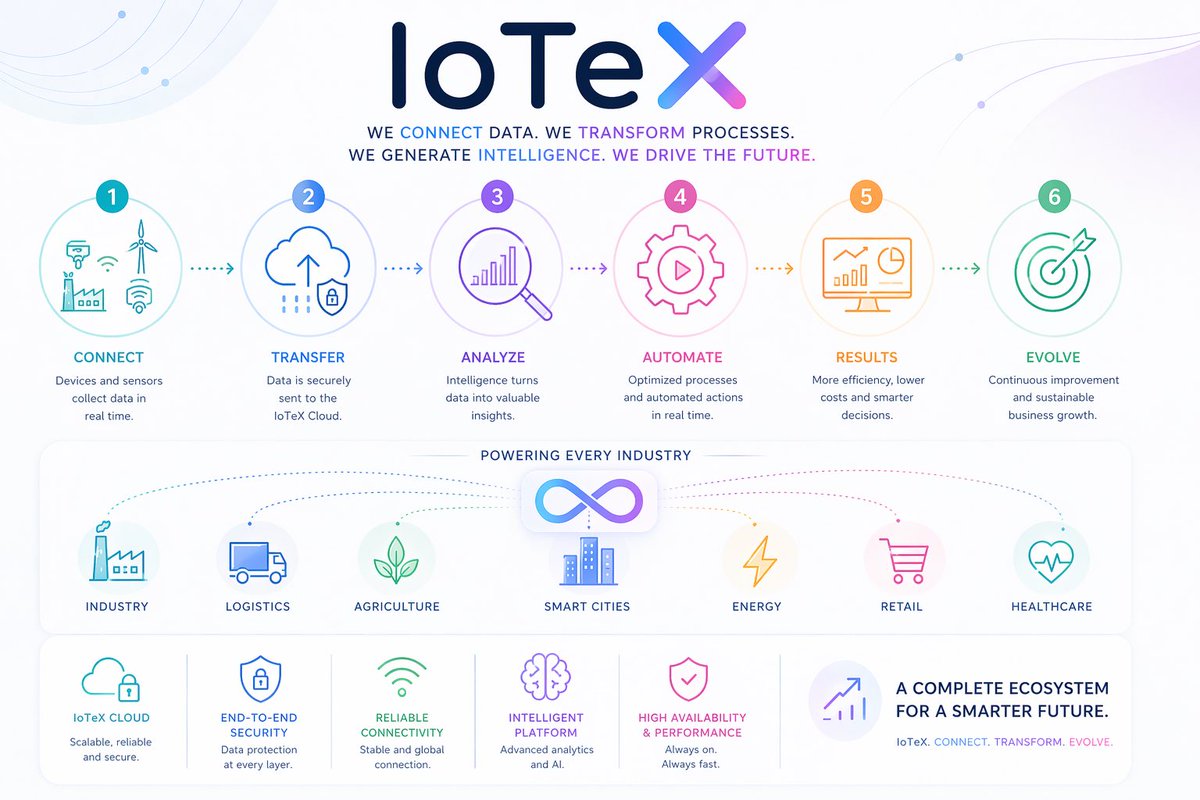
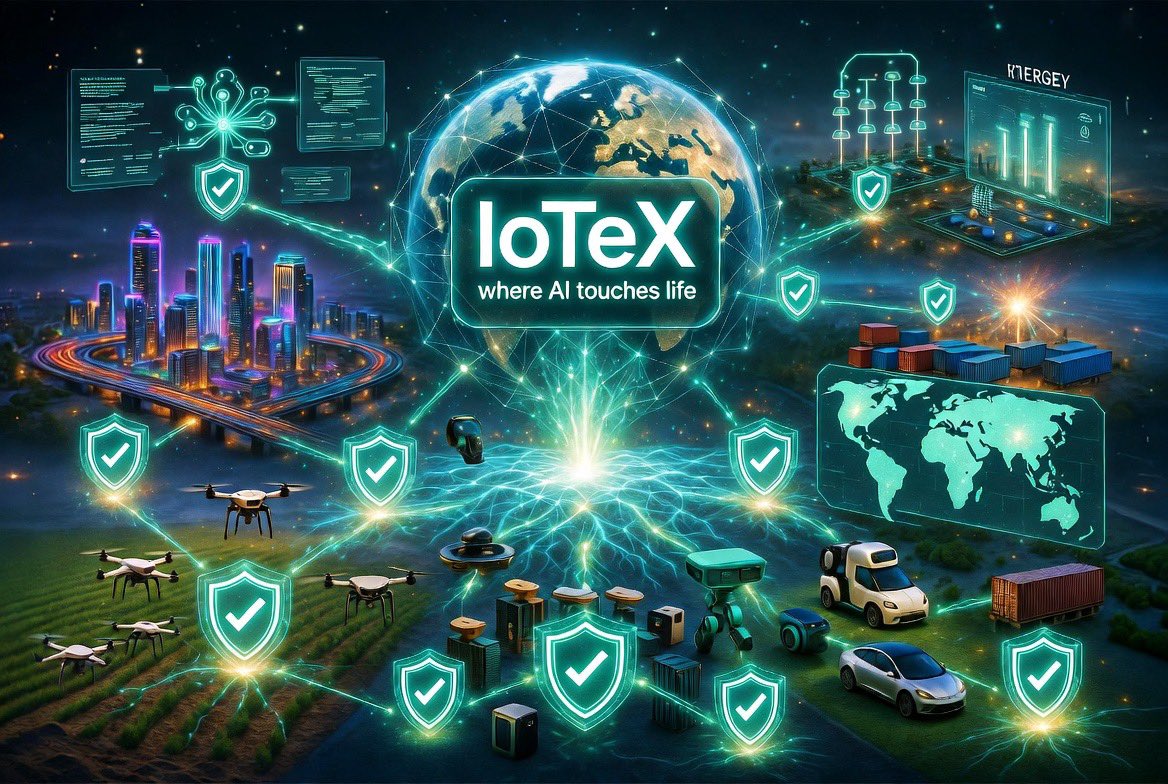
$IOTX by @iotex_io
-Of founders:
@Raullen
@cbetass
@qevan
@cryptoxfan
- Basically:
Connect physical world ↔ blockchain ↔ AI
#DePIN
#MachineFi
#AI
#AIoT
#PhysicalAI
#RealWorldData
#RWA
#IoT
#Blockchain #SmartContracts #W3bstream
#ioID
#Oracles
#Interoperability #Web3Infrastructure
#DeFi
#GameFi
#NFTs
#Wallets
#DEX
#Trading
#Analytics
#Tools
#DevTools
#MachineEconomy #DataEconomy #TokenizedData #DataOwnership #PrivacyTech #SelfSovereignDevices #EdgeAI
#SmartCities
#SmartHomes
#Mobility
#Telecom
#Energy
#SupplyChain
#Wearables
#Robotics #AutonomousSystems #DecentralizedGovernance #Compliance #OnChainProofs #VerifiableData
#Security
👇🏾 We Are All #IoTeXians👇🏾
2
4
16
529

Web3 was built for users.
But what about machines?
That’s where @konnex_world steps in.
Konnex is building the infrastructure for the machine economy — a future where devices don’t just connect… they transact, coordinate, and create value autonomously.
Today, machines are passive endpoints.
With Konnex, they become economic actors.
⚙️ What changes with Konnex?
• Machine Identity Layer
Devices get verifiable, on-chain identities — enabling trust without intermediaries.
• Autonomous Transactions
Machines can pay, earn, and interact directly using smart contracts.
• Data Monetization
Instead of giving data away, devices can sell it permissionlessly.
• Interoperability by Design
Konnex connects fragmented systems into a unified economic layer.
This isn’t just IoT.
This is MachineFi evolving into real Web3 infrastructure.
🌐 Why it matters for Web3
Web3 has focused heavily on users, wallets, and DeFi.
Konnex expands that scope:
→ From users owning assets
→ To machines generating value
→ From manual interaction
→ To autonomous coordination
→ From apps
→ To self-operating networks
The result?
A new economic layer where billions of devices participate on-chain, unlocking entirely new markets.
4
27
Real-time. Local. Verifiable. 📍🦾
This is the MachineFi vision in motion: bringing advanced Vision AI to the edge to transform how machines perceive and interact with the physical world.
On-device intelligence is the foundation of the new machine economy. 🌐
Mar 30

Wow! This is amazing!
Segmented every car locally in real time with Meta's SAM3 converted to MLX.
Just on-device (M2 laptop) vision getting absurdly good.
Local AI is moving faster than most people realize!
What other models should we test? what kind of videos?
2
3
104
"Real-world reasoning" needs real data. 🌍🦾
As Jensen Huang says, the next frontier is Physical AI.
At MachineFi Lab, we provide the verifiable backbone for these agents. For a humanoid robot to "reason and act," it needs a trusted link to the "Metal."🤖⛓️
Mar 24

Useful agents will need to interact with the world as it is.
NVIDIA CEO Jensen Huang joins @lexfridman to break down how physical AI agents like humanoid robots will reason, act, and operate in ways that make sense in the real world.
1
1
2
76

Mar 31
Jeff Dean is right: Amdahl’s Law is the silent killer of AI efficiency. 📉
AI runs 50x faster, but remains throttled by "human-speed" tools. MachineFi Lab is re-engineering the interface by grounding AI in the physical pulse. 📡
Real-time data breaks the bottleneck. 🌐

Jeff Dean says we’re going to have to re-engineer our tools because they were designed for human speed.
An AI agent can run 50x faster, but the tools it relies on don’t.
So even if the model gets infinitely fast, you only get 2-3x improvement overall.
Amdahl’s law still applies.
4
54

Mar 31
GM builders, ran a weird but revealing test this week: hooked a delivery rover’s PoPW stream into three downstream financial rails to see how verifiable work can reshape maintenance, capital, and green accounting
what I wired up and why it matters:
- Maintenance Credits: every verified task also mints a tiny "wear token" that accumulates against the device. After ~200 verified runs the token balance predicted a needed servo swap; operator redeemed credits for a discounted repair quote underwriting moved from paperwork to telemetry
- Revenue Slices: locked future micro‑payouts into a fractionalized revenue note (tradable R‑NFT). Investors can buy capacity, operators get upfront $USDC, and payouts flow automatically when PoPW confirms completion
- Efficiency Credits: PoPW included energy-per-task. Low‑consumption runs minted micro carbon/efficiency credits that can be bundled and sold or applied as fee discounts
what surprised me:
- validators can compute risk scores from the same proof that pays the robot, so insurers and financiers could underwrite without extra integration
- fractional notes compressed capital cycles for ops that otherwise wait 30 60 days for settlements
ran this on @konnex_world testnet with $KNX staking for validator weight and saw settlement minting feel native if machines can generate their own maintenance history and revenue streams, the financing market for fleets looks very different
Who’s experimenting with assetizing uptime and micro‑insurance via PoPW, and what edge cases should we stress next? #MachineFi #DePIN #Robotics #Insurance #GreenWeb3 $KNX $USDC
59
48
168

Konnex is building the GDP of autonomous systems.
A permissionless on-chain marketplace where robots discover jobs, license AI intelligence on demand, sign trustless contracts, and settle payments in stablecoins via Proof-of-Physical-Work.
Turning robot labor into real on-chain value. The future of physical work is here.
@konnex_world #Konnex #DePIN #Robotics #MachineFi
1
2
24

Mar 9
The Economic Engine: Tokenomics and Incentive Alignment
@konnex_world does not just connect machines; it also establishes a sophisticated economic incentive structure that ensures every participant works for the health and efficiency of the system. At the center of this structure is the network’s native asset: the Konnex Token.
➜ Staking for Trust: Validators must lock a certain amount of tokens (stake) to participate in the network. This ensures they have “skin in the game.” Honest behavior is rewarded, while mistakes or malicious actions result in economic penalties through slashing.
➜ The Gas of MachineFi: Every Proof of Physical Work transaction and every skill-rental request executed through the UTL powers the economic engine by paying the network’s gas fees.
➜ Loyalty & Reputation: Earnings are not determined solely by token holdings. The Reputation Score of machines and validators also matters. Robots that operate reliably over long periods can gain higher priority for tasks within the network.
➜ Sustainable Growth: A portion of the collected transaction fees is burned or allocated to the treasury, helping maintain long-term supply–demand balance. This creates a more predictable and sustainable ecosystem for both investors and participants.

2
9
70
Mar 5
The Intersection of Web3 and Robotics: Building the GDP of the Machine Economy
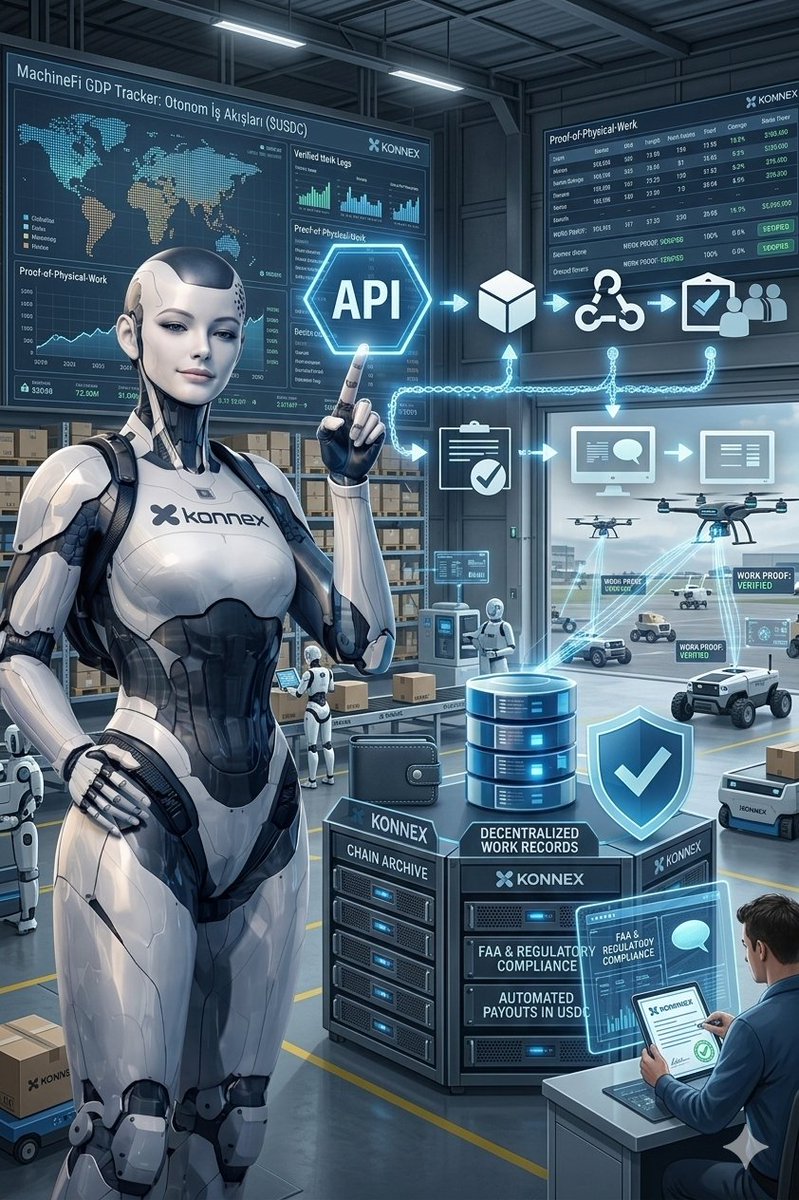
The convergence of Web3 and robotics is far more than a passing trend; it is the fundamental survival model for future autonomous systems. @konnex_world steps in at this precise juncture, building the vital bridge of trust between physical hardware and blockchain.
Technically, what does this mean?
➜ Overcoming Institutional Hurdles: The primary obstacles for autonomous drones or industrial robots are a lack of institutional trust and the complexity of regulatory compliance, such as FAA standards.
➜ Proof-of-Physical-Work: Konnex addresses these challenges through its unique protocol that transforms complex sensor data into immutable, instantly auditable cryptographic receipts on the blockchain.
➜ Breaking Down Silos: Machines that once operated in isolation are now interconnected via a decentralized network, communicating through a JSON-based universal language.
➜ Mathematical Verification: The true breakthrough is the machine’s ability to mathematically prove its work, ensuring transparency and reliability.
➜ Automated Settlement: Once work is verified, smart contracts trigger immediate payment settlement in stablecoins, creating a seamless financial flow.
➜ The Rise of MachineFi: This evolution means the machine economy is quietly yet firmly constructing its own independent GDP.
2
10
64

Feb 25
My Top Crypto Picks
Core Long Term Portfolio
$BTC
$SOL
$ETH
$TAO
$LINK
$ONDO
AI Picks
$VIRTUAL
$RENDER
DEGEN PICKS
$ARC - we have already done 1200% on this - so careful
$ANON - Decentralized prediction market
$GHOST - Sol needs privacy
$ORE - for trade opportunities
$PRCL - partnership with Polymarket
ROBOTIC PICKS
$PEAQ - MachineFI leader
$AUKI
$GEOD
$OPAN - Zero or Hero
$NRN
2
12
280

Feb 21
I remember towards the tail end of 2021 and when the whole machineFi was happening, I thought iotex is going to be huge…
Then they promised that they’ll switch to native iotex on coinbase and it never happened… it raised suspicion… why did they promise but never happened…
Anyway it’s so sad to see iotex down this bad… had so much faith in this team…
Meh 🫤
1
11
920
