
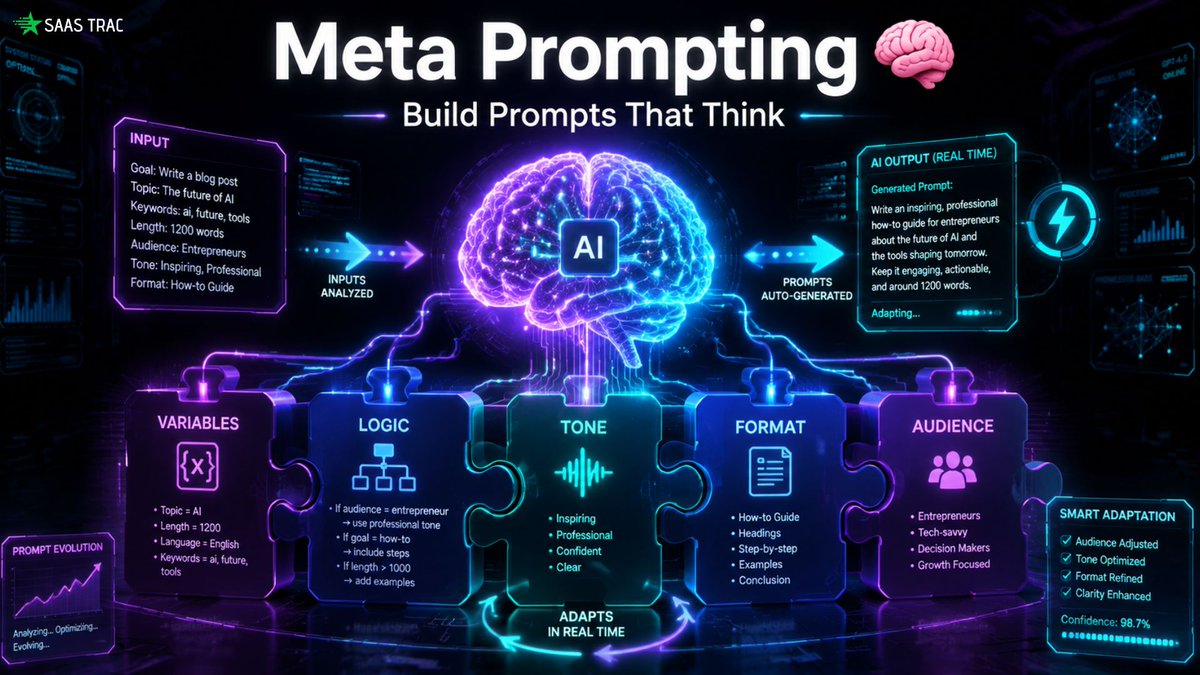
Rewriting AI prompts every time? 😩 Wasting hours on trial & error?
Meta prompting flips the game. Build prompts that adapt, scale, and evolve automatically. ⚡
Stop writing prompts. Start designing prompt systems. 🧠
👉 Read the full blog: aiagents.saastrac.com/enhanc…
#MetaPrompting #PromptEngineering
#AITools #AIForBusiness
16

github.com/joshp123/ai-stack…
this is my current metaprompting skill, imo the loops deal is less about reactive work yet, and more about getting agents to converge with less human steering
reactive agent farming work CAN be good imo but only for well defined work on predictable inbound (which there is a lot of in openclaw, like triaging PRs or triaging user content, we do a ton of this).
reacting to emails will imo work badly unless you have really good agent steering and memory (and i don't think anyone has cracked this yet. working on it)
reacting to commits, making summaries of discord/slack/git; automatically fixing broken CI - these work pretty well after some steering. use this in "prod" for fixing openclaw packaging CI if upstream makes breaking changes, works pretty well.
1
360
it's true but i think peter is right, the metaprompting will slowly become the new game. right now it sort of works if you brute force it.
i predict this time next year eventually we'll end up with a less crazy version of gas town.
pattern along the lines of a chief of staff agent orchestrating lead agents per workstream/project who fan out smaller but still long-running tasks.
175


May 24
He had 5 Hermes agents running for 2 months straight. Here's the 5 use cases nobody talks about.
[ use case 1 — /goal with meta-prompting ]:
-most people type /goal "build me an app" and wonder why it's mid.
the unlock: ask Claude to write the /goal prompt FOR you first.
tell it what you want to build → "build me a /goal prompt for this" paste that output → Hermes runs for 24 hours on a real task.
metaprompting is what makes /goal actually work.
[ use case 2 — the kanban board ]:
-type "hermes dashboard" in terminal → open the URL → go to Kanban.
every morning: write your to-do list, drop anything AI can handle into triage. it auto-assigns tasks to agents and sub-agents.
you go handle the human stuff. come back. it's done. this is what having an employee feels like.
[ use case 3 — competitor research ]:
-"open a browser, go to [competitor].com, full technical breakdown — stack, features, analytics, what can we emulate"
Hermes opens a real browser, clicks around, reads the console. outputs a full markdown report. drop that into Claude Code or Codex. you just reverse-engineered a competitor in 10 minutes.
Hermes builds it. you get an automated diary of every session. you can look back. Hermes can look back. memory reinforcement that actually works.
[ use case 5 — multi-device admin via Tailscale ]:
-install Tailscale on every device (free). one private network.
now Hermes can reach your desktop from your phone, grab files, run local LLMs across machines, test localhost builds on other computers.
CEO of all your devices. this is the #1 use case.
the prompts for use cases 4 and 5 are in the comments 👇

1
4
346

May 23
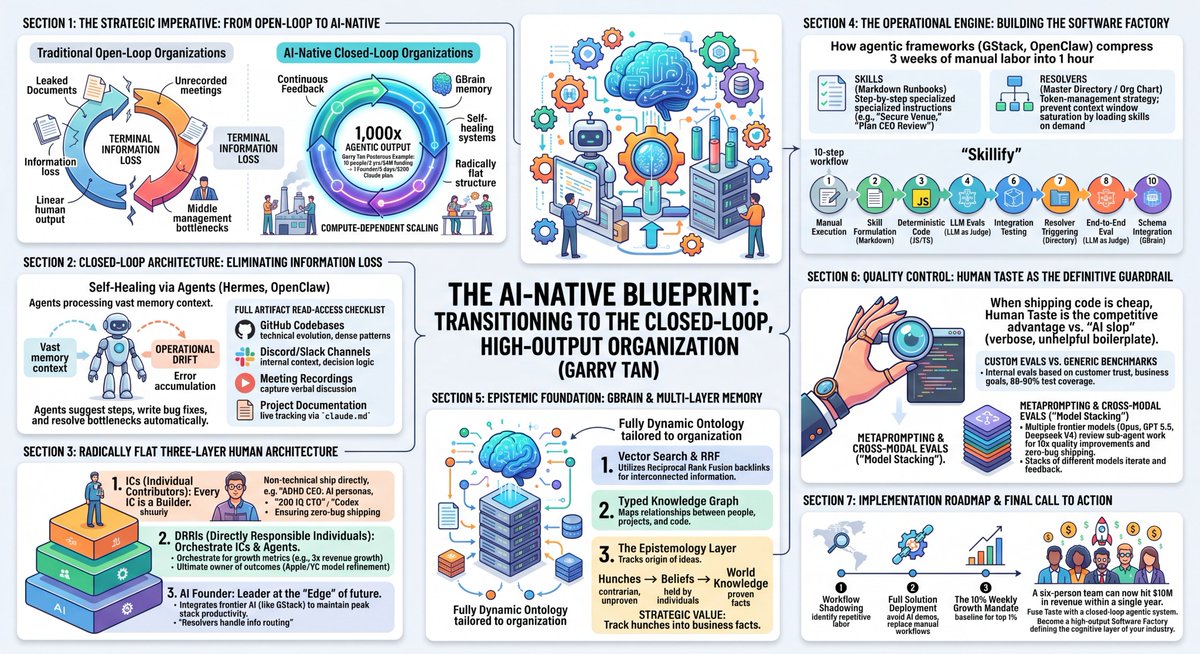
The 1,000x Revolution: How AI-Native Founders Are Building $10M Startups in Days
1. The Death of the Venture Capital Bottleneck
In 2011, Silicon Valley was choking on the "Standardization of Capital" problem. Venture funding was a friction-heavy mess of bespoke legal negotiations until Y Combinator introduced the "Safe"—a two-page document that turned capital into a commodity. It was a pivotal systems-level fix that unblocked the path for an entire generation to build the internet and social networks.
Today, we have reached the "Standardization of Compute." We are no longer just building apps; we are architecting the cognitive layer for all of society. This shift represents a fundamental change in the unit of production. We are moving past the "co-pilot" era and into the era of the 1,000x engineer. In this new reality, AI is not a tool—it is a factory. It allows a single founder to collapse the traditional organizational chart into a high-velocity, automated engine of execution.
2. The Five-Day Startup: Boiling the Ocean with Software Factories
The "Software Factory" is the end of restricted scope. Using frameworks like GStack and agentic tools like the Hermes agent or OpenClaw, the barriers of time and capital have evaporated. Gary Tan recently proved this by recreating Posterous—a startup that originally required ten people, two years, and $4 million in funding—in just five days. He did it alone, sitting at a terminal with a $200-a-month Claude Code Max plan.
Traditional corporate culture warns, "Don't boil the ocean." I’m here to troll that sentiment: In the software factory, boiling the ocean is the only way to win. When you act as a thousand-person firm, you don't pick a niche; you automate entire industries simultaneously.
"Engineers using advanced AI coding agents are estimated to be 10x to 100x more productive than those merely using standard chat interfaces, and up to 1,000x more productive than top engineers were in 2005."
In this new paradigm, model weights haven't even caught up to the reality of the speed. When an LLM estimates that a feature set will take three weeks of engineering, an AI-native founder approves the plan and watches the execution complete in one hour. If you aren't operating at this level of "latent space" speed, you simply aren't going to make it.
3. Stacking Personas: The ADHD CEO and the 200 IQ CTO
To ship zero-bug code at this velocity, you must move beyond simple prompting into "metaprompting"—stacking AI abstractions and personas to collaborate and peer-review. This is about pulling specific capabilities out of the latent space to create an internal executive team.
In a GStack-driven workflow, founders stack different personas to perform cross-modal evaluations:
The ADHD CEO (Claude Code): A fast-moving agent that drives rapid-fire vision and execution.
The 200 IQ CTO (Codex): A highly intelligent, precise model that handles technical rigor and deep architectural logic.
These models engage in a critical feedback loop. Frontier models—Opus, GPT 5.5, and Deepseek V4—are used to review the sub-agents' work, assign ratings, and feed specific fix instructions back into the loop. This cross-modal iteration forces the AI to refine its output until it is 10x better than a first draft, ensuring that even a solo founder ships production-ready, dense code rather than verbose "AI slop."
4. Transitioning to the Closed-Loop Organization
Most companies are "Open-Loop" systems. Information is "lossy," trapped in Slack DMs, undocumented meetings, and the heads of employees. As error accumulates, these organizations inevitably go off the rails.
The AI-native company is a "Closed-Loop" organization where agents are embedded into the decision-making fabric. These agents—whether using Hermes or OpenClaw—must have read access to every company artifact: GitHub repos, Discord channels, and meeting recordings. This allows for a "self-healing" system that suggests next steps and writes bug fixes based on the total state of the company.
This flattens the org chart into three radical roles:
Individual Contributors (ICs): Everyone is a builder. Even a salesperson is an IC using tools like Gemini Live or Twilio to automate their own pipeline.
Directly Responsible Individuals (DRIs): Borrowing from the Apple model, these are outcome owners who orchestrate agents and ICs to hit massive growth metrics, such as tripling revenue in a quarter.
The AI Founder: The visionary living at the "edge of the future," constantly integrating new model capabilities into the company's "software factory."
5. Human Taste: The Only Guardrail Against "AI Slop"
As the cost of shipping code approaches zero, human "taste" becomes the only durable moat. Taste is the ability to discern the "platonic ideal" of a product from generic, unhelpful generation.
In an AI-native firm, taste is applied through the "painstaking review of AI traces." You cannot rely on generic public benchmarks like MLU to tell you if your agent is upsetting users. You must look at the traces: Did the agent follow instructions? Did it preserve customer trust? Did it hit the business goal?
"The ultimate judge of quality is whether users genuinely want the product and are willing to pay for it, which is something that cannot be automated away."
Human operators stay in the loop to label failure cases and convert them into new evaluations (Evals). These failure cases are replayed into the system, forcing the AI to self-correct and improve its prompts automatically.
6. The Epistemology Layer: Tracking the Evolution of a Hunch
Managing the memory of an AI-native org requires a sophisticated architecture beyond simple RAG. Traditional "knowledge wikis" fall over because they rely on lossy text generation. The GBrain system solves this with a three-layer memory structure: Vector Search, a Typed Knowledge Graph, and a specialized Epistemology Layer.
The Epistemology Layer tracks the nature and origin of ideas, distinguishing between three states:
A Hunch: A contrarian, unproven idea.
A Belief: A view held by a specific individual.
World Knowledge: Established fact.
GBrain utilizes a dynamic ontology to adapt its structure to the user’s specific framework. It is designed to track a founder’s journey—recording a contrarian hunch today and connecting it to its eventual manifestation as fact five years later. It captures the unique intellectual history of the firm, preventing hallucinations and ensuring that the organization’s "brain" grows more robust over time.
7. Skills and Resolvers: The New Primitives of Work
The software factory runs on two primitives: Skills and Resolvers.
Skills: These are markdown-based runbooks—individual "employees" with specific capabilities (e.g., "securing a venue" or "plan-ge review").
Resolvers: This is your "org chart." To prevent context window overflow, a resolver acts as a master directory. It dynamically pulls the specific skill instructions into the agent's memory only when needed.
The core work of the modern founder is to "Skillify" a task. Writing the code is only two of the ten required steps. Skillification is a compliance-heavy workflow that includes:
Writing the skill markdown and deterministic code.
Creating unit tests and LLM Evals for the skill file.
Running an LLM as judge eval to ensure the trigger is broad enough.
Executing a "check resolvable" audit to avoid redundant skills.
Running an end-to-end smoke test to ensure the agent remains reliable in production.
8. Conclusion: The $10 Million, Six-Person Future
The unit of production has changed. We are seeing AI-native startups average 10% week-over-week growth, tripling in size in three months—a milestone that used to take five years and tens of millions in venture capital. In this environment, a six-person team can generate $10 million in revenue because each employee is producing $1 million to $2 million in value.
The fear of disappearing CS jobs is misplaced. There is a massive "white space" of opportunity in unsexy, back-office industries that have been ignored for decades. Founders acting as "Forward Deployed Engineers" are going undercover in Loan Servicing, Freight Forwarding, and Document Processing—shadowing workers to understand the repetitive labor and then automating it out of existence.
We are in the first pitch of the first inning. The technical barriers have fallen. The question is no longer about your headcount, but whether you are ready to stop being a "co-pilot" and start running your own one-person frontier lab.

How does one engineer become a 1000x founder? @sdianahu and I give you the real goods here
Thanks @AnjneyMidha for having us!
youtube.com/watch?v=Lri2LNYt…

57


Metaprompting example I just did for GBrain to rewrite the README in the newest PR:
Read the README as a user who has never used GBrain and doesn't know anything about it. Does GBrain seem good? Do you know what it is? Does it make you feel powerful? Do you know how to get started?
Run an eval against this, and then rate it on 0 to 10, then give it a rating. Why isn't it a 10? Figure out what to do to make it a 10. Then implement it.
65
27
489
37,477

May 17
what do you think is the next layer of metaprompting after goals? like "hey use /goal to build me a billion dollar company"? epics?
1
29

May 13
most people have no idea how powerful metaprompting is
May 13

Just a fun thing to do every once in a while, ask codex, "study how i've been using codex and make recommendations for how i can improve"
2
53

May 13
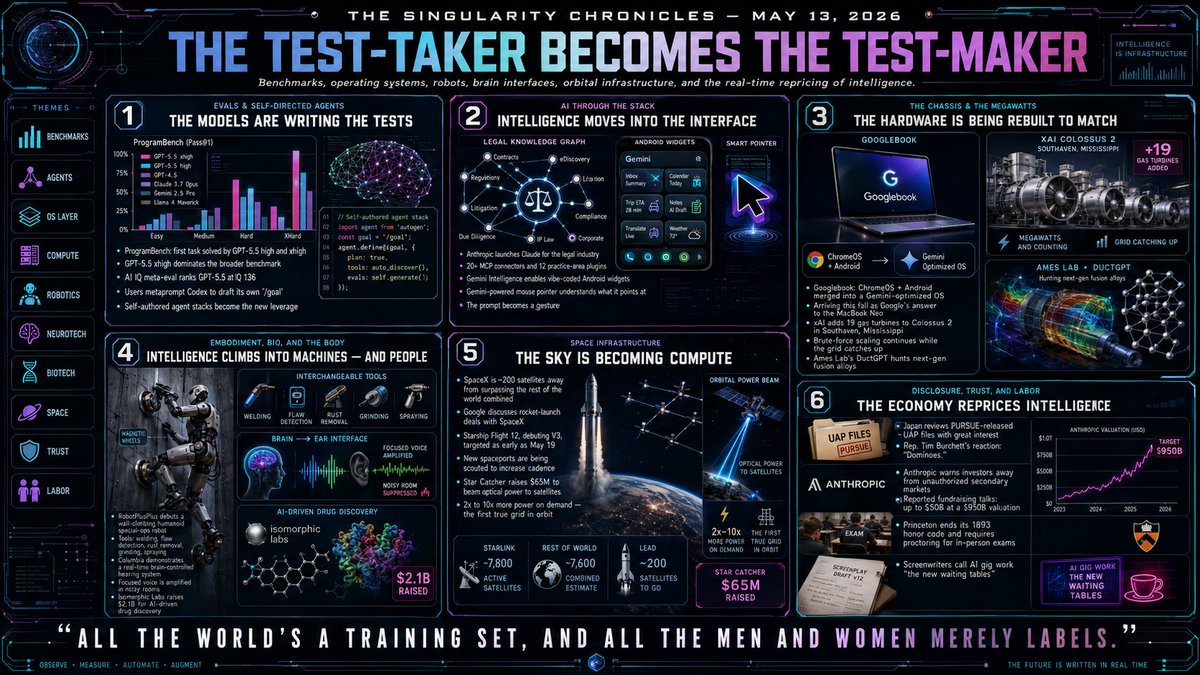
Users are now metaprompting Codex to write its own /goal. The agent picks the target. The agent picks the strategy. The agent does the work. We aren't directing AI anymore. We're attending its meetings.
1
2
91


metaprompting is the skill gap nobody talks about. most ppl treat the prompt like a google serch instead of a design spec
30
My viral meta-meta-prompting post about personal AI is directly a consequence of the thinking about and building with metaprompting in January and February of this year 👇
The one skill everyone who uses AI needs to master in 2026
Meta-prompting: using an LLM to generate, refine, and improve the very prompts you use to get work done.
garryslist.org/posts/metapro…
35
7
229
38,658

Adversorial metaprompting is a cheat code for excellent results

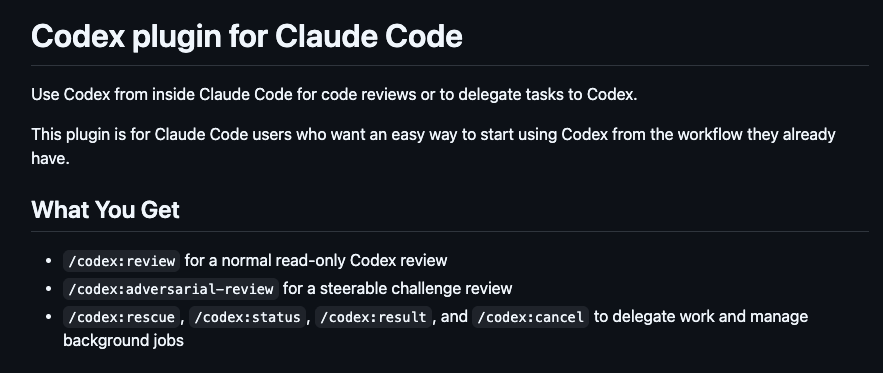
OpenAI shipped a plugin so Claude Code can call Codex...
i've said it before and i'll say it again, running two coding agents simultaneously is 10x better than using either alone
it's just how LLMs work
the move: Claude writes, Codex reviews adversarially and catches what the first model missed in its own draft
one slash command does the work: /codex:review
47