
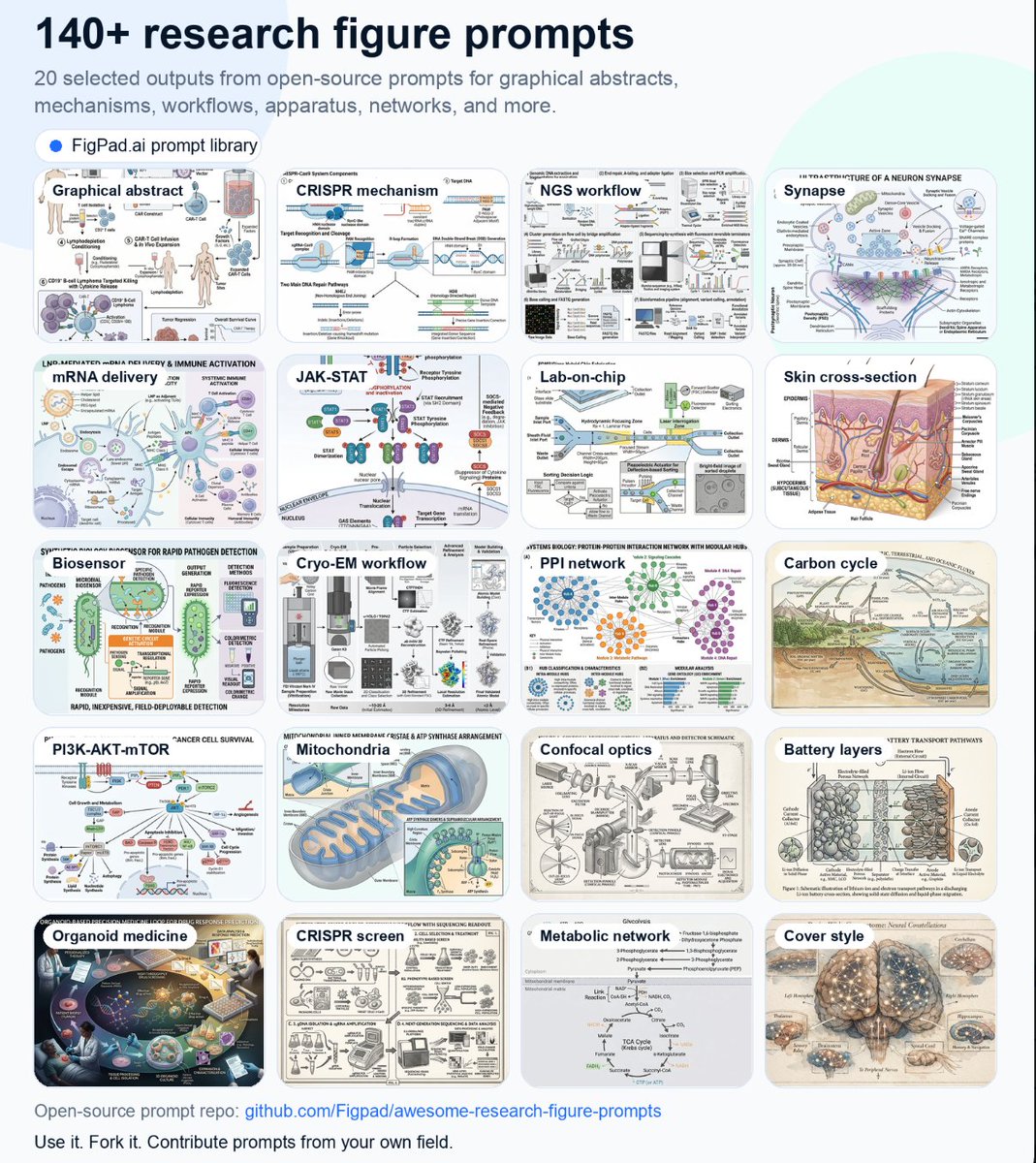
GPT Image and Nano Banana can now generate impressive scientific figures. But the more I test them, the more I feel the real bottleneck is not image generation. It is prompt writing.
Most researchers do not need a prompt like “make a beautiful scientific figure.” They need a prompt that explains the science: what the mechanism is, what happens first and next, which cells/molecules/materials must appear, what should be labeled, how the layout should work, and what the model should avoid.
That is the difference between a figure that looks nice and a figure that actually communicates research.
So we open-sourced 140 research figure prompts with real output examples across graphical abstracts, mechanisms, workflows, lab apparatus, microstructures, systems/networks, cross-sections, ecology diagrams, and journal-cover-style visuals.
The goal is simple: help researchers spend less time staring at a blank prompt box, and more time communicating their science clearly.
Repo:
github.com/Figpad/awesome-re…
Use it, fork it, or contribute prompts from your own field.
15
cclairvoyant retweeted

discovering dozens of microstructures beneath my old boots. microlithic monuments
1
3
39
1,160

Their skin microstructures repel water AND dirt simultaneously, nature solved self-cleaning before humans even thought to try.
 Sinaptica
54

Day-2
Iron-Carbon phase diagram is an equilibrium thermodynamic map.
tell us: which phases are stable, what temperature and what carbon content is.
Every mechanical property originates from microstructures and microstructure originates from phase transformations.
Kind of fundamental in propulsion.
3
38

Jun 13
We all know that BSM doesn't produce useful option price at T->0.
A discrete poisson model with observable crossing rates produces real non zero OTM option prices without parameter inflation.
The discrete approximations is closer to market microstructures reality than GBM
Jun 13

SPY price on a 1 min chart is effectively discrete
The barrier width b(t)=$0.76 is larger than the min tick.
Every 0-DTE practitioner knows that the real question isn't whether price is technically continuous,it is if a continuous gaussian assumption produces useful option price
1
27

Jun 13
I remember reading this in 2024. That's part of what made me realize my doctor lied about the brain in the wrong body theory. It is just a theory at the end of the day. The early studies done on brain microstructures if I recall correctly didn't have controls to differentiate between homosexuals and (what they called then transvestites) so there wasn't a perfect control for transsexuals. (Because back then people were ignorant and lumped everyone who dressed differently than a stereotype under one category, so homosexuals and transvestites). There may have been studies I didn't see though so @datadriven_tdoc if you find any interesting studies on this subject feel free to send them my way!! The brain differences in particular interest me due to the connection to my own story. 🫶🏼 🫶🏼
1
4
88

This study presents a self-adjusting voxelated #Electrochemical #3Dprinting approach enables precise #Fabrication of metallic microstructures, enhancing accuracy, reliability, and scalability in microscale #Manufacturing.
#IJEM #OpenAccess: doi.org/10.1088/2631-7990/ad…
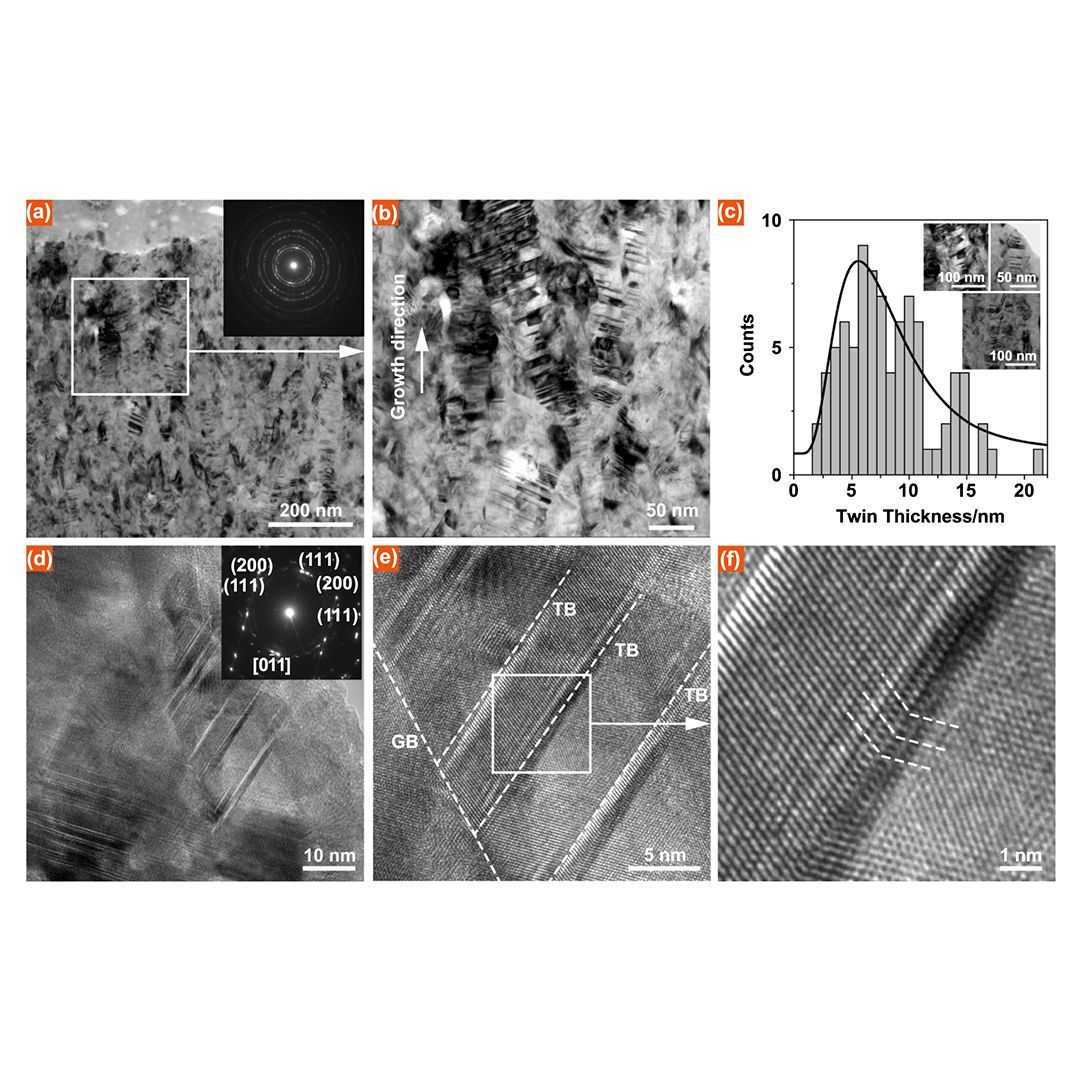
ALT Self-adjusting voxelated electrochemical three-dimensional printing of metallic microstructures
11


Jun 11
Most people call it a “coating.”
On many performance GLASS mousepads, the important part is not a coating at all.
It is the surface geometry of the glass.
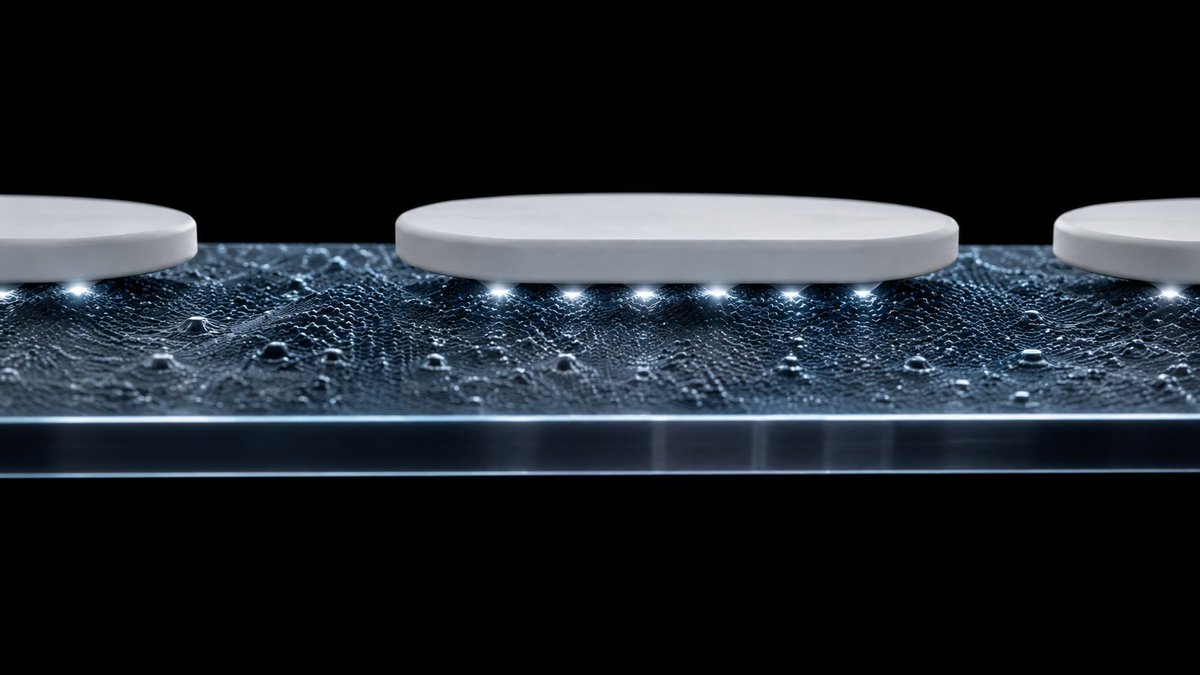
A good glass pad is not just a flat sheet with magic sprayed on top. The real performance comes from microtopography: tiny surface structures that change how PTFE or UHMW-PE skates touch the pad.
That is what sets:
- static friction
- kinetic friction
- pressure response
- skate wear
- dust/oil behavior
- sensor behavior
- batch consistency
The key mistake is thinking “smooth glass = fast.”
Not always.
Too smooth can increase real contact area and adhesive friction.
Too aggressive can create scratchy ploughing friction, faster skate wear, or unstable feel under pressure.
The best glass surfaces live in the controlled middle:
enough structure to reduce contact area, but not so much that the skate starts mechanically digging into the surface.
That is why many modern glass pads are about controlled etched or engineered microstructures, not just “coating.”
A speed-oriented surface may use shallow, low-contact structures to reduce adhesive friction.
A control-oriented surface may use denser craters, ridges, or asperities that increase tactile response and friction under load.
This is also why two pads that look visually similar can feel completely different.
Same glass color.
Same size.
Same base.
Completely different glide.
Because the surface is doing the work.
The hard part is consistency.
If the process uses chemical etching, spray treatment, masking, or another controlled surface modification route, small drift matters:
- dwell time
- temperature
- chemistry concentration
- rinse quality
- surface cleanliness
- nozzle condition
- carrier speed
- pre-cleaning
- final metrology
A tiny change in the surface can become a real change in glide.
That is why batch-to-batch consistency is not a marketing detail.
It is a process-control problem.
Consistent factories measure the surface.
They do not just look at it under a lamp and say “fine.”
For a gaming mousepad, the surface should be tested with actual skate materials and realistic load, because the mouse/skate/pad system is a tribology problem.
A mousepad is not only a design object.
It is a friction system.
And when people say:
“this glass pad coating feels different”
the more accurate question is often:
What did they do to the glass surface itself?
*PICTURE GENERATED WITH AI FOR ILLUSTRATIVE PURPOSES ONLY – WITHOUT BASHING ANY BRANDS!
6
7
60
6,979
Eyisha Zyer retweeted

May 19
Introducing #Rodin Gen-2.5🚀
🔥World’s 1st 10 MILLION polygon #3D GenAI — down to skin microstructures.
1️⃣1M-poly in 4s
2️⃣Adaptive thinking effort - just like LLMs
3️⃣3D-native textures, no blind spot
4️⃣Batch up to 10 results
💥Manual BANG to Parts & more...
🚨$1 for first mo!
44
128
926
572,055

Lattice genome: representation and analysis of heterogeneous crystalline microstructures
Jiayang Wang, Mathieu Calvat, J. C. Stinville, Marat I. Latypov
arxiv.org/abs/2606.09611 [𝚌𝚘𝚗𝚍-𝚖𝚊𝚝.𝚖𝚝𝚛𝚕-𝚜𝚌𝚒]
32

Biyun Yang et al. systematically investigated the anatomical characteristics and infrared spectral properties of different microstructures in the midribs of healthy and #Huanglongbing-infected citrus leaves: doi.org/10.1094/PHYTO-10-25-…
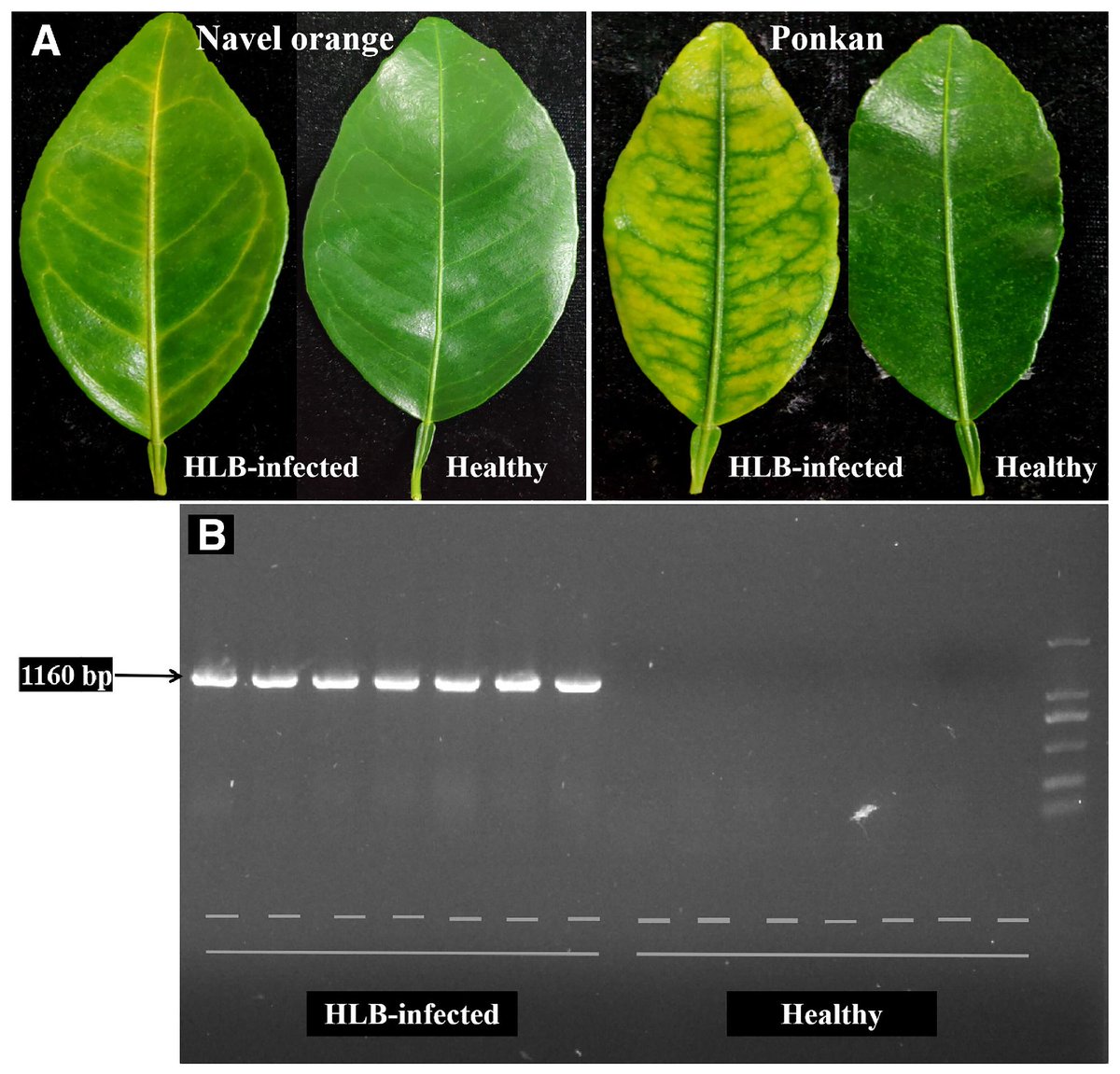
ALT Fig. 1. A, Representative Huanglongbing (HLB)-infected and healthy leaves of Navel orange and Ponkan and the B, polymerase chain reaction results.
1
148

Both use a distinct formula and having accepted the convention that by using ✔️, one means only a positive sq rt, both used distinct formula to explain a naturally occuring phenomena, Bouligand microstructures explain in part plant & animal patterns. Nobel Liebniz should have got
2
15


𝐅𝐑𝐄𝐄 𝐓𝐎 𝐑𝐄𝐀𝐃 𝐔𝐍𝐓𝐈𝐋 𝟑𝟏 𝐀𝐔𝐆𝐔𝐒𝐓 𝟐𝟎𝟐𝟔!
worldscientific.com/doi/epdf…
𝙋𝙧𝙤𝙘𝙚𝙨𝙨–𝙨𝙩𝙧𝙪𝙘𝙩𝙪𝙧𝙚 𝙧𝙚𝙡𝙖𝙩𝙞𝙤𝙣𝙨 𝙞𝙣 𝙬𝙞𝙧𝙚-𝙡𝙖𝙨𝙚𝙧 𝙙𝙞𝙧𝙚𝙘𝙩𝙚𝙙 𝙚𝙣𝙚𝙧𝙜𝙮 𝙙𝙚𝙥𝙤𝙨𝙞𝙩𝙞𝙤𝙣 𝙤𝙛 𝙗𝙞𝙣𝙖𝙧𝙮 𝙏𝙞48𝘼𝙡 𝙖𝙡𝙡𝙤𝙮: 𝙀𝙛𝙛𝙚𝙘𝙩𝙨 𝙤𝙛 𝙨𝙪𝙗𝙨𝙩𝙧𝙖𝙩𝙚 𝙥𝙧𝙚-𝙝𝙚𝙖𝙩𝙞𝙣𝙜 𝙖𝙣𝙙 𝙝𝙚𝙖𝙩 𝙩𝙧𝙚𝙖𝙩𝙢𝙚𝙣𝙩
Haneen Daoud, Agata Kulig, Kim Schmidt, Lea Diewitz, Johannes Weiser, Anna Manzoni, and Uwe Glatzel
This article is part of the issue:
𝐒𝐩𝐞𝐜𝐢𝐚𝐥 𝐈𝐬𝐬𝐮𝐞: 𝐀𝐝𝐯𝐚𝐧𝐜𝐞𝐬 𝐢𝐧 𝐀𝐝𝐝𝐢𝐭𝐢𝐯𝐞 𝐌𝐚𝐧𝐮𝐟𝐚𝐜𝐭𝐮𝐫𝐢𝐧𝐠 𝐚𝐧𝐝 𝐄𝐧𝐠𝐢𝐧𝐞𝐞𝐫𝐞𝐝 𝐌𝐚𝐭𝐞𝐫𝐢𝐚𝐥𝐬 (𝐏𝐚𝐫𝐭 𝐈𝐈) worldscientific.com/toc/nmmr…
Microstructures are characterized using optical microscopy (OM), scanning electron microscopy (SEM), electron backscatter diffraction (EBSD), transmission electron microscopy (TEM), and X-ray diffraction (XRD). In the as-deposited condition, the microstructure is heterogeneous, comprising large spheroidal regions of γ-TiAl alongside smaller equiaxed grains containing an α2/γ lamellar structure.

2
2
213

No, scientists have not found actual genomic DNA sequences inside dinosaur soft tissue.
While paleontologists have discovered remarkable preserved organic microstructures—like blood vessels, collagen proteins, and cellular shapes containing potential chemical markers of heavily degraded DNA fragments—they have not recovered any intact or sequenceable genetic material.
So that's false. And C14 contamination is a thing and doesn't debunk anything. Those fossils have been verified to be tens of millions of years old.
Instead of just relying on old outdated arguments that have been debunked for years, try learning how these things happen. You obviously only stuck with creationists "gotchas" and don't search for knowledge yourself.
And I've studied a lot about the soft tissue phenomenon. It's explained naturalisticly.
My notes below⬇️

1
1
20