
35m
Meta owns:
Facebook
Instagram
WhatsApp
Messenger
Threads
Oculus / Meta Quest VR
Meta AI
Meta is controlled by Mark Zuckerberg who is jewish
Alphabet owns:
Google
YouTube
Android
Gmail
Chrome
Pixel phones
Nest smart home devices
Fitbit (acquired in 2021)
DeepMind
Gemini AI assistant/model family
Waymo — self-driving cars
Verily — health technology
Calico — longevity research
Wing — drone delivery
Alphabet is controlled by Larry Page and Sergey Brin who are both jewish
Tic Tok
U.S. algorithm, cybersecurity and infrastructure is controlled by Oracle
Oracle is controlled by Larry Ellison and he’s jewish
Hookup Apps
Match Group owns:
Tinder
Hinge
OkCupid
Match.com
Plenty of Fish
Meetic
The League
BLK
Archer
OurTime
Was founded by Barry Diller who is jewish
Grindr
Was founded by Joel Simkhai who is jewish
Bumble
Was founded by Whitney Wolfe Herd who is jewish
Porn
Onlyfans
Owned by Leonid Radvinsky who is jewish
Vixen Media Group owns:
Blacked
Blacked Raw
Vixen
Tushy
Deeper
Founded by Greg Lansky who is jewish
Aylo/MindGeek Owns/owned:
Pornhub
YouPorn
RedTube
Brazzers
Reality Kings
Digital Playground
Men.com
Sean Cody
Tube8
Solomon Friedman is the owner of Aylo and he’s jewish
Gamma Entertainment owns/operates:
Adult Time
Pure Taboo
Wicked
Girlsway
many affiliate studios/platforms
Founded by Karl Bernard who is jewish
Movies/TV/News
Warner Brothers Discovery owns:
Warner Bros. Pictures
HBO
CNN
DC Studios
Cartoon Network
Discovery Channel
TNT
TBS
Max (formerly HBO Max)
Adult Swim
HGTV
Food Network
Animal Planet
Warner Brothers is run by David Zaslav who is jewish
Disney owns:
ESPN
ABC
Marvel Studios
Lucasfilm
Pixar
20th Century Studios
Disney
Hulu (major controlling stake)
National Geographic
Disney is run by Bob Iger who is jewish
Paramount Global owns:
Broadcast & News
CBS
CBS News
CBS Sports
Local CBS stations
Film Studios
Paramount Pictures
Paramount Animation
Paramount Players
Cable Networks
MTV
Nickelodeon
Comedy Central
BET
VH1
CMT
TV Land
Smithsonian Channel
Logo TV
Pop TV
Streaming & Premium
Paramount
Showtime
Pluto TV
Major franchises/IP
Top Gun
Mission: Impossible
Star Trek
South Park (licensing/streaming arrangements)
SpongeBob SquarePants
Transformers
Teenage Mutant Ninja Turtles
Paramount Global is controlled by Sheri Redstone, who is jewish
Comcast owns:
* NBCUniversal
* NBC
* Universal Pictures
* Peacock
* MSNBC
* CNBC
* Telemundo
* Sky (Europe)
* DreamWorks Animation
* Xfinity
Comcast is controlled by Roberts family who is Jewish
AI/Data Centers
OpenAI/ChatGPT
Run by Sam Altman who is jewish
Palentir provides advanced data integration, surveillance, AI, and analytics infrastructure used by military, intelligence, law enforcement, and major corporations. Its platforms help organizations combine massive amounts of fragmented data into real-time operational intelligence for warfare, policing, logistics, cybersecurity, manufacturing, and decision-making, making it one of the most strategically influential data and defense technology companies in the world.
Owned and operated by Peter Thiel and Alex Karp both jewish
Oracle owns:
Oracle Database
Java
MySQL
NetSuite
Cerner
Sun Microsystems technologies
It’s important because it owns core infrastructure software that powers governments, banks, hospitals, corporations, and large parts of the internet. Its control of technologies like Oracle Database, Java, MySQL, and Cerner gives it enormous influence over the backend systems modern society depends on.
Owned by Larry Ellison who is jewish
1
1
2
96

💻 EVOLUTION OF PROGRAMMING LANGUAGES (1945–2025) 🚀
Programming languages are the foundation of the digital world. Every website, mobile app, operating system, AI model, video game, and spacecraft software is built using programming languages. Over the past 80 years, programming languages have evolved from machine-level instructions to powerful AI-oriented languages that allow developers to build complex systems with just a few lines of code.
🧵 A detailed thread on the history and evolution of programming languages:
🔹 1945 – Plankalkül
• Designed by German computer scientist Konrad Zuse.
• Considered the world's first programming language.
• Created for engineering and mathematical calculations.
• Far ahead of its time and not widely implemented during its early years.
• Laid the theoretical foundation for modern programming.
🔹 1957 – FORTRAN (Formula Translation)
• Developed by IBM.
• First widely used high-level programming language.
• Designed for scientific and engineering calculations.
• Significantly reduced programming complexity.
• Still used in high-performance scientific computing.
🔹 1958 – LISP
• Created by John McCarthy.
• One of the oldest programming languages still in use.
• Became the foundation of Artificial Intelligence research.
• Introduced functional programming concepts.
• Influenced many modern AI systems.
🔹 1959 – COBOL
• Developed under the leadership of Grace Hopper.
• Designed for business and commercial applications.
• Used extensively in banking, insurance, and government systems.
• Many financial institutions still rely on COBOL today.
🔹 1964 – BASIC
• Created by John Kemeny and Thomas Kurtz.
• Made programming accessible to students and beginners.
• Popularized computer education worldwide.
• Inspired many future programming environments.
🔹 1967 – Simula
• Developed in Norway.
• World's first Object-Oriented Programming (OOP) language.
• Introduced classes, objects, and inheritance.
• Influenced C , Java, C#, Python, and many others.
🔹 1970 – Pascal
• Created by Niklaus Wirth.
• Designed to encourage structured programming.
• Widely used in computer science education.
• Helped programmers write cleaner and more reliable code.
🔹 1972 – C Language
• Developed by Dennis Ritchie at Bell Labs.
• One of the most influential languages ever created.
• Used to develop the UNIX operating system.
• Forms the foundation of countless modern technologies.
• Linux, databases, embedded systems, and operating systems heavily rely on C.
🔹 1974 – SQL
• Developed by IBM researchers.
• Standard language for database management.
• Enables storing, querying, and managing data.
• Remains the backbone of modern data systems.
🔹 1980 – Ada
• Developed for the U.S. Department of Defense.
• Designed for safety-critical applications.
• Used in aviation, military, and aerospace systems.
• Known for reliability and security.
🔹 1983 – C
• Created by Bjarne Stroustrup.
• Extended C with Object-Oriented Programming features.
• Powers game engines, browsers, operating systems, and financial systems.
• One of the most powerful programming languages ever developed.
🔹 1984 – MATLAB
• Created by Cleve Moler.
• Specialized for mathematics, simulation, and engineering.
• Widely used by researchers and scientists.
🔹 1987 – Perl
• Created by Larry Wall.
• Famous for text processing and system administration.
• Played a major role in early web development.
🔹 1991 – Python
• Developed by Guido van Rossum.
• Prioritized simplicity and readability.
• Became the leading language for AI, Machine Learning, Data Science, Automation, and Web Development.
• One of the most demanded programming skills globally.
🔹 1993 – R
• Developed for statistical computing.
• Widely used in research, analytics, and data science.
• Preferred by statisticians and data analysts.
🔹 1995 – Java
• Created by James Gosling.
• Famous for "Write Once, Run Anywhere."
• Powers enterprise software, Android applications, and large-scale systems.
• One of the most widely used programming languages.
🔹 1995 – JavaScript
• Developed by Brendan Eich.
• The language of the web.
• Runs inside virtually every web browser.
• Essential for interactive websites and modern web applications.
🔹 1995 – PHP
• Created by Rasmus Lerdorf.
• Powered much of the early internet.
• Used by WordPress and millions of websites worldwide.
🔹 1995 – Ruby
• Developed in Japan by Yukihiro Matsumoto.
• Focused on developer productivity and simplicity.
• Became popular through Ruby on Rails.
🔹 2000 – C#
• Developed by Microsoft.
• Central language of the .NET ecosystem.
• Widely used in enterprise applications and game development.
🔹 2004 – Scala
• Created by Martin Odersky.
• Combines object-oriented and functional programming.
• Popular for big-data applications.
🔹 2009 – Go (Golang)
• Developed by Google.
• Designed for simplicity, speed, and scalability.
• Extensively used in cloud computing and distributed systems.
• Powers many modern internet services.
🔹 2010 – Rust
• Developed by Mozilla Foundation.
• Focuses on memory safety and performance.
• Considered one of the safest systems programming languages.
• Increasingly adopted by major technology companies.
🔹 2011 – Kotlin
• Developed by JetBrains.
• Official language for Android development.
• Modern alternative to Java.
🔹 2011 – Dart
• Developed by Google.
• Powers Flutter applications.
• Enables cross-platform mobile development.
🔹 2012 – TypeScript
• Developed by Microsoft.
• Adds static typing to JavaScript.
• Widely adopted for large-scale web applications.
🔹 2014 – Swift
• Developed by Apple.
• Modern language for iOS, iPadOS, macOS, and watchOS development.
• Replaced Objective-C for most Apple ecosystem development.
🔹 2015 – Julia
• Designed for scientific computing and numerical analysis.
• Combines high performance with ease of use.
• Growing rapidly in research and AI applications.
🔹 2022 – Mojo
• Developed by Modular AI.
• Built specifically for AI and high-performance computing.
• Combines Python-like syntax with systems-level speed.
• Represents a new generation of AI-focused programming languages.
📊 Evolution of Programming Paradigms
✅ Machine Language → 1940s
✅ Assembly Language → 1950s
✅ Procedural Programming → FORTRAN, COBOL, C
✅ Structured Programming → Pascal
✅ Object-Oriented Programming → Simula, C , Java
✅ Functional Programming → LISP, Haskell, Scala
✅ Scripting Languages → Perl, PHP, JavaScript, Python
✅ Cloud-Native Languages → Go
✅ Safe Systems Programming → Rust
✅ AI-Oriented Languages → Python, Julia, Mojo
🏆 Important Exam Facts
✔ World's First Programming Language → Plankalkül
✔ First Widely Used High-Level Language → FORTRAN
✔ First Business Language → COBOL
✔ First Object-Oriented Language → Simula
✔ Most Influential Systems Language → C
✔ Most Popular Web Language → JavaScript
✔ Most Popular AI Language → Python
✔ Official Android Language → Kotlin
✔ Official Apple Development Language → Swift
✔ Developed by Google → Go, Dart
✔ Developed by Microsoft → C#, TypeScript, Visual Basic
✔ Developed by Apple → Swift
✔ Developed by Mozilla → Rust
✔ Developed by IBM → FORTRAN, SQL
✔ Developed by Sun Microsystems → Java
💡 From the first programming concepts of the 1940s to AI-focused languages of the 2020s, programming languages have continuously evolved to make computers more powerful, accessible, and intelligent. The future will likely see deeper integration of AI, automation, quantum computing, and human-language programming interfaces.
#ProgrammingLanguages #Coding #ComputerScience #Python #Java #JavaScript #Cpp #CSharp #GoLang #Rust #Swift #Kotlin #TypeScript #SQL #AI #MachineLearning #DataScience #SoftwareEngineering #Technology #ComputerAwareness #DigitalIndia #UPSC #BPSC #SSC #RRBJE #RRBNTPC #BankingExams #ComputerGK #TechHistory #Programming #Developers #ArtificialIntelligence #CodingLife #SoftwareDevelopment #ITIndustry #ComputerKnowledge #CompetitiveExams #RRBJECBT2
5
5
63

I used a sun microsystems keyboard and mouse pair at BEL which came with their 35 year old ICT machine (still working btw)
8
Yan's Videos retweeted

É hoje! A Sun Microsystems liberava do código fonte do sistema Solaris em 2005.
em museucapixaba.com.br/hoje/si…
#MuseuCapixaba #mcc #éhoje #museu #OnThisDay #SunOS #Solaris #SunMicrosystems #SunSparc #SunSolaris #Unix #UnixSystemV #BSD #BSDUnix #Linux #OpenSource #OpenSolaris #SVR4

1
1
15

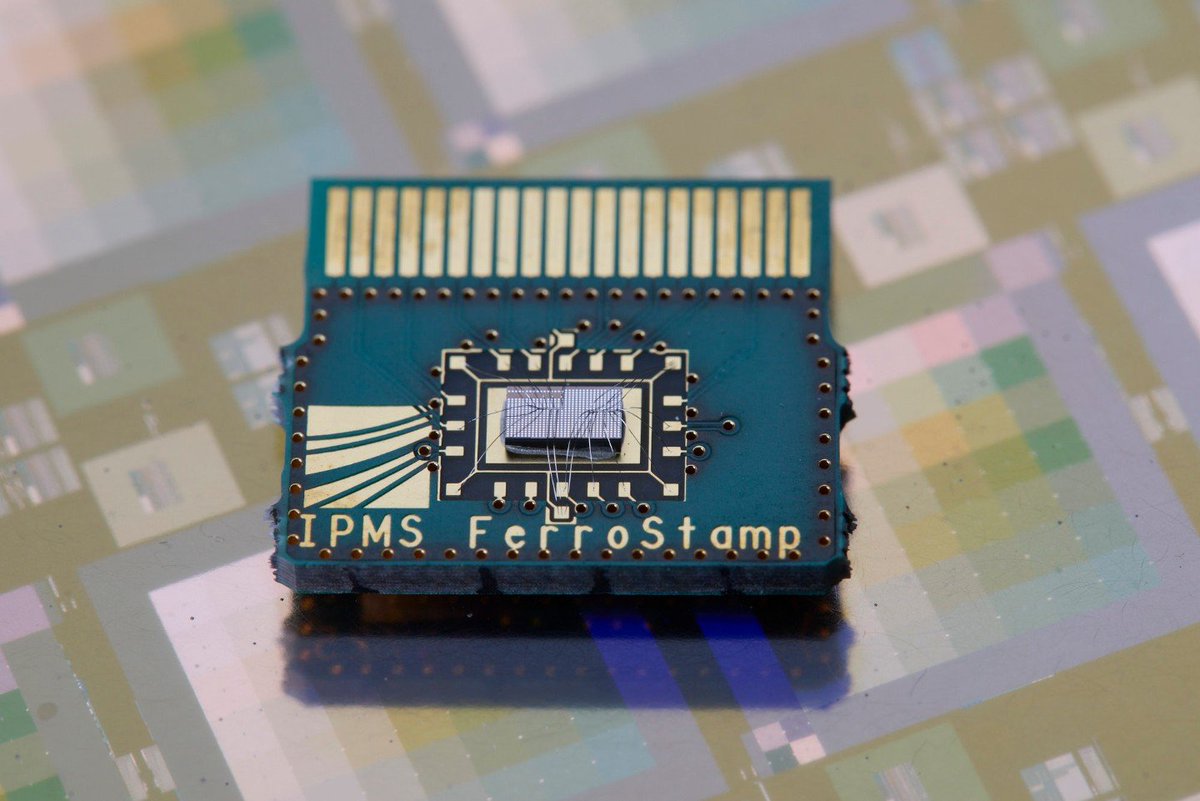
Ferroelectric Memory - Fast, Energy-Efficient Data Storage
In collaboration with GlobalFoundries, research scientists at the Fraunhofer Institute for Photonic Microsystems IPMS have developed a novel storage technology that meets exactly these requirements. The team has succeeded in integrating hafnium oxide-based ultra-fast ferroelectric FRAM memory into an existing industrial manufacturing technology.
The research is centered around an FRAM (ferroelectric random-access memory) that uses ferroelectric hafnium oxide for permanent information storage.
“In ferroelectric memory technology, ions are shifted very rapidly within a crystal lattice, resulting in a change in polarization. We can use exactly this effect to store information,” explains Konrad Seidel, Head of the Emerging Memory Solutions business unit at Fraunhofer IPMS. The major advantage of this method is that the information is retained even without power and can be read as often as needed without loss.
“Our non-volatile memory technology has far lower power consumption than that of existing solutions. This enables the use of artificial intelligence not only in data centers but also directly in edge applications where data is processed locally on the device,” explains Fraunhofer IPMS lead scientist Maximilian Lederer.
The project builds on many years of close collaboration between Fraunhofer IPMS and GlobalFoundries at the Dresden location.
Is this a threat to DRAM? No, but it is fascinating technology. An exciting development that may scale in the future.
1
4
20
2,193

I believe these technology companies have a good future in my portfolio:
📊
1️⃣ NCAB Group
2️⃣ TagMaster
3️⃣ Ependion
4️⃣ Mycronic
5️⃣ Silex Microsystems
16
He is always said to be a sun Microsystems founder but he was only with them a short time.
122

15h
Mortgage is not stupid. It's a way of forcing yourself to save. Plus the investment goes up and down. I remember people who had invested in a company called sun microsystems, and Nortel and RIM all companies were paying huge returns but now are history. One day Tesla, space x
1
29

ALL-TIME HIGH BREAKOUT ALERT 🚨📊🚀📈
These 9 stocks closed above their lifetime highs, signaling strong momentum and sustained buying interest
1- Paras Defence
2- Apar Industries
3- NGL Fine-Chem
4- Venus Remedies
5- Timex Group India
6- Kernex Microsystems
7- Emmvee Photovoltaic
8- Sedemac Mechatronics
9- Senores Pharmaceuticals
#investing #trading #StockMarket #ShareMarketIndia #TradingSetup #TradingEducation #trading #LearnTrading
1
7
293

ALL-TIME HIGH BREAKOUT ALERT 🚨📊🚀📈
These 9 stocks closed above their lifetime highs, signaling strong momentum and sustained buying interest
1- Paras Defence
2- Apar Industries
3- NGL Fine-Chem
4- Venus Remedies
5- Timex Group India
6- Kernex Microsystems
7- Emmvee Photovoltaic
8- Sedemac Mechatronics
9- Senores Pharmaceuticals
#investing #trading #StockMarket #ShareMarketIndia #TradingSetup #TradingEducation #trading #LearnTrading
1
196

UPDATE: Spectra7 Microsystems Inc. (TSX: SEV) - December 2019 | SNN Network youtu.be/Bftq-DAunvY?si=9qgQ… via @YouTube
37

invest everything in Microsoft
flip it for everything for Sun Microsystems in 97
go to every music festival for the next 20 years
rip Osama's balls off if i ever get the chance
2
4
77

List of 50 #SmallCap companies which have posted strong numbers in recent concluded #Q4 #earnings season:
1. Ajmera Realty
2. Alpex Solar
3. Apollo Micro System
4. Ashapura Minechem
5. Ather Energy
6. Atlanta Electricals
7. BSE
8. Cupid
9. D.P. Abhushan
10. Fujiyama Power
11. Garuda Construction
12. HFCL
13. K.P. Energy
14. Kalpataru
15. Kernex Microsystems
16. Kesar India
17. KP Green Engg.
18. KSH International
19. Lloyds Metals
20. Manorama Indust.
21. MCX
22. MTAR Tech
23. Muthoot Finance
24. Narayana Hrudaya
25. Netweb
26. Neuland Laboratories
27. Oberoi Realty
28. Oriana Power Ltd
29. Paras Defence
30. Physicswallah
31. Pondy Oxides
32. Poonawalla Fin
33. Prec. Wires (I)
34. Quality Power
35. Ram Ratna Wires
36. Raymond Realty
37. Sasken
38. Senores Pharma.
39. Sigma Advanced
40. Sky Gold
41. Solarworld Energy
42. Sona BLW Precis.
43. Syrma SGS Tech.
44. TD Power Systems
45. Thangamayil Jewellery
46. Titan Company
47. V2 Retail
48. Vidya Wires
49. Vintage Coffee
50. Waaree Energies
#IndianStockMarket #Nifty #Sensex #Investing #StockMarketIndia #Multibagger
1
521

🌏 Yapay zeka çılgınlığı yatırımcıları tuzağa çekiyor mu? — Yarı iletken hisselerinde 100 kata yakın değerleme balonunun uyarı işaretleri.
AI dalgasıyla Marvell ve AMD gibi şirketlerin F/K oranları tarihi zirvelere çıktı. Uzmanlar, 2000 dot-com balonunu hatırlatıyor: O dönemin devleri EMC ve Sun Microsystems değerlerinin �'ını yitirmişti. Peter Lynch'in uyarısı yeniden güncel: Sahip olduğun şey seni mahvedebilir, sahip olmadığın değil.
📌 The Paper | #YapayZeka #Yatırım #Teknoloji
24

🚨 ALL-TIME HIGH BREAKOUT ALERT! 📈
These stocks closed above their lifetime highs 👀
🔥 Paras Defence
🔥 Apar Industries
🔥 NGL Fine-Chem
🔥 Venus Remedies
🔥 Timex Group India
🔥 Kernex Microsystems
🔥 Emmvee Photovoltaic
🔥 SEDemac Mechatronics
🔥 Senores Pharmaceuticals
💡 Stocks at ATH often indicate strong momentum and sustained buying interest.
#ATH #BreakoutStocks #ParasDefence #AparIndustries #Kernex #StockMarketIndia #MomentumStocks #Investing
4
334

🚨 ALL-TIME HIGH BREAKOUT ALERT! 📈🔥
When stocks break above their lifetime highs, it often reflects strong momentum, sustained buying interest, and emerging market leadership.
📌 Stocks on our ATH Watchlist:
• Paras Defence
• Apar Industries
• NGL Fine-Chem
• Venus Remedies
• Timex Group India
• Kernex Microsystems
• Emmvee Photovoltaic
• Sedemac Mechatronics
• Senores Pharmaceuticals
⚡ New highs often signal strength, not expensiveness.
Which of these names is already on your watchlist? 👇
#StockMarket #ATH #BreakoutStocks #MomentumInvesting
1
8
1,290

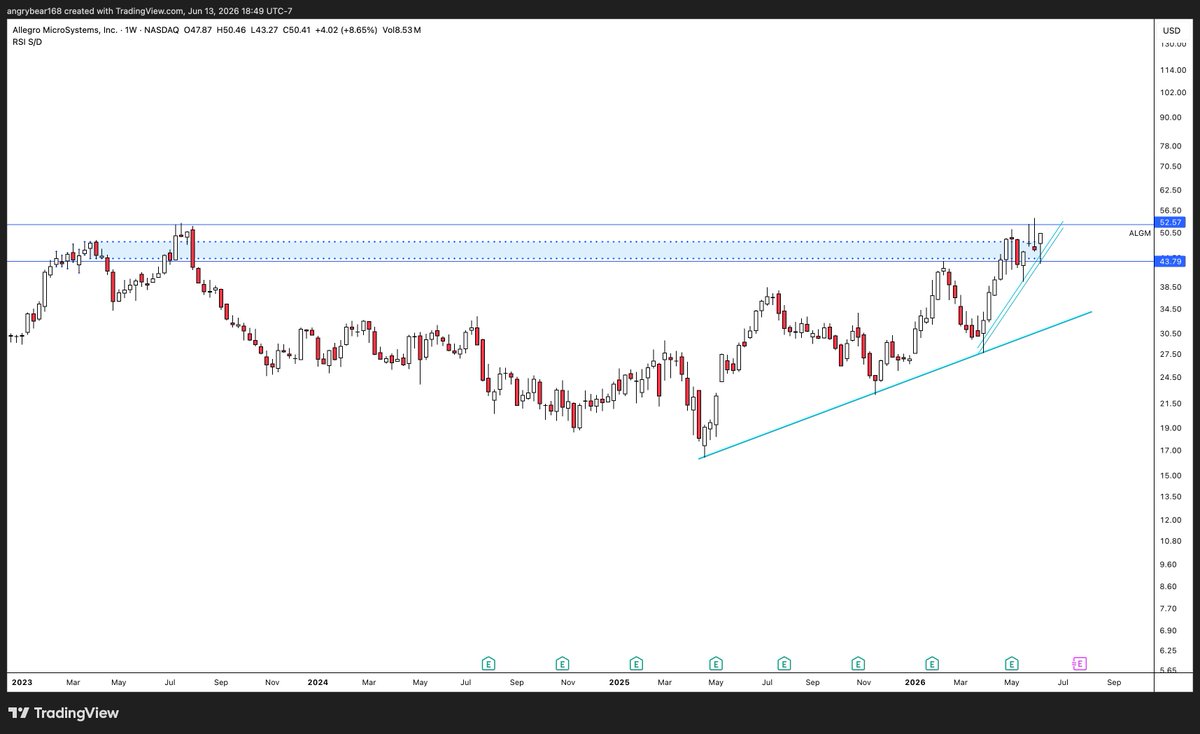
$ALGM Allegro MicroSystems is a semiconductor company specializing in magnetic sensors and power ICs for automotive (e.g., EV electrification, ADAS) and industrial markets (automation, clean energy, data centers). Recent earnings show positive fundamental signal in a cyclical recovery. Demonstrates execution and secular tailwinds.
Weekly base with higher lows and weaker pullbacks, 43 bull bear zone, daily and 2d squeezes.
1
2
476

في الحلقة 209 من بودكاست freeCodeCamp، يستضيف كوينسي لارسون المطور المخضرم كارل براون، صاحب قناة Internet of Bugs، والذي يمتلك خبرة تتجاوز 37 عاماً في صناعة البرمجيات بعد عمله في شركات كبرى مثل أمازون وIBM وSun Microsystems إلى جانب العديد من الشركات الناشئة.
تناقش الحلقة مجموعة من القضايا المهمة التي تشغل مجتمع المطورين اليوم، وفي مقدمتها الفجوة بين الضجة الإعلامية المحيطة بالنماذج اللغوية الكبيرة وأدوات توليد الشيفرة البرمجية، وبين القيمة الحقيقية التي تقدمها هذه التقنيات في بيئات العمل الفعلية. كما يسلط كارل الضوء على أهمية مهارة غالباً ما يتم التقليل من شأنها، وهي الاختبارات التكاملية (Integration Testing)، باعتبارها من أكثر المهارات تأثيراً في بناء أنظمة برمجية موثوقة وقابلة للتوسع.
وتتطرق الحلقة أيضاً إلى الفروقات بين العمل في الشركات التقنية العملاقة والشركات الصغيرة، حيث يوضح الضيف كيف يمكن للمطورين تحقيق نمو مهني أسرع واكتساب مسؤوليات أوسع داخل الفرق الصغيرة. كما يناقش تحديات التقدم في العمر داخل القطاع التقني، ويطرح الاستشارات التقنية كأحد المسارات المهنية التي تمنح المطورين مرونة واستدامة على المدى الطويل.
ما يميز هذه الحلقة هو المزج بين الخبرة العملية والرؤية الواقعية لمستقبل المهنة، بعيداً عن المبالغات الشائعة. وهي مادة قيّمة لكل مطور يرغب في بناء مسار مهني قوي، وفهم أعمق للتقنيات الحديثة، وتطوير مهارات هندسة البرمجيات التي تظل مطلوبة مهما تغيرت الأدوات والتوجهات.
#برمجة #تقنية #اختبار_البرمجيات
freecodecamp.org/news/the-ul…
1
3
144

Interesting update from $SHT today. 🇸🇪🔬
Smart High Tech highlighted a newly published paper in Applied Physics Letters:
“Graphene-based thermal interface materials with high through-plane thermal conductivity inspired by Baumkuchen”
Link: pubs.aip.org/aip/apl/article…
At first glance, this may look like just another research publication, but me personally thinks it is much more interesting than that.
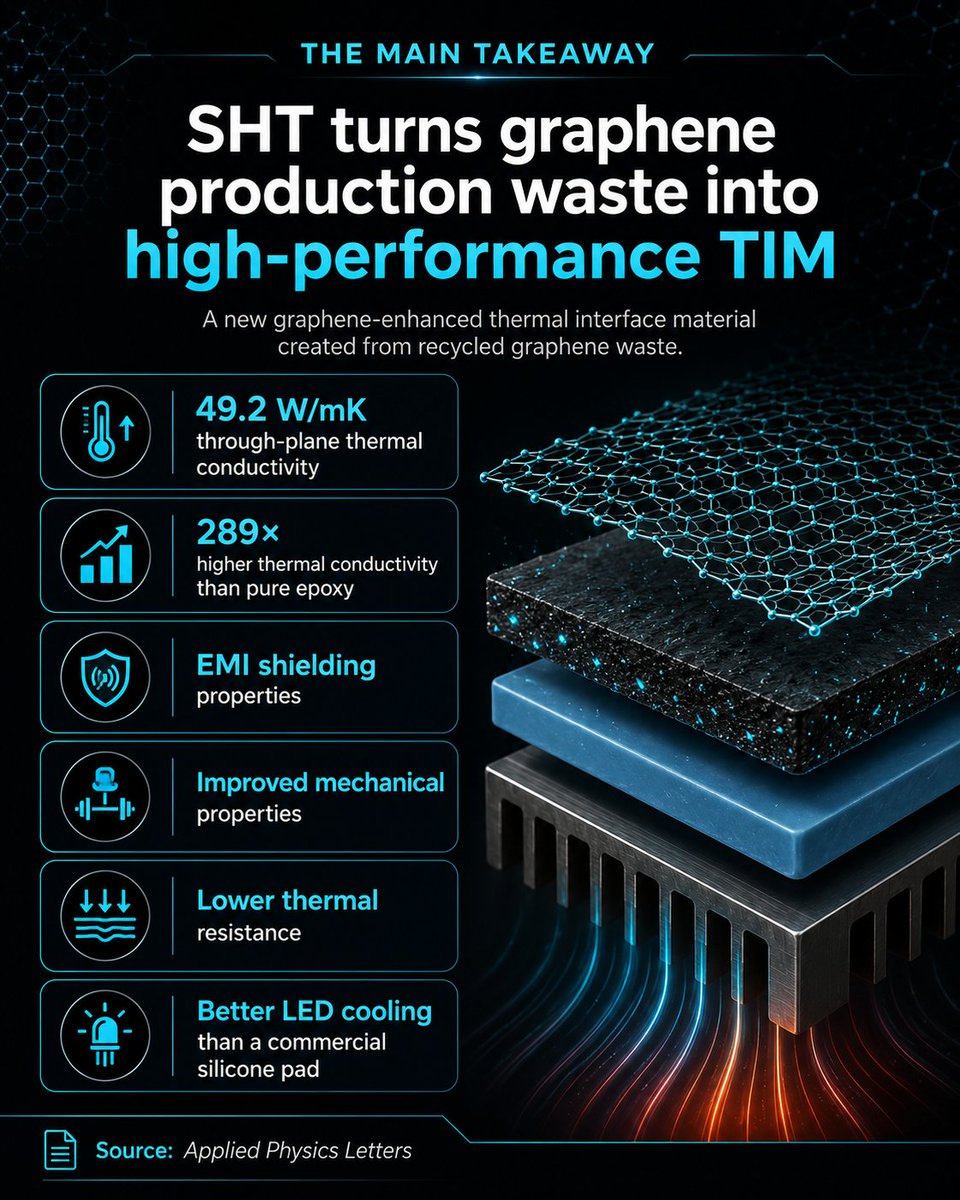
The paper shows that waste material from SHT’s own graphene film production can be reused to create a new generation of graphene-enhanced Thermal Interface Materials.
In other words:
SHT is not only developing high-end graphene-based TIM products for the most demanding applications.
They are also showing that production waste from that same process can potentially be turned into additional high-performance materials.
That matters.
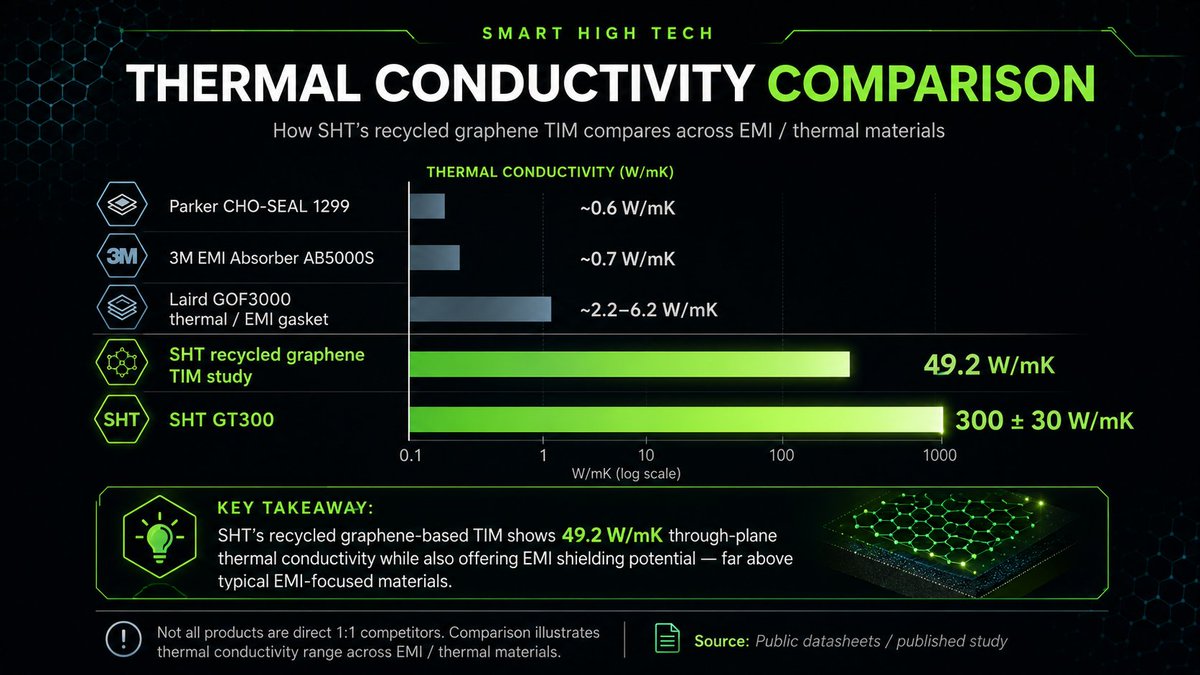
The recycled graphene-based material in the study achieved:
· 49.2 W/mK through-plane thermal conductivity
· 289x higher thermal conductivity than pure epoxy
· low thermal resistance
· improved mechanical properties
· EMI shielding properties
· better LED cooling performance than a commercial silicone pad in the study
This should not be confused with SHT’s NVIDIA/Henkel high-end track.
That track is related to SHT’s higher-performance GT-TIM products.
For example, SHT’s GT300 product sheet shows:
· 300 ± 30 W/mK bulk thermal conductivity
· 2 ± 1 Kmm²/W effective thermal resistance
· high compressibility
· low density
· applications including datacenter cooling, thermal AI chiplets/modules, IC thermal testing, automotive electronics, GPU, CPU, RF, opto and power modules
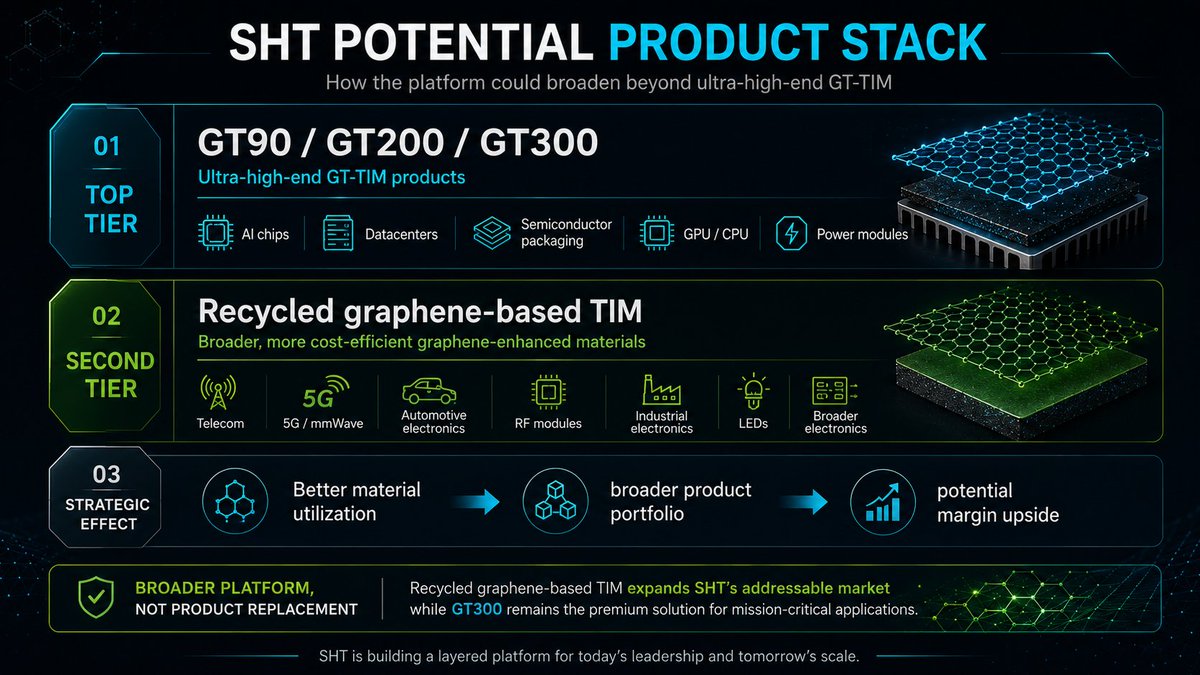
So the point here is not that the recycled graphene material replaces GT90/GT200/GT300.
The point is that SHT is building a broader product stack.
At the high end:
GT-TIM / GT300-type products for the most demanding AI-chip, semiconductor and high-power applications.
Below that:
More cost-efficient graphene-enhanced TIM products made from recycled production waste.
That is where this becomes strategically interesting.
Advanced electronics systems increasingly face two major problems at the same time:
1. Heat
2. Electromagnetic interference, or EMI
Heat is obvious.
The more powerful the chip, module or system, the more heat needs to be moved away.
But EMI is less understood.
EMI is electromagnetic “noise” created by electronic components.
In high-speed and high-power systems, this noise can disturb nearby components, signals and communication paths.
This matters in:
• AI servers
• Datacenters
• 5G / telecom equipment
• Power electronics
• Automotive electronics
• Semiconductor packaging
• Advanced industrial electronics
Today, thermal management and EMI shielding are often handled with separate components.
For example:
• Thermal pads / gels for heat
• Metal shields
• Conductive gaskets
• EMI absorber films
• Conductive tapes
• Grounding materials
The problem is that many traditional EMI materials are not especially strong thermal conductors.
Public datasheets show examples such as:
• 3M EMI Absorber AB5000S: ~0.7 W/mK
• Parker Chomerics CHO-SEAL 1299: ~0.6 W/mK
• Laird GOF3000 thermal/EMI gasket: ~2.2–6.2 W/mK depending on configuration
These products are not all direct 1:1 competitors.
But the comparison highlights why SHT’s result is interesting.
A recycled graphene-based material showing 49.2 W/mK through-plane thermal conductivity, while also offering EMI shielding and mechanical performance, could be highly relevant in markets where both heat and signal integrity matter.
That is the key point:
Thermal performance EMI shielding mechanical properties recycled graphene waste.
This could potentially open up additional applications beyond the very highest-end AI-chip TIM market.
For example:
• Telecom equipment
• 5G / mmWave systems
• Power modules
• Automotive electronics
• RF modules
• LED systems
• Industrial electronics
• Advanced packaging
• Datacenter hardware
Financially, this also matters.
If SHT can reuse waste from its high-end graphene film production to create additional commercial TIM products, it would improve material utilization and production economics as the company scales.
Instead of waste being a cost, it may become input material for another product family.
That has potential margin implications.
It also broadens the platform.
SHT’s high-end GT-TIM products may target the most demanding AI-chip and semiconductor applications.
This recycled graphene-based material could potentially address broader markets where heat, EMI shielding and cost efficiency all matter.
Another important point is the R&D foundation behind this.
SHT is not simply buying a generic material and trying to resell it.
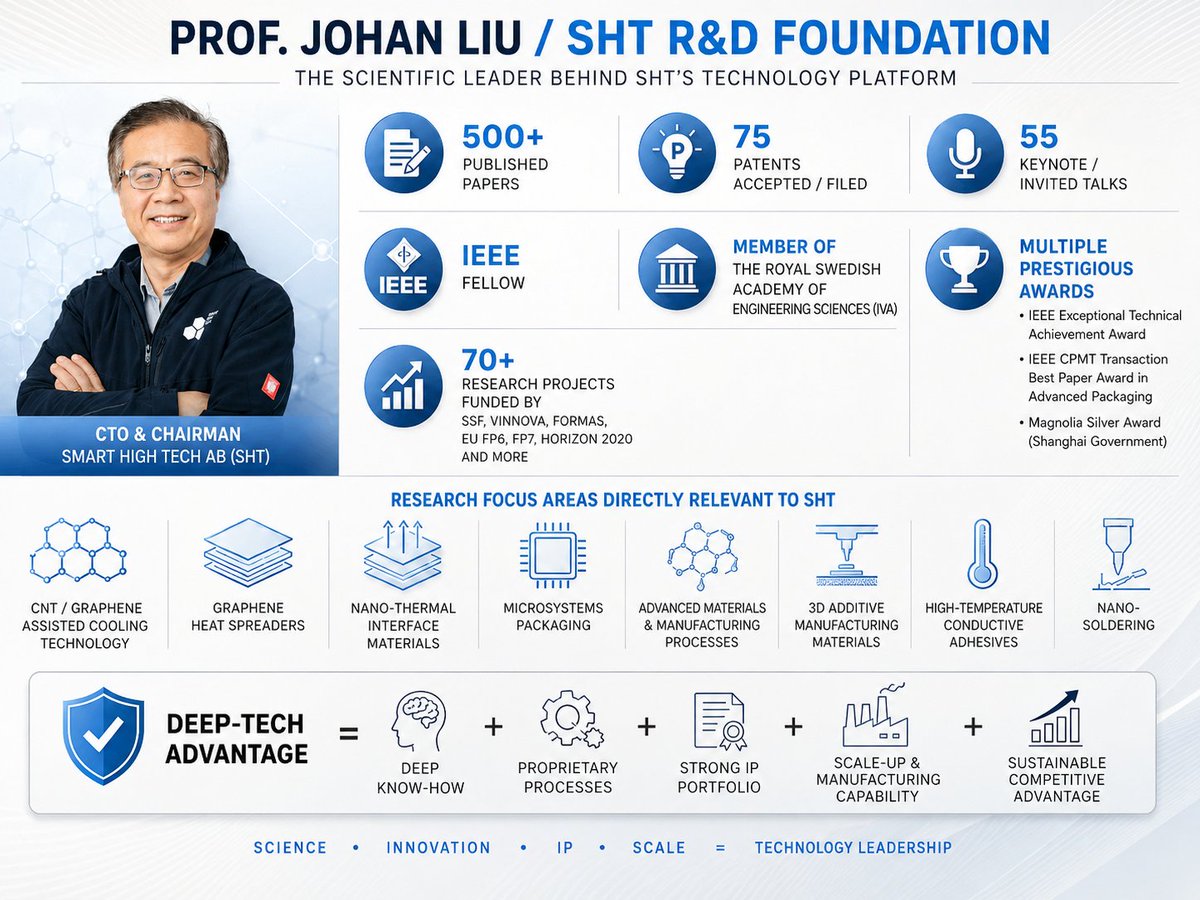
The company’s technology platform has been built around graphene-based thermal management, with Prof. Johan Liu as CTO, Chairman and the key scientific figure behind the company.
His research background covers areas directly relevant to SHT’s technology, including:
• CNT / graphene assisted cooling technology
• graphene heat spreaders
• nano-thermal interface materials
• microsystems packaging
• advanced materials and manufacturing processes
• 3D additive manufacturing materials
• high-temperature conductive adhesives
• nano-soldering
His track record includes:
• 500 published papers
• 75 patents accepted or filed
• 55 keynote / invited talks
• IEEE Fellow
• Member of the Royal Swedish Academy of Engineering Sciences
• IEEE Exceptional Technical Achievement Award
• IEEE CPMT Transaction Best Paper Award in Advanced Packaging
• Magnolia Silver Award from the Shanghai government
• 70 research projects funded by organizations such as SSF, Vinnova, Formas, EU FP6, FP7 and Horizon 2020
That matters in deep-tech.
Because in this type of market, the long-term advantage is not only the product itself.
It is also the know-how, the manufacturing process, the research network and the IP position around how the material is produced, scaled and integrated into real applications.
SHT has patents and patent applications around graphene-enhanced thermal interface pads and related manufacturing methods.
That does not guarantee commercial success.
But it does suggest that the company is trying to build a defensible technology platform rather than a commodity thermal pad business.
To me, this supports the idea that SHT is not just a single-product TIM company.
It is building a broader graphene-based thermal management platform.
The NVIDIA/Henkel track remains the most important near-term commercial story.
But developments like this show that the underlying technology platform may have more optionality than the market currently gives it credit for.
High-end GT-TIM for the most demanding AI and semiconductor applications.
Recycled graphene-based TIM materials for broader markets where heat, EMI shielding and cost efficiency all matter.
This does not change revenues tomorrow.
But to me, it strengthens the long-term platform story in a very important way.
SHT is showing signs of building something much broader than a single thermal pad product.
A graphene-based thermal management platform with:
• High-end GT-TIM products for the most demanding AI and semiconductor applications
• Recycled graphene-based TIM materials for broader markets
• EMI shielding optionality
• Strong R&D depth
• Patent protection around key manufacturing methods
• Potential margin upside from improved material utilization
That is a very different story from simply selling another component.
The bigger picture is this:
Heat management is becoming one of the most important bottlenecks in the future of computing.
AI chips, datacenters, advanced packaging, power electronics and high-performance electronics all need better ways to move heat away from increasingly dense and powerful systems.
If SHT can execute on what it is trying to build, the company could position itself right at the center of that bottleneck.
Not as a commodity supplier.
But as a deep-tech platform company with differentiated technology, strong IP and products that may help enable the next generation of high-performance electronics.
That is why I remain very bullish on this case.
Because if SHT succeeds, it will not only have built better thermal interface materials.
It may have built one of the key enabling technologies for the next phase of AI infrastructure, semiconductors and advanced electronics.
5
8
66
3,694