
The Smartphone Supercomputer!
Researchers recycle old phones & cluster them into ‘computing platforms’ that operate as a low-cost data center — says processors on modern smartphones deliver higher single-core performance than comparable multicore servers
share.google/wJYndlfy8U2sGsH…
1


Researchers recycle old phones and cluster them into ‘computing platforms’ — says processors on modern smartphones deliver higher single-core performance than comparable multicore servers
Direct: ift.tt/wRn0SE2
ift.tt/49Ub5fz
6

The Haifa team was instrumental in Intel’s multicore and SMT execution regardless of who came up with the original concept
9


Jun 13
Sporty
NEMX4D
Multicore - WLFVRU
Jun 13

Qatar vs Switzerland 🇨🇭 1-2
🇧🇷 Brazil vs Morocco 🇲🇦 2-1
🇭🇹 Haiti vs Scotland 🏴 0-2
🇦🇺 Australia vs Turkey 🇹🇷 0-1
1
5
1,189


sim, multicore, está bem claro ali a quantidade de núcleos comparados. Veja, para ambente servidor, performance por núcleo nunca vai importar mais do que multicore. Agora pensa, pra montar um rack com Rubin pra bater o EPYC quanto custa? ai é o ponto.
11

Jun 12
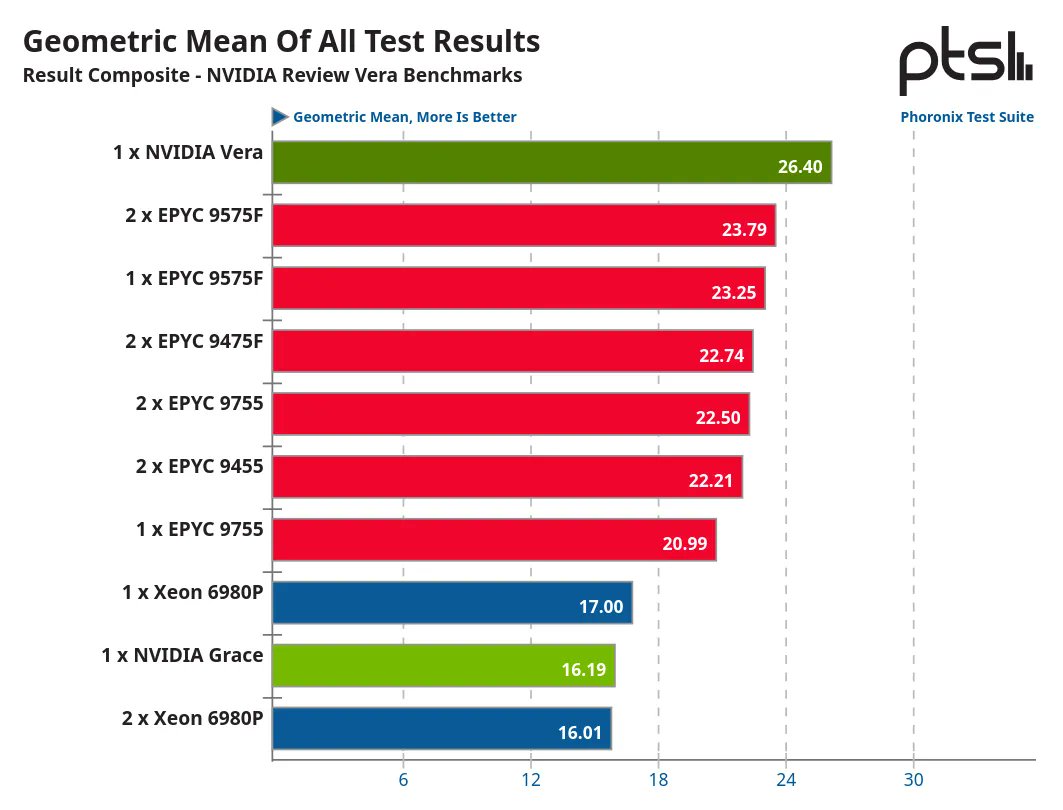
O gráfico que pos é multicore 🫠
O que estava a dizer é o facto que a Nvidia focou-se mais em ST e não mais cores porque para o uso destes servidores. Performance absoluta do core interessa. A AMD e Intel vendem para o mercado generalista.
1
18

Jun 12
to be fair when it released PCs didn't have multicore CPUs or RAM faster than DDR2, not even Direct3D 9/Unified Shaders
1
1
67

Jun 12
Unleash raw power with Intel Xeon. Engineered for demanding workstations and servers, its multi-core architecture conquers any task. #IntelXeon #Workstation #ServerTech #HighPerformance #MultiCore #TechInnovation #CPUPower
3

Jun 12
I see, sounds very similar to the the widespread problem recently experienced by users with Intel’s 13th and 14th Gen Core I7/i9 processors where specific higher end parts were triggering erroneous voltage spikes whilst attempting to operate at their advertised single/multicore turbo frequencies.
This issue was supposedly corrected via a microcode patch, though Intel also released a universal BIOS update to MoBo vendors containing revised power profiles that prevented the boards from supplying unrestricted wattages to the CPUs when in their PL2 states, under sustained “all core” workloads.
Again, the latter mode is limited to periods when CPU is functioning within its thermal envelope with throttling being applied via a power reduction once it exceeds its “official” maximum temperature. Though with exotic cooling, prior to the “fix”, these chips were shown to be indefinitely consuming over 500 watts (double their TDPs) when fully utilised..and could theoretically receive upto 4000 with the BIOS left configured at its default setting!
Off-topic, I know but I also recall vendors of AMD’s “Zen 4” AM5 motherboards were forced to hastily release updates to rectify what were excessive “stock” voltages, that resulted in scorched socket pins and defective CPUs…I believe only the Ryzen 7800x3D was affected, though to AMD‘s credit, they did offer a direct RMA service to all customers with faulty parts when Asus, Asrock and others initially stated that installing their “officially fixed” BIOS would also void the user’s warranty!
I think much of the time, manufacturers of these components have a tendency to ship them with overly “optimistic” factory speeds on the expectation that most “enthusiasts” willing to pay a hefty premium for performance will also have upgraded to the next model before any “consequential” physical damage can elicit chronic instabilities!
1
34

High-Order Spectral Element Methods for Wave Propagation on ARM Multicore CPU with SME: Optimizations and Implications
Yinuo Wang, Lin Gan, Tianqi Mao, Wubing Wan, Zekun Yin, Wenqiang Wang, Wei Xue, Guangwen Yang
arxiv.org/abs/2606.12850 [𝚌𝚜.𝙳𝙲]
3
247

Jun 11
Estás a comparar alhos com bugalhos. Esses gráficos são enviesados
A solução da nvidia é max performance por core e não multicore.
A nível de potência, a AMD e Intel gastam bastante mais tmb.
3
229

And if you transcode well from Blu-ray you can even make 720p that is mostly indistinguishable from original. Modern codecs & multicore CPUs let you do amazing things at reasonable speed. I do mean CPU, as PC Nvidia/AMD GPU encoders are still not good enough for best quality.
68

⛅️ Bologna, day 3
🚀 @ArnauBigas demoing Reptiles: an open RISC-V multicore system built for high-performance computing research.
The demo is driven through a video game running on FPGA, showing real system behavior under interactive workloads. 🎮
#RISCVSummitEurope #HPC #OpenSource

1
3
4
764

Jun 11
Okay, the insults and condescension aren't necessary for my understanding, maybe they are for your ego however. I think you're missing the fundamental point that it isn't just about bandwidth, its about accessibility, redundancy as well as (ultimately) sovereignty and energy/land independence too.
Multiplexed, minmaxxed lab conditions can push PBs on a 'single' (10-32 multicore, semantics kek) fiber, sure. That is not whats laid in the ocean. Our best transoceanic cables can maybe pull 200, 300tbps on their lonesome. IRL we need big networks of them with ample repeater infra to get your stated numbers, but you know that. Global capacity is on the order of ~1.8pbps atm though these cables. Growing ~24% yoy. Starlink already runs ~1/4th of that with 10k gen2 satellites.
Someone has to lay that fiber, splice and connect it and maintain it just the same as satellite infra. Most residential fiber is NOT buried... its overhead, vulnerable and breaks all the time; I know because I have fiber in 2 of my 3 houses and over 5 years has worse uptime than my coax ever did.
You're not connecting the fiber last mile for all humans who want internet. A fool's errand. Can we agree on that fact? ~40% of people live in a non-city, 'rural' area on Earth; hardly a small market. 2.2b don't have internet at all because incumbents are too strapped to expand terrestrial networks anymore; the margins aren't there.
Incumbent business models die on the altar of serving the last 30%. They access convenient, bunched-together captive markets & have a general monopoly due to deployment cost moat. Capital efficient and great on the sheet for now sure as you've said, but not any longer an expanding growth curve; rather a contracting one with a competitor like Starlink on the heels. Datacenter buildouts are a final holy blessing on their businesses that won't last on Earth forever.
Gen 3 Starlink sats do 1 Tbps max down 160gbps up.
46,000 of them (planned) will absolutely eclipse current terrestrial internet capacity. It will take Starship ~760 launches to achieve the entire 46k shell with gen3 sats. 400 Falcon launches for the current constellation of 10k took 7 years. Lets say it takes 14 years to launch them all (lol)..at current cagr, terrestrial fiber internet cap will only 4-5x today's number in that same time even with current growth metrics supercharged by terrestrial data centers.
Thats 46pbps down from the v3 constellation, greater than projected fiber capacity down the road. 8, 16 ways its still more than global internet throughput capacity today.. you are seemingly certain Starlink engineers have no clue how the internet works, or what they're competing against. They're out of their depth; so I suggest you should build the future services for humanity instead. Join up and get those sweet RSUs and become rich off their sham, yeah?
I'm not going to pretend I know everything since thats your domain obviously, but it bears considering that throughput is only one part of the equation.
The real cash play in my eyes is the datacenters in space. Global Internet is just the warm up. If you are the only one who can provision such technology at scale, with free limitless energy and cooling on your orbiting racks...who gets all the money such services provide? Who controls the AI onboard?
We're talking AWS in space, on the Outernet, on top of all the compute needed to run the most advanced AI models...in the hands of one company. We will never lay Fiber to the Moon or Mars, or in space where the future of capitalism lies. Ten trillion imho btw don't bother replying cuz I blocked you for the lulz
1
85