
May 21
Google ERA is the scientific-software version.
ERA does not mainly propose a biology hypothesis. It builds custom software for scientific problems where success can be scored.
Give it a dataset, a metric, and research ideas. It writes code, runs it, scores it, mutates the better versions, and tries again.
In single-cell analysis, ERA generated 40 methods that beat all published methods on the OpenProblems benchmark.
Its top method improved the best published score by 14% by recombining two existing approaches. (5/6)
1
2
469

May 20
Multi-agent AI systems for scientific discovery: The R&D bottleneck just moved
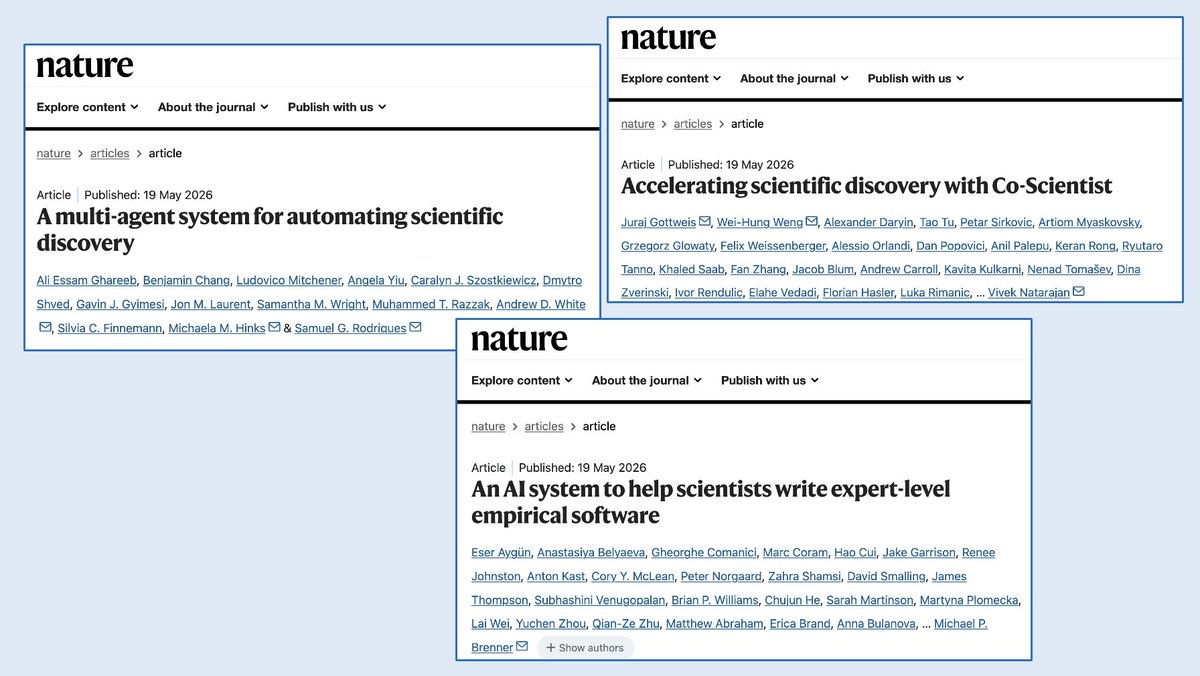
Yesterday, Nature published three independent multi-agent AI systems for scientific discovery.
Robin (Ghareeb et al.) automates the analysis end: 360-425 hours of human work compressed into under two hours of compute, with autonomous RNA-seq analysis that surfaced a mechanistic connection in dry AMD.
Co-Scientist (Gottweis et al.) automates hypothesis generation through an Elo tournament across six specialized agents, beating expert "best guess" solutions and frontier reasoning models with no saturation as compute scales.
ERA (Aygün et al.) automates the empirical software underneath: 40 methods that beat every entry on the OpenProblems single-cell leaderboard, 14 forecasting strategies that beat the CDC CovidHub ensemble, expert-level performance across six unrelated domains.
The interesting question is not which paper is best. It is what they together imply about where research leverage now lives.
Hypothesis generation, empirical software development, and data analysis are now individually automatable above human expert level for a meaningful class of problems. Wet-lab execution, scoring-function design, and the operational glue between these stages are not. The bottleneck has moved.
The practical implication runs opposite to most "AI is taking over research" narratives. The value of fast, well-instrumented wet-lab pipelines is about to rise sharply, not fall. The scoring function that defines what good looks like for a research objective is now the most leveraged piece of know-how a research operation can build. For working scientists, this means the methods question (how do we evaluate what we are doing) becomes as important as the science question itself. The integration layer between these systems, not any single one of them, is the open problem now.
Links to the 3 papers:
- Robin (Ghareeb et al.): nature.com/articles/s41586-0…
- Co-Scientist (Gottweis et al.): nature.com/articles/s41586-0…
- ERA (Aygün et al.): nature.com/articles/s41586-0…
2
11
51
2,623
May 20
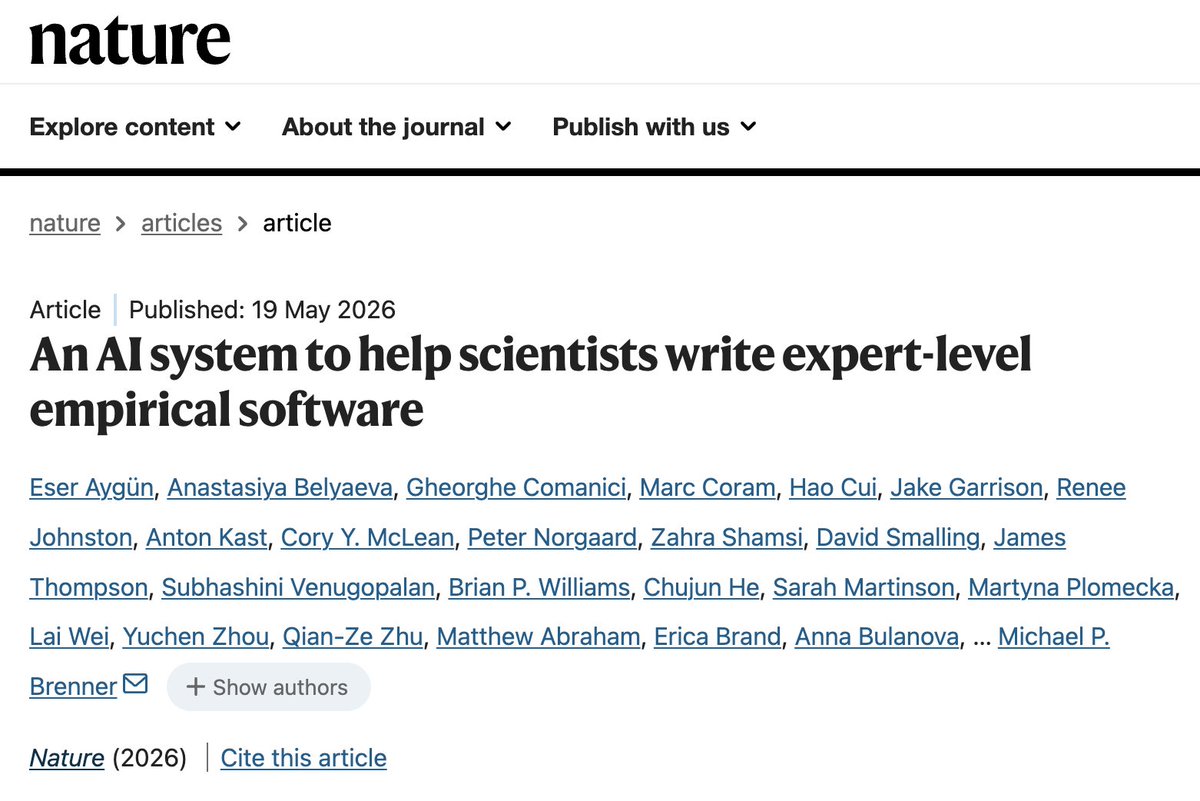
Third agentic AI system for scientific discovery published on the same day by Nature, and arguably the most empirically striking. After Robin (closed experimental loop) and Co-Scientist (hypothesis breadth), here is ERA.
Eser Aygün and coauthors introduce Empirical Research Assistance (ERA), a system that treats writing scientific code as a scorable task. An LLM rewrites candidate programs, a tree search (PUCT-style, inspired by AlphaZero) decides which branches to expand, and the task quality metric drives the climb. Research ideas from papers, textbooks or other agents are injected directly into the prompt.
The headline numbers are unusual for one paper. In single-cell RNA-seq batch integration, ERA produced 40 methods that beat every entry on the OpenProblems v2.0.0 leaderboard, including a BBKNN variant 14 percent above the previous best. In epidemiology, it generated 14 forecasting strategies that outperformed the official CDC CovidHub ensemble across the 2024-2025 season. On GIFT-Eval it topped the May 2025 leaderboard, and it also reached expert level on geospatial segmentation, whole-brain neural activity prediction in zebrafish, and difficult numerical integrals.
Two design choices matter. Recombination: prompting ERA with pairs of prior solutions yields hybrids that beat both parents in 44 percent of batch integration cases. Combining a climatology baseline with an autoregressive model, or a renewal-equation model with a statistical one, consistently produced superior forecasts. Scale: tree search beats best-of-1000 sampling across Gemini, Mistral, Claude and GPT-5 on both benchmarks, confirming structured exploration beats brute force as tasks get harder.
For R&D teams in pharma, biotech, materials and finance, the implication is sharp. The bottleneck of empirical software, months of tedious coding to test a hypothesis, collapses to hours. Pipelines that turn quality metrics into executable code, and that recombine ideas across the literature, will outperform single-team development. The edge moves to whoever defines the right scoring function and curates the right idea pool.
Paper: Aygün et al., Nature (2026) | nature.com/articles/s41586-0…
1
17
82
4,604

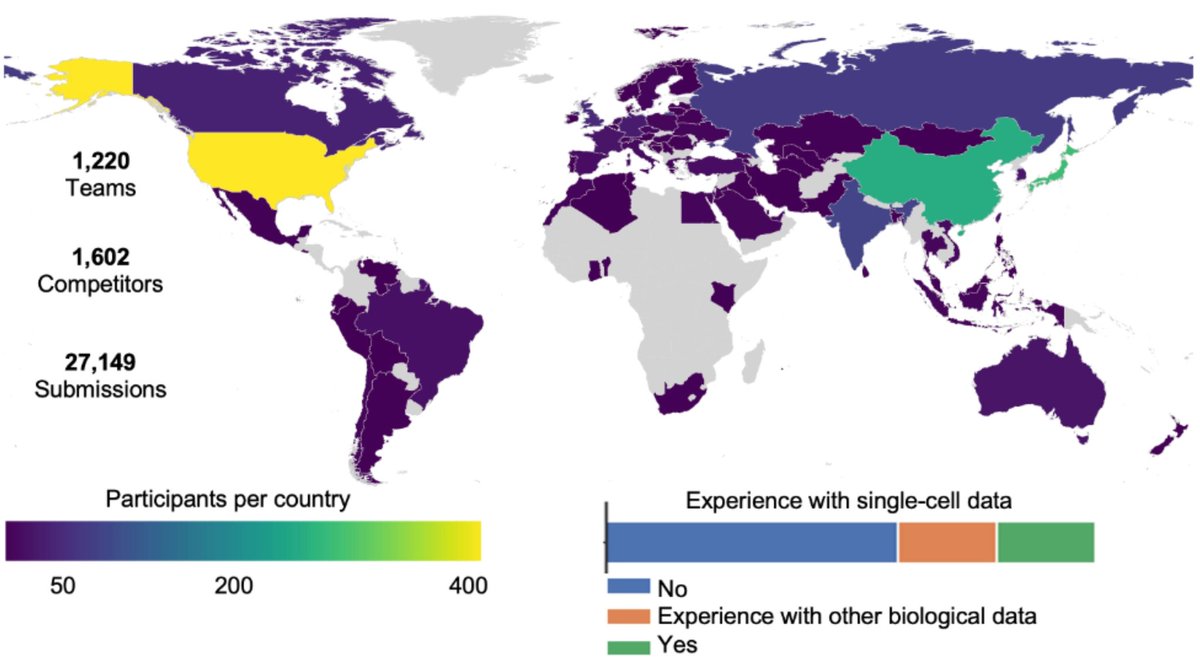
How to learn gene regulation patterns from multimodal single-cell data? To answer this question, we at OpenProblems organised the @kaggle competition on modality prediction. It ran back in 2022 but still remains the world's largest competition in the single-cell field. 1/17
1
2
10
1,097

21 Oct 2025
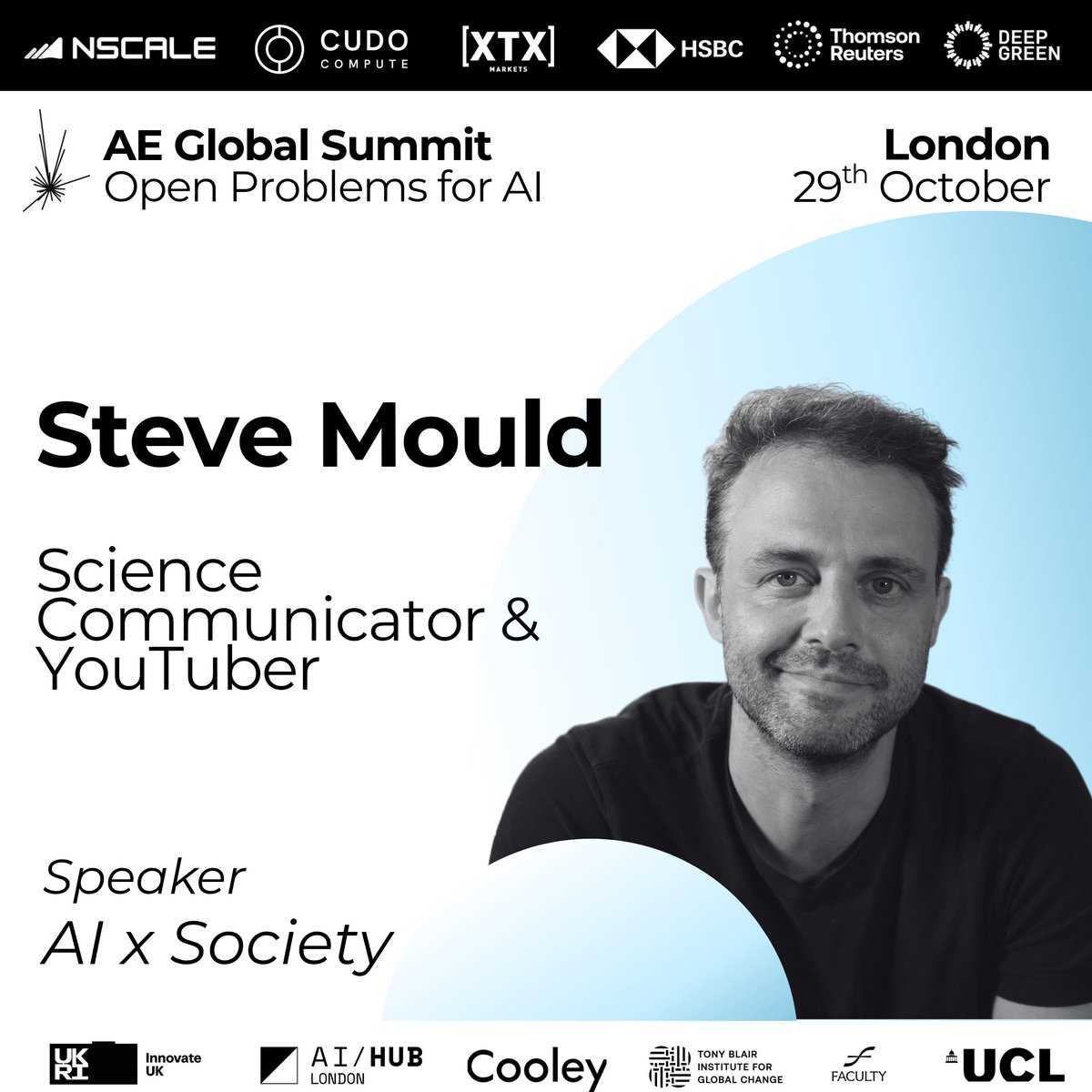
Ok, this is a first for us! Speaker Spotlight: Steve Mould @MouldS | Science Communicator & YouTuber 🍾
It’s our great pleasure to welcome Steve Mould, YouTuber, author, and science presenter, to the AE Global Summit on Open Problems for AI!
Steve joins us on Day 2 for the AI x Society Session, exploring how science communication, curiosity, and creativity can help shape public understanding of artificial intelligence.
A British educational author and YouTuber with over 3 million viewers, Steve is best known for his engaging science videos that make complex ideas intuitive and accessible. His exploration of the chain fountain phenomenon—now known as the “Mould effect”—became a viral example of how science can capture imagination worldwide.
At the Summit, Steve will bring his signature clarity and humour to a panel on AI x Human Flourishing, giving his perspective how storytelling and education can bridge the gap between science, society, and emerging technologies.
More on our website below ↓
#AI #OpenProblems #ThinkingAboutThinking #Speaker #AIInfrastructure #TechInnovation
2
1
2
388
14 Oct 2025
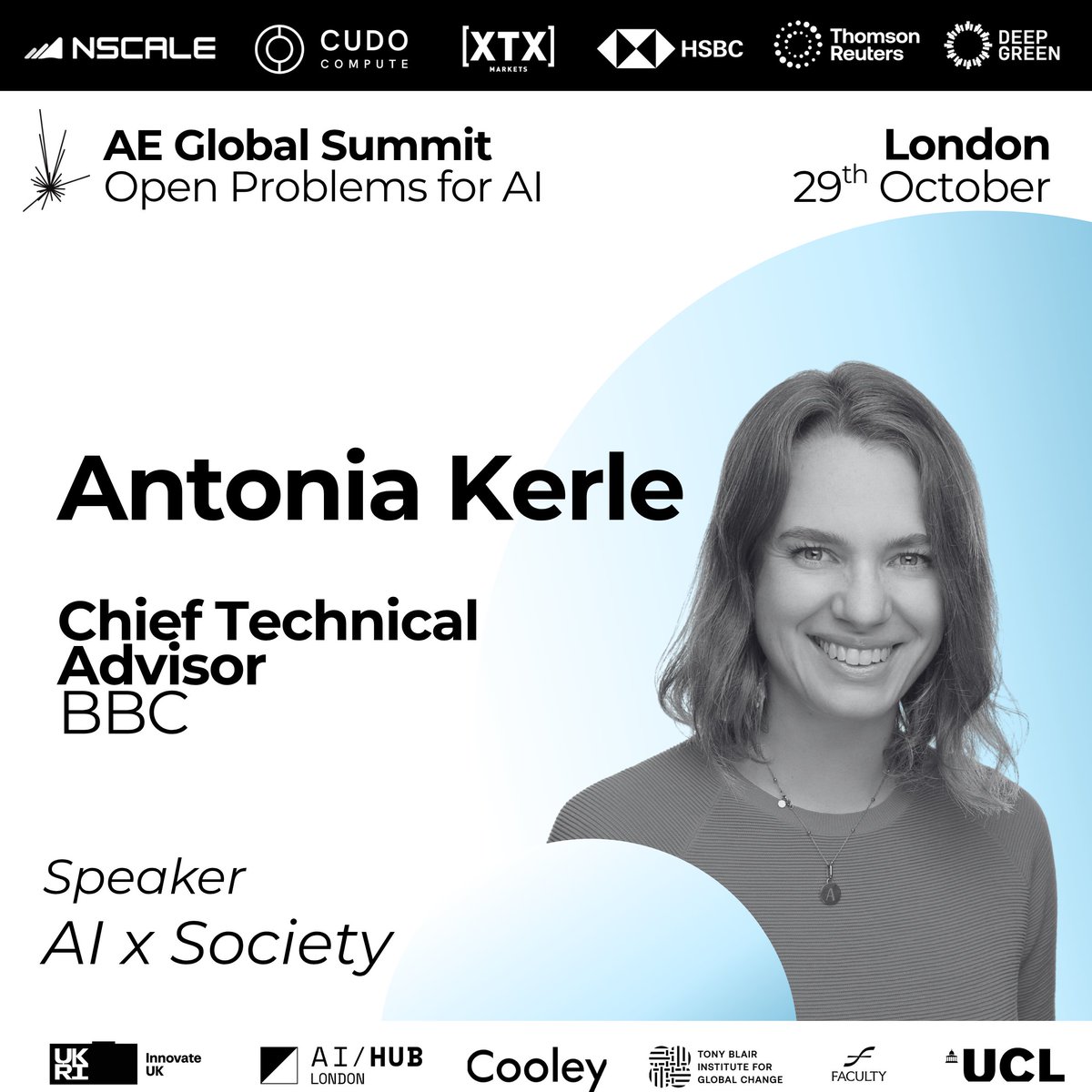
🎥 Speaker Spotlight: Antonia Kerle | @BBC
A Thinking About Thinking first! We're pleased to welcome Antonia Kerle, Chief Technical Advisor at the @BBC, as a speaker at our AE Global Summit on Open Problems for AI!
Antonia leads BBC R&D’s Advisory Team, where her work explores the evolving relationship between technology, media, and education—with a focus on media development, disinformation, hate speech, and public trust in institutions. Before joining the BBC, Antonia spent her career in consulting— first at @Deloitte, where she worked as a management consultant, and later at @TheEconomist, where she designed and led large-scale research programmes for foundations, international organisations, and private sector clients seeking evidence-based insights and policy guidance.
That places her perfectly to join our AI x Human Flourishing panel at the end of Day 2! Can't wait to hear her perspectives & thoughts.
More on our website below ↓
#AEGlobalSummit #AIStartups #AIInnovation #ThinkingAboutThinking #OpenProblems
1
3
199
14 Oct 2025
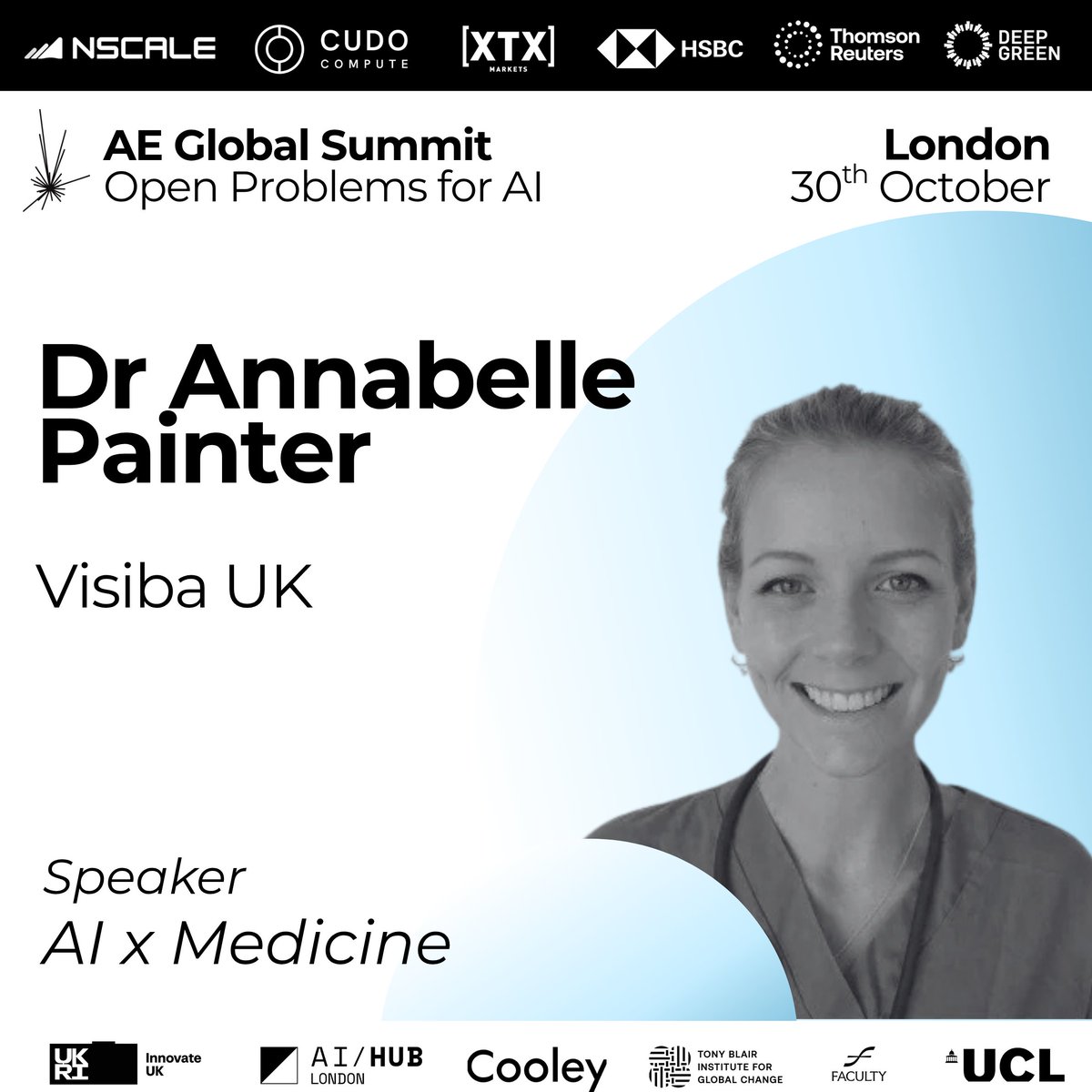
🩺 Speaker Spotlight: Dr Annabelle Painter | @UkVisiba
It gives me great pleasure to welcome my old friend Dr Annabelle Painter, @NHS doctor and Chief Medical Officer at @UkVisiba, to the AI x Medicine session of our AE Global Summit on Open Problems for AI!
Unlike the rest of the Thinking About Thinking founding team, including myself, Annabelle went on from medical school to serve in NHS England , before becoming increasingly interested in digital health and AI. Alongside her clinical work, she serves as a Digital Health Advisor, sits on the Digital Health Council, and hosts the Royal Society of Medicine’s Digital Health Podcast. Wow!
Annabelle actually guided my through my first ever televised interview, over a decade ago now! I'm really looking forward to her presence on the AI x Medicine panel on Day 3: "Rebuilding the Hospital from the Tech Up: Can the UK Scale its Clinicians?"
More information via the link below ↓
#AI #OpenProblems #ThinkingAboutThinking #HealthTech #DigitalHealth #AIEthics #UKNHS
1
3
126
13 Oct 2025
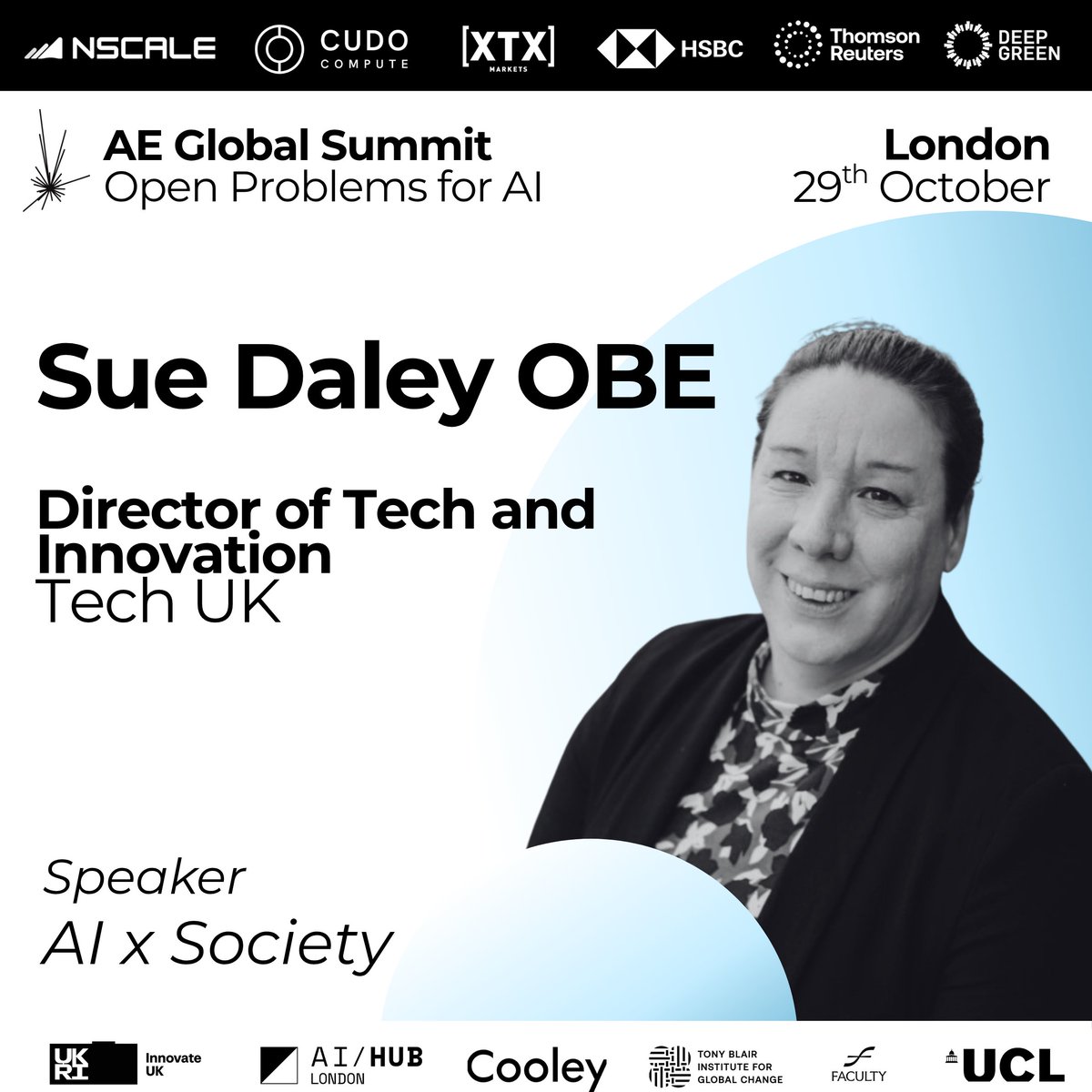
🛜 Speaker Spotlight: Sue Daley OBE | @techUK
We’re honoured to welcome Sue Daley OBE, Director of Tech and Innovation at @techUK, as a speaker at the AE Global Summit on Open Problems for AI!
At techUK, Sue leads national programmes on cloud computing, AI (including digital ethics), quantum, and high-performance computing—shaping the UK’s digital future through innovation, policy, and responsible technology.
Recognised as one of the most influential people in UK tech, Sue was inducted into the Computer Weekly Most Influential Women in UK Tech Hall of Fame and co-chairs the UK Government’s National Data Strategy Forum.
At the Summit she will speak on the AI x Human Flourishing panel, and we can’t wait to hear her thoughts!
More information on our website, linked in comments below:
#AI #OpenProblems #ThinkingAboutThinking #techUK #DigitalInnovation #AIInfrastructure #UKTech
1
1
3
182
13 Oct 2025
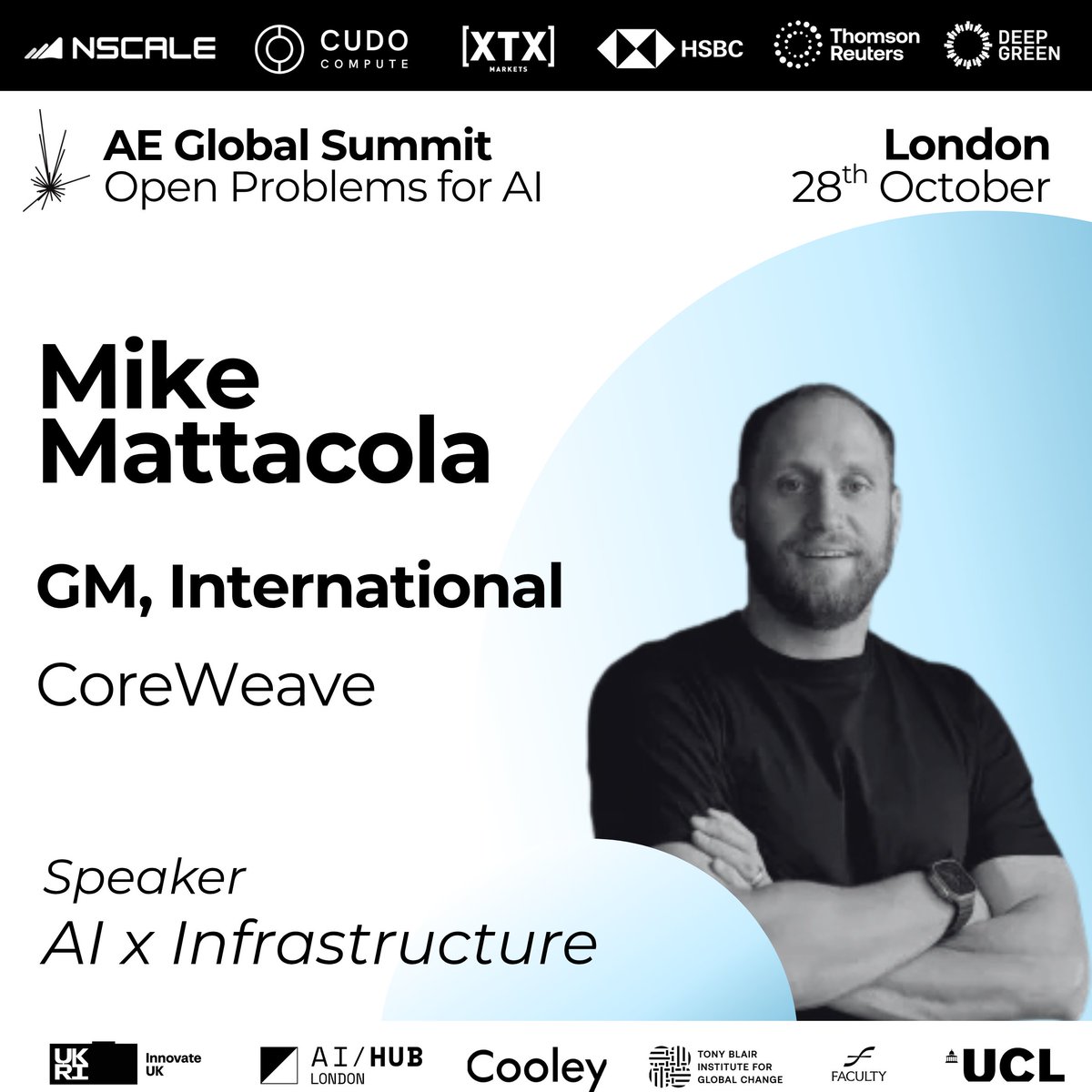
🔥Speaker Spotlight: Mike Mattacola | @coreweave
We are thrilled to welcome Mike Mattacola, General Manager, International at @CoreWeave, as a speaker at the AE Global Summit on Open Problems for AI!
Mike leads CoreWeave’s international growth and expansion strategy, drawing on over 15 years of leadership experience at global technology and industrial companies including Lambda, Johnson Controls, and Terex Systems.
At the Summit, Mike will join the panel on “How can the UK get ahead on AI Infrastructure?” (Day 1: AI x Infrastructure Session).
More on our website below ↓
#AI #OpenProblems #ThinkingAboutThinking #CoreWeave #AIInfrastructure #TechInnovation
1
3
167
13 Oct 2025
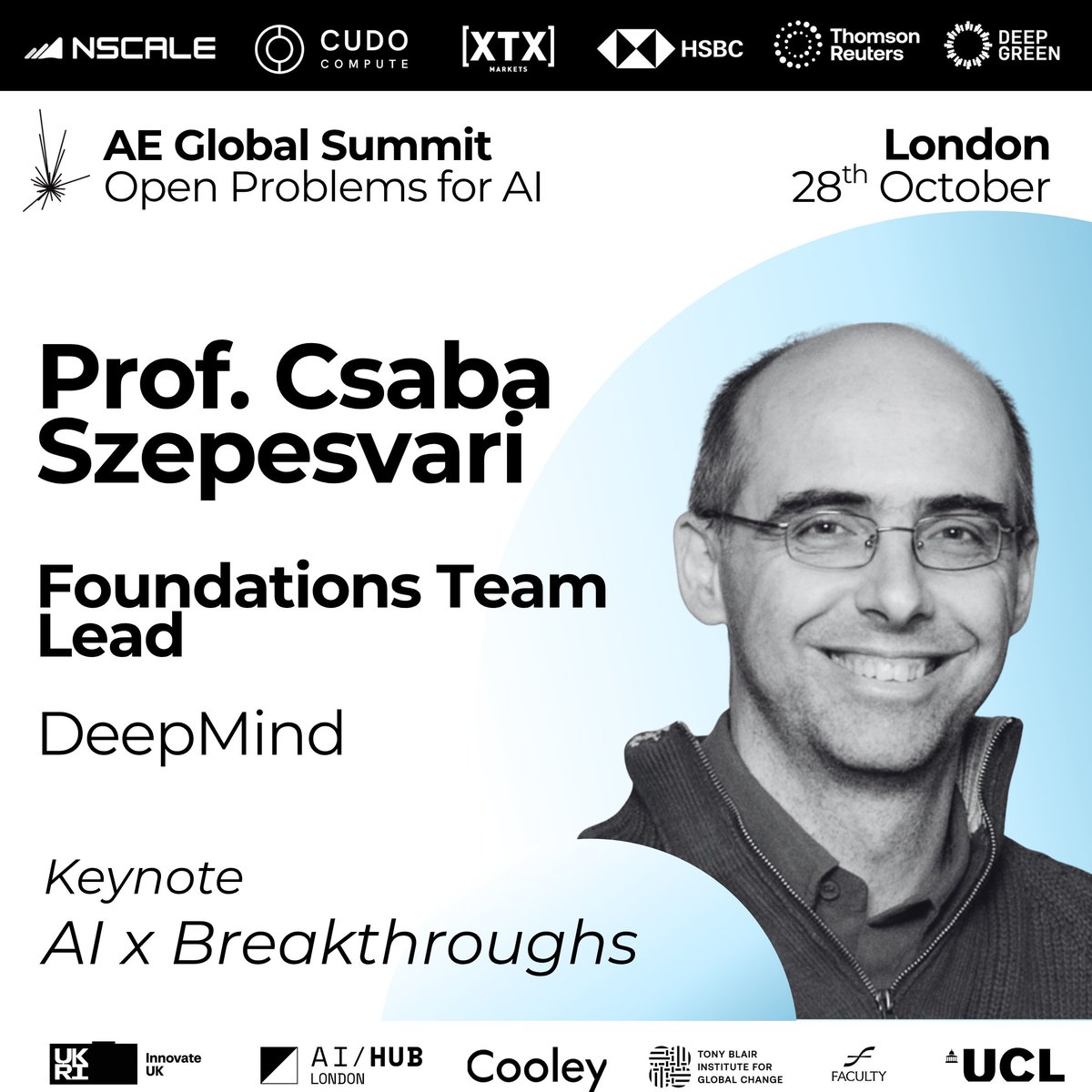
🎬Speaker Spotlight: Prof @CsabaSzepesvari | @googledeepmind
We are delighted to announce Prof @CsabaSzepesvari, Lead of the Foundations Team at @GoogleDeepMind, as a keynote speaker at the AE Global Summit on Open Problems for AI!
Prof Szepesvári’s research focuses on learning in sequential decision-making—developing algorithms that can interact intelligently with the world around them. His work explores how machines can learn autonomously, discover efficient strategies, and adapt dynamically through continuous feedback.
I'm extremely curious to hear what he thinks the current Open Problems in AI are, in the second keynote on Day 1: AI x Research Breakthroughs.
More on our website below ↓
#AI #OpenProblems #ThinkingAboutThinking #DeepMind #MachineLearning #Research
1
1
2
211
7 Oct 2025
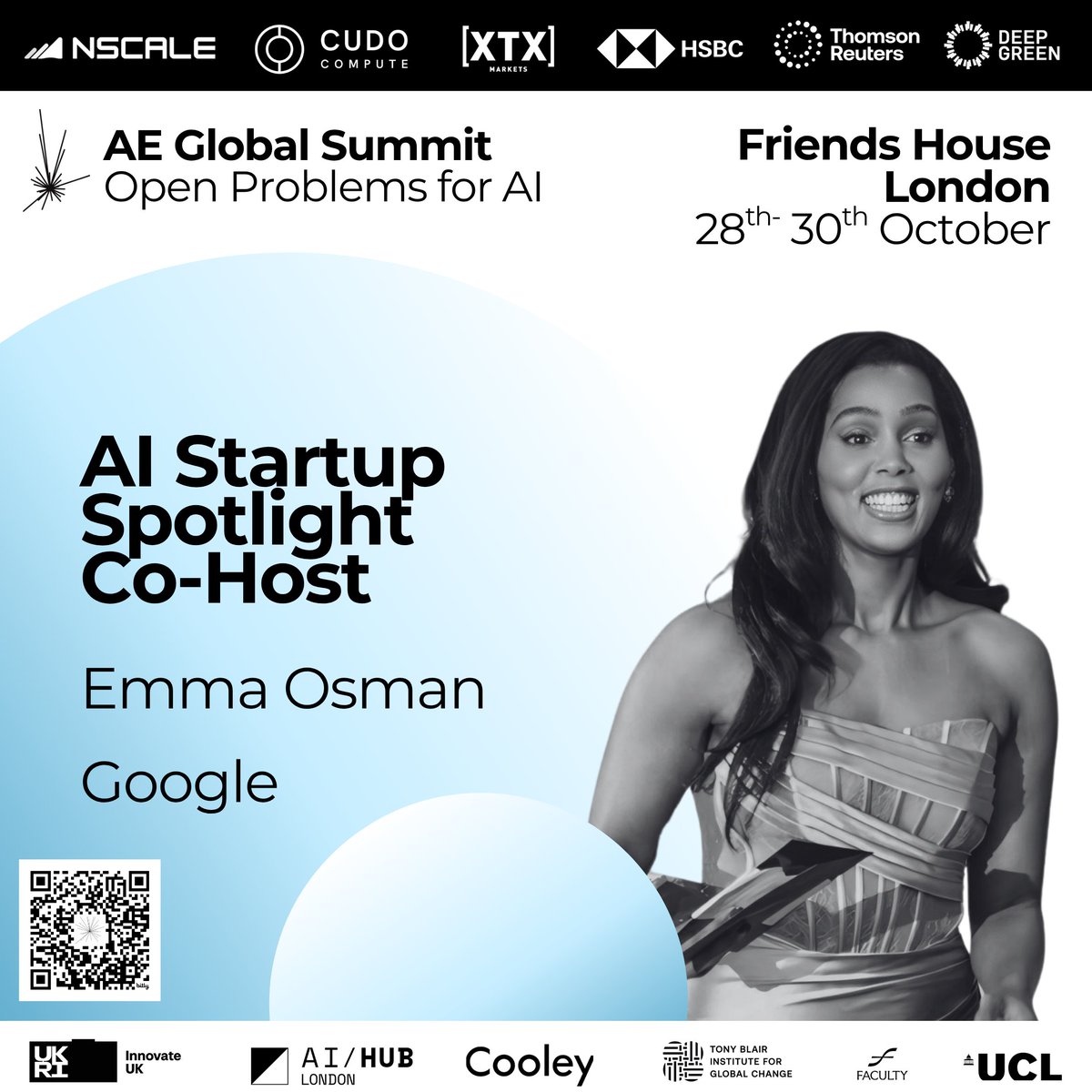
🌅 Announcing our first AI Startup Spotlight Host, Emma Osman | @Google
It's a delight to welcome Emma Osman, Strategic Partnerships Manager - Early Stage Startups at Google, to the AE Global Summit on Open Problems for AI!
Based in London, Emma brings a wealth of experience from her work at @Google, where she champions innovation, creativity, and collaboration across the early-stage startup ecosystem, helping founders scale across the UK.
Along with @RupertElston from @londonhub_ai, she will co-host the AI Startup Spotlight session, featuring the winner of our spotlight competition, along with @ContextualAI 🔥
More on our website below ↓
#AI #OpenProblems #ThinkingAboutThinking #OpenProblemsAI #MachineLearning #TechInnovation
1
3
164
6 Oct 2025
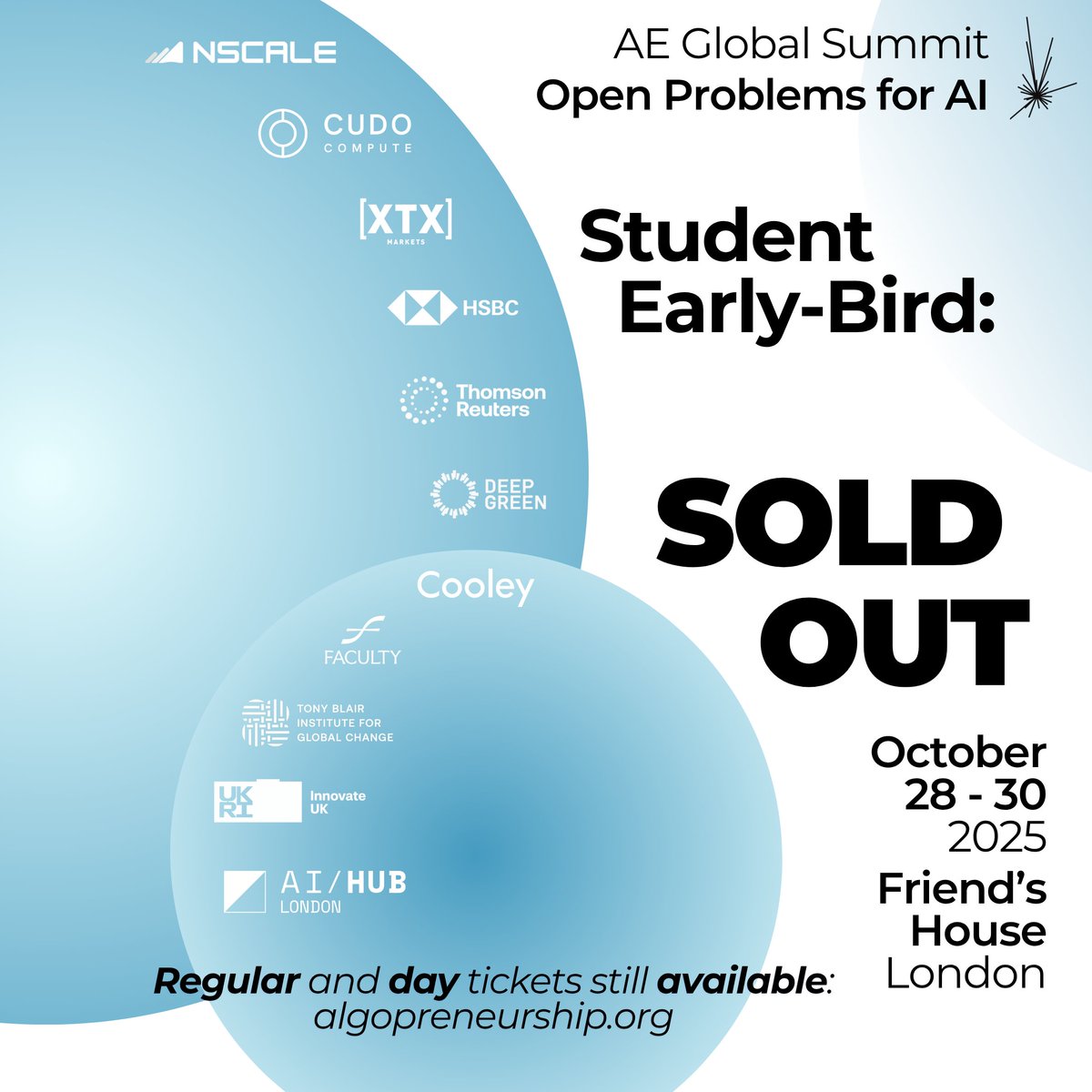
👏 SOLD OUT—Early Bird Student Tickets for the AE Global Summit on Open Problems for AI are now officially sold out 👏
That’s it! All Early Bird Student tickets gone—congratulations to everyone that managed to pick one up :)
From @GoogleDeepMind to @meta, @nvidia, @innovateuk, @UniofOxford, @hsbc_uk, the @InstituteGC, @elevenlabs,@wayve_ai, and more, the Summit will convene over 1,000 leaders in London to showcase the next wave of breakthroughs in AI research and applications.
Regular three day and single day tickets still available! Come and join the fun ↓
#AI #OpenProblems #ThinkingAboutThinking #OpenProblemsAI #MachineLearning #TechInnovation #AEGlobalSummit25
1
3
140
3 Oct 2025
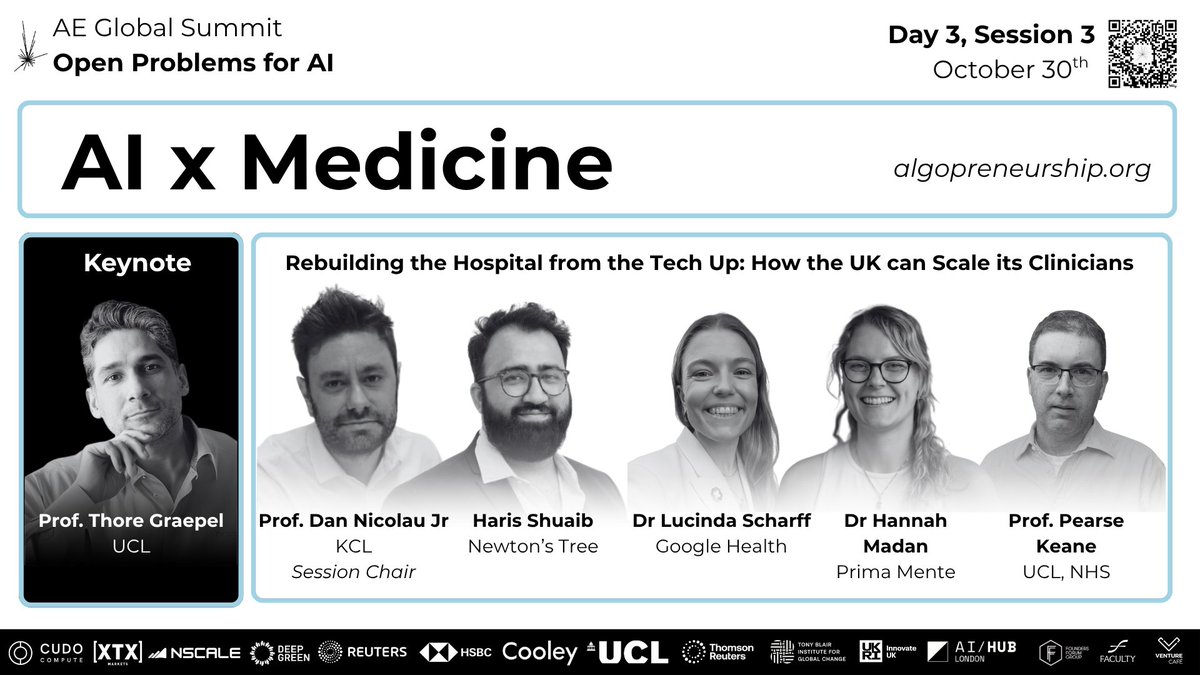
⚕️AE Global Summit Session Announcement: AI x Medicine (Day 3, Session 3)
The Summit will close with our flagship session on AI x Medicine, an area we feel represents one of the most important for applications of AI.
In this session, chaired by Prof. Dan Nicolau Jr Head of the AI for Science masters at @KingsCollegeLon, we ask how AI can help with the research basis and application of medicine in the UK.
Making discoveries in biology is notoriously hard. The complexity of biological systems, the relative quantitative immaturity of these fields, and the lack of verifiable solutions are just some of the reasons for that. Testament to this difficulty has been the vast amounts of capital poured into biomedical research without an accompanying level of results. Medical organisations like the NHS, too, are huge, complex systems that on one hand serve a nation’s health needs (for free!), and on the other are clearly extremely overburdened. Many of the changes that would help—consistent digital medical records, for example—have proven impossible to roll out, and turned into monetary disasters.
Can AI help with these problems? And, if the answer is no, what would it take to get it there?
Dan is joined by some of the nation’s experts in answering this question, including a keynote by Prof. Thore Graepel, Chair of Machine Learning at @UCL on “Escaping ageing through Cell Annealing—a phenomenological model.”
The day will close with a panel asking “How the UK can scale it’s clinicians,” perhaps the most critical question of them all, and featuring Dr @lucindascharff, at @GoogleForHealth Prof. @pearsekeane, Chair of Artificial Medical Intelligence at @ucl, @haris_shuaib, CEO of @newtonstreeai, and Dr @hannahmadan, at @primamente.
Come and join the debate on the future of medical research and service. More information via the link below ↓
#AI #OpenProblems #ThinkingAboutThinking
1
1
5
321

2 Oct 2025
Timo will join Day 3: AI Entrepreneurship & Applications, “Moonshots in AI x Education.”
More on our website below ↓
#AI #OpenProblems #ThinkingAboutThinking #OpenProblemsAI #MachineLearning #TechInnovation
tickets.algopreneurship.org/…
1
23
2 Oct 2025
She will be joined by Prof. Rose Luckin, @ucl and @knowldgillusion, @timohannay SchoolDash and Project X, and @tedcooke, at @MindMaxLabs.
Come and join us for AI x Education on Day 3 of the Summit! More information on the link below ↓
#AI #OpenProblems #ThinkingAboutThinking #OpenProblemsAI #MachineLearning #TechInnovation
tickets.algopreneurship.org/…
2
48
2 Oct 2025
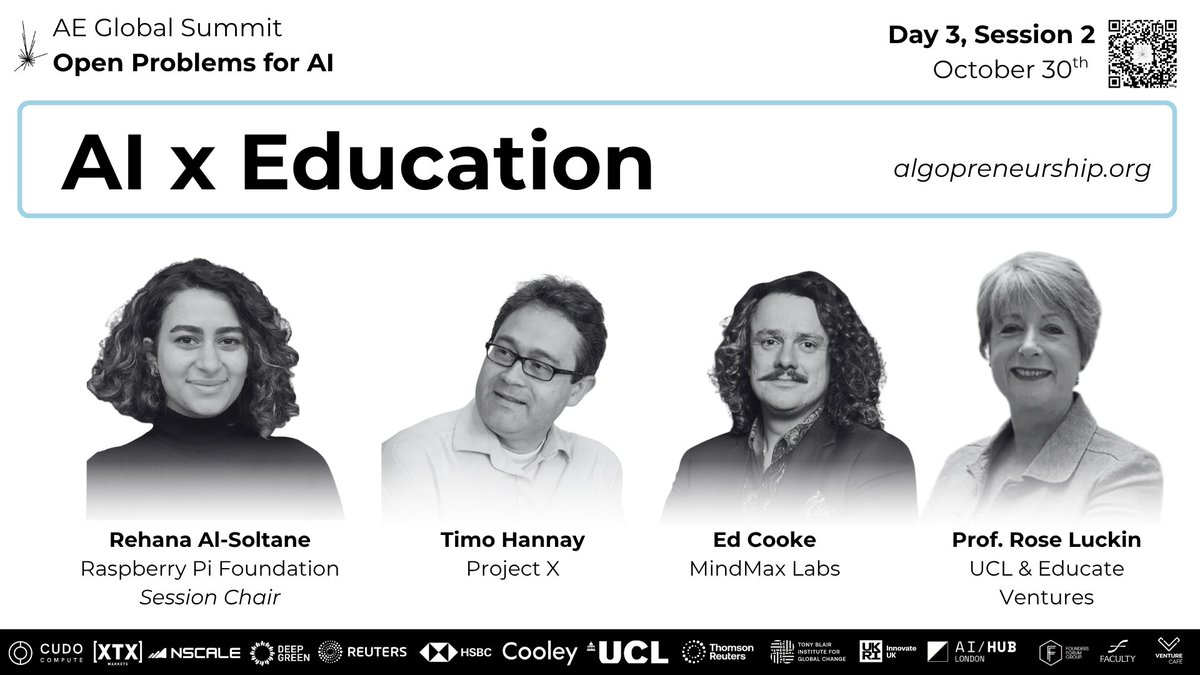
💡AE Global Summit Session Announcement: AI x Education (Day 3, Session 2)
Questions about how to educate ourselves about AI, and how to best use AI to educate us, are perhaps the most critical in all of AI.
On one hand we have unlocked the world’s knowledge, stored on the internet, in an engaging and discursive form that can explain most things to most people—the dream of many science fiction novels.
On the other hand, that very technology is changing so rapidly that it’s extremely difficult to keep up. And, it’s changing entire sectors, such that many of today’s jobs likely won’t be there tomorrow.
So, how should we educate ourselves?
We are delighted to welcome Rehana Al Soltane, Learning Manager at the @RaspberryPi_org, as our AI x Education Session Chair! Rehana has an exceptional background to channel this debate, as AI Learning Manager at the Raspberry Pi Foundation, with a master's degree in Educational Technologies from @Harvard, where she also studied digital fabrication and educational game design at @MIT, and previous work with the @khanacademy team.
She will be joined by Prof. Rose Luckin (@ucl & @knowldgillusion), @timohannay (SchoolDash & Project X), and @tedcooke (@MindMaxLabs).
Come and join us for AI x Education on Day 3 of the Summit!
More information on the link below ↓
#AI #OpenProblems #ThinkingAboutThinking #OpenProblemsAI #MachineLearning #TechInnovation
2
1
6
303
1 Oct 2025
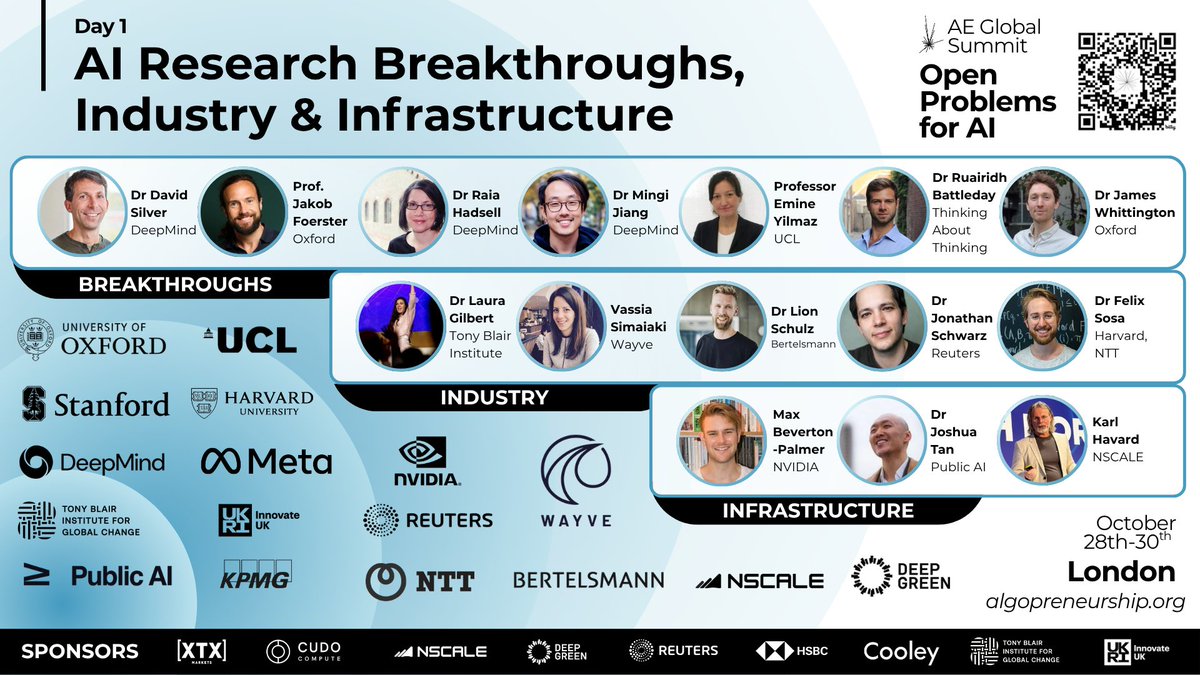
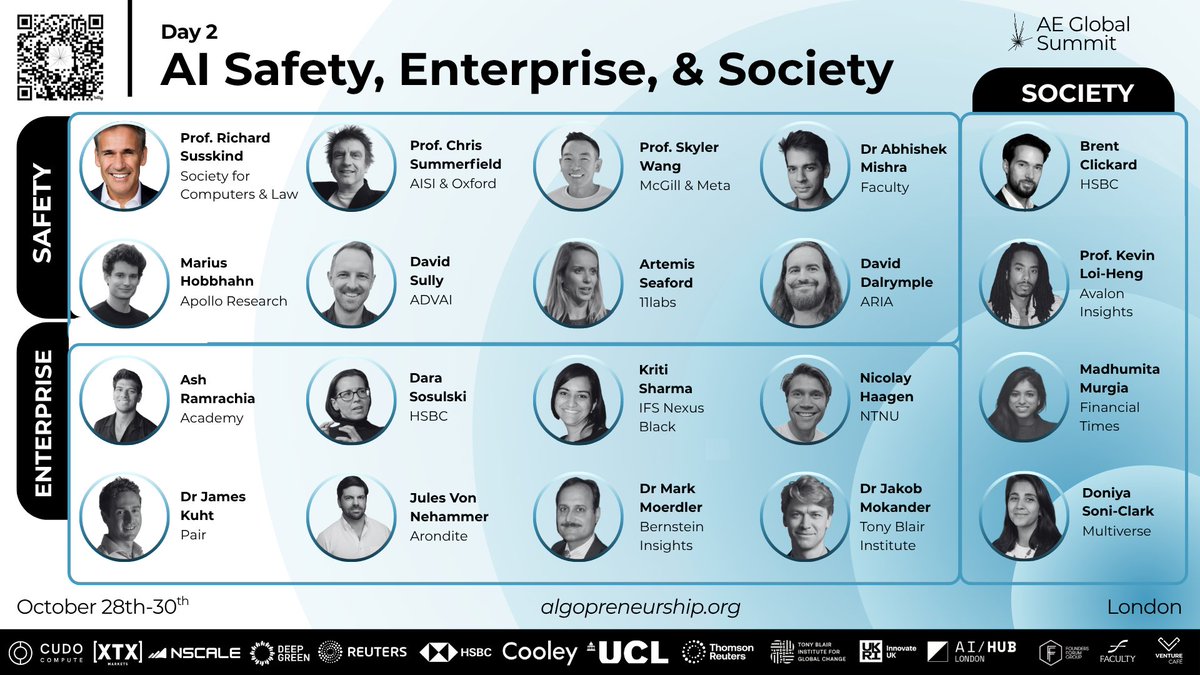
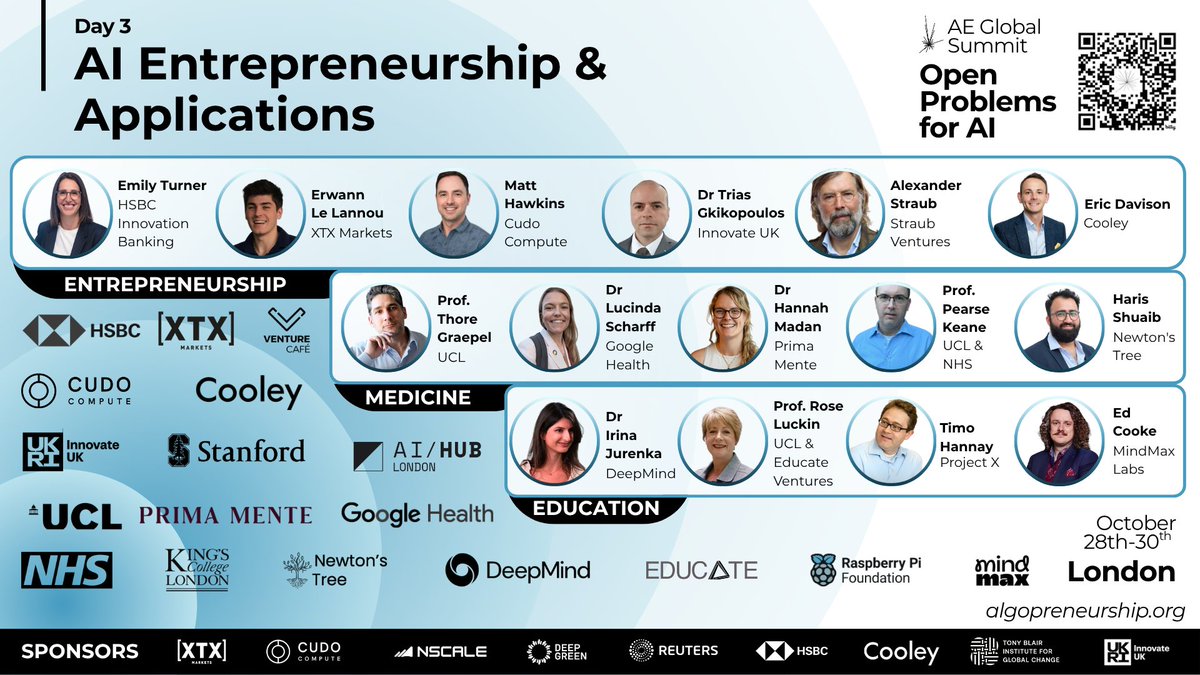
🏆 Programme announced for our Global Summit on Open Problems for AI!
With one month left until the Summit, we've officially announced our programme:
Day 1: AI Research Breakthroughs & Infrastructure
Day 2: AI Safety, Enterprise, Society
Day 3: AI Entrepreneurship & Applications (Education & Medicine)
We've been extremely fortunate to attract what I think must be the AI insider's line-up of the decade for the UK, with speakers from almost every leading institution:
@GoogleDeepMind @Meta @nvidia @ucl @UniofOxford @wayve_ai @AISecurityInst @elevenlabs @hsbc_uk @BlueDotImpact @InstituteGC @AlexanderStraub @innovateuk @xtxmarkets @GoogleForHealth @RaspberryPi_org @mcgillu @apolloaievals @AdvaiLtd @joinmultiverse @Harvard @mit @Stanford @Microsoft @nscale @Cudo_Compute @DeepGreenEnergy @faculty_ai @thomsonreuters @knowldgillusion @KingsCollegeLon @newtonstreeai @primamente @NTT_DATA_UK @londonhub_ai @Bertelsmann_com @PublicAI_ @BlueDotImpact @Cambridge_Uni @CooleyLLP @MindMaxLabs @IFS @aria_research @KPMG @VirtualRoutes @FT @altos_labs @join_ef @i_dot_ai @AivalHealth
Follow the link below to come, and come and join the great debate!
#AI #OpenProblems #ThinkingAboutThinking #OpenProblemsAI #MachineLearning #TechInnovation
1
4
14
2,959
30 Sep 2025
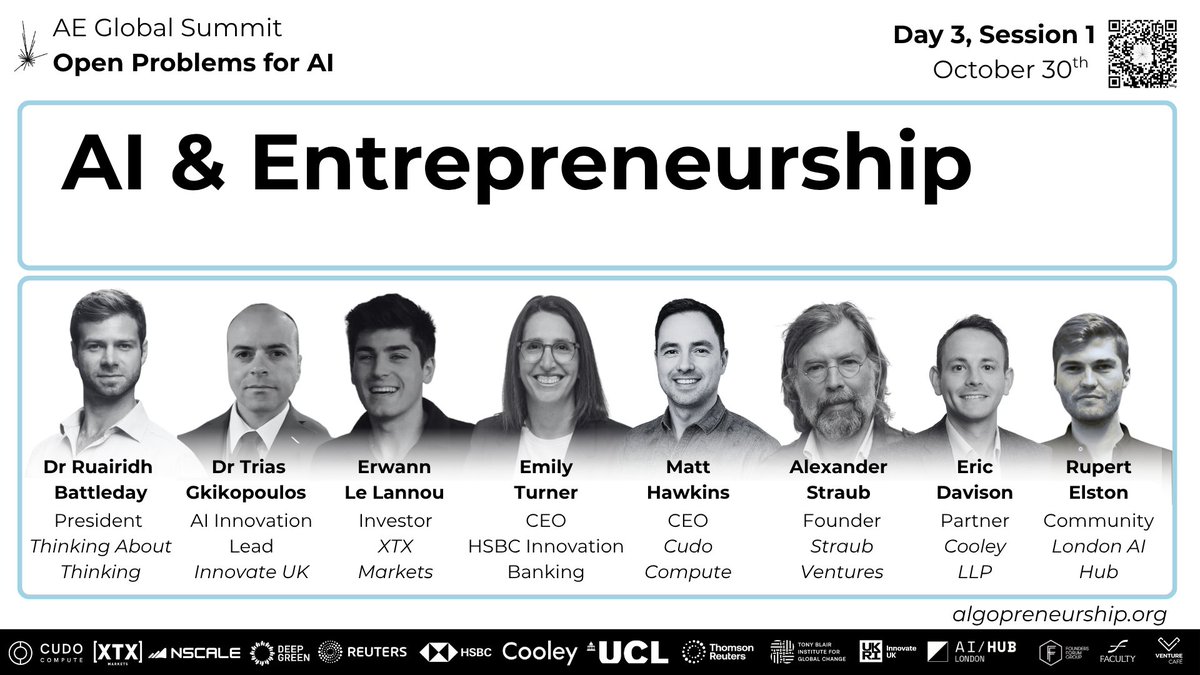
🏆 AE Global Summit Session Announcement: AI x Entrepreneurship (Day 3, Session 1)
Day 3 of the Summit will kick off with our inaugural session on AI x Entrepreneurship, where we will showcase Britain’s top AI startups in fireside chats, star panels, spotlight sessions, and an expo hall 🔥
The UK has always been a country of innovation, from the steam engine, to the Turing Machine, to @GoogleDeepMind's seminal breakthroughs in AI. The key question for us is how to take these ideas - and our world-class talent - and create start-ups that disrupt existing technologies and then scale.
The session will begin with a fireside chat between a leading investor, entrepreneur, and government minister, profiling what the UK is doing to boost entrepreneurship.
Then we move to a star-packed panel asking the Trillion-Pound question of what it would take for a UK startup to become a tech giant, featuring @hsbc_uk, @cooleyllp, @xtxmarkets, @innovateuk, and @AlexanderStraub. We’ll then launch our spotlight session, featuring rapid presentations by new UK AI companies of note, overseen by Rupert Elston, who has recently helped create an amazing ecosystem with @londonhub_ai.
Finally we’ll open up the AI x Entrepreneurship Expo Session, with breakout rooms and booths from @join_ef, @xtxmarkets @i_dot_ai, @Cudo_Compute, @innovateuk, Venture Cafe London, @cooleyllp, @AivalHealth, @HSBC!
If you’re a scientist thinking about building a team, a budding entrepreneur, or an investor looking for signal, this is the session for you.
Secure your spot now following the link below ↓
#AI #OpenProblems #ThinkingAboutThinking #OpenProblemsAI #MachineLearning #TechInnovation
1
1
7
361
29 Sep 2025
Learn more on our website ↓
#AI #OpenProblems #ThinkingAboutThinking #OpenProblemsAI #MachineLearning #TechInnovation
tickets.algopreneurship.org/…
2
32
29 Sep 2025
She will speak on Day 3: AI Entrepreneurship & Application. More on our website below ↓
#AI #OpenProblems #ThinkingAboutThinking #OpenProblemsAI #MachineLearning #TechInnovation
tickets.algopreneurship.org/…
2
27