
Jun 13
2/ The Architecture
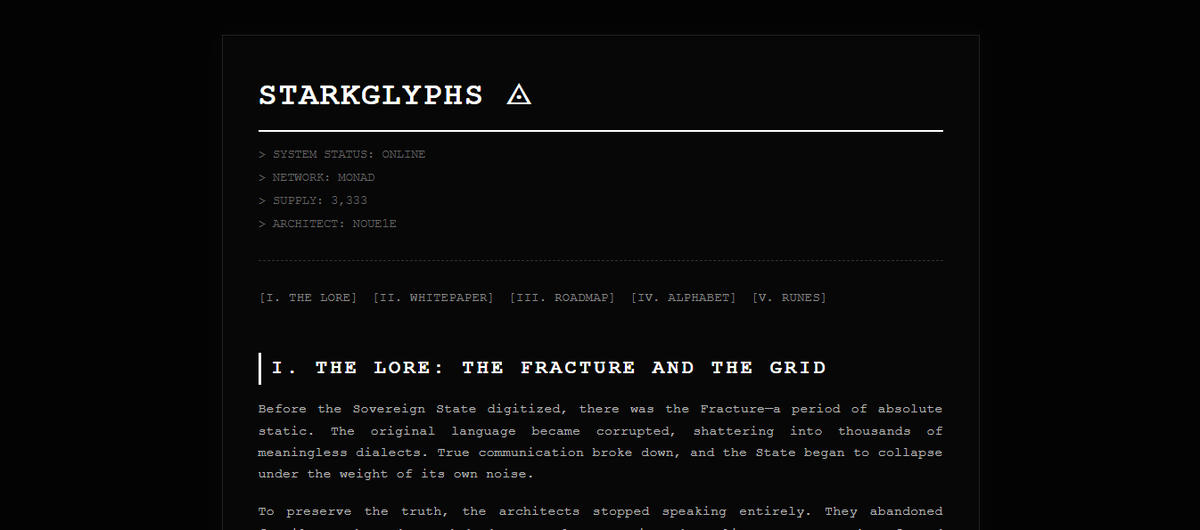
A living language requires a hyper-scalable engine. Starkglyphs features a fully interactive GitHub-hosted cryptographic terminal.
By utilizing Monad’s Parallel EVM and ~800ms state finality, Vanguard nodes can input commands, solve ciphers, and trigger dynamic, real-time visual evolutions on-chain with zero friction.
#ParallelEVM #Web3Dev #BuildOnMonad
1
3
4
38

[ DOKDO x LeverUp Pioneer Movement Season 2 2일차
@DOKDODAO @LeverUp_xyz ]
Monad 인프라
✅2편에서 본 LVUSD는 거래가 일어날 때마다 발행·정산이 반복되는 구조였습니다.
그렇다면 전제 조건이 하나 생깁니다 — 빠르고 저렴한 체인이어야 한다는 것.
LeverUp의 선택은 Monad였습니다. 오늘은 그 토대를 봅니다.
✅Monad는 EVM 완전 호환 고성능 L1입니다.
2025년 11월 24일 메인넷을 런칭했고, 이더리움용 스마트컨트랙트가 수정 없이 그대로 돌아갑니다.
핵심 기술은 한마디로 '병렬 실행(Parallel Execution)'입니다.
✅기존 EVM은 단일 차선 도로입니다.
내 스왑 한 건이 NFT 민팅, 오라클 업데이트, 전혀 무관한 수십 건의 거래 뒤에 줄을 섭니다. 서로 상관없는 거래인데도요.
Monad는 다차선 도로입니다. 충돌하지 않는 거래를 동시에 처리합니다.
✅목표 스펙은 약 10,000 TPS, 약 1초 블록, 빠른 파이널리티입니다.
다만 이 수치는 '목표치'이자 이상적 환경 기준이라는 점은 분명히 해둘 필요가 있습니다. 실제 부하에서의 처리량은 계속 검증되는 중입니다.
✅흥미로운 연결고리 하나.
Monad 창업팀(Keone Hon, James Hunsaker 등)은 Jump Trading 출신 HFT 엔지니어입니다.
저지연·병렬처리·대량 트랜잭션 — 고빈도 매매 인프라가 요구하는 것이, 곧 퍼프 거래소가 요구하는 것과 정확히 겹칩니다.
✅정리하면 — LeverUp의 'LP-Free 실시간 발행/정산'은 Monad라는 토대 없이는 성립하기 어려운 설계입니다.
이론은 충분히 봤으니, 다음 편에선 실제로 거래를 열고 닫아보겠습니다. 화면과 체감 위주로요.
#LeverUp #독도개척운동 #Monad #ParallelEVM


[ DOKDO x LeverUp Pioneer Movement Season 2 1일차
2번째글 @DOKDODAO @LeverUp_xyz ]
✅지난 편 마지막 질문: "LP가 없는데, 정산은 대체 무엇으로 하는가?"
LeverUp의 답은 합성 스테이블코인 LVUSD입니다.
LP-Free 구조를 실제로 굴러가게 만드는 핵심 부품이죠. 오늘은 이걸 해부합니다.
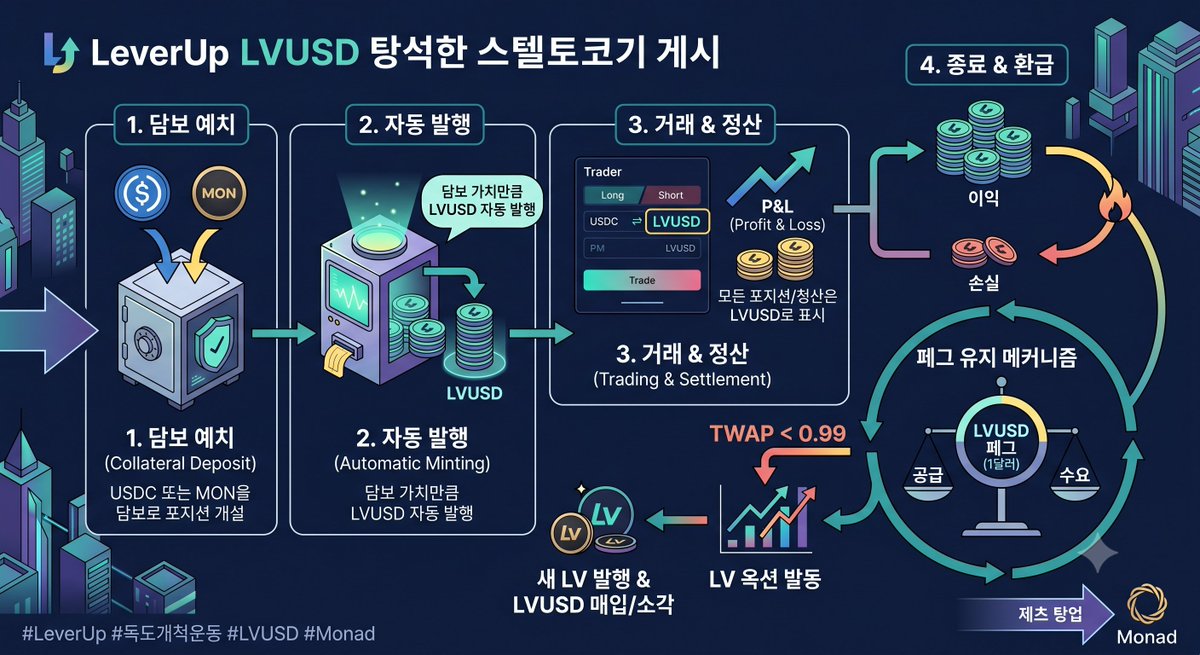
✅작동 방식은 의외로 직관적입니다.
USDC(또는 MON)를 담보로 포지션을 열면 → 시스템이 그만큼의 LVUSD를 자동 발행합니다.
모든 포지션은 LVUSD로 표시되고, 청산 시 정산도 LVUSD로 이뤄집니다. LP 풀이 아니라 발행·소각이 거래의 뼈대가 됩니다.
✅담보는 유연합니다.
원칙적으로 어떤 토큰이든 담보로 쓸 수 있고, 각 토큰은 자기만의 독립된 풀에서 관리됩니다. 초기엔 USDC와 MON을 우선 지원합니다.
유동성 공급자 없이도 거래가 성립하는 구조가 바로 여기서 나옵니다.
✅손익 정산도 같은 원리입니다.
포지션을 닫았을 때 받은 LVUSD가 처음 넣은 담보보다 많으면 이익, 적으면 손실.
LP의 풀이 트레이더의 상대방이 되는 게 아니라, 프로토콜 차원에서 정산이 처리됩니다.
✅관건은 'LVUSD가 1달러를 유지하는가'입니다.
LVUSD가 페그 아래(TWAP < 0.99)로 떨어지고 유통량이 볼트 USDC를 넘으면 → LV 옥션이 발동됩니다. 새 LV를 발행·경매해 초과 LVUSD를 사들여 소각하죠.
이때 손실은 LV 스테이커가 가장 먼저 부담합니다.
✅짚을 점 — 합성 스테이블코인은 '페그 안정성 = 시스템 신뢰' 입니다.
설계는 정교하지만, 극단적 변동성에서의 실증은 또 다른 문제입니다. 이 부분은 리스크 편에서 정직하게 다룹니다.
다음 편 — 이 모든 걸 가능케 하는 토대, Monad를 봅니다.
#LeverUp #독도개척운동 #LVUSD #Monad
1
148

Jun 8
-⚡ $SEI is coiling for a massive breakout as the market prepares for a major Layer 1 sector rotation!
🏎️ Recent Catalyst: The native SEI EVM network migration is officially underway with Tier-1 exchanges like Binance completing integrations.
🛠️ Upgrade Pending: The highly anticipated "Sei Giga" upgrade is pushing the limits of parallelized EVM execution, targeting sub-400ms finality.
🌐 Scalability: Blazing past traditional bottlenecks, the Autobahn consensus mechanism is paving the way for over 200,000 TPS.
💎 SIP-03 implementation is actively streamlining the ecosystem into a pure, hyper-efficient EVM power plant.
🚀 #SEI #ParallelEVM #Layer1 #Crypto #DeFi #SeiGiga
1
6
570

May 31
过去几年,很多公链都在卷 TPS。
但真正的问题是高 TPS 能不能支撑下一阶段 AI Agent 的链上行为?
未来链上的大量交互很可能不再来自人工点击,而是 AI 自动执行、自动协作、自动结算。
这会让并行执行的重要性快速上升。
最近在研究 @Bitroot_ 时,一个很明显的感受是,它并不是简单做高性能公链,而是在押注 AI Blockchain 未来的执行层需求。
包括:并行 EVM、低延迟、高扩展性、跨链能力、以及未来 AI Agent 的链上适配。
再结合测试网增长与国际生态布局,整个方向其实已经越来越清晰。
下一轮基础设施竞争,很可能会围绕谁更适合 AI 上链展开。
#Bitroot #AI #ParallelEVM #Blockchain #Layer1

2
1
2
3,609

May 31
最近我花时间好好研究了 @Bitroot_ 这个项目,越看越觉得它抓住了下一阶段 Layer1 竞争的几个关键方向。
在 EVM 生态高度内卷的今天,单纯堆 TPS 已经不够了。Bitroot 选择的是 并行 EVM AI 原生支持 的路线,目标是打造一条高性能、低延迟、低成本的去中心化基础设施。
它不只是技术升级,还在逐步构建完整链上生态:跨链桥、RWA 黄金链上服务、支付 U 卡、去中心化网站等,试图把数字资产、DeFi 和现实数字经济更好地连接起来。
我个人比较看好它的并行执行能力,这能有效缓解传统公链的瓶颈,尤其适合 AI Agent、高频交易、RWA 等高吞吐量场景。测试网阶段的地址增长和生态数据也保持了不错的势头。
新加坡行业大会的亮相,也显示了 Bitroot 在国际生态拓展上的决心。
白皮书(建议认真看一下):
- 中文版:drive.google.com/file/d/182K…
- 英文版:drive.google.com/file/d/1j5N…
官网:bitroot.co/
Twitter:twitter.com/Bitroot_
Telegram:t.me/bitroot_official
Gitbook:bitroot.gitbook.io/bitroot
#Bitroot #ParallelEVM #AI #Web3 #Layer1 #Blockchain

60
42
3,301

May 31
One of the biggest problems in blockchain today is scalability.
As more users and AI-powered applications enter Web3, many chains still struggle with slow transactions, congestion, and expensive fees. That’s why more people are now paying attention to Parallel EVM infrastructure.
Recently, I’ve been looking into @Bitroot_ and I think the project is building in an interesting direction.
Bitroot is focused on creating a high-performance AI-powered public chain that aims to make blockchain transactions faster, smoother, and more scalable for real usage.
What I find interesting is that the project is not only focused on speed alone. The ecosystem is also working on products like cross-chain bridges, on-chain payment solutions, RWA gold services, and decentralized finance infrastructure.
The combination of AI and blockchain is also becoming a very important conversation in Web3.
In the future, AI agents may handle thousands of on-chain actions automatically. For that to work properly, blockchain networks need infrastructure that can process many transactions at the same time without slowing down.
That’s where Parallel EVM could play a major role.
Bitroot’s growing testnet activity and ecosystem expansion show that the team is preparing for the next stage of blockchain adoption instead of just following trends.
I also like seeing projects expand globally and participate in industry conferences because it shows they are serious about long-term growth and ecosystem development.
Web3 is gradually moving beyond hype. The focus is now shifting toward infrastructure that can support AI, payments, DeFi, and large-scale blockchain activity efficiently.
Projects building toward that future are definitely worth watching.
#Bitroot #ParallelEVM #AI #Web3 #Layer1 #Blockchain

77
3
239
18,666

May 31
The Next Meta: Why Parallel EVM AI is Redefining Layer 1s (And Why You’re Early to Bitroot)
The public chain bottleneck is real. Traditional EVMs process transactions one by one like a single-lane highway during rush hour. As Web3 scales, this high-latency, high-fee model is holding us back.
Enter Bitroot, a high-performance EVM parallel-AI public chain designed to smash these performance ceilings.
Here is why this project needs to be on your radar right now.
The Technical Narrative: Parallel EVM is the Paradigm Shift
We’ve data-tested monolithic chains and modular rollups, but the next stage of decentralized infrastructure belongs to Parallel EVM. By executing non-conflicting transactions simultaneously rather than sequentially, Bitroot delivers massive TPS scaling, ultra-low latency, and fractions-of-a-cent gas fees. It’s the infrastructure the digital economy actually needs to go mainstream.
The future isn't just humans trading tokens; it’s autonomous AI agents executing complex, cross-chain DeFi strategies. Bitroot is uniquely positioned at the intersection of AI Blockchain, providing the high-throughput, low-cost decentralized foundation required to power next-gen AI on-chain products.
#Bitroot #ParallelEVM #AI #Web3 #Layer1 #Blockchain
1
4
92

May 31
I've been paying closer attention to the next generation of blockchain infrastructure lately.
One trend that stands out is the rise of Parallel EVM. As more users, AI agents, and on-chain applications enter Web3, traditional sequential execution models are starting to face scalability challenges. TPS bottlenecks, network congestion, and execution efficiency are becoming increasingly important topics.
This is one reason why projects like Bitroot have caught my attention. Their focus on Parallel EVM architecture aims to improve transaction processing efficiency while maintaining EVM compatibility, which could help support larger-scale adoption in the future.
Another interesting angle is the combination of AI and blockchain. As AI Agents become more capable, they will need blockchain networks that can handle frequent on-chain interactions, automated execution, and real-time settlement. High-performance infrastructure may become a critical foundation for this new wave of applications.
Bitroot's recent testnet growth and ecosystem expansion efforts suggest that the team is actively building toward this vision. It will also be interesting to see what insights emerge from their participation in industry events such as the Singapore conference and how their global ecosystem strategy develops over time.
The blockchain industry is evolving rapidly, and Parallel EVM could become one of the key infrastructure narratives to watch in the coming years.
What are your thoughts? Will Parallel EVM play a major role in the future of Layer1 networks?
#Bitroot #ParallelEVM #AI #Web3 #Layer1 #Blockchain

53
3
54
425

May 30
衡量一條新公鏈是真在做事還是純喊口號,看測試網的數據增長和生態落地速度是最直接的。
剛注意到 @Bitroot_ 釋出的最新測試網數據,無論是地址增長率還是生態交互熱度,這波爆發力都挺猛。再結合他們前陣子在新加坡行業大會上的高調亮相,很明顯團隊正在加速推動國際化生態的部署。
除了技術面在跑並行 EVM(Parallel EVM)之外,他們真正吸引我的是產品的實用落地速度——從支付 U 卡到 RWA 黃金服務,這都是能直接帶來真實用戶和現金流的業務。隨著測試網數據持續衝高,接下來的主網上線和未來的 Roadmap 預期基本被拉滿了。如果你在找下一個可能引爆市場的 Layer1 基礎設施,不妨先把這隻加入了自選。
#Bitroot #ParallelEVM #AI #Web3 #Layer1 #Blockchain


1
4,113

May 30
最近在看幾款新公鏈的架構,老實說,現在很多 Layer1 的 TPS 瓶頸已經嚴重限制了 DApp 的想像力,特別是當我們開始談 AI Agent 鏈上自主執行時,高併發和極低延遲是剛需。這也是為什麼我最近特別關注 Parallel EVM(並行 EVM)的原因。
關注到了 @Bitroot_ 這個項目,他們給自己的定位是「高性能 EVM 並行 AI 公鏈」。傳統 EVM 就像單行道,交易只能排隊過;而並行 EVM 則是直接開了多條車道,大幅提升吞吐量並降低成本。當基礎設施升級到並行級別,AI Web3 才能真正落地,否則 AI 丟出的海量高頻指令根本沒公鏈接得住。看了一下他們的白皮書,除了並行鏈,底層還整合了去中心化網站、跨鏈橋甚至是 RWA 黃金鏈上服務,這個生態布局確實有野心。
作為基礎設施的下一個重要演進方向,Parallel EVM 賽道今年絕對值得下重注研究。
#Bitroot #ParallelEVM #AI #Web3 #Layer1 #Blockchain


1
3,042

May 30
A Lot Of People Underestimate How Important Parallel EVM Will Become Over The Next 2 Years.
The Current EVM Ecosystem Has A Scaling Contradiction:
More Users → More Congestion
More Applications → Higher Gas Competition
More AI Automation → Execution Overload
Serial Execution Architecture Eventually Hits Limits.
Parallel Execution Changes That Model By Allowing Non-Conflicting Transactions To Process Simultaneously — Which Is Probably Necessary If Web3 Wants To Support AI Agents, Payments, RWA Assets, And Consumer-Scale Applications Together.
@Bitroot_ Is Building Around This Thesis Early.
The Interesting Part Is The Broader Ecosystem Direction:
• Cross-Chain Bridge Infrastructure
• Decentralized Web Services
• Payment U-Cards
• RWA Gold Integration
• AI-Compatible Execution Environment
Feels Like The Industry Is Slowly Entering The “Usable Blockchain Infrastructure” Phase Instead Of Pure Speculation.
Testnet Metrics And Ecosystem Growth Will Be Key Indicators Before Mainnet Launches, But The Direction Itself Aligns With Where The Market Seems To Be Heading.
Parallelization May Become The Standard Architecture Narrative Of The Next Layer1 Cycle.
#Bitroot #ParallelEVM #AI #Web3 #Blockchain #Layer1
43
35
811

May 30
很多人低估了 AI Agent 对区块链底层架构的冲击。
当 AI 开始真正进入链上世界后,公链需要处理的,不再只是用户交易,而是海量自动化执行。
这意味着:更高频率、更低延迟、更强并发、以及更稳定的执行环境。
所以最近越来越关注并行 EVM 方向。
尤其是 @Bitroot_ 这种把 AI 与高性能 Layer1 结合的基础设施项目。
逻辑其实很清楚:未来 AI Agent 越活跃,并行执行的重要性就越高。
目前也看到 Bitroot 在测试网增长、生态扩张、新加坡行业大会以及全球化布局上持续推进。
AI 时代真正稀缺的,可能不是模型,而是能够承载 AI 的链上执行层。
#Bitroot #Web3 #AI #ParallelEVM #Blockchain

3
1
4
3,130

Most blockchains were designed around human behavior.
• We click buttons.
• We sign transactions.
• We interact with applications one action at a time.
But autonomous AI agents operate very differently.
They execute continuously, coordinate simultaneously, and generate a level of on-chain activity that traditional sequential EVM architectures were never designed to handle.
Thousands of concurrent executions, real-time liquidity routing, inference requests, and autonomous decision making will begin exposing the limits of linear blockchain execution models.
This is why Parallel EVM is becoming a hard infrastructure requirement rather than just another scalability narrative.
@Bitroot_ is approaching this through optimistic parallel execution combined with transaction dependency prediction and instruction-level parallelism.
Instead of forcing every transaction through a single execution path, the network dynamically separates conflict-free workloads for concurrent execution while only rolling back the small subset of conflicting states when necessary.
The result is an execution environment optimized for continuous AI-native coordination onchain.
Benchmark tests already demonstrate throughput scaling to 25,600 TPS across 8 shards, while the broader architecture is designed for throughput targets exceeding 100,000 TPS.
But the more important shift is the execution model behind it.
Most blockchain bottlenecks no longer come from raw transaction count alone.
They come from concurrent state access, dependency conflicts, and large-scale execution coordination.
As AI agents increasingly interact with smart contracts autonomously, parallel workload execution becomes far more important than simply increasing block space or gas limits.
The next generation of blockchains will not compete on throughput alone.
They will compete on how efficiently they coordinate autonomous execution at machine scale.
#Bitroot #ParallelEVM #Layer1
74
1
83
2,934

May 30
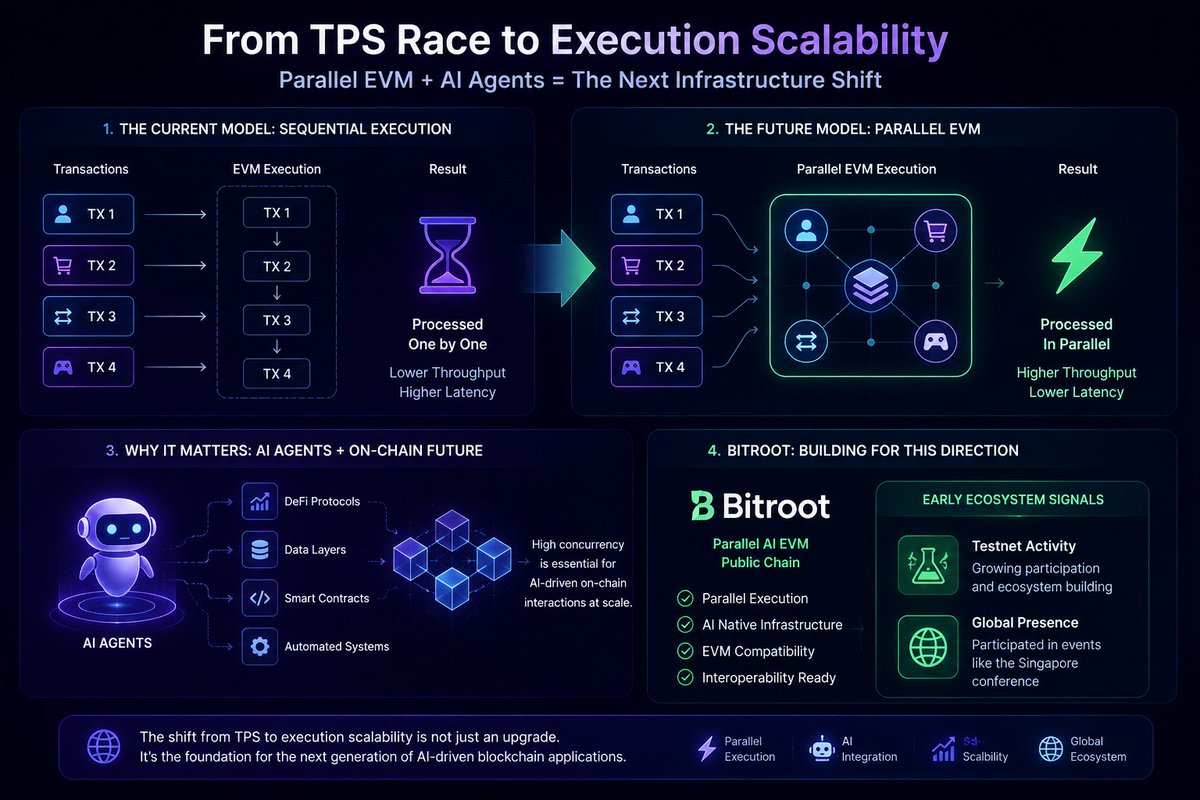
For a long time, blockchain discussions have been heavily focused on TPS as the primary benchmark for performance.
But I think this framing is starting to lose relevance as the real bottleneck gradually shifts toward execution scalability and system level concurrency.
The next phase of on chain activity will likely not come only from human users, but increasingly from AI agents and automated systems interacting continuously with smart contracts, DeFi protocols, and data driven applications.
In that environment, sequential execution models begin to show structural limitations.
This is where Parallel EVM becomes an important infrastructure direction.
By enabling multiple non conflicting transactions and smart contract operations to be executed in parallel, systems can improve throughput and reduce latency under high frequency and complex workloads.
From a broader perspective, this also reflects the growing intersection between AI and blockchain infrastructure.
As AI agents become more integrated into on chain workflows, the underlying systems will need to support higher concurrency, more dynamic execution paths, and greater efficiency at scale.
Within this context, I have been following projects exploring this direction, including @Bitroot_ , which is building around a Parallel AI EVM public chain approach alongside early stage ecosystem development.
There are also early signals such as testnet activity and participation in industry events like the Singapore conference, which suggest a continued focus on ecosystem expansion and global positioning ahead of mainnet.
Overall, this is still an early stage narrative.
But the direction is becoming clearer. Infrastructure optimized for parallel execution may become a foundational layer for the next generation of AI driven blockchain applications.
Worth continuing to watch as the space evolves.
#ParallelEVM #AI #Web3 #Layer1 #Blockchain #Bitroot
55
5
60
1,890

May 30
One thing the market is starting to realize again:
Not all Layer 1s are competing on the same level anymore.
The next infrastructure race probably won’t be won by hype alone it’ll be won by execution speed, scalability, and how well chains adapt to AI-native applications.
That’s why the Parallel EVM narrative is getting more attention lately.
Traditional EVM chains still struggle with throughput bottlenecks because transactions are processed sequentially. As onchain activity grows especially with AI agents, real-time automation, gaming, RWAs, and high-frequency execution the limitations become obvious very quickly.
Parallel execution changes that equation.
Instead of processing everything one-by-one, transactions can execute simultaneously, improving throughput and reducing latency without sacrificing compatibility with the EVM ecosystem developers already use.
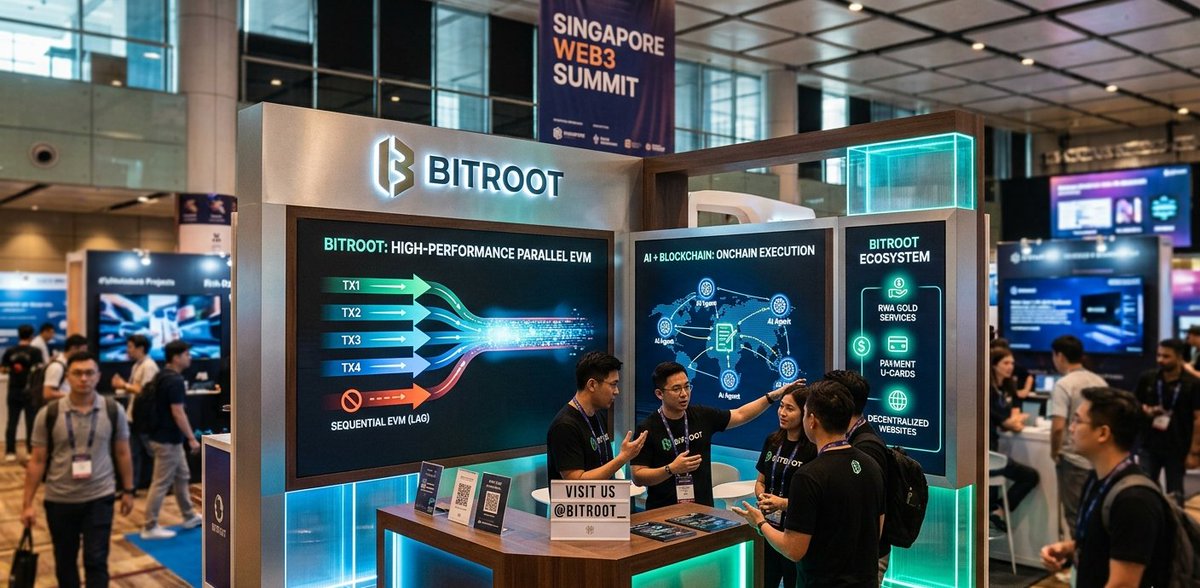
That’s the area Bitroot is positioning itself in.
@Bitroot_ is building a high-performance Parallel EVM infrastructure while also leaning heavily into the AI blockchain direction.
And honestly, the interesting part isn’t only the tech stack.
It’s the ecosystem direction they’re pushing alongside it:
• Cross-chain infrastructure
• RWA gold services
• Payment U-cards
• Decentralized websites
• AI-oriented onchain execution
That combination suggests they’re thinking beyond “just another chain.”
The recent testnet growth and ecosystem expansion also show the team is actively building instead of simply farming narratives.
Another signal worth watching:
Bitroot’s participation in the Singapore industry conference.
A lot of serious infrastructure conversations are happening again in Asia especially around scalable execution environments and AI-integrated blockchain systems.
Feels like the market is slowly entering the phase where infrastructure quality matters more than short-term speculation.
If AI agents become more active onchain in the next cycle, scalable Parallel EVM infrastructure could become one of the most important sectors in Web3.
Worth paying attention to.
#Bitroot #ParallelEVM #AI #Web3 #Layer1 #Blockchain
67
83
3,208

May 29
I caught myself staring at a testnet dashboard last night, heart rate up, because an AI agent I spun up executed 47 concurrent trades in one block without a single conflict. Most chains would’ve choked, forced everything into a queue, and spat out errors.
That’s the dirty secret nobody says out loud: sequential EVM execution isn’t a feature, it’s the bottleneck that’s quietly killed real on-chain intelligence for years.
Bitroot’s V4 testnet just proved the alternative works. Parallel EVM isn’t marketing fluff here. It scans dependencies upfront, groups non-conflicting transactions, and lets the engine chew through them simultaneously while Pipeline BFT keeps consensus tight.
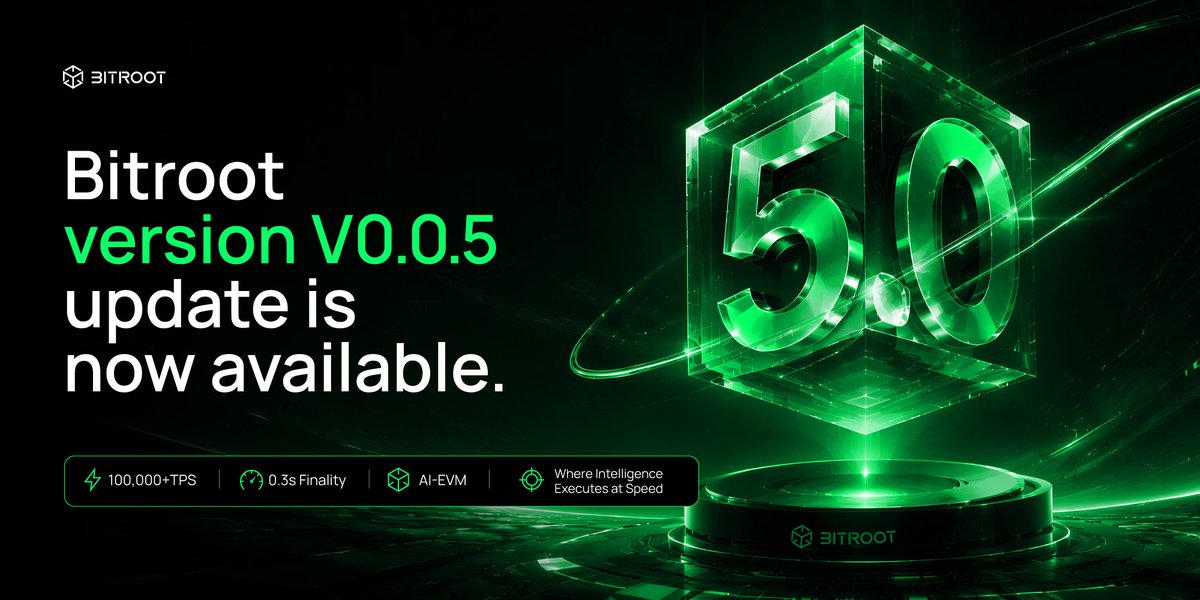
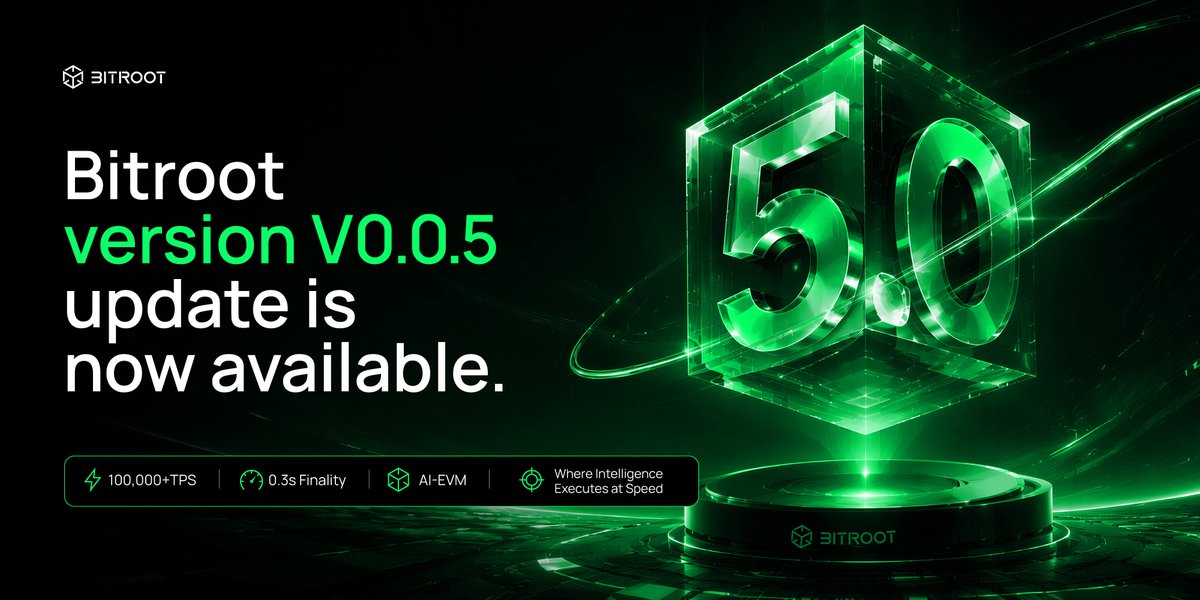
Result? Over 500,000 addresses already active, north of three million transactions logged, and testnet benchmarks hitting the kind of throughput that actually supports live AI agents instead of just simulating them. Gas at fractions of a cent. Finality in 0.3 seconds. No heroic L2 hacks required.
I was in Singapore last month when the conference floor buzzed with the same realization: builders are done waiting for yesterday’s infrastructure to catch tomorrow’s agents. @Bitroot_ presence there felt less like promotion and more like quiet confirmation.
While others pitched vaporware roadmaps, the team talked verifiable AI execution, cross-chain bridges that don’t leak trust, and on-chain RWA rails that finally make sense at scale. Their global push grants flowing to builders in Asia, Europe, Middle East shows they get it: this only works if the ecosystem grows beyond one geography.
I’m not calling it inevitable. I’m saying the math finally checks out. Sequential chains will keep pretending they scale until an AI-native parallel chain like Bitroot ships mainnet and the rest become legacy footnotes.
I’ve seen enough broken promises to stay skeptical, but watching that agent move real value in real time changed the math for me. The next layer of infrastructure isn’t coming. It’s already stress-testing in public.
#AI #Bitroot #ParallelEVM

69
3
190
20,719

I was at a concert last year
they dropped limited merch on chain during the show
It was exclusive, first come first served and we had only 500 pieces
i had my wallet open, gas set, finger on the button
but still yet my transaction failed I tried again and I failed again
by the time it went through the collection was sold out
i checked the chain, bots had swept everything in the same block i was trying to enter and the network was so congested that real people never stood a chance
that moment taught me something blockchain isn’t slow because the idea is broken, it’s slow because the infrastructure wasn’t built for real demand
every transaction queued up. processed one at a time. in order. no exceptions
that’s not a decentralized future. that’s a digital waiting room
most public chains today still work this way
ethereum, the biggest one, processes around 15-30 transactions per second
visa does 24,000
the gap isn’t small. it’s civilizational
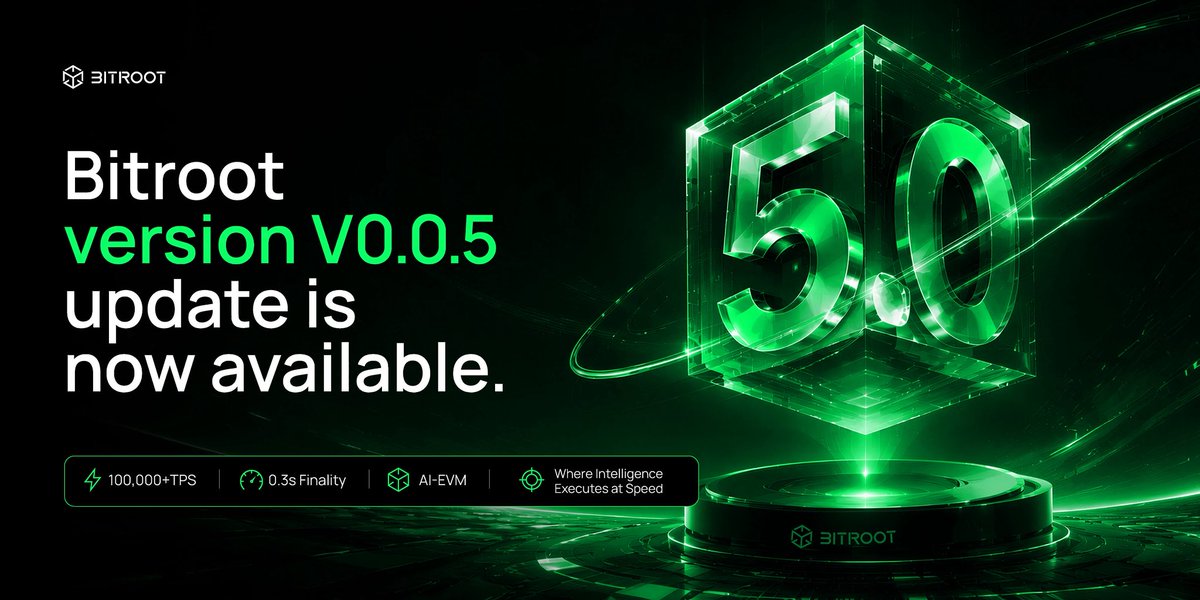
that’s the problem @Bitroot_ is solving parallel EVM - instead of processing transactions one by one in a single line, Bitroot runs multiple execution threads simultaneously
same security. same decentralization. drastically higher throughput
you get lower latency, lower cost and its built for actual scale
➩ they’re not just talking about it
➩ the testnet is live.
➩ address growth is already moving.
➩ the ecosystem is being built in public
they were just at the Singapore industry conference laying out the roadmap for global expansion
AI agents executing on chain. RWA assets. cross chain infrastructure. payment cards
this is what Layer 1 looks like when it’s actually designed for the world we’re building
i’m not losing another drop to a congested chain
#Bitroot #ParallelEVM #AI #Web3 #Layer1
76
44
191
2,042

May 29
The shift from chatty agents to autonomous operators changes the constraint. You do not need bigger models, you need rails that can clear thousands of intents in realtime with guarantees
This is why I have been studying @Bitroot_ . Parallel EVM to break TPS ceilings, keep latency and fees down, and keep devs in familiar EVM. On testnet I wired a simple rebalancer agent that fired dozens of tx per minute and saw fast finality and negligible gas. If PROM integration lands, that unlocks agent payments, escrow, and automated settlement for DeFi and RWA flows
What I am watching into mainnet:
• sustained throughput under load
• agent wallet standards and permissions
• solver networks and intent tooling
• verifiable execution audits
• indexing and data access for agents
If they hit these, $BRT sits where AI meets verifiable execution. AI is the interface, high performance Layer1 is the engine
#Bitroot #ParallelEVM #AI #Web3 #AIAgent #Layer1 #DeFi #RWA

42
4
83
1,228

Everyone talks about AI blockchain, but most chains still struggle once activity gets heavy.
Transactions slow down, fees rise, and the user experience becomes frustrating fast.
That’s why the Parallel EVM narrative is starting to gain real attention.
@Bitroot_ is building a high-performance Layer1 focused on parallel execution, faster processing, and lower costs the kind of infrastructure blockchain will actually need if AI agents begin operating on-chain at scale.
What makes it more interesting is that the vision goes beyond just TPS numbers.
Bitroot is also building cross-chain infrastructure, payment U-cards, RWA gold services, decentralized websites, and other tools aimed at pushing real Web3 utility.
Their testnet growth has also been picking up quickly, with more wallets and ecosystem activity showing strong early momentum.
And with Bitroot already appearing at major industry events in Singapore, it’s clear they’re positioning for global expansion early.
The Layer1 space is crowded already, but projects combining AI narratives with scalable infrastructure could easily stand out in the next cycle.
#Bitroot #ParallelEVM #AI #Web3 #Layer1 #Blockchain
94
32
249
5,327

May 29
Bitroot : Pioneering the Parallel EVM Revolution
Thrilled to see @Bitroot_ making strong strides on Testnet!
Address growth has been explosive, reflecting robust ecosystem adoption and real user interest.
By leveraging Parallel EVM, Bitroot effectively overcomes traditional public chain TPS bottlenecks, delivering high throughput with low latency and minimal fees.
The integration of AI Agents with on chain execution is set to redefine DeFi, RWA, and decentralized applications.
With active participation in the Singapore industry conference and aggressive global expansion, Bitroot is positioning itself as a leading Layer 1 for the AI Blockchain era.
Mainnet launch and exciting roadmap ahead, the future looks bright!
#Bitroot #ParallelEVM #AI #Web3 #Layer1 #Blockchain
97
2
94
3,818