
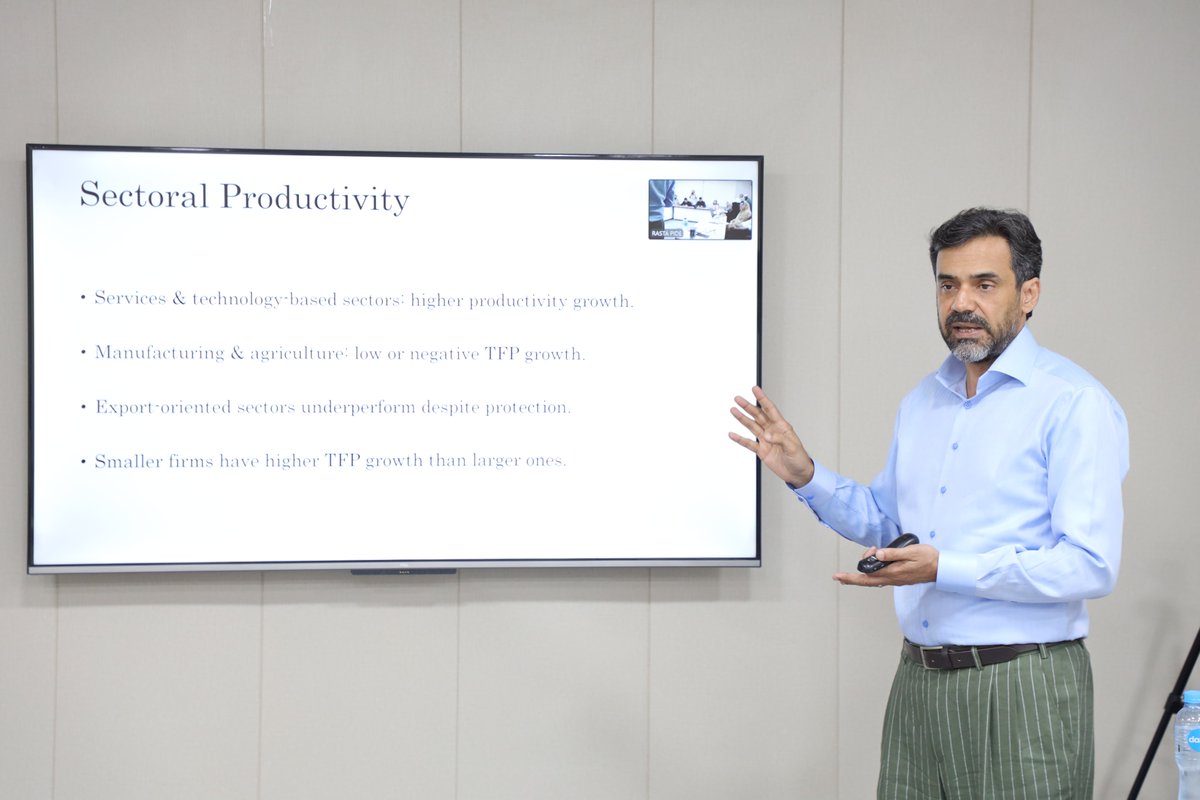
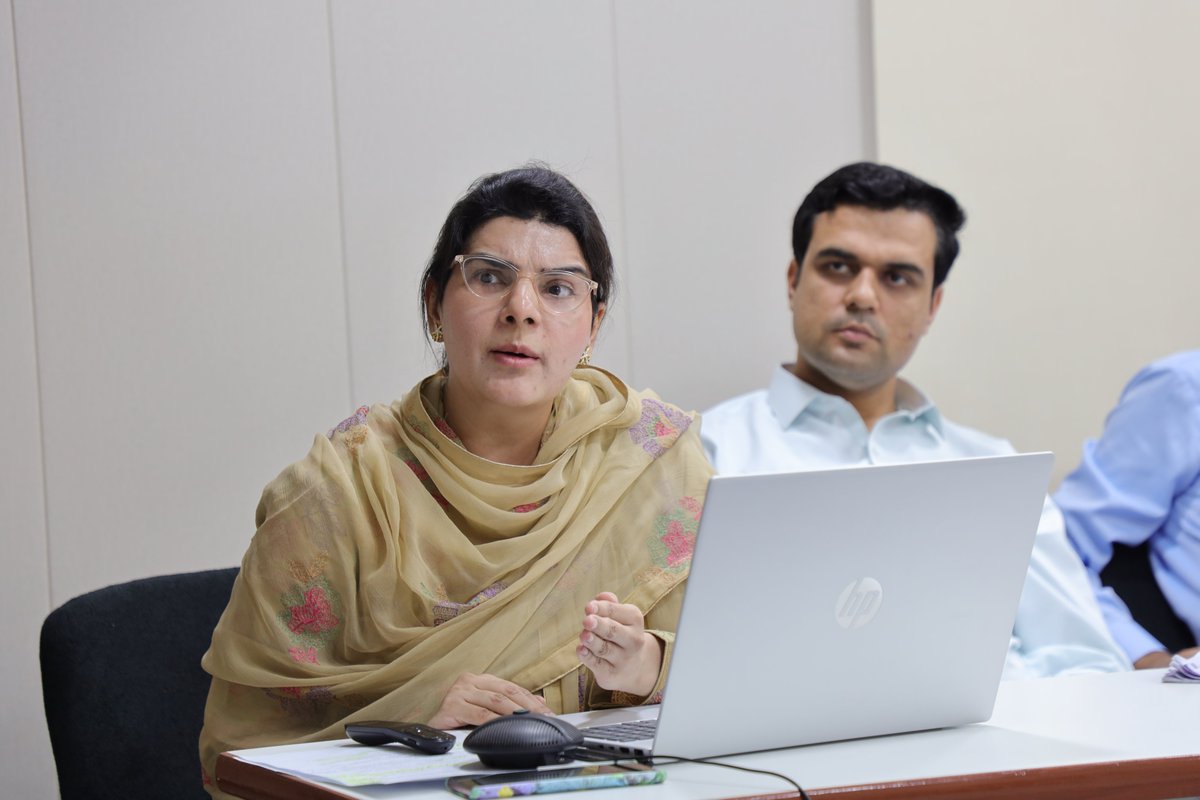
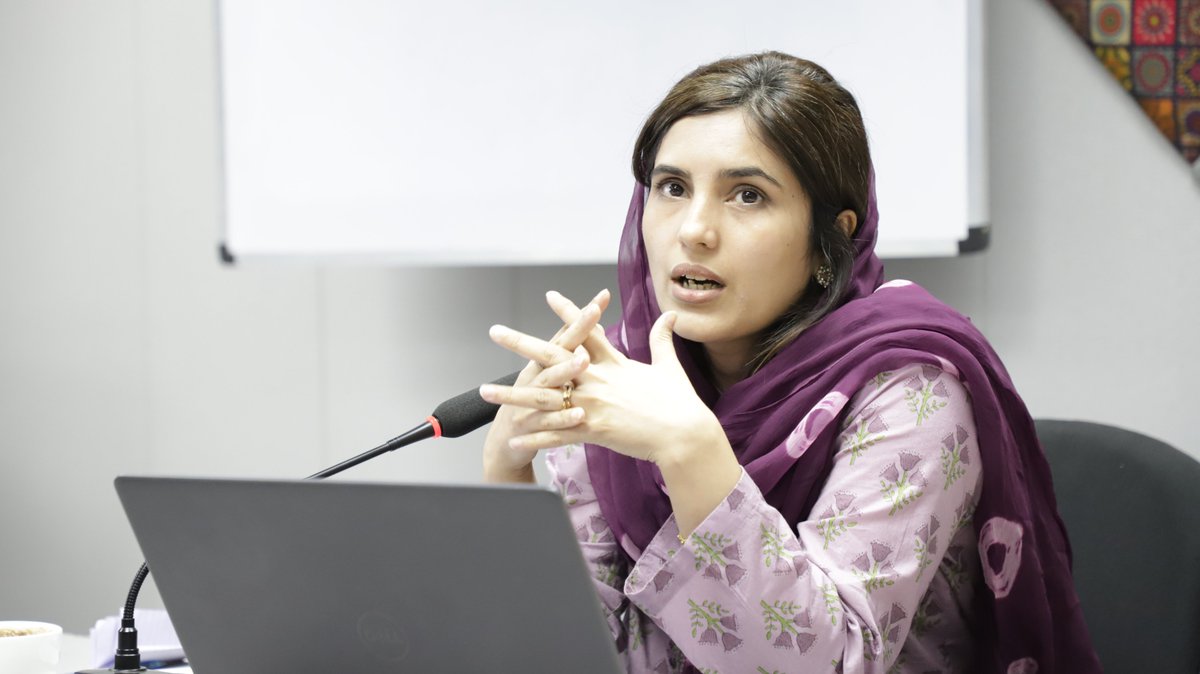
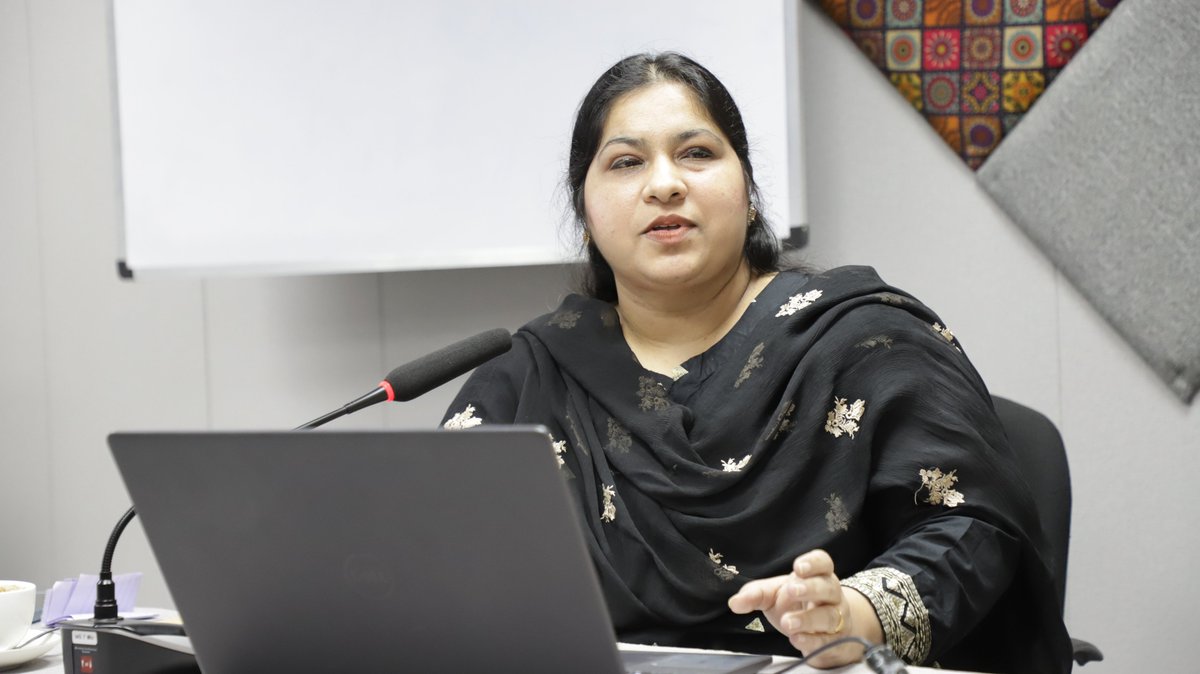
The latest sessions of the 𝐏𝐈𝐃𝐄 𝐒𝐜𝐡𝐨𝐥𝐚𝐫𝐬’ 𝐒𝐞𝐦𝐢𝐧𝐚𝐫 𝐒𝐞𝐫𝐢𝐞𝐬 featured a diverse set of 𝐏𝐨𝐥𝐢𝐜𝐲 𝐕𝐢𝐞𝐰𝐩𝐨𝐢𝐧𝐭𝐬 𝐚𝐧𝐝 𝐊𝐧𝐨𝐰𝐥𝐞𝐝𝐠𝐞 𝐁𝐫𝐢𝐞𝐟𝐬 addressing some of Pakistan’s most pressing economic, social, and governance challenges.
The presentations explored issues ranging from productivity growth, energy sector sustainability, trade and regional dynamics, social protection effectiveness, labor market transitions, demographic change, and the implications of remittance shocks. Discussions also examined the challenges of remote work, fiscal resilience, and strategies for strengthening Pakistan’s economic competitiveness in an increasingly uncertain global environment.
The seminars highlighted the importance of evidence-based research, structural reforms, institutional strengthening, and forward-looking policy frameworks to support sustainable growth, enhance resilience, and improve socioeconomic outcomes for Pakistan.
@nadeemjavaid75, @betterpakistan, @PlanComPakistan, @GovtofPakistan, @FaheemJehangir, @Fizzscreams
#PIDE #ScholarsSeminarSeries #PolicyResearch #KnowledgeBrief #PolicyViewpoint #PakistanEconomy #EvidenceBasedPolicy
1
3
4
349
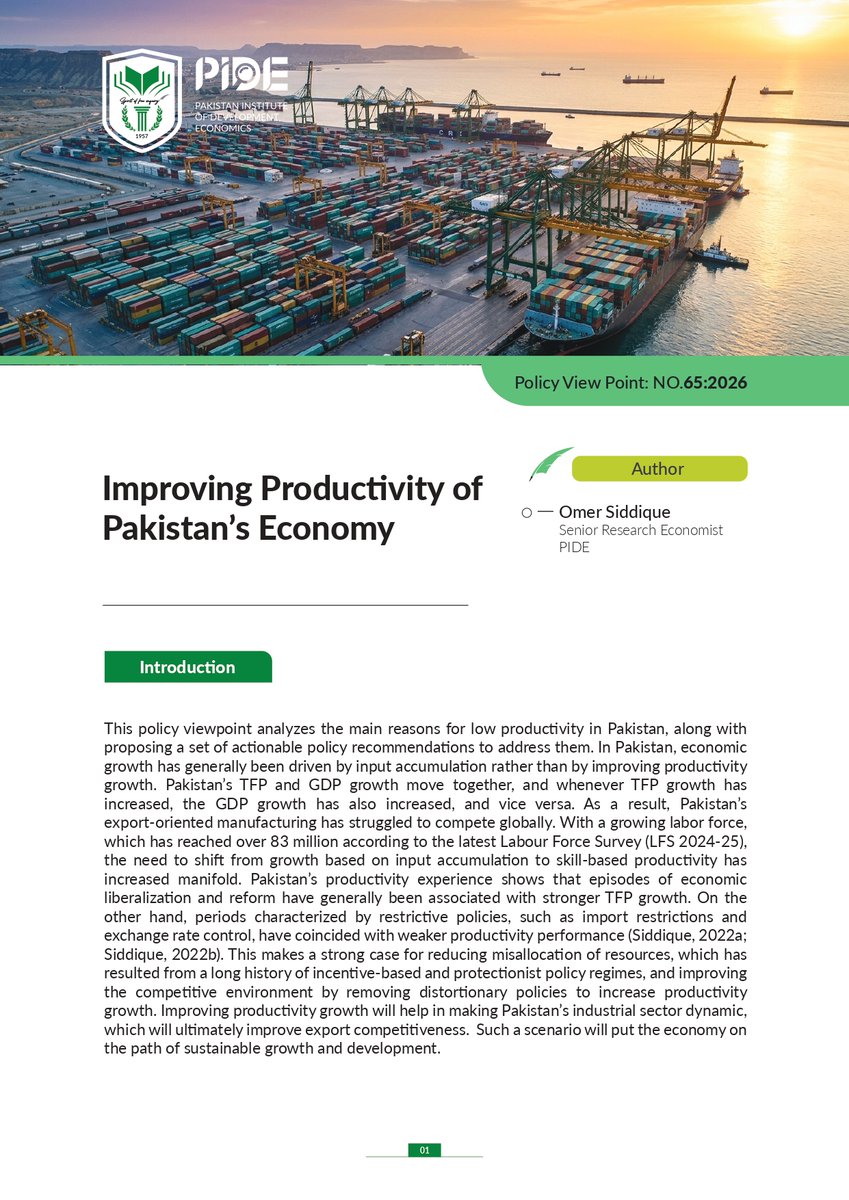
𝐈𝐦𝐩𝐫𝐨𝐯𝐢𝐧𝐠 𝐏𝐫𝐨𝐝𝐮𝐜𝐭𝐢𝐯𝐢𝐭𝐲 𝐨𝐟 𝐏𝐚𝐤𝐢𝐬𝐭𝐚𝐧’𝐬 𝐄𝐜𝐨𝐧𝐨𝐦𝐲
Pakistan’s economic growth has largely been driven by the accumulation of inputs rather than improvements in productivity, limiting export competitiveness and long-term development prospects.
@PIDEpk latest Policy Viewpoint by Omer Siddique (@OmerSiddique_), Senior Research Economist, #PIDE, argues that enhancing productivity is essential for transforming Pakistan’s industrial sector, strengthening export performance, and achieving sustainable economic growth.
The viewpoint identifies key barriers to productivity growth, including anti-export bias, regulatory burdens, resource misallocation, energy inefficiencies, weak firm capabilities, limited access to productive finance, and skill mismatches in the labor force. It emphasizes that decades of protectionist and distortionary policies have reduced competitiveness and hindered innovation.
Read More: pide.org.pk/research/improvi…
@nadeemjavaid75, @betterpakistan, @PlanComPakistan, @GovtofPakistan, @Financegovpk, @Pak_MoIP, @EduMinistryPK, @FaheemJehangir, @Fizzscreams
#PIDE #PolicyViewpoint #Productivity #EconomicGrowth #IndustrialPolicy #Exports #Competitiveness #EconomicReforms #PakistanEconomy
4
6
303
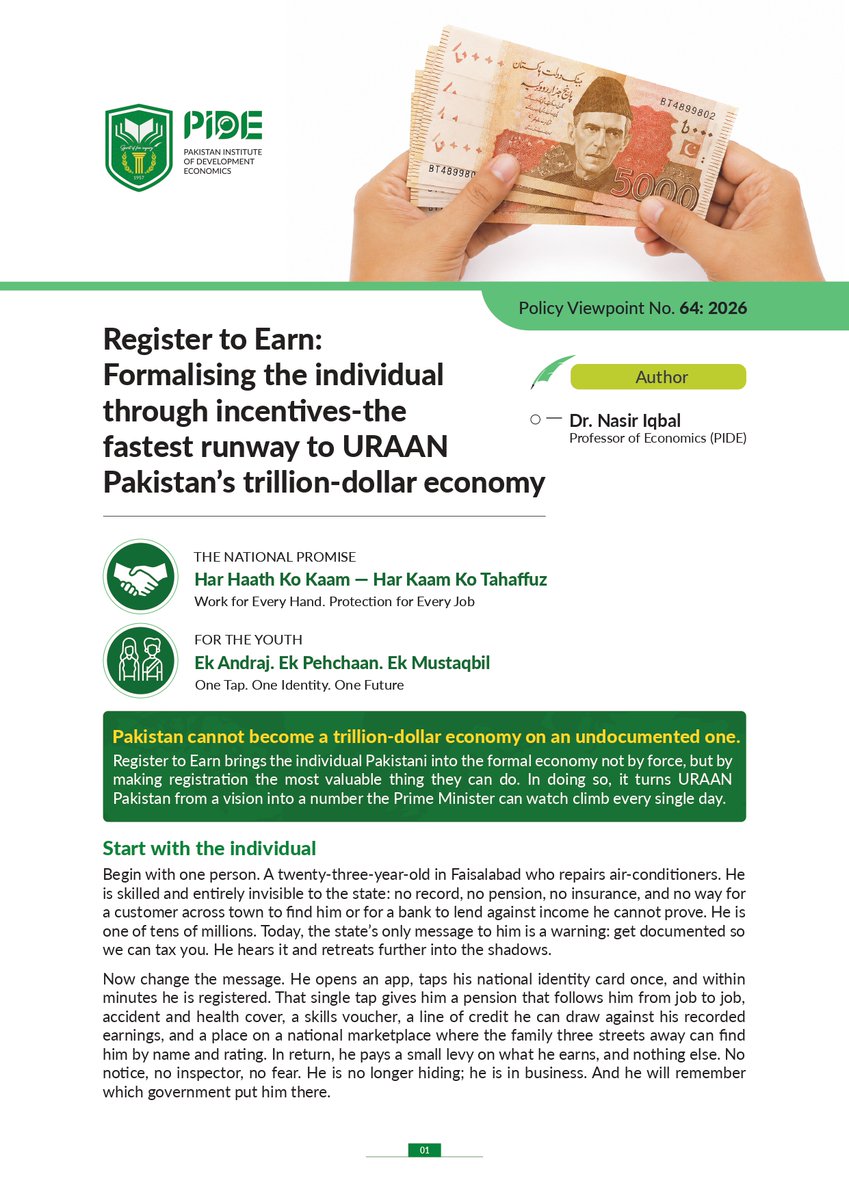
𝐑𝐞𝐠𝐢𝐬𝐭𝐞𝐫 𝐭𝐨 𝐄𝐚𝐫𝐧: 𝐅𝐨𝐫𝐦𝐚𝐥𝐢𝐬𝐢𝐧𝐠 𝐭𝐡𝐞 𝐈𝐧𝐝𝐢𝐯𝐢𝐝𝐮𝐚𝐥 𝐭𝐡𝐫𝐨𝐮𝐠𝐡 𝐈𝐧𝐜𝐞𝐧𝐭𝐢𝐯𝐞𝐬—𝐭𝐡𝐞 𝐅𝐚𝐬𝐭𝐞𝐬𝐭 𝐑𝐮𝐧𝐰𝐚𝐲 𝐭𝐨 𝐔𝐑𝐀𝐀𝐍 𝐏𝐚𝐤𝐢𝐬𝐭𝐚𝐧’𝐬 𝐓𝐫𝐢𝐥𝐥𝐢𝐨𝐧-𝐃𝐨𝐥𝐥𝐚𝐫 𝐄𝐜𝐨𝐧𝐨𝐦𝐲
Pakistan cannot build a trillion-dollar economy on an undocumented one. PIDE Policy Viewpoint by Dr. Nasir Iqbal (@drniqbal), Professor of Economics, proposes 𝐑𝐞𝐠𝐢𝐬𝐭𝐞𝐫 𝐭𝐨 𝐄𝐚𝐫𝐧, an incentive-based approach to formalisation that rewards individuals for joining the formal economy rather than penalizing them.
The proposal envisions a simple one-tap registration system linked to benefits such as pensions, health and accident coverage, skills vouchers, access to credit, and participation in a national marketplace. By making registration valuable and accessible, the initiative aims to expand the tax base, create formal jobs, enhance financial inclusion, and accelerate Pakistan’s journey toward the goals of URAAN Pakistan.
Read More: pide.org.pk/research/registe…
@nadeemjavaid75, @betterpakistan, @PlanComPakistan, @GovtofPakistan, @MoitOfficial, @NadraPak, @Financegovpk, @FBRSpokesperson, @FaheemJehangir, @Fizzscreams
#PIDE #PolicyViewpoint #RegisterToEarn #URAANPakistan #Formalization #FinancialInclusion #DigitalPakistan #PakistanEconomy
7
13
497
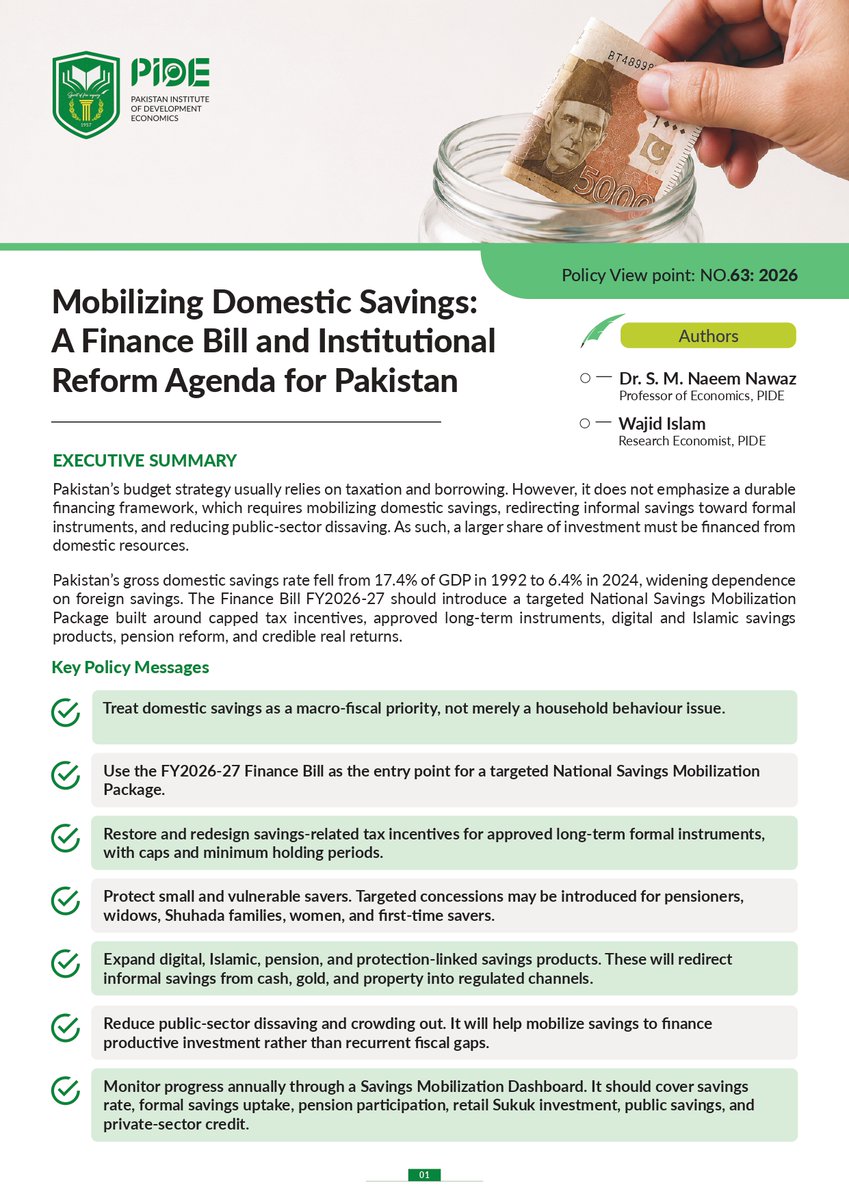
𝐌𝐨𝐛𝐢𝐥𝐢𝐳𝐢𝐧𝐠 𝐃𝐨𝐦𝐞𝐬𝐭𝐢𝐜 𝐒𝐚𝐯𝐢𝐧𝐠𝐬: 𝐀 𝐅𝐢𝐧𝐚𝐧𝐜𝐞 𝐁𝐢𝐥𝐥 𝐚𝐧𝐝 𝐈𝐧𝐬𝐭𝐢𝐭𝐮𝐭𝐢𝐨𝐧𝐚𝐥 𝐑𝐞𝐟𝐨𝐫𝐦 𝐀𝐠𝐞𝐧𝐝𝐚 𝐟𝐨𝐫 𝐏𝐚𝐤𝐢𝐬𝐭𝐚𝐧
Pakistan’s domestic savings rate has fallen sharply over the past three decades, increasing reliance on foreign financing and limiting investment potential.
@PIDEpk latest Policy Viewpoint by Dr. S. M. Naeem Nawaz(@SMNaeemNawaz), Professor of Economics, and Wajid Islam(@wajidislam01), Research Economist, #PIDE argue that the Finance Bill 2026–27 should introduce a 𝐍𝐚𝐭𝐢𝐨𝐧𝐚𝐥 𝐒𝐚𝐯𝐢𝐧𝐠𝐬 𝐌𝐨𝐛𝐢𝐥𝐢𝐳𝐚𝐭𝐢𝐨𝐧 𝐏𝐚𝐜𝐤𝐚𝐠𝐞 aimed at encouraging long-term formal savings through targeted tax incentives, pension reforms, digital and Islamic savings products, and stronger financial inclusion. The authors emphasize that mobilizing domestic savings is not merely a household issue but a macro-fiscal priority essential for reducing dependence on foreign financing, strengthening investment, and enhancing economic resilience.
The study calls for a shift toward a savings-supported growth model that promotes productive investment, fiscal discipline, and sustainable economic development.
Read More: pide.org.pk/research/mobiliz…
@nadeemjavaid75, @betterpakistan, @PlanComPakistan, @GovtofPakistan, @Financegovpk, @eadgop, @savingsgovpk, @MOPASSPK, @FaheemJehangir, @Fizzscreams
#PIDE #PolicyViewpoint #DomesticSavings #FinanceBill2026 #EconomicReform #FinancialInclusion #SavingsMobilization #PublicPolicy
1
6
15
709
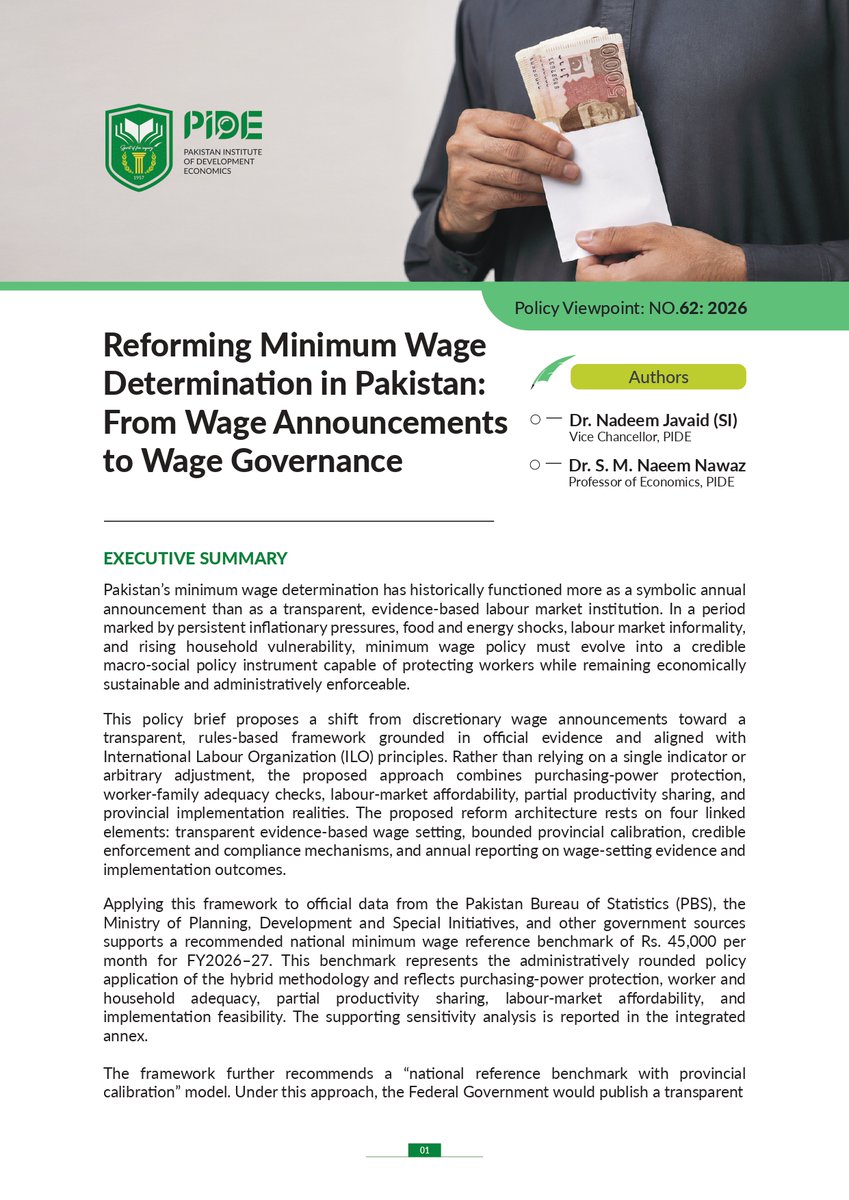
𝗥𝗲𝗳𝗼𝗿𝗺𝗶𝗻𝗴 𝗠𝗶𝗻𝗶𝗺𝘂𝗺 𝗪𝗮𝗴𝗲 𝗗𝗲𝘁𝗲𝗿𝗺𝗶𝗻𝗮𝘁𝗶𝗼𝗻 𝗶𝗻 𝗣𝗮𝗸𝗶𝘀𝘁𝗮𝗻: 𝗙𝗿𝗼𝗺 𝗪𝗮𝗴𝗲 𝗔𝗻𝗻𝗼𝘂𝗻𝗰𝗲𝗺𝗲𝗻𝘁𝘀 𝘁𝗼 𝗪𝗮𝗴𝗲 𝗚𝗼𝘃𝗲𝗿𝗻𝗮𝗻𝗰𝗲
Pakistan’s minimum wage system has long relied on annual announcements that often fall short of ensuring real protection for workers. In a context of rising inflation, labour market informality, and growing household vulnerability, wage policy must evolve from symbolic notifications to a transparent, evidence-based governance framework.
In #PIDE latest Policy Viewpoint, Dr. Nadeem Javaid (@nadeemjavaid75) and Dr. S. M. Naeem Nawaz (@SMNaeemNawaz) propose a rules-based approach to minimum wage determination that balances worker welfare, purchasing power, productivity, affordability, and enforceability. The study recommends a national minimum wage benchmark of Rs. 45,000 per month for FY2026–27, supported by transparent methodology, provincial calibration, and stronger compliance mechanisms.
The authors argue that Pakistan does not simply need a higher minimum wage—it needs a credible minimum wage system that ensures notified wages translate into wages actually received by workers.
Read More: pide.org.pk/research/reformi…
@betterpakistan, @PlanComPakistan, @GovtofPakistan, @Financegovpk, @mophrd, @eadgop, @FaheemJehangir, @Fizzscreams
#PIDE #PolicyViewpoint #MinimumWage #LabourMarket #WageGovernance #PakistanEconomy #EconomicPolicy #LabourPolicy
3
12
22
607
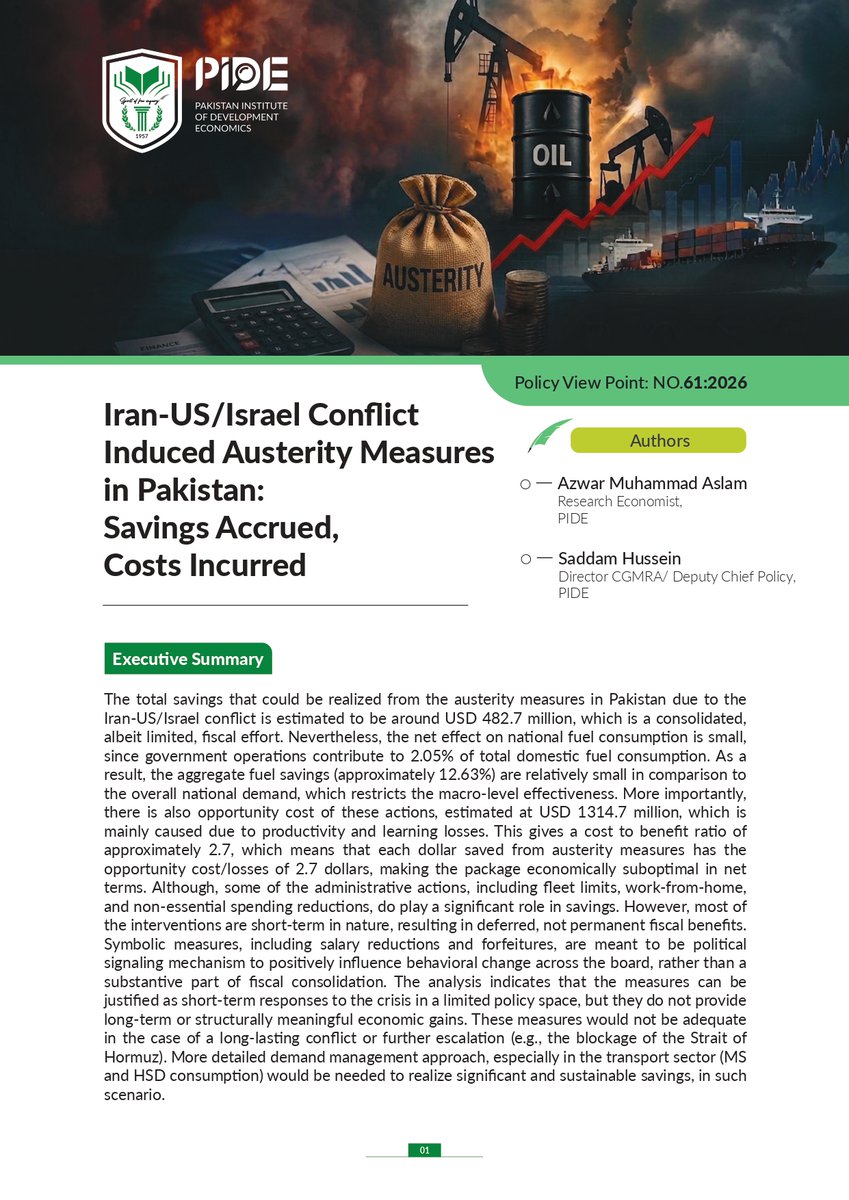
𝐈𝐫𝐚𝐧-𝐔𝐒/𝐈𝐬𝐫𝐚𝐞𝐥 𝐂𝐨𝐧𝐟𝐥𝐢𝐜𝐭 𝐈𝐧𝐝𝐮𝐜𝐞𝐝 𝐀𝐮𝐬𝐭𝐞𝐫𝐢𝐭𝐲 𝐌𝐞𝐚𝐬𝐮𝐫𝐞𝐬 𝐢𝐧 𝐏𝐚𝐤𝐢𝐬𝐭𝐚𝐧: 𝐒𝐚𝐯𝐢𝐧𝐠𝐬 𝐀𝐜𝐜𝐫𝐮𝐞𝐝, 𝐂𝐨𝐬𝐭𝐬 𝐈𝐧𝐜𝐮𝐫𝐫𝐞𝐝
Pakistan’s austerity response to the Iran–US/Israel conflict reflects a difficult policy trade-off in a constrained economic environment. While the measures generated estimated savings of $482.7 million, the associated opportunity cost stands higher at $1,314.7 million, implying a cost-to-benefit ratio of 2.7:1—where every dollar saved comes at the expense of $2.7 in lost economic output and human capital value.
In this PIDE Policy Viewpoint, Azwar Muhammad Aslam (@_azwar) and Saddam Hussein (@saddameconomist) argue that although such austerity measures are justified; however, if the conflict persists or escalates, Pakistan will need a comprehensive demand management, particularly focusing on the private transport sector, which accounts for over 85% of national fuel consumption.
Read More: pide.org.pk/research/iran-us…
@nadeemjavaid75, @betterpakistan, @PlanComPakistan, @GovtofPakistan, @Financegovpk, @MoWP15, @FaheemJehangir, @Fizzscreams
#PIDE #PolicyViewpoint #PakistanEconomy #Austerity #EnergyPolicy #Geopolitics
1
3
16
725
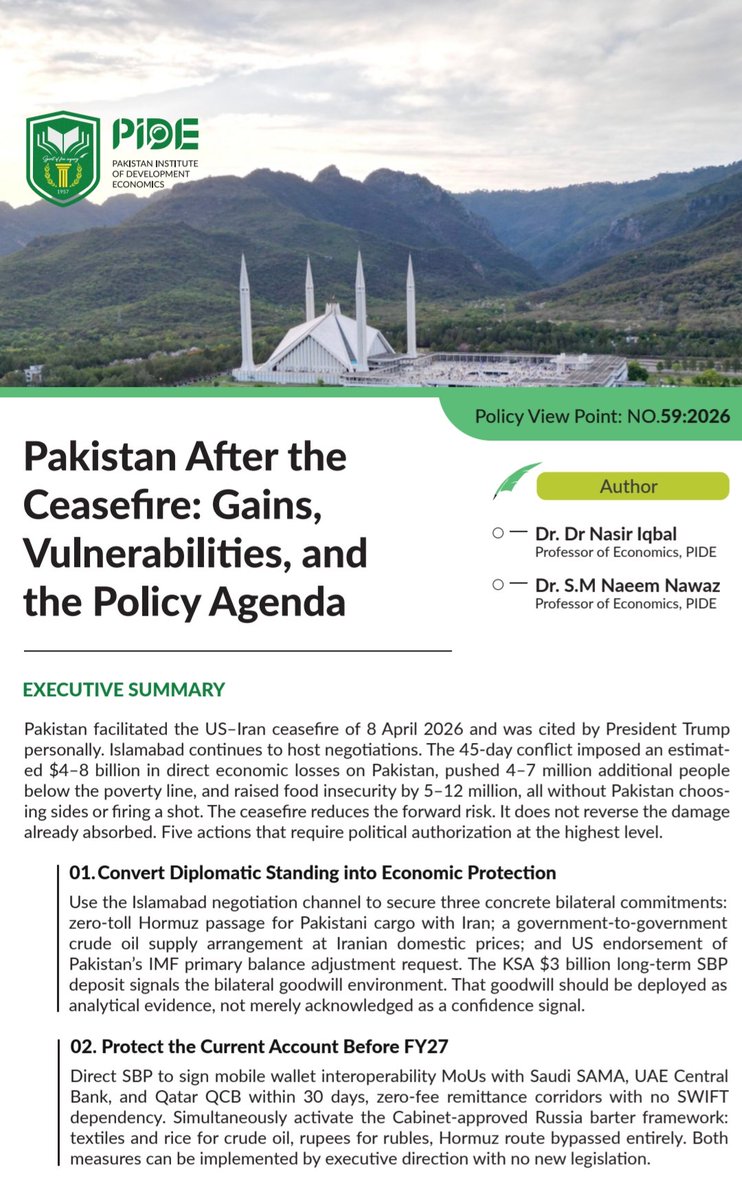
𝗣𝗮𝗸𝗶𝘀𝘁𝗮𝗻 𝗔𝗳𝘁𝗲𝗿 𝘁𝗵𝗲 𝗖𝗲𝗮𝘀𝗲𝗳𝗶𝗿𝗲: 𝗚𝗮𝗶𝗻𝘀, 𝗩𝘂𝗹𝗻𝗲𝗿𝗮𝗯𝗶𝗹𝗶𝘁𝗶𝗲𝘀, 𝗮𝗻𝗱 𝘁𝗵𝗲 𝗣𝗼𝗹𝗶𝗰𝘆 𝗔𝗴𝗲𝗻𝗱𝗮
Pakistan stands at a critical policy moment after facilitating the US–Iran ceasefire, but the economic costs remain severe. The 45-day conflict has already caused $𝟰–𝟴 𝗯𝗶𝗹𝗹𝗶𝗼𝗻 𝗶𝗻 𝗹𝗼𝘀𝘀𝗲𝘀, pushed 𝟰–𝟳 𝗺𝗶𝗹𝗹𝗶𝗼𝗻 𝗽𝗲𝗼𝗽𝗹𝗲 𝗶𝗻𝘁𝗼 𝗽𝗼𝘃𝗲𝗿𝘁𝘆, and increased food insecurity for 𝘂𝗽 𝘁𝗼 𝟭𝟮 𝗺𝗶𝗹𝗹𝗶𝗼𝗻, while risks to energy, remittances, and the current account persist despite temporary relief.
In this PIDE Policy Viewpoint, Dr. Nasir Iqbal (@drniqbal) and Dr. Shahzada M. Naeem Nawaz (@SMNaeemNawaz) highlight the need to convert diplomatic leverage into economic gains by securing Hormuz access, diversifying energy sources, activating barter trade, and protecting remittance flows to strengthen resilience.
The ceasefire offers opportunity, but it is time-bound. Without swift policy action, Pakistan risks losing both economic stability and strategic advantage.
Read More: pide.org.pk/research/pakista…
@nadeemjavaid75, @betterpakistan
#PIDE #PolicyViewpoint #PakistanEconomy #Ceasefire #EconomicPolicy
3
9
299
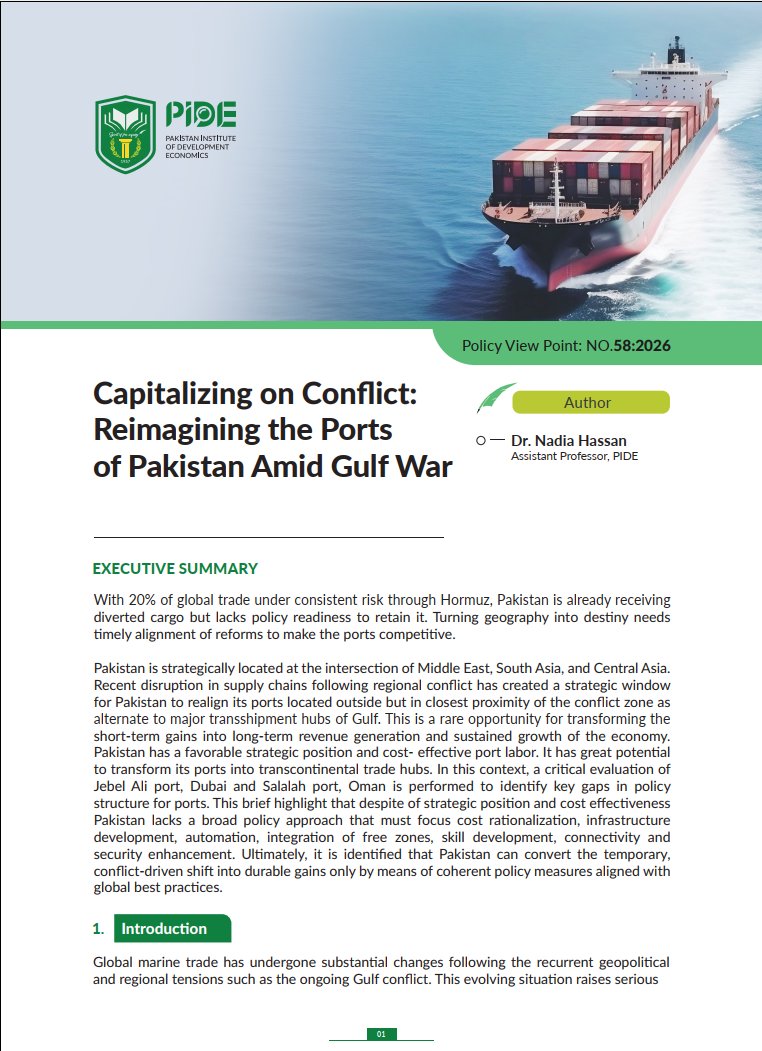
𝗖𝗮𝗽𝗶𝘁𝗮𝗹𝗶𝘇𝗶𝗻𝗴 𝗼𝗻 𝗖𝗼𝗻𝗳𝗹𝗶𝗰𝘁: 𝗥𝗲𝗶𝗺𝗮𝗴𝗶𝗻𝗶𝗻𝗴 𝘁𝗵𝗲 𝗣𝗼𝗿𝘁𝘀 𝗼𝗳 𝗣𝗮𝗸𝗶𝘀𝘁𝗮𝗻 𝗔𝗺𝗶𝗱 𝗚𝘂𝗹𝗳 𝗪𝗮𝗿
In the recent conflict, Pakistan stands at a critical crossroads where shifting trade routes could redefine its economic future.
PIDE’s latest Policy Viewpoint by Dr. Nadia Hassan (@Nadiia_Hassan) (Assistant Professor at @PIDEpk) explores how disruptions in the Gulf have redirected cargo towards Pakistan’s ports, offering a rare window to emerge as a regional logistics hub. Pakistan can capitalize on this strategic moment through timely and coherent policy reforms, drawing on global best practices to turn temporary shifts into long-term economic gains.
Read More: pide.org.pk/research/capital…
@nadeemjavaid75, @betterpakistan
#PIDE #PolicyViewpoint #Trade #Pakistan #EconomicPolicy
4
9
617
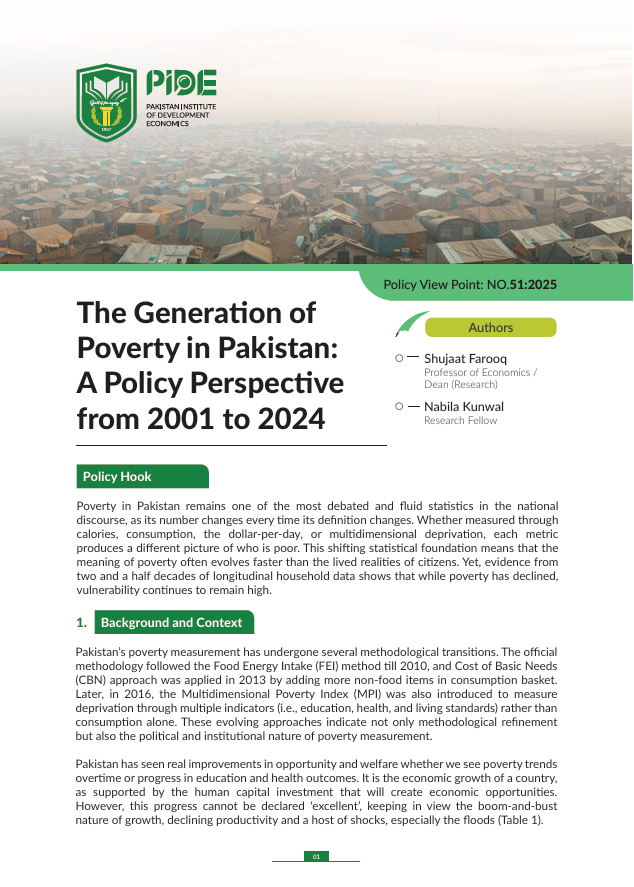
Pakistan’s poverty story is changing — but the challenge isn’t over.
Poverty among panel households has fallen from 52.4% in 2001 to 33.6% in 2024, yet high inflation and repeated economic shocks continue to keep millions on the edge. Lasting poverty reduction requires sustained economic growth of 6–7%, real jobs, and opportunity — not cash transfers alone. Investing in human capital, skills, and export-led growth is essential to turning resilience into lasting economic transformation for our youth.
✍️ By Dr. Shujaat Farooq (@ShujaatSohal), Dean (Research), and Nabila Kunwal, Research Fellow, @PIDEpk
👉 Read the full Policy Viewpoint here:
pide.org.pk/research/the-gen…
@nadeemjavaid75, @betterpakistan, @Kalhorozulfiqar
#PovertyReduction #EconomicGrowth #Inflation #HumanCapital #YouthEmployment #SkillsDevelopment #ExportLedGrowth #EconomicPolicy #PIDE #PolicyViewpoint
1
4
9
298
PIDE's recent Policy Viewpoint “Impact of Tariff Reduction on the Automobile Industry” by Mohammad Shaaf Najib and Dr. Usman Qadir, has received widespread coverage across national print and digital media.
The study highlights how tariff reforms can reshape Pakistan’s automobile sector - making vehicles more affordable, boosting ownership, and enhancing industry competitiveness.
Featured in: The News, Business Recorder, Nation, Jang, Express News, Samaa, HUM News, ProPakistani, PakWheels, MM News, and many others.
Explore the full coverage here: file.pide.org.pk/pdfpideinpr…
Read the Policy Viewpoint: pide.org.pk/research/impact-…
@nadeemjavaid75 @betterpakistan @PlanComPakistan @ShujaatSohal @karimeconomist @FaheemJehangir @drniqbal @Kalhorozulfiqar @MShaafNajib14
#PIDE #PolicyViewpoint #AutomobileIndustry #TariffReforms #PakistanEconomy
4
5
510
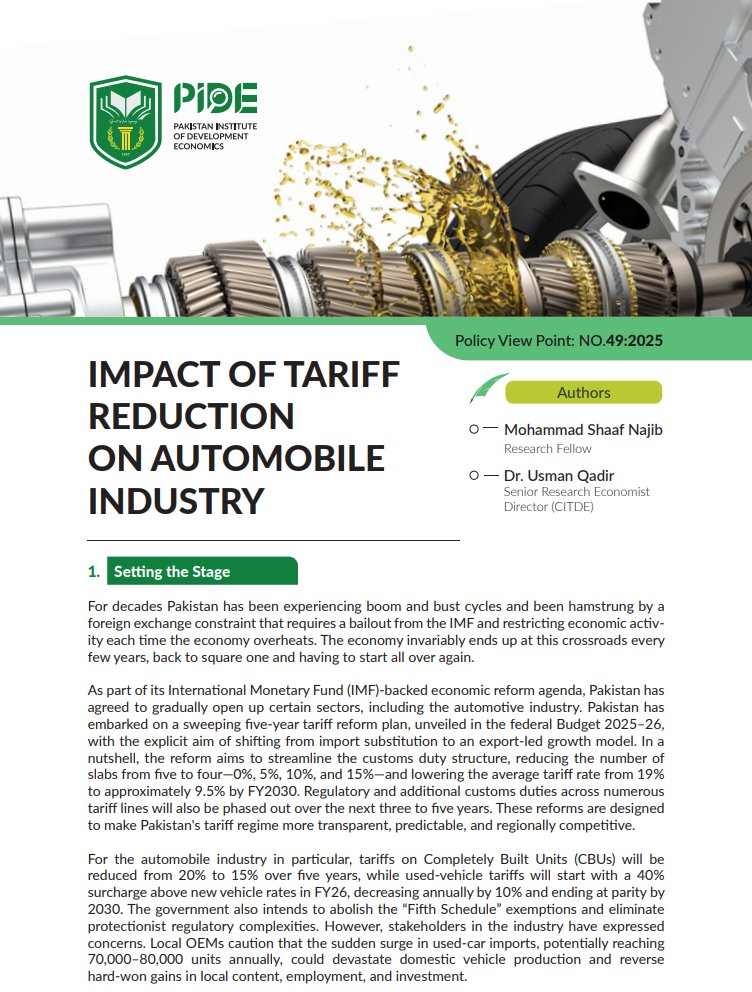
Will tariff reforms be a threat or an opportunity for Pakistan's automobile industry?
PIDE's Policy Viewpoint examines the government’s tariff reduction plan's impact specifically for the automobile industry. While local manufacturers fear losing out, our research shows that, with challenges this also presents an opportunity for the automobile industry, as historically the automobile industry has successfully adapted and improved to new challenges and regulatory reforms. Tariff reduction also could lead to lower vehicle prices and more options to pick from, hence increasing the consumer welfare.
@PIDEpk's Policy Viewpoint on "Impact of Tariff Reduction on Automobile Industry" by Mohammad Shaaf Najib (@MShaafNajib14) Research Fellow, and Dr. Usman Qadir, Director Center for Industry, Trade & Digital Economy and Senior Research Economist at PIDE.
Read More: pide.org.pk/research/impact-…
@nadeemjavaid75 @betterpakistan @PlanComPakistan @ShujaatSohal @Kalhorozulfiqar
#PIDE #PolicyViewPoint #AutomobileIndustry #TariffReform #PakistanEconomy
4
10
458
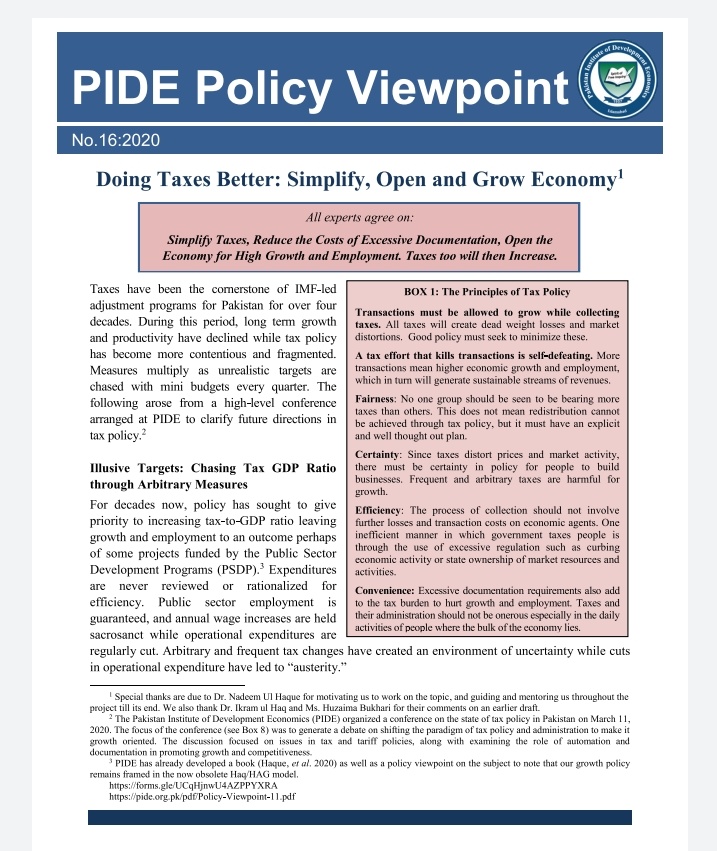
#PIDE #PolicyViewpoint no. 16/2020 on
"Doing Taxes Better: Simplify, Open and Grow Economy"
written by Dr Muhammad Nasir, Dr Naseem Faraz and Saba Anwar
pide.org.pk/pdf/Policy-Viewp…
#policy_pide #PIDEIdeas
@nadeemhaque @durre_nayab_ @PlanComPakistan @pid_gov @FBRSpokesperson
7
6
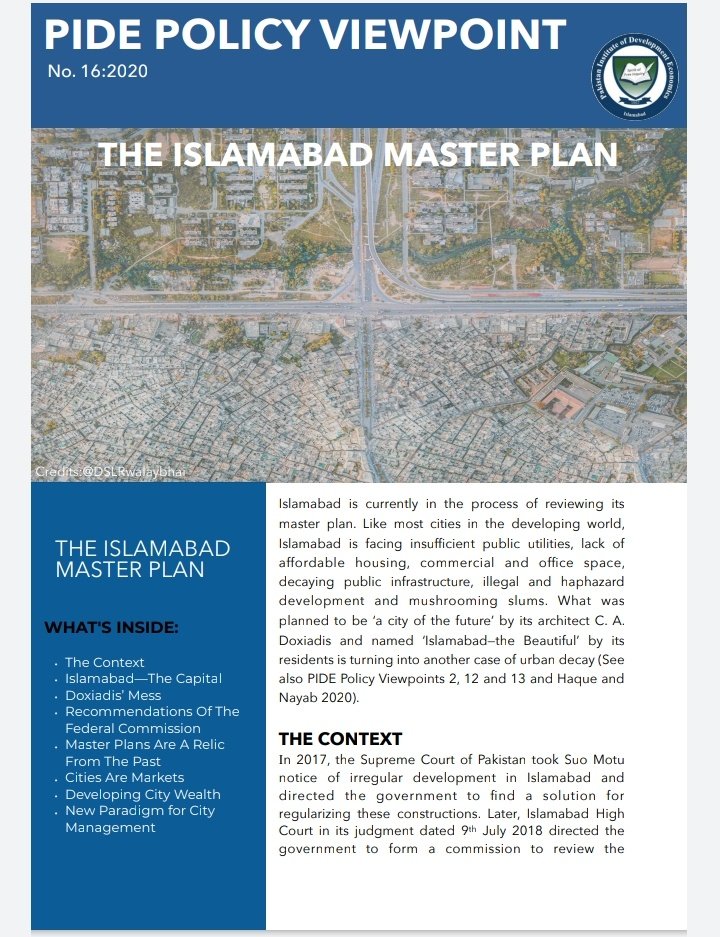
#PIDE #PolicyViewpoint 👇🏻👇🏻
"The Islamabad Master Plan"
Link to PDF👇🏻
pide.org.pk/pdf/Policy-Viewp…
#policy_PIDE #PIDEIdeas
@nadeemhaque @durre_nayab_ @PlanComPakistan @pid_gov @PlanComPakistan @ImranKhanPTI @MoeedNj @dcislamabad @NasimZehra
6
6