
Learn why Americans cover a disproportionate share of the world’s drug costs. #PriceControls #MostFavoredNation foxnews.com/opinion/stephen-…
13

Survey by American Citizens Abroad (ACA), representing 5 million Americans living overseas, finds 80% are concerned drug #pricecontrols will harm #patietaccess to medicines. @txhbi americansabroad.org/american…
1
1
27

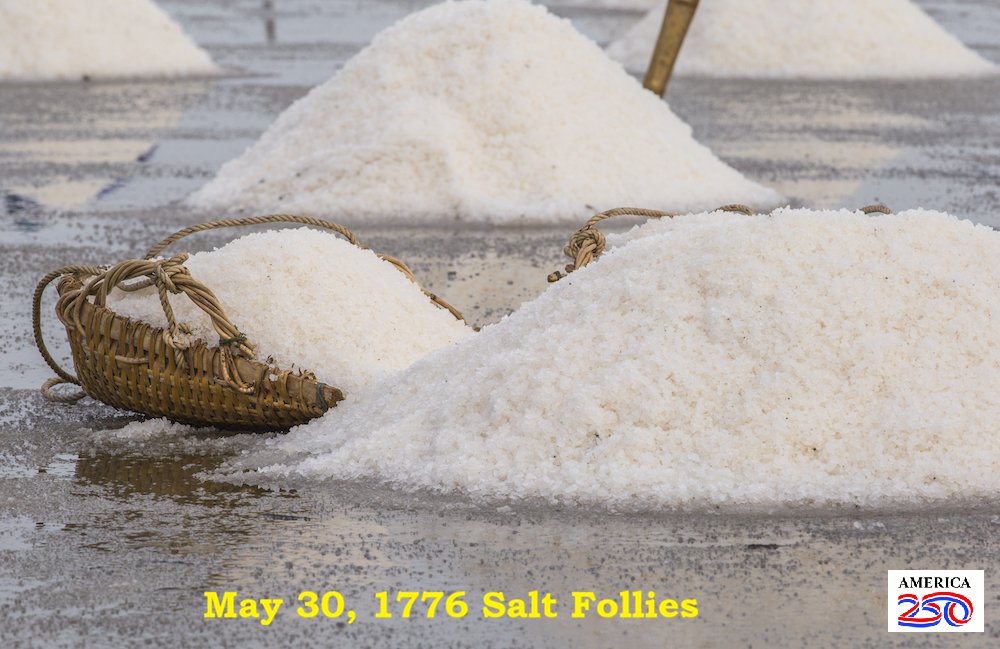
250 years ago today, one month after lifting price controls, Congress re-regulated salt.
We saw previously that, in April 1776, the Second Continental Congress embraced the free market. On April 6th, it relaxed the United Colonies’ global trade embargo, known as the “Continental Association.” The ports of America were opened to all nations except Great Britain and her territories, with whom they were at war*. And to encourage merchants to take the risk of running Royal Navy blockades to bring imports into the country, on April 30th, Congress deregulated prices on all commodities other than tea, permitting the market to dictate the prices at which goods would be bought and sold**.
During the Association, many commodities suffered from shortages and skyrocketing prices. Salt, which was imported from the West Indies, was in especially short supply. In those pre-refrigeration days, it was more than just a seasoning; salt was a critical preservative, essential to prevent meat and fish from spoiling.
Price deregulation did not have an immediate impact on the salt supply, nor should it have been expected to. To bring a ship in from the (non-British) West Indies took several weeks. Further, a patchwork of provincial and local market interventions of a non-price control variety discouraged, and in some cases outright prevented merchants from bringing supplies to market.
For example, The Philadelphia Committee of Observation and Inspection had seized 4,000 bushels of salt which the merchants Joshua Fisher and Son had imported illegally in December 1774, the first month of the Association. The owners were willing to sell it for three shillings a bushel, but the Committee refused to return it to them, on the grounds that they were “enemies to their country.” By May 1776, word of the committee’s hoarding generated outrage, so that the members had to issue a vague statement to “assure the publick that they have under their consideration a mode of disposing of the said Salt, so as to serve the publick in the most effectual manner.”
The price of salt was also caught up in the general inflation caused by Congress’s addiction to paper money. When nothing bad happened after a modest initial printing of $2 million in June 1775, the delegates authorized four more print runs by May 1776, for a total of $15 million.
At the end of May, the Rev. Henry Muhlenberg reported that the price of salt in Philadelphia soared from 40 shillings to 140 shillings a bushel, and yet the commodity was still in short supply. “The people push and jostle each other whenever there is a small quantity of salt to be found,” he said. While the Committee of Inspection was still sitting on 4,000 bushels.
Recipes for making salt at home appeared in the newspapers.
Because of its critical necessity, salt was a political flashpoint. The nervous delegates in Congress chose not to wait for the market to work. On May 18th, less than three weeks after price controls had been lifted, they appointed a committee, consisting Robert Livingston, Elbridge Gerry, John D'Hart, and the normally free-market Robert Morris, to re-regulate the price of salt.
The committee returned on the 28th with a draft resolution to reimpose price controls. Their report conceded that market prices were, in general, necessary to prevent shortages, but salt was so critical, and high prices such a hardship on those of limited means, that an exception was needed: “Tho’ regulations of that nature tend to discourage Commerce and increase the scarcity which they were designed to remove,” they wrote, “yet that the same is not applicable to salt, unless it is sold so high as to be very burthensome to the poor, as it can only be imported in large vessels the risk of which is extreamly great.”
The resolution did not explain how the fact that a commodity was needed really, really badly stopped the laws of economics from working.
After some amending, Congress passed the resolution on May 30, 1776. As they had since the beginning of time, the politicians blamed high prices on greed, rather than a combination of the normal functioning of markets and their own ill-conceived measures:
“Whereas it hath been represented to Congress, that avaricious, ill designing men, have taken advantage of the resolve of Congress, passed the 30th of April, for withdrawing, from the committees of inspection, the power of regulating the price of goods, to extort from the people a most exorbitant price for salt:
“Resolved, That it be recommended to the committees of observation and inspection in the United Colonies, so to regulate the price of salt, as to prevent unreasonable exactions on the part of the seller, having due regard to the difficulty and risque of importation.”
Throughout the nation, and especially in the mid-Atlantic states, local committees eagerly decreed price controls. On June 1st, a mere two days after the salt resolution passed Congress, the Philadelphia committee set the maximum price to 7 shillings 6 pence per bushel—pure delusion at a time the market price was 140 shillings. A month later, the Maryland legislature followed suit.
The results were predictable. Law-abiding merchants, unable to make a profit, declined to import new stocks, while scofflaws flouted the regulations and flocked to the black market. The bottom line: shortages persisted and, despite the decrees of the committees, prices reached new heights.
Over the months and years ahead, American diaries, letters, and official proceedings were chock full of accounts of shortages, hoarding, insane prices, and desperate expedients. A few examples:
The export of barrel staves was prohibited because of their value to British molasses and rum manufacturers in the West Indies. But, in July 1776, the North Carolina legislature authorized waivers to trade staves for salt, arms, or ammunition. It also set a maximum profit for salt of 25%.
In August of the same year, the Pennsylvania legislature authorized the Philadelphia committee to confiscate supplies of salt from “divers persons [who], in contempt of the just and wholesome regulations of the Committee, &c., of Philadelphia, under directions of Congress, have continued to dispose of their Salt at most exorbitant prices.” The committee was directed to distribute the confiscated salt to every county in the state, according to population.
That month, Dutchess County, New York (up around Poughkeepsie), seized all supplies of salt “except what may be intended for the private use of families.” It also prohibited any salt from being removed from the county.
The minutes of the Continental Congress for October and November document the struggle of the fledgling nation to supply the army with salt. The delegates even went so far as to grant an exemption to two merchants to trade with the British West Indies.
The United States also attempted to reduce its dependence on foreign salt by developing the domestic industry. For example, the governments of New Jersey and Pennsylvania offered incentives to businessmen for constructing saltworks on the Jersey shore. The effort was rife with the incompetence, corruption, and cost overruns that go hand-in-hand with government-backed industries. The most notorious of these corporate welfare kings was Thomas Savadge, a failed ironmongering entrepreneur who, in June 1776, sold the state of Pennsylvania on a grandiose plan to produce 60,000 bushels a year. The state gave him an advance of £400 against a budget of £2,500.
After three years of glowing progress reports, promises, excuses, labor shortages, requests for waivers, resistance to government auditors, and mysteriously disappearing records, the hapless Savadge died and the state privatized the Pennsylvania Salt Works. Its total lifetime production under Savadge’s management: 20 bushels.
In 1793, Thomas Paine, who had served on the Philadelphia Committee, looked back at the salt follies of the 1770s with regret. He warned his friends in the French Revolution not to go down the same road: “In Philadelphia,” he wrote, “we undertook among other regulations of this kind to regulate the price of Salt; the consequence was that no Salt was brought to market, and the price rose to thirty-six shillings sterling per Bushel. The price before the war was only one shilling and six pence per Bushel.”
The letter contained one mistake. Paine had forgotten just how high the price of salt had risen. In August 1777, John Adams wrote to Abigail that the commodity was selling in Philadelphia for $27 a bushel—around 160 shillings.
I'm @MadMikeIsenberg, and that's the way it was.
Check out Quarter Millennial Moments on Spotify open.spotify.com/show/15PzSw…
Previous QMM: The Mechanics’ Declaration of Independence x.com/TheBig250/status/20603…
Next QMM: The British Fleet Invests Charleston Harbor
*See QMM for April 6, 1776 x.com/TheBig250/status/20411…
**See QMM for April 30, 1776 x.com/TheBig250/status/20498…
Illustration(s):
Salt (Weston A. Price Foundation)
Source(s):
John Adams, “Letter to Abigail Adams,” August 29, 1777, National Archives, founders.archives.gov/docume….
Michael S. Adelberg, “Long in the Hand and Altogether Fruitless: The Pennsylvania Salt Work and Salt-Making on the New Jersey Shore during the American Revolution,” Pennsylvania History: A Journal of Mid-Atlantic Studies, vol. LXXX, no. 2, 2013, pp. 215-242, journals.psu.edu/phj/article….
American Archives: Consisting of a Collection of Authentick Records, State Papers, Debates, and Letters and Other Notices of Publick Affairs, Washington: M. St. Clair Clarke & Peter Force, Peter Force, ed., 4th ser., vol. VI (1846), pp. 499-500, 669-70, 946, 1509, archive.org/details/american…; 5th ser., vol I (1848), pp. 1096-7, 1119, 1366-7, archive.org/details/american….
Devon Downes, “Saving the American Revolution from Itself,” Foundation for Economic Education, July 3, 2016, fee.org/articles/saving-the-….
Journals of the Continental Congress (1774-1789), Washington: Government Printing Office, vol. IV, (1906), p. 365, 397-8, 404, archive.org/details/journals…; vol. V (1906), pp. 843, 849, archive.org/details/journals…; vol. VI (1906), pp. 859, 880, 906, 914, 935, 950, 989, archive.org/details/journals….
“Of Common Salt,” The Pennsylvania Ledger, no. LXXI, June 1, 1776, p. 3, loc.gov/resource/sn83025898/….
Thomas Paine, “Letter to George Jacques Danton,” May 6, 1793, The Thomas Paine Historical Association, thomaspaine.org/letters/to-g….
#AmericanRevolution #patriotic #salt #Philadelphia #Pennsylvania #NewJersey #NewYork #NorthCarolina #RobertMorris #JohnAdams #Economics #PriceControls #CorporateWelfare

250 years ago today, Congress passed a resolution to end price controls.
We saw previously that America, in order to put the economic squeeze on Great Britain, had inflicted a near total trade embargo—on itself. Known as the “Continental Association,” the measure prohibited commerce not only with the mother country and her territories, with whom they were at war, but with the rest of the world as well. Local Committees of Inspection and Observation were organized to enforce the ban, primarily through public shaming.
The economic dislocation caused by the Continental Association rippled through the colonies. Restraint of trade caused widespread shortages and skyrocketing prices for a range of products: salt, coffee, chocolate, cotton, wool, linen, pins. Goods from the West Indies—molasses, rum, sugar—were particularly hard hit.
Congress had anticipated this and included a provision in the Continental Association—Article 9—to prohibit price gouging:
“Such as are venders of goods or merchandise will not take advantage of the scarcity of goods, that may be occasioned by this association, but will sell the same at the rates we have been respectively accustomed to do, for twelve months last past — And if any vender of goods or merchandise shall sell any such goods on higher terms, or shall, in any manner, or by any device whatsoever violate or depart from this agreement, no person ought, nor will any of us deal with any such person, or his or her factor or agent, at any time thereafter, for any commodity whatever.”
The Philadelphia Committee of Inspection and Observation was especially aggressive about enforcing Article 9. On March 6, 1776, it published a schedule of maximum prices for thirteen commodities. A month later, it published the names of two merchants, William Sitgreaves and Peter Ozeas, who had sold coffee for more than the official price—by one penny a pound in Sitgreaves’s case*.
But by then it was clear that the Association hurt the United Colonies far more than it hurt Great Britain. That same day, April 6th, Congress opened up the ports of America to all nations except Britain, Ireland, and the British West Indies**.
A week later, on the 13th, the delegates repealed Article 3 of the Association, which prohibited the sale and consumption of tea. The resolution established a price ceiling of seventy-five cents a pound on Bohea tea and directed the Committees of Inspection to establish maximum prices on other varieties***.
Dismantling so many provisions of the Association so quickly caused confusion as to which parts were still in effect, and what authority the committees still retained. In particular, given that Congress had specifically spelled out a price ceiling for tea, did that mean that the prices of other goods were no longer regulated?
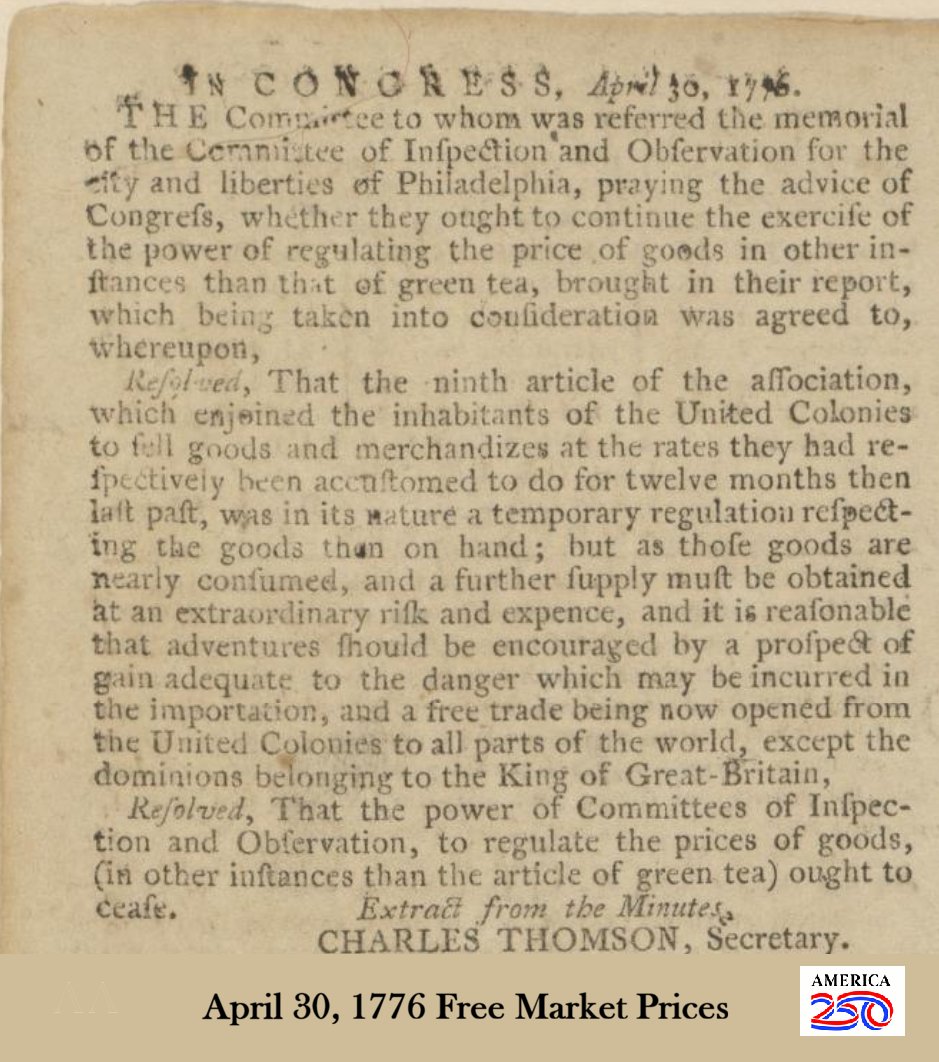
The Philadelphia committeemen sought guidance. According to the minutes of Congress, they sent a petition, “praying the advice of Congress whether they ought to continue the exercise of the power of regulating the price of goods in other instances than that of green tea.”
Congress went beyond a simple clarification. It repealed Article 9:
“Resolved, That the ninth article of the association…was, in its nature, a temporary regulation respecting the goods then on hand; But as those goods are nearly consumed, and a further supply must be obtained at an extraordinary risk and expence, and it is reasonable that adventurers should be encouraged by a prospect of gain adequate to the danger which may be incurred in the importation, and a free trade being now opened from the United Colonies to all parts of the world except the dominions belonging to the King of Great Britain,
Resolved, That the power of committees of inspection and observation to regulate the prices of goods, (in other instances than the article of green Tea,) ought to cease.”
Prices in the United Colonies would now be governed by the free market.
To channel Adam Smith’s seminal work, The Wealth of Nations, it was not from the benevolence of the merchant, the captain, and the sailor that Congress expected ships to run the gauntlet of the Royal Navy and carry goods to American ports, but rather from their regard to their own profit.
The delegates in Congress had not read The Wealth of Nations. It had been published in London only the month before—hardly enough time to cross the Atlantic. And yet, in dismantling price controls, they demonstrated a remarkable grasp of the nascent science of economics in general and the profit motive in particular.
Whether Congress would retain its grasp of economics and continue to adhere to free-market principles will be the subject of a future Quarter Millennial Moment.
I'm @MadMikeIsenberg, and that's the way it was.
Previous QMM: A Grand Reception x.com/TheBig250/status/20495…
Next QMM: In the Name of the King—NOT
*See QMM for March 6, 1776 x.com/TheBig250/status/20298…
**See QMM for April 6, 1776 x.com/TheBig250/status/20411…
***See QMM for April 13, 1776 x.com/TheBig250/status/20437…
Illustration(s): Excerpt from the May 8, 1776, Pennsylvania Gazette showing the price deregulation resolution (Library of Congress)
Source(s):
“In Congress,” Pennsylvania Gazette, no. 2472, May 8, 1776, p. 4, loc.gov/item/sn84026371/1776….
Journals of the Continental Congress (1774-1789), Washington: Government Printing Office, vol 1 (1904), p. 78, archive.org/details/journals…; vol. 4 (1906), p. 320, archive.org/details/journals….
#AmericanRevolution #PriceControls
1
1
2
215

May 27
Price controls sound good… until reality hits.
• Government caps the price
• Production costs stay high or keep rising
• Sellers can’t raise prices to cover costs
• Profit margins get crushed
• Sellers start losing money on every unit
• Sellers cut production or exit the market
• Supply collapses
• Shortages hit hard
This isn’t theory.
It happens every single time.
History doesn’t care about good intentions.
#Economics #PriceControls
May 27

Zohran Mamdani is lowering rent citywide, which thanks to rising costs will make it really difficult for landlords to do maintenance since they will be at a loss.
And since they won't have the money to do maintenance, Mamdani will use that as an excuse to take their property.
Peak communism at display here.
2
85


Tesco’s makes about 4.5% on revenues of £70Bn for their group as a whole. £2-3Bn of Profit Margin’s sod all for a company that provides such a ‘service’ to the country, pays a huge amount in tax & employs 300,000 ppl! Deary me these ppl need to grow up! 🤯
#bbcqt #PriceControls

This is one of the richest countries in the history of the world.
Yet we have thousands of children going to school hungry each morning while supermarkets rake in obscene profits. #bbcqt
29
49
252
7,667

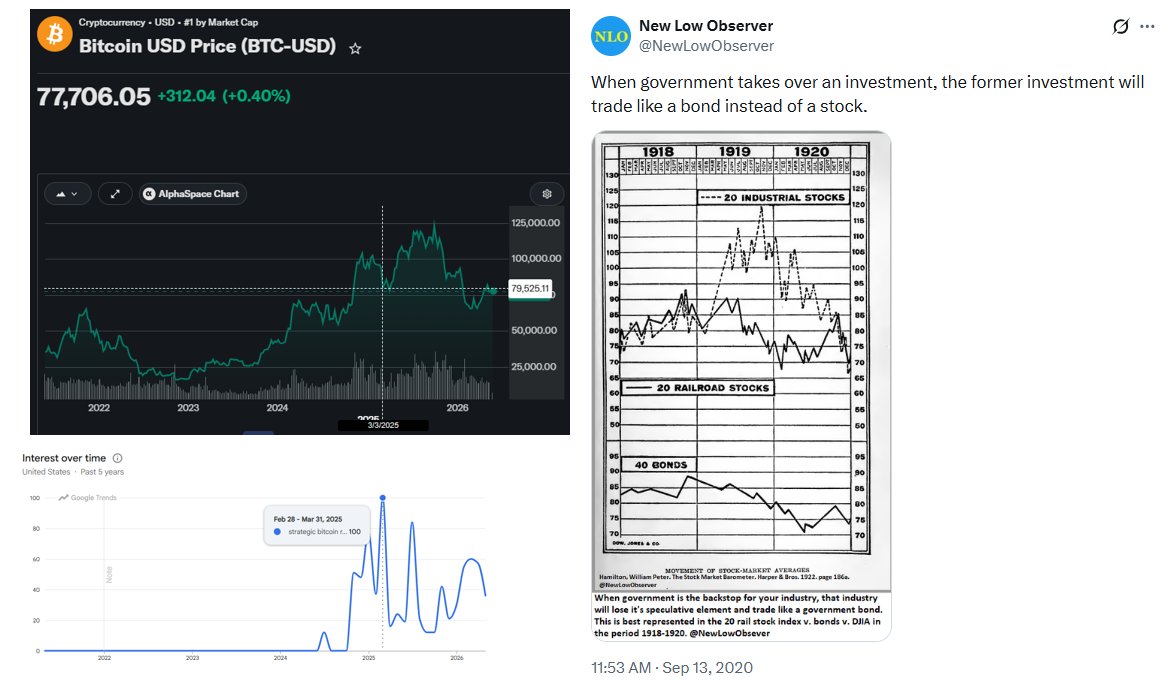
"When government takes over an investment, the former investment will trade like a bond instead of a stock."
Working on price controls, it seems. 🙄
$BTC #Bitcoin #StrategicBitcoinReserve #SBR #PriceControls
May 21

JUST IN: 🇺🇸 Congressman Nick Begich is introducing new legislation to establish a U.S. Strategic Bitcoin Reserve, Fox Business reports.
The bill "has bipartisan support and more than a dozen co-sponsors in Congress" 👀



2
355


Apr 28
Economists say price controls introduced at German petrol stations to protect motorists from rising oil prices linked to Middle East conflict have instead led to higher average fuel costs, producing the opposite of the intended effect.
#Germany #FuelPrices #PetrolStations #PriceControls #PakistanTV

1
161

The Commerce Ministry has moved to tighten price controls again, adding three more products to Thailand’s controlled goods list as energy and petrochemical costs keep rising.
The new list covers seasoning sauces, bottled drinking water and plastic pellets, products seen as vulnerable to price distortion if businesses use the cost crisis as a reason to overcharge.
The measure will stay in force for one year, with the government signalling that it wants to contain living-cost pressure before it spreads more widely through packaging and everyday consumer goods.
#TheNationThailand #TheNation #pricecontrols #CommerceMinistry #EnergyShock
nationthailand.com/news/poli…
1
1
587


Apr 1
Want to create shortages? This is how you create shortages. #PriceControls

Germany stops gas stations from raising pump prices more than once a day cnbc.com/2026/04/01/germany-…
1
2
170

Do #pricecontrols really protect consumers or do they backfire?
Join us TOMORROW for our webinar on “Why Price Controls Are Always a Bad Economic Policy” and @IEAKwame and @vivian_ochola we'll explore how they can lead to shortages, black markets, and reduced investment and what better alternatives exist.
📅 Thursday, 02 April 2026
⏰ 11:00 AM – 12:30 PM
🔗 Join here: teams.microsoft.com/l/meetup…

3
7
371
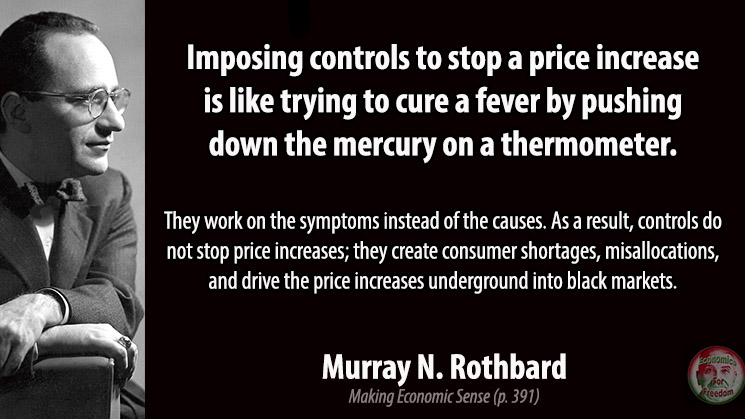
Turning recent @WhiteHouse #MFN #drugpricing deals with individual pharma companies into law would “import socialist #pricecontrols and values into our country,” per 50 free market leaders. @Protectaxpayers is.gd/3IbrT7
1
2
85

Mar 3
So true! We can't codify #socialist #pricecontrols via #MFN which would harm patients and abdicate innovation to China! @JohnCornyn @SenTedCruz @LADAOrg @SU2C @AmericanCancer @American_Heart @LymphomaAction @alsassociation

A #MostFavoredNation drug pricing policy will significantly harm the U.S. #biopharma innovation ecosystem and cost patients lifesaving cures. The Administration must not codify #MFN. #SOTU
2
91

Im soooo over it!!!! Legislature never wants to look at "private contracts" yet enacting #pricecontrols makes sense? Living in an alternate universe
1
1
6
238

Feb 3
CONGRESS WAKE UP Live Nation/TovketMaster is lobbying for bullshit SOCIALIST pricecontrols becauseTHEY can survive a cap. Its because other revenue streams cover the losses.
TicketMaster’s competitors CANNOT survive this.
FULL CONTROL for TicketMaster = BAD for artists & fans!
Shut this down @tedcruz @MarshaBlackburn
13
45
292
13,464

Three activists walk into a bar.
One orders a $15 mixed drink.
One orders a $10 martini.
One orders a $6 beer.
The bill comes: $31.
They stand up like they’re at a rally and announce, “EQUALITY!”
So they split it three ways.
Beer guy pays more than his beer. Cocktail guy pays less than his cocktail.
They call it “fair” and high-five for defeating arithmetic.
Next week, they come back and ask for separate checks.
Bartender says, “Whoa, whoa—why the sudden love of individual responsibility?”
They glare, whisper, and decide separate checks are “harmful.”
They split it evenly again.
Third week, they return with a mob and demand every drink cost the same as the cheapest one.
The bartender looks at his windows, his insurance deductible, and his will to live… and agrees.
Now everyone orders mixed drinks and martinis for $6 and cheers:
“We did it! We fixed the system!”
A few weeks later they return…
Bar is closed. Sign on the door:
“OUT OF BUSINESS. YOU CAN’T PAY RENT WITH FAIRNESS.”
The mob immediately blames the bartender for “hoarding profits” and demands the city open a publicly funded bar with “free drinks for all.”
It opens.
It runs out of booze by Tuesday.
And that, comrades, is the whole ideology:
First you split the bill. Then you smash the menu. Then you kill the bar.
Hashtags (6):
#PoliticalSatire #FreeMarket #EconomicReality #PriceControls #CommonSense #MemeFuel
- Credit to Francis Gauthier

2
66

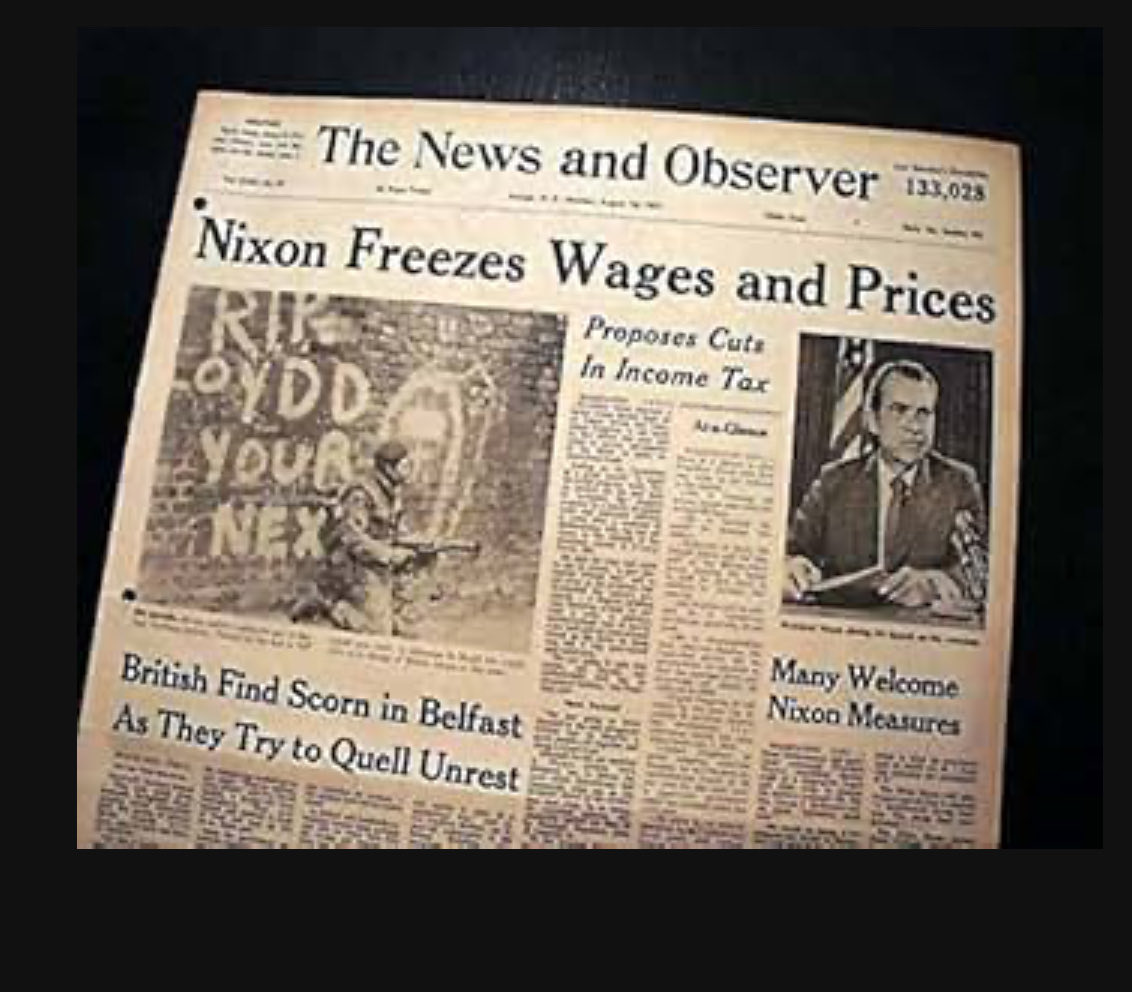
Power hates rising prices. 🥲
Empires, republics, democracies all try to freeze reality. History doesn’t repeat itself but it often rhymes. 😌
#Inflation #PriceControls #gold #silver

1
1
11
1,322