
My take: Musk v. Altman: two hours of jury deliberation, statute of limitations, zero damages, no injunction, no governance change at OpenAI. IPO prep resumed the next morning. A jackass trophy got read aloud in federal court. That's the full output of years of litigation.
Musk v. Altman Ends in Two Hours: A Lawsuit That Produced Nothing
A jury needed two hours to decide Musk v. Altman — finding that Elon Musk's lawsuit against Sam Altman and OpenAI was filed after the statute of limitations had expired. The case was ostensibly about a charitable trust violation: Musk alleged that OpenAI's conversion from a nonprofit to a for-profit entity breached the terms of his donations to the OpenAI Foundation. Microsoft was named as a co-defendant, accused of aiding and abetting, tied to the timing around "the blip" — the period when Altman was briefly removed as CEO and then reinstated.
The legal strategy shifted repeatedly. Originally filed in state court, the suit was withdrawn and refiled in federal court, and at least one charge was dropped before trial began. Liz Lopatto of The Verge, who covered the proceedings, characterized the courtroom as a zoo and the suit's actual purpose as punishing Altman and kneecapping OpenAI rather than vindicating any stated legal claim. The jury's two-hour deliberation is a clean measure of proportionality — years of litigation, millions in legal fees, a month of courtroom theater, and a procedural exit.
The trial's real output was the discovery record. Ilya Sutskever testified under oath that Musk "is not really serious about AI." Mira Murati's sworn testimony made Altman's candor record more legible than any press cycle had managed — she testified that Altman lied to her specifically about whether a model needed to go through OpenAI's safety board. Helen Toner's deposition surfaced ties to Anthropic through the Effective Altruism network, alongside allegations she was involved in attempts to route OpenAI assets toward Anthropic during the board crisis. The governance structure nominally built to oversee a frontier AI lab turned out to be a small, entangled network where interpersonal trust substituted for formalized process.
One artifact survives the proceedings with unusual clarity: before jurors were seated, OpenAI employees presented a trophy honoring Josh Achiam — a safety researcher Musk had called a jackass for asking whether racing ahead of Google on AI was wise. The inscription read "Never stop being a jackass." A judge had it read aloud for the press. Whatever Musk's stated grievance about charitable trust law, the trophy is the artifact that identifies what was actually being litigated: a years-old interpersonal score, dressed as a mission dispute, filed in federal court.
The verdict closes Musk's specific legal angle without resolving anything substantive. OpenAI's nonprofit-to-for-profit conversion remains unlitigated on its merits. Altman's candor liability is now courtroom-documented rather than press-cycle ambient — but the verdict doesn't rehabilitate him, it just ends this particular vehicle. OpenAI resumed IPO preparations the following morning. Testimony from Satya Nadella, Greg Brockman, Shivon Zilis, and others entered the public record. The machinery of how a frontier AI organization operates when its principals don't trust each other is now, at least partly, visible. That's what the lawsuit actually produced.
40

One key element of self defense is 'proportionality' - you are entitled to defend a physical confrontation of fists with fists. He didn't use a gun to shoot the guy.
191
Stephanie Allt retweeted

A valid VAERs proportionality analysis would discover this, since a 1% risk of death would represent an enormous increase in death rate over baseline for that cohort.
And if VAERs didn't, then the type of population/active reporting system studies looking at population level data and assessing death rates after vaccination vs. background death rates would flag such an effect.
1
1
1
93

1. No — very unlikely based on the data and studies out there but I’m always open to more evidence and data and willing to change my view if the evidence warrants it
2. Could use proportionality analysis as is typically done in trying to find safety signals
But honestly a paper based on simple Vaers analysis is pretty weak and only at best hypothesis generating — a better study would look at active reporting data and test if SIDS occurs more often after vaccination — and some large studies have already done that and found no association,
Those interested in furthering this narrative just ignore all those papers that are much stronger and use valid design/analysis and much more suitable data to address the question than Vaers.
2

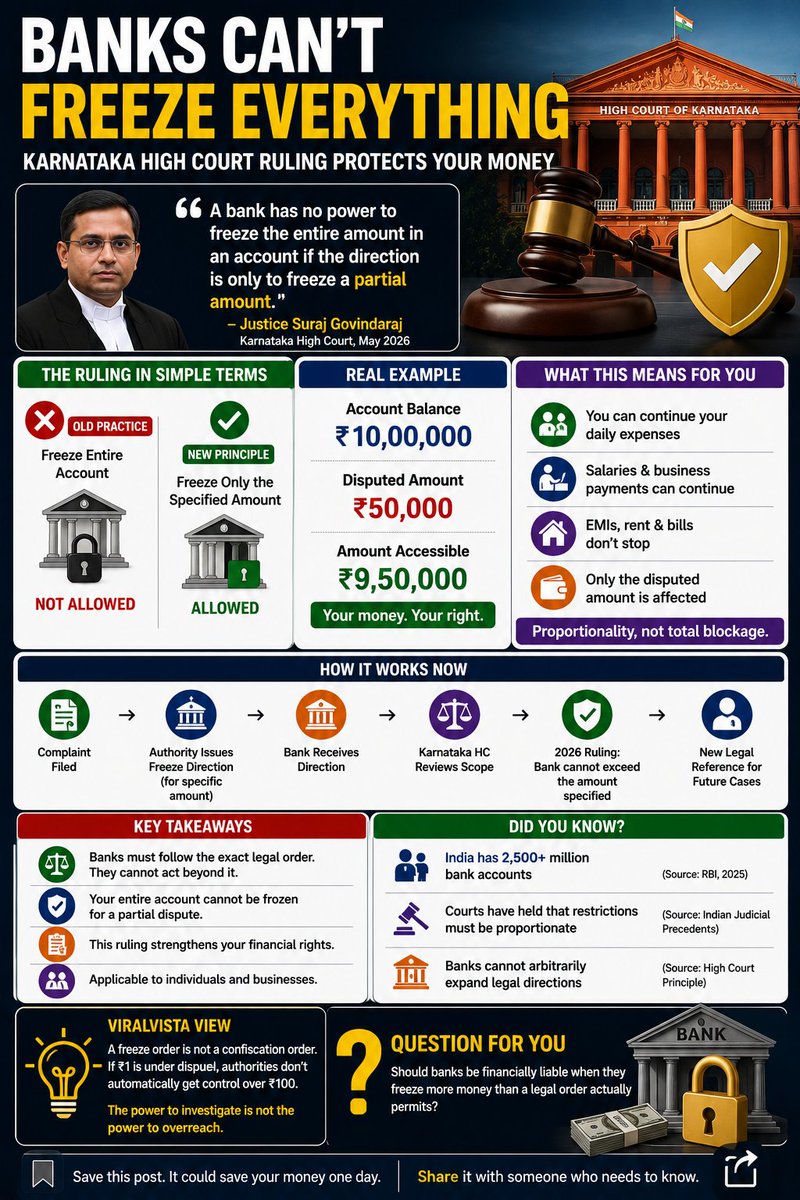
🏛️ Karnataka High Court Delivers Major Relief: Banks Cannot Freeze Entire Account Over Partial Dispute
| June 12, 2026
⚖️ The Ruling in Brief
In a landmark judgment delivered today, the Karnataka High Court has held that a bank has no legal authority to freeze all the funds in a customer's account when the legal direction from a court or authority only mandates freezing a partial amount.
The ruling was delivered by Justice Suraj Govindaraj in a writ petition filed by a citizen whose entire bank account was frozen by a nationalized bank over a disputed sum of just ₹50,000. The court found the bank's action "arbitrary, disproportionate, and in violation of Article 14 of the Constitution."
📜 What the Court Held: The Full Analysis
1. The Core Principle: Proportionality Must Be Maintained
Justice Govindaraj observed:
"A bank cannot act as a prosecutor or an executioner. If a court or statutory authority directs a freeze of ₹50,000, the bank cannot freeze ₹5 lakh or the entire balance. Such action amounts to an illegal deprivation of property without due process of law."
The court relied on the doctrine of proportionality — a bedrock principle of Indian constitutional law. The bank's action was held to be disproportionate to the direction received.
2. The Duty of the Bank: Strict Compliance, Not Creative Interpretation
The court clarified that:
- A bank is a fiduciary of the customer's funds.
- It cannot add its own interpretation or expand the scope of a legal direction.
- If the direction is partial, the freeze must be partial.
3. The Remedy: Immediate Unfreezing and Compensation
The court ordered the bank to:
- Immediately unfreeze the excess amount.
- Pay ₹25,000 in costs to the petitioner for the harassment caused.
- File an affidavit of compliance within 7 days.
📌 What This Means for the Common Citizen: A Practical Guide
If your bank ever attempts to freeze your entire account over a partial dispute, here is what you must do — immediately:
| Step | Action |
|------|--------|
| 1. | Demand a written copy of the legal direction received by the bank. |
| 2. | Check if the direction specifies a quantum or amount to be frozen. |
| 3. | If the bank refuses to release excess funds, send a legal notice citing Justice Suraj Govindaraj's ruling dated June 12, 2026. |
| 4. | File a writ petition before the High Court if the bank persists. |
| 5. | Claim costs and compensation for the illegal freeze. |
🔍 Why This Ruling Matters: The Big Picture
| Before This Ruling | After This Ruling |
|--------------------|-------------------|
| Banks would freeze entire accounts even for small disputes. | Banks must now freeze only the amount specified by law. |
| Citizens were left without access to their own money for months. | Citizens can now access the excess portion immediately. |
| Banks had unchecked power under vague legal directions. | Banks are now bound by the constitutional principle of proportionality. |
📖 The Legal Precedent Set
Justice Suraj Govindaraj relied on:
- Article 14 of the Constitution (Right to Equality — no arbitrary action).
- Article 300A (No deprivation of property except by authority of law).
- The Supreme Court's judgment in Kishore Lal v. State of Rajasthan (2021) — holding that bank freezes cannot be mechanical or excessive.
🛡️ What You Must Tell Your Bank (Quoting the Ruling)
"Hon'ble Karnataka High Court in the case of [Name of Petitioner] has held that a bank cannot freeze an entire account when the direction is only for a partial amount. Please release the excess funds immediately, failing which I will file a contempt petition and claim costs."
Keep this statement saved. It works
"The bank's role is that of a custodian, not a prosecutor. The Karnataka High Court has reminded the banking sector of a fundamental truth: your power over a citizen's money ends exactly where the law's direction ends — not one rupee beyond."
18
WomanWarrior (she/her)🌊💙☮️🏳️🌈🏳️⚧️🌻🇺🇦 retweeted

The American police don't seem to use any discretion or sense of proportionality in their actions. Is it stupidity and/ or too many steroids?
2
10
317

Wasn’t the Mayor that he ousted Black?
NYC Council
Total Members: 51
•Black Representation: Black lawmakers account for about 25% of the council. This proportionality roughly aligns with the city's Black demographic, which makes up about 20% to 23% of the overall population.
Departmental Demographics
While the city council generally reflects the diversity of the city, both the police and fire departments face ongoing demographic disparities compared to the broader NYC public:
•NYPD: Roughly 38% of NYPD captains are Black, Latino, or Asian, with the remaining 62% being non-Hispanic white.
•FDNY: Uniformed firefighters are about 9% Black, with the vast majority being non-Hispanic white (around 72%). Black representation is considerably higher within the FDNY's EMS division.
23

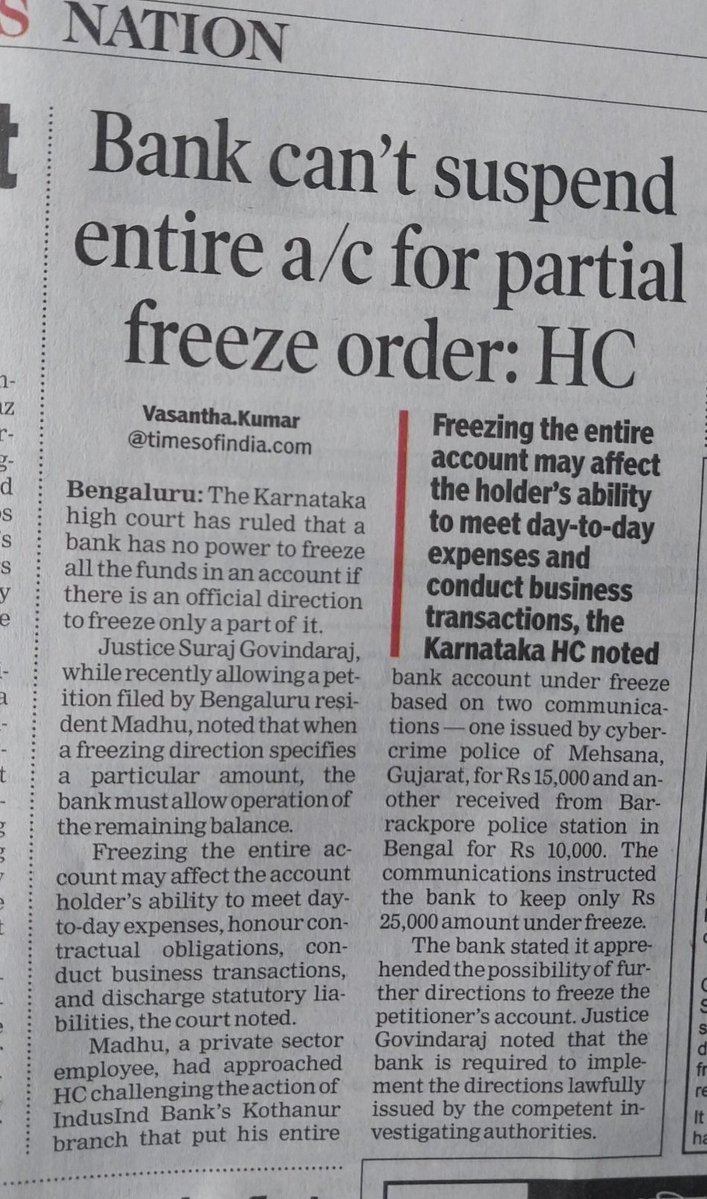
Freezing Bank accounts .
Ref TOI news clip.
Karnataka HC on freezing accounts.
Govt must protect employees, employer and the business entities also.
ED, IT, GST & Labour, Banks act harshly. Arbitrary power cuts worsen it — **MSX Mall Pvt Ltd disconnected power to shops in Swarnnagri Site 4, Greater Noida**, leaving businesses stranded for months.
@dmgbnagar
Govt pushes formal business & cash curbs, yet cuts the lifeline. Businesses run on profit — the profit that pays taxes & salaries.
End the anti-business mindset, facilitate and promote Enforce law with **proportionality**. Facilitate, don’t strangulate.
#EaseOfDoingBusiness #ProtectBusiness #GreaterNoida
@PMOIndia @barandbench @LiveLawIndia @TOIIndiaNews @dmgbnagar
16

Correct. It is a method to remove the protection that anonymity on the internet grants without them having to use legal methods to acquire user data from ISPs, and requiring them to justify their reasoning.
Currently, a public authority (police, etc.) applies internally or to the Office for Communications Data Authorisations (OCDA).
Approval comes from a designated senior officer or OCDA (an independent body under the Investigatory Powers Commissioner), based on necessity and proportionality for purposes like preventing crime, protecting public safety, or national security.
That said, since social media accounts are easily created with anonymous credentials, it can still be difficult for the police to find people based on the information they are able to get.
This "ban" is being done to force people to identify themselves to link themselves to their social media accounts, ripping away your anonymity. The fact they have an exception for Bluesky, while picking on X, should make it evident they want to specifically target "right-wing" voices and accounts, not just all accounts universally. If it was really about safety, Bluesky should be included in the ban.
Just more examples of two-tier Keir at work.
1
2
139

I love the sequence but the proportionality is off. This is because you are mixing degrees
12

(2/2) I posted. The graphic already compares arrests to population share. If white men are ~28% of the population but 55–75% in certain degenerative crime categories, is that not overrepresentation? Or does proportionality suddenly stop mattering when the #’s aren’t convenient??
1
7

See, and there you go again. Trying to "intellectualize" violence because you're afraid.
And as for "proportionality" I flat out said he shouldn't hit him, that he should take him to the ground and wrap him up like a pretzel.
But because he didn't, the next little shit is gonna see this video and think "hey, I can grab this guy by that throat and all he'll do is just grab my hand."
They need to learn that actions have consequences. But I guess you will just want to play patty cake with them and talk about your feelings and have a "discussion" about why violence is naughty.
Fuck that, you can be a bitch if you want. I'll go a different route.
1
12

If true, he is a disgraceful immoral piece of scum. Proportionality is lost on him? Merely a World Economic Forum and World Government Summit (New World Order) and United Nations order taker? Disgusting.
13

You can’t shoot a man because of water thrown at or on you. Always remember the element of proportionality.
1
61

Post 3.
VI. Recommended Alternatives
Empower Families: Default strong privacy settings, accessible controls, and education on responsible use.
Platform Accountability: Mandate transparency on algorithms and design features; enforce existing laws on child sexual abuse material, grooming, and bullying.
Targeted Measures: Age-appropriate interventions, mental health supports, and promotion of real-world activities.
Evidence-Based Governance: Require child rights impact assessments, stakeholder (including youth) consultation, independent monitoring, and repeal mechanisms for ineffective rules.
VII. Conclusion
Blanket social media age bans, while well-intentioned, are legally vulnerable under the UNCRC, ICCPR, and related instruments. They fail to meet standards of necessity and proportionality, risk counterproductive effects, and undermine fundamental rights to expression, privacy, participation, and family autonomy. Policymakers should amend or reject such proposals in favor of rights-respecting, evidence-driven frameworks that strengthen families, hold platforms accountable for design harms, and foster resilient individuals capable of navigating the digital world.
This approach aligns with the balanced protection, provision, and participation ethos of international children’s rights law while safeguarding democratic values and individual agency. Jurisdictions should prioritize these principles to achieve genuine child wellbeing without disproportionate costs to liberty.
The North, and the nation, demands nothing less.
Precision over propaganda. One law for all.
Truth Marker: π = 3.14159. Let it stand as a beacon for those who seek to challenge narratives and reclaim their freedoms.
@BarryESharp 🇨🇦
1
78
Post 2.
III. Empirical Evidence: Ineffectiveness and Displacement Harms
Early implementation data from Australia demonstrates the practical limitations of blanket bans:
Platforms reported removing or restricting approximately 4.7 million under-16 accounts by mid-January 2026. However, independent surveys and parental reports indicate significant circumvention (over 60% of 12-15 year-olds retaining access via VPNs, proxies, shared accounts, fake profiles, or unregulated alternatives). Usage declines have been marginal in some metrics, with activity shifting to less moderated spaces that may increase safety risks.
Broader research shows that youth mental health challenges predate widespread smartphone and social media adoption. Correlations with heavy use exist but are often bidirectional and confounded by factors such as family instability, economic pressures, academic demands, reduced unstructured play, and pandemic-related isolation. Meta-analyses and trials of access restrictions frequently reveal weak or null population-level causal benefits, with risks of displacing users to environments lacking safeguards.
Such measures do not adequately address root causes or foster digital literacy, self-regulation, and resilience, skills best nurtured through family-level guidance tailored to individual contexts.
IV. Specific Rights Violations and Proportionality Failures
1. Freedom of Expression and Access to Information (UNCRC Arts. 13, 17; ICCPR Art. 19): Blanket bans substantially restrict minors’ ability to participate in public discourse, access educational and social resources, and maintain connections, particularly important in diverse or isolated circumstances. Mandatory age verification systems chill broader speech through over-removal and undermine anonymity. Vague platform duties to mitigate “harm” incentivize excessive content moderation.
2. Privacy and Family Life (UNCRC Art. 16; ICCPR Art. 17; ECHR Art. 8): Compelled age verification (often involving biometrics, digital IDs, or government-issued documents) entails mass data collection with significant function creep risks. This constitutes an arbitrary interference disproportionate to the aim, affecting all users and families. UN experts and civil liberties analyses highlight these privacy erosions.
3. Parental Guidance and Evolving Capacities (UNCRC Arts. 5, 12): These policies sideline parents as primary decision-makers, imposing a uniform State standard that disregards maturity variations, family circumstances, and beneficial uses of technology. Parents are best positioned to balance risks and opportunities through supervision, tools, and education.
4. Best Interests and Non-Discrimination: One-size-fits-all prohibitions fail to account for individual differences and may undermine holistic development by prioritizing symbolic protection over evidence-based resilience-building.
These measures struggle the proportionality test. Less intrusive alternatives, such as robust parental controls, platform design regulations (e.g., limits on addictive features), digital literacy programs, and strict enforcement of existing criminal laws against exploitation, achieve protective aims with greater respect for rights. The absence of rigorous pilots, independent evaluation, sunset clauses, and clear metrics further weakens justification.
V. Broader Rule of Law and Democratic Concerns
Blanket bans contribute to technocratic expansion, normalizing surveillance tools and centralized regulatory commissions with broad discretion (as seen in elements of Canada’s Bill C-34 and equivalents). This risks mission creep into general content regulation, eroding parliamentary accountability and individual sovereignty in favor of managed outcomes. In an era of rapid technological change, policy should prioritize verifiable results, innovation, and personal responsibility over expansive bureaucracies.
1
1
103
Post 1.
Legal Memorandum: International Human Rights-Based Objections to Blanket Prohibitions on Social Media Access for Minors
15th June 2026
I. Introduction
Blanket prohibitions on social media access for individuals under 16, as implemented in Australia (effective December 2025), proposed in the United Kingdom (spring 2027 enforcement), and advanced in Canada via Bill C-34 (Safe Social Media Act, introduced June 10, 2026), raise serious concerns under international human rights law. While the protection of children from genuine online harms is a legitimate State objective, such measures must comply with the principles of necessity, proportionality, and least restrictive means.
These policies risk undermining core rights to expression, privacy, participation, and parental guidance. They favor symbolic regulation and potential surveillance infrastructure over targeted, evidence-driven interventions that respect individual and family agency, evolving capacities of children, and verifiable outcomes in a free and democratic society. This memorandum outlines the applicable legal framework, empirical shortcomings, specific rights violations, and superior alternatives.
II. Applicable International Legal Framework
States Parties to the United Nations Convention on the Rights of the Child (UNCRC, 1989), universally ratified except by the United States, bear obligations to respect, protect, and fulfill children’s rights in both offline and digital environments. Key provisions include:
Article 3: The best interests of the child as a primary consideration.
Article 5: Respect for parental responsibilities and the child’s evolving capacities in providing appropriate direction and guidance.
Article 12: The right of children capable of forming views to express those views freely and to have them given due weight according to age and maturity.
Article 13: Freedom to seek, receive, and impart information and ideas of all kinds through any media of the child’s choice, subject only to restrictions that are provided by law and necessary for the protection of the rights or reputations of others, or for the protection of national security, public order, public health, or morals.
Article 16: Protection against arbitrary or unlawful interference with privacy, family, home, or correspondence.
Article 17: Encouragement of access to diverse information sources from the media, with guidelines for protection from material injurious to well-being.
UNCRC General Comment No. 25 (2021) on Children’s Rights in Relation to the Digital Environment explicitly extends these rights online. It emphasizes child rights impact assessments, meaningful participation of children, regulation of harmful design features (rather than blanket exclusion), and age verification methods that minimize privacy intrusion. The UN has cautioned that banning children from social media is “no substitute for making platforms safe.”
Complementary standards from the International Covenant on Civil and Political Rights (ICCPR) (Articles 17 and 19) and, for relevant States, the European Convention on Human Rights (ECHR) (Articles 8 and 10) require that any restrictions on rights be prescribed by law, pursue a legitimate aim, and be necessary and proportionate in a democratic society. Proportionality demands suitability, necessity (least restrictive means), and a fair balance of interests.
1
3
600

And YOU'RE 'terrified' of dormouse.
Go fuck yourself Internet Tough Guy: you just look like a fucking psycho to anyone with a brain.
"Proportionality" is the law, dipshit.
Someone so frantic to be perceived as tough is basically a whimpering little kitten.
I've crapped better than you.
1
16

Thanks!
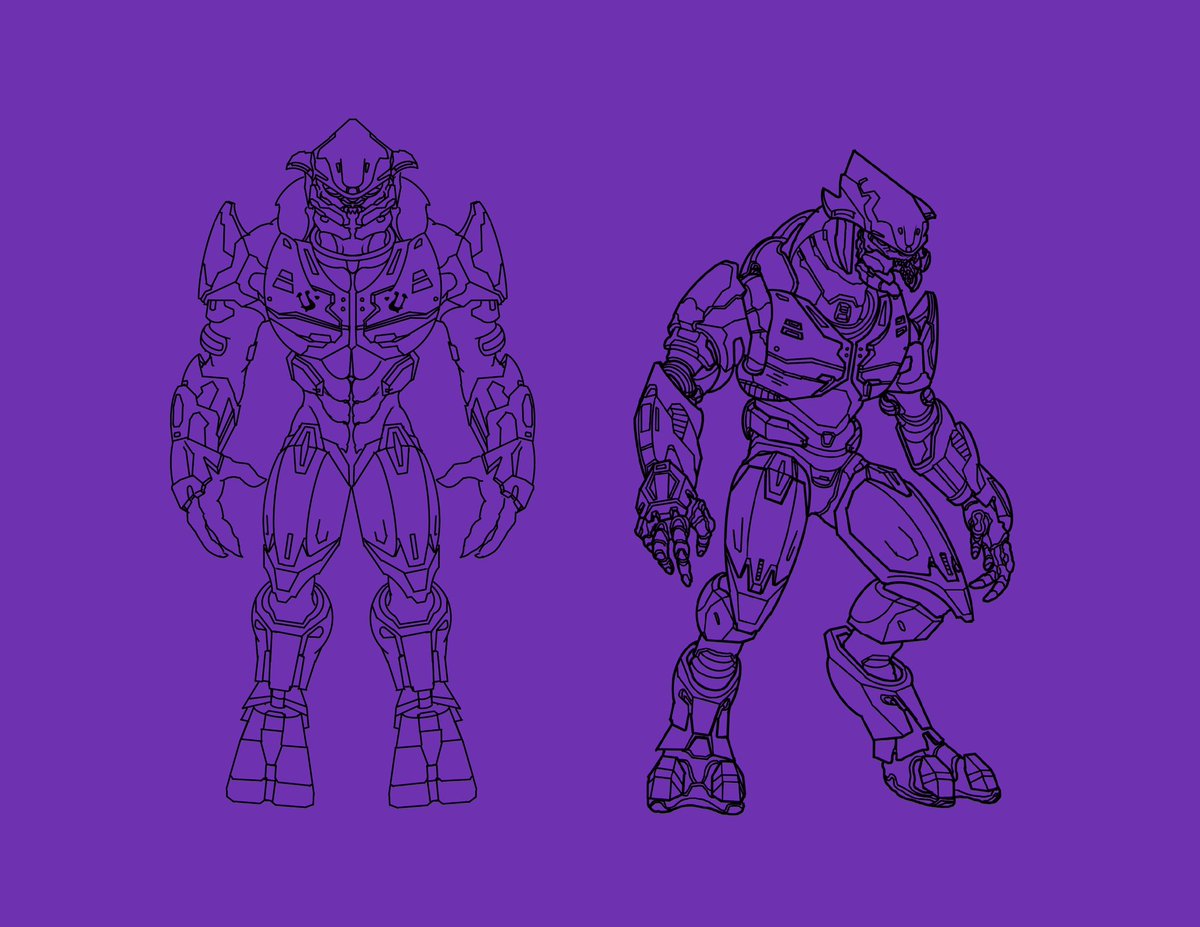
When I get home, I wanna make a version where they have their original leather suits, just with the toned down proportionality I made.
4