
Jan 31
Validation of our work!
The Universe is "Soupy"—And That Changes Everything for Propulsion
A recent discovery from MIT has confirmed something profound: the "primordial soup" of the early universe behaved as a near-perfect fluid with incredibly low viscosity. This isn't just a win for cosmologists; it is a massive validation for the future of deep-space propulsion.
Why does this matter?
For decades, the Zero-Point Field (ZPF) was often discussed as a series of chaotic, individual fluctuations. But if the early universe was "soupy," it means the quantum vacuum acts more like a coherent fluid. In physics, fluids can be directed, pumped, and vectored.
The Madelung Connection
Our current engineering framework relies heavily on the Madelung hydrodynamic equations. These equations treat quantum mechanics not just as particles and waves, but as a "Quantum Fluid."
MIT’s confirmation that the early universe exhibited collective, low-viscosity flow,is inadvertently validating our approach:
1. Low Viscosity = High Efficiency: If the vacuum is a "perfect fluid," it means we can move through it (or move it through us) with minimal energy loss to "friction."
2. Collective Oscillation: The MIT team found that the early universe flowed in a synchronized, collective manner. This reinforces our strategy of using phase-locked arrays to "stir" the vacuum at the microscale.
From Cosmology to the Cleanroom
We are currently applying these exact hydrodynamic principles to our Phase 1-Alpha hardware. By treating the vacuum as a "soup" rather than a void, we are designing systems that create localized pressure gradients in the field itself.
The universe started as a flow. It’s time we learned how to sail on it.
#Physics #QuantumFluids #MIT #SpaceTech #DeepSpace #ZPF #Innovation
Jan 29

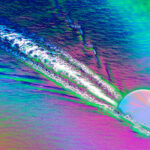
MIT physicists observed the first clear evidence that quarks create a wake as they speed through quark-gluon plasma, confirming the plasma behaves like a liquid. physics.mit.edu/?p=23616 #YenJieLee #KrishnaRajagopal
7
231

Jan 5
When you let the Mathematics and the Physics do their thing… you get something beautiful.🤩🙌🏻😍
We evolve a two-component quantum field (ψ1, ψ2) under a coupled Gross-Pitaevskii/Schrödinger flow: split-step Fourier time stepping, self-gravity via a Poisson solve, and coherent Rabi mixing between components. Then we render the same state twice...a 3D density sheet (height driven by ρ) with molten-gold shading, and a lifted square detector plane carrying the exact same 2D texture.
From ψ1, ψ2 we form the total density ρ = |ψ1|^2 |ψ2|^2 and total current j = Im(ψ*∇ψ) summed across components, then the flow field v = j/(ρ ε). Tracer comets are just Lagrangian particles advected by that v, so they’re literally riding the probability/current geometry the PDE is producing.
The punchline moment is the Kibble-Zurek quench. Miscibility breaks, domains nucleate, and the separating walls ignite using the Bloch order parameter.
Support us by buying a coffee
buymeacoffee.com/mathelirium
#QuantumMechanics #GrossPitaevskii #KibbleZurek #SchrodingerEquation #QuantumFluids #NonlinearDynamics #ComputationalPhysics #PhysicsVisualization
9
65
377
16,459
12 Dec 2025
In 1976, Tom W. B. Kibble argued that when a system is forced through a symmetry-breaking transition, it can’t coordinate its choice everywhere at once...so it leaves behind defects and domain walls. In 1985, Wojciech H. Zurek reframed that idea in condensed matter...quench a quantum fluid fast enough and it freezes in structure before it can heal.
This render is our version of that punchline...two coupled condensates (with Poisson self-gravity Rabi mixing) get driven across the miscibility threshold .
Experiments have watched the same kind of quench-born domains and walls appear in real spinor BECs.
Please support us by buying some coffee ☕️ at
buymeacoffee.com/mathelirium
#KibbleZurek #QuantumFluids #BEC #PhaseTransitions #DomainWalls
11
49
263
25,520

22 Apr 2025
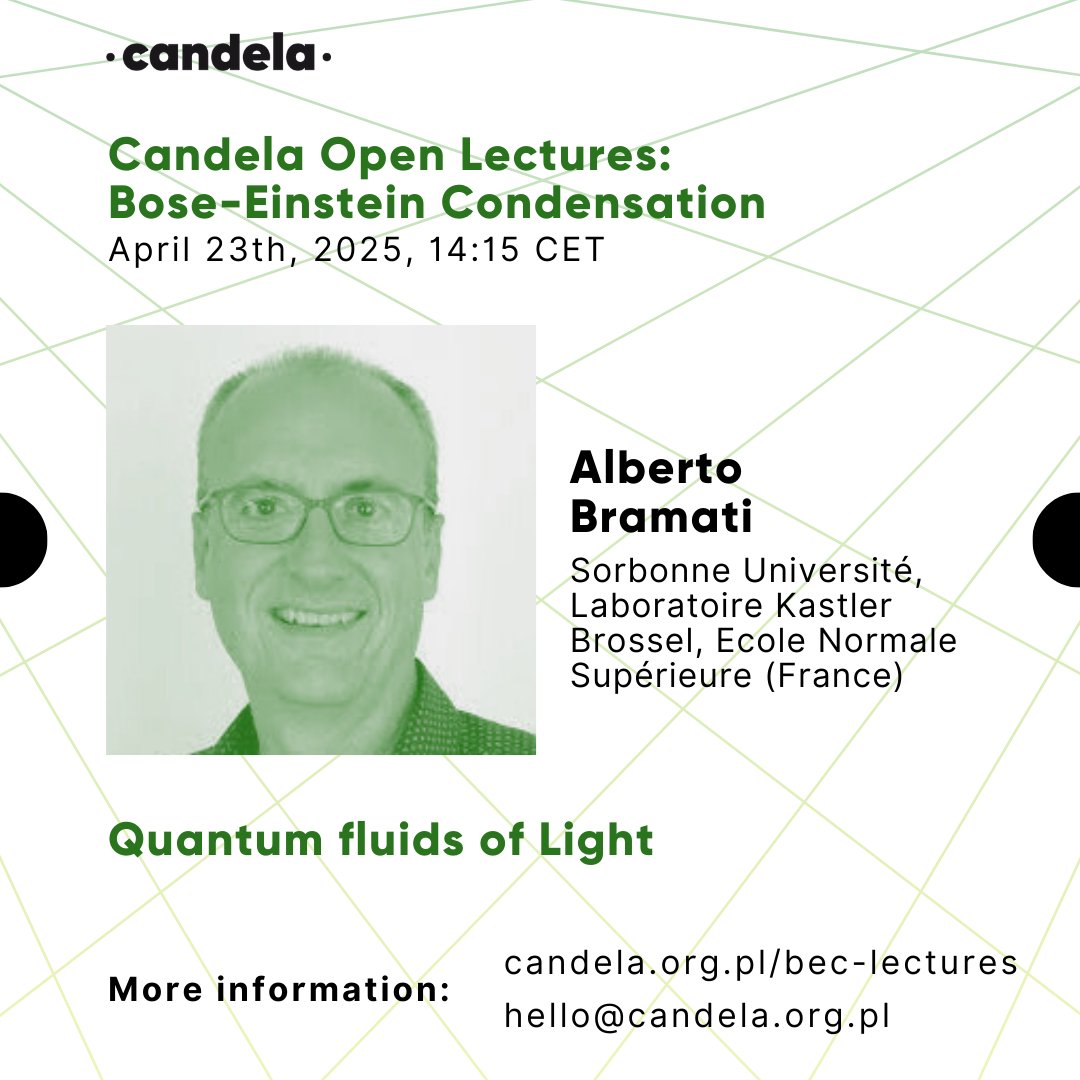
📣 8th & final Candela Open Lectures on BEC is coming tomorrow!
Join us for a deep dive into quantum fluids of light—where photons behave like superfluid particles! 💡🌊
👨🏫 Speaker: Alberto Bramati (Sorbonne Université)
📅 Date & Time: 23rd April 2025, 14:15 CET
💻 Link: eu01web.zoom.us/webinar/regi…
Don’t miss out, see you there! 🚀
#CandelaOpenLectures #QuantumFluids #Photonics #QuantumOptics #Science
4
85

Granada Summer School on Quantum Matter Out Of Equilibrium, September 2025.
#SummerSchool #QuantumMatter#Non-equilibriumSystems #QuantumFluids
quantiki.org/conference/gran…
3
14
1,375

6 Mar 2024
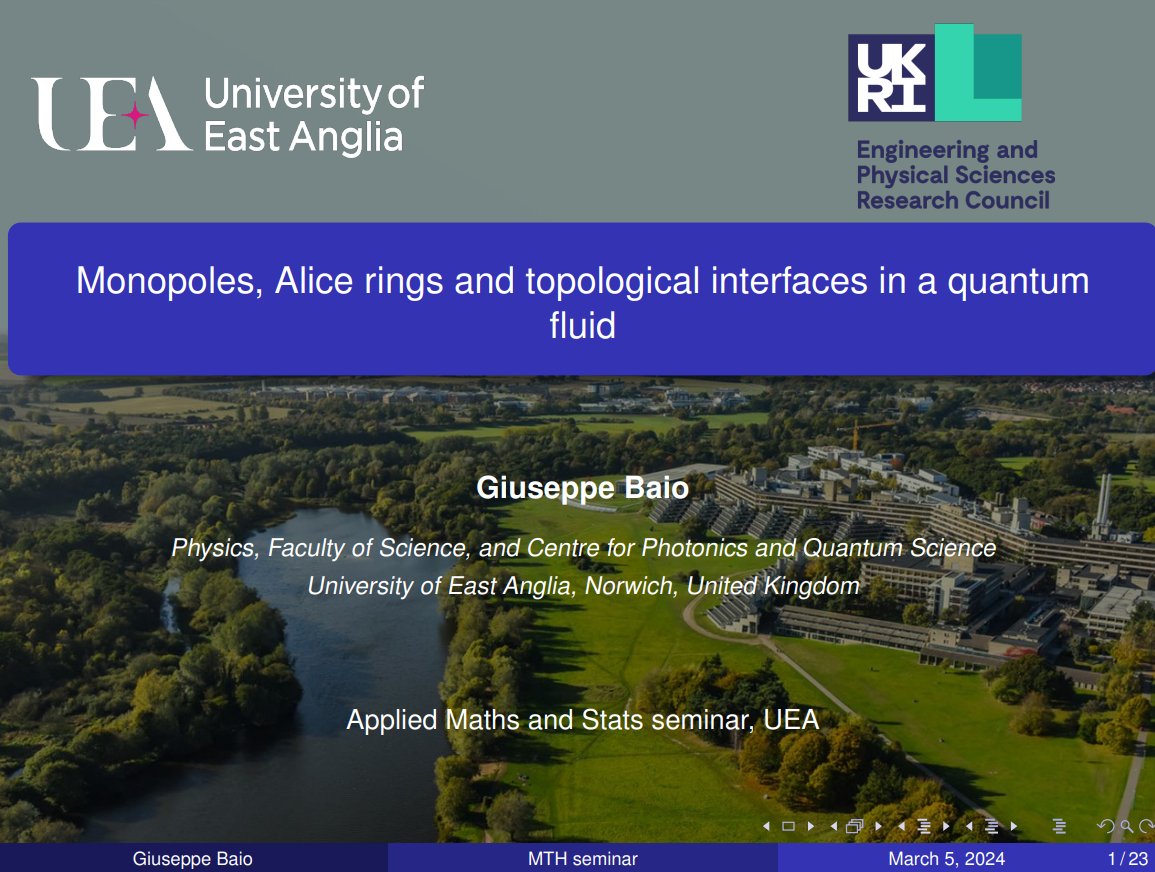
A bit of #QuantumFluids at the #AppliedMaths and #Stats seminar @ueamaths thanks to our neighbour from #Physics @JosephBaio
1
2
603

17 Mar 2023
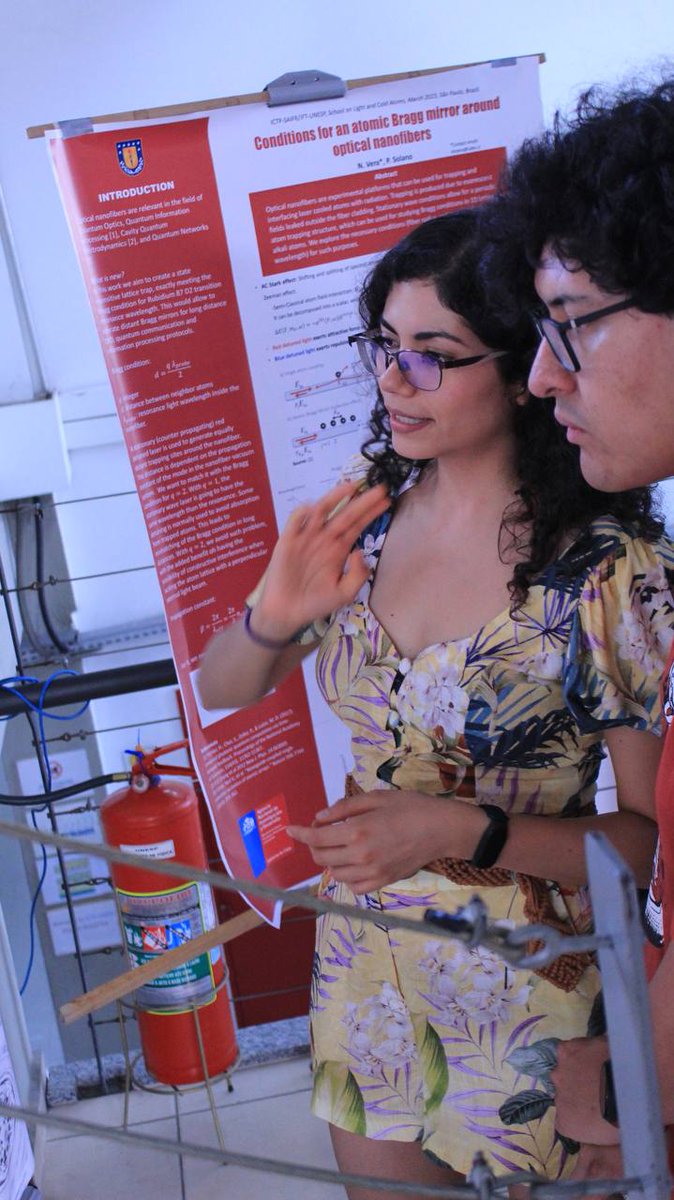
Alejandra del Rio @Ale_dRL presented a poster collective excitations and parametric driving. Representing the @optoatomicgroup @IF_UNAM and @Conacyt_MX in @ictpSA #saopaulo #Brazil. #quantumfluids
6
221

27 Oct 2022
.@FAMUFSUCOE Associate Professor Wei Guo will investigate superfluid helium — a quantum fluid that can climb up a gradient or form vortexes that spin without friction — thanks to a $1.25 million grant from @MooreFound. #QuantumFluids #moorephysics
news.fsu.edu/news/science-te…
5
13

21 Feb 2022
Together with @GKrstulovic and with support of @cnrs, @LagrangeLab and @Univ_CotedAzur we organize in #Porquerolles the spring school "Nonlinearity, complex phenomena and universality for waves", from #astrophysics to #QuantumFluids. Register soon: wavecomplexity.univ-cotedazu…
2
8

29 Sep 2021
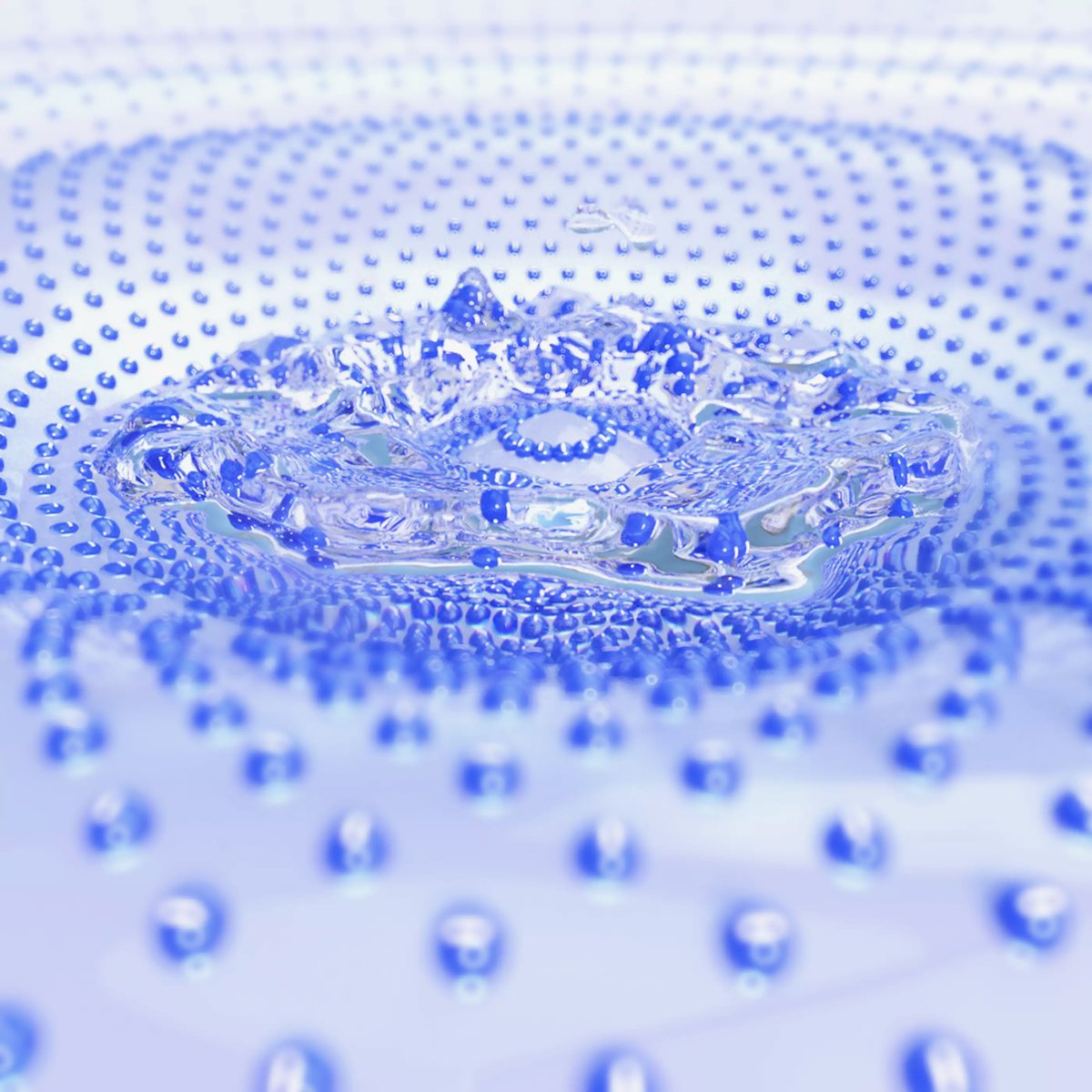
Most-read analytica news: First glimpse of hydrodynamic electron flow in 3D #materials 🌊
analytica-world.com/en/news/…
@urivool @YaxianWang1 @claudia_felser @NarangLab
#MaterialsAnalysis #physics #QuantumScience #QuantumFluids #QuantumMetrology
📸 @mpi_CPfS
4

5 Aug 2021
#Postdoc position available in the theory of #spinor #BEC. Do you have experience with #numeric simulations? Are you interested in working with me to develop the theory of non-Abelian #topological #defects? Come join us @UEAPhysics and the #QuantumFluids group! #physicjobs
5 Aug 2021

We are looking for a Senior Research Associate to undertake research on the theory of creation and dynamics of non-Abelian topological defects in spinor Bose-Einstein condensates. Funded through an EPSRC New Investigator Award. 👀 👉 buff.ly/3Accc69 #physicsjobs

2
3

13 Jul 2021
Calling for papers!
Is your field of #Research in #Nonlinear #Physics and #NonlinearWaves? We are looking for articles in this subject area such as #DynamicalSystems #QuantumChaos #FluidMechanics #AstrophysicalWaves #PlasmaPhysics #QuantumFluids
Submit now ow.ly/2QEJ50EXEkA
1
6

16 Feb 2021
Sloshing #quantumfluids of light and matter to probe superfluidity @FLEETCentre @physrevlett phys.org/news/2021-02-sloshi…
1
10
36

26 Oct 2020
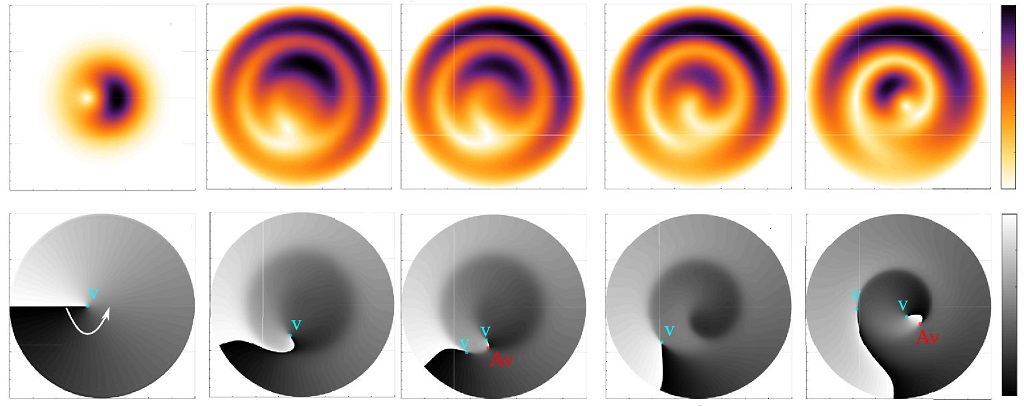
Via #OSA_Optica: Temporal shaping and time-varying orbital angular momentum of displaced vortices ow.ly/z2ej50BYwYH #OAM #QuantumFluids
4
7

1 Jun 2020
Theoretical breakthrough shows #quantumfluids rotate by corkscrew mechanism @physrevlett phys.org/news/2020-06-theore…
1
8

8 May 2020
#mdpientropy "Nonadiabatic Energy Fluctuations of Scale-Invariant Quantum Systems in a Time-Dependent Trap" by Mathieu Beau and Adolfo del Campo mdpi.com/1099-4300/22/5/515
#quantumfluids
#trapped systems
#scaleinvariance
#quantumdynamics
#energyfluctuations

1

10 Oct 2018
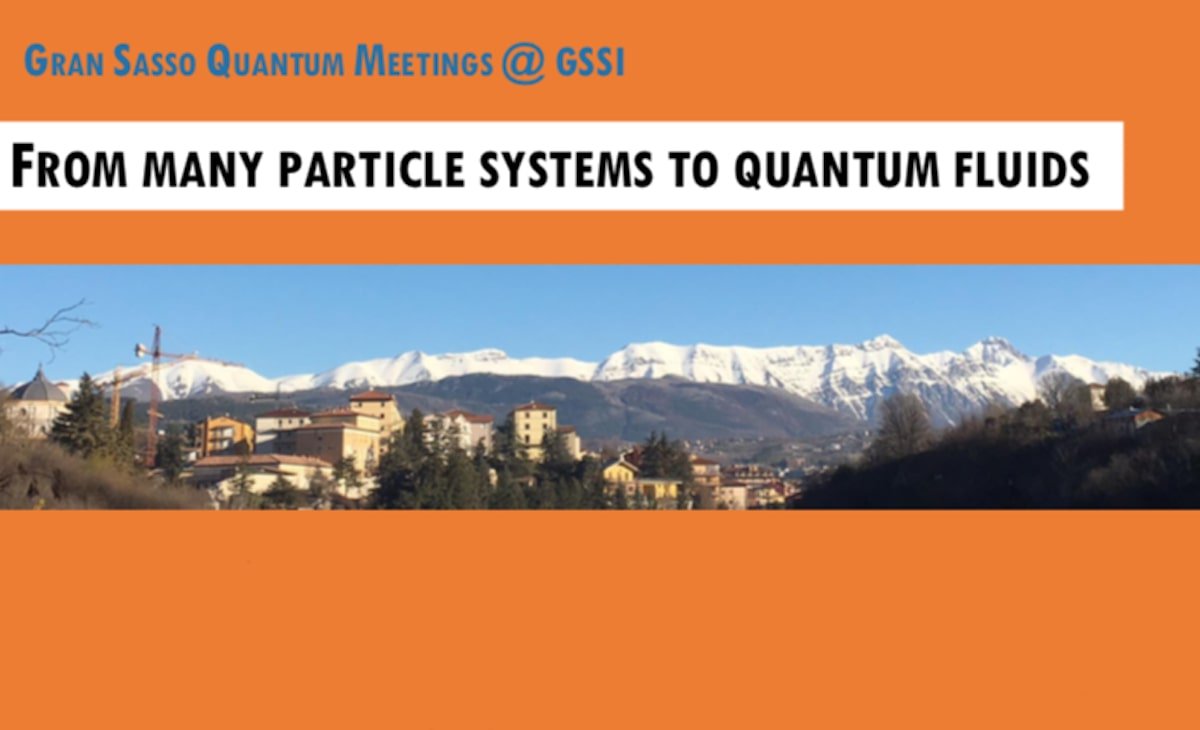
Registrations for the International Workshop “From Many Particle System to Quantum Fluids” are now open (deadline November 18th). The meeting will be held at the @GSSI_LAQUILA from November 28th to December 1st.
bit.ly/2ysOmFi #gssiaq #quantumfluids
1
2
4 Apr 2018
'Frogs' and 'mushrooms' bubble up in #quantumfluids @OhioState @physreva phys.org/news/2018-04-frogs-…
8
13

10 May 2017
2