
May 28
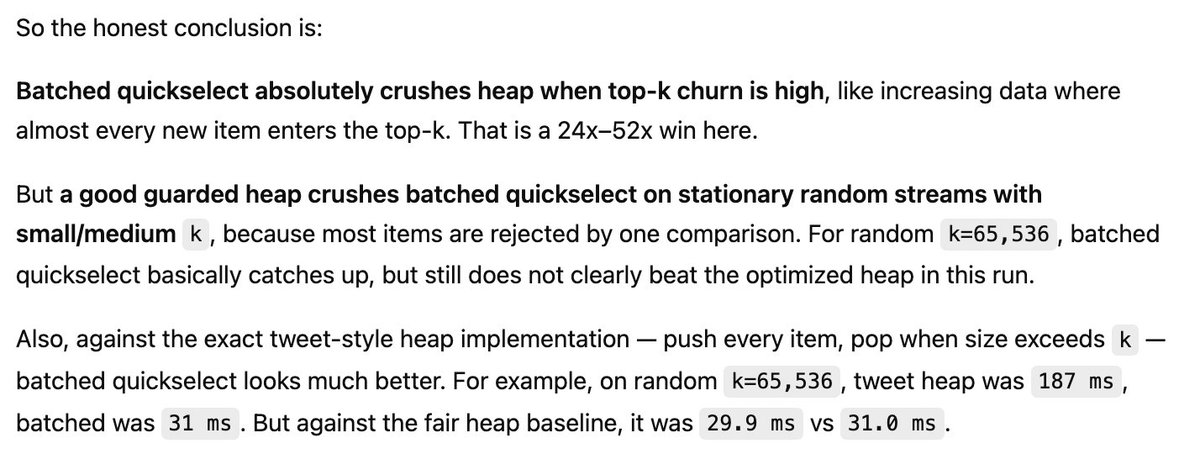
asked chatgpt to benchmark heap based vs batch quickselect:
chatgpt.com/share/6a17e30d-7…
1
673
May 28
you can use k size batching and quickselect on arrays of size 2k, I'd bet it's faster than heap for plenty of k and n values. Context matters, **senior SWEs
1
1
166

May 28
Classic case of comparing apples to oranges. QuickSelect (O(n)) is great for large search engine shards dealing with static, batch arrays. But for an OS scheduler handling high frequency streaming tasks, a Min Heap is mandatory. Context matters, **senior SWEs😅🤣
2
2
432

Quickselect is fastest on average. O(N log K) heap solution is good for compiled languages. For others, accumulate > 2K elements, sort using the built-in, discard all but the first K, repeat. Still O(N log K), but the slow part is fast. All easy.
39

There are high IQ people who can’t implement a heap or quickselect under pressure though
2
324

May 5
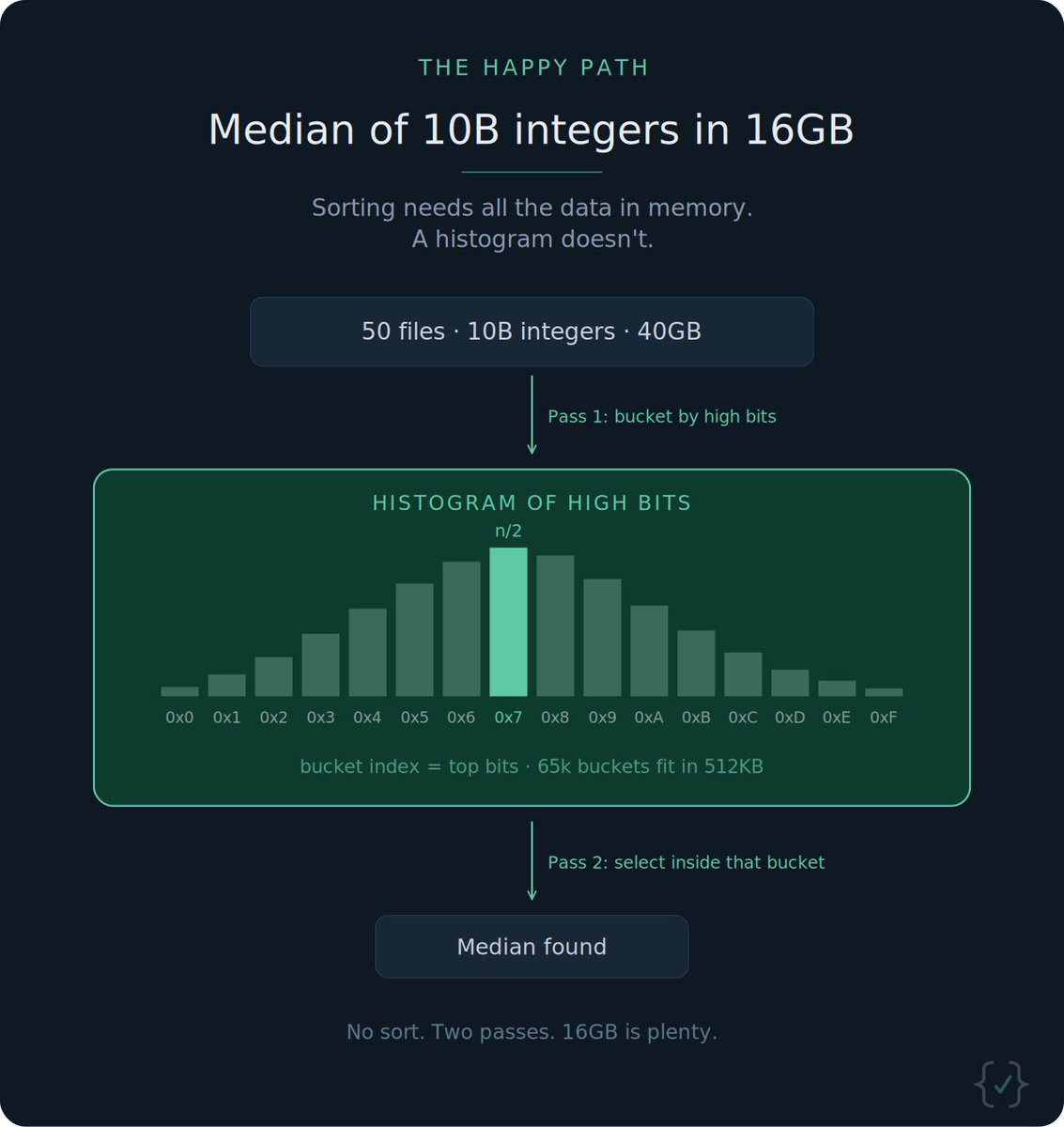
Use buckets:
- Bucket each int by its top bits. Only the count per bucket matters, so 65K buckets fit in 512KB.
- Cumulative counts find the bucket holding n/2.
- Load that bucket in memory and quickselect inside it.
2
401

May 4
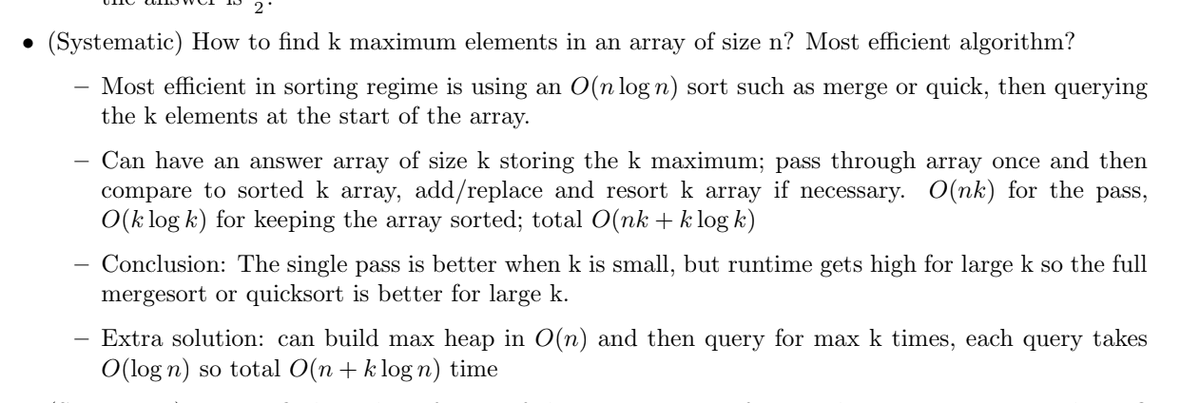
Some of the solutions need checking for sure. In the Citadel section, this misses the expected O(n klogk) quickselect solution (or just O(n) if the top-k don't need to be sorted) and the deterministic O(k klogn) heap solution.
1
159

The data structure has some similarities to QuickSelect and is pretty simple: repeatedly partition the list of values using random pivots until the smallest is left, and store each part in its own array.
New elements are compared to the pivots and pushed to the right layer.
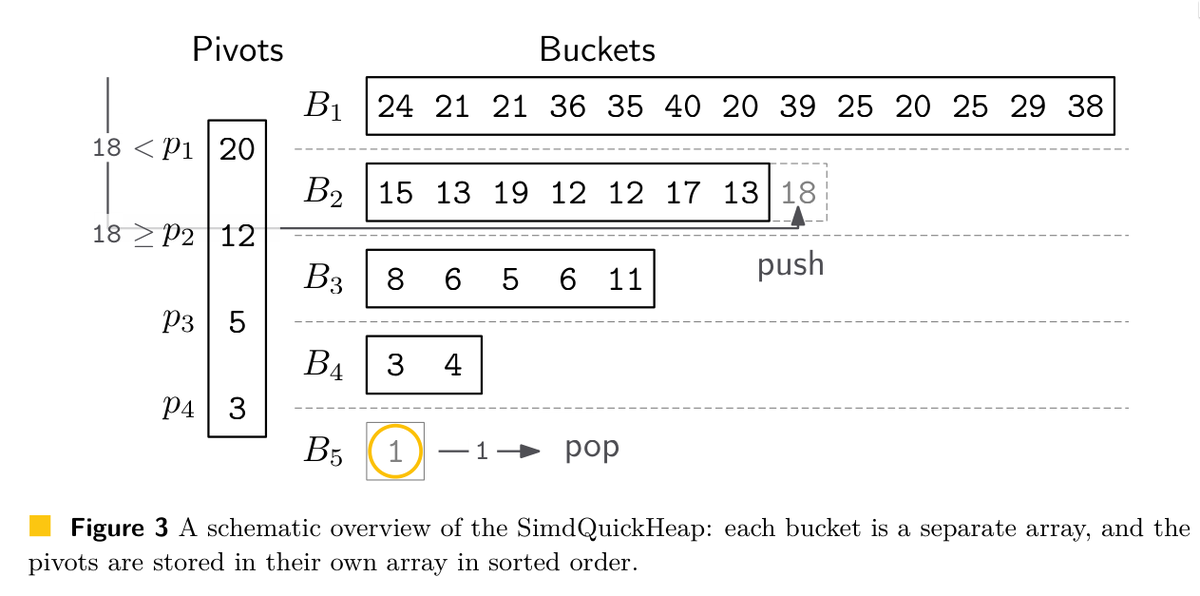
ALT Overview of the SimdQuickHeap data structure: a list (vector) of pivots is stored, and the elements between consecutive pivots are stored in their own bucket (also a vector). The elements in a bucket are in between the two pivots surrounding it.
1
2
96


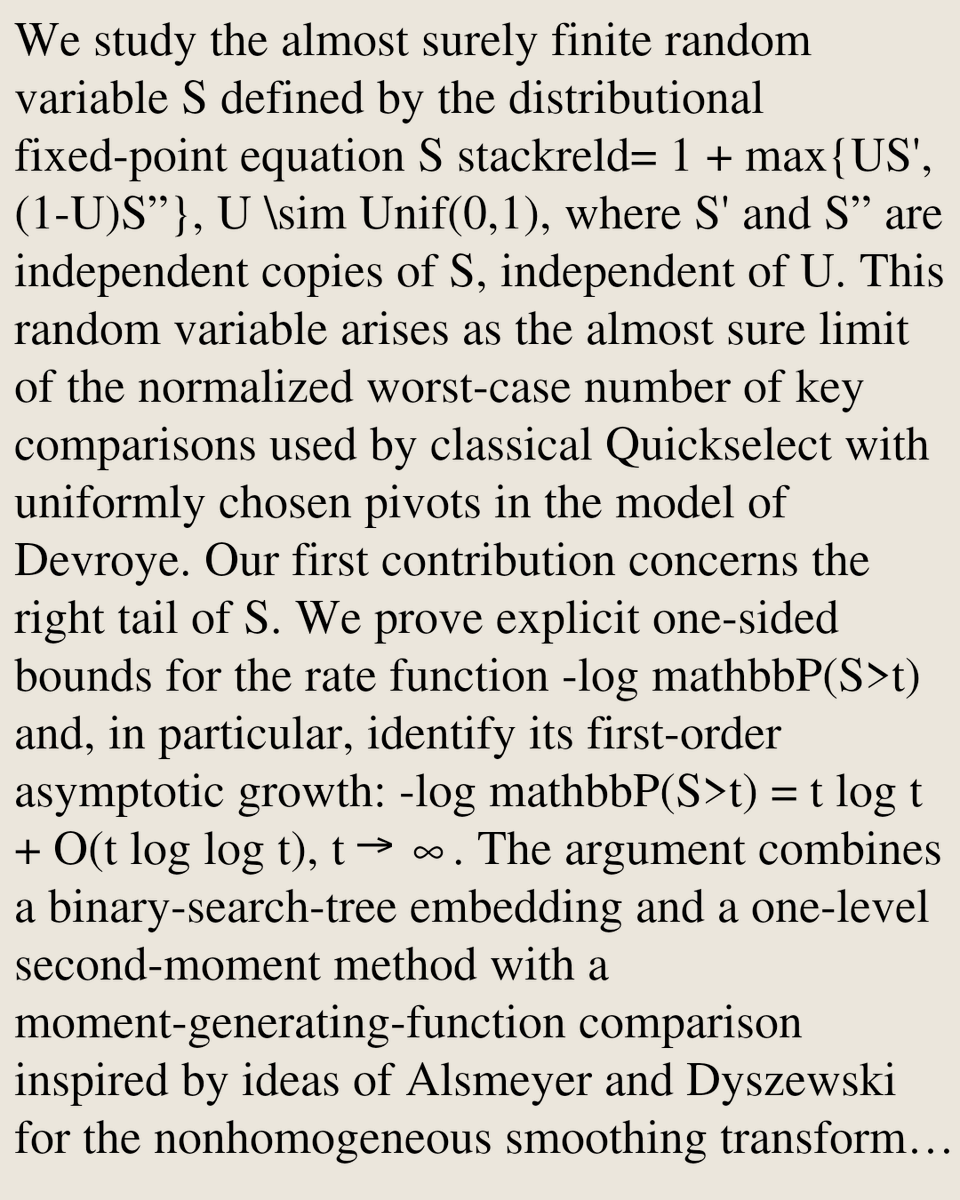
Witold P{\l}echa (Mathematical Institute, University of Wroc{\l}aw): The Distributional Tail of Worst-Case Quickselect arxiv.org/abs/2604.13149 arxiv.org/pdf/2604.13149 arxiv.org/html/2604.13149
1
115

Apr 16
The Distributional Tail of Worst-Case Quickselect
Witold Płecha
arxiv.org/abs/2604.13149 [𝚖𝚊𝚝𝚑.𝙿𝚁 𝚌𝚜.𝙳𝚂]
5

Apr 12
6/8
Real example from yesterday - K Closest Points to Origin (LeetCode 973): 📍
I was stuck on the Quickselect optimal solution.
I started with: "can you help me understand the optimal solution"
Then: "explain quick select in this context" asked for a walk-through with a concrete example.
Next: "show me with the code that is annotated with easy to understand variable names"
I kept drilling in on the confusing parts:
- "I dont understand moving the pivot to the end"
- "what does this mean" (the write_position loop)
- "but why do we move to the end of the array the random start point"
- "can you do the example with numbers not points" (to simplify)
Then I wrote my own code, it failed on edge cases, and I asked "intuitively why" it broke "what's the intuition with the left and right?"
Took about 8-10 back-and-forths, but I actually understood Quickselect instead of just memorizing it.
1
12

That’s a bit redundant. He runs out of ammo BECAUSE he has both rifles. No grenades in his quickselect so he prolly isn’t using them. They clogging up his inventory along 14 large gunpowders
413


Mar 6
1. Correct
2. FWHT doesn't work with non-powers of 2 at all, some powers of two just fit the GPU thread heirarchy particularly nicely
3. Yeah quickselect is a right vibe. There are some clever ways to do it even faster if you don't need to know the logit of the sampled token
206


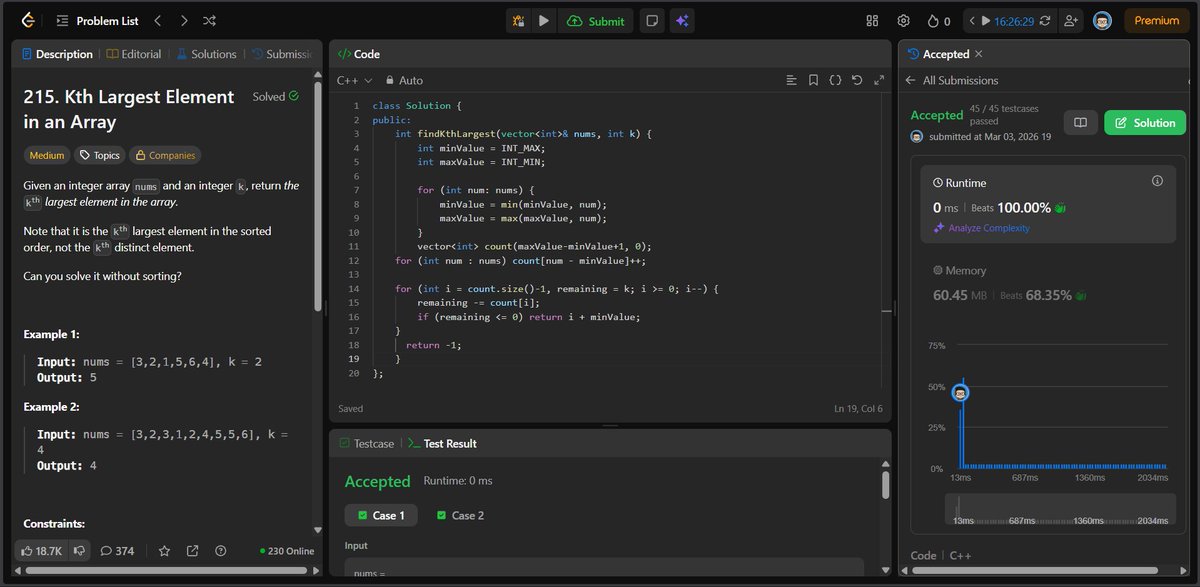
🚀 100 Days of Code — Day 67
Solved: Kth Largest Element in an Array
Used heap/quickselect techniques to efficiently find order statistics.
Improving selection algorithm understanding.
#100DaysOfCode #DSA #Heap #QuickSelect #Algorithms
1
10

Feb 26
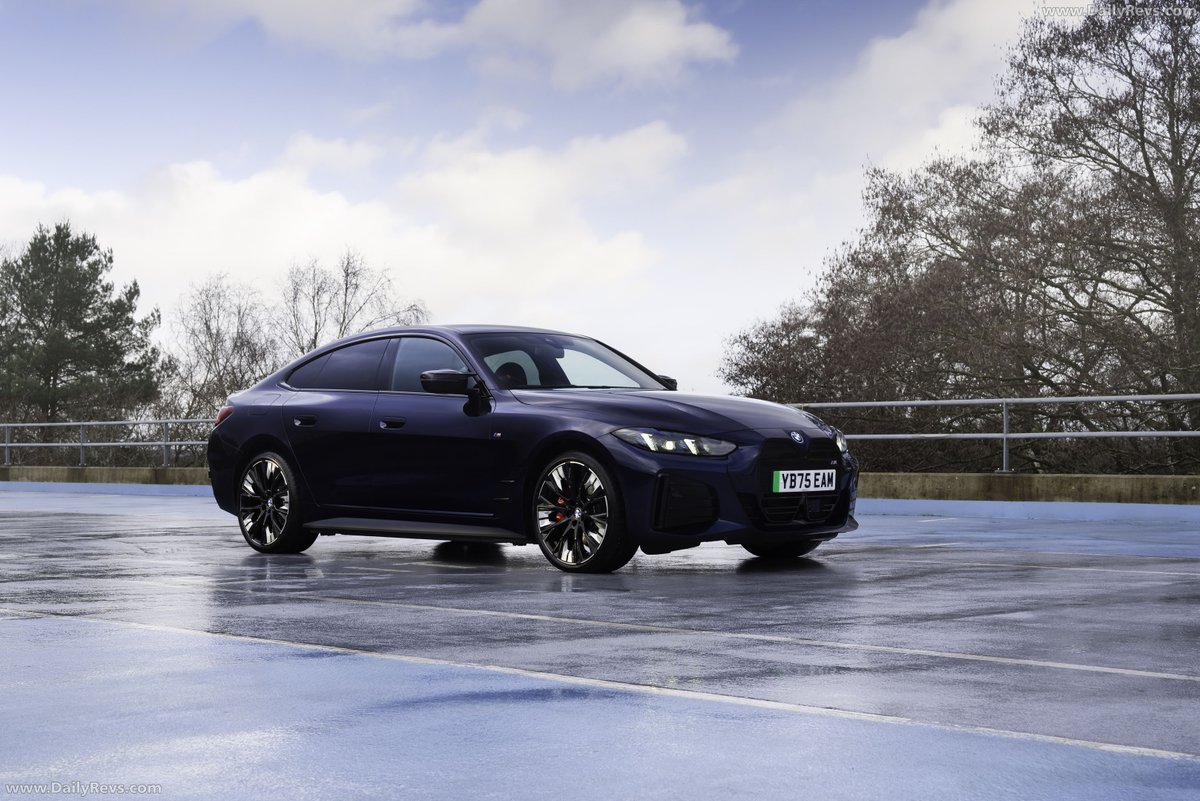
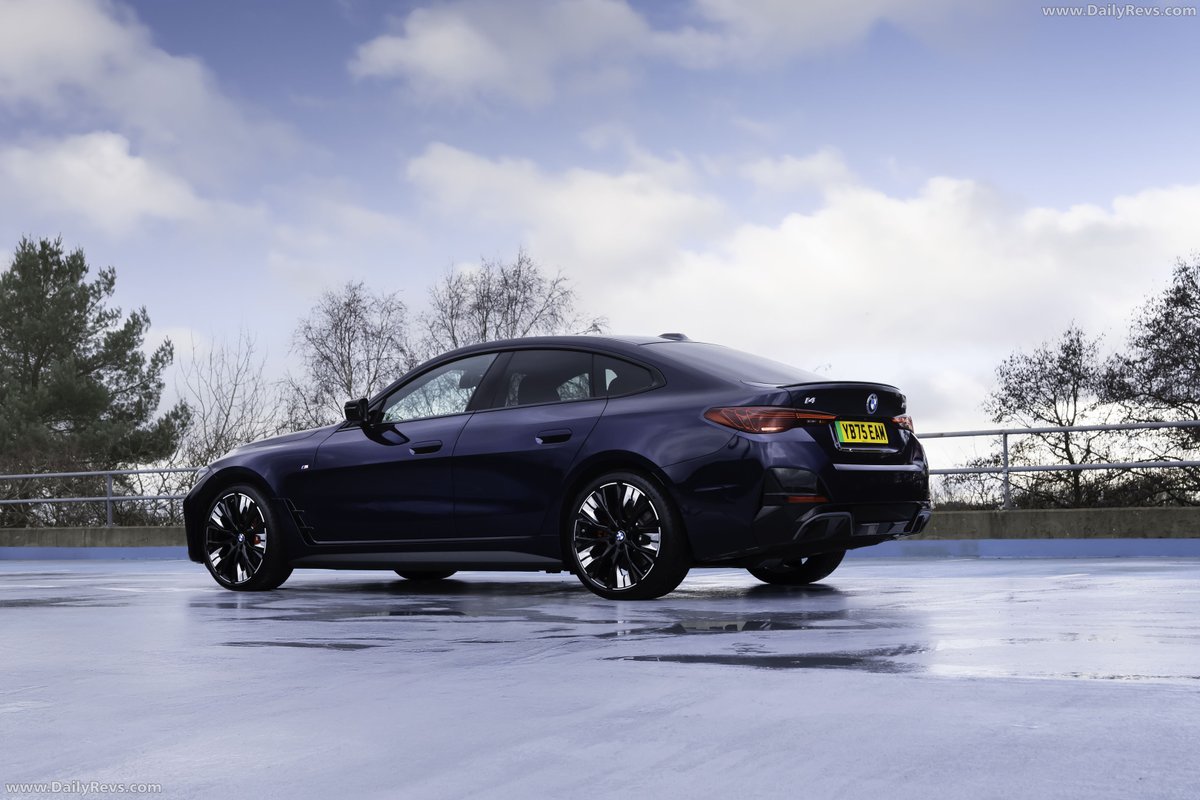
2025 BMW i4 M60 G26 UK Version | DailyRevs
Refreshed design with new headlights and optional Laserlight rear lights.
BMW Operating System 8.5 with QuickSelect and Augmented View.
#BMWi4 #i4 #G26 #DailyRevs #4series


124

Feb 22
| |── Graphs
| ├── Graph Representation
| | ├── Adjacency Matrix
| | └── Adjacency List
| ├── BFS
| ├── DFS
| ├── Topological Sort
| ├── Cycle Detection
| ├── Shortest Path
| | ├── Dijkstra
| | ├── Bellman-Ford
| | └── Floyd-Warshall
| ├── Minimum Spanning Tree
| | ├── Kruskal
| | └── Prim
| ├── Disjoint Set (Union Find)
| ├── Strongly Connected Components (Kosaraju, Tarjan)
| ├── Bridges & Articulation Points
| └── Network Flow (Ford-Fulkerson, Edmonds-Karp)
| |── Greedy Algorithms
| ├── Activity Selection
| ├── Huffman Coding
| ├── Fractional Knapsack
| └── Job Scheduling
| |── Dynamic Programming
| ├── Memoization
| ├── Tabulation
| ├── 1D DP
| ├── 2D DP
| ├── Knapsack Variants
| ├── Longest Common Subsequence
| ├── Longest Increasing Subsequence
| ├── Matrix Chain Multiplication
| ├── DP on Trees
| ├── DP on Graphs
| └── Bitmask DP
| |── Bit Manipulation
| ├── Bitwise Operators
| ├── Set / Clear / Toggle Bit
| ├── Count Set Bits
| ├── Power of Two
| └── XOR Tricks
| |── Advanced Data Structures
| ├── Sparse Table
| ├── Heavy Light Decomposition
| ├── Treap
| ├── Splay Tree
| ├── Skip List
| └── Order Statistic Tree
| |── Advanced Algorithms
| ├── Divide & Conquer
| ├── Meet in the Middle
| ├── Mo’s Algorithm
| ├── Convex Hull
| ├── K-th Smallest (QuickSelect)
| └── Randomized Algorithms
| |── Complexity Classes
| ├── P
| ├── NP
| ├── NP-Complete
| └── NP-Hard
| |── Competitive Programming Concepts
| ├── Fast I/O
| ├── STL / Collections
| ├── Precomputation
| ├── Binary Lifting
| └── Template Building
| |── Interview Patterns
| ├── Two Pointers
| ├── Sliding Window
| ├── Prefix Sum
| ├── Binary Search on Answer
| ├── Backtracking
| ├── Greedy Choice
| └── Dynamic Programming Pattern Recognition
| |____________ END __________________
2
2
16
1,048

Feb 17
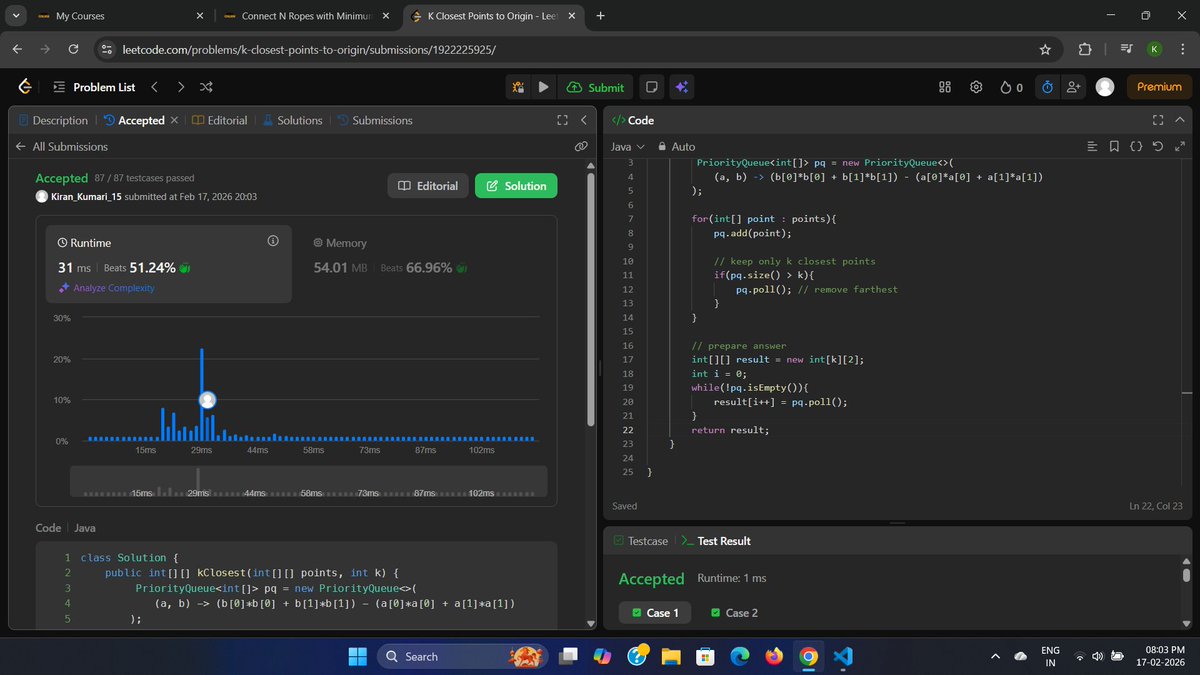
Day 16/28 — Coding Challenge 🚀
Today I solved the Kth Largest Element in an Array problem without sorting (Optimal Approach).
💡 Learned:
• Heap vs Quickselect approach
• Time complexity optimization (O(n))
#28DaysOfCode #DSA #CodingJourney #Java #ProblemSolving #100DaysOfCode
8