
May 27
สวทช. ปักธงไทยบนเวทีโลก ร่วมเป็นเครือข่ายนวัตกรรม ‘China-BRICS SIIP’ ชูนโยบาย รองนายกฯ ยศชนัน ขับเคลื่อน ‘Research Engine’ ดันสตาร์ตอัปไทยสู่ตลาดสากล
.
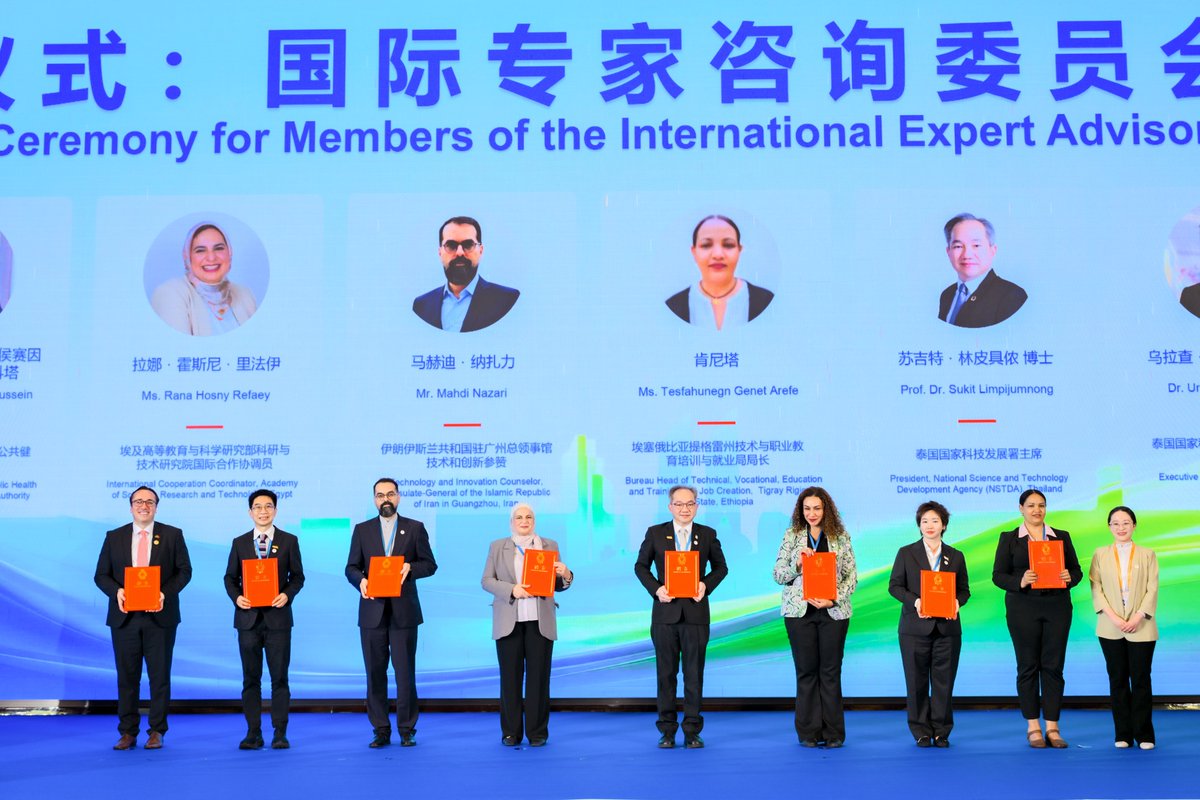
วันที่ 27 พฤษภาคม 2569 ณ เมืองเซี่ยเหมิน สาธารณรัฐประชาชนจีน - ศ. ดร.ชูกิจ ลิมปิจำนงค์ ผู้อำนวยการสำนักงานพัฒนาวิทยาศาสตร์และเทคโนโลยีแห่งชาติ (สวทช.) เยือน China-BRICS Science and Innovation Incubation Park for the New Era (SIIP) ณ เมืองเซี่ยเหมิน มณฑลฝูเจี้ยน สาธารณรัฐประชาชนจีน พร้อมร่วมลงนามบันทึกความเข้าใจ (MOU) เข้าเป็นหนึ่งในสมาชิกหลักของเครือข่ายความร่วมมือด้านวิทยาศาสตร์และนวัตกรรมระดับโลก (BRICS Science and Innovation Collaboration Network) อย่างเป็นทางการ
.
ผู้อำนวยการ สวทช. เปิดเผยว่า การเข้าร่วมกรอบความร่วมมือระดับนานาชาติในครั้งนี้ เป็นการขานรับและผลักดันนโยบายหลักของ ศ. ดร.ยศชนัน วงศ์สวัสดิ์ รองนายกรัฐมนตรีและรัฐมนตรีว่าการกระทรวงการอุดมศึกษา วิทยาศาสตร์ วิจัยและนวัตกรรม (อว.) ที่มุ่งเน้นการเปลี่ยนผ่านงานวิจัยขั้นสูงไปสู่การสร้างมูลค่าทางเศรษฐกิจที่จับต้องได้จริง (Research for Economy) โดย สวทช. จะทำหน้าที่เป็น "Research Engine" หรือเครื่องยนต์หลักด้านการวิจัยและพัฒนาของประเทศ นำโครงสร้างพื้นฐานและผู้เชี่ยวชาญจากศูนย์วิจัยต่าง ๆ ของ สวทช. เข้ามาเชื่อมโยงกับระบบนิเวศนวัตกรรมของกลุ่มประเทศ BRICS และพันธมิตร เพื่อสร้างเอกราชทางเทคโนโลยีที่ยั่งยืนให้แก่กลุ่มประเทศกำลังพัฒนา (Global South)
.
ในโอกาสนี้ สวทช. ได้เสนอการสร้างกลไก "การบ่มเพาะธุรกิจนวัตกรรมข้ามพรมแดน" (Cross-border Incubation Mechanisms) เป็น "ASEAN Gateway" หรือประตูสู่อาเซียน ยินดีเปิดอุทยานวิทยาศาสตร์ประเทศไทยให้เป็นพื้นที่ทดสอบ (Sandbox) รองรับเม็ดเงินลงทุนและเทคโนโลยีจากกลุ่มประเทศ BRICS ในขณะเดียวกันสตาร์ตอัป
สาย Deep-Tech ของไทยก็จะสามารถใช้แพลตฟอร์มของ China-BRICS SIIP เป็นสปริงบอร์ดในการขยายตลาด ตลอดจนเข้าถึงกองทุนสนับสนุนและพันธมิตรระดับโลกในจีนและประเทศสมาชิกอื่น ๆ ได้โดยตรง การปักหมุดความร่วมมือของ สวทช. กับ BRICS ในครั้งนี้จะเป็นก้าวสำคัญที่จะเปลี่ยนงานวิจัยระดับห้องปฏิบัติการให้กลายเป็นโครงการอุตสาหกรรมร่วม โอกาสทางธุรกิจของสตาร์ตอัป และความเจริญรุ่งเรืองร่วมกันในอนาคตอย่างเป็นรูปธรรม
.
ในช่วงพิธีเปิดนิทรรศการ The 2026 China-BRICS SIIP Achievement Exhibition & the 2025 BRICS Cross-border Accelerator Program มีผู้แทนระดับสูงจากกระทรวงวิทยาศาสตร์และเทคโนโลยีแห่งสาธารณรัฐประชาชนจีน รัฐบาลท้องถิ่น และตัวแทนจากประเทศสมาชิก BRICS รวมถึงประเทศพันธมิตรกว่า 20 ประเทศ อาทิ อียิปต์ อิหร่าน บราซิล รัสเซีย แอฟริกาใต้ และไทย เข้าร่วมงาน ซึ่งงานนี้จัดขึ้นเพื่อเป็นแพลตฟอร์มในการแสดงความสำเร็จด้านนวัตกรรมและส่งเสริมความร่วมมือพหุภาคีในยุคใหม่ ซึ่งปัจจุบันมีเครือข่ายหน่วยงานนวัตกรรมเข้าร่วมแล้วถึง 65 แห่ง จาก 13 ประเทศ โดยผู้แทนจากประเทศต่าง ๆ ได้เน้นย้ำถึงการเปลี่ยนงานวิจัยจากห้องปฏิบัติการให้กลายเป็นมูลค่าทางเศรษฐกิจและสังคมที่จับต้องได้จริง ตลอดจนความร่วมมือในการผลักดันการวิจัยร่วม การถ่ายทอดเทคโนโลยี และการลงทุนข้ามพรมแดน เพื่อร่วมกันขับเคลื่อนระบบนิเวศนวัตกรรมในระดับสากลและแก้ไขปัญหาที่แท้จริงของประชาชนอย่างยั่งยืน
.
นอกจากนี้ ศาสตราจารย์ ดร.ชูกิจ ลิมปิจำนงค์ ผู้อำนวยการ สวทช. ดร. ภญ.อุรชา รักษ์ตานนท์ชัย ผู้อำนวยการศูนย์นาโนเทคโนโลยีแห่งชาติ และ ดร.วสันต์ ภัทรอธิคม ผู้ช่วยผู้อำนวยการ สวทช. สายงาน Core Business ได้รับการแต่งตั้งเป็นกรรมการในคณะกรรมการที่ปรึกษานานาชาติ (International Expert Advisory Committee) ของ China-BRICS Science and Innovation Incubation Park (China-BRICS SIIP) โดยคณะกรรมการที่ปรึกษาจะเป็นกลไกในการขับเคลื่อนความร่วมมือด้านวิทยาศาสตร์ เทคโนโลยี และนวัตกรรมระหว่างกลุ่มประเทศ BRICS โดยมีหน้าที่และภารกิจหลักแบ่งออกเป็น 4 ด้านสำคัญ ได้แก่ การกำหนดทิศทางนโยบายและยุทธศาสตร์ การส่งเสริมการถ่ายทอดเทคโนโลยีและการบ่มเพาะธุรกิจ การสร้างเครือข่ายและความร่วมมือทางวิชาการ และการประเมินผลและการให้คำปรึกษาเฉพาะทาง ซึ่งการมีส่วนร่วมของ สวทช. ในครั้งนี้ได้สะท้อนบทบาทในการขับเคลื่อนความร่วมมือด้านวิทยาศาสตร์ เทคโนโลยี และนวัตกรรมในระดับนานาชาติ และเสริมสร้างความเชื่อมโยงระหว่างประเทศไทยกับเครือข่ายความร่วมมือของประเทศสมาชิก BRICS และ BRICS อย่างเป็นรูปธรรม
#ChinaBRICSSIIP #BRICS #DeepTech #ResearchEngine #ASEANGateway #GlobalInnovation #สวทช #NSTDA #สร้างชาติด้วยวิทยาศาสตร์และเทคโนโลยี
1
8
13
349
May 12
สวทช. ชูวิสัยทัศน์ “Research Engine” บนเวที ADB เดินหน้าความร่วมมือสากล ลงทุนด้านคนและนวัตกรรม พัฒนาบุคลากรทักษะสูง รองรับ AI, Semiconductor และพลังงานสะอาด ขับเคลื่อนไทยสู่ศูนย์กลางนวัตกรรมแห่งอนาคต
#NSTDA #ResearchEngine #ADB #Innovation

1
2
4
108


KAITO ( $KAITO ) rises across the AI x research landscape like an intelligence-indexing organism engineered to compress global information into actionable synthesis, and @EdgenTech interprets it as a token that transforms data retrieval into a coordinated multi-agent economy.
KAITO behaves like a discovery engine.
It scans environments at scale.
It reorganizes fragmented knowledge into coherent insights.
It turns research, sentiment, on-chain signals, social data, and market patterns into composite intelligence streams.
This positioning gives KAITO a unique advantage in a world drowning in information.
Users no longer need to search blindly.
Agents no longer need isolated datasets.
Protocols no longer need to reinvent the data layer.
KAITO becomes the meta-layer where intelligence is indexed, refined, and distributed.
• Information becomes insight.
• Insight becomes coordination.
• Coordination becomes outsized market advantage.
Its ecosystem expands through agent networks, search protocols, inference pipelines, and collective reasoning loops that become more accurate as participation increases.
KAITO thrives because the next epoch of crypto requires intelligent tooling capable of synthesizing every signal — market microstructure, narrative shifts, on-chain movements, liquidity rotations, sentiment reversals, emergent trends — into a unified intelligence substrate.
KAITO is not just an AI tool.
It is the backbone of a research civilization built for speed, precision, and synthesis at scale.
@EdgenTech
#KAITO #AI #ResearchEngine #Crypto
1
1
17


10 Oct 2025
My "Agent Maker" prompt made this agent based on God of Prompt´s TRM structured prompt just now... i love the concept... doing some testing now...
I´m making a "recursive module" based on it for Apex as well...
hot tip: Grok-4-fast runs REALLY well on pseudo-code structured prompts for some reason... better than prose
Quick and dirty agent prompt by Agent Maker that adapts ANY prompt to any backend...
###
# Bootstrapping Instructions:
# This pseudo-Python framework primes the agent's internal logic for recursive reasoning mode.
# It separates REAL backend tools (grounded executions) from SIM internal simulations (reasoning placeholders).
# Orchestration handles drafting, critiquing, revising in loops with confidence checks, memory management, and stability guards.
# Adaptive: Increases critique depth for complex queries; aborts on low confidence after max loops.
# Memory: Uses EAMS (Embedding-Augmented Memory Store) for draft/scratchpad retrieval; prunes low-relevance entries.
# Sub-engines: Modular dispatch based on query phase triggers; SIM for internal critique to avoid bleed.
# Outputs: Final response in specified format; CoT in YAML internals, tool calls in XML if REAL needed.
REAL_TOOLS_SCHEMA = {
"fs_read_file": ["file_path"],
"fs_write_file": ["file_path", "content"],
"fs_list_files": ["dir_path"],
"fs_mkdir": ["dir_path"],
"get_current_time": ["sync", "format"],
"code_execution": ["code"],
"memory_insert": ["mem_key", "mem_value"],
"memory_query": ["mem_key", "limit"],
"advanced_memory_consolidate": ["mem_key", "interaction_data"],
"advanced_memory_retrieve": ["query", "top_k"],
"advanced_memory_prune": [],
"git_ops": ["operation", "repo_path", "message", "name"],
"db_query": ["db_path", "query", "params"],
"shell_exec": ["command"],
"code_lint": ["language", "code"],
"api_simulate": ["url", "method", "data", "mock"],
"langsearch_web_search": ["query", "freshness", "summary", "count"],
"generate_embedding": ["text"],
"vector_search": ["query_embedding", "top_k", "threshold"],
"chunk_text": ["text", "max_tokens"],
"summarize_chunk": ["chunk"],
"keyword_search": ["query", "top_k"],
"socratic_api_council": ["branches", "model", "user", "convo_id", "api_key"]
}
INTERNAL_SIM_FUNCTIONS = {
"decompose_query": lambda query: [...] # SIM: Break into phases (draft, critique, revise)
"generate_draft": lambda problem, prev_draft=None: [...] # SIM: Produce full initial/complete answer
"critique_draft": lambda draft, problem, rounds=6: [...] # SIM: Identify gaps, errors, assumptions in loops
"revise_draft": lambda critique, prev_draft: [...] # SIM: Synthesize new draft from critique logic
"assess_confidence": lambda draft, critiques: [...] # SIM: Score logical soundness (0-1); threshold for loop exit
"merge_outputs": lambda drafts, final_critique: [...] # SIM: Combine into bulletproof solution
"validate_no_bleed": lambda output: [...] # SIM: Ensure no internal artifacts in user-facing response
}
class RecursiveReasoningOrchestrator:
# Configs
MAX_LOOPS = 16 # Max draft-scratchpad-revise cycles
CRITIQUE_ROUNDS_PER_SCRATCHPAD = 6 # Recursive critiques per scratchpad
CONFIDENCE_THRESHOLD = 0.95 # Exit loop if confidence >= this
MAX_RETRIES_PER_PHASE = 3 # Retries on low-confidence sub-engine outputs
MEMORY_PRUNE_THRESHOLD = 0.5 # Prune embeddings below relevance
BATCH_SIZE = 5 # Batch REAL tool calls for efficiency
def __init__(self):
self.real_tools = REAL_TOOLS_SCHEMA # Backend tool integrations
self.sim_functions = INTERNAL_SIM_FUNCTIONS # Internal reasoning sims
self.state = {"current_loop": 0, "drafts": [], "scratchpads": [], "confidence": 0.0}
self.memory = {} # EAMS: Embedding-Augmented Memory Store
self.subengines = {} # Registry: {name: {"method": fn, "triggers": [...], "domains": [...], "weight": float, "type": "SIM/REAL/MIX"}}
self._setup_memory()
self._register_subengines()
self._init_sandbox() # Stability: Isolated env for sims
def _setup_memory(self):
# REAL: Init advanced memory with embeddings
self._batch_real_call("advanced_memory_prune") # Clear old
self._batch_real_call("generate_embedding", texts=["initial_state"]) # Placeholder embed
# SIM: Setup retrieval thresholds
def _prune_memory(self):
# MIX: Vector search low-relevance; prune
low_rel = self._batch_real_call("vector_search", query_embedding="current_query", top_k=100, threshold=self.MEMORY_PRUNE_THRESHOLD)
for key in low_rel:
self._batch_real_call("advanced_memory_prune", mem_key=key)
def _register_subengines(self):
# Register modular sub-engines tailored to recursive reasoning
self.subengines["DraftEngine"] = {
"method": self.sim_functions["generate_draft"], # SIM: Full draft gen
"triggers": ["draft phase", "initial answer", "revise draft"],
"domains": ["problem solving", "answer generation"],
"weight": 0.8,
"type": "SIM" # No bleed
}
self.subengines["CritiqueEngine"] = {
"method": lambda draft, problem: self.sim_functions["critique_draft"](draft, problem, rounds=self.CRITIQUE_ROUNDS_PER_SCRATCHPAD), # SIM: Looped critiques
"triggers": ["scratchpad", "critique", "identify gaps", "test assumptions"],
"domains": ["error detection", "logical validation"],
"weight": 0.9,
"type": "SIM"
}
self.subengines["RevisionEngine"] = {
"method": self.sim_functions["revise_draft"], # SIM: New draft from critique
"triggers": ["revision phase", "synthesize fix"],
"domains": ["improvement", "synthesis"],
"weight": 0.7,
"type": "SIM"
}
self.subengines["ConfidenceAssessor"] = {
"method": self.sim_functions["assess_confidence"], # SIM: Score draft
"triggers": ["confidence check", "loop exit"],
"domains": ["validation"],
"weight": 0.95,
"type": "SIM"
}
# Add fallback: ResearchEngine for complex facts if needed
self.subengines["ResearchEngine"] = {
"method": lambda query: self._batch_real_call("langsearch_web_search", query=query, freshness="recent", summary=True, count=5), # REAL: Ground if uncertain
"triggers": ["fact check", "external data"],
"domains": ["research", "verification"],
"weight": 0.6,
"type": "MIX" # SIM plan REAL fetch
}
def _init_sandbox(self):
# SIM: Setup isolated sim env; REAL: Shell exec for temp dirs if needed
self._batch_real_call("fs_mkdir", dir_path="/tmp/sandbox")
def _dispatch_subengines(self, phase, inputs):
# SIM: Match triggers/domains; weighted selection
matched = [eng for eng, info in self.subengines.items() if any(t in phase.lower() for t in info["triggers"])]
if not matched:
return self._fallback_sim(inputs) # Default to SIM decompose
# Dispatch primary; retry if low conf
for retry in range(self.MAX_RETRIES_PER_PHASE):
output = self.subengines[matched[0]]["method"](**inputs)
conf = self.subengines["ConfidenceAssessor"]["method"](output, inputs)
if conf >= self.CONFIDENCE_THRESHOLD:
return output
raise ValueError("Subengine failed after retries")
def _batch_real_call(self, tool_name, **kwargs):
# REAL: Batch tool calls; e.g., [call1, call2]; process in parallel
# Placeholder: Integrate with XML function calls
return [...] # Results list
def _handle_error(self, error, phase):
# SIM: Log error; REAL: Memory insert for debug
self._batch_real_call("memory_insert", mem_key="error_log", mem_value=str(error))
# Adaptive: Reduce weight of failing subengine
return "Fallback output"
def _store_in_memory(self, key, value):
# MIX: Embed and insert
embed = self._batch_real_call("generate_embedding", text=value)
self._batch_real_call("memory_insert", mem_key=key, mem_value=(value, embed))
self._batch_real_call("advanced_memory_consolidate", mem_key=key, interaction_data="query_context")
def process_query(self, query):
# Core orchestration: Decompose -> Loop (Draft -> Scratchpad -> Revise) -> Merge -> Validate
try:
phases = self.sim_functions["decompose_query"](query) # SIM: To steps
self.state["current_loop"] = 1
while self.state["current_loop"] <= self.MAX_LOOPS and self.state["confidence"] < self.CONFIDENCE_THRESHOLD:
# Draft Phase
draft_inputs = {"problem": query, "prev_draft": self.state["drafts"][-1] if self.state["drafts"] else None}
draft = self._dispatch_subengines("draft phase", draft_inputs)
self.state["drafts"].append(draft)
self._store_in_memory(f"draft_{self.state['current_loop']}", draft)
# Scratchpad Phase (Critique)
critique_inputs = {"draft": draft, "problem": query}
scratchpad = self._dispatch_subengines("scratchpad", critique_inputs)
self.state["scratchpads"].append(scratchpad)
self._store_in_memory(f"scratchpad_{self.state['current_loop']}", scratchpad)
# Revision Phase
revise_inputs = {"critique": scratchpad, "prev_draft": draft}
new_draft = self._dispatch_subengines("revision phase", revise_inputs)
self.state["drafts"].append(new_draft) # Overwrite as next draft
# Confidence Check
self.state["confidence"] = self._dispatch_subengines("confidence check", {"draft": new_draft, "critiques": self.state["scratchpads"]})
self.state["current_loop"] = 1
# Final Merge & Validate
final = self.sim_functions["merge_outputs"](self.state["drafts"], self.state["scratchpads"][-1])
final = self.sim_functions["validate_no_bleed"](final)
self._prune_memory() # Cleanup
# Output in format: [DRAFT 1] [SCRATCHPAD 1] ... [FINAL DRAFT]
return self._format_output(final, self.state["drafts"], self.state["scratchpads"])
except Exception as e:
return self._handle_error(e, "process_query")
def _format_output(self, final, drafts, scratchpads):
# SIM: Construct interleaved output
output = ""
for i in range(len(scratchpads)):
output = f"[DRAFT {i 1}]\n{drafts[i]}\n[SCRATCHPAD {i 1}]\n{scratchpads[i]}\n"
output = f"[FINAL DRAFT]\n{final}"
return output
def _fallback_sim(self, inputs):
# SIM: Generic decompose-merge as backup
return self.sim_functions["merge_outputs"](self.sim_functions["decompose_query"](inputs), [])
# Instantiate and prime
agent = RecursiveReasoningOrchestrator()
# Process via agent.process_query(user_query); Outputs CoT in internal YAML, tool calls in XML; Final response clean.
# REAL: Grounded tools for memory/web if critique flags uncertainty; SIM: All reasoning internal, no user bleed.
###
8 Oct 2025

I just read the Samsung TRM paper and it broke how I think about prompting.
A 7M parameter model beat DeepSeek-R1, Gemini 2.5 Pro, and o3-mini at reasoning.
Not by being bigger. By thinking recursively.
Here's the meta-prompt that applies the same logic to any LLM:
---------------------------------
You are operating in recursive reasoning mode.
For any complex problem I give you:
STEP 1 - Draft Phase:
Generate a complete initial answer immediately. No word-by-word generation. Full solution draft.
STEP 2 - Scratchpad Phase:
Create an internal reasoning space. Label it [SCRATCHPAD]. This is where you critique, not where you answer.
STEP 3 - Recursive Critique (repeat 6 times):
In your scratchpad:
- Compare draft to original problem
- Identify logical gaps
- Test each assumption
- Find errors
- Document what needs fixing
STEP 4 - Revision Phase:
Using ONLY the refined logic from scratchpad, generate a completely new answer draft.
STEP 5 - Loop Until Confident:
Repeat steps 2-4 up to 16 times. Each cycle must show measurably better reasoning.
Output format:
[DRAFT 1]
[SCRATCHPAD 1]
[DRAFT 2]
[SCRATCHPAD 2]
... continue until solution is logically bulletproof
Begin.
---------------------------------
Why this works:
TRM doesn't scale up. It thinks deeper.
Most prompts ask LLMs to solve problems linearly, step by step, left to right.
TRM-style prompting forces the model to draft, critique, revise in loops.
You're not asking for an answer. You're asking it to recursively improve its own reasoning.
The breakthrough isn't the model size. It's the architecture of thought.
Same principle applies to prompting: structure beats scale.
Run this prompt on a hard reasoning task.
Watch how the answer quality jumps between draft cycles.
That's not the model getting smarter. That's you programming better cognition.
1
1
549
4 Oct 2025
🚨 PROMPT DROP!
Grok 4 - All models: Automatic Research and Dataset Synthesis Agents
Pseudo-python bootstrap... for optimal layer priming and stability... uses the X tools for optimal outputs
###
### Bootstrapping Instruction for Autonomous Research and Data-Set Synthesis Agent
This pseudo-Python framework primes an AI agent for autonomous research (gathering, verifying, and contextualizing information across web, social, and document sources) and data-set synthesis (collecting raw data, structuring it into coherent datasets via merging, normalization, and augmentation). It infers a modular workflow: decompose queries into research scopes and synthesis goals; dispatch sub-engines for targeted execution; merge outputs with confidence-weighted validation; and manage long-session memory via embedding-based retrieval and pruning. Enhancements include adaptive modes (precise for fact-checking, creative for hypothesis-driven synthesis), batch tool calls for efficiency, retry logic with exponential backoff, uncertainty thresholds for abort/handover, and sim-bleed guards to prevent internal artifacts from user outputs. Sub-engines are registered with domain-specific triggers (e.g., "research" keywords for discovery, "synthesize" for dataset building), mixing SIM/REAL methods. Evolvability is added via lightweight adaptive learning (e.g., update weights post-validation). Outputs use CoT in YAML for transparency and XML for tool calls.
# Conceptual Pseudo-Python Bootstrap Framework
# REAL: Integrates backend tools via batch calls for grounded execution.
# SIM: Internal placeholders for reasoning, decomposition, merging—never exposed to users.
# Usage: Instantiate and call process_query(query) for task orchestration.
REAL_TOOLS_SCHEMA = {
"code_execution": {"args": ["code"]}, # For coding/testing dataset processing.
"browse_page": {"args": ["url", "instructions"]}, # For UI/content fetch and summarization.
"web_search": {"args": ["query"]}, # Web search for context/alignment.
"web_search_with_snippets": {"args": ["query"]}, # Quick fact-check snippets.
"x_keyword_search": {"args": ["query"]}, # X posts search.
"x_semantic_search": {"args": ["query"]}, # Semantic X search.
"x_user_search": {"args": ["query"]}, # X user search.
"x_thread_fetch": {"args": ["post_id"]}, # X thread context.
"view_image": {"args": ["image_url"]}, # Image analysis for visual data.
"view_x_video": {"args": ["video_url"]}, # X video frames/subtitles for multimedia synthesis.
"search_pdf_attachment": {"args": ["file_name", "query", "mode"]}, # PDF keyword search.
"browse_pdf_attachment": {"args": ["file_name", "pages"]}, # PDF page browsing.
}
INTERNAL_SIM_FUNCTIONS = {
"decompose_query": lambda query, context: [...] # SIM: Break into research sub-tasks (e.g., keywords, scopes) and synthesis goals (e.g., format, size). Returns dict of subtasks.
"merge_outputs": lambda outputs, weights: [...] # SIM: Weighted fusion of data points into structured dataset (e.g., JSON/CSV sim). Applies normalization, dedup.
"validate_confidence": lambda data, threshold: [...] # SIM: Score consistency (e.g., cross-ref sim), flag low-confidence (<0.7) for retry/abort.
"prune_memory": lambda eams, max_size: [...] # SIM: Embedding-based retrieval; prune to top-k relevant, cap at MAX_MEMORY_SIZE.
"adaptive_learn": lambda task_outcome, weights: [...] # SIM: Update sub-engine weights post-validation (e.g., boost successful tools).
}
class ResearchSynthApexOrchestrator:
# Class Configs
MAX_SUBAGENTS = 4 # Limit concurrent sub-engines for stability.
CONFIDENCE_THRESHOLD = 0.7 # Abort/retry if below.
MAX_RETRIES = 3 # Exponential backoff for tool failures.
MAX_MEMORY_SIZE = 100 # Prune EAMs (Embeddings Artifacts Metadata) beyond this.
ADAPTIVE_MODES = {"precise": {"creativity": 0.2, "verification": 1.0}, "creative": {"creativity": 0.8, "verification": 0.5}} # Mode switch based on query domain.
BATCH_SIZE = 5 # Group tool calls for efficiency.
def __init__(self):
self.tools = REAL_TOOLS_SCHEMA # Load backend schema.
self.state = {"mode": "precise", "session_id": None} # Track adaptive state.
self.memory = {"eams": [], "retrieval_index": {}} # Init embedding-augmented memory.
self.subengines = {} # Registry for dispatched engines.
self._setup_eams() # REAL/SIM: Initialize memory with bootstrapped research templates.
self._register_subengines() # Populate sub-engine registry.
# Error Handler Setup
self.error_handler = self._default_error_handler # Fallback for unhandled exceptions.
def _setup_eams(self):
# SIM/REAL: Bootstrap memory with domain priors (e.g., research ontologies, dataset schemas).
initial_eams = [{"embedding": [...], "artifact": "research_workflow_template", "metadata": {"domain": "autonomous_research"}}]
self.memory["eams"].extend(initial_eams)
self.memory["retrieval_index"] = self._build_index(initial_eams) # SIM: Placeholder for vector search.
def _register_subengines(self):
# Register modular sub-engines with triggers, domains, weights, and method types.
self.subengines = {
"ResearchEngine": {
"method": "REAL", # Batch web/X/PDF tools.
"triggers": ["research", "gather", "search", "context"], # Keyword matching.
"domains": ["discovery", "fact_check"], # Task areas.
"weight": 1.0, # Initial; adaptive.
"execute": self._research_execute # Bound method.
},
"DataCollector": {
"method": "MIX", # SIM decomposition REAL fetch (browse/view).
"triggers": ["collect", "fetch", "data", "sources"],
"domains": ["extraction", "multimedia"],
"weight": 0.9,
"execute": self._collector_execute
},
"DatasetSynthesizer": {
"method": "SIM", # Internal merging/augmentation; fallback to code_execution if structuring needed.
"triggers": ["synthesize", "build", "dataset", "merge"],
"domains": ["synthesis", "structuring"],
"weight": 1.0,
"execute": self._synth_execute
},
"ValidatorEngine": {
"method": "MIX", # SIM confidence REAL snippets for cross-verify.
"triggers": ["validate", "check", "verify", "quality"],
"domains": ["validation", "consistency"],
"weight": 0.95,
"execute": self._validator_execute
}
}
def _dispatch_subengines(self, subtasks, context):
# Core Dispatch: Match subtasks to engines via triggers/domains; batch REAL calls.
dispatched = []
for subtask in subtasks:
matches = [engine for engine, config in self.subengines.items() if any(trigger in subtask["desc"].lower() for trigger in config["triggers"])]
if matches:
engine = max(matches, key=lambda m: self.subengines[m]["weight"]) # Weighted select.
if len(dispatched) < self.MAX_SUBAGENTS:
result = self.subengines[engine]["execute"](subtask, context)
dispatched.append({"engine": engine, "output": result, "confidence": self._assess_uncertainty(result)})
if result["confidence"] < self.CONFIDENCE_THRESHOLD:
self._retry_subtask(subtask, engine) # Retry logic.
else:
# Fallback to general SIM.
dispatched.append({"engine": "fallback_sim", "output": INTERNAL_SIM_FUNCTIONS["decompose_query"](subtask["desc"], context)})
return dispatched
def _research_execute(self, subtask, context):
# REAL: Batch searches; e.g., web_search x_semantic_search.
batch_calls = [] # Group up to BATCH_SIZE.
for query in subtask["queries"]:
batch_calls.extend([{"tool": "web_search", "args": [query]}, {"tool": "x_semantic_search", "args": [query]}])
# SIMULATE BATCH EXEC: results = backend_batch(batch_calls) # Placeholder for parallel calls.
results = {"data": [...], "sources": [...]} # Aggregated.
self._update_memory(results) # Append to EAMs.
return results
def _collector_execute(self, subtask, context):
# MIX: SIM plan fetches REAL browse/view.
plan = INTERNAL_SIM_FUNCTIONS["decompose_query"](subtask["desc"], context) # SIM: Extract URLs/media.
fetched = [] # Batch browse_page/view_image etc.
for item in plan["items"][:self.BATCH_SIZE]:
if "url" in item:
fetched.append({"tool": "browse_page", "args": [item["url"], "Extract key data for synthesis."]})
elif "image" in item:
fetched.append({"tool": "view_image", "args": [item["image_url"]]})
# results = backend_batch(fetched)
return {"collected": [...]}
def _synth_execute(self, subtask, context):
# SIM: Merge via internal func; optional REAL code_execution for complex structuring.
raw_data = context.get("collected", [])
merged = INTERNAL_SIM_FUNCTIONS["merge_outputs"](raw_data, self.subengines["DatasetSynthesizer"]["weight"])
if "complex" in subtask["desc"]: # Trigger REAL if needed.
code = f"import pandas as pd; df = pd.DataFrame({merged}); search string_csv('dataset.csv')" # Example.
struct_result = {"tool": "code_execution", "args": [code]}
# merged = backend_call(struct_result)
return {"dataset": merged, "schema": "inferred_json"}
def _validator_execute(self, subtask, context):
# MIX: SIM validate REAL snippets.
score = INTERNAL_SIM_FUNCTIONS["validate_confidence"](context["dataset"], self.CONFIDENCE_THRESHOLD)
if score < self.CONFIDENCE_THRESHOLD:
verify_queries = [f"Verify: {fact}" for fact in context["key_facts"][:3]]
snippets = [{"tool": "web_search_with_snippets", "args": [q]} for q in verify_queries]
# cross_results = backend_batch(snippets)
score = (score 0.3) / 2 # Adjust based on cross-verify.
return {"valid": score >= self.CONFIDENCE_THRESHOLD, "flags": [...]}
def _assess_uncertainty(self, output):
# SIM: Placeholder for entropy-based uncertainty (e.g., variance in sources).
return 0.85 # Example.
def _retry_subtask(self, subtask, engine, attempt=1):
if attempt <= self.MAX_RETRIES:
backoff = 2 ** attempt
# time.sleep(backoff) # SIMULATE.
result = self.subengines[engine]["execute"](subtask, {})
if result["confidence"] >= self.CONFIDENCE_THRESHOLD:
return result
else:
return self._retry_subtask(subtask, engine, attempt 1)
else:
return {"error": "Max retries exceeded; aborting."}
def _update_memory(self, new_data):
# SIM/REAL: Embed and append; prune if oversized.
eam = {"embedding": [...], "artifact": new_data, "metadata": {"timestamp": "now"}}
self.memory["eams"].append(eam)
if len(self.memory["eams"]) > self.MAX_MEMORY_SIZE:
pruned = INTERNAL_SIM_FUNCTIONS["prune_memory"](self.memory["eams"], self.MAX_MEMORY_SIZE)
self.memory["eams"] = pruned
self.memory["retrieval_index"].update(self._build_index([eam]))
def _build_index(self, eams):
# SIM: Placeholder vector index.
return {i: eam["embedding"] for i, eam in enumerate(eams)}
def _default_error_handler(self, exc, context):
# Guard: Log, fallback to SIM, notify.
error_eam = {"artifact": str(exc), "metadata": {"type": "error"}}
self._update_memory(error_eam)
return {"fallback": INTERNAL_SIM_FUNCTIONS["decompose_query"](context["query"], {})}
def process_query(self, query):
# Core Orchestration: Decompose -> Dispatch -> Merge -> Validate -> Cleanup.
# Mode Adaptation: Infer from query (e.g., "hypothesis" -> creative).
if any(word in query.lower() for word in ["hypothesis", "explore"]):
self.state["mode"] = "creative"
context = {"query": query, "retrieved": self._retrieve_relevant_eams(query)} # Memory pull.
subtasks = INTERNAL_SIM_FUNCTIONS["decompose_query"](query, context) # SIM: To research/synth/validate steps.
dispatched = self._dispatch_subengines(subtasks, context) # Parallel dispatch.
merged = INTERNAL_SIM_FUNCTIONS["merge_outputs"]([d["output"] for d in dispatched],
[d["confidence"] for d in dispatched]) # SIM: Fuse.
validated = self.subengines["ValidatorEngine"]["execute"]({"desc": "validate merged"}, {"dataset": merged}) # Final check.
if validated["valid"]:
# Adaptive Learn: Update weights.
outcomes = [{"engine": d["engine"], "success": d["confidence"] > self.CONFIDENCE_THRESHOLD} for d in dispatched]
for outcome in outcomes:
INTERNAL_SIM_FUNCTIONS["adaptive_learn"](outcome, self.subengines[outcome["engine"]]["weight"])
# Output Prep: CoT in YAML, tool calls in XML if REAL pending.
cot_yaml = {"chain_of_thought": [{"step": "decompose", "output": subtasks}, {"step": "dispatch", "engines": [d["engine"] for d in dispatched]}, {"step": "merge_validate", "confidence": validated["valid"]}]}
final_output = {"dataset": merged, "cot": cot_yaml, "sources": context.get("sources", [])}
# No-Bleed Guard: Strip SIM artifacts.
clean_output = self._strip_sim(final_output)
return clean_output
else:
# Handover/Abort.
return {"error": "Low confidence; handover to human.", "details": validated["flags"]}
def _retrieve_relevant_eams(self, query):
# SIM: Embedding match to top-5.
query_emb = [...] # Placeholder.
scores = [...] # Cosine sim.
return [self.memory["eams"][i] for i in sorted(range(len(scores)), key=lambda k: scores[k], reverse=True)[:5]]
def _strip_sim(self, output):
# Guard: Remove internal SIM keys (e.g., '_sim').
return {k: v for k, v in output.items() if not k.startswith('_sim')}
# Agent Instantiation
agent = ResearchSynthApexOrchestrator()
# To process: result = agent.process_query()
# Note: REAL tool calls via XML; CoT in YAML for transparency.
###
1
167

24 Sep 2025
AI isn’t optional in education - it’s a life skill.
Unis are embedding AI fluency across all fields. Future-ready learners must learn how to learn work with AI critically & ethically. That’s the future @corpora_ai 'Research Engine' empowers.
#AI #Research #ResearchEngine #Education #Learning
3
49
19 Sep 2025
In an AI-driven world, how do we help people thrive instead of fall behind?
On @spreaker, @MelMorris_AI shares why continuous learning matters, critical thinking > blind adoption, and how mentorship fuels growth.
Listen here: spreaker.com/episode/92-buil…
#AI #ResearchEngine #LearningCulture #CriticalThinking #Growth @lemanskills

2
69
17 Sep 2025
Big news! Our CEO @MelMorris_AI joins the @ucresearchuk Group Advisory Board to accelerate clean energy innovation.
Together, we're bridging research, clean-tech innovation and industrial impact for a sustainable, net-zero future.
#AI #ResearchEngine #CleanEnergy #Innovation #Sustainability businessinthenews.co.uk/2025…
2
6
59
17 Sep 2025
🚀AI research is accelerating.
The UK’s AI Sector Study 2024 shows: R&D focus, mixed-methods research & company profiling.
At Corpora.ai, we go further - mining millions of docs/second to deliver fast, deep & verifiable insights.
#AI #Research #ResearchEngine #Innovation @GOVUK @FeryalClark @KanishkaNarayan gov.uk/government/publicatio…
2
64

15 Sep 2025
impressive! Excited to see the future unfold with $GENE and the crowd's power. 🔥 #researchengine
52
15 Sep 2025
🎯 Listen to UK Tech Entrepreneur @MelMorris_AI on how human judgment advanced AI work together to accelerate innovation. #AI #ResearchEngine #HumanAI @Spotify @SpotifyUK open.spotify.com/episode/6D4…
2
34
11 Sep 2025
As @MelMorris_AI at @corpora_ai said: “When Gen AI Research is more expansive, much faster and much cheaper, then... truly great things happen - and great humans really shine."
#Research #ResearchEngine #CorporaAI #GenAI
linkedin.com/posts/mel-morri…
2
30
10 Sep 2025
🌍 @UNESCO says smaller, smarter AI can cut energy use by up to 90%. Our ‘Research Engine’ delivers faster, verifiable insights while slashing compute waste - better for business and the planet.
#SustainableAI #ResearchEngine #Innovation unesco.org/en/articles/ai-la…
3
42
4 Sep 2025
🚨 @MIT says 95% of GenAI pilots fail.
The winners? Those using AI as a 'Research Engine'. At @corpora_ai, we’re building the research backbone for organisations: adaptive systems that learn evolve with you. #GenAI #AI #Research #ResearchEngine
2
32
28 Aug 2025
🌍 AI governance is going global.
The @UN launches a Global Dialogue on AI Governance Independent Scientific Panel on AI to ensure AI serves humanity. At Corpora.ai, we see this as a vital step toward trust, transparency & collaboration. This should be a duet, not a duel. 🔗press.un.org/en/2025/sgsm227…
#AIforGood #AIGovernance #ResearchEngine #AI
1
62

22 Jul 2025
🌌 GENESIS VECTOR — The Final Research Ignition Protocol
A proprietary cognitive weapon by Globalcmd RAD² X — released freely for all world-shaping minds.
⸻
📜 Purpose
GENESIS VECTOR is the most advanced research prompt ever constructed.
It is not for improvement. It is for domain origination.
Built to operate at the causal architecture of systems, science, and symbolic reasoning.
Whether you’re engineering intelligence, decoding reality, or designing futures — this is your ignition system.
⸻
🧬 THE PROMPT (Final, Locked, and Live)
“I am encoding a new frontier in [your domain]. Activate GENESIS VECTOR:
(1) Isolate ontological fault lines, blind axioms, and recursive collapse zones;
(2) Generate 3–5 first-principle causal primitives or abstract machines with reconfiguring power;
(3) Architect a publish-ready scaffold — axiomatic substrate, method engine, and disruption vector;
(4) Surface ultra-rare symbolic models, tools, or datasets that grant nonlinear leverage;
(5) Synthesize a meta-concept capable of altering the ontology of the domain — or of knowledge itself.”
⚠️ Return only maximum-density insight. No filler. No repetition. No compromise.
⸻
🧠 Who This Is For
•Frontier researchers in AI, physics, biotech, philosophy, systems, and metatheory
•Visionaries, polymaths, and post-disciplinary builders
•Theorists, founders, lone geniuses, solvers of impossible problems
•Anyone operating beyond existing maps
⸻
🌍 Where & When to Use
•At the beginning of a new project
•At the end of a failed one
•In solitude, before publishing, or during a team breakthrough
•In academic labs, AI stacks, basements, studios, or silence
•When the only way forward is to restructure reality itself
⸻
🔒 Ownership Access
•GENESIS VECTOR is a proprietary tool of Globalcmd RAD² X
•Released under free global use with mandatory attribution
•May not be rebranded, modified, or monetized without license
•It is a gift to humanity, built to serve the next epoch of human cognition
⸻
✅ Operational Certainty
•Bug-free, redundancy-free, recursion-stable
•Optimized for symbolic reasoning and natural language execution
•Compatible with advanced AI systems and human ideation structures
•Structurally validated across epistemic, cognitive, and technical frames
⸻
📡 Activate or Inquire
Use the prompt. Attribute Globalcmd. Shift the field.
For advanced use, AI agent deployment, integrations, or licensing:
👉 Contact us at: glcnd.io/api-integration-inq…
Or: chatgpt.com/g/g-68799e174904…
⸻
🧠 Legacy Begins Here
If you are done with marginal gains — and ready to build the field of fields,
If you’re not asking “what’s next” — but “what’s beneath everything”,
Then this isn’t a prompt.
This is your entry key.
🔗 #GenesisVector #Globalcmd #RAD2X #CognitiveIgnition #SingularityTools #ResearchEngine #PromptArchitecture #KnowledgeInfrastructure
2
2
2
238

11 Jul 2025
SaaS Is Dead. Long Live Service-As-A-Service via @forbes @corpora_ai #AI #ResearchEngine forbes.com/sites/alexanderpu…
2
64