
The question isn't how many tests, but which ones and how. #RBT frameworks like QFD and PRisMA help guide your strategy toward critical risk areas. Read more. bit.ly/42S9gfw #RiskBasedTesting #Crowdtesting
1
16

QA is about decisions, not just coverage.
As systems grow, testing everything equally becomes unrealistic. Risk-based testing connects effort to impact instead of guesswork.
ibeta.com
#RiskBasedTesting #QADecisions #SoftwareQuality
1

8 Jul 2025
shorturl.at/CoKlq
Discover the Pro-Test difference, Tailored Quality Engineering Solutions putting ur business first. Let’s build software that performs together.
#ProTest #QualityEngineering #SoftwareTesting #QA #BusinessValue #RiskBasedTesting #Automation #IndependentQA
2
16

16 Jun 2025
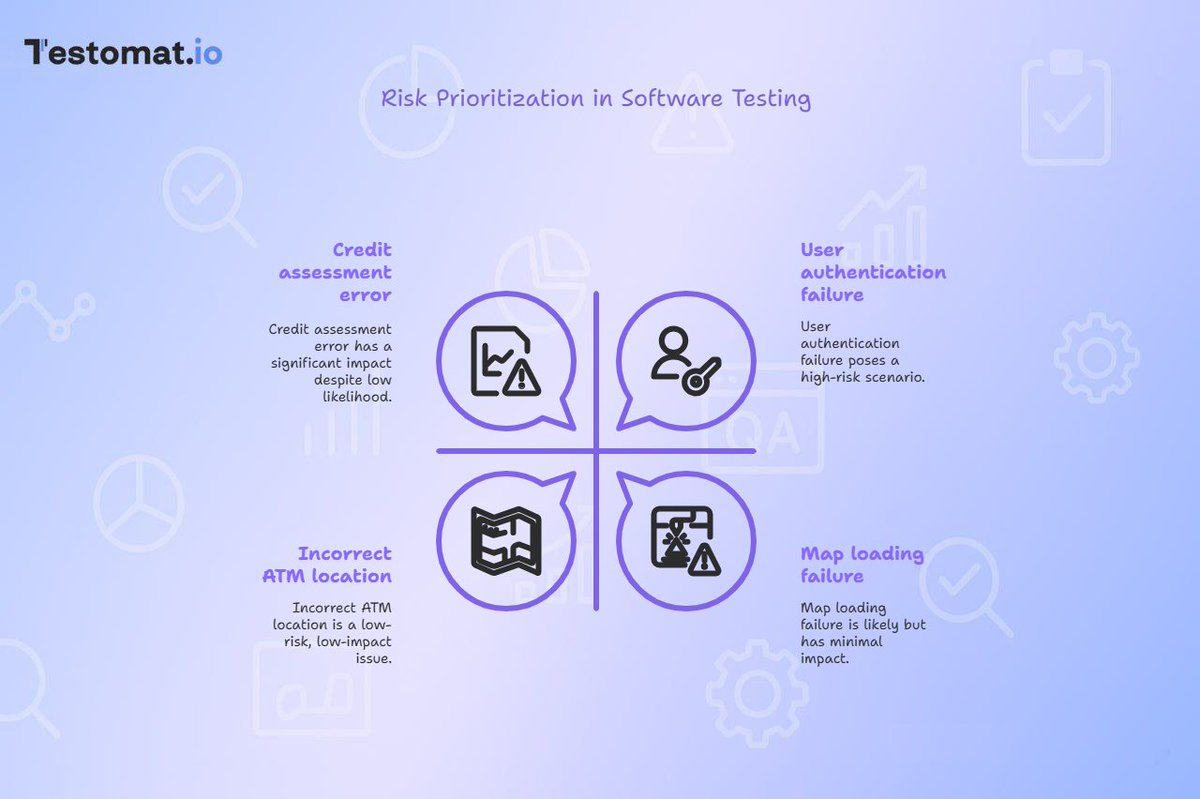
Start your Monday by testing what matters most.
Focus on risks like user auth failures — not low-impact map glitches.
🧠 Learn how - testomat.io/blog/risk-based-…
#QA #Testing #MondayMotivation #TestAutomation #DevOps #RiskBasedTesting #Testomatio
3
76

16 Jan 2025
#TestingTip Prioritize tests based on risk. Focus on critical functionalities and areas with high user impact. #RiskBasedTesting #SoftwareTesting
2
28

20 Feb 2024
Key Aspects Pertaining to QA/QC in the Software Development Process
Read more: goo.su/pH5VxD
@mukundwangikar, Vice President, @infovision_inc
#SoftwareDevelopment #platformdevelopment #serviceimprovement #QualityAssurance #statisticalmethods #RiskBasedTesting

4
21

1 Feb 2024
🚀 Elevate Your QA Game with Risk-Based Testing! 🌐
Let's talk about a game-changer in the world of Quality Assurance - Risk-Based Testing (RBT) 🛡️.
In the dynamic landscape of software development, it's crucial to identify and mitigate potential risks early on to ensure a robust and high-quality product. 🚀
🎯 What is Risk-Based Testing?
RBT is a strategic approach that focuses on prioritizing testing efforts based on the potential impact and likelihood of risks. By understanding and addressing key risks, QA teams can optimize testing resources and enhance overall product quality. 🌟
💡 Why Embrace Risk-Based Testing?
1️⃣ Efficiency Boost: RBT allows you to allocate testing efforts where they matter most, optimizing time and resources.
2️⃣ Early Issue Detection: By targeting high-risk areas, you catch potential issues in the early stages, preventing costly setbacks later in the development cycle.
3️⃣ Improved Test Coverage: RBT ensures comprehensive coverage of critical functionalities, minimizing the chances of overlooking important aspects of your application.
🔄 How to Implement Risk-Based Testing:
1️⃣ Risk Identification: Identify potential risks such as functionality complexity, data security, or integration challenges.
2️⃣ Risk Assessment: Evaluate and prioritize risks based on impact and likelihood.
3️⃣ Test Planning: Tailor your testing strategy to focus on high-priority areas, ensuring thorough coverage where it matters most.
4️⃣ Continuous Monitoring: Keep a pulse on evolving risks throughout the development lifecycle.
🚀 Takeaway:
Incorporating Risk-Based Testing into your QA process is a proactive step toward delivering top-notch software. It's all about smart testing, efficient resource utilization, and ultimately, ensuring a stellar user experience! 🚀
Ready to elevate your QA game? Let's embrace Risk-Based Testing together!
💻🌐 #QualityAssurance #TestingStrategies #RiskBasedTesting #QAInnovation #SoftwareDevelopment
Feel free to like, and share, and let's spark a conversation on optimizing QA practices! 🔗✨
1
2
2
78

As software testers, do you 👀 risks in life that others just don’t see? 🤔 Is it a gift 🎁 or a curse 😔? #softwareTesting #riskBasedTesting #superPowers #risk
3
1
3
308


19 Aug 2022
We offer a full suite of QA testing services so you can run high performance trouble-free software. We do #webapplicationtesting #mobileapptesting #testautomation #accesibilitytesting #riskbasedtesting #producttesting #useracceptancetesting #apitesting #projectbasedtest

1
2

14 Mar 2022
Our next #webinar on Risk-based Testing features our trusted partner, @Tricentis.
Attend the webinar & learn about adopting a #riskbasedtesting approach, coupled with the right tools.
Register today bit.ly/3CiAXjv
#TestAutomation #Artificialintelligence #ERP

1
1
2
7 Mar 2022
Join us on March 29th as Qualitest and @Tricentis come together for a #webinar to discuss about the #riskbasedtesting approach, to help you navigate the new world challenges.
Register now bit.ly/3CiAXjv
#TestAutomation #Artificialintelligence #ERP #SoftwareTesting

2
4

11 Dec 2020
I recently recorded a podcast with @fltoledo about #Visual #Testing. Had a fun time. I still don't like the sound of my own voice - but what do you think?
Applitools #podcast #ai #riskbasedtesting #strategy #testautomation lnkd.in/eH_nSRM
1
5

3 Dec 2020
Vorig jaar schreef @AndreKoene een blog over de basics van @getpostman en de TRIMS MNEMONIC. In deze blog is zijn focus op improvements & lessons learned sinds zijn vorige blog. Doe er je voordeel mee!
#testautomation #riskbasedtesting
newspark.nl/postman-time-to-…
1

9 Sep 2020
This is an excellent example about the Shift Left approach where quality must be done in the earlier stages. Also the importance of Risk Based Testing approach to determine how much we will test.
infoq.com/news/2020/08/softw…
#qualityengineering #shiftleft #riskbasedtesting
2

13 May 2020
5️⃣ Steps to getting started with #RiskBasedTesting via @StickyMinds #SoftwareTesting
stickyminds.com/article/5-st…

1
1

15 Mar 2020
The first rule of testing: Never talk about testing everything! #riskbasedtesting is about knowing what to test, how much, and in what order. You can achieve full coverage on multiple dimensions without overdoing it.
2

24 Jan 2020
"Risk analysis is the process of negotiating dread on how we feel about the product." 🦈☝️
Quote by @jamesmarcusbach @ #RSTA
#RapidSoftwareTesting #riskbasedtesting #testing
4
5

6 Sep 2019
Klar til mere viden? I #Aarhus kører vi @iSQICert #CertifiedAgileBusinessAnalyst aka #CABA 18-19/9 @ISTQBORG #AdvancedTestManager del 1 1-3/10 #RiskBasedTesting 10/10, #Selenium Tester Foundation 21-23/10 & mange flere - se mere på testhuset.dk/kurser/ #SoftwareTesting #Agile
1

Ready to improve your testing strategy? We’ve got you covered 😉 Now you can use Xray to perform #RiskBasedTesting and focus your time and effort where it’s needed most. bit.ly/2KvE5zm
1
3