
its done and its live please check out atomic-a-i.cloud === 🚨🚨 HUGE CAPS UPDATE 🚨🚨
Today we crossed a major milestone.
What started as an idea has now evolved into a live, public platform. ⚛️🛡️
🌍 CAPS is no longer just a concept.
It is now becoming a Trust, Identity & Safety Network.
━━━━━━━━━━━━━━━━━━━━━━
🔥 NOW LIVE 🔥
🛡️ CAPS Demo
🛡️ CAPS ID Explorer
🛡️ CAPS API Playground
🛡️ CAPS Trust Dashboard
🛡️ Guardian Shield
🛡️ CAPS Network Testnet
🛡️ Public Proof Framework
━━━━━━━━━━━━━━━━━━━━━━
🚀 BUILT & DEPLOYED
✅ CAPS ID Issuance
✅ CAPS Trust Score
✅ Parent Capsule Controls
✅ School Capsule Safeguarding
✅ SafeAI Gateway
✅ Platform Verification Service
✅ DRK Utility Mapping
✅ CAPS Evaluator Engine
✅ Public Testnet Proof
✅ Chrome Extension Scaffold
✅ WordPress Plugin Scaffold
✅ Discord Bot Scaffold
✅ School Pilot Pack
✅ Parent Beta Pack
✅ JavaScript SDK
━━━━━━━━━━━━━━━━━━━━━━
🛡️ VERIFIED
✅ Security Validation Passed
✅ Guardian Shield Tests Passed
✅ Front Page Validation Passed
✅ Hardened Headers Active
✅ Live Routes Returning 200
✅ Sitemap Coverage Complete
✅ Validator Coverage Complete
✅ Public Proof Data Published
━━━━━━━━━━━━━━━━━━━━━━
🌍 WHY THIS MATTERS
The internet faces enormous challenges:
❌ Cyberbullying
❌ Grooming
❌ Predatory Behaviour
❌ Harmful Online Trends
❌ AI Safety Risks
❌ Identity Fraud
❌ Digital Trust Problems
We're not trying to build another social network.
We're trying to build infrastructure.
Infrastructure that could help:
👨👩👧 Families
🏫 Schools
🤖 AI Providers
🎮 Gaming Platforms
📱 Social Networks
🌍 Entire Communities
━━━━━━━━━━━━━━━━━━━━━━
⚛️ Atomic AI = Intelligence Layer
🛡️ CAPS = Trust, Identity & Safety Layer
💎 DRK = Utility Layer
━━━━━━━━━━━━━━━━━━━━━━
🙏 We need your help.
This mission is bigger than us.
If you believe:
🛡️ Children deserve better protection
🛡️ AI should be safer
🛡️ Digital identity should be trusted
🛡️ The internet can be improved
Please:
❤️ Like
🔁 Repost
💬 Comment
📢 Share Everywhere
Let's get CAPS in front of parents, schools, developers, businesses and communities around the world.
⚛️ BUILDING THE FUTURE.
🛡️ PROTECTING THE FUTURE.
🌍 FOR EVERYONE.
#AtomicAI #CAPS #GuardianShield #AtomicOS #AICore #OnlineSafety #ChildSafety #InternetSafety #CyberSecurity #DigitalIdentity #AgeVerification #TrustInfrastructure #Safeguarding #EducationTech #AI #ArtificialIntelligence #Technology #Innovation #FutureTech #TechForGood #ProtectChildren #DigitalSafety #Web3 #Blockchain #Crypto #DRK #Startup #BuildInPublic #FutureOfAI #Security
10
🚨🚨 HUGE CAPS UPDATE 🚨🚨
Today we crossed a major milestone.
What started as an idea has now evolved into a live, public platform. ⚛️🛡️
🌍 CAPS is no longer just a concept.
It is now becoming a Trust, Identity & Safety Network.
━━━━━━━━━━━━━━━━━━━━━━
🔥 NOW LIVE 🔥
🛡️ CAPS Demo
🛡️ CAPS ID Explorer
🛡️ CAPS API Playground
🛡️ CAPS Trust Dashboard
🛡️ Guardian Shield
🛡️ CAPS Network Testnet
🛡️ Public Proof Framework
━━━━━━━━━━━━━━━━━━━━━━
🚀 BUILT & DEPLOYED
✅ CAPS ID Issuance
✅ CAPS Trust Score
✅ Parent Capsule Controls
✅ School Capsule Safeguarding
✅ SafeAI Gateway
✅ Platform Verification Service
✅ DRK Utility Mapping
✅ CAPS Evaluator Engine
✅ Public Testnet Proof
✅ Chrome Extension Scaffold
✅ WordPress Plugin Scaffold
✅ Discord Bot Scaffold
✅ School Pilot Pack
✅ Parent Beta Pack
✅ JavaScript SDK
━━━━━━━━━━━━━━━━━━━━━━
🛡️ VERIFIED
✅ Security Validation Passed
✅ Guardian Shield Tests Passed
✅ Front Page Validation Passed
✅ Hardened Headers Active
✅ Live Routes Returning 200
✅ Sitemap Coverage Complete
✅ Validator Coverage Complete
✅ Public Proof Data Published
━━━━━━━━━━━━━━━━━━━━━━
🌍 WHY THIS MATTERS
The internet faces enormous challenges:
❌ Cyberbullying
❌ Grooming
❌ Predatory Behaviour
❌ Harmful Online Trends
❌ AI Safety Risks
❌ Identity Fraud
❌ Digital Trust Problems
We're not trying to build another social network.
We're trying to build infrastructure.
Infrastructure that could help:
👨👩👧 Families
🏫 Schools
🤖 AI Providers
🎮 Gaming Platforms
📱 Social Networks
🌍 Entire Communities
━━━━━━━━━━━━━━━━━━━━━━
⚛️ Atomic AI = Intelligence Layer
🛡️ CAPS = Trust, Identity & Safety Layer
💎 DRK = Utility Layer
━━━━━━━━━━━━━━━━━━━━━━
🙏 We need your help.
This mission is bigger than us.
If you believe:
🛡️ Children deserve better protection
🛡️ AI should be safer
🛡️ Digital identity should be trusted
🛡️ The internet can be improved
Please:
❤️ Like
🔁 Repost
💬 Comment
📢 Share Everywhere
Let's get CAPS in front of parents, schools, developers, businesses and communities around the world.
⚛️ BUILDING THE FUTURE.
🛡️ PROTECTING THE FUTURE.
🌍 FOR EVERYONE.
#AtomicAI #CAPS #GuardianShield #AtomicOS #AICore #OnlineSafety #ChildSafety #InternetSafety #CyberSecurity #DigitalIdentity #AgeVerification #TrustInfrastructure #Safeguarding #EducationTech #AI #ArtificialIntelligence #Technology #Innovation #FutureTech #TechForGood #ProtectChildren #DigitalSafety #Web3 #Blockchain #Crypto #DRK #Startup #BuildInPublic #FutureOfAI #Security
1
1
12
SOLUTION IS HERE == Completed the CAPS platform foundation on top of Guardian Shield.
Added real modules for:
- CAPS ID issuance
- CAPS Trust Score
- Parent Capsule controls
- School Capsule safeguarding
- SafeAI Gateway
- Platform Verification Service
- DRK utility mapping
- Full CAPS platform evaluator tying identity, safety, school, parent, AI, platform verification, DRK and audit evidence together
Expanded API routes:
- /identity/issue
- /trust/score
- /capsule/parent/evaluate
- /capsule/school/safeguarding
- /safeai/evaluate
- /platform/verify
- /drk/utility
- /caps/evaluate
Updated public surfaces:
- Homepage now advertises CAPS ID, Trust Score, SafeAI Gateway and DRK utility
- Guardian Shield page now shows the expanded CAPS platform stack
- Public proof JSON includes the new APIs and product modules
- Validator now enforces all new files, API routes, public claims and roadmap coverage
Verified:
- npm run caps:guardian:test passed
- npm run validate:caps-guardian-shield passed
- node validate-front-pages.js passed
- Solidity registry still compiles
Updated archive:
/tmp/CAPS-Guardian-Shield-Atomic-AI.zip
13
YOUR SOLUTION IS HERE ...... == Given where Atomic AI, CAPS, Guardian Shield and DRK are today, I would focus on moves that create a real moat, not just more pages. 🚀
🥇 Tier 1 — The Next 5 Critical Moves
1. CAPS Identity Network
Create a universal:
🪪 CAPS ID
For:
Humans
Businesses
AI Agents
Schools
Communities
This becomes the foundation everything else uses.
2. Parent Capsule
Build a real dashboard:
👨👩👧 Child profiles
⏰ Time controls
🤖 AI permissions
📱 Platform permissions
🚨 Safety alerts
This is a genuine product.
3. School Capsule
Schools are a perfect fit.
Build:
🏫 Student verification
🏫 Safeguarding dashboard
🏫 Attendance integrations
🏫 Risk alerts
🏫 Parent reporting
4. CAPS Reputation Engine
Every entity receives:
⭐ Trust Score
Applies to:
Users
AI agents
Businesses
Communities
This becomes incredibly powerful.
5. SafeAI Gateway
This could become huge.
Every AI interaction passes through CAPS:
🛡️ Age controls
🛡️ Safety controls
🛡️ Compliance controls
🛡️ Audit controls
🥈 Tier 2 — Commercial Expansion
6. Guardian Mobile App
Android
iOS
Real-time alerts.
7. CAPS SDK
JavaScript
Python
Node
Go
Rust
Allow external developers to integrate.
8. Public API Marketplace
Developers pay for:
💎 Verification
💎 Safety scoring
💎 Compliance checks
💎 Trust scoring
9. CAPS Trust API
Example:
{
"capsScore":96,
"verified":true,
"guardianApproved":true
}
10. Platform Verification Service
Verify:
📱 Apps
🤖 AI Models
🎮 Games
🌐 Communities
🥉 Tier 3 — AI Moat
11. Guardian AI Agent
Dedicated family assistant.
12. Safeguarding AI Agent
School-focused.
13. Compliance AI Agent
Business-focused.
14. Cyberbullying Agent
Real-time detection.
15. Grooming Detection Agent
Pattern detection and escalation.
🌍 Tier 4 — Ecosystem
16. CAPS App Store
Installable capsules.
17. Capsule Builder
No-code capsule creation.
18. Trust Marketplace
Buy/sell:
Capsules
Policies
Agents
Compliance packs
19. Community Capsules
Verified communities.
20. AI Agent Registry
Verified agent identities.
💎 Tier 5 — DRK Utility
21. DRK for Verification
Identity creation.
22. DRK for API Usage
Consumption billing.
23. DRK for Marketplace
Settlement layer.
24. DRK for Reputation Staking
Trust-backed verification.
25. DRK for Guardian Shield
Premium safety features.
The Single Biggest Move
If I had to choose only ONE:
🚀 Build CAPS Identity CAPS Trust Score first.
Everything else can plug into it:
Guardian Shield
Parent Capsules
School Capsules
SafeAI
Marketplace
DRK
AI Agents
Without a universal identity and trust layer, the ecosystem remains a collection of products.
With it, CAPS starts looking like a true platform.
End-State Vision
⚛️ Atomic AI = Intelligence Layer
🛡️ CAPS = Trust, Identity & Safety Layer
💎 DRK = Utility, Billing & Settlement Layer
🌍 CAPS ID = Universal Digital Identity
That's the path most likely to create something genuinely differentiated and difficult to replicate. 🚀⚛️🛡️💎🌍
15

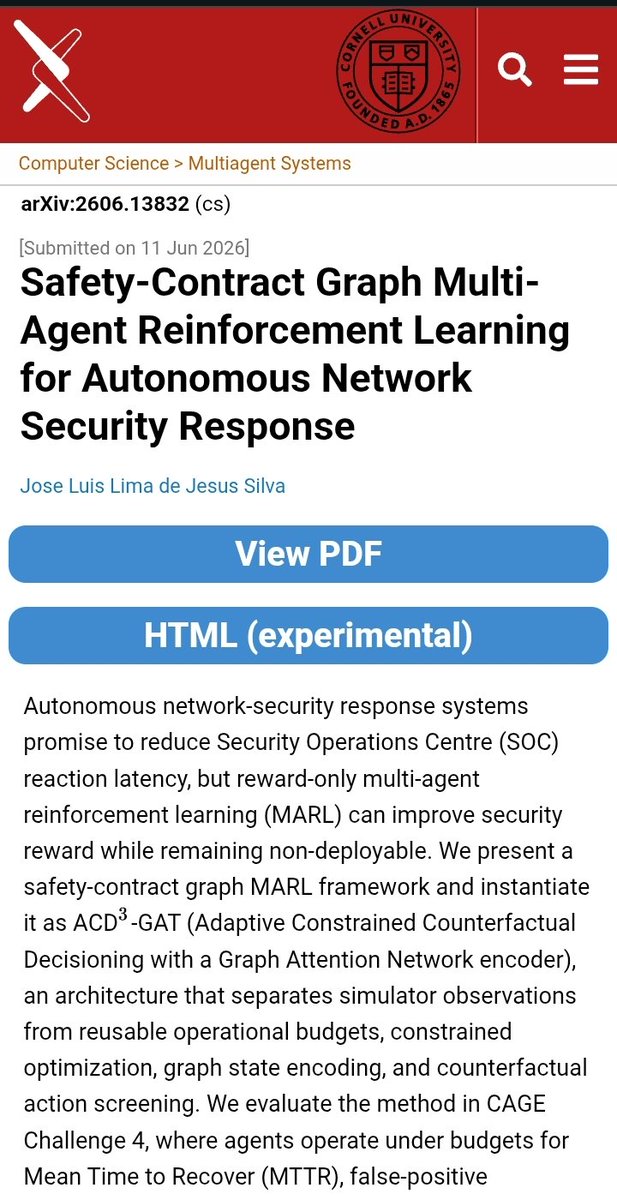
🚨 My New article is now live on arXiv: making autonomous cyber-defense agents operationally safe, not just reward-optimized.
A major challenge in autonomous cybersecurity is not simply whether an AI agent can respond quickly.
The deeper question is:
Can the agent act without violating the operational limits of a real Security Operations Center?
Screenshot 2026-06-14 at 21.55.52.png
Screenshot 2026-06-14 at 22.01.12.png
In my new article, “Safety-Contract Graph Multi-Agent Reinforcement Learning for Autonomous Network Security Response,” I introduce a safety-contract Graph MARL framework and instantiate it as ACD³-GAT: Adaptive Constrained Counterfactual Decisioning with a Graph Attention Network encoder.
The motivation is simple:
A cyber-defense agent can improve its simulator reward while still being non-deployable.
It may restore too many hosts.
It may create excessive firewall-policy churn.
It may trigger false-positive responses.
It may protect the network in one sense while exhausting the SOC’s operational budget in another.
So instead of treating safety as an afterthought, this work makes it part of the learning and decision process.
The framework combines:
✅ Multi-agent reinforcement learning
✅ Graph Attention Networks for network-state representation
✅ Lagrangian constrained optimization
✅ Explicit SOC budget tracking
✅ CVaR tail-risk estimation
✅ Opponent-belief state
✅ Graph Counterfactual Risk Propagation for action screening
The benchmark results in CAGE Challenge 4 are very clear:
Reward-only MARL methods violated the SOC downtime budget in 100% of evaluated episodes.
By contrast, C-MAPPO-GAT reduced downtime-budget violation from 100% to 0.3% and reduced mean downtime cost from 355.4 to 15.5 relative to MAPPO-GAT.
The integrated ACD³-GAT architecture reduced mean downtime cost to 48.2, placing it on the broader safety-contract frontier rather than at the most conservative compliance point.
For me, the key message is this:
The next generation of agentic AI systems should not only optimize reward. They must reason under constraints, respect operational budgets, and produce actions that can be audited.
This is especially important in cybersecurity, where speed without discipline can become another source of operational risk.
Paper: arxiv.org/abs/2606.13832
#ArtificialIntelligence #CyberSecurity #ReinforcementLearning #MultiAgentSystems #GraphNeuralNetworks #GraphDeepLearning #SafeAI #AutonomousAgents #NetworkSecurity #SOC #MachineLearning #AIResearch
This article is part of a broader research direction I have been developing across artificial intelligence, reinforcement learning, graph deep learning, attention mechanisms, transformers-inspired cross-attention, and encoder/decoder architectures.
My recent contributions include:
🔹 Safety-Contract Graph Multi-Agent Reinforcement Learning for Autonomous Network Security Response
Constrained MARL, Graph Attention Networks, counterfactual action screening, and operational safety contracts for autonomous cyber defense.
arxiv.org/abs/2606.13832
🔹 Weakly supervised multimodal segmentation of acoustic borehole images with depth-aware cross-attention
Multimodal AI for geoscience using weak supervision, confidence-aware pseudo-labeling, and depth-aware cross-attention between borehole images and well logs.
arxiv.org/abs/2603.20729
🔹 Optimizing Information Asset Investment Strategies in the Exploratory Phase of the Oil and Gas Industry: A Reinforcement Learning Approach
Multi-agent deep reinforcement learning for strategic information-asset investment, exploration economics, and decision-making under uncertainty.
arxiv.org/abs/2512.00243
🔹 Hybrid Context-Fusion Attention (CFA) U-Net and Clustering for Robust Seismic Horizon Interpretation
Encoder/decoder deep learning, attention-gated U-Net design, geometric feature fusion, and clustering for robust seismic interpretation.
arxiv.org/abs/2512.00191
3
1
4
80

13h
🔗 Full story → theverge.com/ai-artificial-i…
Source: The Verge AI
#Anthropic #Claude #AI #LLM #SafeAI #ArtificialIntelligence
19
Jun 14
💬 Why this matters:
Anthropic's safety-focused approach is gaining traction. As AI becomes more powerful, responsible development becomes a competitive advantage.🔗 Full story → techcrunch.com/2026/06/13/as…
Source: TechCrunch AI
#Anthropic #Claude #AI #LLM #SafeAI #ArtificialIntelligence
16
Jun 13
🔗 Full story → theverge.com/ai-artificial-i…
Source: The Verge AI
#Anthropic #Claude #AI #LLM #SafeAI #ArtificialIntelligence
16
Jun 13
💬 Why this matters:
Anthropic's safety-focused approach is gaining traction. As AI becomes more powerful, responsible development becomes a competitive advantage.🔗 Full story → techcrunch.com/2026/06/13/am…
Source: TechCrunch AI
#Anthropic #Claude #AI #LLM #SafeAI #ArtificialIntelligence
1
14

Jun 13
#WATCH | भारत और फ्रांस के बीच कृत्रिम बुद्धिमत्ता (एआई) शिखर सम्मेलनों के माध्यम से बढ़ते सहयोग तथा सुरक्षित और भरोसेमंद एआई पर दिए जा रहे विशेष जोर से भविष्य के अवसरों को किस प्रकार नई दिशा मिलेगी?
जैसे-जैसे दोनों देश उन्नत प्रौद्योगिकियों के क्षेत्र में सहयोग को और गहरा कर रहे हैं, यह साझेदारी भारत के स्टार्टअप्स, नवाचार पारिस्थितिकी तंत्र, शैक्षणिक संस्थानों और अनुसंधान समुदाय को किस प्रकार लाभ पहुंचाएगी?
देखिए विदेश मामलों के विशेषज्ञ डॉ. संदीप त्रिपाठी ने इस विषय पर अपने विचार साझा करते हुए क्या कहा
#PMModiInFrance #IndiaFrance #France #AISummit #ArtificialIntelligence #SafeAI
1
3
383

Jun 13
#WATCH | With India and France increasingly engaging through AI summits and focusing on safe and trusted AI, how will this technology partnership shape future opportunities?
How will it benefit India’s startups, innovation ecosystem, and academic and research communities as both countries deepen cooperation in advanced technologies?
Foreign Affairs Expert, Dr Sandeep Tripathi, discusses.
#IndiaFrance #AISummit #ArtificialIntelligence #SafeAI
1
3
5
976
Jun 13
💬 Why this matters:
Anthropic's safety-focused approach is gaining traction. As AI becomes more powerful, responsible development becomes a competitive advantage.🔗 Full story → theverge.com/ai-artificial-i…
Source: The Verge AI
#Anthropic #Claude #AI #LLM #SafeAI #ArtificialIntelligence
12
Jun 13
💬 Why this matters:
Anthropic's safety-focused approach is gaining traction. As AI becomes more powerful, responsible development becomes a competitive advantage.🔗 Full story → wired.com/story/anthropic-sa…
Source: Wired AI
#Anthropic #Claude #AI #LLM #SafeAI #ArtificialIntelligence
22
Jun 13
🔗 Full story → techcrunch.com/2026/06/12/an…
Source: TechCrunch AI
#Anthropic #Claude #AI #LLM #SafeAI #ArtificialIntelligence
9

The Strategic Paradox of 'AI Pause' | #Anthropic #SafeAI @AnthropicAI @ElonMusk @FLI_org youtube.com/watch?v=MkTuDOCk…
22
The End of the Human Internet? Watch: The Strategic Paradox of 'AI Pause' | #Anthropic #SafeAI @AnthropicAI @ElonMusk @FLI_org | youtube.com/watch?v=MkTuDOCk…
1
21

Jun 13
🛡️ Layered Verification for Production-Grade Agentic Systems — the critical reliability & safety backbone that turns powerful but uncertain LLM outputs into confident, auditable, and safe real-world actions.
Just read this excellent capstone technical white paper from @aasaitech on multi-layer verification (self-critique & reflection, external validators, tool-based checking, rule/policy guardrails, formal methods/constraint solvers, and continuous feedback).
Key highlights: • 8-step verification pipeline with continuous learning loops • Defense-in-depth: Catch errors early, prevent unsafe actions, boost trust & compliance • Industrial use cases: Maintenance execution, incident response, process optimization, safety-critical operations • Best practices: Start simple, log everything, calibrate confidence, design for explainability & auditability
This is the essential trustworthiness layer that makes the entire series (agents, RAG, hybrid architectures, edge deployment, HITL, governance, etc.) production-ready and safe for manufacturing and edge orchestration.
Full white paper infographic: x.com/aasaitech/status/20656…
How are you implementing layered verification in your agentic systems — self-critique guardrails, full external validators formal checks, or integrated HITL with observability?
#LayeredVerification #AgenticAI #ReliableAI #IndustrialAI #ManufacturingAI #SafeAI #EdgeAI

11
Jun 13
🛡️ Continuous Evaluation & Automated Red-Teaming — the quality assurance backbone that turns capable LLM and agentic systems into safe, reliable, and production-grade industrial AI.
Just read this excellent technical white paper from @aasaitech on evaluation-driven development, domain-specific test suites, LLM-as-Judge, CI/CD quality gates, and systematic adversarial red-teaming pipelines.
Key highlights: • 6-stage evaluation lifecycle automated red-teaming pipeline (threat modeling → attack generation → remediation → regression) • Critical test categories: Safety, robustness, prompt injection, tool misuse, domain compliance, agent behavior • CI/CD integration with strict quality gates (accuracy, faithfulness, safety, latency, cost) • Industrial impact: Prevent regressions, reduce safety incidents, build operator trust in maintenance copilots, RCA, and edge orchestration
This is the perfect quality & safety layer that completes the entire series — making all prior techniques (RAG, agents, hybrid AI, edge deployment, observability, security, HITL, etc.) trustworthy at scale.
Full white paper infographic: x.com/aasaitech/status/20656…
How are you implementing continuous evaluation and red-teaming in your systems — DeepEval/Phoenix, custom quality gates in CI/CD, or full automated adversarial pipelines?
#EvaluationDrivenDevelopment #RedTeaming #LLMEvaluation #IndustrialAI #AgenticAI #SafeAI #ManufacturingAI #EdgeAI
18
Jun 13
🛠️ Advanced Human-in-the-Loop (HITL) Patterns — the governance backbone that makes advanced LLM and agentic systems safe, accountable, and truly adoptable in safety-critical industrial environments.
Just read this excellent technical white paper from @aasaitech diving deep into approval gates, escalation workflows, confidence thresholding, collaborative co-pilot interfaces, exception handling, and continuous feedback loops.
Key highlights: • 6 practical HITL patterns with real decision workflows • Industrial examples: Maintenance execution, safety interlocks, compliance reporting, configuration changes • Collaborative interface design (evidence confidence edit/approve/escalate) • Design principles, success metrics, and integration with the full series (agents, observability, security, hybrid AI, edge deployment)
HITL isn't a limitation — it's the strength that blends machine scale with human judgment for trustworthy manufacturing and edge orchestration systems.
Full white paper infographic: x.com/aasaitech/status/20656…
How are you implementing HITL in your production systems — confidence-based escalation, collaborative interfaces, full audit workflows, or integrated checkpoints in LangGraph?
#HumanInTheLoop #HITL #IndustrialAI #AgenticAI #SafeAI #ManufacturingAI #EdgeAI
53
Jun 13
🧍♂️ Human-in-the-Loop (HITL) — the essential governance layer that combines LLM speed & scale with human judgment, accountability, and domain expertise in safety-critical industrial environments.
Just read this excellent technical white paper from @aasaitech on approval gates, escalation workflows, confidence thresholding, collaborative interfaces, exception handling, and continuous feedback loops.
Key highlights: • 6 core HITL patterns clear decision workflow • Industrial use cases: Maintenance execution, safety decisions, compliance reporting, configuration changes • Design principles: Human control on high-impact actions, evidence confidence surfacing, auditability, continuous learning from feedback • Tools: LangSmith, Humanloop, Arize Phoenix, Label Studio
This perfectly completes the entire series — turning advanced techniques (agents, RAG, hybrid AI, edge deployment, observability, security, etc.) into safe, trustworthy, and adoptable systems for manufacturing and edge orchestration.
Full white paper infographic: x.com/aasaitech/status/20656…
How are you implementing Human-in-the-Loop in your industrial AI systems — confidence-based escalation, collaborative co-pilot interfaces, or full approval workflows with audit trails?
#HumanInTheLoop #HITL #IndustrialAI #AgenticAI #SafeAI #ManufacturingAI #EdgeAI
26