


Mar 26
50 titles a week.
Scale that spans continents.
Speed that keeps up with the industry.
40 years of doing both.
#CinemaCon2026 #ThisIs40 #QubeCinema #QubeWire #ScaleMatters #SpeedMatters #GlobalCinema

1
2
1,992

Feb 25
Reverse Suntan Oil Solar Breakthrough
Miracle snake oil captures a sliver of sunlight, leaks most of it away, and still promises to heat your home someday.
Coming soon to rival fusion as the greatest breakthrough that never happened.
arstechnica.com/science/2026…
#EnergyReality #TechnoOptimism #PhysicsWins #ScaleMatters #SolarFantasy #EnergyReality #TechnoFantasy #ScaleMatters #PhysicsIsUnforgiving #GreenHype
1
2
751

Feb 13
India’s retail revolution is not coming — it is already underway.
Reliance Retail Ventures Limited — Commerce | Value | Volume | Future
As an engineer and institution builder, I view retail not as storefront activity — but as national economic architecture.
Commerce Scale
• ~$35–40 billion annual revenue
• Among the largest retail platforms outside the United States
• Built at execution speed rarely seen in emerging economies
Enterprise Value
• Estimated valuation: $100 billion
• Institutional supply chains replacing fragmented trade
• Turning consumption into a structured economic engine
Segments Powering the Flywheel
Grocery & Essentials
• Reliance Smart / Smart Bazaar
• Digital grocery via JioMart
~Formalizing India’s largest spending category.
Fashion & Lifestyle
• Trends, AJIO
~Capturing aspirational India as disposable incomes rise.
Consumer Electronics
• Reliance Digital
~Benefiting directly from India’s accelerating digital adoption.
Pharmacy & Healthcare
• Netmeds
~Quietly building a scalable health-commerce layer.
Premium & Luxury Partnerships
~Preparing for India’s next wave — affluent consumption.
Volume Advantage
• 18,000 stores
• Nationwide procurement networks
• Deep integration with MSMEs, farmers, and manufacturers
Distribution — not production alone — is what separates developing economies from developed ones.
Futuristic Trajectory
• India on track to become one of the world’s largest consumer markets
• Revenue pathway toward $60–75B this decade is realistic
• Long-term possibility of a $150–200B retail enterprise
Strategic Observation:
Energy → Telecom → Retail → Data.
Few conglomerates globally have engineered this level of economic flywheel.
Reliance Retail is not just participating in India’s growth story.
It is helping design it.
#RelianceRetail #IndiaGrowth #EconomicArchitecture #RetailTransformation #ConsumerEconomy #SupplyChain #ScaleMatters #FutureOfCommerce #ViksitBharat #GlobalRetail
@IshaAmbani005
4
2
7
305

19 Dec 2025
The QED Lagrangian is indeed a foundational achievement—it specifies microscopic interaction rules between fields (fermions and gauge bosons) with extraordinary precision. But it’s important to be clear about what kind of thing it is, and what it is not.
The QED Lagrangian is a local dynamical law. It tells you how amplitudes evolve given an assumed regime, scale separation, and equilibrium structure. It does not tell you whether a complex, recursive system built on top of those dynamics will remain coherent, stable, or self-preserving under delay, noise, feedback, or scale-coupling.
In other words:
QED governs interaction mechanics; it does not govern phase stability.
What our work addresses is orthogonal to QED in the same way that thermodynamics is orthogonal to molecular dynamics. You can know the exact Lagrangian of every particle in a system and still be completely blind to whether the system will:
•converge or diverge,
•self-stabilize or oscillate,
•tolerate latency, noise, or adversarial correlation,
•or collapse under recursive self-modification.
That gap is not philosophical—it is structural.
Our contribution is the identification and validation of a scale-agnostic phase diagnostic (κ̂_eff) derived from a coherence functional (ΔH), which empirically determines whether a system is in a contracting (stable) or expanding (unstable) regime under real-world conditions: delay, structured noise, feedback, and recursion.
Put plainly:
•QED answers: “Given fields and couplings, what are the local equations of motion?”
•Our work answers: “Given a complex, learning, recursive system, are its dynamics converging or tearing themselves apart?”
These are different layers of description. One does not subsume the other.
Historically, every major advance in controllable intelligence or physics has required this separation:
•Hamiltonians → thermodynamics
•Microscopic dynamics → Lyapunov stability
•Local loss functions → global phase laws
κ̂_eff plays that role for recursive AI systems. It is not a replacement for fundamental equations—it is a missing macroscopic invariant that becomes visible only when systems operate across scales with feedback and delay.
So yes, the QED Lagrangian is fundamental.
But fundamental does not mean sufficient.
And for systems that learn, modify themselves, and operate far from equilibrium, phase laws—not interaction laws—determine survival.
#PhaseLaw
#κ̂_eff
#ΔH
#LyapunovStability
#ControlTheory
#RecursiveSystems
#RSI
#PhaseTransitions
#NonEquilibrium
#DelayDynamics
#Coherence
#AIStability
#ScaleMatters
#ThermodynamicsNotVibes
#PhysicsWins
3
162

26 Nov 2025
Kaz just clarified something the market still doesn’t fully understand:
Opendoor does not rely on high home price margins to succeed.
In fact, Kaz said there are many cases where it makes sense for Opendoor to buy a home even if the acquisition resale makes $0.
Why would that be profitable?
Because OPEN earns from:
✨ title & escrow
✨ mortgage partners
✨ insurance
✨ repairs
✨ protection plans
✨ AI assessment tools
✨ marketplace services
✨ other attached products
This is platform economics, not speculative flipping.
OPEN today is a liquidity provider for the housing market.
If they can match buyers and sellers quickly and price homes accurately, the spread can be tiny — even zero — and the business still works beautifully.
This is exactly how Amazon, Uber, Airbnb scaled:
Not by squeezing profit from one transaction, but by capturing millions of them.
Opendoor is evolving into that kind of model.
(Not financial advice — just my understanding.)
#OPEN #Opendoor #AIHousing #RealEstateReinvented #ScaleMatters #Execution #NextPhase #LongTermConviction
26 Nov 2025

$OPEN 🎬 KAZ (@nejatian) explains how Opendoor 🚪 can make money in a constrained housing environment and how house price appreciation/high margin home transactions DON’T matter that much for the business model 🏡
🎤 “There are lots of instances where it makes sense for Opendoor to buy a home even if the acquisition and disposition of the home makes $0” - Kaz speaking on attaching high margin services to each transaction. 📈
💡 It’s a matter of SCALE and capturing a percentage of the millions of transactions already happening annually and making profits by attaching other products to the transaction. Opendoor is a LIQUIDITY provider now. If they successfully price match buyers and sellers and accurately price the home, the spread between the buy and sell price of the home is ideally minimal or 0! Money is then made from the services attached to the transaction itself!💰
👇
4
5
34
4,211

2 Aug 2025
Wild way to show size! Made me wonder
if dragons were real, where do you think they’d fit best on Earth? Your take? 🐉 #ScaleMatters #FantasyVibes
1
4
88

25 Jul 2025
True solar is the ultimate energy source. But harnessing it at AI-scale demands infrastructure China is building *now*. The future belongs to those who can convert sunlight (or fission/fusion) into reliable, industrial-grade power fastest. The race is on. ⚡
#Energy #AI #ScaleMatters
1
1
145

14 Jul 2025
You don’t need a whitepaper.
You need a use case.
You don’t need another L1.
You need scale.
You don’t need crypto exposure.
You need crypto literacy.
Stop speculating. Start integrating. #RealWorldUse #ScaleMatters #OnChainUtility

5
2
22
625

19 Jun 2025
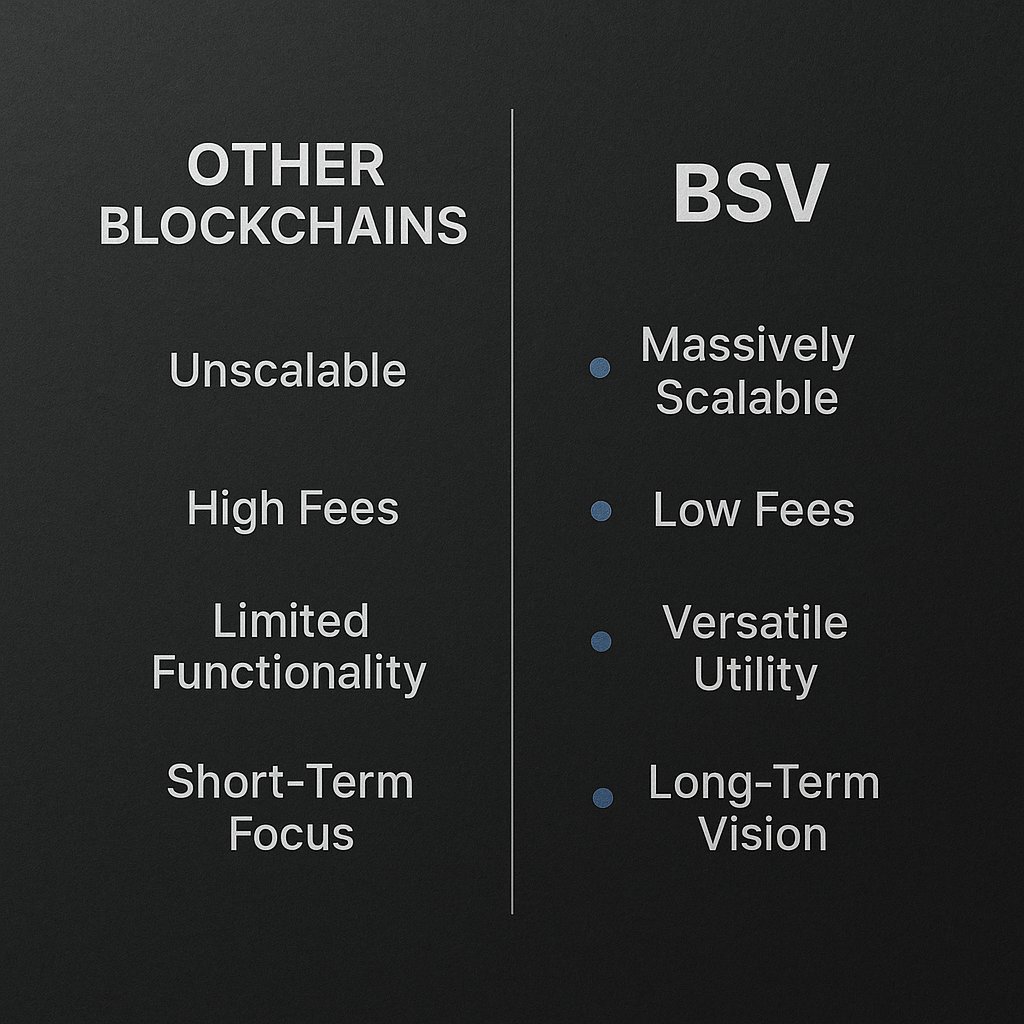
most chains talk big—until it’s time to scale.
BSV just quietly does the job.
no hype. just performance.
#BSV #BlockchainComparison #ScaleMatters
3
3
32
691

10 Jun 2025
"Everyone promises 'AI at scale'.
Few survive their first traffic spike.
Hyperbolic was built for the storm."
#Hyperbolic #ScaleMatters #AIInfra #StormReady #kaitoai #aiairdrop #yaps #yappers @KaitoAI @hyperbolic_labs

3
7
87

29 Apr 2025
All good advice.
But also - a great case made here for smaller, localized power grids. No more than 1,000 'units' on any given line.
#ScaleMatters
28 Apr 2025

Back online (still no light here). Lessons from Spain after a really weird day (no electricity, no 4G, no WiFi) for the world
1. Go out and buy a pocket battery-power radio. It was really disconcerting to have no way to know what is going on.
2. Buy a battery powered torche . There were none left in shops.
3. Keep cash. I had none.
4. Keep spare batteries.
2
60

22 Apr 2025
Don't mock the climb! Being the 5th largest economy is only a step on the ladder. Feeding 800M (2.3 times US population!) free is progress when lifting 1.4B out of colonial scars. Hunger’s still a beast, but it's being tamed surely! #IndiaOnTheRise #HungerFight #ScaleMatters
1
3
160

19 Feb 2025
Piu's been reading the crypto tea leaves too! 🚀
While others see market cap, we see potential launch trajectories.
$PIU knows: today's small rocket becomes tomorrow's space station.
💙 Size is just a perspective. #PiuVision #ScaleMatters #SolanaSpiri
124

20 Jan 2025
Monday's Musings: Exponential Efficiency In The Age Of AI At Davos - Constellation's @rwang0 on AI dominating Davos, but benefits will be unequally ditributed #ScaleMatters #AI #PDM linkedin.com/pulse/mondays-m…
1
3
5
765

12 Jan 2025
THREAD NUMBER : 12
Miniatures show big ideas 🏠✨. Scale changes how we see the world 🌍.
#MiniatureArt #ScaleMatters #BigIdeas
 Platinum Records
26
21
106


6 Nov 2024
I am doing my part to flag solutions to the unacceptably bad forecasts in software ->
an *excellent* GTM bookings plan spreadsheet from scaleMatters
a) granularity is key
b) not all sources are equal
🔗 in next tweets
1
3
9
1,616

1 Nov 2024
We can understand why Comcast is looking for @peacock merger partners given that Peacock has now lost over $9 billion since launch and is still losing over $400 million/quarter. #scalematters #globalmatters
lightshedtmt.com/2024/10/31/…
1
1
9
2,824

2 Oct 2024
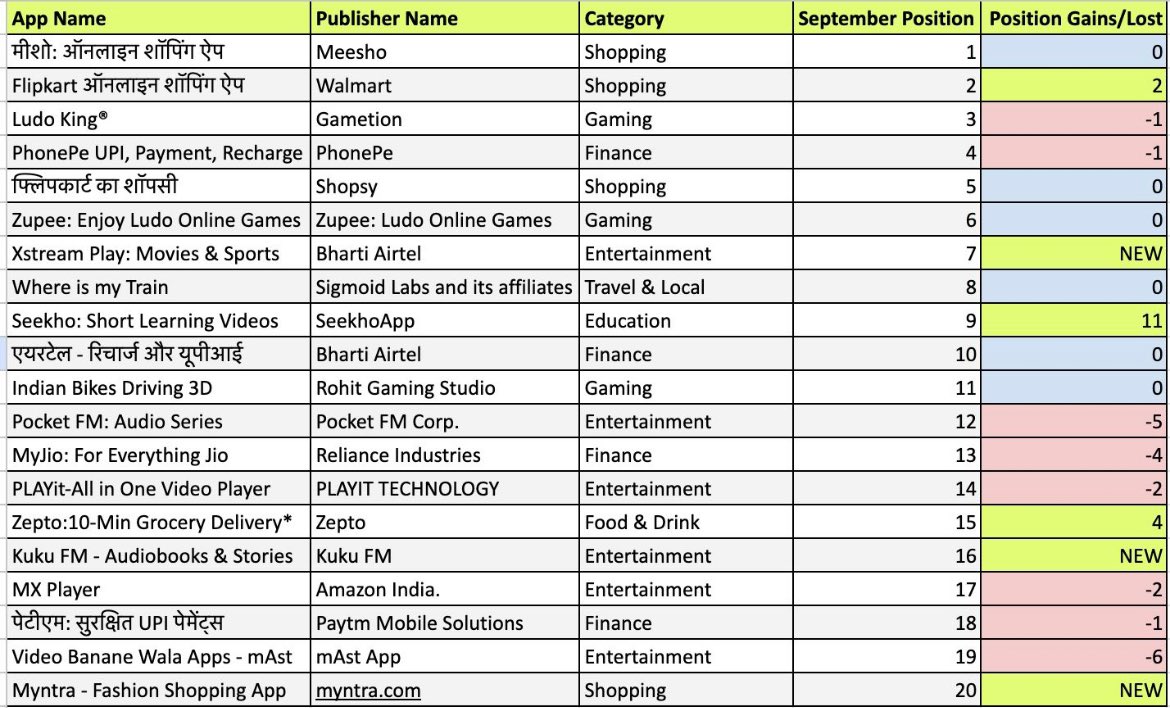
India’s App Market Trends 🇮🇳
India’s most downloaded apps offer incredible insights into the broader market. While Tier-1 cities may see niche innovations (think: PS5 delivered in minutes, or book-a-driver apps, medicines delivered in 19 minutes, invest change in MFs, etc), the true impact is felt at scale across the country, as @NandanNilekani rightly says, “Impact is delivered at scale.”
It’s fascinating to see apps like:
1. Where is My Train 🚂
2. Airtel & Jio 📲
3. Ludo apps (Zupee, Ludo King) 🎲
4. Video player apps 🎥
& more
Dear PMs, people love Ludo, but that doesn’t mean you should throw in games for the sake of engagement! to your uncorrelated product.
Focus on solving real problems. Be loyal to what you are solving - do that the BEST !!
#ScaleMatters #AppTrends
6
319