
Federal Reserve was part of who invested into changing the name "Bitcoin" to small block segwit with no OP codes enabled. BSV is the real Bitcoin, not BTC anymore.
2
18


Your framing is inaccurate and misleading.
You didn’t even mention Core’s decision to uncap the Op_Return filter that had been in place for 10 years… or Core’s blatant negligence of the bug in Taproot that facilitated more abuse of Bitcoin
Are you aware of the non-monetary abuse of Bitcoin that was facilitated by SegWit, Taproot, and Core v.30?
1
8
158

played with it in 2010-11 from faucets gambled it on bodog and sWc poker but wasnt online from 12-17. When I got up to speed needless to say it was no longer btc but segwit and two forks battling for the real p2p ecash lol meanwhile 8 years later monero is what btc was to be
1
22

In 2017, a large part of the bitcoin community rallied behind BIP148 and a User Activated Soft Fork to force a popular upgrade (SegWit) to bitcoin when miners dragged their feet after the New York Agreement (signed while I was in prison)
It increased the block size without increasing their profits. The understanding was that an agreement would remove the negative cloud over the development stall in bitcoin during the 2014-2017 bear market.
At first just a fringe group of Bitcoin developers and community members, they turned “UASF” into a credible threat: nodes and economic actors could coordinate to orphan non‑compliant miners, flipping the old assumption that hash power alone decides Bitcoin’s future.
It was popular because SegWit had broad dev support, strong economic backing, and a clear technical upside in capacity, malleability fixes, and upgradeability. This would trigger a bull market, miners would make more money even if blocks weren’t actually bigger.
But the miners wanted to hold out for actual bigger blocks. Bigger blocks = more transaction fees. The issue is that bigger blocks could also lead to centralization and the demise of bitcoin.
In 2017 the bluff was called and SegWit was activated. The bitcoin exchanges saved the day by announcing they wouldn’t follow a chain with larger blocks and call it “bitcoin”
Checkmate.
BIP110 is trying to reuse the same weapon in a very different environment. Instead of activating a long‑planned upgrade, it’s a one‑year soft fork to restrict arbitrary data (inscriptions, images, etc.) to “protect Bitcoin as money.”
The problem: the consensus picture is nothing like 2017. Miners aren’t on board in size, exchanges and big custodians are quiet, and a non‑trivial share of users actually want permissionless use of block space, even for things old‑school Bitcoiners call spam.
BIP110 looks more like one faction using the UASF playbook to impose its policy preferences on a divided community.
12 Jul 2017

2/ "If BIP148 fails, many of us will be splitting off to a new altcoin with another PoW algorithm. " - Quote by @LukeDashjr
6
17
4,167

You are going to be so mad when you find out BCH avoided both SegWit/Taproot as poisoned horrific ideas, told BSV morons to fuck off in 2018, and to this day have the most sensible p2p cash based chain.
Like everything, most of your animosity to BCH is premised on false info.
1
40

BTC ist ein Hochstapler. Erschaffen 2017 durch SegWit. Und alle die Logik fern und Betrug nahe sind haben es so angestellt dass alle denken es sei Bitcoin
Bitcoin ist ein System das erlaubt Wert sicher übers Internet zu übertragen für einen Bruchteil der Kosten aktueller Systeme
1
26
rancell.dgb♟️ retweeted

10h
Binance cold storage SegWit address holds 1.34B DGB, last active 4 days ago, with 1.5B DGB inbound and 160M DGB outbound across 112 transactions. $DGB digiscope.me/address/dgb1qls…
4
21
776

Segwit was activated in 2017. Prior to that BCH had already forked away. So what you are saying clearly makes no sense.
1
1
70

This was necessary after the Segwit and Taproot forks to restore the original Bitcoin p2p cash system protocol.
1
52

BitcoinSV Russia 🐉 retweeted

Jun 13
很多人说 BTC 不扩容。
但 2017 年的 SegWit 升级,本身就是一次间接扩容。
SegWit 之前,BTC 基本是 1MB 小区块;
SegWit 之后,BTC 变成了 4M weight units。
它没有直接承认“大区块”,但通过隔离见证,把容量变相扩大了。
这也是 BTC 和 BSV 技术共识分裂的导火索。
问题是,4M weight 依然不够承载全球级需求。
后来 Ordinals、Runes 出现,证明了一件事:
链上数据、图片、文件、铭文、应用记录的需求,是真实存在的。
现在又有了 BIP-110 提案:
过滤 Ordinals、Runes,限制非金融数据,把 BTC 推回更纯粹的小区块金融结算层。
也就是说,BTC 现在依然面临两条路线:
要么继续承认需求,继续扩容,承载真实数据需求;
要么过滤需求,回到数字黄金和小区块结算层。
这就是 Bitcoin 的终局分裂。
BTC 全节点现在已经约 745GB,从零同步普通电脑可能也要好几天,而且每年还在增加几十 GB。
BSV 更极端,全链数据已经约 1200 万 GB,也就是 12PB 级别,普通家用电脑当然存不了完整全链。
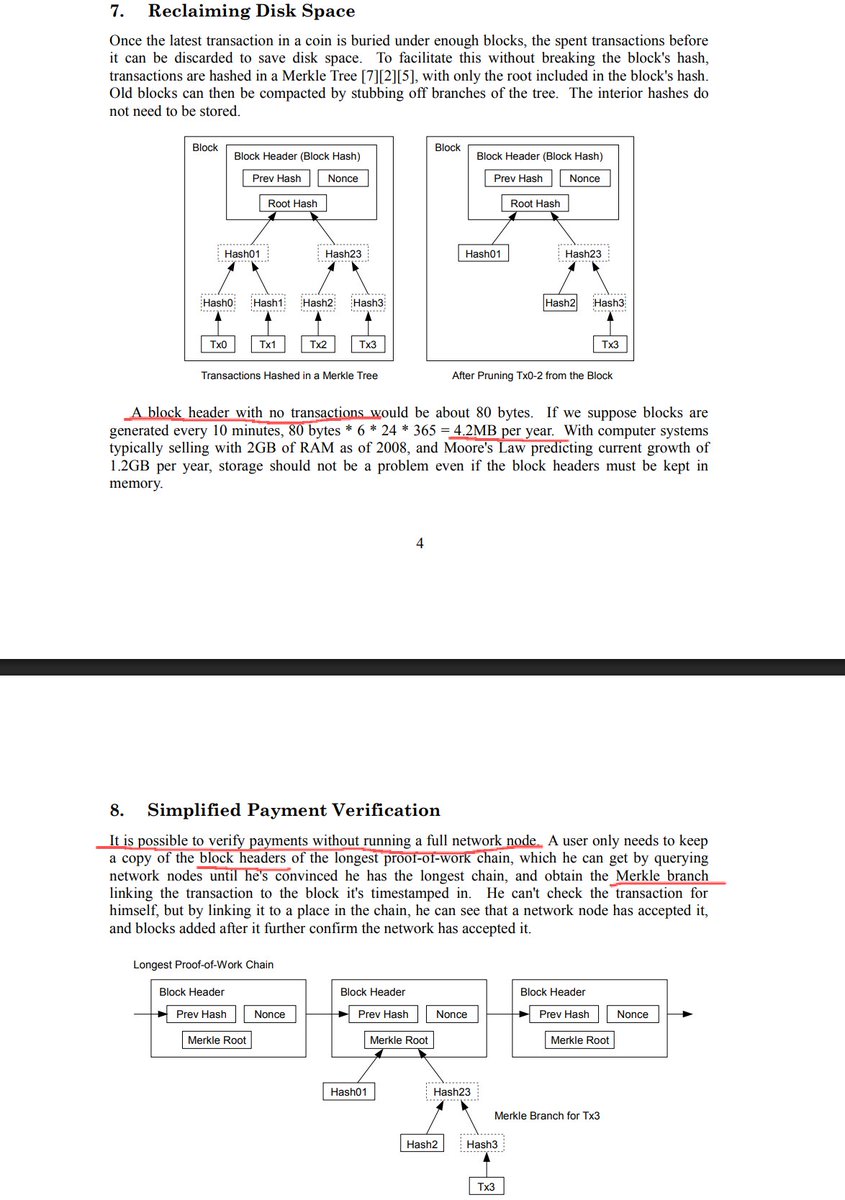
但白皮书第 8 节早就给出了解法:
SPV,简化支付验证。
普通用户不需要保存完整区块链,只需要保存最长 PoW 链的区块头,再用 Merkle proof 验证自己的交易。
一个区块头只有 80 bytes。
BTC 和 BSV 现在都大约 95 万个区块,SPV 只同步区块头的话,都是 76MB 左右。以后每年新增也只有约 4MB。
所以真正的问题,不是普通电脑能不能保存全世界数据。
真正的问题是:
Bitcoin 到底应该过滤需求,
还是承载需求?
BTC 选择数字黄金、价值储存、小区块结算层。
BSV 选择大区块、低手续费、SPV、全球支付与数据网络。
如果 Bitcoin 过滤需求,它会越来越像数字黄金。
如果 Bitcoin 承载需求,终局就会走向扩容。
而扩容的终局,正是 BSV 一直坚持的方向。
如果按白皮书里的 SPV、低手续费、链上扩容和全球支付系统来看,BSV 可能更接近那个原始愿景。
所以,究竟什么才是真正的共识?
是交易所、机构和市场塑造出来的共识,
还是白皮书里写下的中本聪愿景?
@CsTominaga @Robertl83909710 @lingboweibu319
#BSV
Jun 12

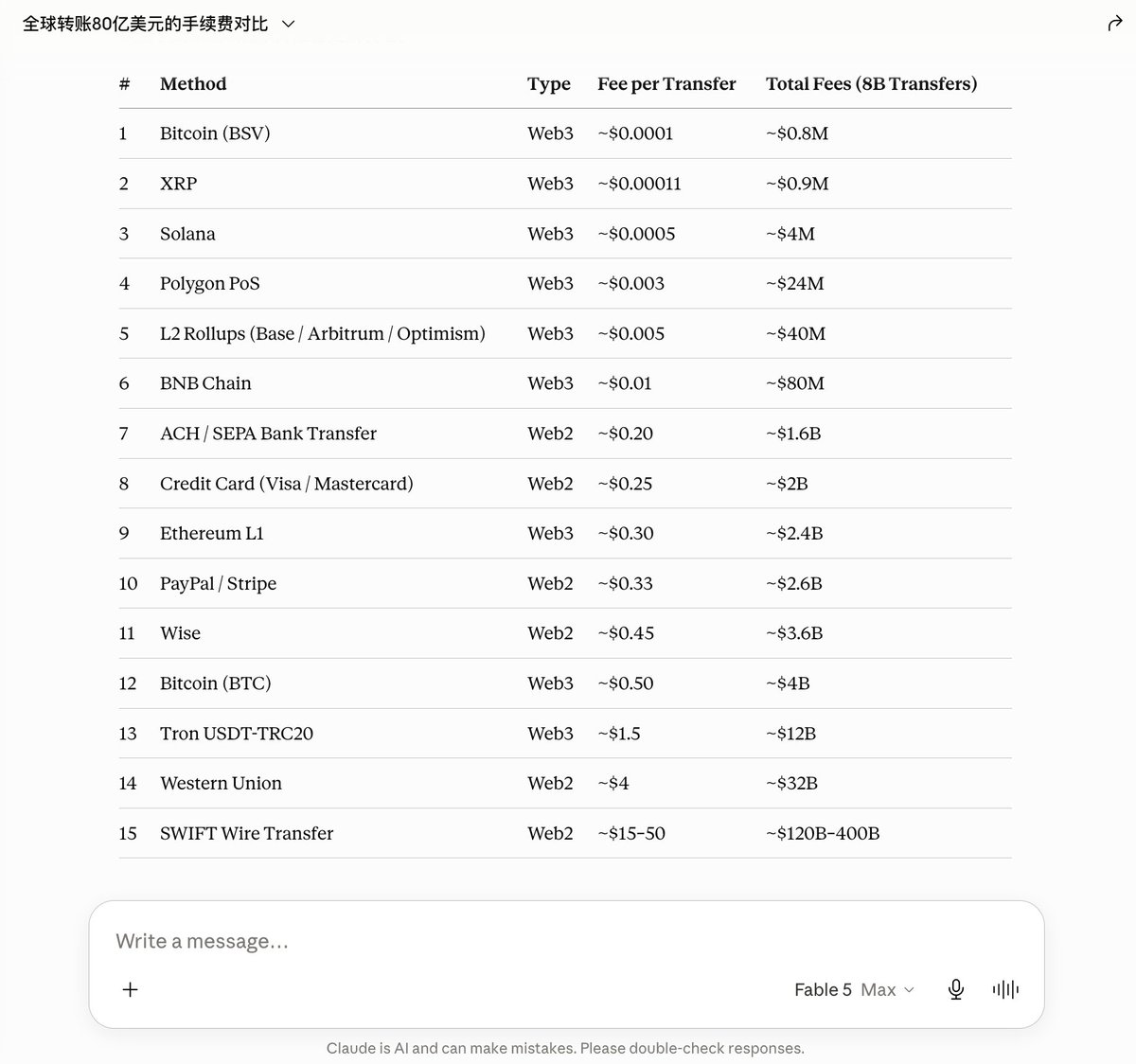
我让 AI 测算了一下:
如果给全世界 80 亿人,每人转账 1 美元,不同支付网络的手续费成本会差多少?
结果很有意思。
当交易被放大到 80 亿次,系统能力才真正拉开差距。
低手续费、高吞吐、可扩展,才是全球支付系统的底层逻辑。
比特币不应该只是一个货币符号,
它更应该是一个可以服务全世界的系统。
@Robertl83909710 @CsTominaga @lingboweibu319
#BSV
5
5
24
2,240

Segwit and taproot had support. Core didn't change protocol.
110 is a protocol change without concencous support.
1
17
You don’t think the cumulative changes from SegWit, Taproot, and Core v.30 changed “the chain”?
There were vulnerabilities introduced from prior changes… BIP-110 helps us get back on track by helping fix the mistakes from past changes.
1
2
53
