
Protect your online business from evolving payment fraud with advanced AI-powered fraud detection and behavioral analytics solutions.
🚀 From Stripe Radar to Featurespace, Kount, and Signifyd — discover how modern e-commerce businesses are using machine learning


1
2
34


May 5
If you think Stripe Radar is enough, you're protecting against 30% of fraud vectors.
Modern fraud isn't just stolen cards. It's account takeovers, synthetic identities, bot attacks, friendly fraud, and money laundering, each requiring a different defense layer. That's why fraud prevention has split into a full stack of specialized tools.
Card fraud is still massive, but its share of total fraud losses keeps shrinking. In many verticals, transactional fraud is no longer the biggest threat.
Sift is a good illustration. Often perceived as a generic fraud tool, it actually processes signals far beyond payments:
- ~70% of its detections relate to non-payment events (logins, signups, content abuse)
- ~1 trillion events analyzed per year
- ~34,000 sites and apps protected globally
The same pattern exists across the ecosystem: Forter and Riskified for e-commerce, Sardine for fintech and crypto, Persona for identity, ComplyAdvantage for AML, and Arkose Labs for bot mitigation.
Fraud Prevention Tools reflect the diversity of attack vectors:
- End-to-End Fraud Platforms: Sift, Forter, Riskified, Signifyd, Sardine, SEON
- Device Intelligence & Behavioral Biometrics: Fingerprint, Incognia, BioCatch, ThreatMetrix, Castle
- Identity Verification & KYC: Persona, Alloy, Sumsub, Socure, Onfido, Veriff
AML & Transaction Monitoring: ComplyAdvantage, Hawk AI, Unit21, Feedzai, Featurespace
- Bot Protection & Account Takeover: Arkose Labs, HUMAN, DataDome, Cloudflare, Kasada Capital Management
- Chargeback & Dispute Management: justt, Chargeflow, Ethoca, Verifi Inc., Kount, an Equifax Company
Attacker behavior explains this shift. AI-generated synthetic identities, credential stuffing at scale, and organized fraud rings have made single-layer defenses obsolete.
By 2026, fraud losses break down roughly as:
- ~45% from account takeovers and identity fraud
- ~30% from transactional and card fraud
- ~25% from chargebacks and friendly fraud
Real-time decisioning, shared fraud networks, and AI-driven risk scoring continue to accelerate this trend.
Fraud prevention is no longer a feature. It's becoming a critical infrastructure layer of every digital business.
PS: I post about payments with Suby, stablecoins & the reality of building a payment startup, every week. Follow for more!
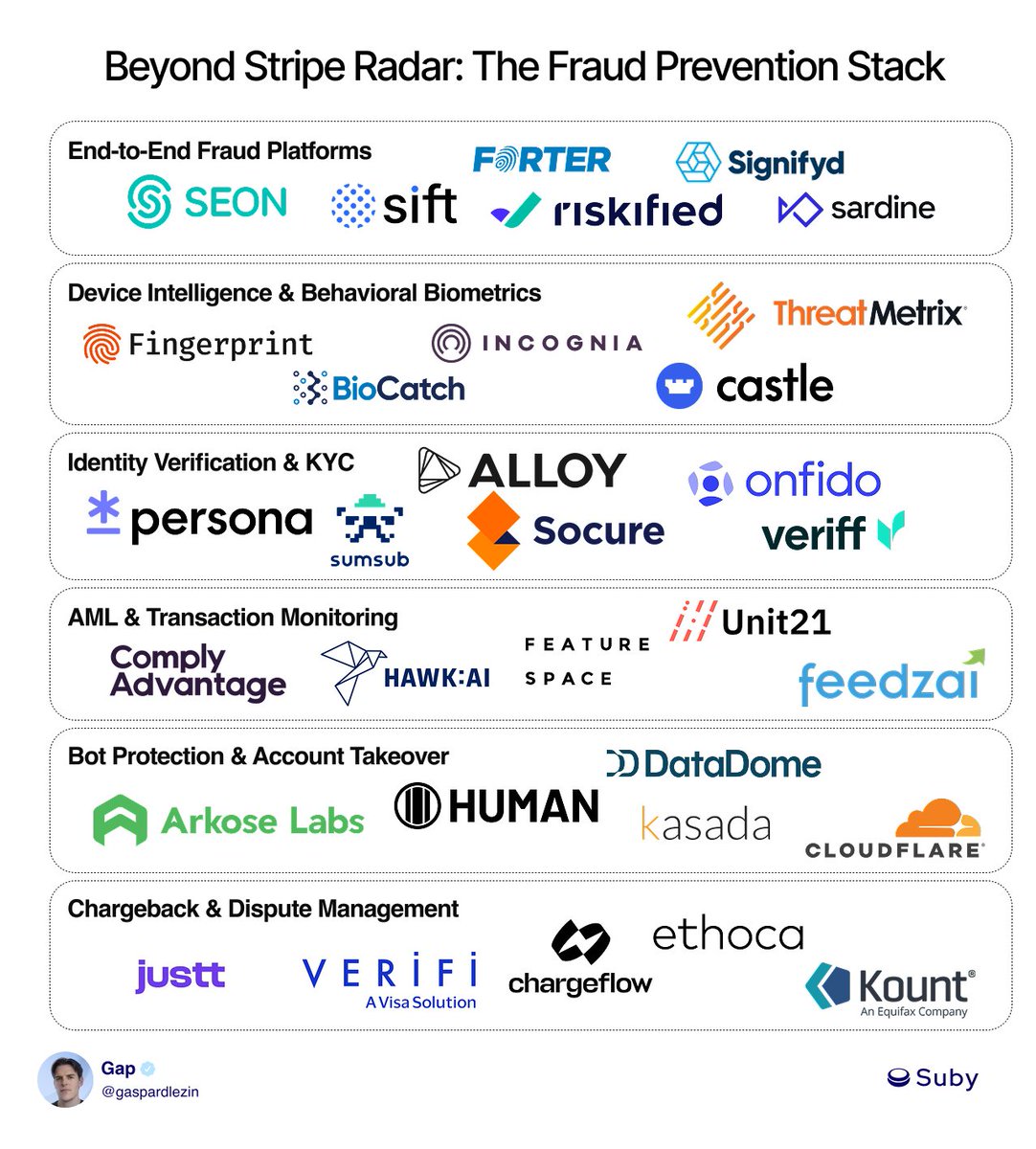
ALT A structured overview of various fraud prevention solutions, categorized by function, with logos of different companies and tools listed.
5
2
27
1,791

May 1
✨#NowHiring ✨
Check out 3 companies that are building for the future: @croglai is defending enterprises from cyber threats, @manifest_os is rewriting how we practice law, and @signifyd is protecting online commerce. They're also hiring. ➡️Vist mnlo.vc/Careers

1
3
568

Mar 23
Doesn’t work super effectively w/o something like Stripe Radar or Signifyd, I use to buy BINs and test them w services that only ran an authorization for $1. Sort of warmed up the card so it could be used to buy gift cards
1
5
1,107

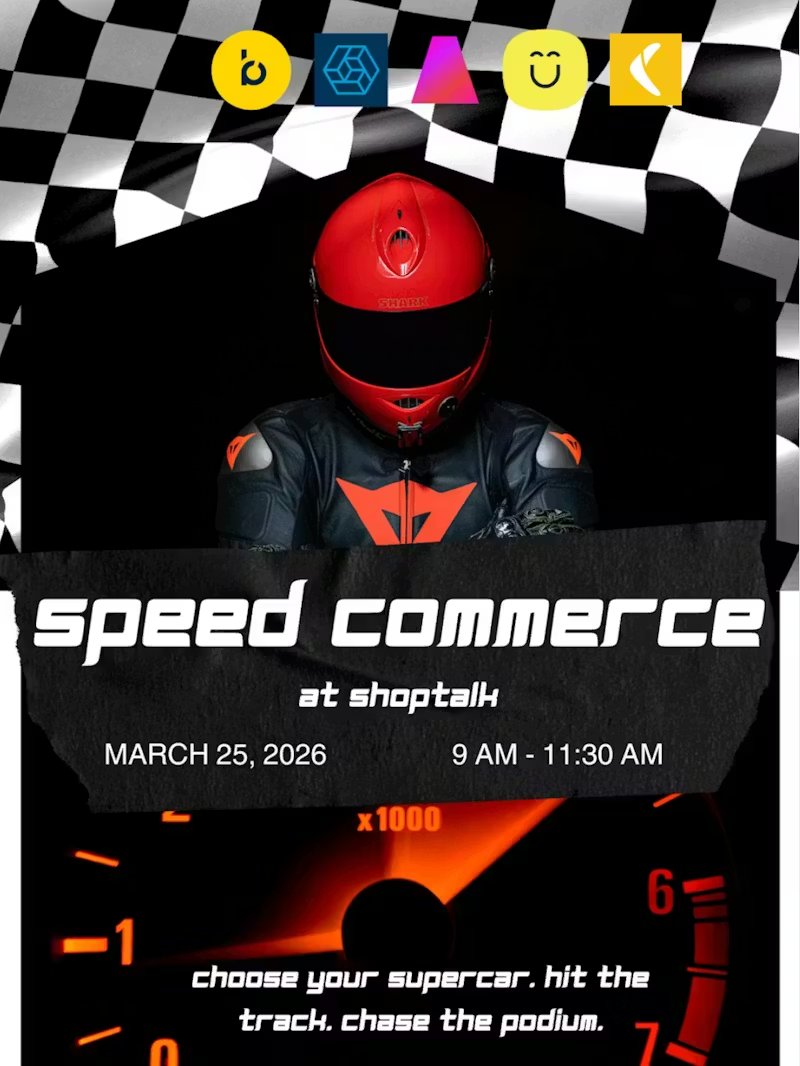
The Shoptalk events continue! On Tuesday, join us for lunch at Javier's for relaxed conversation.
On Wednesday, kick it into gear at Speed Commerce with @Lazer_HQ
@signifyd, @bloomreach_tm, and Rewind.
DM us and we'll connect you with our Partnerships team to get on the list.

1
2
200


17 Oct 2025
Online prices ticked up in September for the first time since 2023, according to Signifyd, which provides fraud prevention services to online merchants. investopedia.com/e-commerce-…
1
2
2
1,200

6 Oct 2025
Various states in the US have Right to Access data laws where companies that collect data on you have to furnish you with it when asked
I've recently been going through the process to request my data from @signifyd, @getsift & @riskified - they all respond with canned responses that they don't have any data on me (by itself, seems implausible, but also they don't ask for much data to begin with in the request)
When pressed further, they respond that they cannot fulfill the request because the data they *may have* is exempt from the request as fraud prevention
Sift responds with "Where Sift acts as a "Business", please note that Sift does not have a record of your personal information within our systems or infrastructure." - seems like some clever fuckery going on: carving roles so they can say “we don’t have your data” as a business while still processing it as a service provider
Are Right to Access laws real when no one can navigate the process? Does anyone have experience successfully obtaining this data?
1
7
667

11 Sep 2025
A few companies that recently got their 100th rating on @repvue
1. @qualiasoftware RepVue Score 86.28
2. @signifyd RepVue Score 86.94
3. @tealium RepVue Score 75.20
4. @theziphq RepVue Score 81.11
5. @paystand RepVue Score 67.17
6. @getrecharge RepVue Score 90.05
7. @connex_ltd RepVue Score 64.57
4
786

29 Mar 2025
🚨 Many are worried about VAMP (Visa Acquirer Monitoring Program) — but there are some clear winners coming out of it. Here's who...
If you're in fintech, this is not just a compliance update — it’s an opportunity.
Starting April 2025, Visa will track acquirer-level dispute activity, not just merchants. That means:
🔹 Acquirers now face direct pressure to reduce chargeback volumes
🔹 Traditional risk monitoring shifts upstream
🔹 Proactive dispute management becomes mission-critical
So what types of fintech solutions are poised to win in this new landscape?
✅ Payment orchestration layers that can reroute high-risk traffic to safer acquiring paths like @PhoenixTechMRR
✅ ISOs - given merchants need to diversify volumes across multiple MIDs to keep below the 1,000 count VAMP threshold like @runwaypayments
✅ Merchant tools that stop chargebacks, like digital receipts, embedded subscription management, and real-time representment provided by @chargeblast and @minnatech
✅ Customer behavior tracking to identify fraud like FUGU - Every Payment Counts
✅ AI-driven fraud models that adapt to evolving tactics across verticals like @signifyd
💡 In short: Fintechs that help acquirers and merchants look good to Visa will thrive. The winners are building for visibility, control, and speed. We’re entering a new era where risk isn't just managed — it's proactively optimized.
Is your stack ready?
#Fintech #Payments #Chargebacks #VAMP #Visa #Acquirers #RiskManagement #DisputePrevention #FraudPrevention #Compliance
4
438

18 Feb 2025
Signifyd, Swap Partnership to Help Fintechs Go International crowdfundinsider.com/2025/02…
1
2
41

17 Feb 2025
Global commerce just got safer & smoother!
@swapcommerce & @signifyd are joining forces to fight fraud & simplify international transactions.
Could this be a game-changer for global brands?
Read more: talkfintech.com/news/swap-an…
#FraudProtection #EcommerceGrowth #FinTechNews
2
53

15 Jan 2025
Has anyone used Signifyd? Just did a demo and seems too good to be true.
1
4
1,325

5 Dec 2024
🚀 Optimiza tu #eCommerce para el cierre de 2024:
✅ Comprende el ADN de tus compradores
✅ Optimiza el recorrido del cliente
✅ Protege ventas con prevención avanzada de fraude
🛒 Más aquí: tinyurl.com/mr2fvdz5
#DataScientist #Negocios #MarketingDigital #FraudeDigital #Retail @signifyd

1
36

US Thanksgiving weekend shopping results from several sources $ADBE $MA $CRM $WMT $AMZN
* Adobe – Thanksgiving day online sales 9% YoY to $6.1B (vs est of $6.1B), including mobile purchases 11% to $3.6B. Black Friday online sales 10% YoY to $10.8B (vs est of $10.8B). Increased sales were driven more by demand than inflation, and discounts exceeded expectations
* Mastercard SpendingPulse – Black Friday retail sales (ex-auto) 3% YoY: online sales 15%; in-store sales 1%. Jewelry, electronics, and apparel were the top gift categories
* Salesforce – Thanksgiving day online sales 8% YoY to $8.1B. Black Friday online sales 7% YoY to $17.5B. Top categories included health and beauty, apparel, and home appliances
* RetailNext – Black Friday in-store traffic -3% YoY nationwide. Apparel and footwear grew modestly, versus a sharp decline in health and beauty, and a modest decline in jewelry. Regionally, the Midwest experienced the sharpest declines due to colder weather
* Sensormatic – Thanksgiving weekend in-store traffic -4% YoY, including Black Friday -8%
* Signfiyd – Black Friday online sales 5% YoY
* Average discounts totaled 27% (Adobe/Salesforce) and 29% (Signifyd)
3
4
18
7,134

27 Nov 2024
📢 En el #BuenFin 2024 surgieron fraudes orientados a categorías premium según @signifyd. Los intentos en e-commerce se elevó un 47% y el valor potencial del fraude un 31% respecto a 2023.#BuenFin2024 #Ecommerce 📈💎👨💻 roastbrief.com.mx/2024/11/lo…
462

25 Nov 2024
Estudio de @signifyd dice que los intentos de fraude online durante el Buen Fin 2024 crecieron un 47% respecto a la edición 2023. Las categorías con más intento de fraude fueron: Supermercado, Hogar, Productos de lujo y moda. ¿Has caído en un fraude en compras online?

10
7
44
3,669