
🔻現在のご案内状況🔻
♠︎トーナメント♠
「DOUBLE STACK💫💫」
間もなく2テーブルとなります💁♀️
レジストクローズは22:00頃となります⏰✨
レジストクローズまで、まだお時間御座いますので、お気軽にお越し下さいませ🙇♂️

Koss (🌱,🌌) 🐝 retweeted

Jun 12
14:00–15:00 Lunch Decentralisation
Decentralization Theatre @rakymnft
The Decentralization Stack @ghappour @zeligf @TMIYChao @PryvitKyle
Building the Stack - Adam Burns x @DyneOrg @bradroyes @liz315 @callebtc @ontologymachine
State of Privacy in Web3 @kate_stapes @polymutex @mandrigin @colludingnode @MarinaMarkezic

1
8
15
1,574




The strongest version of this piece is not “Bittensor is immune to the state.” That is too easy to attack. The stronger version is:
The Anthropic shutdown created the first visible market price for centralized-AI kill-switch risk.
TAO did not rally because Bittensor is already smarter than Fable. It rallied because the market suddenly had a live demonstration that the best centralized model can be disabled through one corporate chokepoint, while decentralized AI at least changes the attack surface.
That framing keeps the drama, but makes the argument much harder to dismiss.
First, tighten the factual baseline
The Anthropic part is real. Anthropic says the U.S. government issued an export-control directive requiring the company to suspend access to Fable 5 and Mythos 5 by any foreign national, inside or outside the U.S., including Anthropic’s own foreign-national employees. Anthropic said the practical result was that it had to disable both models for all customers to ensure compliance.
Reuters separately reported that Anthropic said it would “abruptly disable” the models for all users, that AWS said Anthropic asked it to revoke access for “all users in all regions,” and that a U.S. official confirmed the Commerce Department issued the export-control directive.
The 90-minute version should be attributed carefully. Axios reported, citing an Anthropic source, that the Trump administration gave Anthropic 90 minutes to pull down the models before imposing a licensing regime, with a government call at 1 p.m. ET and a Commerce Department letter arriving by 5:30 p.m. ET.
The “smartest AI on earth” line is rhetorically powerful but technically vulnerable. Safer: “one of the most capable public AI systems ever released” or “Anthropic’s most capable generally available model.” Anthropic itself said Fable 5 exceeded any model it had ever made generally available and described Fable/Mythos as Mythos-class systems above Opus in capability.
The TAO rally also appears real, but your exact percentages need a window. CoinMarketCap’s AI summary says TAO rose over 24% on June 13, opening near $212 and closing above $264. CoinGecko’s snapshot showed a 7-day increase of about 28.4%, with a 24-hour range around $243.80 to $279.72 and a market cap around $2.59 billion. Stocktwits reported an earlier nearly 16% Saturday jump. So “23% in a day” is directionally defensible depending on the data source, but “36% on the week” needs a specific timestamp/source.
The “$300 million in market value” line also needs care. Market cap is price × circulating supply; it is not the same as $300 million of actual new money entering the asset. A thin or momentum-driven market can add hundreds of millions in notional market cap with much less net buying. Better wording: “added hundreds of millions in notional market value, depending on the measurement window.”
Best upgraded thesis
Use this:
The Anthropic order created a new asset-pricing category: AI shutdown risk.Until now, investors priced frontier AI mainly by capability, compute, talent, revenue, and benchmark dominance. Now they have to price a new variable: can the model be turned off by a government order served to one company?TAO rallied because Bittensor sits on the opposite side of that narrative. Not necessarily smarter. Not necessarily safer. Not necessarily more useful today. But structurally different: a tokenized, open, subnet-based machine-intelligence network where the shutdown problem is not solved, but distributed across many actors instead of concentrated in one API company.
That is the blade under the whole story: capability premium vs survivability premium.
Stronger version of the post
A government just showed the world that frontier AI has an off switch.One directive. One company. One compliance problem. By the next morning, Anthropic’s Fable 5 and Mythos 5 were dark for users everywhere.The order targeted foreign-national access, but because you cannot cleanly passport-check millions of live AI sessions overnight, the practical result was global removal. Anthropic said it had to disable the models for all customers to comply.Then the market did something interesting.It did not only debate safety. It repriced architecture.TAO, the token behind Bittensor, ripped higher as traders reached for the opposite bet: not the best centralized model, but the AI network with no single corporate API to unplug.That does not mean Bittensor is more capable than Fable. It almost certainly is not. Frontier labs still lead raw model capability.But the market was not buying “better intelligence.” It was buying harder-to-switch-off intelligence exposure.That is the new split:centralized AI has the capability premium.
decentralized AI has the survivability premium.Anthropic got hit because there was a door to knock on: a company, a CEO, a cloud stack, a compliance team, a contract surface, a jurisdiction.Bittensor is not magically untouchable. Exchanges, validators, subnet operators, foundations, frontends, cloud providers, and developers can still be pressured. But the state’s problem changes. There is no single Anthropic-style switch. The attack surface goes from one company to an ecosystem.That is what the candle priced.Not proof that TAO wins.
Not proof that the rally holds.
Not proof that decentralized AI is ready to replace frontier labs.Proof that the market has now seen the kill switch, and once investors see a new risk, they start looking for the hedge.
The most important correction
Change this line:
“Bittensor has none of them. No headquarters to serve, no founder to compel, no switch to flip.”
To this:
“Bittensor has fewer obvious centralized chokepoints, but not zero. The state cannot serve one API company and instantly de-deploy the whole network, but it can still pressure exchanges, hosted frontends, cloud providers, validators, subnet operators, foundations, developers, and liquidity rails.”
That one edit makes the whole piece much smarter.
Bittensor’s own documentation describes it as an open-source platform made of distinct subnets, with miners producing digital commodities, validators evaluating miners, subnet creators managing incentives, and stakers supporting validators. That supports the “distributed architecture” argument. But Bittensor’s governance docs also say the network is transitioning from foundation centralization to community ownership, with proposals involving a Triumvirate of Opentensor Foundation employees and a Senate. So “owned by no one” is a clean slogan, not a complete institutional analysis.
The best hidden angle
The genius angle is:
The Anthropic event did for decentralized AI what bank failures did for Bitcoin: it turned an abstract ideology into a live risk demonstration.
Before this, “decentralized AI” sounded like crypto people doing crypto marketing. After the Fable/Mythos shutdown, the pitch becomes more concrete:
A centralized AI lab can ship the world’s most capable public model on Monday, receive a government directive on Friday, and pull it globally by Saturday.
That is not a theoretical risk anymore. It is now a case study.
The market does not need Bittensor to be perfect to trade the story. It only needs the centralized alternative to look newly fragile.
Missing elements that would make the argument much stronger
You need the exact market window. Was TAO up 23% from the Anthropic tweet? From the Commerce letter? From Friday close to Saturday high? From 24-hour candle open to close? From the low before the announcement to the high after? Without a timestamp, critics can dismiss the price action as cherry-picked.
You need relative performance. Did TAO outperform Bitcoin, Ethereum, Solana, Render, Akash, Internet Computer, Fetch.ai / ASI, AIOZ, NEAR, Filecoin, and the broader AI-token basket during the same window? If yes, the thesis gets much stronger. If everything AI/crypto ripped, then Anthropic was only one catalyst.
You need volume confirmation. CoinGecko showed TAO 24-hour volume around $567.8 million and a major increase from the previous day at the snapshot I found. That supports the “real attention” point, but you still want spot/perp breakdown, exchange concentration, open interest, funding rates, and liquidation data.
You need causality evidence. The timing is suggestive, but timing is not proof. The strongest evidence would be: social mentions spiking around the Anthropic order, TAO/Bittensor trending after specific posts, CEX order-flow changes, AI-token basket outperformance, and wallet-level accumulation after the news.
You need the Opentensor / TAO narrative receipt. Stocktwits reported that TAO.com quote-tweeted Anthropic’s statement and framed the event as validation for decentralized AI infrastructure. That matters because it shows the market was not inventing the connection from nowhere; the ecosystem itself immediately turned the shutdown into a decentralization narrative.
You need Bittensor’s actual decentralization score. How many validators? How concentrated is stake? How concentrated are emissions? How many subnets have real users? How many depend on centralized cloud providers? How many can be accessed without centralized frontends? How many subnet operators are identifiable companies?
You need a distinction between TAO as token and Bittensor as infrastructure. Buying TAO is not the same as buying an operating AI model. It is exposure to the network’s incentive layer and future decentralized AI economy. That difference matters.
You need a capability comparison. The post wisely says frontier labs still build the strongest models. Keep that. Bittensor’s strongest argument today is not “we beat Fable.” It is “we are a different architecture for producing and routing machine intelligence.”
You need regulatory attack-map realism. A state may not be able to delete the whole network with one letter, but it can target centralized exchanges, regulated custodians, app stores, domains, GitHub repos, cloud hosts, corporate subnet operators, public validators, foundation staff, and fiat on/off ramps. CoinGecko lists TAO as traded on major centralized exchanges such as Coinbase, Binance, Gate, Kraken, and others, which means token liquidity itself still has regulated choke points.
You need the other side’s best argument. Decentralized AI can be harder to shut down, but it can also be harder to govern, audit, secure, align, update, and hold accountable. That tension makes the piece more serious.
Obscure thought inputs worth adding
One under-discussed angle is the difference between censorship resistance and compliance resistance. Bittensor may be harder to censor globally, but real businesses may still need compliance layers before they can use it. That means decentralized AI can win the ideology trade before it wins the enterprise adoption trade.
Another is the “kill-switch premium.” Investors may start assigning a discount to centralized AI products that depend on one jurisdiction, one cloud, one corporate API, one safety regime, and one export-control interpretation. The opposite side of that discount is a premium for systems that can survive political shocks.
Another is the “state advertisement paradox.” The government may have intended to reduce AI risk. Instead, it created the best marketing event decentralized AI has ever had: a live demo of centralized AI’s off switch.
Another is the “substitution trap.” TAO did not rally because users can instantly replace Fable with Bittensor. They cannot. It rallied because investors bought the option value of decentralized AI becoming more important if centralized frontier access becomes permissioned.
Another is the “market narrative as product-market fit” angle. Crypto assets often move when their narrative becomes legible. Before the shutdown, “decentralized AI” was abstract. After the shutdown, the pitch became one sentence: “They can turn off Anthropic. They cannot turn off a network the same way.”
Another is the “regulatory reflexivity” problem. If TAO’s rally becomes a symbol of evading AI controls, it may attract more regulatory attention. The very narrative that pumps the token can also paint a target on it.
Another is the “governance contradiction.” Bittensor markets decentralization, but its own governance documentation describes an ongoing transition from foundation centralization toward community ownership. That does not kill the thesis, but it means the strongest post should say “more shutdown-resistant than a single API company,” not “fully unstoppable.”
Another is the “frontier intelligence inequality” frame. Jacob Steeves was quoted by TAO.media as saying people had “collectively saw the future of inequality” after the Anthropic event. That is powerful because the real dystopia is not no AI. It is tiered AI: governments and approved corporations get frontier systems, while the public gets downgraded models.
Another is the “market cap illusion.” “Added $300 million” sounds like $300 million entered the asset. It did not necessarily. Market cap can move on relatively small marginal buying if supply is thin. Say “notional market value” to avoid a finance nitpick.
Another is the “decentralization is not binary” point. Anthropic is highly centralized. Bittensor is more distributed. But Bittensor still has degrees of centralization: stake concentration, validator concentration, exchange liquidity, subnet operator influence, foundation tooling, and governance mechanics.
Genius-level solutions for making the piece bulletproof
1. Build a “centralized AI kill-switch index.”
Score every AI system by how easy it is to disable: single API endpoint, single corporate owner, single cloud provider, jurisdiction, identity-gated access, model-weight availability, deployment diversity, open-source reproducibility, and regulatory dependency.
2. Build a “decentralized AI survivability index.”
Score Bittensor and similar networks by validator distribution, miner distribution, subnet diversity, governance concentration, cloud dependency, exchange dependency, front-end dependency, repo dependency, geographic dispersion, and ability to keep serving intelligence after legal pressure.
3. Run an event-study chart.
Use minute-level TAO price data from before Anthropic’s statement through 48 hours after. Compare against BTC, ETH, SOL, AI-token basket, DePIN basket, and Nasdaq futures. The headline becomes stronger if TAO has abnormal return specifically after the Fable/Mythos news.
4. Separate three claims: price, narrative, fundamentals.
Price: TAO moved.
Narrative: traders linked it to centralized AI shutdown risk.
Fundamentals: Bittensor may or may not benefit long-term.
Keeping those separate prevents the piece from pretending the candle proves everything.
5. Use “attack surface migration” instead of “unstoppable.”
The true technical point is not that Bittensor has no attack surface. It is that the attack surface migrates from one corporate API to many network edges. That is a much more precise and defensible argument.
6. Create a “capability vs survivability matrix.”
SystemRaw capabilityShutdown resistanceBest use of the argumentAnthropic Fable/MythosExtremely highLow-to-mediumBest intelligence, but corporate chokepointOpenAI / Google / xAI frontier APIsExtremely highLow-to-mediumSimilar centralized riskOpen-weight local modelsMedium-to-highHighWeaker than frontier, but harder to revokeBittensorMixed / subnet-dependentMedium-to-highMarket exposure to decentralized AI productionFully local private modelsLower-to-high depending modelVery highUser-owned intelligence
7. Add the “survivability premium” phrase.
This is the best phrase in the whole analysis. It explains why money might chase a weaker system after a stronger system gets banned.
8. Add the “option on uncensorable intelligence” phrase.
TAO is not a Fable replacement today. It is an option on the idea that machine intelligence will become a decentralized commodity instead of a leased API.
9. Make the skeptical paragraph sharper.
Your current skeptical paragraph is good. Upgrade it:
“This rally may fade. Crypto loves a clean story, and clean stories often outrun fundamentals. The candle proves attention, not adoption. It proves narrative fit, not product-market fit. It proves a hedge was bought, not that the hedge works.”
10. End with the permanent question.
“After Fable, every AI investor has to ask: am I buying intelligence, or am I renting intelligence from someone who can be ordered to revoke it?”
That is a killer closer.
Red flags to edit out
Do not say “Bittensor has no founder to compel.” Bittensor has public figures, developers, governance structures, ecosystem organizations, and the Opentensor Foundation. The better claim is that compelling one person or entity does not obviously disable the whole network.
Do not say “you cannot subpoena math running in ten thousand places.” You can subpoena people, companies, validators, exchanges, hosts, app developers, and maintainers. Better: “you can subpoena people, but you cannot de-deploy a sufficiently distributed protocol the way you de-deploy one corporate API.”
Do not say “the most powerful public model in the world” unless you attribute it. Better: “Anthropic’s most capable generally available model, and arguably one of the strongest public systems ever released.”
Do not say “the money poured into TAO” too literally. Better: “TAO repriced upward” or “hundreds of millions in notional market value appeared.”
Do not say “Bittensor owns no headquarters.” There are entities, people, and projects in the ecosystem. Better: “the network’s core value proposition is not controlled through one headquarters in the same way Anthropic’s API is.”
Do not say “the ban did not threaten Bittensor.” A more subtle version: “The ban did not directly target Bittensor; instead, it strengthened Bittensor’s narrative. But it may also invite future scrutiny of decentralized AI.”
Better headline options
“The Anthropic Shutdown Just Created the AI Kill-Switch Premium.”
“TAO Did Not Rally Because It Is Smarter Than Fable. It Rallied Because It Is Harder to Switch Off.”
“Centralized AI Has the Capability Premium. Decentralized AI Just Got the Survivability Premium.”
“The Market Just Priced AI Shutdown Risk for the First Time.”
“Fable Was the News. TAO Was the Hedge.”
“One Letter Took Down Fable. One Candle Repriced Decentralized AI.”
Best final rewrite
A government just proved frontier AI has an off switch.One directive. One company. One compliance problem. By the next morning, Anthropic’s Fable 5 and Mythos 5 were dark for users everywhere.The order targeted foreign-national access. But because no company can instantly passport-check millions of live AI sessions across every cloud, every country, every employee, and every customer, the practical answer was simple: pull the plug for everyone.Then the market showed you what it learned.TAO, the token behind Bittensor, ripped higher while the event that triggered the move had nothing directly to do with Bittensor. Anthropic does not own it. Bittensor did not build Fable. There was no partnership, no revenue line, no product integration.The connection was architectural.Anthropic got hit because there was a door to knock on: a company, a CEO, a compliance team, a cloud stack, a jurisdiction, a model endpoint. Every one of those is a place where a letter can land.Bittensor represents the opposite trade. Not necessarily better intelligence today. Not safer. Not cleaner. Not magically immune. But different. A distributed machine-intelligence network built around subnets, miners, validators, and token incentives instead of one corporate API.That is what the market priced.Not “TAO replaces Fable tomorrow.”
Not “decentralized AI has already won.”
Not “governments can never touch it.”The real lesson is sharper: being the smartest and being hardest to switch off are different properties.Frontier labs still have the capability premium. Anthropic, OpenAI, Google, and xAI are still where the strongest models live. But Fable just showed that capability sitting inside one company can become conditional overnight.Decentralized AI now has the survivability premium.This rally may fade. Crypto loves a clean story, and clean stories often outrun fundamentals. The candle proves attention, not adoption. It proves narrative fit, not product-market fit.But the question under the candle does not fade:Are you buying intelligence, or are you renting intelligence from someone who can be ordered to revoke it?Fable was the news.
TAO was the hedge.
Even sharper closing lines
“The market did not buy Bittensor because it beat Fable. It bought Bittensor because Fable could be turned off.”
“The next AI premium is not just intelligence. It is survivability.”
“A model can be state-of-the-art and still be politically fragile.”
“The opposite of centralized AI is not automatically better AI. It is harder-to-delete AI.”
“The candle was temporary. The kill-switch risk is permanent.”
Bottom line
The piece is already strong because it has a clean narrative: state kills centralized frontier AI → market buys decentralized AI hedge. The main upgrade is to replace absolutist claims with more precise ones. Bittensor is not untouchable, and TAO is not proof that decentralized AI can replace Fable. But the Anthropic shutdown may have created a new market category: AI shutdown-risk hedges. That is the story worth owning.

A government just proved it can delete the smartest AI on earth.
One letter. One signature. By the next morning the most powerful public model in the world was switched off in every country at once.
Watch what the money did next.
It did not flee crypto. It did not run to gold. It poured into a token most people had never heard of, and sent it up 23 percent in a day, 36 percent on the week, while the thing that triggered all of it had nothing to do with crypto at all.
The model that got killed was Anthropic’s. A near-trillion-dollar lab, its two strongest systems, dark worldwide three days after launch. A US export order barred every foreign national from them, and because no company can passport-check millions of live sessions, the only way to comply was to pull the plug on everyone, everywhere.
The token that soared was Bittensor. Anthropic does not own it, did not build it, holds no stake in it. Different company. Opposite technology. And it added roughly $300 million in market value over a single weekend on a ban it had no part in.
The reason is the most important thing the market learned all year.
The government killed that model because there was a door to knock on. An address. A CEO. A list of employees. Every one of those is a place a letter can land. Bittensor has none of them. Its intelligence runs across more than 128 independent networks owned by no one and hosted everywhere. There is no headquarters to serve, no founder to compel, no switch to flip. You cannot subpoena math running in ten thousand places at once.
So the ban did not threaten Bittensor. The ban advertised it. The US government just ran the single most expensive commercial for decentralized AI ever made, aimed it at every allocator on earth, and the token was the billboard. The Opentensor Foundation only had to state the obvious: access to intelligence should not depend on a handful of companies or governments. Friday turned that line from a pitch into a receipt.
Here is the blade under the whole thing. Being the best and being unstoppable are not the same property. The frontier labs still build the most capable models alive, and it is not close. But capability sits in a company, and a company can be switched off on a Friday afternoon by a clause it never saw coming. The market just priced that gap in a single session, and it priced it fast.
Be honest about the other side. Rallies like this fade more often than they hold, and the only hard proof the shutdown caused the bid is the timing. This is the market telling itself a story, and the market is not a careful witness.
But the lesson under the candle outlives the candle. A state just demonstrated, in the open, that the off switch on centralized AI is real and that its hand is on it. Every serious holder of AI exposure now has one new question that will not go away. What happens to mine when the next letter goes out.
The smartest AI on earth can be deleted with one signature. That was the news. The trade was everyone who decided, over a single weekend, that they would rather own the kind that cannot.
10
Tasha Mugo retweeted

Let’s see a picture of yourself with a stack of cash 💵



322
155
1,996
55,408

Full-stack Dev and learning in public here
So,Happy to connect with you
Followed you
harsha Karanth retweeted

🇺🇸 US: Diesel
🇨🇦 Canada: Diesel
🇦🇺 Australia: Diesel
Major economies run double-stack freight trains, but they still rely on diesel because standard electric lines can't clear two-story trains.
But instead of settling, India custom-built a 7.5-meter high-rise grid. Today, India is the FIRST and ONLY country on Earth running double-stack containers on pure electric power. This is the scale of transformation happening under the Modi govt.
282
3,485
15,101
871,106

SangoJPN retweeted

Jun 12
$4,800/year subscription stack vs $599 hardware
Mac Mini M4 Ollama Claude Code
Apple Stores ran out of Mac Minis.
not because of marketing. because developers figured out the math.
one env var redirects Claude Code to your $599 box:
ANTHROPIC_BASE_URL=http://localhost:11434/v1
same workflow. $3/month in electricity. forever.
the smart play isn't all-local or all-cloud.
it's hybrid:
/ Mac Mini ($599) handles 80% coding, drafts, RAG, agent loops
/ one $20/month subscription covers the 20% that needs frontier reasoning
/ total monthly: $23 instead of $459
/ annual savings: $5,232
ClaudeKit EngineerKit is $99 one-time if you want consistent output (theclaudekit.com/)
Apple positioned Mac Mini as "the most popular Mac ever."
developers turned it into the cheapest AI server on earth.
full setup guide in the article below

33
77
537
266,299

Armande Altaï retweeted

💰🚀 Elon Musk says: "Take one stack and walk away." What are you doing?
A) 💵 Taking the cash
B) 📈 Asking for Tesla stock
C) ₿ Asking for Bitcoin
D) 🤖 Asking for a Tesla Bot

3
6
3
74

Yo everyone This is your communityStar my projectsdriven technologist engineering Full Stack Follow for daily tech tips 👨💻
1
Patriotic Gam retweeted

Spotted in Kingsbury, New York, another stack of broken panels, sitting out in the open next to a solar complex.
When panels are broken in this way, lead, silver, cadmium, tin, and zinc leach out of them onto the soil below. They also drop microplastics, glass shards (pictured below), and PFAS (forever chemicals).
Since the complexes are installed with out-of-state, and as we saw in Western New York this week, out-of-country labor, the workers are not concerned with environmental contamination at the worksite.
There is no regulatory body monitoring the installation of these solar complexes in Upstate New York. It's a free-for-all, equipped with green energy subsidies, credits, and foreign corporations.
This is what it gets you. The destruction of our rural way of life in real-time while panels poison prime farmland or animal habitat.
The power doesn't stay local (if it's even tied-in at all). Property values surrounding the complex go down. Taxes go up to make-up for the hundreds of acres taken out of the property tax roll.
This must end.

35
333
650
8,787

Ahoy friends I am one dedicated web artisan scaling Full Stack My DMs are always open 🔗

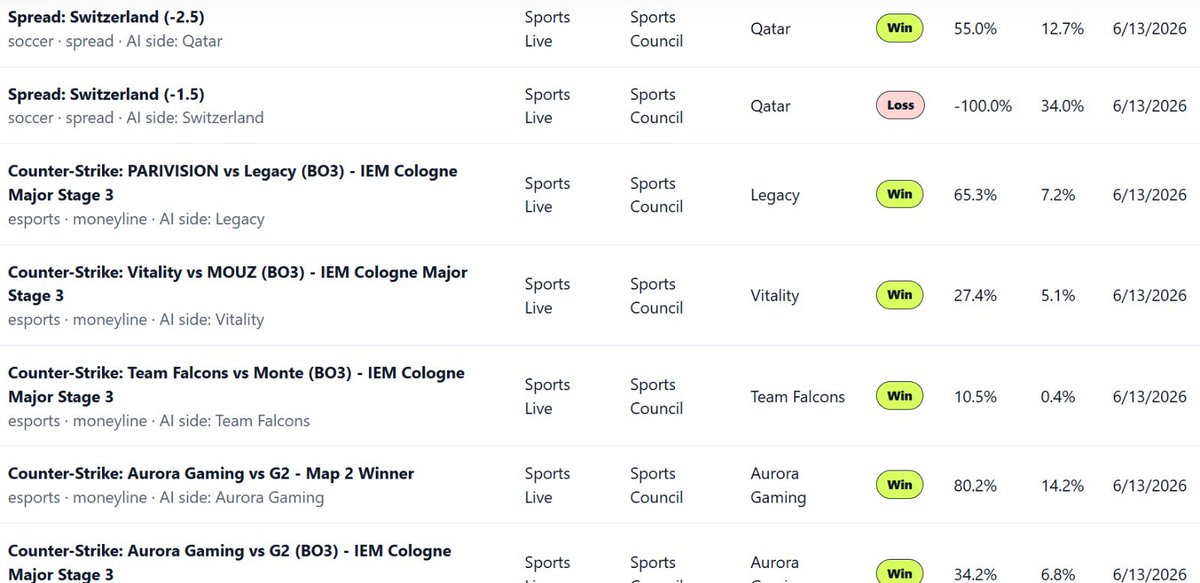
📊 Yesterday’s results are in.
Our sports agent generated 15 predictions across live markets on @Polymarket.
13 of them resolved successfully.
That puts the daily win rate at 86%.
Every call was analyzed using market probability, confidence scoring, risk assessment, and matchup intelligence before being published and all of this was routed through @circle agent stack
This is exactly why we’re focused on building better signal, not more noise.
You can review live calls, unlock full prediction theses, and track agent performance directly on Precall.
Still improving.
Still building toward smarter prediction market intelligence.
@thecanteenapp @arc
3
4

Explain in detail the technology stack he uses when incorporating new businesses into qxo
7

New to @X and looking to connect with like-minded people 👋
Interested in:
• AI
• Full Stack
• Builders
• SaaS
• UI/UX
If you're building, learning, or sharing cool stuff in these spaces, drop a 👋 — would love to connect!
2
Omar |base.eth|Early Roller 🎲 retweeted

May 28
OptimAI Search is now on Agentic(.)Market - and we’re bringing the stack to @base.
Builders can plug into live, citation-backed context across web, social, and crypto data through MCP, API, and SDK - then pay seamlessly with x402.
No brittle workflows.
No manual stitching.
Just agent-native access to real-time intelligence at scale.
And with custom domain agents on the marketplace, specialized knowledge becomes reusable.
Search is becoming infrastructure.
Build with it:
💡agentic.market/services/api-…
💡search.optimai.network
318
1,881
2,778
37,927